
Occupy 2.0
Posted: March 21, 2012 Filed under: #Occupy and We are the 99 percent!, 2012 elections, Action Memo, Anti-War, Austerity, Banksters, Civil Liberties, corporate greed, corporatism, corruption, Economy, Global Financial Crisis, income inequality, social justice, U.S. Economy, U.S. Politics 12 CommentsUntil this past weekend, the Occupy Movement was flying under the radar, percolating beyond public view. But members returned to Zucotti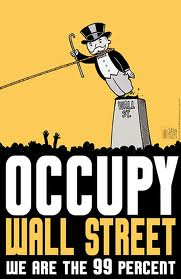 Park on St. Pat’s Day to celebrate the Movement’s six-month anniversary. From on the ground reports, the demonstration was peaceful. Until the NYPD arrived. Then there was trouble—a number of arrests and one woman reportedly had a seizure after she was thrown to the ground and handcuffed. Several participants said it took 17 minutes for the police to react, after which an ambulance was called.
For naysayers, the Occupy Wall St. Movement [OWS], their members and reasons for being were summarily dismissed before they began. Who is the leader of this motley group? journalists and pundits asked repeatedly. What do these people want?
Surprisingly, there is a leader or so I’ve read, someone well known to Occupy organizers but deliberately kept out of public view. As far as what they want? The answer seemed perfectly clear to me at the start because I think it’s what most Americans want or if they don’t want it, they expect it: an end to the gross inequality in the country, for which Wall St. and Government collusion holds the lion’s share of responsibility and an end to ‘bought’ elections, where the 1% and corporate interests routinely choose our leaders, shape policy and control the message, known in polite circles as ‘perception management.’
All of this transcends parties, btw. We’re talking Republican and Democratic parties alike, regardless of how many times we enter the ‘lesser than two evils’ spin.
You don’t need to be a psychic to ‘get’ the OWS message. You don’t even need to be a member of Occupy. All that’s needed is a modicum of alertness, a shaking-off of the trance-inducing distraction and deflection of pundits, media hounds and political operators.
So, what has OWS managed to accomplish, thus far? According to the critics—not a damn thing. But is that really the case?
Last summer, the headlines were ripe with talk of deficits, crushing debt and woe is me. We need a Grand Bargain, wisemen crooned [translation: we need to cut public services]. Somehow, we always have money for foreign adventures, national security, weapons and surveillance equipment. For instance, how many drones will be in American skies by 2020? Hummm. Try 30,000. That’s the Federal Aviation Administration’s rough estimate. The ever popular ‘shop ‘til you drop’ hee-haw isn’t working either, even with the news that ‘average’ Americans are flocking back to restaurant dining. Despite a stumbling economy there is money for weapons and drones and assorted homeland security gear. When it comes to education, infrastructure, home mortgage write downs, decent healthcare, aide to our poor, disabled and elderly? We’re just stone-broke and need to be put on an austerity diet. See Paul Ryan’s reiteration on social program slashes and numbers that don’t add up. It’s a nice set piece that will contrast with the soon-to-come kinder and gentler Democratic version.
One could call the dialogue change a bizarre coincidence but public conversation pivoted after Occupy came on the scene. We went from Oooooo, we need to slash Medicare, Medicaid and refigure Social Security to why is Wall St. getting bailed out on the backs of the taxpayer? Why do we have a system where the profits go to the top income bracket, while risk is carried by Main Street? Why have the wages of middle-class workers[if they’re fortunate enough to still have a job] barely kept pace with inflation, while the top 1% has had a 275% increase in income?
Uncomfortable questions, the sort that make politicians squirm.
OWS has also focused attention on home foreclosures, working with foreclosed families to save their homes. The Movement rallied the public in a Change Your Bank Day strategy that is estimated to cost TBTFs a $185 billion in transfers to community banks and credit unions. Religious organizations have joined the effort. According to Think Progress, The New Bottom Line, a coalition of faith groups has pledged to remove $1 billion from the major banks this year alone. OWS also pushed against the ATM fee-increase proposal; the banks pulled back. In late February, Occupy the SEC submitted a 300+ page document, urging regulators to resist the financial sector’s desire to water down the Volker Rule, part of the Dodd-Frank Wall St. reform. The group that put the document together was comprised of former Wall St. workers. OWS members also stood with private landowners, Tea Party members and environmentalists protesting the Keystone XL pipeline, a project that the President has expressed a new-found love for.
Not too shabby for six months activism. Yet still the critics howl. Where is the direction, what are the goals?
The Movement is young and still developing but you cannot fault it for sitting on its hands. More importantly, the Occupy spirit is global in nature because many activists are ‘graduates without a future’—young, educated and fed up. Paul Mason documented this facet of the worldwide
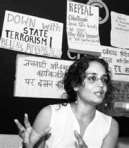
Arundhati Roy
social/political movements in his book, “Why It’s Kicking Off Everywhere,” and Arundhati Roy wrote this in a recent essay: “Capitalism, A Ghost Story”:
As Gush-Up concentrates wealth on to the tip of a shining pin on which our billionaires pirouette, tidal waves of money crash through the institutions of democracy—the courts, Parliament as well as the media, seriously compromising their ability to function in the ways they are meant to. The noisier the carnival around elections, the less sure we are that democracy really exists.
Sound familiar? The neoliberal model, the gross inequality that rewards the few at the expense of the many has circled the globe, creating universal discontent and misery.
So, what’s coming up for 2012? What will Occupy 2.0 look like?
I’d suggest checking the OWS page here for an updated list of scheduled actions. OWS plans to be in Chicago in mid-May to protest the NATO Summit although the city is throwing up barriers to prevent demonstrations. Somehow, I don’t think the protest will be stopped.
May 1 will be a National Action, the day traditionally known as International Worker’s Day. This year OWS is calling for a General Strike across the country. From the Occupy site:
We are calling on everyone who supports the cause of economic justice and true democracy to take part: No Work, No School, No Housework, No Shopping, No Banking – and most importantly, TAKE THE STREETS!
This Saturday, March 24, a Disrupt Dirty Power protest has been called in NYC to jumpstart a month-long action until Earth Day, April 22. More information here.
Sunday, March 25, Occupy Town Square IV will focus on public parks and other public spaces in NYC. More info here.
If you’re interested in local actions in particular states, towns, cities or countries, info can be found at the Occupy Together site here.
And if you want to eliminate the idea of ‘a failed movement’ from your brain. Check out the participation map here. The scope is massive.
The essay I mentioned by Arundhati Roy is well worth a read—highly informative, even shocking about vulture capitalism’s impact on India. Be prepared, it’s long. As Roy moves into her concluding paragraphs, she writes this:
Capitalism is in crisis. Trickledown failed. Now Gush-Up is in trouble too. The international financial meltdown is closing in. India’s growth rate has plummeted to 6.9 per cent. Foreign investment is pulling out. Major international corporations are sitting on huge piles of money, not sure where to invest it, not sure how the financial crisis will play out. This is a major, structural crack in the juggernaut of global capital.
Capitalism’s real “grave-diggers” may end up being its own delusional Cardinals, who have turned ideology into faith. Despite their strategic brilliance, they seem to have trouble grasping a simple fact: Capitalism is destroying the planet. The two old tricks that dug it out of past crises—War and Shopping—simply will not work.
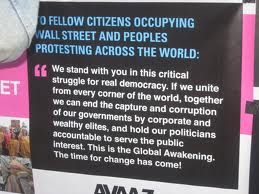
Disaster capitalism has certainly lived up to its name, be it continuous war, environmental degradation or exploding poverty. What is Occupy about? Speaking for myself, Occupy is about a break of faith with a global economic system that serves no one but an elite minority, where infinite money and power is the only morality. The movement is a massive rejection of the ongoing mantra: there’s no other way. Occupy challenges that static position, calls on us to envision something else, something better than the consensus mind. It dares us to shake off the old and embrace a sense of possibility. It demands we wake up, now.
Whatever Happened to the Department of Justice?
Posted: March 6, 2012 Filed under: Central Intelligence Agency, Civil Liberties, Injustice system, Middle East, Patriot Act, U.S. Politics | Tags: Assassination of US citizens abroad, Eric Holder, terrorism 13 CommentsMaybe we should change the name of the DOJ to the Department of Expedience. The War on Terrorism continues to be a War on the American and our Constitutional idea of justice. Eric Holder’s  speech yesterday at Northwestern’s School of Law puzzles many of us that had hoped a change from the Bush/Cheney regime would mean a return to civil liberties. Assassination of US citizens–implying no trial, no jury of peers, and no due process–by classifying them as terrorists is an end run around our Constitution that must not stand. Eric Holder’s thin justification of the Obama policy of assassination sounds a lot like triangulation.
Some have argued that the president is required to get permission from a federal court before taking action against a United States citizen who is a senior operational leader of Al Qaeda or associated forces. This is simply not accurate. “Due process” and “judicial process” are not one and the same, particularly when it comes to national security. The Constitution guarantees due process, not judicial process.
Glenn Greenwald explains it like this.
When Obama officials (like Bush officials before them) refer to someone “who is a senior operational leader of Al Qaeda or associated forces,” what they mean is this: someone the President has accused and then decreed in secret to be a Terrorist without ever proving it with evidence.
This process still seems to be a murky one as pointed out at Empty Wheel. This is beyond unacceptable.
As of a month ago–four months after Awlaki was killed–the Senate Intelligence Committee had not been provided with the legal framework for Awlaki’s kill. This, in spite of the fact that SSCI member Ron Wyden had been requesting that framework for over five months before Awlaki was killed.
I said when Wyden made that clear that it showed there had not been adequate oversight of the killing. By his words–if not his deeds–Holder effectively made the same argument.
The speech appears to be an elaborate justification of a policy that could basically spin on the whims of a president and his/her cronies. This is especially appalling given the FBI “stings” that have been aimed at catching terrorists that seem more aptly labelled as pushing some depressed, emotionally damaged people into becoming aspirational terrorists and then enabling them to do something dangerous. I can only assume that the CIA is probably just as bad if not worse.
The Holder speech was weak as a public explanation. It’s basis in law appears weaker.
Still, the speech contained no footnotes or specific legal citations, and it fell far short of the level of detail contained in the Office of Legal Counsel memo — or in an account of its contents published in October by The New York Times based on descriptions by people who had read it.
The administration has declined to confirm that the memo exists, and late last year, The Times filed a lawsuit under the Freedom of Information Act asking a judge to order the Justice Department to make it public. In February, the American Civil Liberties Union filed a broader lawsuit, seeking both the memo and the evidence against Mr. Awlaki.
Last month, Justice Department court filings against Umar Farouk Abdulmutallab, the Nigerian man who attempted to blow up a Detroit-bound airliner on Dec. 25, 2009, provided a detailed account — based on his interrogations — of Mr. Awlaki’s alleged involvement.
Mr. Holder, by contrast, did not acknowledge the killing of Mr. Awlaki or provide new details about him, although he did mention him in passing as “a U.S. citizen and a leader” of Al Qaeda’s Yemen branch when discussing Mr. Abdulmutallab.
Holder even objects to the word “assassinations”.
Holder also noted that in using lethal force, the United States must make sure that it is acting within the laws of war by ensuring that any target is participating in hostilities and that collateral damage is not excessive. And he noted that law-of-war principles “do not forbid the use of stealth or technologically advanced weapons” — an apparent reference to drones.
More broadly, Holder argued that the targeting of specific senior belligerents in wartime in not unusual, and noted the 1943 U.S. tracking and shooting down of the plane carrying Japanese Adm. Isoroku Yamamoto, the commander of the attack on Pearl Harbor.
He said that “because the United States is in an armed conflict, we are authorized to take action against enemy belligerents under international law . . . and our legal authority is not limited to the battlefields of Afghanistan.”
Holder said he rejected any attempt to label such operations “assassinations.”
“They are not, and the use of that loaded term is misplaced,” he said. “Assassinations are unlawful killings. Here, for the reasons I have given, the U.S. government’s use of lethal force in self-defense against a leader of al-Qaeda or an associated force who presents an imminent threat of violent attack would not be unlawful — and therefore would not violate the executive order banning assassination or criminal statutes.”
Holder said “it is preferable to capture suspected terrorists where feasible — among other reasons, so that we can gather valuable intelligence from them — but we must also recognize that there are instances where our government has the clear authority — and, I would argue, the responsibility — to defend the United States through the appropriate and lawful use of lethal force.”
I am not a constitutional lawyer. I do not even play one on TV so I can’t speak to the finer points of the due process clause. I just know this does not pass my “smell test”. I have read statements by lawyers. Here’s a sampling from MOJO and Adam Sewer.
Both supporters and opponents of the administration’s targeted killing policy offered praise for the decision to give the speech. They diverged, however, when it came to the legal substance. “It’s essential that if we’re going to be doing these things, our top national security and legal officials explain why it’s legal under international and constitutional law,” said Benjamin Wittes, a legal scholar with the Brookings Institution, who said he thought the speech fulfilled that obligation. “I think [the administration] is right as a matter of law.”
In a statement, Hina Shamsi, director of the ACLU’s national security project, called the authority described in the speech “chilling.” She urged the administration to release the Justice Department legal memo justifying the targeted killing program—a document that the ACLU and the New York Times are currently suing the US government to acquire. “Anyone willing to trust President Obama with the power to secretly declare an American citizen an enemy of the state and order his extrajudicial killing should ask whether they would be willing to trust the next president with that dangerous power.”
Here’s a point-by-point list of things that I think is worth reading from Lawfare. This is a small portion of that article. I really suggest you go read all of the points to get an understanding of the policy and its process.
That is, the speech asserts that Due Process permits targeting of a citizen at least when the target is:
(i) located abroad rather than in the United States,
(ii) has a senior operational role
(iii) with al Qaeda or an al Qaeda-associated force,
(iv) is involved in plotting focused on the death of Americans in particular,
(v) that threat is “imminent” in the sense that this is the last clear window of opportunity to strike,
(vi) there is no feasible option for capture without undue risk, and
(vii) the strike will comply with the IHL principles of necessity, distinction, proportionality, and humanity
All of this takes away from the many questions surrounding the first recipient of the assassination treatment. Marcy at Empty Wheel reminds of the thin ice upon which Holder skates.
Perhaps it’s because of all the dubious reasons the Administration continues to keep its case against Anwar al-Awlaki secret, but Eric Holder gave the impression of not knowing precisely what evidence the government had shown against Awlaki.
Or, deliberately misrepresenting it.
Holder mentioned Awlaki just once–purportedly to summarize Abdulmutallab’s case against Awlaki they released last month.
For example, in October, we secured a conviction against Umar Farouk Abdulmutallab for his role in the attempted bombing of an airplane traveling from Amsterdam to Detroit on Christmas Day 2009. He was sentenced last month to life in prison without the possibility of parole. While in custody, he provided significant intelligence during debriefing sessions with the FBI. He described in detail how he became inspired to carry out an act of jihad, and how he traveled to Yemen and made contact with Anwar al-Aulaqi, a U.S. citizen and a leader of al Qaeda in the Arabian Peninsula. Abdulmutallab also detailed the training he received, as well as Aulaqi’s specific instructions to wait until the airplane was over the United States before detonating his bomb. [my emphasis]
Note, this misrepresents what Abdulmutallab said, at least as shown by the summary released last month (setting aside the reasons DOJ chose not to test those claims at trial). What the summary did say was that Awlaki gave Abdulmutallab specific instructions to ignite his bomb while over the US. It did not say Awlaki was “a leader of al Qaeda in the Arabian Peninsula.” That’s DOJ’s elaboration, a frankly dishonest one, given the construction (and one that was probably at least significantly challenged by the intelligence Jubeir al-Fayfi delivered ten months after Abdulmutallab gave his testimony).
This is obviously a complex situation that needs full time attention by a lot of folks with a lot more than I can provide here. It’s something, however, we all need to follow.
There’s A Hot Wind Blowing
Posted: March 5, 2012 Filed under: #Occupy and We are the 99 percent!, Anti-War, Austerity, Banksters, Civil Liberties, Department of Homeland Security, financial institutions, income inequality, Russian elections 8 CommentsThere were few surprises in yesterday’s Russian election. Vladimir Putin won in what he declared a ‘clean victory.’ For his side.
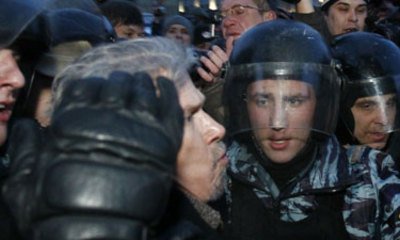
Arrests in Moscow--image via SkyNews
For protestors of the last few months, the White Ribbon movement, opinion was to the contrary, comments generally expressing ‘shame, disgrace, treachery.’ Yet according to official results, Putin pulled a 64% majority, well over the 50%, which would require a run-off vote. Independent observers, however, reported widespread irregularities, insisting that Putin’s majority was perilously close to the 50% cliff. According to one observer, Roman Udot, with Galos, a free election watchdog organization, which recorded many cases of multiple voting and voter intimidation:
“It’s one pixel away from a second round.”
What was the reaction to Putin’s victory speech? Thousands of protestors hitting the streets in Moscow and St. Petersburg. And combat-style police, 12,000 reported in Moscow alone, on the ready.
One of the details that piqued my interest was the fact that Putin’s support comes heavily from elderly pension holders. Putin has been wise enough to keep the pension money flowing, even with a slight increase. For the older generation, Putin is the Devil they know. For the digital-savvy young? Not so much. The educated middle-class have reached a tipping point, disgusted with governmental fraud, corruption and political lip service to democratic principles.
This is not a new phenomenon. Social uprisings have been springing up all over. Currently, we’re watching Syria fall apart, desinigrating into civil war. This is on the heels of insistent calls for change across the Middle East—Egypt, Bahrain, Yemen, Libya—the message of which spread like a virus across Europe, the UK, the United States, Japan, China and now Russia.
Say what the pundits will but just beneath our own political process, the charade of another electoral season guided and shaped by money and corporate interests, there’s a hot wind blowing. The strident cacophony of the right wing, each member trying to outdo the other with outrageous comments or the pitiful whines of Wall St. bemoaning the decline in kingly bonuses, only underscores the obvious: the self-regulating, free market, privatize-the-world philosophy is a bust. Fraud is as wide as our broken housing market, the Big Lie deeper than a fracking well.
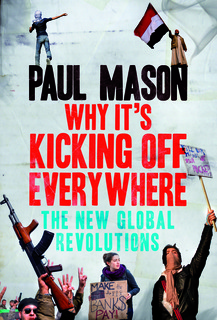 The intriguing question is what common denominators run through all these movements, despite the vast geographical/political differences? And why, presumably, did these social/political movements catch so many pundits, experts and leaders by surprise?
These are two of the questions, Paul Mason, a UK journalist and Economics Editor for the BBC attempts to answer in his book: ‘Why It’s Kicking Off Everywhere: The New Global Revolutions.’ Mason brings on-the-ground reporting, essay-like reflections, economic insights as well as a historical perspective to what we read in the headlines, websites and tweets of last year. And what we might expect coming at us, all of us in the coming months. He also does an effective job of bringing the pain, the anxiety, the suffering of people caught in the jaws of poverty, austerity and political crackdowns to life. We can see it. We can feel it and understand that we share more with the rest of the world than we have differences. This is a shattering truth.
The ‘why’ of the Dissent that Circled the World is intricately tied to the shuddering economic principles of globalization, fueled by a neoliberal narrative, the particular type of capitalism that has been favored and defended for the last forty years and has enriched the top 1% at the expense of everyone else. This is a system that insists markets are self-regulating, that free, unimpeded markets are the path to Paradise and privatization is always superior to public [government] direction. It is an ideology that refuses to look at the damage caused to vast swaths of the world’s population–the liberties extinguished, the income inequality produced, the environmental destruction–the very realities which are rejected, even when the evidence is undeniable. For instance, the global economic collapse and the implications of climate change.
Mason has reduced the drivers of the world-wide pushback to three main factors: graduates without a future, the rise and sophistication of social networks and the change in consciousness those very networks have produced, particularly as it relates to the definition of freedom and what that really means to ordinary people. Social networks—Facebook, twitter and cell phone usage—have changed the way we see and interact with one another and have fundamentally erased barriers of class, nationality, language and geographical distances. This is the hum of the hive and it’s growing stronger, which is why it’s regarded as a threat.
Anyone thinking the use of the word ‘threat’ is hyperbole should check the recent bill [HR 347] passed overwhelmingly in the US Congress making it a felony to participate in many of the Occupy Wall Street protests of last year. In fact, the bill has been coined the ‘anti-Occupy bill.’ Why haven’t we heard about this? Where is our brave press, the Fourth Estate, defending American liberty? They claim it simply isn’t relevant—no big deal. Interesting too–not a single Democrat voted against the bill’s passage. Not one. In fact, it’s reported that only Ron Paul and two other Republicans voted ‘nay.’ The bill’s vague language leaves the discretion regarding events of ‘national significance’ up to the discretion of the Department of Homeland Security.
Why is there a hot wind blowing? This is why.
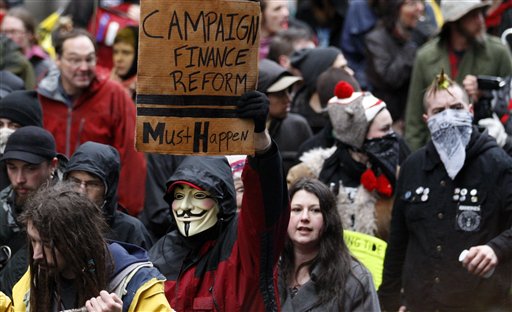
Occupy Portland, February 29, 2012--AP photo/Rick Bowmer
Margaret Sanger: A Rebel With A Mighty Cause
Posted: February 6, 2012 Filed under: birth control, black women's reproductive health, children, Civil Liberties, education, Feminists, health, Hillary Clinton, Human Rights, just because, Planned Parenthood, PLUB Pro-Life-Until-Birth, Women's Rights | Tags: An American Rebel, Birth Control, contraception, Margaret Sanger, sex education, women's reproductive rights 11 CommentsA Book Review; Review of a Life
Two weeks ago, I had the pleasure of catching Jean Baker, history professor at Goucher College, featured on BookTV. Baker discussed her book ‘Margaret Sanger: A Life of Passion,’ but more importantly connected the dots between the Right Wing’s attack on Sanger and the Pro-Choice, Family Planning movement.
A couple years ago while Glenn Beck hurled his diatribes, chalk boarding his twisted worldview on an unsuspecting public, he took Margaret Sanger to task. Beck described Sanger as one of his ‘evil’ progressives, a woman dedicated to racism and the application of eugenics in America.
The attack startled me. Why Sanger? I knew she had spearheaded the whole idea of inexpensive, reliable contraception and that her family clinics and her own reputation had come under constant assault. Anything and everything having to do with sexual behavior was taboo when Sanger began her work in the early, heady days of the 20th century. I also knew that Hillary Clinton had specifically mentioned Sanger as a personal hero. At the time, I thought that was Beck’s aim—discredit Sanger, discredit Clinton.
Au contraire!
Though Hillary Clinton did, in fact, make it on the list of evil progressives [along with Teddy Roosevelt, Wilson, FDR, even Lindsey Graham and John McCain], the attack on Margaret Sanger had and continues to have far broader implications. This is particularly true in any discussion of birth control, abortion and/or family planning and in the midst of a concerted effort to push a fetal personhood amendment to the fore.
The recent dustup between the Komen Foundation and Planned Parenthood is a case in point. Women’s healthcare has become politicized. We as women are discussed in a myriad of parts—our uteruses, our vaginas, our breasts, our reproductive capabilities. Too often, our autonomy as full-fledged human beings, adults capable of thought and decision-making about our own destiny is dismissed, made secondary to the considerations of others. Sadly, today’s opposition to female self-determination is the same that Sanger faced throughout her lifetime: men, who were convinced they had the right to an opinion and the hierarchy of the Catholic Church and other religious institutions that felt and continue to feel perfectly justified to chime in, making moral declarations, complete with Biblical arguments and opinions.

Young 'Maggie'
Professor Baker claims [and makes a very good argument] that the attack on Sanger’s work is also directly related to the attacks now being waged—female autonomy, the ability for women to direct their own reproductive lives. But Sanger had an especially hard road to travel, introducing her radical vision on the heels of the Victorian era.
Whatever’s old is new again!
While reading Baker’s new biography, I was startled by the similarity of the arguments, the pitfalls, the myriad of excuses to block any and all reasonable discussion when it comes to reproductive freedom. That being said, it’s hard to contemplate a time when the very discussion of or writing about birth control was considered perverse, pornographic and could end in jail time. Such was the case in the early 20th century.
Sanger’s efforts were so reviled by the status quo and Catholic Church that she was forced to leave the country for a brief stay in the UK or face arrest. She faced continuous harassment and was eventually arrested for her public, relentless stands. But ironically, this woman who had a spotty formal education, no training in public speaking would become by age fifty, one of the most influential women in the world.
Why? Because she would not stop. Because she was totally gripped by a single, burning idea–women were entitled to information [sexual or otherwise] and had a right to be empowered when it came to their own bodies.
Her background was fertile for dissent, her family a template for radical reaction. Born Margaret [Maggie] Higgins in 1879 in Corning, NY., she was the sixth child of 11 surviving children. Her mother, a devout Catholic, died at the age of 48, suffering with tuberculosis, the scourge of the 19th and early 20th centuries.
But here’s a factoid that Sanger’s critics rarely mention: her mother had eighteen pregnancies during her short life.
Eighteen!
Sanger’s father, a stone carver who royally ticked off the Church with his firebrand criticisms of Rome’s dictates, found it difficult to provide for his huge, ever-growing family. The family was poor, shanty Irish poor, with too many mouths to feed and an increasingly sick mother, made all the worse by cramped, squalid surroundings.
Though her impossible dream had been medical school, Sanger went to New York City following her mother’s death. There she trained as a nurse and midwife and spent several years attending patients on the Lower East Side. The living conditions in the tenements were appalling—cramped, rat-infested, devoid of anything approaching basic hygiene. She watched scores of young immigrant women die of pregnancy-related complications and botched abortions [many self-performed]. And she listened to scores of these women beg attending physicians [when available], pleading for help to prevent back-to-back pregnancies, birthing more children than they were able to feed or care for. To no avail. From that experience, that massive wave of human suffering, the idea of birth control and family planning was born.
Sanger took the remedy upon herself. Because no one else dared.
A prolific self-taught writer, Sanger traveled across America and was invited around the world to speak to the issue of contraception, sex education and reproductive services. Her work became the basis for health clinics dedicated to the health and education of women. She was, in fact, the mother of Planned Parenthood.
Ahhhh. No wonder she’s on the enemies’ list.
So what are the arguments against Sanger? Read the rest of this entry »
It Can Happen Here
Posted: January 9, 2012 Filed under: Barack Obama, Civil Liberties, court rulings, George W. Bush, Gitmo, Human Rights, legislation, torture | Tags: Barack Obama, Defense Authorizattion Act, due process, Gitmo, Guantanamo, Habeas Corpus, indefinite detention, Lakhdar Boumediene, Military Commissions Act (MCA), terrorism, Torture 20 Comments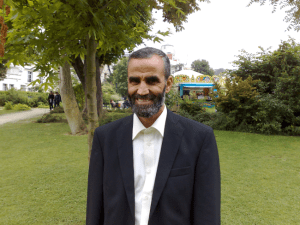
Lakhdar Boumedienne
Now that President Obama has signed the 2012 Defense Authorization Act, what happened to Lakhdar Boumediene could happen to any of us.
In a horrifying op-ed in yesterday’s New York Times Boumediene described how he was arrested in Bosnia in 2002 and held in Guantanamo for seven years without due process. At the time of his arrest Boumediene was working as a humanitarian aid worker focusing on helping children. During his imprisonment, he was never allowed to see his wife or his children, and received only a few of the many letters they sent him. The ones he did receive were cruelly censored.
Boumediene writes:
I left Algeria in 1990 to work abroad. In 1997 my family and I moved to Bosnia and Herzegovina at the request of my employer, the Red Crescent Society of the United Arab Emirates. I served in the Sarajevo office as director of humanitarian aid for children who had lost relatives to violence during the Balkan conflicts. In 1998, I became a Bosnian citizen. We had a good life, but all of that changed after 9/11.
When I arrived at work on the morning of Oct. 19, 2001, an intelligence officer was waiting for me. He asked me to accompany him to answer questions. I did so, voluntarily — but afterward I was told that I could not go home. The United States had demanded that local authorities arrest me and five other men. News reports at the time said the United States believed that I was plotting to blow up its embassy in Sarajevo. I had never — for a second — considered this.
The fact that the United States had made a mistake was clear from the beginning. Bosnia’s highest court investigated the American claim, found that there was no evidence against me and ordered my release. But instead, the moment I was released American agents seized me and the five others. We were tied up like animals and flown to Guantánamo, the American naval base in Cuba. I arrived on Jan. 20, 2002.
I still had faith in American justice. I believed my captors would quickly realize their mistake and let me go. But when I would not give the interrogators the answers they wanted — how could I, when I had done nothing wrong? — they became more and more brutal. I was kept awake for many days straight. I was forced to remain in painful positions for hours at a time. These are things I do not want to write about; I want only to forget.
Eventually he went on a hunger strike that lasted two years and was brutally force fed twice a day. Finally, in 2008, his case reached the Supreme Court.
In a decision that bears my name, the Supreme Court declared that “the laws and Constitution are designed to survive, and remain in force, in extraordinary times.” It ruled that prisoners like me, no matter how serious the accusations, have a right to a day in court. The Supreme Court recognized a basic truth: the government makes mistakes. And the court said that because “the consequence of error may be detention of persons for the duration of hostilities that may last a generation or more, this is a risk too significant to ignore.”
When he was finally freed, France took him in, and he was reunited with his family. Boumediene writes that there are 90 prisoners at Guantanamo who have also been cleared to leave the facility, but they are being held because they are from countries where they would be tortured or killed if they returned.
So there they sit, not guilty of any crime but held in indefinite detention. Just as you or I could be held if this president or the next one decides we somehow helped or supported terrorism.

 peej
peej Carissa
 bostonboomer
 dakinikat
 ecocatwoman
 mablue2
 Mama Lopez
 peggysue22
 quixote
 skydancingguestblogger
 Mona (aka Wonk the Vote)



 Sky Dancing
Recent Comments