
Tuesday Reads
Posted: December 21, 2010 Filed under: Barack Obama, Catfood Commission, Civil Rights, Democratic Politics, Team Obama, U.S. Economy, U.S. Politics, We are so F'd | Tags: Al Franken, Council of Conservative Citizens, Haley Barbour, Obama Targets Social Security, Racism, racist groups, Robert Kuttner, START TREATY, State budget woes 66 Comments Good Morning!

The Tax Cuts for Billionaires (tm) program has passed and will keep all the scrooges making merry merry for a bit. Unfortunately, the stimulus and capital investment will probably go outside the United States and a budget fight is on deck. The next budget crisis is looming. The Federal government will probably hit the debt ceiling in April. There’s 50 other problem budgets out there also. CBS has an interesting state of the states piece up called “The Day Of Reckoning”.
Most states will have worse problems because they must balance their budget, they’re running cyclic deficits which happens when unemployment goes up and they can’t print money. State budgets are overwhelmed with needs for state programs like food stamps and unemployment as well as SCHIP and other family safety net programs. They are also underwhelmed by incoming revenues because demand for things is way off. Federal tax cuts make this worse because many states–including here in Louisiana–base their income tax formulas on how much Federal Taxes have been paid. It’s tough for them to change the law at this point to reflect that Obama/McConnell Billionaire rescue plan ™. States and municipalities must watch their bond ratings and compete with other states for investor funds. This keeps them on a much tighter rein than the Feds. Additionally, there was some stimulus money in the original Obama stimulus progam that is not being renewed and will run out. All-in-all, 2011 will be a bad year for states. The worst is yet to come.
This situation has already worried Wall Street and will undoubtedly cause an increase in unemployment as state and local workers are laid off to balance budgets. One problem that we’ve had here in Louisiana is that state employment levels have been frozen in the clerical areas and the increased demand for unemployment has led to a 4 – 6 month backlog in processing unemployment benefits. If you don’t have a rich relative or an emergency savings fund, you’re most likely going to find yourself out on the street. It’s been the topic of many an investigative report in local TV. I found that it’s not just in Louisiana. It’s happened in Connecticut, Kansas, Rhode Island, and California too.
The states have been getting by on billions of dollars in federal stimulus funds, but the day of reckoning is at hand. The debt crisis is already making Wall Street nervous, and some believe that it could derail the recovery, cost a million public employees their jobs and require another big bailout package that no one in Washington wants to talk about.”The most alarming thing about the state issue is the level of complacency,” Meredith Whitney, one of the most respected financial analysts on Wall Street and one of the most influential women in American business, told correspondent Steve Kroft
Whitney made her reputation by warning that the big banks were in big trouble long before the 2008 collapse. Now, she’s warning about a financial meltdown in state and local governments.
“It has tentacles as wide as anything I’ve seen. I think next to housing this is the single most important issue in the United States, and certainly the largest threat to the U.S. economy,” she told Kroft.
Asked why people aren’t paying attention, Whitney said, “‘Cause they don’t pay attention until they have to.”
Whitney says it’s time to start.
This investigative report has examples of looming problems for California, Arizona and New Jersey. If you live in any of these three states, you should be prepared for an incredible scale back of government services and possible tax hikes. Another state with serious problems is Illinois. Illinois is already in the ‘deadbeat’ state category. Here in Louisiana, severe budget cuts by “Bobby is for Bobby” Jindal have led to attempts to break all public service unions including the ones for teachers, state clerical workers, firefighters and police. Here’s a list of targeted furloughs, layoffs, and firings in Louisiana as reported by WBRZ, a Baton Rouge TV station last month. If they’re not happening in your state already, they will undoubtedly be starting next year when the stimulus funds run out. Prison guards are even on the list. I wonder who will win the debtor’s prisons and poor house farms? Halliburton perhaps?
There is one more major lame duck issue sitting on the docket. Democratic senate leaders are hopeful they will get the START treaty ratified despite ongoing Republican obfuscation. Let’s hope they’ve got the votes they need. Even Condoleeza Rice and Colin Powell are on board with ratification.
By the end of another tumultuous day, treaty backers said they could count more than the two-thirds majority required for approval in votes that could begin as early as Tuesday. The Senate mustered as many as 64 votes in defeating Republican amendments on Monday, just two short of what supporters need for final approval, and three senators who supported one of the amendments have already said they will vote for the treaty in the end.
The momentum building for the treaty came despite the announcements of the two top Senate Republican leaders, Mitch McConnell of Kentucky and Jon Kyl of Arizona, that they will vote against the treaty, known as New Start. Treaty supporters pressured wavering Republicans on Monday with an appeal by Adm. Mike Mullen, chairman of the Joint Chiefs of Staff and the nation’s top military officer, to approve the agreement.
Mississippi Governor Haley Barbour’s recent slip of the tongue will undoubtedly create issues should he decided to make a run for the presidency in 2012. Barbour gave an extensive interview that basically showed how many parts of the south have not changed. The Mississippi governor praised a civic group that is–for all intent and purpose–a white supremacist group in the state. He also made a comment about the things not being so bad during the civil rights era. Kinda makes me think Trent Lott might have a better shot at the presidency than good ol’ Haley does.
Mississippi Gov. Haley Barbour says he doesn’t remember the Civil Rights era being “that bad,” citing his attendance at a Martin Luther King Jr. rally nearly 50 years ago.
“I just don’t remember it as being that bad,” Barbour (R), 63, told the conservative Weekly Standard, which did a lengthy profile on the governor. “I remember Martin Luther King came to town, in ’62. He spoke out at the old fairground and it was full of people, black and white.”
The profile also showed Barbour’s ignorance of the role of hate group in trying to maintain segregation. The group has a long history of white supremacist activities and writings.
“You heard of the Citizens Councils? Up north they think it was like the KKK,” said Barbour. “Where I come from it was an organization of town leaders. In Yazoo City they passed a resolution that said anybody who started a chapter of the Klan would get their ass run out of town. If you had a job, you’d lose it. If you had a store, they’d see nobody shopped there. We didn’t have a problem with the Klan in Yazoo City.”
The White Citizens Council movement was founded in Mississippi in 1954, shortly after the Brown v. Board of Education Supreme Court decision that outlawed segregated public schools, and was dedicated to political activities opposing civil rights — notably boycotts of pro-civil rights individuals in Barbour’s hometown, as opposed to Barbour’s recollection of actions against the Klan. It was distinguished from the Klan by the public self-identification of its members, and its image of suits and ties as opposed to white robes and nooses.
If you check the Southern Poverty Law Center’s Hate map of Mississippi, you’ll see that they’ve identified approximately 25 hate groups there. Many are in the area surrounding Yazoo. You’ll see that the Council of Conservative Citizens is quite active around the area. Some of these groups have changed their name to sound more palatable but it’s the same old racist screeds. It wouldn’t take much for Barbour to learn about these folks.
The Council of Conservative Citizens (CCC) is the modern reincarnation of the old White Citizens Councils, which were formed in the 1950s and 1960s to battle school desegregation in the South. Created in 1985 from the mailing lists of its predecessor organization, the CCC, which initially tried to project a “mainstream” image, has evolved into a crudely white supremacist group whose website has run pictures comparing pop singer Michael Jackson to an ape and referred to blacks as “a retrograde species of humanity.” The group’s newspaper, Citizens Informer, regularly publishes articles condemning “race mixing,” decrying the evils of illegal immigration, and lamenting the decline of white, European civilization.
In Its Own Words
“God is the author of racism. God is the One who divided mankind into different types. … Mixing the races is rebelliousness against God.”
— Council of Conservative Citizens website, 2001“We believe the United States is a European country and that Americans are part of the European people. … We therefore oppose the massive immigration of non-European and non-Western peoples into the United States that threatens to transform our nation into a non-European majority in our lifetime. We believe that illegal immigration must be stopped, if necessary by military force and placing troops on our national borders; that illegal aliens must be returned to their own countries; and that legal immigration must be severely restricted or halted through appropriate changes in our laws and policies. We also oppose all efforts to mix the races of mankind, to promote non-white races over the European-American people through so-called ‘affirmative action’ and similar measures, to destroy or denigrate the European-American heritage, including the heritage of the Southern people, and to force the integration of the races.”
—Statement of Principles, Citizens Informer, 2007“Controlling immigration is about the security of this republic [terrorists illegally crossing the borders] and making sure countries like Mexico stop dumping their murderers, rapists, those carrying AIDS and other communicable diseases and gang members on America’s door step.”
—Devvy Kidd, Citizens Informer, 2006
Yup, nothing to see here. Just about as benign as your local chamber of commerce or Elk’s Club. You’d think a governor would be familiar with terrorist and hate groups in his own state, wouldn’t you?
This Politico op-ed by Robert Kuttner is undoubtedly one of the first in the a number that will come up as Obama moves on Social Security. It’s called ‘Obama to blink first on Social Security’. Kuttner says that key senate Democrats and the White House are moving to embrace the Cat Food commission report AND cuts in social security. We’re supposed to hear about it in the State of the Union address coming up in January.
The idea is to pre-empt an even more draconian set of budget cuts likely to be proposed by the incoming House Budget Committee chairman, Rep. Paul Ryan (R-Wis.), as a condition of extending the debt ceiling. This is expected to hit in April.
White House strategists believe this can also give Obama “credit” for getting serious about deficit reduction — now more urgent with the nearly $900 billion increase in the deficit via the tax cut deal.
How to put this politely? For a Democratic president, this approach is bad economics and worse politics.
For starters, cutting Social Security as part of a deficit reduction deal is needless — since Social Security is in surplus for the next 27 years. The move also gives away the single most potent distinction between Democrats and Republicans — Democrats defend your Social Security, and Republicans keep trying to undermine it.
If you think the Democratic base feels betrayed by Obama’s tax-cut deal, just imagine the mayhem when Obama proposes to cut the Democrats’ signature program.
Sen. Al Franken (D-Minn.) compared Obama’s tax deal to punting on first down. A pre-emptive cut in Social Security is forfeiting the game before kickoff.
Hey, Al, I got an idea. Why don’t you and the others fight him just for once? Frankly no deal is better than the deals he’s been negotiating for us. Don’t hold your nose and vote for this one like you did with the Tax Cut for Billionaires (tm) plan. Please?
Altogether now, “We are so F’d”.
What’s on your reading and blogging list today?
Moody’s Plays the Market
Posted: December 14, 2010 Filed under: Catfood Commission, Equity Markets, Global Financial Crisis, legislation, The Great Recession | Tags: Debt Ceiling, Moody's, Obama-McConnell Tax plan, Steven Hess, US soverign debt ratings 22 Comments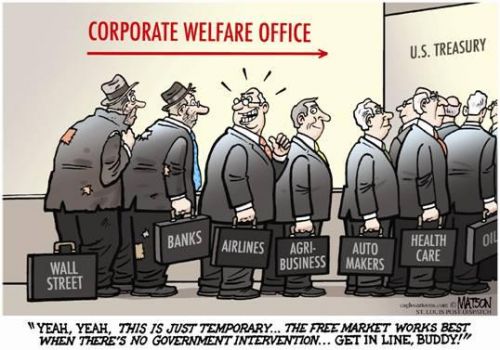 I mentioned in my thread on Tax Pandering last night that the rating company Moody’s is threatening to downgrade the U.S.’s credit rating over the Obama-McConnell Tax plan. Well, it seems a few folks have noticed a very interesting situation. Richard Smith at Naked Capitalism and Jane Hamsher at FDL notice a distinct change in message from Moody’s based on prior statement a week before. Also, Scarecrow at FDL has a related post up now.
It basically looks like they were for it before they were against it. This is odd and can only come under the heading of something’s rotten in Wall Street.
I’ve been down on Moody’s since they played such a major contributing role to the Financial Crisis by rating mortgage investment trash AAA. I’ve believe that it is only through lobbying and influence that they have managed to avoid legal and financial responsibility for their role in the entire debacle. Both Moody’s and Standard and Poor’s put their AAA+ ratings on trash. High ratings indicated to the market that the investments were safe so that many pension plans invested in what was essentially a junk bond level investment. They even highly rated subprime tranches. I’ve always felt there was a massive fraud investigation out there or at the very least a class action law suit but it’s never happened. My guess is they are highly connected to the current White House.
So, this week’s actions of note is that they seemed to have changed their tune from what they were saying prior to the cloture vote this week. On December 7th–via Scarecrow’s link to Jane–we can see Moody’s approach to reckless tax policy was simply “No Problem”. This comes from Bloomberg.
“The extension of the current tax rates is for a temporary period of two years and we think that if that’s all there is to it — it does not have ratings implications,” Steven Hess, senior credit officer at Moody’s in New York, said in an interview today. “We have a stable outlook. We don’t feel it will get changed downward in the next year or two.”
A week later, the same Steven Hess puts out a completely different vibe to The Hill. This is the message I read when I wrote my post last night.
“From a credit perspective, the negative effects on government finance are likely to outweigh the positive effects of higher economic growth. Unless there are offsetting measures, the package will be credit negative for the US and increase the likelihood of a negative outlook on the US government’s Aaa rating during the next two years,” Moody’s analyst Steven Hess writes.
So, reasonable minds would like to know what changed Mr. Hess’ mind so quickly? Was it that he was greasing the vote before the cloture vote and now he’s setting us up for something else since this horrible tax plan looks like it will pass? Richard Smith snarks in the affirmative.
A cynic might think that the Dec 7th report was Moody’s putting all its credibility behind the deal to extend the tax cuts, while the Dec 12th report was Moody’s putting all its credibility behind a move to ensure Obama got no political credit for it, once the deal, that they had implicitly supported a week earlier, was looking much more certain. That type of maneuver will have a familiar feel to the bedraggled Obama, one suspects.
Scarecrow talks about how these ‘impermanent’ tax cuts shouldn’t rattle any markets. The analysis is spot on so actual financial/economic analysis can’t possibly be the reason for the announcements and the change of heart.
For the umpteenth time, the US, unlike the suffering Ireland, Portugal, Spain, etc in the Euro zone, has its own currency and fiat money. It can’t be forced to default. Unless the people who run the country are complete idiots [insert news stories here], and refuse to use the tools and powers they have, the US is not at any risk of defaulting on its debt.
Moreover, the tax package is for two years. If one assumes that’s it, then there is no long-term structural deficit to cause us problems in the long run.
Richard Smith goes into some detail and argues that Moody’s can’t possibly be taken seriously by any one in the market any more because of the aforementioned subprime market crisis. Moody’s had tingling legs aplenty during the lead up time for both Countrywide and Bank of America who wouldn’t even exist today if it weren’t for congressional and white house largess using tax payer money.
Moody’s words can still probably move some markets. But, I think more importantly, it can move Congress Critterz and enable them to do all kinds of things.
So, what is the deal here? Well, this is the hypothesis of both Bostonboomer and me. It’s future cover for the upcoming Obama Tax ‘simplification’ plan and his plan to slash the budget–make that the part that impacts you and me and not Halliburton–when government gets shut down by the Republicans. My guess is the Hess statement will be brought up during the sturm and drang over increasing the debt ceiling once we bump into it early next year.
I’m pretty convinced of this. I’ll point to a CSM op ed for some back up on that.
Obama tax deal could start an era like Reagan’s
The Obama tax plan, if passed, would build trust between Republicans and Democrats. The next step could be tax simplification. The Reagan-era reforms provided helpful lessons.When it comes to tax reform, is Barack Obama another Ronald Reagan?
That seems to be the way President Obama is painting his political role over the next two years.
Like Reagan in the 1980s, Mr. Obama hopes to find a bipartisan consensus with Congress for simplifying the tax code.
His first big step toward that goal was to negotiate a deal with the newly empowered Republicans on extending the Bush-era tax rates. He also endorsed some ideas from his deficit-cutting commission, especially those aimed at eliminating most tax deductions, credits, and exemptions. And he has instructed aides to prepare tax-reform proposals.
The Republicans have already shown that they are willing to shut down government over the pending debt ceiling issue. This despite the fact we’ve basically got wars going on on four fronts: Iraq, Afghanistan, Pakistan and Yeman.
It’s all about who’s in the White House. One of the last bills the 110th Congress passed under the Bush Administration contained an increase in the debt, and 33 Republicans voted for it. Just a few months later, right after the Obama Administration took power, only 2 Republicans voted in favor of a bill raising the debt limit. Now, in these two examples, the debt limit provisions were attached to larger bills — TARP and the Stimulus Act — but, take a look at the historical data and the trend is borne out.
Speaking with unusual candor after the most recent debt limit vote, Rep. Michael Simpson [R, ID-2] said that it wasn’t the minority party’s responsibility to vote for raising the debt limit and called such votes “the burden of the majority.” It’s not clear how the Democratic majority will pull this off next session over what will likely be unanimous Republican opposition. David Waldman at Congress Matters suggests that the Democrats take up filibuster reform first, possibly in the lame duck session, so they can do it with 51 votes.
Obama appears to dislike conflict and taking Democratic-principled stands. I can only imagine what concessions are being planned at this very moment to deal with how the Congress will deal with raising the debt limit. Obama caved in on inheritance taxes, caved in on extending tax breaks to millionaires and billionaires, and he’s added pork goodies to the Dubya tax extensions like ‘grants’ to ethanol growers and equipment write off benefits for some one. I say some one because it’s sure not due to our current Industrial Production Capacity or the lack of corporate profits right now. We’re being bribed with 13 months of extended unemployment benefits and a social security payroll holiday that every one appears to dislike and find suspicious. The question is, for what?
We may truly be on the verge of another era of Reagan’s VooDoo economics пятилетка. This is a folly that we cannot afford. Even David Stockman and Bruce Bartlett–architects of Reaganomics–know these policies are detrimental to the U.S. economy and will be detrimental to all but the very rich among us. All this tax crap is pandering and manipulation. It has no basis in economic theory or past economic data. This has to be more of the Starve the Beast Republican Holy Grail enabled by a President who would rather go to a party hosted by Michelle than stick around and deal with questions of policy. I am sure this will be used to foist the nonsense from the Cat Food Commission on us all. I am simply bereft of hope for the future of this country.
update: A few minutes after I posted this, DDay at FDL has another germane post up: ‘Corker Assembles Debt Limit Shock Doctrine Team’. He must be thinking what BB and I are thinking. Corker is demanding cuts to ALL social programs in exchange for a yes vote to lift the debt ceiling.
The single most important thing that House Democrats could demand, in exchange for the tax cut bill’s passage, is an increase of the debt limit inside the package. It would in effect protect whatever stimulus you might get out of the bill, and deny Republicans another hostage-taking event.
Social Security: Why mess with an American Success Story?
Posted: December 10, 2010 Filed under: Catfood Commission, legislation, POTUS, The Bonus Class, U.S. Economy, Voter Ignorance | Tags: Clinton Obama presser, payroll tax holiday, Social Security 54 Comments
I spent most of the day listening to the Bernie Sanders show, but stories of the joint Clinton/Obama presser that turned into the Bill Clinton show grabbed my interest. I have more than a passing interest in Social Security. I haven’t paid into it for about 15 years, but I have an exhusband who has and I have 20 years worth of dibs on his account. I’m a tailend boomer with a much smaller nest egg post Financial Crisis than pre Financial Crisis. Ex Hubby’s social security and his pension plan loom on my horizon. They stop me from having bag lady nightmares.
So, what’s all this talk about a payroll tax holiday and why, all the sudden, is the Cat Food Commission’s foray into social security creeping me out? Well, for one I think that a lot of people–including the President–don’t seem to get social security, its history, its issues, and its challenges and that always irks me. For another, I think it opens this trap door to having more of my future Shanghaied. I don’t want any more of anything related to my future going off to Shanghai.
So, since the President–among others–is spreading disinformation about the Social Security program, I thought I’d take the time to remind you that I wrote a four part series on Social Security in May 2009. If you want a little background and perspective, you can go check it out. (Fortunately, it’s here in the file cabinet portion of Sky Dancing.) It is all based on Academic work and people that do active research on the program, its solvency, and its issues.
First, here’s a list of links to those old posts of mine:
Social Security: Reform, Refund or Opt-Out (Part 1) Introduction
Social Security: Reform, Refund or Opt-Out (Part 2) Public Pension Concepts and Alternatives
Social Security: Reform, Refund or Opt-Out? (Part 3) Lessons from the World
Social Security: Reform, Refund, or Opt Out? (Part 4) What to do when Pensions are out of balance
I wanted to point these out since I don’t want to completely reinvent the conversation here. The government has a website that it dedicated solely to the Social Security Act of 1935. There are still many, many people that do a lot of research in the area. Here is a link to one of the new studies that looks at the impact of increasing the level of maximum earnings subject to Social Security and its impact on the program. This is one of the things that is being suggested to increase funding for social security. Here is a brief from the National Academy of Social Insurance that looks at various funding formulas. This group is actually associated with actuaries so it is quite statistics intensive. Findings specific to this brief are:
- The number of Social Security beneficiaries per 100 covered workers will increase from 30 in 2005 to 46 in 2030 and to 50 in 2050.
- Social Security benefits will rise from 4.3 percent as a share of the total economy today to 6.1 percent in 2030.
- When baby boomers are retired, the total number of people each worker supports(including workers themselves, children, retirees, and other nonworking adults) will not be as large as it was when the baby boomers were children.
- As a share of the total economy, spending for Social Security benefits when baby boomers are retired will grow less than spending for public education grew when baby boomers were children.
- While baby boomers may have been a surprise when they turned up in record numbers to enroll in kindergarten in the 1950s, their retirement six decades later is not. Policymakers began to plan as early as 1983, when Congress lowered the cost of Social Security benefits for boomers and later generations by raising the age at which unreduced retirement benefits will be paid.
- Workers’ wages are projected to grow in real terms (that is, faster than inflation). By 2030, real wages will increase 33 percent. Even if policymakers chose to balance Social Security’s finances solely by a tax rate increase, workers’ net wages (after paying the higher tax) would still be 28 percent higher than they are today.
- While earnings that are taxed to pay for Social Security represent 38 percent of the total economy, other national income is not taxed for Social Security purposes.
- Broadening the tax base, reducing scheduled benefits, raising the Social Security tax rate, or allocating other kinds of revenue to Social Security are ways to improve Social Security finances.
So, you can see this isn’t an urgent issue right now. I guess my point is that the ‘sudden’ urgency we seem to have with social security is not something out of the blue and it’s not something that hasn’t been discussed, planned for, or actually worked on. As recently as August, the President himself gave a speech saying just these things which is why I am so confused about the Cat Food Commission’s dalliance with the program.
President Obama said Social Security is not in crisis and only modest changes are needed to keep it solvent.
The president acknowledged at a small town hall gathering in Columbus, Ohio, Wednesday that the pension fund “has to be tweaked because the population is getting older” but said Republicans’ plans to drastically overhaul the program are wrong.
“Social Security is not in crisis,” Obama said. “We’re going to have to make some modest adjustments in order to strengthen it.”
I also wanted to bring up a little bit on the idea of Payroll Tax Holidays and that bizarre Clinton/Obama presser today. I’m even more confused by this sudden urge to create a payroll tax holiday. This is an odd thing.
The tax deal reached between President Obama and congressional Republicans could mean a higher tax bill for roughly one in three workers as a result of the Social Security tax cut Republicans pushed as a replacement for the current Making Work Pay tax credit.
The Making Work Pay credit gives workers up to $400, paid out at 8 percent of income, meaning that anybody making at least $5,000 gets the full amount — and gets as much as anybody else. Its replacement knocks two percentage points off the payroll tax cut, meaning a worker would need to make $20,000 to get a $400 break. Of the nation’s roughly 150 million workers, around 50 million make less than $20,000 and will see at least some increase as a result.
Additionally, roughly a quarter of 20 million state and local workers pay no payroll tax, because they have a separate pension system. Some of those workers with children will benefit from the extension of other tax credits, but overall will have less money in their pocket.
Rep. Raul Grijalva (D-Ariz.), co-chair of the Congressional Progressive Caucus, said many House liberals were opposed to the payroll tax cut because of its effect on the poorest workers. Progressives are also concerned that the tax cut will become permanent and undermine Social Security’s funding stream and political support over time.
Social Security is a stand alone program. Mixing it as part of a goodie bag with other tax things doesn’t strike me as a very good idea from a political standpoint. It’s not part of the general budget. It’s a form of insurance. We (or in my case, my exhusband mostly) paid into it. Why mix it up with other tax give aways?
I did go hunting about for information on Payroll Tax Holidays to see if they really could stimulate the economy effectively. One of my issues is that I know that the FICA taxes are regressive because of the maximum income ceiling so I thought that the spending impact couldn’t be very large. So, it seems like getting rid of some of those taxes really gives more to the rich than the poor. Rich folks really aren’t very reliable spenders. Turns out, my hunch was studied and released in early 2009 at CBPP. They basically say that the biggest benefits would go to workers least likely to spend the money. That also seems to be every one’s take on this program. Also, there are people like me who worked for states and municipalities that don’t do Social Security. We don’t get a thing from this.
A payroll tax holiday, however, would both be costly — a two-month suspension could cost about $120 billion, for example — and likely relatively ineffective as a stimulus measure. Public resources would be better spent on stimulus measures with a higher “bang for the buck,” such as the Making Work Pay tax cut that President-elect Obama has proposed.
Economic stimulus measures aim to encourage an immediate increase in aggregate demand by boosting consumer spending. The most efficient way to boost consumer spending is to put money into the hands of people who will spend it quickly rather than save it; tax cuts focused on moderate- and low-income households are more effective as stimulus than tax cuts that are larger for people with higher incomes, because people at low-income levels spend a larger share of tax cuts they receive than people at higher income levels do.
A payroll tax holiday does not score well on this front — too little of the benefit goes to lower-income households struggling to make ends meet and too much goes to higher-income taxpayers, who are likely to save a significant fraction of any new resources they receive. Under the payroll tax, employees pay tax of 6.2 percent on earnings up to $106,800. So, for example, a worker earning $10,000 would receive a tax cut of just $103 from a two-month payroll tax holiday, while a worker earning ten times as much ($100,000) would receive a tax cut ten times as big — $1,030. Indeed, the highest-income fifth of households could receive more than half of the benefits that would go to workers from a two-month payroll tax holiday.
So, when President Clinton got up to day in a presser with Obama to support this comprise deal, I was really confused. It seemed like a double play triangulation move with a snagglepuss type-exit stage-left by POTUS. You can say a lot about Clinton–both good and bad–but he does understand his economic theory. Why would he support this?
Clinton comfortably outlined how the pending package of tax cuts, business incentives and unemployment benefits would boost the economy – even though it included tax help for the wealthy that Obama had to swallow.
“There’s never a perfect bipartisan bill in the eyes of a partisan,” Clinton said. “But I really believe this will be a significant net-plus for the country.”
When he finished his pitch, Clinton played the role of humble guy, saying, “So, for whatever it’s worth, that’s what I think.”
So, it all boils down to what can we get something past the Republicans? This entire deal puts Social Security in an awkward light. It also uses money for a payroll tax holiday that probably isn’t as efficacious as it could be if put to other uses. It also plays into the idea that giving taxes back to rich people stimulates the economy enough (VOODOO economics). It also indicates that playing up to adherents of VooDoo economics is worth adding to the deficit and to the problems with the deficit and the challenges social security faces in the future. It sets them up to make bigger arguments down the line.
I guess after reviewing everything, I just don’t see how this is worth it. Passing all of this because it’s the best you can do given the state of the Republican Klan in Kongress just isn’t good enough for me. It opens up too many issues in other areas. However, this is the graph they’re circulating as a White House talking point to show how Obama got the better deal. This is the graph that has Charles Krauthammer’s tie in a too tight double Windsor knot so much that Clinton brought it up.
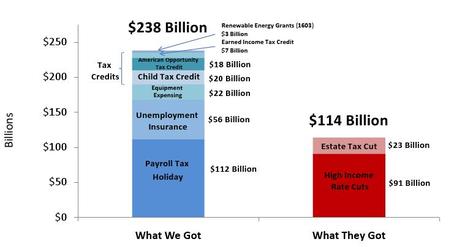
I’m not buying it. How about you?
Death of a Salespitch
Posted: December 5, 2010 Filed under: Catfood Commission | Tags: Catfood Commission, Social Security, Social Security Reform 48 CommentsI’m really hoping that Stan Collender has got it right. He’s arguing in short form today that the Cat Food Commission 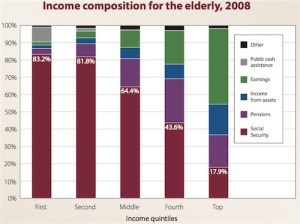 is dead with a promise of further details in an upcoming column at Roll Call. His first argument seems pretty reasonable. The Report needs 14 to pass and only 11 participants seem willing to do so. Here are his others.
- The 11 members of the commission who favored the plan likely overstates the actual amount of support. It seems clear that at least two and maybe more announced their support only when they were certain the plan wouldn’t get 14 votes. Their approval was more about political posturing for the future than actual enthusiasm.
- Don’t read too much into the bipartisan support for some of the options. If these same proposals are considered at all, they will next be debated in a very different political context and in a package that will look very different from the one the commission considered. Support for them in the commission is no indication they will be supported again.
- Don’t read too much into the enthusiastic response the plan received from various deficit hawk groups. Many of them supplied the commission with staff, helped develop what ultimately was proposed, and had a stake in its outcome. Under these circumstances, their enthuisastic approval and attempt to define the outcome as a success was not at all suprising. It’s also not especially indicative of any larger movement toward what was proposed.
I’m actually finding the power of the nifty graph from Matt Ygelisias at TP an even more compelling reason. He’s posting a response to Paul Krugman who can’t believe that the Beltway crowd is so obsessed with ruining social security. Krugman’s blog post today also contains his thoughts and the same nifty graph.
Look at the number of seniors that rely on social security for the majority or near majority of their incomes. That’s just income quintiles. You know that the distribution is skewed right (i.e population is largest on the lower ends.) Who wants to turn their life savings and major income source in old age over to a bunch of Wall Street High rollers or even worse, have it diced and sliced into pieces that you may or may not receive?
Even though Social Security is only a very mildly redistributive program, inequality of wealth is such that it’s a vital element of the bottom 60 percent’s living standards but kind of small beer to the top twenty percent. But I would say the other thing here on the Medicare / Social Security contrast is that Medicare isn’t just a subsidy program for old people. It’s also a subsidy program for doctors, nurses, hospital administrators, pharmaceutical executives, etc. Those people have lobbyists, many of their professions are well-respected, and many members of the political/media elite have siblings, cousins, college buddies, and even spouses who work in those fields.
The tragedy is that this very same factor that makes it harder to cut Medicare is also why cutting Social Security is a much worse idea. Our health care sector is low productivity mess and there are a lot of health-improving things a low-income senior can buy with Social Security money but can’t buy with Medicare. Healthy food, a gym membership, home-repair, etc.
Baby Boomers may not be a monolithic group, but I have to think that since most of us had our private savings and our home values chewed up and spit out by hedge funds and investment banks, we’re not going to go quietly into the night while having our social security gutted. I can’t imagine our remaining parents are going to be happy about it either since most of them have been paying in to the program since its initiation. Also, remind your children that should this pass, you will be expecting a room in their house because you will need it.
The graph and a lot of good information is from Our Fiscal Security. That’s the organization that I wrote about earlier that came up with a liberal response to the Bowles-Simpson ice floes plan. Let me just remind you of a few things from them about our Social Security.
- Social Security is currently in surplus and will take in more than it pays out until at least 2037, more than a quarter century from now.
- Raising the employer and employee payroll tax rates by just 1.1 percent each would erase the entire 75-year projected shortfall.
- Inequality leads to the projected Social Security shortfall: as income growth has become concentrated at the top, more income has fallen above the payroll cap of $106,800. Congress could close the entire 75 year projected funding gap by raising or eliminating the cap on taxable payroll income.
- Not just an I.O.U.: Income to the Social Security trust funds must be invested in guaranteed Treasury securities, which can be redeemed at any time at face value, giving the trust funds the same flexibility as cash.
- Social Security can never add to the yearly deficit; by law it cannot draw a single dollar from general revenues, even if payroll taxes fall short of scheduled benefits.
There’s a few more points out there if you’d like to go read them. It’s a data worth sending to your Congress Critterz.
The Presidential Democratic Values Apology Tour
Posted: November 30, 2010 Filed under: Catfood Commission, Surreality, Team Obama | Tags: bipartisanship, John Boehner, Mitch McConnell, Obama apologizes for being too bipartisan 48 Comments No. It didn’t take place in Saudi Arabia. It took place on Capitol Hill. It’s proof to me of an alternate universe there.
Ed Henry just said that it’s true that President Obama apologized for failing to be bipartisan and promised to work harder to find common ground.
There was a Republican presser with a follow up column at WAPO today by John Boehner and Mitch McConnell. Both were a joke. They don’t want to work with their Democratic colleagues. They want a one term Democratic president and damn any Democrat that believes any differently after they’ve said it over and over again.
Here’s Johnny!! (and Closet Case Mitchie too!)
The day after the election, President Obama seemed to acknowledge that a change in course is needed when he conceded that “the overwhelming message” he heard from the voters was “we want you to focus completely on jobs and the economy.”
Despite what some Democrats in Congress have suggested, voters did not signal they wanted more cooperation on the Democrats’ big-government policies that most Americans oppose. On the contrary, they want both parties to work together on policies that will help create the conditions for private-sector job growth. They want us to stop the spending binge, cut the deficit and send a clear message on taxes and regulations so small businesses can start hiring again.
We can work together and accomplish these things, but the White House and Democratic leaders in Congress first will have to prioritize. It’s time to choose struggling middle-class families and small businesses over the demands of the liberal base. It’s time to get serious.
What isn’t clear about this? They’ve said what they want and that’s all that they want. There’s no sign of cooperation here unless it’s you do what we say. Which is frankly kind’ve weird given we’ve gotten so much Republican-style policy through Capitol Hill without them.
What’s the President apologizing for? Gee, I know you mugged me, next time I’ll be sure to carry more cash and less credit, I’m so sorry.
Still, despite all the talk of a fresh start, Obama acknowledged the elephant in the room – what he called “the current hyper-partisan climate.”
“There are always those who argue that the best strategy is simply to try to defeat your opposition, instead of working with them,” the president said.
He needed look no further than McConnell to see someone whose stated goal is to make sure Obama does not win a second term. And in a Washington Post opinion piece published Tuesday by McConnell and Boehner, the rhetoric seemed distinctly McConnell-esque.
The column – titled “Where we and Democrats can work together” – called on the White House and Democratic leaders to “prioritize.”
“It’s time to choose struggling middle-class families and small businesses over the demands of the liberal base,” the GOP leaders wrote. “It’s time to get serious.”
Okay, let’s just start from the assumption that it’s not just the liberal base that doesn’t want their social security and Medicare privatized or shut down. Let’s also assume that most of us ARE concerned about jobs and not tax cuts. What exactly do they think the demands of the liberal base are? Giving unemployed people their unemployment checks? I haven’t seen any decent demands coming out of the liberal base in forever! No demand to shut GITMO. No demand to get out of Afghanistan. No demand to stop giving preferential treatment to banks. No demand to not put American citizens on hit lists. No demand to hold Cheney and Dubya accountable for breaking the Geneva Convention. What frigging demands? We can’t even protect a Woman’s right to choose over Insurance companies’ rights to extraordinary profits! DADT should’ve been gone by now and Pay Equity should’ve passed. What FRIGGING demands?
Yet, if you read reports from the PBS Newshour, POTUS is “Encouraged”. (Videos of pressers from this link)
Encouraged about what? Giving multimillionaires tax cuts? Implementing Allan Simpson’s plans to send seniors to homeless shelters? Maybe, it’s their desire to tank START?
What fresh hell is this?
Notable tweets from the un-notable Ed Henry CNN on the “Slurpee summit”
edhenrycnn Ed Henry
(oldest to newest)
President striking conciliatory tone, saying he’s committed to “common ground” on taxes — a phrase Boehner used several times
Breaking news: Senior admin official tells CNN the President did tell Repubs behind closed doors he failed to reach out enough in 1st 2 yrs
Senior official tells CNN President told Repubs “he had to do better and the President is ready to do his part” in the days to work together
Senior admin official is confirming account from Republicans that Potus acknowledged “he had not reached out enough” in words of Cantor

 peej
peej Carissa
 bostonboomer
 dakinikat
 ecocatwoman
 jjlolatina
 mablue2
 Mama Lopez
 peggysue22
 quixote
 skydancingguestblogger
 Mona (aka Wonk the Vote)



 Sky Dancing
Recent Comments