
Occupy 2.0
Posted: March 21, 2012 Filed under: #Occupy and We are the 99 percent!, 2012 elections, Action Memo, Anti-War, Austerity, Banksters, Civil Liberties, corporate greed, corporatism, corruption, Economy, Global Financial Crisis, income inequality, social justice, U.S. Economy, U.S. Politics 12 CommentsUntil this past weekend, the Occupy Movement was flying under the radar, percolating beyond public view. But members returned to Zucotti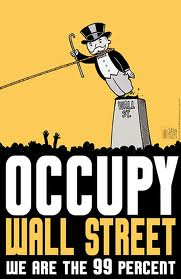 Park on St. Pat’s Day to celebrate the Movement’s six-month anniversary. From on the ground reports, the demonstration was peaceful. Until the NYPD arrived. Then there was trouble—a number of arrests and one woman reportedly had a seizure after she was thrown to the ground and handcuffed. Several participants said it took 17 minutes for the police to react, after which an ambulance was called.
For naysayers, the Occupy Wall St. Movement [OWS], their members and reasons for being were summarily dismissed before they began. Who is the leader of this motley group? journalists and pundits asked repeatedly. What do these people want?
Surprisingly, there is a leader or so I’ve read, someone well known to Occupy organizers but deliberately kept out of public view. As far as what they want? The answer seemed perfectly clear to me at the start because I think it’s what most Americans want or if they don’t want it, they expect it: an end to the gross inequality in the country, for which Wall St. and Government collusion holds the lion’s share of responsibility and an end to ‘bought’ elections, where the 1% and corporate interests routinely choose our leaders, shape policy and control the message, known in polite circles as ‘perception management.’
All of this transcends parties, btw. We’re talking Republican and Democratic parties alike, regardless of how many times we enter the ‘lesser than two evils’ spin.
You don’t need to be a psychic to ‘get’ the OWS message. You don’t even need to be a member of Occupy. All that’s needed is a modicum of alertness, a shaking-off of the trance-inducing distraction and deflection of pundits, media hounds and political operators.
So, what has OWS managed to accomplish, thus far? According to the critics—not a damn thing. But is that really the case?
Last summer, the headlines were ripe with talk of deficits, crushing debt and woe is me. We need a Grand Bargain, wisemen crooned [translation: we need to cut public services]. Somehow, we always have money for foreign adventures, national security, weapons and surveillance equipment. For instance, how many drones will be in American skies by 2020? Hummm. Try 30,000. That’s the Federal Aviation Administration’s rough estimate. The ever popular ‘shop ‘til you drop’ hee-haw isn’t working either, even with the news that ‘average’ Americans are flocking back to restaurant dining. Despite a stumbling economy there is money for weapons and drones and assorted homeland security gear. When it comes to education, infrastructure, home mortgage write downs, decent healthcare, aide to our poor, disabled and elderly? We’re just stone-broke and need to be put on an austerity diet. See Paul Ryan’s reiteration on social program slashes and numbers that don’t add up. It’s a nice set piece that will contrast with the soon-to-come kinder and gentler Democratic version.
One could call the dialogue change a bizarre coincidence but public conversation pivoted after Occupy came on the scene. We went from Oooooo, we need to slash Medicare, Medicaid and refigure Social Security to why is Wall St. getting bailed out on the backs of the taxpayer? Why do we have a system where the profits go to the top income bracket, while risk is carried by Main Street? Why have the wages of middle-class workers[if they’re fortunate enough to still have a job] barely kept pace with inflation, while the top 1% has had a 275% increase in income?
Uncomfortable questions, the sort that make politicians squirm.
OWS has also focused attention on home foreclosures, working with foreclosed families to save their homes. The Movement rallied the public in a Change Your Bank Day strategy that is estimated to cost TBTFs a $185 billion in transfers to community banks and credit unions. Religious organizations have joined the effort. According to Think Progress, The New Bottom Line, a coalition of faith groups has pledged to remove $1 billion from the major banks this year alone. OWS also pushed against the ATM fee-increase proposal; the banks pulled back. In late February, Occupy the SEC submitted a 300+ page document, urging regulators to resist the financial sector’s desire to water down the Volker Rule, part of the Dodd-Frank Wall St. reform. The group that put the document together was comprised of former Wall St. workers. OWS members also stood with private landowners, Tea Party members and environmentalists protesting the Keystone XL pipeline, a project that the President has expressed a new-found love for.
Not too shabby for six months activism. Yet still the critics howl. Where is the direction, what are the goals?
The Movement is young and still developing but you cannot fault it for sitting on its hands. More importantly, the Occupy spirit is global in nature because many activists are ‘graduates without a future’—young, educated and fed up. Paul Mason documented this facet of the worldwide

Arundhati Roy
social/political movements in his book, “Why It’s Kicking Off Everywhere,” and Arundhati Roy wrote this in a recent essay: “Capitalism, A Ghost Story”:
As Gush-Up concentrates wealth on to the tip of a shining pin on which our billionaires pirouette, tidal waves of money crash through the institutions of democracy—the courts, Parliament as well as the media, seriously compromising their ability to function in the ways they are meant to. The noisier the carnival around elections, the less sure we are that democracy really exists.
Sound familiar? The neoliberal model, the gross inequality that rewards the few at the expense of the many has circled the globe, creating universal discontent and misery.
So, what’s coming up for 2012? What will Occupy 2.0 look like?
I’d suggest checking the OWS page here for an updated list of scheduled actions. OWS plans to be in Chicago in mid-May to protest the NATO Summit although the city is throwing up barriers to prevent demonstrations. Somehow, I don’t think the protest will be stopped.
May 1 will be a National Action, the day traditionally known as International Worker’s Day. This year OWS is calling for a General Strike across the country. From the Occupy site:
We are calling on everyone who supports the cause of economic justice and true democracy to take part: No Work, No School, No Housework, No Shopping, No Banking – and most importantly, TAKE THE STREETS!
This Saturday, March 24, a Disrupt Dirty Power protest has been called in NYC to jumpstart a month-long action until Earth Day, April 22. More information here.
Sunday, March 25, Occupy Town Square IV will focus on public parks and other public spaces in NYC. More info here.
If you’re interested in local actions in particular states, towns, cities or countries, info can be found at the Occupy Together site here.
And if you want to eliminate the idea of ‘a failed movement’ from your brain. Check out the participation map here. The scope is massive.
The essay I mentioned by Arundhati Roy is well worth a read—highly informative, even shocking about vulture capitalism’s impact on India. Be prepared, it’s long. As Roy moves into her concluding paragraphs, she writes this:
Capitalism is in crisis. Trickledown failed. Now Gush-Up is in trouble too. The international financial meltdown is closing in. India’s growth rate has plummeted to 6.9 per cent. Foreign investment is pulling out. Major international corporations are sitting on huge piles of money, not sure where to invest it, not sure how the financial crisis will play out. This is a major, structural crack in the juggernaut of global capital.
Capitalism’s real “grave-diggers” may end up being its own delusional Cardinals, who have turned ideology into faith. Despite their strategic brilliance, they seem to have trouble grasping a simple fact: Capitalism is destroying the planet. The two old tricks that dug it out of past crises—War and Shopping—simply will not work.
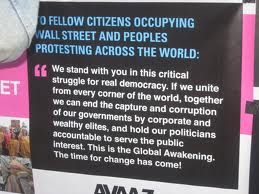
Disaster capitalism has certainly lived up to its name, be it continuous war, environmental degradation or exploding poverty. What is Occupy about? Speaking for myself, Occupy is about a break of faith with a global economic system that serves no one but an elite minority, where infinite money and power is the only morality. The movement is a massive rejection of the ongoing mantra: there’s no other way. Occupy challenges that static position, calls on us to envision something else, something better than the consensus mind. It dares us to shake off the old and embrace a sense of possibility. It demands we wake up, now.
There’s A Hot Wind Blowing
Posted: March 5, 2012 Filed under: #Occupy and We are the 99 percent!, Anti-War, Austerity, Banksters, Civil Liberties, Department of Homeland Security, financial institutions, income inequality, Russian elections 8 CommentsThere were few surprises in yesterday’s Russian election. Vladimir Putin won in what he declared a ‘clean victory.’ For his side.

Arrests in Moscow--image via SkyNews
For protestors of the last few months, the White Ribbon movement, opinion was to the contrary, comments generally expressing ‘shame, disgrace, treachery.’ Yet according to official results, Putin pulled a 64% majority, well over the 50%, which would require a run-off vote. Independent observers, however, reported widespread irregularities, insisting that Putin’s majority was perilously close to the 50% cliff. According to one observer, Roman Udot, with Galos, a free election watchdog organization, which recorded many cases of multiple voting and voter intimidation:
“It’s one pixel away from a second round.”
What was the reaction to Putin’s victory speech? Thousands of protestors hitting the streets in Moscow and St. Petersburg. And combat-style police, 12,000 reported in Moscow alone, on the ready.
One of the details that piqued my interest was the fact that Putin’s support comes heavily from elderly pension holders. Putin has been wise enough to keep the pension money flowing, even with a slight increase. For the older generation, Putin is the Devil they know. For the digital-savvy young? Not so much. The educated middle-class have reached a tipping point, disgusted with governmental fraud, corruption and political lip service to democratic principles.
This is not a new phenomenon. Social uprisings have been springing up all over. Currently, we’re watching Syria fall apart, desinigrating into civil war. This is on the heels of insistent calls for change across the Middle East—Egypt, Bahrain, Yemen, Libya—the message of which spread like a virus across Europe, the UK, the United States, Japan, China and now Russia.
Say what the pundits will but just beneath our own political process, the charade of another electoral season guided and shaped by money and corporate interests, there’s a hot wind blowing. The strident cacophony of the right wing, each member trying to outdo the other with outrageous comments or the pitiful whines of Wall St. bemoaning the decline in kingly bonuses, only underscores the obvious: the self-regulating, free market, privatize-the-world philosophy is a bust. Fraud is as wide as our broken housing market, the Big Lie deeper than a fracking well.
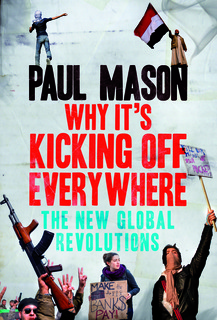 The intriguing question is what common denominators run through all these movements, despite the vast geographical/political differences? And why, presumably, did these social/political movements catch so many pundits, experts and leaders by surprise?
These are two of the questions, Paul Mason, a UK journalist and Economics Editor for the BBC attempts to answer in his book: ‘Why It’s Kicking Off Everywhere: The New Global Revolutions.’ Mason brings on-the-ground reporting, essay-like reflections, economic insights as well as a historical perspective to what we read in the headlines, websites and tweets of last year. And what we might expect coming at us, all of us in the coming months. He also does an effective job of bringing the pain, the anxiety, the suffering of people caught in the jaws of poverty, austerity and political crackdowns to life. We can see it. We can feel it and understand that we share more with the rest of the world than we have differences. This is a shattering truth.
The ‘why’ of the Dissent that Circled the World is intricately tied to the shuddering economic principles of globalization, fueled by a neoliberal narrative, the particular type of capitalism that has been favored and defended for the last forty years and has enriched the top 1% at the expense of everyone else. This is a system that insists markets are self-regulating, that free, unimpeded markets are the path to Paradise and privatization is always superior to public [government] direction. It is an ideology that refuses to look at the damage caused to vast swaths of the world’s population–the liberties extinguished, the income inequality produced, the environmental destruction–the very realities which are rejected, even when the evidence is undeniable. For instance, the global economic collapse and the implications of climate change.
Mason has reduced the drivers of the world-wide pushback to three main factors: graduates without a future, the rise and sophistication of social networks and the change in consciousness those very networks have produced, particularly as it relates to the definition of freedom and what that really means to ordinary people. Social networks—Facebook, twitter and cell phone usage—have changed the way we see and interact with one another and have fundamentally erased barriers of class, nationality, language and geographical distances. This is the hum of the hive and it’s growing stronger, which is why it’s regarded as a threat.
Anyone thinking the use of the word ‘threat’ is hyperbole should check the recent bill [HR 347] passed overwhelmingly in the US Congress making it a felony to participate in many of the Occupy Wall Street protests of last year. In fact, the bill has been coined the ‘anti-Occupy bill.’ Why haven’t we heard about this? Where is our brave press, the Fourth Estate, defending American liberty? They claim it simply isn’t relevant—no big deal. Interesting too–not a single Democrat voted against the bill’s passage. Not one. In fact, it’s reported that only Ron Paul and two other Republicans voted ‘nay.’ The bill’s vague language leaves the discretion regarding events of ‘national significance’ up to the discretion of the Department of Homeland Security.
Why is there a hot wind blowing? This is why.
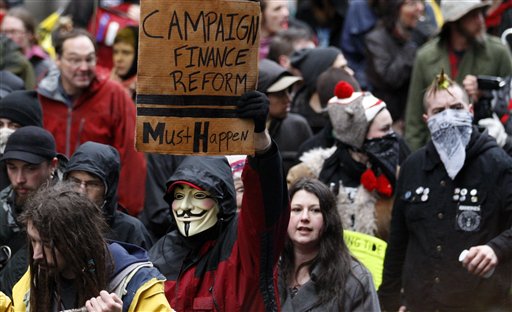
Occupy Portland, February 29, 2012--AP photo/Rick Bowmer
In The Land Of The Delusional
Posted: March 2, 2012 Filed under: 2012 presidential campaign, Austerity, double-speak, Economy, income inequality, Mitt Romney, religious extremists, Republican presidential politics, the GOP, U.S. Economy, War on Women, Women's Healthcare 16 CommentsIn the Land of the Delusional the Koch brothers are principled citizens who merely disagree with Democratic policy stands and are aghast at the vindictive slurs leveled against them and all other sincere, freedom-loving Republicans. In the Land of the Delusional, the hate and rage on review is a product of pink-bellied Lefties, Alinski acolytes, looking to take down American virtue and reduce the country’s might and glory. In the Land of the Delusional bankrupt ideas, economic mayhem and privateering can be obscured by attacks on woman, gays and the down and outers.
March is living up to its reputation—coming in like snarling Lion. Rush Limbaugh exposed a full Monty of misogyny, his comments on Sandra Fluke provoking even House Speaker Boehner to suggest the diatribe was ‘inappropriate.’ What inspired the outburst? Several weeks of desperate frontal attacks on women’s healthcare issues, thinly veiled and wrapped beneath ‘religious liberty’ arguments.
Let’s not kid ourselves! This is little more than shifting the conversation from discussion over economic issues, for which the Republican party has no credible position. The US Budget Watch has reported that Republican plans to slash taxes on corporations and high-income earners would explode the national debt up to $3 trillion. And for all the ballyhoo by the Norquist group the Washington Post reported [as well as many other sources] that the country’s revenue-collection has eroded to a 60-year low.
From the WP report:
Polls show that a large majority of Americans blame wasteful or unnecessary federal programs for the nation’s budget problems. But routine increases in defense and domestic spending account for only about 15 percent of the financial deterioration, according to a new analysis of CBO data.
The biggest culprit, by far, has been an erosion of tax revenue triggered largely by two recessions and multiple rounds of tax cuts. Together, the economy and the tax bills enacted under former president George W. Bush, and to a lesser extent by President Obama, wiped out $6.3 trillion in anticipated revenue. That’s nearly half of the $12.7 trillion swing from projected surpluses to real debt. Federal tax collections now stand at their lowest level as a percentage of the economy in 60 years.

Trickle Down Economics in Nature
But why let facts stand in the way. Paul Ryan, the Republican’s designated ‘serious thinker’ certainly doesn’t.
Ryan also complimented Romney’s economic plan. The congressman’s stamp of approval has been important for Republicans since he earned praise last year for his ambitious budget — which would dramatically change Medicare— from strong conservatives.
“Very credible. They are talking about entitlement reform. They are putting specifics on the table on Medicare and Social Security reform. The president, knowing that these are the big drivers of our debt, is ducking it,” Ryan said of Romney’s proposals.
Ah, yes. The ideologically blind leading those blinded by ambition. That certainly gives me confidence.
But as Paul Krugman suggested a mere 10 ten days ago, Mitt Romney let slip a truism in the swirl of Michigan campaigning when he said:
“If you just cut, if all you’re thinking about doing is cutting spending, as you cut spending you’ll slow down the economy.”
Over which the ideological purists set the dogs loose. The Club for Growth immediately denounced the Romney slip, insisting that it was a clear indication that Mitt was an imposter, not a ‘true’ limited government conservative [translation: not willing to drown all government in that Norquist bathtub].
What’s a candidate to do? Retreat, of course, in the same way Romney flipped on the Blunt Amendment, breaking all records, I would guess. In less than an hour, Candidate Romney twisted from ‘not going to go there’ to ‘of course, I support it.’ Enough to make your head spin. This is a political party in the death throes.
So, what’s the best way to distract?
Let’s pillory the women, start calling them sluts or suggest they film sexual exploits for the sake of some overweight, mean-spirited shock jock. Or let’s pretend that the perceived decline of the Nation rests squarely on the shoulders of the Gay Community and their screechy insistence that they too expect and deserve [can you believe the gall of these people] basic civil rights. And don’t forget the statistics on the ever-expanding numbers of Americans slipping into poverty. We tried calling them losers and moochers. How about we deny they exist, the way a North Carolina legislator recently announced. Yes sir, that’s the ticket!
In the Land of the Delusional schizophrenics rule the day, magical thinking replaces reason and bare-foot and pregnant is a very good thing. In the Land of the Delusional all things are possible.
Except the truth.

A War of a Different Sort
Posted: December 14, 2011 Filed under: Austerity, Banksters, Democratic Politics, Economy, globalization, income inequality, poverty, productivity, U.S. Economy, unemployment | Tags: Federal Reserve, investment, the Great Depression, The Great Slump 25 Comments
In the May edition of Vanity Fair, Joseph Stiglitz [economist and professor at Columbia University and recipient of the Nobel prize in economic sciences, 2001] wrote a prescient essay entitled, “Of the 1%, For the 1% and By the 1%.”
In a strange way, the piece voiced what would months later become the rallying cry of the Occupy Wall Street Movement, a foreshadowing of the public’s growing discontent with high unemployment, rising poverty and income disparity as well as the social damage resulting from Government failure to address the problems: the distortion it creates, how income disparities breed a climate of imbalance and lack of restraint, encouraging:
. . . no limit to the adventures we can undertake; corporations and contractors stand only to gain. The rules of economic globalization are likewise designed to benefit the rich: they encourage competition among countries for business, which drives down taxes on corporations, weakens health and environmental protections, and undermines what used to be viewed as the “core” labor rights, which include the right to collective bargaining.
In addition, Stiglitz underscored how inequality erodes our national identity–the sense of fairness, equal opportunity, our sense of community–the very elements we consider American staples. In fact, while listening to the GOPs’ endless political debates these past months, I’ve felt like a stranger in a strange land. Abandon child labor laws? Let the uninsured die? Begin massive deportations?
Really?
In any case, Stiglitz was the first to sound the warning in clear, concise and effective prose.
Which is why I found Stiglitz’s recent VF piece, ‘The Book of Jobs,’ required reading. Great title, btw. Even better is the comparison made between the Great Depression of the 1930s and the present downturn. Or as Stiglitz refers to our current dilemma: the Great Slump. An interesting aside, Paul Krugman pulled out all the stops over the weekend and called our economic crisis a depression, period. Hardly a surprise for the underwater homeowner, the long-term unemployed or those juggling multiple part-time positions to make ends meet.
 I’d encourage readers to take a few minutes and read Stiglitz’s recent essay. It’s amazingly concise and clear, even for non-economic types [like myself]. But here’s the gist: Ben Bernanke, a self-proclaimed scholar of the Great Depression, turned on the money spigots in response to the 2008-2009 meltdown because traditional wisdom said the Great Depression was the result of excessive money tightening by the Federal Reserve. So, doing the opposite would be the charm, right?
Not quite. As Stiglitz notes, this time we have proof that monetary manipulations were neither the cause nor the answer.
Why?
Because despite the flood of money, we’re still in the crapper. Consider this an Advanced Economics Lab experiment, playing out before your eyes.
So what is the root problem?
The economy itself, Stiglitz contends, a structural dislocation, a weak economy disguised by whopping bubbles in the real estate and financial markets, the easy, even crazy availability of credit, but basically a shift in the jobs we have to the jobs we need.
This is eerily similar to the precursor of the Great Depression. Then, massive unemployment resulted as the country moved from agriculture to industry. The cause? Increased agricultural productivity. What was once done by 20% of the population would be accomplished [with surplus] by 2%. Currently, the economy is moving from industry to service. Again, this shift has been provoked by increased productivity.
What is old is new again. With a twist, of course: the impact of globalization.
Industry to service? you say. Most Americans wince at the prospect of ‘service’ jobs—low skills, lower pay, 8 hours of mindless burger flipping.
Not really.
For instance, addressing our energy needs alone will require an abundance of high tech skills [and commensurate wages] to develop cleaner,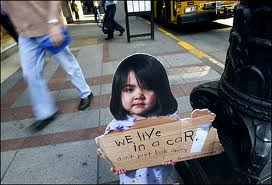 more efficient fuels. Support of basic research work is critical in this and other areas and leads to increased innovation and economic growth. Examples are plentiful—research produced the Internet and biotech industry, spawning huge upticks in economic growth. And this is something Americans excel at—thinking outside the box. Education will be required to retrain the work force and prepare and encourage our children with requisite skills and creative know how. In addition, infrastructure, a growing national concern, offers years of labor for out-of-work construction crews. We certainly don’t need an American version of ‘London Bridge is falling down.’ The Minneapolis bridge collapse in March was one too many.
Yes, Stiglitz says, we will need to rein in the banks, turn them back into the boring businesses they once were [they’re suppose to be serving us, not the other way around]. And we will need to seriously re-evaluate our tax policies, most of which favor the rich. But to solve the most critical problem—structural change—will require investing in our future, our own people. Private enterprise will not and cannot do that on a massive scale [I can hear Republicans wailing in unison].
FDR had World War II, spurring the necessary investment [spending] that launched the US into an unparalleled cycle of growth and prosperity. We are now faced with another war, a battle of ideology and political one-upmanship. Yet the solutions are real and within our grasp, Stiglitz suggests. I, for one, believe him.
Now it’s a matter of mustering the national will. We employed that fierce will during the Second World War; our survival and ultimate victory depended on it.
As it does once again.
Poverty in These United States
Posted: November 15, 2011 Filed under: Austerity, children, Economy, hunger, income inequality, poverty, seniors, unemployment | Tags: austerity, children at risk, Poverty Tour, seniors 10 Comments
We are not Afghanistan. We are not Haiti or the Democratic Republic of the Congo. We are not any of the 3rd world nations that are sometimes callously referred to as the ‘black holes’ of the world, where national incomes range between $700-900 annually, where human assets in nutrition, education, health and adult literacy are the lowest of the low. Nor do national fluctuations in agriculture production, instability of import/export services or economic smallness define us.
We are decidedly not one of the least developed nations on the planet. Quite the contrary. We are the richest, most powerful and technologically advanced nation the world has ever known.
Yet poverty exists and is rising. American poverty is a fact, a condition defined not by 3rd world standards but by the standards of who and what we are as a premier Nation among all nations.
No sooner had the Census Bureau come out with its findings on poverty–the first report in September, followed by a supplemental report in early November—the naysayers lined up reminding us that the findings were misleading, that many of the so-called poor had cars and TVs, that children of the poor sported Xboxes. And my God, a goodly number actually have air conditioning! I suspect many have heating, too.
The arguments are that unless a family or individual meets a 3rd-world definition of poverty then even the mention of rising American poverty levels falls into the category of gross exaggeration. This in a time when unemployment is the top concern of the American electorate, when unemployment sits ‘officially’ at 9% but, in fact, has reached nearly 20%, when from 2001-2009 42,400 American factories closed their doors to traditional middle-class jobs. This is also in a time of historical corporate profits and obscene CEO salaries in the financial services industry that through casino betting, accounting fraud and governmental bailouts brought this country and the world to its knees. And continues to do so, eg., MF Global headed by former NJ Governor Jon Corzine.
The old canards are being taken for a rerun as well: poverty is a symptom of lazy minds and an entitlement generation or an unwillingness to work hard and save money. Many will recall the Welfare Queen stories of the past, imagined always as a black woman with a dozen children, driving idly around town in her brand new Caddie. Living life high on the hog, the hysterical claims insisted, bilking government largesse [ otherwise known as taxpayer money]. But as Ralph B. noted in an earlier thread, there’s nary a word about corporate/millionaire welfare, where companies and even individuals skate on Federal taxes through loopholes and accounting maneuvers and government handouts
Let’s get real. The fallout of 2007-2008 hit many average families between the eyes, this after wages had been stagnating for three decades with a beginning upswing in the 90s, wage advancements quickly lost since 2000. Prices, however, have continued to rise, commodity prices in particular, those base products— gas, foodstuffs—that we all rely on to survive. Medical costs/premiums have gone through the roof. Is it any wonder seniors, who face a disproportionate share of medical problems and costs, have gotten caught in the old trap of choosing food or drugs? Children are caught up in the economic whirlwind, too, as parents lose jobs and homes, scramble for low-paying, part-time positions, work that frequently is not enough to ensure adequate food and/or nutrition on a consistent basis. Should we be surprised then at the increase of American children now classified as ‘food insecure?’
Here’s what we know:
49.1 million Americans have fallen into poverty, 16% of the population or 1 in 7 Americans.
Nearly 20% of that number are children; nearly 16% of the indigent are 65 years and older.
21.5% of American children have been classified as ‘food insecure.’
1 in 15 Americans are classified as the ‘poorest of the poor, which in 2010 translated to $5570 or less for an individual, $11,157 for a family of four.
The Census Bureau’s Supplemental report issued earlier this month takes into account governmental assistance—food stamps, the earned income tax credit, school lunch programs etc—without which the statistics above would be even worse.
From a Center on Budget and Policy Priorities report:
Six temporary federal initiatives enacted in 2009 and 2010 to bolster the economy by lifting consumers’ incomes and purchases kept nearly 7 million Americans out of poverty in 2010, under an alternative measure of poverty that takes into account the impact of government benefit programs and taxes. These initiatives — three new or expanded tax credits, two enhancements of unemployment insurance, and an expansion of benefits through the Supplemental Nutrition Assistance Program (SNAP, formerly called food stamps) — were part of the 2009 Recovery Act. Congress subsequently extended or expanded some of them.
Hence the total number of persons in poverty would have been even higher last year if not for the six government initiatives.
Btw, the link above gives a rather shocking comparison between the poverty rates in the US and Brazil. Not pretty.
Yet, Michelle Bachmann’s prescription as well as many of her Republican colleagues is based on the old saw: self-reliance, an honest day’s work for an honest day’s pay. This in a time of record unemployment and rising poverty in the general population.
How many statistics, comparisons, articles and images are necessary to convince the disbelieving that American poverty is on the rise, that it is not the result of coddling, laziness or lack of self-reliance? Or perhaps we must admit that there is also a poverty of spirit and reason running rampant through country, blinding those who would blame fellow citizens for the dearth of employment and opportunity without offering any workable solutions to an ever growing, bleak reality.


 peej
peej Carissa
 bostonboomer
 dakinikat
 ecocatwoman
 mablue2
 Mama Lopez
 peggysue22
 quixote
 skydancingguestblogger
 Mona (aka Wonk the Vote)



 Sky Dancing
Recent Comments