
The Sequestration Blues: Part 2 Pete Peterson Creates a Crisis
Posted: February 26, 2013 Filed under: Austerity, Barack Obama, Catfood Commission, Economy, Federal Budget, Federal Budget and Budget deficit | Tags: Astroturf, Deficit Delusion, deficit hawks, Deficit Hysteria, Fix the Debt, Pete Peterson, Simpson-Bowles 13 Comments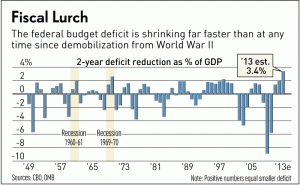 Ben Bernanke joined the chorus of economists concerned about the impact of the sequester on the sluggish recovery. This is not the first time the Fed chair has commented on misguided and dysfunctional Fiscal Policy in our country.
Federal Reserve Chairman Ben Bernanke warned Congress risks slowing the economy by allowing $85 billion in automatic spending cuts to be triggered on Friday, arguing they should be replaced with more deliberate, long-term cuts.
In prepared testimony for the Senate Banking Committee, Bernanke argued the sequester would pose a “significant headwind” to the economic recovery.
“Given the still-moderate underlying pace of economic growth, this additional near-term burden on the recovery is significant,” he warned.Bernanke did not offer an opinion on whether tax hikes should be included as part of a replacement bill, and he did not call for any specific entitlement reforms.
Meanwhile, the White House released reports on how the expected cuts will impact states. This undoubtedly will trigger more Republican whining on how mean the President continues to be to them as they continue their role as economic agents of chaos.
In Kentucky, home of the Senate Republican leader, Mitch McConnell, residents woke up on Monday to news articles like these: Widespread government spending cuts that begin on Friday will cost 21,484 jobs in the state. A construction project at Fort Knox will come to a halt. Three airports may endure partial shutdowns. Nearly $12 million in grants to public schools would be cut, putting at risk the jobs of 160 teachers and aides. More than 1,000 children would lose access to Head Start.
The White House released warnings for every state on Sunday in the hope that angry voters would besiege Republican lawmakers like Mr. McConnell and the House speaker, John Boehner, to stop the $85 billion in cuts, known as a sequester. President Obama wants to replace the sequester with a mix of tax increases on the rich and less damaging spending reductions. Republicans say they won’t consider any proposal that isn’t all cuts, so the sequester is all but certain to begin this week.
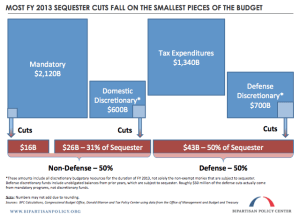 There’s a fairly good list of the types of spending items that will be subject to cuts at the Bipartisan Policy Center.
Setting aside the magnitude of the reductions, the most difficult aspect of both the defense and domestic cuts is that they will be made across the board to all non-exempt government spending regardless of programs’ merits or demerits.*** The reductions designed by law are executed at the Program, Project & Activity (PPA) level of the federal budget, sometimes defined in appropriations bills and which often includes very granular categories of expenditures, such as “two Virginia Class Submarines” or “salaries and benefits” of a particular agency.
Absent a new law passed by Congress, the president has little ability to spare one type of spending and cut more from another. This creates uncertainty in both the public and private sector because there remains much to be determined about how PPAs will be defined by agency administrators and how the cuts will be implemented. This inability to plan is already acting as a drag on economic growth.
Furthermore, the immediate and across the board nature of the cuts, along with their magnitude concentrated in a seven-month period, will impair economic growth as the year progresses. At BPC, we estimated last year that the sequester would reduce 2013 gross domestic product (GDP) growth by half a percentage point, and would cost the economy approximately one million jobs over the next two years. More recent estimates released by the CBO and Macroeconomic Advisors have roughly confirmed these projections.
Given all of this, you would think that most congress critterz would want to avoid the sequester. However, there’s that same group of tea party crazies that are so disconnected from an evidence-based reality it appears congress will tank the economy rather than develop a cogent Fiscal Policy related to economic theory and the state of the economy itself.
The White House strategy on the sequester was built around a familiar miscalculation about Republicans. It assumed that, in the end, they would be reasonable and negotiate a realistic alternative to indiscriminate cuts. Because the reductions hurt defense programs long held sacrosanct by Republicans, the White House thought it had leverage that would reduce the damage to the domestic programs favored by Democrats.
It turns out, though, that the defense hawks in the party are outnumbered. More Republicans seem to care about reducing spending at all costs, and the prospect of damaging vital government programs does not seem to bother them. “Fiscal questions trump defense in a way they never would have after 9/11,” Representative Tom Cole, a Republican of Oklahoma, told The Times. “But the war in Iraq is over. Troops are coming home from Afghanistan, and we want to secure the cuts.”
Cuts this draconian have no place in a tottering economy. But, realistically, the only way to break this standoff is for the cuts to exact their toll on daily life, causing Republicans to face pressure from the public to negotiate an alternative plan with higher revenues in March as part of talks to finance the government for the final six months of the fiscal year.
It’s difficult to believe that so many folks can be so misguided about the need to drastically cut the budget. Read the rest of this entry »
Queen Ann Lays Down the Law on Mitt’s Taxes as Obama Opens a New Campaign Front
Posted: July 19, 2012 Filed under: 2012 presidential campaign, Austerity, Barack Obama, corporate greed, Medicare, Mitt Romney, Team Obama, U.S. Economy, U.S. Politics | Tags: Ann Romney, Ed Kilgore, Florida, Greg Sargent, Jonathan Chait, Leona Helmsley, Ryan budget, tax evasion 39 Comments
Thanks to Delphyne, who posted this link on the morning thread: Ann Romney: We’ve Given ‘All You People Need To Know’ About Family Finances
Mitt Romney’s wife is reinforcing her husband’s refusal to make public several years of tax returns, telling ABC News “we’ve given all you people need to know” about the family’s finances.
“You know, you should really look at where Mitt has led his life, and where he’s been financially,” she said in her interview with Robin Roberts. “He’s a very generous person. We give 10 percent of our income to our church every year. Do you think that is the kind of person that is trying to hide things, or do things? No. He is so good about it. Then, when he was governor of Massachusetts, didn’t take a salary in the four years.”
Roberts pressed: “Why not show that, then?” and reasoned that people could “move on” if her husband released his returns.
Romney responded, “Because there are so many things that will be open again for more attack… and that’s really, that’s just the answer. And we’ve given all you people need to know and understand about our financial situation and about how we live our life. And so, the election, again, will not be decided on that. It will be decided on who is gonna turn the economy around and how are jobs gonna come back to America.”
Queen Ann has spoken, and that’s that, you people. Ann’s attitude puts me in mind of this famous quote from Leona Helmsley: “We don’t pay taxes. Only the little people pay taxes…”
Meanwhile, President Obama is opening a new campaign front today in Florida. The Bain attacks were just a warm-up for an even more lethal attack in which the consequences of Mitt Romney’s stated support of the Ryan budget will spelled out in detail. From MSNBC’s First Thoughts:
Here comes Medicare: The past few weeks on the presidential campaign trail have featured aggressive attacks and counterattacks. On outsourcing by Bain Capital. On Mitt Romney’s post-1999 association with that firm, as well has his tax returns. On charges of “crony capitalism” in the Obama administration. And on President Obama’s views about business. And today when Obama begins a two-day swing through the crucial state of Florida — with all of its seniors — he’ll introduce another attack: hitting Romney on Medicare and the Ryan budget. Per the campaign, the president “will discuss his commitment to strengthening Medicare, and a new report tomorrow that highlights the devastating impact Mitt Romney’s Medicare plan could have on the 3.4 million Floridians that rely on Medicare.” Bottom line, per the campaign’s guidance: Obama will argue that Romney — through his support for the Ryan budget plan — advocates ending Medicare “as we know it.” Obama starts his Florida swing with a 1:25 pm ET event in Jacksonville, and then he heads to West Palm Beach at 6:20 pm. Tomorrow in the Sunshine State, he hits Ft. Myers and Winter Park.
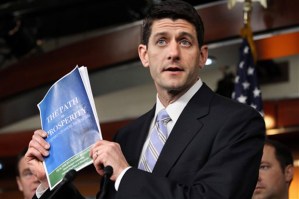
As Ed Kilgore wrote this morning, Jonathan Chait predicted this two-front strategy last month.
I strongly suspect that Obama is currently in the first stage of a two-part assault on Romney. The first is to define his motives and perspective: a rich man who sees the world from the perspective of the CEO suite and blithely assumes what is good for people like himself is good for everybody.
This is the essential predicate for part two, which I would guess (I have no inside information) will dominate the last half of the campaign. Part two is Romney’s fealty to the Bush-era low-tax, anti-regulatory ideology and the radical Paul Ryan plan. The average undecided voter pays little attention to politics and might not understand why a candidate would return to failed Bush-era policies or slash the social safety net in order to clear budgetary headroom for keeping taxes on the rich low. Defining Romney’s business career is a way of making sense of those choices.
This morning, Chait announced that phase two begins today.
Greg Sargent explains why stage two is necessary:
Keep in mind: A focus group convened by the pro-Obama Priorities U.S.A. found that voters simply refused to believe that Romney or Ryan would really transform Medicare into a quasi-voucher program while also cutting taxes for the rich. This is what the assault on Romney’s Bain years is really about. It’s an effort to establish an image of Romney that will make it easier for voters to accept that this is indeed the agenda Romney has embraced and would carry out as president.
As the Obama campaign will point out, Republicans expect Romney to essentially rubber-stamp the Ryan’s agenda. ”We want the Ryan budget,” Grover Norquist recently said. “Pick a Republican with enough working digits to handle a pen to become president of the United States.”
The attacks on Romney’s business background and core rationale for running for president may enable the Obama campaign to fight Romney to a draw on the economy — by persuading swing voters who are unhappy with Obama’s performance that Romney certainly doesn’t have the answers to their economic problems, and could even make things worse.
I heard on the Morning Joe show today that Obama’s Bain attacks aren’t working because polls still show Obama and Romney deadlocked after weeks of the Obama campaign pounding Romney on Bain, outsourcing, and tax evasion. But I agree with Jamelle Bouie that it’s way too early to know for sure whether the attacks will work.
In the summer of 2004 it seemed that the Swiftboat attacks weren’t hurting Kerry, but only political junkies like us are really paying attention right now. The real tests will come after the conventions and during the debates. Bouie writes:
Given the extent to which commentators have analogized this controversy to the Swift Boat attacks on John Kerry, it’s worth looking back at how the former nominee fared during the period in which he absorbed withering attacks on his military record. The Swift Boat ads aired from the beginning of May until the end of August. During this period, according to Gallup, Kerry held a small lead among likely voters.
Kerry’s position began to decline in August, but even then, he ended the month with only a small deficit. George W. Bush didn’t begin to build a large lead until the fall. The growth in Bush’s lead corresponded with a decline in Kerry’s net favorability. It’s possible Kerry was unaffected by the Swift Boat attacks. But it’s also possible that they didn’t begin to have an impact until later. It’s also too early to say whether the attacks on Bain will work. But there’s a chance they’ll have the most effect after the conventions, as undecided voters begin to make a choice, and draw on overall impressions built up over months as they make their decision. Given the new $8 million ad buy from Crossroads — meant to deflect Obama’s attacks on Bain — it’s clear Republicans see long-term danger here.
I have to say, this campaign is getting a lot more interesting. I’m not thrilled with either of the candidates, but I have no problem saying that Romney is much much more horrible than Obama. I probably won’t end up voting for either of these candidates, but as a true political junkie I love watching a hard fought campaign.
Saturday Morning Reads
Posted: June 16, 2012 Filed under: Austerity, Barack Obama, executive orders, immigration, legislation, Mitt Romney, morning reads, U.S. Economy, U.S. Politics | Tags: Affordable Care Act, Angela Merkel, Daily Caller, Egypt, eurozone crisis, Germany, Goodfellas, Greece, Henry Hill, Neil Munro, respect for the office of President, Ruth Bader Ginsburg, SCOTUS, the Euro, Tucker Carlson, White House press corps, wingnuts, wise guys, world economy 24 Comments
Good Morning!!
Yesterday was a pretty busy news day for a Friday. So if you’ve had your sugar bombs and coffee, let me fill you in on the latest before you head outside to enjoy a beautiful June day. The weather folks are saying this will be a nice weekend around the country.
Yesterday the President announced an executive order telling the Department of Homeland Security not to deport children who were brought to the U.S. illegally and have grown up here and gone to school here. These are the young people who would be eligible to stay here and have a path to citizenship under the “Dream Act” if Republicans in Congress would stop blocking the legislation.
In a move that seemed to be aimed at Hispanics whose enthusiasm for voting in the November 6 election could be crucial to Obama’s re-election chances, the president acted to potentially protect 800,000 people from deportation proceedings for at least two years.
Obama, who previously was reluctant to impose such an order even as Republicans in Congress blocked immigration reform bills he supported, called his action “the right thing to do.”
His announcement was on the 30th anniversary of a Supreme Court decision that said children of illegal-immigrant parents were entitled to public education in the United States.
Right wingers–including Mitt Romney–are of course calling the move “political,” but so what? I’ve said it before and I’ll say it again. Politicians make political decisions. Duh! But if they’re doing the right thing, I don’t care what their motivation is. The LA Times published some basic information for people who want to know what this change means to them.
During the President’s announcement of the policy change at a press availability in the Rose Garden, a wingnut blogger from The Daily Caller, rudely broke into Obama’s speech with an offensive question. David Graham at the Atlantic:
An extremely unusual occurrence happened today as President Obama spoke at the White House. The president was offering a statement on his executive order suspending deportations for certain illegal immigrants brought here as children….when a reporter started heckling him and shouting questions.
The reporter has been identified as Neil Munro of the Daily Caller, a conservative online news outlet run by Tucker Carlson….
Interrupting the president mid-speech is considered a serious breach of etiquette, and Obama’s reaction shows how peeved (and probably taken aback) he was. Munro, and the Daily Caller, have immediately come in for harsh criticism by a wide range of journalists, including conservative ones. The problem isn’t that Munro was asking tough questions; it’s that he interrupted the commander-in-chief to ask them and in doing so guaranteed that none of the assembled press would be able to ask any serious questions — since it’s fairly clear that Munro’s query was intended as provocation.
I have video of the confrontation, but youtube seems to be down at the moment. I’ll put it up again later if I can. Munro yelled “Why do you favor foreigners over Americans?” Then when Obama responded, he proceed to argue and then yell while Obama was speaking. Pretty unprofessional for a so-called “journalist.”
Even Bill O’Reilly condemned the wingnut hack’s behavior, along with Fox News talkers Shep Smith and Chris Wallace.
At CNN, Dean Obeidallah says this type of behavior by wingnuts is part of an overall effort to “delegitimize” Obama’s presidency.
A reporter from a right-wing media outlet heckled President Obama — not once, but twice — on Friday as he was unveiling a new immigration policy. If this shocks you, you haven’t been paying attention. This is simply the latest page from the right’s playbook to delegitimize Barack Obama’s presidency.
Some may dismiss it as an isolated incident, but it’s not. It goes much deeper. Believe me, I know hecklers — I’m a stand-up comedian. If someone heckles me once, it can be a mistake: too many drinks, overcome by emotion, etc. But when you heckle twice, you have an agenda.
BTW, Munro is an Irish immigrant. So what is his problem?
A quick perusal of Munro’s Twitter feed reveals he does not hide his contempt for President Obama. His tweets range from claims that Obama is using NASCAR and country music to attract “white non-college voters,” to slams of Michelle Obama, to allegations that Obama is racially discriminating against blacks in his White House hiring practices.
But this is all not about Munro — he is just a small cog in the right’s campaign to diminish the legitimacy of Obama’s presidency. I’m not talking about people disagreeing with policies. I mean specifically the campaign to paint Barack Obama as less than American — as an “other”–as someone whose presidency is not entitled to the same respect as that of the presidents who came before him.
OK, maybe I’m spending too much time on this, but I guess I’m a bit old fashioned. I believe in respecting the office of the President. I think it’s very important for the White House press corps to behave respectfully, while at the same time asking tough questions. In this case, Munro’s behavior led to the press conference being cut off before more responsible reporters could ask questions.
I have some other news for you, and I’ll give it to you quickly so you can get out an enjoy your day.
The send-off for Mitt Romney’s bus tour of “small-town America” was overshadowed by Obama’s announcement.
After weeks of gaining momentum amid a spate of bad economic news that has shaken Obama’s reelection campaign, Romney was faced with a classic demonstration of how the White House can use its power to reset the agenda.
For hours, Romney tried to ignore the news. Finally, after a rally here with a ragtime band playing “Yankee Doodle Dandy” in a town-square gazebo, Romney made a statement that struck a radically different tone from the hard-line approach he took on illegal immigration during the Republican primaries.
“I believe the status of young people who come here through no fault of their own is an important matter to be considered and should be solved on a long-term basis so they know what their future would be in this country,” he told reporters outside of his campaign bus.
“I think the action that the president took today makes it more difficult to reach that long-term solution, because an executive order is of course just a short-term matter. It could be reversed by subsequent presidents. I’d like to see legislation that deals with this issue.”
But he made no commitment to supporting any particular option.
Of course not. Just more meaningless huffing and puffing from an old stuffed suit.
Ruth Bader Ginsburg expects “sharp disagreement” in the Supreme Court over the Affordable Care Act.
The LA Times reports: Egypt revolution losing steam as military asserts power
Germany could be in trouble if Greece opts out of the Euro.
Why can’t the Euro nations agree on a plan? In Germany, the situation is being compared to Titanic, one of the greatest disasters in history.
Since Euro Zone is like the Titanic heading for an iceberg called Greece, there’s plenty of concern on the first-class deck called Germany. If Greece goes down, it can take even Europe’s biggest economy with it.
“I believe Europe is right in a crossroads right now,” Gerhard Hofmann, director of the German Cooperative Bank Group, told CBS News.
How the shock waves will hit the U.S. if it happens.
The NYT says Obama is “looking to Merkel” for aid and comfort.
A collapse of the euro could derail America’s fragile recovery and doom Mr. Obama’s re-election hopes. So the president finds himself in the strange position of having forged a relationship with Ms. Merkel that is perhaps the best he has with any foreign leader, but that has not yet resulted in the chancellor’s agreeing to what Mr. Obama thinks must be done in Europe: an American-style bailout and fiscal stimulus.
Mr. Obama and Ms. Merkel will meet again Monday at a Group of 20 summit meeting in Mexico, with the stakes for Europe even higher than they were last month. With Greece holding elections on Sunday that could precipitate its exit from the European currency union — the nightmare feared by the financial markets — Mr. Obama may be running out of time to make his case.
And there is no indication Ms. Merkel is any more inclined to heed his advice. In a speech to the German Parliament on Thursday, she said the world should not expect Berlin to be Europe’s savior, rejecting calls to create euro bonds to share the debt burden of the Mediterranean countries.
Boy is she ever stubborn. And she seems determined to bring the entire world economy crashing down. Mitt Romney must love her.
A new study suggests that Gay Men Have Evolutionary Benefit For Their Families.
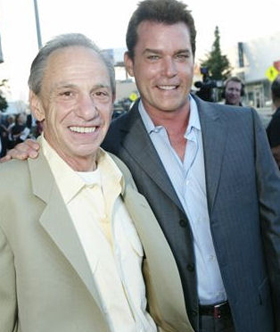
Henry Hill with Goodfellas star Ray Liotta
Finally, Henry Hill has died. He was the “wise guy” who was the inspiration for Martin Scorcese’s “Goodfellas.” Hill was only 69, and died from health problems related to smoking.
Henry Hill, the infamous mob informant whose life of crime was chronicled in the film classic “GoodFellas,” was the first to admit that he did “a lot of bad things back then.”
“I shot at people. I busted a lot of heads, and I buried a lot of bodies,” he told the London-based Daily Telegraph in 2010. “You can try to justify it by saying they deserved it, that they had it coming, but some just got whacked for absolutely no reason at all.”
….
Henry Hill, the infamous mob informant whose life of crime was chronicled in the film classic “GoodFellas,” was the first to admit that he did “a lot of bad things back then.”
“I shot at people. I busted a lot of heads, and I buried a lot of bodies,” he told the London-based Daily Telegraph in 2010. “You can try to justify it by saying they deserved it, that they had it coming, but some just got whacked for absolutely no reason at all.”
RIP, Henry.
Have a fabulous Saturday, and if you’re reading anything interesting today, please share!
Monday Reads: Can we get back to real Economics now?
Posted: May 7, 2012 Filed under: Austerity, Economy, Elections, morning reads | Tags: Austerity Econmics, French Elections, Greek Elections, Paul Krugman, Remaking Capitalism, Robert Reich 40 Comments Good Morning!
It certainly has been a tough few years for reasonable people. We’ve had to endure a repeat of the same old things that didn’t end the Great Depression the first time remixed and put into failed policies in both Europe and the U.S.
The very act of believing something doesn’t make it real or true. Yet, a group of so-called conservatives have been recently led by blind faith in tropes and canards. They followed all the failed policies instead of what we’ve learned that works when dealing with market economies and their cycles over the last 100 years.
It seems voters in a lot of countries are waking up and voting out all those second comings of Herbert Hoover. Austerity economics hasn’t worked for the majority of us.
Paul Krugman has been outspoken about the wrong thinking that’s contaminated the political class here and Europe. There appears to be a group of people out there determined to un-write the history of the 1920s and 1930s. His new book tries to outline what we’ve known since the Roosevelt years and why the plans foisted on us by so-called conservatives were bound to fail. I have no idea why discredited economic thoughts were brought back into vogue by the banking classes, the investment classes, and pushers of bad pulp fiction narratives like Paul Ryan and his slavish Randian/Austrian ideology. Why do modern politicians pick up the economic version of flat-earth geology and then expect the economic equivalent of a successful launch of a rocket to Mars?
The Austerian desire to slash government spending and reduce deficits even in the face of a depressed economy may be wrongheaded; indeed, my view is that it’s deeply destructive. Still, it’s not too hard to understand, since sustained deficits can be a real problem. The urge to raise interest rates is harder to understand. In fact, I was quite shocked when the OECD called for rate hikes in May 2010, and it still seems to me to be a remarkable and strange call.
Why raise rates when the economy is deeply depressed and there seems to be little risk of inflation? The explanations keep shifting.Back in 2010, when the OECD called for big rate increases, it did an odd thing: it contradicted its own economic forecast. That forecast, based on its models, showed low inflation and high unemployment for years to come. But financial markets, which were more optimistic at the time (they changed their mind later), were implicitly predicting some rise in inflation. The predicted inflation rates were still low by historical standards, but the OECD seized on the rise in predicted inflation to justify a call for tighter money.
By spring 2011, a spike in commodity prices had led to a rise in actual inflation, and the European Central Bank cited that rise as a reason to raise interest rates. That may sound reasonable, except for two things. First, it was quite obvious in the data that this was a temporary event driven by events outside of Europe, that there had been little change in underlying inflation, and that the rise in headline inflation was likely to reverse itself in the near future, as indeed it did. Second, the ECB famously overreacted to a temporary, commodity-driven bump in inflation back in 2008, raising interest rates just as the world economy was plunging into recession. Surely it wouldn’t make exactly the same mistake just a few years later? But it did.
Why did the ECB act with such wrongheaded determination? The answer, I suspect, is that in the world of finance there was a general dislike of low interest rates that had nothing to do with inflation fears; inflation fears were invoked largely to support this preexisting desire to see interest rates rise.
The Europeans have had it with the nonsense. They’ve watched their economies and jobs be drained by bankers drunk on casino style betting in financial markets that pass their chits to taxpayers. The first major European leader–Nicholas Sarkozy–has been replaced. Will the French be able to put the out-of-control financial sector back into its proper place?
Mr Hollande – the first Socialist to win the French presidency since Francois Mitterrand in the 1980s – gave his victory speech in his stronghold of Tulle in central France.
He said was “proud to have been capable of giving people hope again”.
He said he would push ahead with his pledge to refocus EU fiscal efforts from austerity to “growth”.
“Europe is watching us, austerity can no longer be the only option,” he said.
After his speech in Tulle, Mr Hollande headed to Brive airport on his way to Paris to address supporters at Place de la Bastille. His voice hoarse, he spoke of his pride at taking over the mantle of the presidency 31 years almost to the day since Socialist predecessor Francois Mitterrand was elected.
“I am the president of the youth of France,” he told the assembled crowd of tens of thousands of supporters, emphasising his “pride at being president of all the republic’s citizens”. “You are a movement that is rising up throughout Europe,” he said.
Mr Hollande has called for a renegotiation of a hard-won European treaty on budget discipline championed by German Chancellor Angela Merkel and Mr Sarkozy.
Robert Reich writes that this is a chance to reform capitalism. It is highly unlikely that France will move to make public any private assets. What it will do is turn its economic future to what works for growth for a country and not the enrichment of the wealthy and powerful few. Financial Markets should not be turned into gambling casinos via government engineering.
During the Depression decade of the 1930s, the nation reorganized itself so that the gains from growth were far more broadly distributed. The National Labor Relations Act of 1935 recognized unions’ rights to collectively bargain, and imposed a duty on employers to bargain in good faith. By the 1950s, a third of all workers in the United States were unionized, giving them the power to demand some of the gains from growth. Meanwhile, Social Security, unemployment insurance, and worker’s compensation spread a broad safety net. The forty-hour workweek with time-and-a-half for overtime also helped share the work and spread the gains, as did a minimum wage. In 1965, Medicare and Medicaid broadened access to health care. And a progressive income tax, reaching well over 70 percent on the highest incomes, also helped ensure that the gains were spread fairly.
This time, though, the nation has taken no similar steps. Quite the contrary: A resurgent right insists on even more tax breaks for corporations and the rich, massive cuts in public spending that will destroy what’s left of our safety nets, including Social Security and Medicare and Medicaid, fewer rights for organized labor, more deregulation of labor markets, and a lower (or no) minimum wage.
This is, quite simply, nuts.
Krugman reminds us that Spain was a prudent and financially responsible government prior to the speculative mortgage bubble brought on by banks. It did them no good in their current downturn.
For this is really, really not about fiscal irresponsibility. Just as a reminder, on the eve of the crisis Spain seemed to be a fiscal paragon:
What happened to Spain was a housing bubble — fueled, to an important degree, by lending from German banks — that burst, taking the economy down with it. Now the country has 23.6 percent unemployment, 50.5 percent among the young.And the policy response is supposed to be even more austerity, with the European Central Bank, natch, obsessing over inflation — and officials claiming that the incredibly foolish rate hike last year was actually something to be proud of.

Greece too has voted against the Austerity Agenda.
Alexis Tsipras became the surprise package of the Greek election by telling Angela Merkel to get lost.
“The people of Europe can no longer be reconciled with the bailouts of barbarism,” Tsipras, 37, said on state-run NET TV late yesterday after his Syriza party unexpectedly came second in the country’s election. “European leaders, and especially Ms. Merkel, should realize that her policies have undergone a crushing defeat.”Tsipras’s calls to tax the rich, delay debt repayments and cut defense spending struck a chord with voters angry at austerity measures imposed by the European Union and the International Monetary Fund in return for bailouts. As far as euro membership is concerned, Tsipras told voters that a Greek exit would put the currency itself in jeopardy and they shouldn’t feel “blackmailed” into more austerity.
The result put Syriza ahead of the Socialist Pasok party, potentially derailing efforts to implement the terms of the country’s financial lifeline. Syriza, which means Coalition of the Radical Left, won 16 percent of the vote, projections showed. That exceeded the 13 percent won by Pasok, one of the two pillars of the political establishment since 1974. New Democracy, led by Antonis Samaras, topped the poll with 20 percent.
Rachel Maddow borrows some analysis from Ezra Klein to show how the UK has been tanking its own economy with its austerity agenda and how closely our own problems resemble the UK government induced recession.
Once President Obama took office and the Recovery Act/stimulus began putting capital back into the economy, the U.S. economy began growing again. In the U.K., the economy started to improve, right up until British officials began implementing an austerity agenda — at which point the national economy stagnated and slipped back into a recession.
Obama rejected austerity, and as a result, American growth, while fragile and insufficient, is easily outpacing Europe’s and UK’s, where austerity measures have ruled the day.
Americans should care about this, if for no other reason because of interconnectivity of the modern global economy. But there’s also a purely political perspective to keep in mind: namely, the problem of Republican predictions.
In short, American conservatives got everything backwards. When Obama’s policies began, Republicans said they wouldn’t generate economic growth, but GOP officials got it backwards. When David Cameron’s austerity policies began, Republicans were not only certain they would work, they pleaded with American policymakers to follow the Tories’ lead.
And we now know GOP officials had this backwards, too.
The remarkable thing is, Republicans aren’t the least bit chastened by their track record of failure.
They said Clinton’s economic policies would fail miserably, but that’s not what happened. They said Bush’s economic policies would produce extraordinary prosperity, but that’s not what happened. They said Obama’s economic policies would make the Great Recession worse, but that’s not what happened. They said Cameron’s economic policies in the U.K. would work brilliantly, but that’s not what happened.
And now these same Republicans are saying they deserve Americans’ votes in 2012 because they have credibility on the economy.
Here’s one last Krugman analysis of what the austerity agenda has done in the U.S. Private employment has recovered to pre-recession levels. That’s not true for public employment.
Here’s a comparison of changes in government employment (federal, state, and local) during the first four years of three presidents who came to office amid a troubled economy:
That spike early on is Census hiring; once that was past, the Obama years shaped up as an era of huge cuts in public employment compared with previous experience. If public employment had grown the way it did under Bush, we’d have 1.3 million more government workers, and probably an unemployment rate of 7 percent or less.

Here’s evidence that Obama is not growing the public sector as Mittens claims. These numbers represent thousands of teachers, health workers, scientists, highway workers. and public safety officials.
AMERICANS have watched austerity sweep Europe with a certain Schadenfreude. But eight months from now they may get a dose of the same medicine. The political compromises that have produced much of America’s deficit of 8% of GDP are programmed to go into reverse at the end of the year, two months after the election. A stimulus package consisting of a payroll-tax cut, investment tax credit and enhanced unemployment insurance expires then, as do George W. Bush’s tax cuts (which have already been extended by two years from their original end-date of 2010). At the same time an automatic, across-the-board cut in domestic and defence spending, called a “sequester”, takes effect, cutting about $100 billion from government spending next year.
The economic impact of this fiscal cliff is a matter of some debate. The Congressional Budget Office reckons that the combined effects of the sequester and the expiring tax cuts would add up to 3.6% of GDP in fiscal 2013. But David Greenlaw of Morgan Stanley, which puts the total effect at almost $700 billion at an annual rate, argues that the calendar-year impact is much larger, at around 5%. Others think the effect would be smaller, noting that some people will not experience the full tax hit until they file their returns in 2014.
Even the lower estimates could easily be enough to tip the economy back into recession.
These tax cuts have not been as successful as other forms of fiscal policy might have been. However, austerity measures taken in many states has been somewhat offset by these Federal Policies. It will be interesting to see how long the economy will hold out under current conditions if and when these things expire. It’s simply been a mind boggling process to watch so many countries unleash unregulated financial innovations and low interests rates then bail out for the financial sector after its bets went bad. It’s been even worse to watch the victims of this excess be forced to pay for the results of government supported speculative bubbles. I’m wondering exactly what the results of these elections will bring to Europe and how our own electorate will act in the fall.
So, I depressed you with a lot of dismal science stuff today. What’s on your reading and blogging list?
Thursday Evening News Wrapup
Posted: April 5, 2012 Filed under: 2012 presidential campaign, abortion rights, Austerity, Barack Obama, Corporate Crime, corruption, Domestic terrorism, fetus fetishists, Hillary Clinton, Medicaid, Medicare, Mitt Romney, Newt Gingrich, Planned Parenthood, SCOTUS, SDB Evening News Reads, Social Security, the villagers, Women's Healthcare | Tags: Affordable Care Act, Augusta Golf Club, Greece, Jamie Dimon, JP Morgan Chase, Judicial Activism, judicial restraint, Lizzie Borden, Masters Tournament, murder, Supreme Court 27 Comments
Afternoon Tea, by Mary Cassat
Good Evening! I’ll start off with some good news. Minkoff Minx has arrived home from the hospital and is doing well. She’ll be resting for I a few days, but she should be back to posting regularly sometime next week. I sure do miss her cheery evening reads! I’m doing my best to fill in again tonight.
It’s been a slow news day, but there are a few things happening even though most of Washington, DC–including Congress and many pundits are on a two-week Easter vacay. Why do they get such long vacations anyway? They only work about three days a week and they accomplish very little.
President Obama has waked up to the reality of women’s electoral power. Today we learned that he thinks it’s high time that Augusta Golf Club, which hosts the Masters Tournament, should start accepting women members.
Not to be outdone, and because he obviously has no original thoughts, Mitt Romney announced that he, too, And he discussed the issue in his usual stuffy manner.
When asked if women should be admitted, the Republican presidential frontrunner responded: “Of course.”
“I am not a member of Augusta. I don’t know if I would qualify. My golf game is not that good,” Romney told reporters after an energy-themed event in Tunkhannock, Pennsylvania. “Certainly if I were a member, if I could run Augusta, which isn’t likely to happen, of course I’d have women into Augusta.”
Newt Gingrich thinks his wife Callista would be “great member,” and Callista herself tweeted that she “wants in.” No word on how he-man woman-hater Rick Santorum feels about the issue.
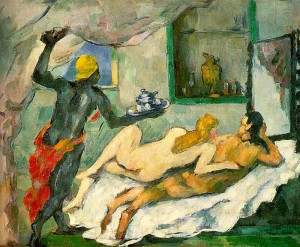
Afternoon Tea, by Cezanne
It’s looking like Romney has the Republican nomination all sewn up–he’s even leading in Santorum’s home state of Pennsylvania now. But at the Daily Beast, Michelle Goldberg explains why conservatives still want Santorum to stay in the race.
Conservative Iowa radio host Steve Deace isn’t convinced. “In the minds of social conservatives, it’s not even close to over,” he says. “The real question is how committed someone like Rick Santorum is to fighting this out all the way to the end. If he’s committed to doing this on a personal level, there’s plenty of social conservatives that will ride him to the finish line.”
Indeed, despite the best efforts of the Republican establishment, many on the religious right are far from ready to accept Romney’s inevitability, or to coalesce behind him. They remain distrustful of his record on abortion, and unsure they can believe his campaign promises. And the harder party elites push Romney on them, the more alienated they become. “The biggest story that everyone in the media has missed this cycle is how frustrated and fed up the Republican Party base is with the Republican Party,” says Deace. “It’s unlike anything I’ve ever seen.”
Goldberg quotes a number of conservative sources who just won’t accept a Romney candidacy and think Santorum to fight to the bitter end at the convention. They sound a lot like Hillary supporters who in 2008 wanted her to take the fight to the convention. Hillary is a loyal Democrat and so she ended up going with the flow, but Santorum is more of a renegade with a lot less to lose than Hillary. In any case, it seems as if the bases of both corporate parties are disgusted with their party elites.

Afternoon Tea Party, by Mary Cassatt
Also at the Daily Beast, Michael Tomasky writes that the Supreme Court is “on the ropes.” Back in the ’80s, Conservative starting pushing for “judicial restraint.” But now that the shoe is on the other foot and there is a Conservative majority on the court, suddenly they love the notion of “judicial activism” that they once reviled (just like they now despise the Heritage Foundaton health care plan now that Democrats have written it into law).
John Roberts has to know and see all this. He has to know that Fifth Circuit Judge Jerry Smith, who asked federal prosecutors for a homework assignment in the wake of Obama’s remarks—a brief stating the Justice Department’s position on judicial review, that had to be at least three pages, single-spaced!—is making conservatives look silly and cheapening the bench. And he has to know that the court’s reputation will suffer an immense blow if it overturns the mandate. It will be seen by a large majority—even a lot of people who weren’t crazy about the law—as completely political. Remember, they didn’t have to take the case in an election year in the first place. They could have put it off. But the court said it must do this now. If it then overturns the ACA, it will look and smell like a political hit job to many Americans. And the court would be saying to America, “We know what you think, and we don’t give a damn.”
What would happen to the court then? Slowly—no; probably quickly—it will come to be seen by most Americans as just another cesspool of political mud wrestling; just another arena where the rich get what they want while everyone else gets screwed (Citizens United); just one more ideological whorehouse full of patrons pretending to be just the piano player.
Despite what we’re all brought up to believe, nothing about the court is sacrosanct. Lifetime appointments can be changed to fixed-year terms. It’d take some doing, but it can be done. And there’s nothing anywhere that says it has to be nine justices. That’s just tradition, but it’s nowhere in the Constitution. It just needs to be an odd number; could be three or 23. For that matter, Congress could disregard Marbury v. Madison. Yep. It could. Tom DeLay used to speak of this from time to time, back in the dear old Terri Schiavo days. He never specifically invoked M v. M, but, referring to judges who would have let Schiavo die, he said things like they had “thumbed their noses at Congress and the president” and would someday pay. He meant a campaign against judicial review. He never got around to it, having been indicted and convicted and all, but that’s what he meant. There’s nothing to prevent liberals from mounting a similar campaign. So far they’ve has held back by their respect for the institution. But that may soon be gone.

There is a heartbreaking story out of Greece: Pensioner’s Suicide Continues to Shake Greece.
Dimitris Christoulas, a divorced and retired pharmacist, took his life on Wednesday in Syntagma Square, a focal point for frequent public demonstrations and protests, as hundreds of commuters passed nearby at a metro station and as lawmakers in Parliament debated last-minute budget amendments before elections, expected on May 6.
In a handwritten note found near the scene, the pensioner said he could not face the prospect “of scavenging through garbage bins for food and becoming a burden to my child,” blaming the government’s austerity policies for his decision.
The incident has prompted a public outpouring, with passers-by pinning notes of sympathy and protest to trees in the square, as well as comment from politicians across the spectrum. A solidarity rally on Wednesday night turned violent when the police clashed with hooded demonstrators in scuffles that left at least three people injured.
I guess we can look forward to similar tragedies here in the U.S. if Congress succeeds in gutting Medicare, Medicaid, and Social Security. And I don’t exempt the Democrats from my cynicism about support for the social safety net among the Villagers.
Speaking of the rich, powerful, and selfish, Jamie Dimon is once again on the top of the heap in terms of CEO compensation. Richard Escrow writes:
JPMorgan Chase CEO Jamie Dimon is still the poster child for today’s morally degraded, self-entitled banker mentality. I don’t know why he keeps talking, but he’s the gift that keeps on giving.
At every major junction in the post-crisis debate about banking, Dimon has stepped in with a perfectly tactless remark that illustrates both the vacuity and the moral corruption of his industry. This week was no exception.
Excrow provides a number of specific examples of Dimon’s and Chase’s lack of ethics. And yet, Dimon is still whining about “excessive” government regulation.
Dimon just complained that regulators “made the recovery worse than it otherwise would have been” — which is not only wrong, but avoids addressing the issue of the recovery’s cause, which was banks like Dimon’s. Dimon added that the government forced banks to de-leverage “”at precisely the wrong time” — which is precisely wrong. The government’s real error was in not breaking up too-big-to-fail banks like Dimon’s.
“Complexity and confusion should have been alleviated, not compounded,” complains Dimon.
So Dimon and his cronies have formed a superpac to intimidate liberal Congresspeople. Please go read the whole article. It’s really frightening.
The domestic terrorist who tried unsuccessfully to blow up a Planned Parenthood office in Wisconsin has explained his motivation.
Francis Grady, 50, spoke to reporters who were covering his first appearance in federal court since the Sunday night attack. The Green Bay Press-Gazette posted video of him walking through the courthouse followed by a short clip of him speaking to reporters outside.
“There was no bomb,” Grady said. “It was gasoline.”
A reporter asked why Grady attacked the clinic.
“Because they’re killing babies there,” he responded.
The newspaper also got more from inside the federal courtroom, where Grady reportedly interrupted the judge to ask, ““Do you even care at all about the 1,000 babies that died screaming?”
“Screaming?” Fetuses that are aborted in the first trimester aren’t “babies,” and they don’t have nervous systems to feel pain or the ability to scream. The ignorance of these people is beyond belief.
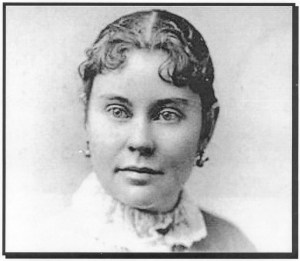
Lizzie Borden
Finally, some new evidence has been found in the Lizzie Borden murder case–journals kept by her attorney.
Borden was acquitted in 1892, and much of the evidence in the case ended up with Andrew Jackson Jennings, Borden’s attorney. The two journals, which Jennings stored in a Victorian bathtub along with other evidence from the case, including the infamous “handless hatchet,” were left to the Fall River Historical Society by Jennings’ grandson, who died last year.
The society received the fragile journals about a month ago but won’t be exhibited until they are properly preserved, curator Michael Martins said.
Each journal is about 100 pages. One contains a series of newspaper clippings, indexed using a lettering and number system that Jennings devised. The second contains personal notes that Jennings assembled from interviews he conducted. Some of the individuals interviewed are people mentioned in the newspaper clippings Jennings retained.
“A number of the people Jennings spoke to were people he knew intimately, on a social or business level, so many of them were perhaps more candid with him than they would have been otherwise,” Martins said. “But it’s also evident that there are a number of new individuals he spoke to who had previously not been connected with the case.”
I hope at least some of those links will pique your interest. What stories have you been following this afternoon and evening?

 peej
peej Carissa
 bostonboomer
 dakinikat
 ecocatwoman
 mablue2
 Mama Lopez
 peggysue22
 quixote
 skydancingguestblogger
 Mona (aka Wonk the Vote)



 Sky Dancing
Recent Comments