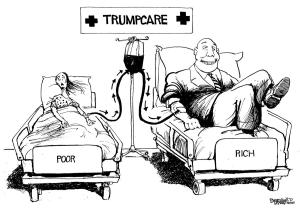
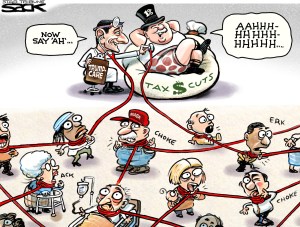
As many have noted, the GOP’s plan to “repeal and replace” Obamacare will hit Trump voters hardest. It’s no mystery as to why. As the New York Times explained, “The Republican plan offers less assistance to older and lower income Americans, especially in rural areas.” Due to the lack of competition for insurers and health care providers, as the Center on Budget and Policy Priorities (CBPP) documented, 12 of the 15 states hardest hit by the AHCA’s shriveled tax credits are rural ones. Fourteen of the 15 voted for Donald Trump for president in 2016. And with the GOP’s plan to redirect $880 billion in Medicaid spending to tax cuts for the richest Americans, older Americans—especially those near the poverty line—will face catastrophic increases in premiums, rendering health insurance an impossible acquisition:
Older, sicker people will be priced out of the market altogether.
The millions losing Medicaid under the GOP plan would be unable to buy their own under the AHCA.
(It should be noted that these effects won’t be limited to those obtaining insurance through the individual or non-group market. As the Wall Street Journal (“GOP Health Bill Jeopardizes Out-of-Pocket Caps in Employer Plans”) and the Brookings Institution warned, “Allowing states to define ‘essential health benefits’ could weaken ACA protections against catastrophic costs for people with employer coverage nationwide.”)
Now, it should be said that the version of the AHCA Senate Republicans are contemplating may not be as disastrous as the draconian House bill. It is rumored that the phase-out of the Medicaid expansion may be extended to seven years. While maintaining the ability for states to waive Obamacare’s list of essential health benefits, a Senate bill may limit insurers ability to charge more to those with pre-existing conditions who let their coverage lapse. Regardless, Senate Majority Leader Mitch McConnell is committed to getting a vote on the GOP’s Obamacare replacement bill before the August recess. As for Donald Trump, he’s “all in.”
Continue reading the analysis by Jon Perr at his DKOS Diary. He’s included a pretty decent round up of analysis from a variety of good sources.
Sarah Kliff–writing for Vox–believes that Obamacare is in ‘real danger’ from the Republican Senate led by Creepy Turtle Man. McConnell has been working on all the angles and rules that could create a health crisis for years ahead. As I mentioned on Friday, he’s severely limited discussion, not allowing modification, keeping the bill under wraps, and plans to force it through with the VEEP giving it 50 vote. This on top of all the people that basically hate the idea of it all. What will their constituents do next year?
Behind closed doors, Senate Republicans have worked out a path toward Obamacare repeal. The plans under discussion would end Medicaid expansion, causing millions of low-income Americans to lose health coverage. They may allow health insurance plans to charge higher premiums to people with preexisting conditions, too.
In other words: The emerging bill looks a whole lot like the unpopular bill the House passed last month. It creates the same group of winners (high-income, healthier people) and the same group of losers (low-income, sicker people).
The Republican plan is coming together because moderate senators are beginning to drop some of their initial repeal objections. Sens. Rob Portman (R-OH) and Shelley Moore Capito (R-WV), for example, now back a plan to end the Medicaid expansion.
Both were ardent critics of the House bill’s deep Medicaid cuts, which would cause 14 million Americans who rely on the public program to lose coverage. Portman put out a harsh statement the day the House passed its health care bill.
“I’ve already made clear that I don’t support the House bill as currently constructed because I continue to have concerns that this bill does not do enough to protect Ohio’s Medicaid expansion population,” Portman said plainly.
But now Portman has endorsed a plan to phase out the Medicaid expansion entirely, just to do so on a longer timeline than the House bill. Portman and Moore Capito want a seven-year phase out, rather than the House bill’s three-year off-ramp.
At the end of the day, though, phasing out Medicaid expansion over seven years has the same effect as three years: You end coverage for millions of low-income Americans.
There are still major issues that divide Senate Republicans on repeal. There is disagreement, for example, over how much to cut the Medicaid program and what kind of subsidies to give people in the private market. But the fact that Republicans are coalescing around ending Medicaid expansion — once thought to be a major sticking point — suggests the path to repeal may be easier to find than initial expectations.
Senate Republicans are on track to finish writing their draft health care bill this evening, but have no plans to publicly release the bill, according to two senior Senate GOP aides.
“We aren’t stupid,” said one of the aides. One issue is that Senate Republicans plan to keep talking about it after the draft is done: “We are still in discussions about what will be in the final product so it is premature to release any draft absent further member conversations and consensus.”
Why it matters: Democratic senators are already slamming Republicans for the secrecy of their bill writing process, and this isn’t going to help. Republicans are sure to release the bill at some point, but it’s unclear when — and they want to vote on it in the next three weeks, before the July 4 recess.
What to watch: When the bill is finished, it’ll be sent to the Congressional Budget Office. It’ll take CBO about two weeks to evaluate and score a draft bill. Senate Republicans then want to vote on the bill before the July 4th recess. “Conversations with CBO continue” but there are no new announcements about timing, said Don Stewart, a spokesman for Majority Leader Mitch McConnell, when asked about these plans.
You know it’s pure evil since Lucifer is trying on a new hat. Ted Cruz as Dealmaker? Seriously?
Cruz has been working to pass a health-care bill for several months. He set up a working group of conservatives and moderates, starting with Tennessee Senator Lamar Alexander, which later expanded to include party leaders. They met once a week for two months in Cruz’s conference room without the press catching wind of it — a point of pride for Cruz.
“The week after the election I brought my staff together,” he said, and told them they had a new mission. For the past four years, he told them, they had been fighting “a president with a radical agenda” and had focused on stopping bad things from happening as the loyal opposition.
Republicans are growing increasingly worried that they will lose the House of Representatives. The pervasive pessimism comes as there continues to be a dearth of legislative victories, and a toxic political environment that appears to be worsening. Of course, the midterm elections are nearly a year and a half away. But more than a dozen Republicans we’ve spoken to in the last few weeks say the prospect for political and legislative wins big and small is dimming. And as much as President Donald Trump has worked to woo over fellow Republicans with dinners at the White House and regular meetings with GOP leadership, it hasn’t had much of an impact on the overall state of play.
THE RANK AND FILE has been frustrated with the House committees, which have not produced a drumbeat of legislation to tout as victories. And the party is deeply split on health-care reform, a tax overhaul and infrastructure spending. Passing a budget to set the groundwork for tax reform is still seen as far off. And the congressional schedule doesn’t leave a lot of time to kick things into high gear. The House is in session for 13 more days and the Senate is in session for 14 more days before the July 4 recess. Not to mention, there’s serious concern in the GOP that there could be more revelations about President Donald Trump, and Robert Mueller’s investigation still remains the wild card. Attorney General Jeff Sessions testifying Tuesday before the Senate Intel Committee is expected to just add more drama to distract from the GOP agenda into the mix.
WHAT DOES ALL THIS MEAN? Republicans will be less willing to take risks as they shift into political survival mode.
Attorney General Jeff Sessions’ letter on Saturday offering to testify before the Senate intelligence committee on Tuesday caught members of the panel by surprise, and senators are concerned he’s trying to avoid testifying publicly, a source familiar with the situation says.
The committee has not confirmed the Tuesday date for Sessions’ testimony and are still discussing whether to allow him to testify in open or closed session, or both, as former FBI Director James Comey did last week.
A number of members are concerned Sessions may be attempting to avoid testifying in public by scrapping his previously scheduled Senate and House Appropriations appearances this week, where he was expected to be grilled on issues related to the federal investigation into Russia’s efforts to influence the US election, several sources say. Sen. Mark Warner of Virginia, the vice chairman of the panel, is among those concerned, a source says.
Ed Wexler / politicalcartoons.com
One final note on Trump which always leads me to a good hot shower to get off the scummy feeling that Orange Swamp Thing eminates. Check out this WAPO headline: ‘D.C. and Maryland sue President Trump, alleging breach of constitutional oath’.
Attorneys general for the District of Columbia and the state of Maryland sued President Trump on Monday, alleging that he has violated anti-corruption clauses in the Constitution by accepting millions in payments and benefits from foreign governments since moving into the White House.
The lawsuit, the first of its kind brought by government entities, centers on the fact that Trump chose to retain ownership of his company when he became president. Trump said in January that he was shifting his business assets into a trust managed by his sons to eliminate potential conflicts of interests.
But D.C. Attorney General Karl A. Racine (D) and Maryland Attorney General Brian E. Frosh (D) say Trump has broken many promises to keep separate his public duties and private business interests. For one, his son Eric Trump has said the president would continue to receive regular updates about his company’s financial health.
The lawsuit, a signed copy of which Racine and Frosh provided to The Washington Post on Sunday night, alleges “unprecedented constitutional violations” by Trump. The suit says Trump’s continued ownership of a global business empire has rendered the president “deeply enmeshed with a legion of foreign and domestic government actors” and has undermined the integrity of the U.S. political system.
It’s like Trump’s the clown that runs around in circles trying to keep you from noticing the circus beats the elephants, starves the big cats, and lets the women fall out of sequin costumes as they spin to their deaths from badly serviced equipment.
So, that’s the bad news for this morning. I’m sure more is on its way. After all, we have Republicans and that means greed and bad ideas abound!
What’s on your reading and blogging list today?
Did you like this post? Please share it with your friends:
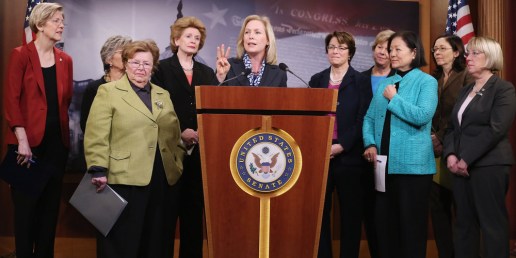
WASHINGTON, DC – JANUARY 30: Women Democratic senators (L-R) U.S. Sen. Elizabeth Warren (D-MA), U.S. Sen. Barbara Boxer (D-CA), U.S. Sen. Barbara Mikulski (D-MD), U.S. Sen. Debbie Stabenow (D-MI), U.S. Sen. Kirsten Gillibrand (D-NY), U.S. Sen. Amy Klobuchar (D-MN), U.S. Sen. Tammy Baldwin (D-WI), U.S. Sen. Mazie Hirono (D-HI), U.S. Sen. Maria Cantwell (D-WA) and U.S. Sen. Patty Murray (D-WA) hold a news conference to announce their support for raising the minimum wage to $10.10 at the U.S. Capitol January 30, 2014 in Washington, DC. Thirteen of the 16 Democratic women senators made appearances during the news conference. (Photo by Chip Somodevilla/Getty Images)
Good Afternoon!
Well, the thing from the Orange Swamp has been sucking all oxygen and energy available to Mother Earth and then some. Women Senators and Representatives have been leading the battle to ensure the entire justice thing is done. Last week the hearings in the Senate were exciting but the focus there let Mitchie and Paulie find ways to circumvent democracy with very little notice or coverage.
I got hit yesterday with weird ass flu and I’m exhausted after spending the day in bed fighting dizziness and stomach ickiness. I wanted to talk about some of the absolutely sneaky shit going on in the House and Senate as the Republicans rush to cram absolutely bad, unpopular, self-serving laws through both houses using arcane rules and your basic slight of hand. They’re trying to rush through the absolutely cringe-inducing, people killing, death panel empowering Unafforadble Health care replacement to the ACA.
They’re also rushing to rid the country of financial regulations again by repealing Dodd Frank. What an economist’s nightmare! These hearings are shocking and important but look what’s going on behind the show tent.
So Comey told Jeff Sessions he didn't want to be alone with Trump. Women across the country can relate.
The House of Representatives passed sweeping legislation Thursday that would strip and replace much of the financial regulations passed under President Obama after the 2008 financial crisis.
Don’t expect the measure to become law, though. It’s not expected to pass in the Senate.
The House passed the Financial CHOICE Act on a party line vote, 233 to 186.
Sponsored by House Financial Services Committee Chairman Jeb Hensarling (R-Texas), the CHOICE Act is the most ambitious Republican effort to roll back the Dodd-Frank Wall Street Reform and Consumer Protection Act, passed in 2010.
It has a completely Orwellian name too. It’s called the Financial Creating Hope and Opportunity for Investors, Consumers and Entrepreneurs (CHOICE) Act, 233-186. The bill passed strictly along party lines and is not expected to pass the Senate.
Democrats have fiercely defended Dodd-Frank. They say the bill has held Wall Street accountable for the risky investment practices that caused the crisis and protected Americans from predatory lending and abusive financial firms.
“It’s shameful that Republicans have voted to do the bidding of Wall Street at the expense of Main Street and our economy,” said Rep. Maxine Waters (Calif.), the ranking Democrat on the Financial Services Committee. “They are setting the stage for Wall Street to run amok and cause another financial crisis. I urge my colleagues in the Senate not to move on this deeply harmful bill.”
The CHOICE Act would roll back much of the Dodd-Frank regulations long targeted by Republicans. It would allow banks that reach certain cash thresholds an off-ramp from Dodd-Frank, reduce the frequency of federal stress tests and restrain oversight powers of several federal agencies that the 2010 law expanded.
Hensarling’s bill would also eliminate orderly liquidation authority — the process through which the federal government takes over and dismantles a major bank before it collapses — and place strict limits on the Consumer Financial Protection Bureau (CFPB).
The CHOICE Act would turn the CFPB, which Republicans consider abusive and unaccountable, into the Consumer Law Enforcement Agency. It would no longer control its own budget, its director would be appointed by the president, and it would lose its authority to crack down on “unfair, abusive and deceptive practices.”
Speaker Paul Ryan (R-Wis.) and GOP leaders touted the bill in the weeks before Thursday’s vote. Ryan, a longtime Hensarling ally who served with him on the House Budget Committee, on Wednesday called the CHOICE Act “the crown jewel” of the GOP deregulation agenda.
“This legislation comes to the rescue of Main Street America,” Ryan said Wednesday. “The Financial CHOICE Act makes it possible for small businesses across this country to stop struggling and to start hiring.”
Paul Ryan never seems to get the basic economics lessons that small businesses across the country will not struggle and will hire and expand their business if they have customers that have the basic incomes to afford their products and services. The smallest contribution to National Income is stuff coming from investments. The largest source of funds in this country for business is consumption by households. Turning the national financial services industry back into a gambling establishment with special tax treatment for gamblers who don’t build businesses but speculate on the face value of paper assets isn’t going to help Main Street America.
An update on an earlier development: The Kansas state legislature told Governor Sam Brownback to pound sand, overriding his veto and upholding its decision to roll back the radical supply-side tax cuts that were central to Brownback’s demolition of the state’s economy. From those Socialist Agitators at Forbes:
Brownback vetoed the legislature’s first attempt to reverse his tax cuts, but two-thirds majorities in both the House and Senate overrode his veto. The measure would boost state taxes by $1.2 billion over two years, in part by raising the top income tax rate from 4.6 percent to 5.7 percent and by once again taxing sole proprietorships, partnerships, and other pass-through businesses. Pressured by Brownback, the legislature had made pass-throughs tax free… Since Kansas enacted tax and spending cuts in 2012 and 2013, Brownback and his allies have argued that this fiscal potion would generate an explosion of economic growth. It didn’t. Overall growth and job creation in Kansas underperformed both the national economy and neighboring states. From January, 2014 (after both tax cuts passed) to April, 2017, Kansas gained only 28,000 net new non-farm jobs. By contrast, Nebraska, an economically similar state with a much smaller labor force, saw a net increase of 35,000 jobs.
Tax cuts balloon deficits and do not lead to growth. Period. This economic theory—to which, it should be noted, the administration and the Republican majorities in the Congress strictly adhere—doesn’t work. It is alchemy. It has no basis in empirical reality. Every argument in its favor has been proven by practical experience to be utter moonshine. It failed under Ronald Reagan and it failed under George W. Bush and, in its purest form, it failed disastrously in Kansas. Its proponents should be drummed out of the respectable national dialogue as thoroughly as Alex Jones has been. Supply-side is the chemtrails of political economies.
Kansas’s moderate ascendance may portend problems for Republicans in Washington, where many in the party, including President Trump, are pushing to adopt federal tax policies similar to the ones Brownback has installed in Kansas. But while Brownback had hoped what he called Kansas’s “real-live experiment” in conservative economic policy would become a national model, it has instead become a cautionary example.
It not only killed Kansas. Jindal let it kill Louisiana: ‘Louisiana has second-worst economy in U.S.: report’. Our current lege session was a total clusterfuck as ignorant Republicans continue to swallow the snakeoil that tax cuts pay for themselves. They do have never and will never do that unless your top marginal tax rate is like way north of like 90 percent. Even then, it’s not the dampening impact is just not that big of a deal.Just imagine if this shit goes nationwide on that kind of a scale.
Louisiana’s economy ranks second-worst among U.S. states and the District of Columbia when examining a wide range of indicators, including employment, building permits, government spending and growth in science and tech industries, according to an analysis WalletHub released Monday (June 5).
Louisiana ranked only better than West Virginia in the study; the bottom five also included Mississippi, Arkansas and Oklahoma. Meanwhile, Washington, California, Utah, Massachusetts and the District of Colombia ranked the top five.
WalletHub used data from the U.S. Census Bureau, the bureaus of Labor Statistics and Economic Analysis, United Health Foundation, American Legislative Exchange Council, CoreLogic, the U.S. Patent and Trademark Office and the National Science Foundation, among others.
Louisiana did shine in one category: the state tied with Texas and Washington for most exports per capita.
Yeah, that’s because that damned President Obama turned us into a net oil exporter. Damn you Obama!!! Thankfully, we have a few Democrats in the District who are fighting like hell.
“Nobody can pretend this was a good day for the state of Louisiana,” the governor said. “We now know that the majority of legislators came here determined to fix these problems and to work in a bipartisan way. We now know that it was a minority in the House that prevented that from happening.”
At least some rank-and-file Republicans in the House appeared to agree with the governor.
Republican Rep. Kenny Havard and Democratic Rep. Major Thibaut, both of whom voted to consider the Senate budget proposal, in unison described the special session as “embarrassing” to the Legislature. Republican Rep. Julie Stokes said she was “disgusted.”
“Petty partisan politics have failed the people of the state today, and it’s time that we grow up and work on solving the people’s problems,” said Stokes, who voted to bring up the Senate budget proposal.
House Republican leaders want to spend less than the full state income forecast, as a cushion to avoid midyear cuts in case the predictions were wrong. The Senate, backed by Edwards and House Democrats, want to spend all available dollars, saying otherwise they’d have to make unnecessary, harmful cuts.
The state’s income forecast has been too optimistic every year for nearly a decade.
Senate President John Alario, a Republican, said he was disappointed at the meltdown.
“My hope is that we complete our work in this special session. It’s too darn important for the people of this state. Education, health care, public safety: there are too many things that would get hurt if we didn’t come to a consensus and make it work,” Alario said.
Senator Claire McCaskill joined the ranks of women in leadership given the misogynist treatment for acting like a leader. McCaskill called Shenanigans on the way the Republicans plan to cram TrumpCare into law.
Thursday in a Senate hearing, Americans were finally presented definitive evidence of a plot so nefarious and cunning, it threatens to upend any remaining trust in our democratic institutions. I am referring, of course, to an exchange between Sen. Claire McCaskill and Sen. Orrin Hatch in the Senate Finance Committee on the progress of the Republican health care bill. McCaskill asked Hatch, the chairman, whether the committee would hold hearings on the as-yet-unreleased legislation.
Hatch: Will we?
McCaskill: Yes.
Hatch: I … I think we’ve already had one. But…
McCaskill: No. I mean on the proposal that you’re planning to bring to the floor of the Senate for a vote. Will there be a hearing?
Hatch, searching for a less damning answer than “No,” was silent as a much younger aide—perhaps young enough to be barred constitutionally from holding the seat Hatch is evidently simply keeping warm—sidled up to him and whispered, audibly enough for his microphone, words that Hatch began to repeat almost verbatim.
Aide: …they’re invited to participate in this process and we’re open to their ideas and suggestions.
Hatch: Well, I don’t know that there’s going to be another hearing, but we’ve invited you to participate and give your ideas and…
McCaskill: No! No, that’s not true, Mr. Chairman. Let me just say I watched carefully all of the hearings that went on on the [Affordable Care Act]. I was not a member of this committee at the time, although I would have liked to be. Sen. Grassley was the ranking member. Dozens of Republican amendments were offered and accepted in that hearing process. And when you say that you’re inviting us—and we heard you, Mr. Secretary, just say, “We’d love your support”—for what? We don’t even know. We have no idea what’s being proposed.
McCaskill might not have any idea, but some details have trickled out in recent days on what the bill is shaping up to be. On Tuesday, Jim Newell described the contents of a presentation on the bill-in-progress that had been shown to Senate Republicans:
Like the House bill, the Senate proposal would allow states to waive the Affordable Care Act’s essential health benefit coverage requirements, as well as loosen the ratio of what older people can be charged relative to younger customers. The Senate bill would not, however, allow states to waive community rating by health status, which bars insurers from charging sick people more than healthy ones. The Washington Examiner reported, too, that the Senate was considering allowing the ACA’s Medicaid expansion to linger past the 2020 deadline set forth in the House bill—and that a program to auto-enroll people into coverage against catastrophic losses was still on the table.
The Senate Republicans’ bill thus far, then, includes only modest changes to a set of proposals the Congressional Budget Office has said would lead to 23 million Americans losing their health insurance. That’s the only understanding of the bill we can surmise, since Republicans have taken the process of transforming one-sixth of the American economy—once again—behind closed doors. This secrecy, McCaskill said—in a classic performance of Democratic indignation—was “hard to take.” “You couldn’t have a more partisan exercise than what you’re engaged in right now,” she said, as though Hatch had simply failed to consider this. “Give me an opportunity to work with you.
They will not. The Bipartisan Policy Center’s Andy Slavitt tweeted Tuesday that Senate Majority Leader Mitch McConnell is pushing to have the text of the bill available to the public for no more than two days.
Oddly enough, McConnel’s procedural jujitsu may be blocked by the Parliamentarian. Guess what issues it’s about?
The Senate parliamentarian has warned Republicans that a provision in their healthcare reform bill related to abortion is unlikely to be allowed, raising a serious threat to the legislation.
The parliamentarian, Elizabeth MacDonough, has flagged language that would bar people from using new refundable tax credits for private insurance plans that cover abortion, according to Senate sources.
If Republicans are forced to strip the so-called Hyde Amendment language from the legislation, which essentially bars federal funds from being used to pay for abortions except to save the life of a mother or in cases of rape and incest, it may doom the bill.
MacDonough declined to comment for this article.
Unless a workaround can be found, conservative senators and groups that advocate against abortion rights are likely to oppose the legislation.
Republicans control 52 seats in the Senate; they can afford only two defections and still pass the bill, assuming Democrats are united against it. Vice President Pence would break a 50-50 tie.
Normally, controversial legislation requires 60 votes to pass the Senate, but Republicans hope to pass the ObamaCare repeal-and-replace bill with a simple majority vote under a special budgetary process known as reconciliation.
The catch is that the legislation must pass a six-part test known as the Byrd Rule, and it’s up to the parliamentarian to advise whether legislative provisions meet its requirements.
The toughest requirement states that a provision cannot produce changes in government outlays or revenues that are merely incidental to the nonbudgetary components of the provision.
In other words, a provision passed under reconciliation cannot be primarily oriented toward making policy change instead of affecting the budget. Arguably, attaching Hyde language to the refundable tax credits is designed more to shape abortion policy than affect how much money is spent to subsidize healthcare coverage.
The abortion language that conservatives want in the healthcare bill may run afoul of a precedent set in 1995, when then-Senate Parliamentarian Robert Dove ruled that an abortion provision affecting a state block grant program failed to meet reconciliation requirements, according to a source briefed on internal Senate discussions.
Not a word of what Senator Claire McCaskill, a Democrat, says here is hyperbolic or inaccurate. The reason Senator Orrin Hatch is acting like he’s been caught here is because he has. What Republicans are attempting to do to the health care system is the legislative equivalent of a mugging.
House Democratic leader Nancy Pelosi said President Trump “needs sleep” and questioned his “fitness for office” at a briefing Friday morning. The former Speaker’s statements were made in reference to Trump’s Twitter habits, after he posted one at 6 a.m. The president broke his unusual silence about former FBI Director James Comey’s Thursday testimony, tweeting: “Despite so many false statements and lies, total and complete vindication… and WOW, Comey is a leaker.” Pelosi also said of Trump, “Know your blood type. He will throw you under the bus.” Pelosi added, “I think his statements need some discipline. He needs work.” Comey said Thursday he believes Trump fired him because of the bureau’s investigation into Russia ties to his presidential campaign. On Comey’s testimony, Pelosi said Trump “knew what he was doing and he didn’t want any witnesses” when he asked to speak with Comey alone.
I’ve been absolutely shocked by the attempts at many people in journalism and around the political arena to suggest that either Bernie Sanders or Joe Biden are the likely folks to lead the Democratic Party and run for President when so many young women and men are standing up to the current situation.
There are many standouts.
California Congressman Ted Lieu is an outstanding public servant with a keen mind and a prosecutor’s verbal combat skills.
.@POTUS made 492 false stmts in first 100 days. I can't wait for Trump to testify under oath before trained FBI agents. #TrumpMustTestify
Senator Al Franken is frankly awesome. He’s got an eye for detail, asks damn good questions, and does it with the most wonderful manner that you don’t know you’ve just had your throat cut. His sense of humor serves him well as he dishes out tough questions that show really insight into the problem at hand.
I will oppose this disastrous, backwards bill every step of the way in the Senate, bc I represent MN families & businesses—not Wall Street.
— U.S. Senator Al Franken (@SenFranken) June 9, 2017
And one more shout out to Senator Kamala Harris from California. She’s also got that prosecutor thing going. She’s perfectly aware of what needs to go on the record and that’s a skill we need right now in these committee meetings. She’s also a damn hard fighter and says what needs to be said.
Saving the #ACA will save lives. Take a look back at how insurers used to treat people with preexisting conditions →https://t.co/YUTihU1LI9
I just learned that Dakinikat is under the weather today, so I’m going to pull together some reading material for discussion. Here are some of the stories I’ve been reading today.
Of course there are lots of horrible articles about Trump and his efforts to destroy our country. On of the ways he’s doing that is by encouraging people who like to shoot guns. For that reason, and because it’s such an important story, I want to begin with a long piece at The Washington Post about a school shooting and its after-effects. I’ll post the beginning of the story. Please follow the link to read the rest. It’s powerful and important.
Recess had finally started, so Ava Olsen picked up her chocolate cupcake, then headed outside toward the swings. And that’s when the 7-year-old saw the gun.
It was black and in the hand of someone the first-graders on the playground would later describe as a thin, towering figure with wispy blond hair and angry eyes. Dressed in dark clothes and a baseball cap, he had just driven up in a Dodge Ram, jumping out of the pickup as it rolled into the chain-link fence that surrounded the play area. It was 1:41 on a balmy, blue-sky afternoon in late September, and Ava’s class was just emerging from an open door directly in front of him to join the other kids already outside. At first, a few of them assumed he had come to help with something or say hello.
Then he pulled the trigger.
“I hate my life,” the children heard him scream in the same moment he added Townville Elementary to the long list of American schools redefined by a shooting.
A round struck the shoulder of Ava’s teacher, who was standing at the green metal door, before she yanked it shut. But the shooter kept firing, shattering a glass window.
Near the cubbies inside, 6-year-old Collin Edwards felt his foot vibrate, then burn, as if he had stepped in a fire. A bullet had blown through the inside of his right ankle and popped out beneath his big toe, punching a hole in the sole of his Velcro-strapped sneaker. As his teachers pulled him away from the windows, Collin recalled later, he spotted a puddle of blood spreading across the gray wax tile floor in the hallway. Someone else, he realized, had been hurt, too.
Outside, Ava had dropped her cupcake. The Daisy Scout remembered what her mom had said: If something doesn’t feel right, run. She sprinted toward the far side of the building, rounding a corner to safety. Nowhere in sight, though, was Jacob Hall, the tiny boy with oversize, thick-lensed glasses Ava had decided to marry when they grew up. He had been just a few steps behind her at the door, but she never saw him come out. Ava hoped he was okay.
After reading this heartbreaking story, I want to just forget about our Trumpian nightmare for the rest of the day.
Of course the monster tweeted this morning after taking a long break from his social media addiction. He just can’t quit.
Despite so many false statements and lies, total and complete vindication…and WOW, Comey is a leaker!
President Trump’s declaration that the Thursday testimony of former FBI director James B. Comey was a “total and complete vindication” despite “so many false statements and lies” was the sort of brashly triumphant and loosely-grounded-in-reality statement we’ve come to expect from the commander in chief. It was news that came out a bit later, news about plans to file a complaint against Comey for a revelation he made during that Senate Intelligence Committee hearing meeting, that may end up being more damaging to the president.
CNN and Fox first reported that Trump’s outside counsel, Marc Kasowitz, plans to file complaints with the inspector general of the Justice Department and the Senate Judiciary Committee about Comey’s testimony. At issue was Comey’s revelation that he provided a memo documenting a conversation with Trump to a friend to be shared with the New York Times.
As the news broke, I was on the phone with Stephen Kohn, partner at a law firm focused on whistleblower protection. We’d been talking about where the boundaries lay for Comey in what he could and couldn’t do with the information about his conversations with the president. Kohn’s response to the story about Kasowitz, though, was visceral.
“Here is my position on that: Frivolous grandstanding,” he said. “First of all, I don’t believe the inspector general would have jurisdiction over Comey any more, because he’s no longer a federal employee.” The inspector general’s job is to investigate wrongdoing by employees of the Justice Department, which Comey is no longer, thanks to Trump — though the IG would have the ability to investigate an allegation of criminal misconduct.
“But, second,” he continued, “initiating an investigation because you don’t like somebody’s testimony could be considered obstruction. And in the whistleblower context, it’s both evidence of retaliation and, under some laws, could be an adverse retaliatory act itself.”
After the public testimony of former FBI Director James Comey on Thursday, President Donald Trump’s personal lawyer, Marc Kasowitz, released a statement. In addition to being riddled with typos, it contained a curious legal argument.
Kasowitz contended that Comey broke the law by leaking memos about his private conversations with the president — what the statement called an “unauthorized disclosure of private information.”
The not-so-subtle implication here is that any and every conversation with the president is privileged, and therefore protected under the law. That’s a rather broad interpretation of executive privilege, and one that 10 legal experts disputed in interviews with Vox.
Executive privilege exists for a reason: to protect against the forced disclosures of classified or confidential executive branch communications. But here’s the problem: The conversations between Trump and Comey were not classified. Moreover, because the president himself has publicly referred to the conversations in question, he has already waived any claim for executive privilege. That Comey is now a private citizen also weakens the Kasowitz’s claim that he’s bound to secrecy.
There is, however, little settled law on the question of executive privilege. So I reached out to 10 legal experts and asked them if Kasowitz’s interpretation of executive privilege makes any sense. Every one of them said it doesn’t.
During former FBI Director James Comey’s dramatic testimony before the Senate on Thursday, Republican senators settled on a pair of strange arguments for why President Trump hadn’t obstructed justice: He didn’t try very hard, or he was really bad at it.
Comey testified that the president asked Comey to shut down the FBI investigation into former National-Security Adviser Michael Flynn, who was ousted after lying about his contact with Russian officials, saying, “I hope you can see your way clear to letting this go, to letting Flynn go. He is a good guy. I hope you can let this go.” Comey testified that he took that statement as “direction.” Republicans weren’t convinced.
“Do you know of any case where a person has been charged for obstruction of justice or, for that matter, any other criminal offense, where they said or thought they hoped for an outcome?” Idaho Republican Jim Risch asked. Comey said he did not, but New York Times legal reporter Adam Liptak quickly found one such example.
Senator James Lankford of Oklahoma took a similar tack. “If this seems to be something the president is trying to get you to drop it,” Lankford said, “it seems like a light touch to drop it, to bring it up at that point, the day after he had just fired Flynn, to come back here and say, I hope we can let this go, then it never reappears again.”
Texas Senator John Cornyn, the number two Republican in the Senate, suggested that firing Comey after not shutting down the Flynn investigation proved Trump wasn’t trying to shut it down. “As a general proposition, if you’re trying to make an investigation go away, is firing an FBI director a good way to make that happen?” Cornyn asked Comey, who replied that “It doesn’t make a lot of sense to me but I’m hopelessly biased given that I was the one fired.”
David Gomez, a senior fellow at George Washington University’s Center for Cyber and Homeland Security and a former FBI agent, said he didn’t find that line of argument persuasive. “I failed to follow Cornyn’s logic. Especially given the public reasons for the firing,” Gomez said. “Firing the man in charge of the FBI—and replacing him with your own man—is exactly what I would expect if you were trying to impede an FBI investigation.”
Republican are at great pains to make excuses for Trump’s behavior. Paul Ryan even claimed it should be overlooked because Trump is new to politics. Do Congressional Republicans even give a sh$t about what happens to our democratic system? That was an academic question.
Matthew Yglesias argues that: The most important Comey takeaway is that congressional Republicans don’t care. Here’s a brief excerpt:
Republicans know something is wrong, but they don’t care
I would only add that it’s a political crisis. Anyone who has had any occasion to speak to Republican members of Congress or other pillars of the Washington conservative establishment knows they are perfectly aware that Trump is unfit to serve as president.
“Washington conservatives know that reporters are not making up these incredible quotes, or relying only on Democratic holdovers, or getting bits of gossip from the janitor,” as Megan McArdle put it in an excellent Bloomberg View column speaking as a member of the beltway right trying to address the grassroots right. “They know that the Trump administration is in fact leaking like a rusty sieve — from the top on down — and that this is a sign of a president who has, in just four short months, completely lost control over his own hand-picked staff.”
Over lunch, a right-of-center think tanker told me that during the transition his colleagues joked that in this administration, you’d rather get a job in a federal agency than a White House job — because that way you’d stay out of jail when the indictments come down.
But Republicans have decided they aren’t going to address this crisis situation. Instead, they are going to try to manage it in pursuit of the shared agenda of tax cuts, welfare state rollback, and deregulation of banks and polluters.
Anyway . . . what else is happening? Please share your thoughts and links in the comment thread below.
Did you like this post? Please share it with your friends:
I’m always a bit ashamed to admit that I was once Republican, worked for Republican candidates and ran for a statewide office as a Republican. The party left women like me decades ago and when I settled in Minneapolis I took my first step away by registering as an Independent Republican. I’ve been nothing but a Democratic party voter since registering here in New Orleans over two decades ago. I’ve finished pretending that they’re anything but the party of personal greed and religious whackery.
The Republican Party was always a bit more about greed than your average political movement but it was not steered by billionaires whose personal wealth, fortune, and ideology was brought to bear on all levels of office. Well, maybe during the Gilded Age, but not as visibly so as today. There was always some religiousity in the party since the very roots of abolition movements came from churches. This has always been a somewhat pious nation even though it was very much birthed in religious tolerance. It is why it has historically been a place of refuge for the persecuted. The persecuted remember well and generally try to pass the favor on to others. The new Republican Evangelicals seem to live their creeds absent of any knowledge of the Beatitudes or any other lessons attributed to the biblical Jesus.
Republicans used to be the party that gained the majority of educated voters. All of what we see today in them is the poison bought by the likes of the Kochs, the Mercers, and Grover Norquist. It was also the Southern Strategy that brought in the Dixiecrats and the completely unJesus like movements of the evangelical right. These coalitions were supposed to be nice silent partners who just won elections. Now they are not so silent. They sit in Congress. They brought on the likes of Orange Satan and they’re destroying the very fabric of our nation.
I found some rather interesting reads that show how this unholy alliance of greed and religious whackery has so taken over the party that no Republican of the past would even recognize it today. They would probably not want to claim it either.
The NYT’s has a long feature piece today in its politics section called “How G.O.P. Leaders Came to View Climate Change as Fake Science”. You need to break behind its wall or use up your freebies to read it. It’s the twisted tell of the Kochs and Norquist and a pretty good indication of why educated people keep abandoning Republican candidates.
I had just finished shaking my head over some right wing whackadoo that said since it was raining today it must be climate change. Only the exceptionally ignorant these days confuse weather with climate. The weather channel is a most outspoken Cassandra on the dangers of climate change. It’s difficult to turn it on without getting a a brief science lecture on the subject.
The NYT article details how the lies and misinformation of folks vested in fossil fuels and politics of drowning governments in bathtubs deliberately misinforms the public. The article outlines the decades they’ve spent turning Republican officeholders and voters into backwater village idiots. Not all Republicans deny climate change as we’ve seen in the outpouring of business interests and politicians shocked at Kremlin Caligula’s lie-filled exit from the Paris accords. Still, many elected officials are beholden to those that have consistently filled their coffers with donations and minds with lies.
Those divisions did not happen by themselves. Republican lawmakers were moved along by a campaign carefully crafted by fossil fuel industry players, most notably Charles D. and David H. Koch, the Kansas-based billionaires who run a chain of refineries (which can process 600,000 barrels of crude oil per day) as well as a subsidiary that owns or operates 4,000 miles of pipelines that move crude oil.
Government rules intended to slow climate change are “making people’s lives worse rather than better,” Charles Koch explained in a rare interview last year with Fortune, arguing that despite the costs, these efforts would make “very little difference in the future on what the temperature or the weather will be.”
Republican leadership has also been dominated by lawmakers whose constituents were genuinely threatened by policies that would raise the cost of burning fossil fuels, especially coal. Senator Mitch McConnell of Kentucky, always sensitive to the coal fields in his state, rose through the ranks to become majority leader. Senator John Barrasso of Wyoming also climbed into leadership, then the chairmanship of the Committee on Environment and Public Works, as a champion of his coal state.
Beyond the White House, Representative Lamar Smith of Texas, chairman of the House Science Committee, held a hearing this spring aimed at debunking climate science, calling the global scientific consensus “exaggerations, personal agendas and questionable predictions.”
Republicans of the past would certainly not believe it possible an entire Republican Presidential Campaign colluded with the Russians. They would be appalled at the treatment of NATO. Many of today’s Republicans–including a few in the West Wing of Orange Satan’s White House–are still reeling from the idea of participating in outright Treason. The Tweeting Terrorist spent the weekend upending world order as usual.
For a presidency that’s already in crisis — see his 36% job-approval rating per Gallup or this Thursday’s upcoming testimony by former FBI Director James Comey — the last 24 hours or so have been extraordinarily horrendous for President Trump.
For starters, there was his out-of-context shot at London’s mayor after the terrorist attack on the city Saturday night (before playing a round of golf). Then there were his tweets this morning that called his revised travel ban “watered down” and “politically correct,” potentially undermining his administration’s legal defense that the ban doesn’t discriminate against Muslims. And then there’s this stunning Politico article — that Trump deliberately failed to include language in his recent NATO speech reaffirming the alliance’s Article 5 provision.
National Security Adviser H.R. McMaster, Defense Secretary Jim Mattis and Secretary of State Rex Tillerson all supported Trump doing so and had worked in the weeks leading up to the trip to make sure it was included in the speech, according to five sources familiar with the episode. They thought it was, and a White House aide even told the New York Times the day before the line was definitely included.
It was not until the next day, Thursday, May 25, when Trump started talking at an opening ceremony for NATO’s new Brussels headquarters, that the president’s national security team realized their boss had made a decision with major consequences – without consulting or even informing them in advance of the change.
Four and a half months into Trump’s presidency, it’s easy for political observers to become numb to every controversy and crisis coming from the White House. But this bears emphasizing: This is a president who, day after day, is destroying his credibility.
So, let’s look at some odd numbers. Support for Donald Trump’s impeachment stands at 43% according to a Politico/Morning Consult poll taken on 05/31/17. Approval for Donald Trump stands at 36% (Gallup daily tracking poll; 06/04/17). Think about this. Support for Donald Trump’s impeachment is now higher than his approval rating. (h/t to buddy Lamar and Uberfacts)
The press is still obsessing over Trump Voters. I still can’t believe any one would vote for him but the sheer ignorance and anger I see spilling over the threads of friends I have that don’t wipe them from their Facebook friends list tells me they are mostly white, mostly angry, mostly male but a few white women are in there too, and really really really stupid. I have yet to see the noble working class everyyman just looking for a job.They are the voices and faces of the stereotypical ugly American. Most are screaming get a job and pay for it yourself so I can hardly think they’re actually some down on his luck auto worker.
A few weeks ago, the American National Election Study — the longest-running election survey in the United States — released its 2016 survey data. And it showed that in November 2016, the Trump coalition looked a lot like it did during the primaries.
Among people who said they voted for Trump in the general election, 35 percent had household incomes under $50,000 per year (the figure was also 35 percent among non-Hispanic whites), almost exactly the percentage in NBC’s March 2016 survey. Trump’s voters weren’t overwhelmingly poor. In the general election, like the primary, about two thirds of Trump supporters came from the better-off half of the economy.
But, again, what about education? Many analysts have argued that the partisan divide between more and less educated people is bigger than ever. During the general election, 69 percent of Trump voters in the election study didn’t have college degrees. Isn’t that evidence that the working class made up most of Trump’s base?
The truth is more complicated: many of the voters without college educations who supported Trump were relatively affluent. The graph below breaks down white non-Hispanic voters by income and education. Among people making under the median household income of $50,000, there was a 15 to 20 percentage-point difference in Trump support between those with a college degree and those without. But the same gap was present — and actually larger — among Americans making more than $50,000 and $100,000 annually.
To look at it another way, among white people without college degrees who voted for Trump, nearly 60 percent were in the top half of the income distribution. In fact, one in five white Trump voters without a college degree had a household income over $100,000.
Observers have often used the education gap to conjure images of poor people flocking to Trump, but the truth is, many of the people without college degrees who voted for Trump were from middle- and high-income households. That’s the basic problem with using education to measure the working class.
As a swarm of reporters waited in the gilded lobby, the Rev. Patrick O’Connor, the senior pastor at the First Presbyterian Church in Queens, and the Rev. Scott Black Johnston, the senior pastor of Manhattan’s Fifth Avenue Presbyterian Church, arrived to pray with the next president.
From behind his desk on the 26th floor, Trump faced the Celtic cross at the top of the steeple of Johnston’s church, located a block south on Fifth Avenue. When Johnston pointed it out to Trump, the President-elect responded by marveling at the thick glass on the windows of his office — bulletproof panels installed after the election.
It was clear that Trump was still preoccupied with his November victory, and pleased with his performance with one constituency in particular.
“I did very, very well with evangelicals in the polls,” Trump interjected in the middle of the conversation — previously unreported comments that were described to me by both pastors.
They gently reminded Trump that neither of them was an evangelical.
“Well, what are you then?” Trump asked.
They explained they were mainline Protestants, the same Christian tradition in which Trump, a self-described Presbyterian, was raised and claims membership. Like many mainline pastors, they told the President-elect, they lead diverse congregations.
Trump nodded along, then posed another question to the two men: “But you’re all Christians?”
“Yes, we’re all Christians.”
I’m having one of those days when I just don’t want to deal with the news, and now WordPress has made my day even worse. I was plugging along and had written quite a bit, when suddenly my entire post disappeared from the editor. I had been saving it, but there were no saved edits, no way to recover what I’d done. So now I’ll try again.
WASHINGTON (AP) — The special counsel investigating possible ties between President Donald Trump’s campaign and Russia’s government has taken over a separate criminal probe involving former Trump campaign chairman Paul Manafort, and may expand his inquiry to investigate the roles of the attorney general and deputy attorney general in the firing of FBI Director James Comey, The Associated Press has learned.
The Justice Department’s criminal investigation into Manafort, who was forced to resign as Trump campaign chairman in August amid questions over his business dealings years ago in Ukraine, predated the 2016 election and the counterintelligence probe that in July began investigating possible collusion between Moscow and associates of Trump.
The move to consolidate the matters, involving allegations of kleptocracy of Ukrainian government funds, indicates that Special Counsel Robert Mueller is assuming a broad mandate in his new role running the sensational investigation. The expansiveness of Mueller’s investigation was described to the AP. No one familiar with the matter has been willing to discuss the scope of his investigation on the record because it is just getting underway and because revealing details could complicate its progress.
In an interview separately Friday with the AP, Deputy Attorney General Rod Rosenstein acknowledged that Mueller could expand his inquiry to include Attorney General Jeff Sessions’ and Rosenstein’s own roles in the decision to fire Comey, who was investigating the Trump campaign. Rosenstein, who appointed Mueller as special counsel to take over the investigation, wrote the memorandum intended to justify Trump’s decision to fire Comey. Sessions met with Trump and Rosenstein to discuss Trump’s decision to fire him despite Sessions’ pledge not to become involved in the Russia case.
Rosenstein told the AP that if he were to become a subject of Mueller’s investigation, he would recuse himself from any oversight of Mueller.
Robert Mueller, the special counsel investigating possible ties between the Trump election campaign and Russia, is expanding his probe to include a grand jury investigation into former national security adviser Michael Flynn, three sources told Reuters.
The move means Mueller’s politically charged inquiry will now look into Flynn’s paid work as a lobbyist for a Turkish businessman in 2016, in addition to contacts between Russian officials and Flynn and other Trump associates during and after the Nov. 8 presidential election.
Federal prosecutors in Virginia are investigating a deal between Flynn and Turkish businessman Ekim Alptekin as part of a grand jury criminal probe, according to a subpoena seen by Reuters.
Alptekin’s company, Netherlands-based Inovo BV, paid Flynn’s consultancy $530,000 between September and November to produce a documentary and research on Fethullah Gulen, an exiled Turkish cleric living in the United States. Turkish President Tayyip Erdogan blames Gulen for a failed coup last July.
Alptekin, an ally of Erdogan, told Reuters he hired Flynn to provide research on how Gulen is “poisoning the atmosphere” between Turkey and the United States. Gulen has denied any role in the coup and dismisses Turkey’s allegations that he heads a terrorist organization.
The grand jury in Virginia has issued subpoenas to some of Flynn’s business associates involved in the work for Inovo, two people familiar with the probe say. The subpoena seen by Reuters seeks bank records, documents and communications related to Flynn, his company, Flynn Intel Group, Alptekin and Inovo.
Special Counsel Robert Mueller is already closely managing the Russian election meddling investigation he was appointed to oversee, receiving daily briefings and weighing in on investigative tactics, a spokesman told NBC News Friday….
Because Mueller is only the second special counsel appointed under rules drawn up nearly two decades ago, there were few precedents to guide how he would oversee the investigation. He could have chosen to take a more removed role, instead of overseeing developments closely.
“Is he going to play a direct role? Yes, he’s very involved in supervising the investigation,” said Peter Carr, the spokesman for the special counsel.
Federal rules specify that a special counsel will have “the full power and independent authority to exercise all investigative and prosecutorial functions of any United States attorney.”
Mueller will act much as a U.S. attorney would in supervising a local FBI investigation, Carr added.
Excellent! And to top off the schadenfreude, Trump toady Devin Nunes is in trouble again.
The Republican-controlled House Intelligence Committee asked U.S. spy agencies late last year to reveal the names of U.S. individuals or organizations contained in classified intelligence on Russia’s meddling in the 2016 election, engaging in the same practice that President Trump has accused the Obama administration of abusing, current and former officials said.
The chairman of the committee, Rep. Devin Nunes (R-Calif.), has since cast the practice of “unmasking” of U.S. individuals and organizations mentioned in classified reports as an abuse of surveillance powers by the outgoing Obama administration.
Trump has argued that investigators should focus their attention on former officials leaking names from intelligence reports, rather than whether the Kremlin coordinated its activities with the Trump campaign, an allegation he has denied. “The big story is the ‘unmasking and surveillance’ of people that took place during the Obama administration,” Trump tweeted Thursday.
All of the above investigations are great, but I have to believe that the investigation of Jared Kushner is the one that will finally bring down Trump.
Here are the latest Kushner stories, along with one relevant old article.
In the middle of December last year, Jared Kushner, the smooth-skinned, impeccably tailored and inscrutable son-in-law of Donald Trump, was riding high. He was basking in the glow of having helped his father-in-law become the most powerful man on earth; was about to take up the role of senior adviser to the President of the United States, which would make him one of the most influential people in the administration; and on the home front he and his wife Ivanka Trump were sitting on a real estate pile worth up to $740m.
If he’d just let his elegantly thin-lapelled suits and pinstriped ties do the talking, he might still be atop that wave, lauded by some as the one voice of reason and calm in a wild and unpredictable White House. But he didn’t rest there.
Instead, he allowed himself to be lured by the Russian ambassador to the US, Sergey Kislyak, to a meeting with a top Russian banker, an alumnus of the country’s top spy academy with close ties to Vladimir Putin. Details of the discussion with Sergey Gorkov remain sketchy, but according to Gorkov himself Kushner was present in his capacity as CEO of Kushner Companies, the family real estate empire from which he had yet to step aside in preparation for his move into the White House.
Gorkov’s description suggests that money matters may have been on the table between the two men. Even more incendiary was the alleged proposal that passed between the two men about setting up a back-channel between the Trump inner circle and the Kremlin, as revealed by the Washington Post.
With that one encounter, barely 30 minutes long, Kushner eviscerated his carefully cultivated image and propelled himself into the center of the inquiry into possible links between Trumpworld and the Russians. He now finds himself as a person of interest, though not a target, of the FBI investigation.
What are we supposed to make of the news that Jared Kushner, President Trump’s son-in-law and senior White House adviser, met with the Russian ambassador in December to discuss establishing a back channel between the incoming Trump administration and the Kremlin, using Russian diplomatic facilities?
Start with the reactions from America’s intelligence community, whose job it is to monitor foreign actors’ attempts to steal the nation’s most closely guarded secrets.
Michael Hayden, the former C.I.A. director, said this: “What manner of ignorance, chaos, hubris, suspicion, contempt would you have to have to think that doing this with the Russian ambassador was a good or an appropriate idea?” Another former top intelligence official called it “extremely naïve or absolutely crazy.” [….]
Stupidity, paranoia, malevolence — it’s hard to distinguish among competing explanations for the behavior of people in this administration. In the case of Mr. Kushner’s meeting with Sergey Kislyak, the ambassador, and his meeting that month with Sergey Gorkov, a Russian banker with close ties to the Kremlin and Russian intelligence, even the most benign of the various working theories suggests that Mr. Kushner, who had no experience in politics or diplomacy before Mr. Trump’s campaign, is in way over his head.
In a happy moment in the otherwise cloudy world of the Trump family and the flood of financial conflicts they’ve carted into Washington, a major Chinese investor has decided not to pour billions of dollars into a Manhattan skyscraper owned by the Jared Kushner clan.
Had this deal gone forward — the effect would have been to bail Kushner out of a huge, misbegotten investment while letting his family take home at least $400 million and retain a minority ownership stake in the building — it would have compromised President Donald Trump’s diplomacy with China.
The background: Anbang, an insurer and prolific deal-maker close to China’s government, had considered investing $4 billion in 666 Fifth Avenue. Kushner had overpaid for the building in 2007, when he bought it with the help of bank loans for $1.8 billion. The financial crisis ensued, occupancy rates plummeted and Kushner had to be rescued by outside investors to keep the troubled building afloat. Anbang’s investment would have valued the building at a handsome $2.85 billion, and also refinanced about $1.15 billion in debt.
The possibility of a transaction brought scrutiny from two Bloomberg news reporters, Caleb Melby and David Kocieniewski, as well as from Congress and the New York Times. I discussed it in a column here two weeks ago. And for good reason: Kushner is a senior White House adviser who has Trump’s ear on foreign policy. The math of Trump’s 36-year-old son-in-law being saved from a reckless investment by China presented all sorts of conflicts of interest and the potential for disastrous policy moves by the White House.
So Anbang is now gone and all has been made right? Well, no.
Kushner’s family still owns a building that needs a financial lifeline, so 666 Fifth Avenue presents something that Congress may want to examine more closely when Jared Kushner meets with the Senate Intelligence Committee as part of an inquiry into possible collusion between Trump’s campaign team and Russia during the 2016 presidential election.
The White House and a Russian state-owned bank have very different explanations for why the bank’s chief executive and Jared Kushner held a secret meeting during the presidential transition in December.
The bank maintained this week that the session was held as part of a new business strategy and was conducted with Kushner in his role as the head of his family’s real estate business. The White House says the meeting was unrelated to business and was one of many diplomatic encounters the soon-to-be presidential adviser was holding ahead of Donald Trump’s inauguration.
The contradiction is deepening confusion over Kushner’s interactions with the Russians as the president’s son-in-law emerges as a key figure in the FBI’s investigation into potential coordination between Moscow and the Trump team.
I’ll end there, because this post is getting way too long.
What stories are you following today?
Did you like this post? Please share it with your friends:
The Sky Dancing banner headline uses a snippet from a work by artist Tashi Mannox called 'Rainbow Study'. The work is described as a" study of typical Tibetan rainbow clouds, that feature in Thanka painting, temple decoration and silk brocades". dakinikat was immediately drawn to the image when trying to find stylized Tibetan Clouds to represent Sky Dancing. It is probably because Tashi's practice is similar to her own. His updated take on the clouds that fill the collection of traditional thankas is quite special.
You can find his work at his website by clicking on his logo below. He is also a calligraphy artist that uses important vajrayana syllables. We encourage you to visit his on line studio.




 You know it’s pure evil since Lucifer is trying on a new hat. Ted Cruz as Dealmaker? Seriously?
 Meanwhile, the Trump Circus of Grift continues to play the big tent. Sessions will testify in an open committee hearing. Check the reporting of CNN’s Manu Raju here.
 Meanwhile,




 Good Afternoon Sky Dancers!
 Republicans used to be the party that gained the majority of educated voters. All of what we see today in them is the poison bought by the likes of the Kochs, the Mercers, and Grover Norquist. It was also the Southern Strategy that brought in the Dixiecrats and the completely unJesus like movements of the evangelical right. These coalitions were supposed to be nice silent partners who just won elections. Now they are not so silent. They sit in Congress. They brought on the likes of Orange Satan and they’re destroying the very fabric of our nation.
 Republicans of the past would certainly not believe it possible an entire Republican Presidential Campaign colluded with the Russians. They would be appalled at the treatment of NATO. Many of today’s Republicans–including a few in the West Wing of Orange Satan’s White House–are still reeling from the idea of participating in outright Treason. The Tweeting Terrorist spent the weekend upending world order as usual.
 So, let’s look at some odd numbers. Support for Donald Trump’s impeachment stands at 43% according to a Politico/Morning Consult poll taken on 05/31/17. Approval for Donald Trump stands at 36% (Gallup daily tracking poll; 06/04/17). Think about this. Support for Donald Trump’s impeachment is now higher than his approval rating. (h/t to buddy Lamar and Uberfacts)
 The press is still obsessing over Trump Voters. I still can’t believe any one would vote for him but the sheer ignorance and anger I see spilling over the threads of friends I have that don’t wipe them from their Facebook friends list tells me they are mostly white, mostly angry, mostly male but a few white women are in there too, and really really really stupid. I have yet to see the noble working class everyyman just looking for a job.They are the voices and faces of the stereotypical ugly American. Most are screaming get a job and pay for it yourself so I can hardly think they’re actually some down on his luck auto worker.
 My guess has always been that if you profile the typical white evangelical, you’ll find the typical Trump voter. Believe me, they may think Trump knows them but it’s rather obvious he doesn’t know them, care about them, or care about their God since his object of worship is himself. This was one of the funniest things I’ve read on line for a long time about him. I guess I found it even funnier because I was raised Presbyterian. Orange Satan had no idea that Presbyterians weren’t evangelical and were Christians. This again speaks volumes about how so many of the Republicans are lined up to just use and abuse the religiously inclined.
 This is it for me today. We have a wonderful world. It’s just a damned shame we’re going to have to fight for it against a lot of bad actors. BTW, go see Wonder Woman. It was wonderful! It’s wonderful news for women and girls fighting injustice everywhere.






 peej
peej Carissa
 bostonboomer
 dakinikat
 ecocatwoman
 mablue2
 Mama Lopez
 peggysue22
 quixote
 skydancingguestblogger
 Mona (aka Wonk the Vote)



 Sky Dancing
Recent Comments