
Friday Morning Reads
Posted: June 15, 2012 Filed under: 2012 presidential campaign, abortion rights, Affordable Care Act, income inequality, morning reads, War on Women, Women's Healthcare, Women's Rights | Tags: cave art, Don't say vagina in Michigan, economy speeches, El Castillo Cave, Obama speech, Republican War on Women, Romney speech, US income inequality. 7 Comments Good Morning!
BB sent me this wonderful link last night to something that’s always fascinated me. I’ve had an enduring interest in the beautiful cave art of prehistoric peoples in Europe. New dating evidence has given us some new takes on these very first expressions of humanity in early people.
Stone Age artists were painting red disks, handprints, clublike symbols and geometric patterns on European cave walls long before previously thought, in some cases more than 40,000 years ago, scientists reported on Thursday, after completing more reliable dating tests that raised a possibility that Neanderthals were the artists.
Hand stencils at the El Castillo Cave in Spain have been dated to have been created earlier than 37,300 years ago, making them the oldest cave paintings in Europe.A more likely situation, the researchers said, is that the art — 50 samples from 11 caves in northwestern Spain — was created by anatomically modern humans fairly soon after their arrival in Europe.
The findings seem to put an exclamation point to a run of recent discoveries: direct evidence from fossils that Homo sapiens populations were living in England 41,500 to 44,200 years ago and in Italy 43,000 to 45,000 years ago, and that they were making flutes in German caves about 42,000 years ago. Then there is the new genetic evidence of modern human-Neanderthal interbreeding, suggesting a closer relationship than had been generally thought.
The successful application of a newly refined uranium-thorium dating technique is also expected to send other scientists to other caves to see if they can reclaim prehistoric bragging rights.
In the new research, an international team led by Alistair W. G. Pike of the University of Bristol in England determined that the red disk in the cave known as El Castillo was part of the earliest known wall decorations, at a minimum of 40,800 years old. That makes it the earliest cave art found so far in Europe, perhaps 4,000 years older than the paintings at Grotte Chauvet in France.

Obama gave a speech on the economy yesterday in swing state Ohio. Here’s the transcript of the speech from WAPO if you’re interested.
This has to be our north star, an economy that’s built not from the top down but from a growing middle class; that provides ladders of opportunities for folks who aren’t yet in the middle class.
You see, we’ll never be able to compete with some countries when it comes to paying workers lower wages or letting companies do more polluting. That’s a race to the bottom that we should not want to win, because those countries don’t have a strong middle class, they don’t have our standard of living.
The race I want us to win — a race I know we can win — is a race to the top. I see an America with the best-educated, best- trained workers in the world; an America with a commitment to research and development that is second to none, especially when it comes to new sources of energy and high-tech manufacturing.
I see a country that offers businesses the fastest, most reliable transportation and communications systems of anywhere on Earth.
I see a future where we pay down our deficit in a way that is balanced — not by placing the entire burden on the middle class and the poor, but by cutting out programs we can’t afford and asking the wealthiest Americans to contribute their fair share.
That’s my vision for America: education, energy, innovation, infrastructure, and a tax code focused on American job creation and balanced deficit reduction.
This is the vision behind the jobs plan I sent Congress back in September, a bill filled with bipartisan ideas that, according to independent economists, would create up to 1 million additional jobs if passed today.
This is the vision behind the deficit plan I sent to Congress back in September, a detailed proposal that would reduce our deficit by $4 trillion through shared sacrifice and shared responsibility.
This is the vision I intend to pursue in my second term as president because I believe..
… because — because I believe if we do these things — if we do these things more companies will start here and stay here and hire here, and more Americans will be able to find jobs that support a middle class lifestyle.
You can fact check the Obama and Romney economics speeches here. Here’s two of Romney’s more obvious honkers.
“How about Obamacare? The president said the other day that he didn’t know that Obamacare was hard for small business. Oh, really? The Chamber of Commerce carried out a survey, some 1,500 businesses across America. Seventy-five percent of those people surveyed said Obamacare made it less likely for them to hire people.”
Oh my. The governor clearly had not read Thursday’s Fact Checker column showing that (a) Obama did not really say that and (b) he was answering a misinformed question. However, with the phrase “those people surveyed,” Romney did properly characterize the Chamber of Commerce survey, which because of its design cannot be used to draw conclusions about all small businesses — only the ones that were surveyed.
“The president said that if we let him borrow $787 billion for a stimulus, he’d keep unemployment below 8 percent nationally. We’ve now gone 40 straight months with unemployment above 8 percent.”
We earlier had dinged Romney with Two Pinocchios for this statement, because the president never said this; this was a staff estimate before he took the oath of office.
The most outrageous example of the Republican war on women happened yesterday in the Michigan legislature. Two Democratic Women members were banned from speaking on the floor because they dared stand up for women’s rights to abortion services. Yesterday, we heard the ban was for using the word vagina. Today, we’re being told it’s for being ‘disruptive’. You can watch their speeches at this link at TP.
A male Republican House leader in Michigan silenced two female Democratic state legislators on Thursday after the pair tried to advance a measure that would have reduced access to vasectomies.
While discussing a bill that would erode the availability of abortion, Reps. Barb Byrum and Lisa Brown introduced an amendment to apply the same regulations to vasectomies that GOP lawmakers wanted to add to abortion services. The debate grew heated, as Republicans sought to gravel down the women. Byrum was not permitted to speak in favor of the measure and Brown was repeatedly interrupted. “I’m flattered that you want to get in my vagina, but no means no,” she said. The next day both were silenced.
This article at Bloomberg shows US Income Equality is actually worse than we’ve even imagined.
The Federal Reservereleased new numbers on Monday. Unsurprisingly, wealth distribution is even more skewed than income distribution. In 2010, the median family had assets (including their house but subtracting their mortgage) of $77,300. The top 10 percent had almost $1.2 million, or more than 15 times as much.
But the headlines — and rightly so — went to the dismal fact that household wealth has been sinking for all categories of Americans. As I said, the net worth of the median family in 2010 was $77,300. In 2007, the net worth of the median family was $126,400. That’s a drop of almost 40 percent in just three years. (All these numbers are corrected for inflation.)
Characteristically taking the longer view, the New York Times led with the fact that household savings were back to where they had been in the early 1990s, “erasing almost two decades of accumulated prosperity.”
Most of the lost household net worth of recent years is due to the drop in housing prices. This is comforting, in a way, because the price of land and things built on land — and what, ultimately, is not? — are different from the price of other goods and services.
Here’s a great story at The Nation that shows how fear of sharia law taking root in the US is just good old fashioned bigotry and based on nothing but fear and loathing.
The true story of Sharia in American courts is not one of a plot for imminent takeover but rather another part of the tale of globalization. Marriages, divorces, corporations and commercial transactions are global, meaning that US courts must regularly interpret and apply foreign law. Islamic law has been considered by American courts in everything from the recognition of foreign divorces and custody decrees to the validity of marriages, the enforcement of money judgments, and the awarding of damages in commercial disputes and negligence matters.
As an attorney, consultant or expert witness, I have handled more than 100 cases involving components of Sharia. In a case I tried in 2002, Odatalla v. Odatalla, a New Jersey couple had signed an Islamic marriage contract consistent with their cultural traditions. When the wife filed for divorce, she asked the court to enforce the mahr, or dowry provision, in her contract, which called for the husband’s payment of $10,000 upon the dissolution of their marriage. Superior Court Judge John Selser found the marriage contract valid under New Jersey law, concluding, “Clearly, this court can enforce a contract which is not in contravention of established law or public policy.”
In a 2003 case involving Exxon Mobil and a Saudi oil company, the parties had agreed as part of a commercial transaction that Saudi law would govern any potential disputes. After the Saudi company sued its former business partner, Exxon Mobil, the Delaware Superior Court heard testimony on Saudi law, which applies traditional Sharia, and the judge instructed the jury to base its decision accordingly. The jury returned a $400 million–plus verdict in favor of Exxon Mobil and against the Saudi firm.
Finally, in a more recent case I was involved in, a state judge declined to recognize a Syrian court order that would have transferred the custody of a child to her father because of the mother’s remarriage. The judge reasoned that remarriage alone is not sufficient to transfer custody. Far from deferring to judgments from foreign countries, US courts regularly refuse to recognize such orders due to the constitutional and due-process implications.
Had an anti-Sharia ban been in place in these courts, Exxon could not have won its verdict, nor would the wife in Odatalla have been able to enforce her marriage contract. The ban would have stripped those judges of their ability to fully and fairly consider the cases. For litigants in states where such a ban exists, these statutes are an unconstitutional infringement of the people’s freedom of contract, free exercise of religion and right to equal protection.
So, that’s a few things to get you started this morning. What’s on your reading and blogging list today?
Judicial Restraint My Old Lady A$$
Posted: March 29, 2012 Filed under: Affordable Care Act, SCOTUS | Tags: Judicial Activism, Kennedy, Scalia, Thomas 20 Comments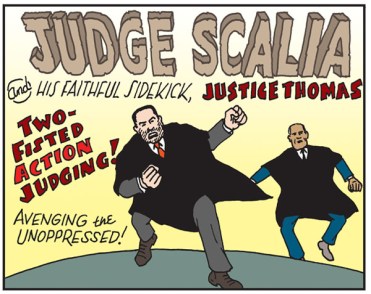 Methinks these Justices protest too much. It’s actually pretty telling too. Scalia seems to be getting his questions from old Fox News shows and Thomas has once again proven that no questions are necessary when you know exactly how you’re expected to vote to keep the perks pouring in. It makes one wonder if Roberts is the least bit concerned about how “his” court will go down in history. If comparing the health care market to broccoli is a sign of great intellect, please, buy my a ticket to Palookaville. Here’s how Charlie Pierce puts it.
It is plain now that Scalia simply doesn’t like the Affordable Care Act on its face. It has nothing to do with “originalism,” or the Commerce Clause, or anything else. He doesn’t think that the people who would benefit from the law deserve to have a law that benefits them. On Tuesday, he pursued the absurd “broccoli” analogy to the point where he sounded like a micro-rated evening-drive talk-show host from a dust-clotted station in southern Oklahoma. And today, apparently, he ran through every twist and turn in the act’s baroque political history in an attempt to discredit the law politically, rather than as a challenge to its constitutionality. (What in hell does the “Cornhusker Kickback” — yet another term of art that the Justice borrowed from the AM radio dial — have to do with the severability argument? Is Scalia seriously making the case that a banal political compromise within the negotiations from which bill eventually is produced can affect its ultimate constitutionality? Good luck ever getting anything passed if that’s the standard.) He’s really just a heckler at this point. If he can’t do any better than that, he’s right. Being on the court is a waste of his time.
Better yet, check out Jonathan Chait’s piece on Conservative Judicial Activists Run Amok. It reintroduces an essay by Jeffrey Rosen from 2005 on how the court was undergoing some fairly radical changes. The Rosen essay specifically references a Thomas decision written with an amazing amount of paraphrasing from a libertarian kook named Richard Epstein who is obsessed with protecting property at all costs; including human ones.
As Epstein sees it, all individuals have certain inherent rights and liberties, including ”economic” liberties, like the right to property and, more crucially, the right to part with it only voluntarily. These rights are violated any time an individual is deprived of his property without compensation — when it is stolen, for example, but also when it is subjected to governmental regulation that reduces its value or when a government fails to provide greater security in exchange for the property it seizes. In Epstein’s view, these libertarian freedoms are not only defensible as a matter of political philosophy but are also protected by the United States Constitution. Any government that violates them is, by his lights, repressive. One such government, in Epstein’s worldview, is our government. When Epstein gazes across America, he sees a nation in the chains of minimum-wage laws and zoning regulations. His theory calls for the country to be deregulated in a manner not seen since before Franklin D. Roosevelt’s New Deal.
After Thomas joined the Supreme Court, Biden’s warnings seemed prescient. In 1995, echoes of Epstein’s ideas could be clearly heard in one of Thomas’s opinions. By a 5-4 majority in United States v. Lopez, the court struck down a federal law banning guns in school zones, arguing that the law fell outside Congress’s constitutional power to regulate interstate commerce. Lopez was a judicial landmark: it was the first time since the New Deal that the court had limited the power of the federal government on those grounds. Thomas, who sided with the majority, chose to write a separate opinion in which he suggested that even his conservative colleagues had not gone far enough. The real problem, he wrote, was not just with the law at hand but with the larger decision of the court during the New Deal to abandon the judicial doctrines of the 19th century that established severe limits on the government’s power. He assailed his liberal colleagues for characterizing ”the first 150 years of this Court’s case law as a ‘wrong turn.”’ He continued, ”If anything, the ‘wrong turn’ was the Court’s dramatic departure in the 1930’s from a century and a half of precedent.”
Thomas did not cite Epstein directly in his opinion. But to anyone familiar with Epstein’s writings, the similarities were striking. Indeed, Thomas’s argument closely resembled one Epstein had made eight years earlier in ”The Proper Scope of the Commerce Power” in the Virginia Law Review — so closely, in fact, that Sanford Levinson, a liberal law professor at the University of Texas, accused Thomas of outright intellectual theft. (”The ordinary standards governing attribution of sources — the violation of which constitutes plagiarism — seem not to apply in Justice Thomas’s chambers,” Levinson wrote in the Texas Law Review.) Biden’s fear that Epstein’s ideas might be written into law had apparently been realized. And the fear would continue to be realized in other courts throughout the 90’s as a small but energetic set of lower-court judges, sympathetic to libertarian arguments, tried to strike down aspects of the Clean Water Act, the Endangered Species Act and other laws, challenging powers of the federal government that had come to be widely accepted during the second half of the 20th century.
Chait takes this essay into the present and the analysis presents a chilling future of judicial activism unlike anything we’ve seen before. The hearings this week on the ACA imply a SCOTUS willing to rewrite legislation in the name of ideology. The so-called swing vote, Justice Kennedy, has created loopholes in cases before that have allowed state legislatures to drive huge right-depriving laws through constitutional rights. By introducing the factually inaccurate, unscientific idea of “fetal pain” in Gonzales V Carhart, Kennedy opened a can of whoop ass based on religious propaganda on American Women.
Writing for the majority, Justice Anthony Kennedy said:
“States . . . have an interest in forbidding medical procedures which, in the State’s reasonable determination, might cause the medical profession or society as a whole to become insensitive, even disdainful, to life, including life in the human fetus . . . A State may take measures to ensure the medical profession and its members are viewed as healers, sustained by a compassionate and rigorous ethic and cognizant of the dignity and value of human life, even life which cannot survive without the assistance of others.”
The National Right to Life Committee thinks that Kennedy’s directive, particularly the bit at the end —”even life which cannot survive without the assistance of others”—leaves open the possibility of revising the viability standard. As Olivia Gans, an NRLC spokesperson, told me a few weeks ago, before the law had passed, “What Kennedy was saying was that states can and should look at other variables to figure out what’s in the best interest of the state.”
This is to medical science as the broccoli argument is to economics. It’s clear that the justices are venturing into something beyond judging constitutionality. Consider this thought offered by Chait.
The spectacle before the Supreme Court this week is Republican justices seizing the chance to overturn the decisions of democratically-elected bodies. At times the deliberations of the Republican justices are impossible to distinguish from the deliberations of Republican senators. They are litigating the problem of adverse selection, and doing it very poorly. (Here are health economists Henry Aaron and Kevin Outterson tearing their hair out over the justices’ bungled attempts to describe the economic dynamics at work.)
Scalia himself offers the most blatant case. His famed thunderings against meddlesome judges are nowhere to be found. He is gleefully reversing his previous interpretation of the Commerce Clause, now that it is being deployed against big government liberals rather than pot smokers. He is railing against Obamacare like an angry Fox News-watching grandfather:
In the morning session — in which the court weighed how much of the law should stand if the mandate is ruled unconstitutional — Scalia cited the horsetrading required to pass the bill — including the politically embarrassing, and failed, Cornhusker Kickback. He also admitted that he’d like to see the whole law fall if the mandate is ruled out of bounds.
In the afternoon, he took pains to remind the court of the unpopularity of the individual mandate.
The exchange occurred when Solicitor General Donald Verrilli Jr. rejected a hypothetical that relied on the notion of Congress passing a massive new tax. This, he argued, would have to overcome massive political constraints.
At that point Scalia chimed in: He would’ve thought the individual mandate would also be too much of a political liability to ever pass Congress.
In fact, the “Cornhusker Kickback” was stripped out before the final bill, but Scalia seems not to know that.
Just two years ago, the idea that conservatives might win the health-care fight in Court rather than the Senate seemed absurd. Just seven years ago, the notion that Republican jurisprudence would be defined by aggressive economic judicial activism seemed even more fantastical. But just as there are few atheists in foxholes, there aren’t a lot of justices of any persuasion willing to walk away from a chance to overturn a duly-passed law that they personally detest.
Whatever issue you may have with the ACA, it was passed by an overwhelming number of Senators and Representatives after a year of hearings, testimony, and rewrites. It deserves a fair hearing before something other than a Kangaroo Court.

 peej
peej Carissa
 bostonboomer
 dakinikat
 ecocatwoman
 mablue2
 Mama Lopez
 peggysue22
 quixote
 skydancingguestblogger
 Mona (aka Wonk the Vote)



 Sky Dancing
Recent Comments