
WTF? Sen. Joe Manchin (D-WV) Not Sure If He’ll Vote for Obama or Romney
Posted: April 20, 2012 Filed under: 2012 elections, 2012 presidential campaign, Democratic Politics, U.S. Politics | Tags: Barack Obama, Ben Nelson, energy, Joe Manchin, Mitt Romney, Ryan budget, The Chicago Way 15 Comments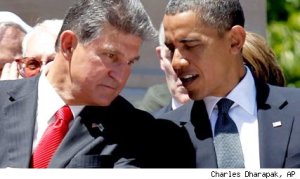
Joe Manchin with Barack Obama
From The Boston Globe:
In a statement Friday, the West Virginia lawmaker said he had “some real differences” with both leaders, finding fault with Obama’s energy and economic policies while questioning whether Romney could understand the challenges facing ordinary people.
“I strongly believe that every American should always be rooting for our president to do well, no matter which political party that he or she might belong to,” Manchin said. “With that being said, many West Virginians believe the last 3 1/2 years haven’t been good for us, but we’re hopeful that they can get better.”
The Globe writer has the nerve to call Manchin “moderate.”
Manchin, one of the more moderate Senate Democrats, has broken with his party on several issues as he seeks re-election this year. His state has backed the Republican candidate in the last three presidential elections, and Obama did not fare well in 2008. Obama lost to GOP nominee Sen. John McCain, 56-43 percent, and was overwhelmed by Hillary Rodham Clinton in the Democratic primary, losing 67-26 percent.
Last time I checked Hillary Clinton was a Democrat and a more liberal one than Obama, so I guess West Virginians are capable of voting Democratic.
Manchin told the National Journal (NJ) that he will vote for the person his constituents want, (which right now looks like it will be Romney says the NJ), but he has concerns about Romney’s support for the Ryan budget because the folks in WV might not like losing their Social Security, Medicare, and Medicaid. But he doesn’t like Obama’s energy policies. Whatever happened to politicians showing leadership?
Manchin’s position echoes the stance he took during his 2010 special election campaign to serve out the term of the late Sen. Robert Byrd. He declined ahead of that election to endorse a second term for Obama or to say if he would vote for Sen. Harry Reid, D-Nev., to remain majority leader.
If Manchin in fact votes based on which candidate most of his constituents embrace, he will likely cast his ballot for Romney. Obama lost West Virginia by 13 points in 2008 and remains unpopular there. While Romney’s wealth, Mormonism, and views on entitlement reform may not be a perfect fit in a state that remains relatively poor, Protestant, and dependent on federal spending, Obama probably will not take the state….
The share of voters who split their ballots between a presidential candidate and a Senate candidate has steadily declined since 1960. It is now common for more than 80 percent of voters who approve of a president’s performance to back the Senate nominee from the same party, a National Journal analysis of competitive races since 2004 found. Similarly, more than 80 percent of voters who disapprove of a president’s performance tend to support the Senate candidate from the other party, according to the analysis. That is Manchin’s challenge.
I’m guessing the Obama campaign’s reaction to Manchin’s up front announcement that he’ll likely vote for Romney is going to be a bit of a challenge too. Has Manchin ever heard of “The Chicago Way?” I don’t recall even Ben Nelson ever going so far as to publicly announce he would vote for the Republican presidential candidate.
Occupy 2.0
Posted: March 21, 2012 Filed under: #Occupy and We are the 99 percent!, 2012 elections, Action Memo, Anti-War, Austerity, Banksters, Civil Liberties, corporate greed, corporatism, corruption, Economy, Global Financial Crisis, income inequality, social justice, U.S. Economy, U.S. Politics 12 CommentsUntil this past weekend, the Occupy Movement was flying under the radar, percolating beyond public view. But members returned to Zucotti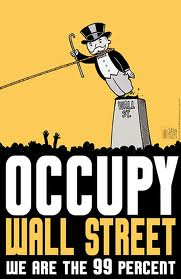 Park on St. Pat’s Day to celebrate the Movement’s six-month anniversary. From on the ground reports, the demonstration was peaceful. Until the NYPD arrived. Then there was trouble—a number of arrests and one woman reportedly had a seizure after she was thrown to the ground and handcuffed. Several participants said it took 17 minutes for the police to react, after which an ambulance was called.
For naysayers, the Occupy Wall St. Movement [OWS], their members and reasons for being were summarily dismissed before they began. Who is the leader of this motley group? journalists and pundits asked repeatedly. What do these people want?
Surprisingly, there is a leader or so I’ve read, someone well known to Occupy organizers but deliberately kept out of public view. As far as what they want? The answer seemed perfectly clear to me at the start because I think it’s what most Americans want or if they don’t want it, they expect it: an end to the gross inequality in the country, for which Wall St. and Government collusion holds the lion’s share of responsibility and an end to ‘bought’ elections, where the 1% and corporate interests routinely choose our leaders, shape policy and control the message, known in polite circles as ‘perception management.’
All of this transcends parties, btw. We’re talking Republican and Democratic parties alike, regardless of how many times we enter the ‘lesser than two evils’ spin.
You don’t need to be a psychic to ‘get’ the OWS message. You don’t even need to be a member of Occupy. All that’s needed is a modicum of alertness, a shaking-off of the trance-inducing distraction and deflection of pundits, media hounds and political operators.
So, what has OWS managed to accomplish, thus far? According to the critics—not a damn thing. But is that really the case?
Last summer, the headlines were ripe with talk of deficits, crushing debt and woe is me. We need a Grand Bargain, wisemen crooned [translation: we need to cut public services]. Somehow, we always have money for foreign adventures, national security, weapons and surveillance equipment. For instance, how many drones will be in American skies by 2020? Hummm. Try 30,000. That’s the Federal Aviation Administration’s rough estimate. The ever popular ‘shop ‘til you drop’ hee-haw isn’t working either, even with the news that ‘average’ Americans are flocking back to restaurant dining. Despite a stumbling economy there is money for weapons and drones and assorted homeland security gear. When it comes to education, infrastructure, home mortgage write downs, decent healthcare, aide to our poor, disabled and elderly? We’re just stone-broke and need to be put on an austerity diet. See Paul Ryan’s reiteration on social program slashes and numbers that don’t add up. It’s a nice set piece that will contrast with the soon-to-come kinder and gentler Democratic version.
One could call the dialogue change a bizarre coincidence but public conversation pivoted after Occupy came on the scene. We went from Oooooo, we need to slash Medicare, Medicaid and refigure Social Security to why is Wall St. getting bailed out on the backs of the taxpayer? Why do we have a system where the profits go to the top income bracket, while risk is carried by Main Street? Why have the wages of middle-class workers[if they’re fortunate enough to still have a job] barely kept pace with inflation, while the top 1% has had a 275% increase in income?
Uncomfortable questions, the sort that make politicians squirm.
OWS has also focused attention on home foreclosures, working with foreclosed families to save their homes. The Movement rallied the public in a Change Your Bank Day strategy that is estimated to cost TBTFs a $185 billion in transfers to community banks and credit unions. Religious organizations have joined the effort. According to Think Progress, The New Bottom Line, a coalition of faith groups has pledged to remove $1 billion from the major banks this year alone. OWS also pushed against the ATM fee-increase proposal; the banks pulled back. In late February, Occupy the SEC submitted a 300+ page document, urging regulators to resist the financial sector’s desire to water down the Volker Rule, part of the Dodd-Frank Wall St. reform. The group that put the document together was comprised of former Wall St. workers. OWS members also stood with private landowners, Tea Party members and environmentalists protesting the Keystone XL pipeline, a project that the President has expressed a new-found love for.
Not too shabby for six months activism. Yet still the critics howl. Where is the direction, what are the goals?
The Movement is young and still developing but you cannot fault it for sitting on its hands. More importantly, the Occupy spirit is global in nature because many activists are ‘graduates without a future’—young, educated and fed up. Paul Mason documented this facet of the worldwide
Arundhati Roy
social/political movements in his book, “Why It’s Kicking Off Everywhere,” and Arundhati Roy wrote this in a recent essay: “Capitalism, A Ghost Story”:
As Gush-Up concentrates wealth on to the tip of a shining pin on which our billionaires pirouette, tidal waves of money crash through the institutions of democracy—the courts, Parliament as well as the media, seriously compromising their ability to function in the ways they are meant to. The noisier the carnival around elections, the less sure we are that democracy really exists.
Sound familiar? The neoliberal model, the gross inequality that rewards the few at the expense of the many has circled the globe, creating universal discontent and misery.
So, what’s coming up for 2012? What will Occupy 2.0 look like?
I’d suggest checking the OWS page here for an updated list of scheduled actions. OWS plans to be in Chicago in mid-May to protest the NATO Summit although the city is throwing up barriers to prevent demonstrations. Somehow, I don’t think the protest will be stopped.
May 1 will be a National Action, the day traditionally known as International Worker’s Day. This year OWS is calling for a General Strike across the country. From the Occupy site:
We are calling on everyone who supports the cause of economic justice and true democracy to take part: No Work, No School, No Housework, No Shopping, No Banking – and most importantly, TAKE THE STREETS!
This Saturday, March 24, a Disrupt Dirty Power protest has been called in NYC to jumpstart a month-long action until Earth Day, April 22. More information here.
Sunday, March 25, Occupy Town Square IV will focus on public parks and other public spaces in NYC. More info here.
If you’re interested in local actions in particular states, towns, cities or countries, info can be found at the Occupy Together site here.
And if you want to eliminate the idea of ‘a failed movement’ from your brain. Check out the participation map here. The scope is massive.
The essay I mentioned by Arundhati Roy is well worth a read—highly informative, even shocking about vulture capitalism’s impact on India. Be prepared, it’s long. As Roy moves into her concluding paragraphs, she writes this:
Capitalism is in crisis. Trickledown failed. Now Gush-Up is in trouble too. The international financial meltdown is closing in. India’s growth rate has plummeted to 6.9 per cent. Foreign investment is pulling out. Major international corporations are sitting on huge piles of money, not sure where to invest it, not sure how the financial crisis will play out. This is a major, structural crack in the juggernaut of global capital.
Capitalism’s real “grave-diggers” may end up being its own delusional Cardinals, who have turned ideology into faith. Despite their strategic brilliance, they seem to have trouble grasping a simple fact: Capitalism is destroying the planet. The two old tricks that dug it out of past crises—War and Shopping—simply will not work.
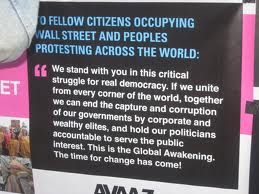
Disaster capitalism has certainly lived up to its name, be it continuous war, environmental degradation or exploding poverty. What is Occupy about? Speaking for myself, Occupy is about a break of faith with a global economic system that serves no one but an elite minority, where infinite money and power is the only morality. The movement is a massive rejection of the ongoing mantra: there’s no other way. Occupy challenges that static position, calls on us to envision something else, something better than the consensus mind. It dares us to shake off the old and embrace a sense of possibility. It demands we wake up, now.
Wednesday Reads
Posted: March 21, 2012 Filed under: 2012 elections, 2012 presidential campaign, 2012 primaries, Barack Obama, Mitt Romney, morning reads | Tags: Greg Mankiw, sick humor 13 Comments Good Morning!
Minx is waiting for a new modem so I get to share the morning links with you! I’ve got some good reads. Unfortunately, many of them are very discouraging.
First up is a good example of sick humor. I’m not sure what Economist Greg Mankiw had in mind with this one. Perhaps he was thinking of Jonathan Swift or just channeling the insensitivity of his past and present bosses Dubya and Willard. I would like to think Harvard would suggest he take a nice, long, upaid sabbatical over this one. Maybe he’s been spending too much time with his charming colleague Larry-the misogynist-Summers. Here’s an explanation of the pseudo news item from Politico.
Under the header “A Fiscal Solution,” Mankiw, who served as Chairman of the Council of Economic Advisers under George W. Bush, posted an uploaded photo of an unidentified newspaper clip, a joke, that read:
“Budget Cuts: The Immigration Department will start deporting seniors (instead of illegals) in order to lower Social Security and Medicare costs. Older people are easier to catch and less likely to remember how to get home.”
It’s unclear what the source of the original clip was – but it doesn’t appear to be The Onion. Mankiw offered no comment other than “Thanks to the reader who sent this along” – but he clearly thought it was funny.
If Mankiw was just a Harvard professor, the joke wouldn’t likely resonate. But he posted it on Tuesday – the day when Paul Ryan released a budget Democrats instantly decried as a Medicare killer and two days after Romney scored a big win in Puerto Rico’s primary – which counter the flurry of criticism he’s drawn from Hispanic groups for his embrace of the controversial “self-deportation” immigration strategy.
Sorta puts a new twist on the concept of grannie starving, doesn’t it?
Jonathan Chait has a new feature up at New York Magazine on “How Obama Tried to Sell Out Liberalism in 2011” that’s worth a look. Makes me feel a little nervous about the upcoming budget fights. I’ve jumped to the bottom line.
…faced with unrelenting criticism for his decision to not fully endorse Bowles-Simpson, when the next bipartisan plan came out, this time Obama chose to praise it to the skies. And the criticism is that he killed a bipartisan deal by doing so!
The obvious reality is that there never has been any way to get House Republicans to agree to a balanced deficit deal. Even the capitulation Obama offered — $800 billion in semi-imaginary revenue, all raised from the non-rich — was too much for them to agree to. Locking in that low level of revenue would have required huge cuts in spending, making a decent liberal vision of government impossible. The Post is making the case that there was a potential deal, and Obama blew it by failing to properly handle the easily-spooked Republican caucus. What the story actually shows is that Obama’s disastrous weakness in the summer of 2011 went further toward undermining liberalism than anybody previously knew.
David Corn has a new book out titled Show Down which is being dissected by the pundit class. It’s an update on the workings of the Obama administration along the lines of Suskind’s Confidence Men. This is some musings on an excerpt from WP’s Greg Sargent at The Plum Line. It shows how two of Obama’s advisers–Sperling and Plouffee–knew Obama’s economic rhetoric was straight out of Reaganland and not particularly based in genuine economics
In “Showdown,” an insider account of Obama’s response to the 2010 midterm losses, author David Corn reports on a number of behind-the-scenes discussions that led to the Dems’ emphasis on deficit reduction. Here’s what drove Obama strategist David Plouffe’s thinking (page 132):
Plouffe was concerned that voter unease about the deficit could become unease about the president. The budget issue was easy to understand; you shouldn’t spend more money than you have. Yes, there was the argument that the government should borrow money responsibly when necessary (especially when interest rates were low) for the appropriate activities, just like a family borrowing sensibly to purchase a home, to pay for college, or to handle an emergency. But voters needed to know — or feel — that the president could manage the nation’s finances. The budget was a test of government competence — that is, Obama’s competence.
This is a reference to the “government must tighten its belt” analogy. Obama repeatedly has invoked this language, arguing that government, like families, needs to live within its means. As Paul Krugman has explained at length, this analogy is flawed on many levels. And judging by the above passage, Plouffe knew this. He knew the policy justification for the pivot was thin. But Obama’s team clearly didn’t feel they could win this argument with voters.
Romney won Illinois yesterday. This Saturday is the Louisiana primary. I’ve already been treated to some of the nastiest ads I’ve ever seen. Romney ads are on all the time. It makes me wonder what we’re going to see this fall. As usual, pundits are talking about what the results may or may not mean.
Everything in the sense that Romney beat Santorum again in a large Midwestern state where a majority of voters don’t think of themselves as evangelicals and prize electability and experience as the most important traits for a Republican candidate to possess. Everything in the sense that Romney’s victory — coupled with some organizational flubs by Santorum — means that the former Massachusetts governor will extend his already near-determinative delegate lead.
And nothing in the sense that even Romney’s staunchest allies don’t expect him to pick up enough momentum to win the Louisiana’s caucuses set for Saturday, meaning that the “Romney can’t win the South” and “Romney can’t win conservatives over” storylines will linger as the calendar turns from March to April.
“Nothing impossible in Louisiana but Santorum [is] not likely to be closed out soon,” acknowledged Charlie Black, a longtime Republican campaign hand who is supporting Romney.
Watching politics unfold is anything but dull in the good ol US of A. So, what’s on your reading and blogging list today?
Paul Ryan in La La Lie Land
Posted: March 20, 2012 Filed under: 2012 elections, Economy, voodoo economics | Tags: Paul Ryan budget 12 Comments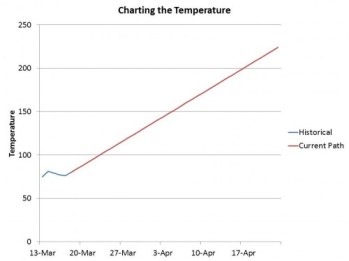
Economist Aaron Carroll forecast the trend in temperature for Indianapolis based on the last two days. Scared yet?
Lying with statistics is one of those things you watch out for when you work with numbers. It’s one of the reasons there’s peer review for journal submissions. Mistakes in methodology ruin academic careers and reputations. However, loosey goosey methodology is the hallmark of advocacy research. Paul Ryan’s chart–published today in the WSJ–is going to be a hallmark of Stats Gone Wild. Finding a trend in an economic variable is a standard practice for analyzing time series. It’s taught to undergraduates in their first stat class and doctoral students continually in econometrics. Results are dependent on a lot of things you can do while running the analysis. The first thing you teach to your undergrads is there has to be a certain number of observations. Then, you start looking for other things that could cause problems. Forecasts are only as good as the assumptions. We’ve seen this problem before when Ryan’s number crunching. Paul Ryan’s new little chart takes the cake. Ryan’s assumptions continually fail the reality test. They also are extreme in their result.
Ryan’s assumptions and programs are summed up by Ezra Klein this way.
Ryan’s budget funds trillions of dollars in tax cuts, defense spending and deficit reduction by cutting deeply into health-care programs and income supports for the poor.
Yes, folks, the poor are going to pay if Paul Ryan gets his way. All of this based on ideology and the same baseless assumptions he always makes. Tax cuts more than pay for themselves. Privatization always saves money. Health care costs only increase by the rate of inflation. Giving money to the rich will grease the wheels of manufacturing and hiring. We might as well assume that the Treasury can hire a few alchemists to turn hay bushels into gold.
Ryan tells CBO to assume his tax plan will raise revenues to 19 percent of GDP and then hold them there. He tells them to assume his Medicare plan will hold cost growth in Medicare to GDP+0.5 percentage points. He tells them to assume that spending on Medicaid and the Children’s Health Insurance Program won’t grow any faster than inflation. He tells them to assume that all federal spending aside from Medicare, Medicaid and Social Security will fall from 12.5 percent of GDP in 2011 to 3.75 percent of GDP in 2050.
Oh, there’s more of that Republican wishful thinking. Or as I like to call it, big fat ol’ lies. Lies and ideology in. Ideology and Lies and Pain out.
At the end of his initial release, Ryan posts a table comparing his budget to the president’s budget. The single largest difference is in the tax section: Ryan raises $2 trillion less in revenue than the White House does. In the president’s budget, those revenues come mostly from increasing taxes on the wealthy. So that’s the first big gap between the two proposals: Under Ryan’s budget, revenue would be lower, and the distribution of taxes more regressive, than under Obama’s budget.
On the spending side, Ryan’s biggest cuts come from health-care programs. He eliminates the $1.5 trillion that the Affordable Care Act uses to purchase health insurance for 30 million Americans. Then he cuts Medicaid and related health programs by $770 billion — which is to say, by about a third. Medicare takes $200 billion in cuts on top of that.
Yes. All of us will be held hostage to Insurance Companies in Paul Ryan’s world. Ryan thinks he’s doing us all a favor. Here’s some more thoughts from Matthew Yglesias who reminds us that all of Paul Ryan’s analysis comes from the bad fiction of Ayn Rand.
What Ryan is talking about here is Medicaid which offers health care coverage to the poor, to the disabled, and to an important class of elderly people. Currently the money for Medicaid comes from both the states and the federal government. States have to meet a lot of minimum coverage standards and get federal financial assistance for doing so, and in addition states have the option of securing additional federal monies for additional coverage if they’re willing to kick in extra money of their own. Because health care is proejcted to grow more expensive over the next fifty years, the cost of this program is projected to go up substantially. One way of preventing that from happening is to just refuse to pony up the money, and make Medicaid beneficiaries get by with less health care. And that’s what Ryan’s plan does. On the one hand, it excuses states from their minimum coverage responsibilities. On the other hand, it reduces the amount of money that’s available to give people coverage. Which is all about what you’d expect from a tax cutting Ayn Rand fan. Keep the money in the hands of the job creators who earned it rather than handing it out to the moochers and looters looking for a little free medicine.
But please God almighty can we avoid referring to this as a measure that “strengthens the safety net” by empowering states to “tailor assistance to their specific populations”? Ryan doesn’t like taxing the wealthy to give resources to the poor and disabled, so he proposes to give fewer resources to the poor and disabled.
Every time I read something that comes out of Paul Ryan I end up wondering what is seriously wrong with this man. He’s like the master of doublespeak. We’ve seen this before and it’s still called voodoo economics in my book. There is no evidence that giving excessive tax cuts to rich people creates jobs. There is plenty of evidence that our health care delivery system is the worst and most expensive of all the development nations. Paul Ryan wants to continue life support to the sick system we have now. The one that was put into place by the Dubya Bush administration that’s delivered endless, expensive wars, poor job creation and economic growth, huge deficits, and a global financial crisis. Why does he keep playing the scratched-up record? My hope is that all the political activism and outrage brought about by Scott Walker in Wisconsin will hand Paul Ryan a pink slip in the fall. The nation cannot afford any more lies, distorted statistics, and voodoo economics. How can congress ever negotiate a budget in good faith when at least one of the major players appears to be delusional?
Political Profiling: Pundits in Southland
Posted: March 19, 2012 Filed under: 2012 elections, 2012 presidential campaign, 2012 primaries, religious extremists, U.S. Politics, Voter Ignorance 5 Comments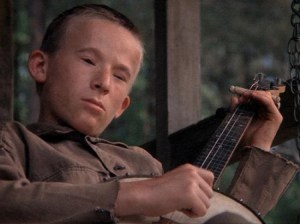 I’ve lived down here in Lousyana for about 16 years now. I never expected to have a southern address. NEVER. I remember watching dinner time news as a kid. Two things stood out to me. The endless Vietnam War news and body counts were very disturbing. Watching angry white southerners fight desegregation with words and fire hoses was the other horrifying story. Who would want to live in a place like that? Today’s South is a complex place. There are a lot of folks down here that would prefer to live in the remote past. This political season appears to be bringing out the ones that want to erase modernity. They want to wrap their prejudices up in religion and the American Flag. As we wrap up the Southern Primary season this week with the Louisiana primary on Saturday, I’d just like to remind you that hateful rubes live everywhere. You probably won’t get that message by reading or watching the news.
The pundits and press have been chasing the Republican candidates around my neck of the woods and have come face-to-face with that brand of Southerner. A lot of economically and culturally insecure rednecks have not failed to disappoint them. You look around for a stereotype and you can surely find one. Here’s a little bit from a Santorum shindig up the road in Baton Rouge. My daughter lives about 2 miles from the location. This pastor is a living, breathing stereotype of the Southern Baptist preacher with the exception he’s changed just enough to bless a Roman Catholic Yankee. About 40 years ago, that would’ve been unheard of. Such is progress in some parts of our country.
Just in case you can’t stomach the whole thing, here’s the synopsis from Right Wing Watch.
Greenwell Springs Baptist Church pastor Dennis Terry introduced presidential candidate Rick Santorum and Family Research Council president Tony Perkins tonight in Baton Rouge, Louisiana, with a rousing speech railing against liberals and non-Christians and condemning abortion rights, “sexual perversion,” same-sex marriage and secular government. Terry said that America “was founded as a Christian nation” and those that disagree with him should “get out! We don’t worship Buddha, we don’t worship Mohammad, we don’t worship Allah!” Terry, who has a long history of attacks against the gay community, went on to criticize marriage equality for gays and lesbians, and said that the economy can only recover when we “put God back” in government.
We’re not the only ones that got this treatment. Santorum managed to whip out his man-on-dog wackiness in Illinois too. However, the punditry isn’t describing the audience in quite the same way.
But, here is an interesting conversation that’s come up during their trek down here. Should the media apologize for showing exactly how stupid voters are? Of course, you know exactly where the examples come from.
We arrived at this current round of stupidity-skepticism because of where the Republican primary ended up. Last week’s big contests were in Alabama, Mississippi, and Hawaii. The candidates, for unselfish reasons, opted to skip the last state and campaign in the Deep South. Pollsters and reporters, dutifully covering the race, discovered voters who believed that Barack Obama was a Muslim and that he was born in some foreign terrorist hotbed.
Nobody should have been surprised. Mississippi’s primary voters, some of the most conservative in the lower 48, are also some of the poorest. That wasn’t new. Sixty-three years ago, in Southern Politics in State and Nation, V.O. Key observed that “every other southern state finds some reason to fall back on the soul-satisfying exclamation, ‘Thank God for Mississippi.’ ” Public Policy Polling didn’t goose its results. It pointed out that most Mississippi Republicans believed untrue things that confirmed their suspicions about Barack Obama.
I trekked to Mississippi and Alabama last weekend for a few stories about the primaries. The only way I could have avoided hearing some confirmation biases was by locking myself in a leftover sensory depravation chamber from the Altered States set. While they were waiting for Newt Gingrich or Rick Santorum or Jeff Foxworthy to start talking, I asked why they thought Barack Obama had won in 2008. Sometimes a voter would go on a tangent and talk about the president’s unfamiliarity with John 3:16; sometimes they’d riff on how Mormonism wasn’t really Christianity. Some of what they said wound up in a slide show. The rest of it informed how I read Tuesday’s election results—Mitt Romney, who’d outspent everyone in both states, coming in third place.
Voters aren’t saints. When primaries get to certain parts of the country, they get disturbing, fast. In 2008, anybody with a digital camera could interview white Democrats who feared Barack Obama for the wrong reasons. One of the videos that went viral pitted a shocked reporter from the Real News against West Virginians who would have none of his logic.
“Why do you think he’s Muslim?” asked the reporter in one scene. “He wasn’t raised Muslim.”
“I don’t agree with that,” shrugged his subject.
That’s a report by David Weigel and Slate. Part of his piece was aimed at a Bill Maher program from last week. You can go watch a video and be appalled at some folks from Mississippi if you can take Maher’s smarmy, patronizing assholiness. Part of Weigals’ bit was inspired by this Politico article which doesn’t focus on the dumb Southerner sterotype but the dumb voters in general.
“The first lesson you learn as a pollster is that people are stupid,” said Tom Jensen of Public Policy Polling, a Democratic polling firm. “I tell a client trying to make sense of numbers on a poll that are inherently contradictory that at least once a week.”
Jensen, a Democrat, pointed to surveys showing that voters embraced individual elements of the Affordable Care Act, while rejecting the overall law, as an example of the political schizophrenia or simple ignorance that pollsters and politicians must contend with.
“We’re seeing that kind of thing more and more. I think it’s a function of increased political polarization and voters just digging in their heels and refusing to consider the opposing facts once they’ve formed an opinion about something,” said Jensen, who has generated eye-catching data showing many GOP primary voters still question the president’s religion and nationality. “I also think voters are showing a tendency to turn issues that should be factual or non-factual into opinions. If you show a Tennessee birther Obama’s birth certificate, they’re just going to say ‘well in my opinion he’s not a real American.’ It’s not about the birth certificate; it’s about expressing hatred for Obama in any form they can.”
But irrationality on policy issues transcends party lines and cuts across groups that feel differently about the president. Taken all together, the issue polling compiled so far in the 2012 cycle presents a sharp corrective to the candidates’ description of the race as a great debate placing two starkly different philosophies of government before an informed electorate.
In reality, the contest has been more like a game of Marco Polo, as a hapless gang of Republican candidates and a damaged, frantic incumbent try to connect with a historically fickle and frustrated electorate.
And “fickle” is a nice way of describing the voters of 2012, who appear to be wandering, confused and Forrest Gump-like through the experience of a presidential campaign. It isn’t just unclear which party’s vision they’d rather embrace; it’s entirely questionable whether the great mass of voters has even the most basic grasp of the details – or for that matter, the most elementary factual components – of the national political debate.
I’ve written a lot about the telling and embracing of outright lies this primary season. It’s party of a bigger, very human picture. People like to have their beliefs reinforced. It makes them feel better in a chaotic world. It’s why history is full of successful confidence men and games. None of that history is limited to the modern U.S. south. But, some times you wouldn’t know that when reading stuff that comes out of Washington DC or New York City. I’ve lived other places. I found rubes, bigots and idiots wherever I have lived. I’ve also found some genuinely loving and intelligent beings. The one thing that I have noticed that’s different about Southerners is that they are straightforward when it comes to expressing things. Head up to Michelle Bachmann’s Minnesota and you are going to find some of those same kinds of hateful attitudes. I guarantee it. I lived there too. You can read between their lines and find the same ick factor. For some reason, the Beltway and Manhattan set prefer to come down here and dredge up the Deliverance Set. I’m not sure if it’s just because it’s easier to find them down here or because that’s what they start looking for and find it. I guess voters aren’t the only ones that can be real stupid. Just remember, the worst of the culture warriors this election came from Minnesota and Pennsylvania. (Newt’s from Pennsylvanian too.)

 peej
peej Carissa
 bostonboomer
 dakinikat
 ecocatwoman
 mablue2
 Mama Lopez
 peggysue22
 quixote
 skydancingguestblogger
 Mona (aka Wonk the Vote)



 Sky Dancing
Recent Comments