
Monday Reads: Goodnight Kabul
Posted: August 16, 2021 Filed under: morning reads | Tags: Afghan War, Fall of Kabul, Fall of Saigon 43 Comments
Nik Wheeler/Corbis/Getty Images The conflict in Vietnam ended in 1975 with the largest helicopter evacuation of its kind in history.
Good Morning Sky Dancers!
Well, this is a sight I thought I’d never see again, but then, back in 2001, I really expected a complete failure in the Afghanistan theatre eventually. We join some of the greatest armies of their time in that failure. History never teaches much to chickenhawks like Dick Cheney, who dodged the draft with five deferments. Unlike Cheney, Donald Rumsfeld actually had a three-year stint in the military about when I was born. He was a navy pilot and instructor. Rumsfeld was basically the failed architect of the seemingly endless war in Afghanistan and recently died, so he doesn’t have to see the fall of Kabul unless in his particular hell realm they have CNN on an endless loop.
I was at university when Saigon fell. Like everything else about the Vietnam war, it was televised during your mealtimes. I asked my ex-husband if this meant I could finally burn his draft card. He held onto it for a while before I finally took it and incinerated it in a fired-up grill.
The dulcet tones of “White Christmas” that crackled over Armed Forces Radio airwaves on April 29, 1975, failed to spread cheer across sunbaked Saigon. Instead, the broadcast of the holiday standard after the announcement that “the temperature in Saigon is 105 degrees and rising” instilled fear and panic in all who recognized the coded signal to begin an immediate evacuation of all Americans from Vietnam.
Although the United States had withdrawn its combat forces from Vietnam after the signing of the Paris Peace Accords in 1973, approximately 5,000 Americans—including diplomats, marine guards, contractors and Central Intelligence Agency employees—remained. President Richard Nixon had secretly promised South Vietnam that the United States would “respond with full force” if North Vietnam violated the peace treaty. However, after the Watergate scandal forced Nixon to resign, the North Vietnamese Army felt emboldened to launch a major offensive in March 1975.
“From Hanoi’s point of view, the turmoil leading up to and including Nixon’s resignation was an opportunity to take advantage of a distracted United States,” says Tom Clavin, co-author of Last Men Out: The True Story of America’s Heroic Final Hours in Vietnam. “North Vietnam never intended to abide by the 1973 agreement—its ultimate mission was to unify the country—but the political crisis in America allowed them to move up their timetable.”

Taliban fighters in Kabul, the capital, on Sunday on a Humvee seized from Afghan forces. The speed of the Taliban’s sweep through the country startled American officials. Credit…Jim Huylebroek for The New York Times
The Bodega on the corner is run by a family around my age. There is a grandmother and a grandson. I’ve never really asked the grandmother or the parents about Vietnam, but I know they are part of the large diaspora of South Vietnamese that landed here. My French teacher was in Saigon when it fell. I’ve seen his photos and listened to his stories, although I’m not really sure how he and his Vietnamese bride got out of there. It’s actually getting difficult to find Vietnamese Veterans these days who will share their stories. But they’re out there still.
What will we say about the Fall of Kabul 45 years from now? I’ll not be around for that, but my children and grandchildren will, climate change willing. The Taliban swept through the country and took Kabul on Sunday. From the New York Times: “Kabul’s Sudden Fall to Taliban Ends U.S. Era in Afghanistan. A takeover of the entire country was all but absolute as the Afghan government collapsed and the U.S. rushed through a frenzied evacuation.”
Taliban fighters poured into the Afghan capital on Sunday amid scenes of panic and chaos, bringing a swift and shocking close to the Afghan government and the 20-year American era in the country.
President Ashraf Ghani of Afghanistan fled the country, and a council of Afghan officials, including former President Hamid Karzai, said they would open negotiations with the Taliban over the shape of the insurgency’s takeover. By day’s end, the insurgents had all but officially sealed their control of the entire country.
The speed and violence of the Taliban sweep through the countryside and cities the previous week caught the American military and government flat-footed. Hastily arranged American military helicopter flights evacuated the sprawling American Embassy compound in Kabul, ferrying American diplomats and Afghan Embassy workers to the Kabul military airport. At the civilian airport next door, Afghans wept as they begged airline workers to put their families on outbound commercial flights even as most were grounded in favor of military aircraft.
Amid occasional bursts of gunfire, the whump of American Chinook and Black Hawk helicopters overhead drowned out the thrum of traffic as the frenzied evacuation effort unfolded. Below, Kabul’s streets were jammed with vehicles as panic set off a race to leave the city.
Two decades after American troops invaded Afghanistan to root out Qaeda terrorists who attacked on Sept. 11, 2001, the American nation-building experiment was in ruins — undercut by misguided and often contradictory policies and by a relentless insurgency whose staying power had been profoundly underestimated by U.S. military planners.
More than 2,400 American troops gave their lives and thousands more were wounded in an effort to build a democratic Afghan government. Tens of thousands of civilians died in the fighting, and thousands more were displaced from their homes. In recent days alone, thousands fled to Kabul as the Taliban advanced through other cities at breakneck speed.

Evacuation of Kabul (Left) and Fall of Saigon (Right). Picture: Collected
This entire 20-year ordeal didn’t have to happen. Much like I still can’t figure out what the hell the point of the Vietnam “conflict’ was about. This New York Times Analysis offers some insight: ” Taliban Sweep in Afghanistan Follows Years of U.S. Miscalculations. An Afghan military that did not believe in itself and a U.S. effort that Mr. Biden, and most Americans, no longer believed in brought an ignoble end to America’s longest war.”
President Biden’s top advisers concede they were stunned by the rapid collapse of the Afghan army in the face of an aggressive, well-planned offensive by the Taliban that now threatens Kabul, Afghanistan’s capital.
The past 20 years show they should not have been.
If there is a consistent theme over two decades of war in Afghanistan, it is the overestimation of the results of the $83 billion the United States has spent since 2001 training and equipping the Afghan security forces and an underestimation of the brutal, wily strategy of the Taliban. The Pentagon had issued dire warnings to Mr. Biden even before he took office about the potential for the Taliban to overrun the Afghan army, but intelligence estimates, now shown to have badly missed the mark, assessed it might happen in 18 months, not weeks.
Commanders did know that the afflictions of the Afghan forces had never been cured: the deep corruption, the failure by the government to pay many Afghan soldiers and police officers for months, the defections, the soldiers sent to the front without adequate food and water, let alone arms. In the past several days, the Afghan forces have steadily collapsed as they battled to defend ever shrinking territory, losing Mazar-i-Sharif, the country’s economic engine, to the Taliban on Saturday.
Mr. Biden’s aides say that the persistence of those problems reinforced his belief that the United States could not prop up the Afghan government and military in perpetuity. In Oval Office meetings this spring, he told aides that staying another year, or even five, would not make a substantial difference and was not worth the risks.
In the end, an Afghan force that did not believe in itself and a U.S. effort that Mr. Biden, and most Americans, no longer believed would alter the course of events combined to bring an ignoble close to America’s longest war. The United States kept forces in Afghanistan far longer than the British did in the 19th century, and twice as long as the Soviets — with roughly the same results.
No matter how much you call it ‘nation-building,’ it still winds up to be colonization. That part of the world has had its history full of that. Please read this thread. I unrolled it here. It documents–in 7 tweets with sources–why it should’ve never happened.
So, there will be a lot more happening, and I’m sure the discussion will be brisk. Please add anything interesting you’ve read on seen or your thoughts, please!
What’s on your reading and blogging list?
Friday Reads: America, Land of Democracy Deserts
Posted: August 13, 2021 Filed under: Afternoon Reads | Tags: 2020 Census, gerrymandering 15 Comments
Salvador Dalí, Soft Construction with Boiled Beans (Premonition of Civil War), 1936, Philadelphia Museum of Art
Good Day Sky Dancers!
The title is shocking, isn’t it? That’s what caught my eye when I went to read this article in The Guardian with the lede “America is full of ‘democracy deserts.’ Wisconsin rivals Congo on some metrics written by David Daley and Gaby Goldstein, who shows how “gerrymandering allows legislators to ignore what voters really want.” They also indicate that “experts fear it’s about to get a lot worse.” I’ve been watching all the voter suppression laws passing in many red states. However, gerrymandering could bring a few of those purple states into the lost cause category.
I was thinking a lot about the Spanish Civil War because BB has been reading a book on it. So, I chose these pictures today that are from that period about the event. They are mostly Modernist and Avant-Garde. Some, as you may see at this link, are propaganda. I think it’s important to remember that history has lessons for us if we’re really to listen.
From The Guardian story:
The United States is becoming a land filled with “democracy deserts”, where gerrymandering and voting restrictions are making voters powerless to make change. And this round of redistricting could make things even worse.
Since 2012, the Electoral Integrity Project at Harvard University has studied the quality of elections worldwide. It has also issued bi-annual reports that grade US states, on a scale of 1 through 100. In its most recent study of the 2020 elections, the integrity of Wisconsin’s electoral boundaries earned a 23 – worst in the nation, on par with Jordan, Bahrain and the Congo.
Why is Wisconsin so bad? Consider that, among other things, its a swing-state that helped decide the 2016 election. Control the outcome in Wisconsin, and you could control the nation. But Wisconsin isn’t the only democracy desert. Alabama (31), North Carolina (32), Michigan (37), Ohio (33), Texas (35), Florida (37) and Georgia (39) scored only nominally higher. Nations that join them in the 30s include Hungary, Turkey and Syria.
Representative democracy has been broken for the past decade in places like Wisconsin, North Carolina, Ohio, Pennsylvania, Michigan, Florida. When Republican lawmakers redistricted these states after the 2010 census, with the benefit of precise, granular voting data and the most sophisticated mapping software ever, they gerrymandered themselves into advantages that have held firm for the last decade – even when Democratic candidates win hundreds of thousands more statewide votes.
In Wisconsin, for example, voters handed Democrats every statewide race in 2018 and 203,000 more votes for the state Assembly – but the tilted Republican map handed Republicans 63 of the 99 seats nevertheless. Democratic candidates have won more or nearly the same number of votes for Michigan’s state house for the last decade – but never once captured a majority of seats.
Now redistricting is upon us again. This week, the US Census Bureau will release the first round of population data to the states, and the decennial gerrymandering Olympics will begin in state capitols nationwide. And while there has been much coverage of the national stakes – Republicans could win more than the five seats they need to control of Congress next fall through redrawing Texas, Georgia, North Carolina and Florida alone, and they’ve made clear that’s their plan – much less alarm has been raised about the long-term consequences of entrenched Republican minority rule in the states.

Joan Miró, Help Spain, 1937, Museum of Modern Art, New York
The peril we face as a democratic Republic is great. John Nichols writes this for The Nation: “The Next Gerrymandering Nightmare Has Begun. With the release of 2020 Census data, GOP legislators will rush to draw new maps. If they get their way, they’re likely to flip the US House.”
It may not be too late to prevent the partisan gerrymandering of electoral maps that Republicans believe will deliver them control of the US House of Representatives in 2022—as well as a tighter grip on the statehouses that will set so many of the rules for the 2024 presidential election. But it is almost too late.
Ten years ago, Republican governors and legislators used the redistricting process that extended from the 2010 Census to gain dramatic political advantages. Now, with the release of fresh Census data, they are poised to do so again. No one should doubt what is at stake. If the supporters of voter suppression succeed, they could deny Americans representation based on the racial and ethnic diversity that the new data reveals.
“States have long been preparing for this moment, and they now have the green light to start gerrymandering. If left unchecked, this year’s redistricting cycle represents a severe threat to our democracy,” explains Josh Silver, who heads the nonpartisan reform group RepresentUs. “Gerrymandering is one of the worst forms of political corruption, and leads to extremism and partisan gridlock. The maps drawn this year will shape American politics and policy for the next decade.”
The best scenario for American democracy would have been for Senate Democrats to scrap the filibuster and enact the For the People Act before Thursday’s release of the Census data. That legislation seeks to ban partisan gerrymandering and strengthen the position of advocates for communities of color in the redistricting process. “It would also,” notes the Brennan Center for Justice, “enhance the ability of voters to challenge racially or politically discriminatory maps in court, require meaningful transparency in the map-drawing process, and mandate the use of independent commissions to draw maps.”
When senators failed to pass the For the People Act before the August recess, they left an opening for partisans to warp district lines in the 35 states where maps will be drawn by legislators, as opposed to nonpartisan commissions. That gives Republicans a substantial advantage. As Drew DeSilver of the Pew Research Center reminds us, “Republicans will drive that process in 20 states, versus 11 for Democrats.” In four states, divided government makes it most likely that the final decision could be made in the state courts.
Republicans are in full control of states that will be adding seats based on patterns of population growth confirmed by the Census data, such as Texas and Florida. They also control several large states, such as Georgia, where seats will not be added but where a redrawing of lines could be used to tip existing seats to the GOP candidates. In contrast, a number of states where Democrats are in charge, such as New York and Illinois, will lose congressional seats. So, too, will heavily Democratic California, where lines are drawn by a nonpartisan commission.
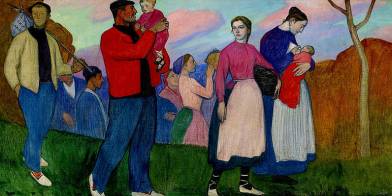
The Party Road Painting Aurelio Arteta
This discussion has yet to reach the level of coverage it deserves. Here’s an interesting article on the role of Math and stopping gerrymandering from The MIT Technology Review. Basically, there’s an algorithm for that!
The maps for US congressional and state legislative races often resemble electoral bestiaries, with bizarrely shaped districts emerging from wonky hybrids of counties, precincts, and census blocks.
It’s the drawing of these maps, more than anything—more than voter suppression laws, more than voter fraud—that determines how votes translate into who gets elected. “You can take the same set of votes, with different district maps, and get very different outcomes,” says Jonathan Mattingly, a mathematician at Duke University in the purple state of North Carolina. “The question is, if the choice of maps is so important to how we interpret these votes, which map should we choose, and how should we decide if someone has done a good job in choosing that map?”
Over recent months, Mattingly and like-minded mathematicians have been busy in anticipation of a data release expected today, August 12, from the US Census Bureau. Every decade, new census data launches the decennial redistricting cycle—state legislators (or sometimes appointed commissions) draw new maps, moving district lines to account for demographic shifts.
In preparation, mathematicians are sharpening new algorithms—open-source tools, developed over recent years—that detect and counter gerrymandering, the egregious practice giving rise to those bestiaries, whereby politicians rig the maps and skew the results to favor one political party over another. Republicans have openly declared that with this redistricting cycle they intend to gerrymander a path to retaking the US House of Representatives in 2022.

Francis Picabia. La Révolution espagnole (The Spanish Revolution). 1937
The Washington Post has some details from the 2020 census. “Census data shows Maryland is now the East Coast’s most diverse state, while D.C. is Whiter.”
According to the U.S. Census Bureau’s diversity index — which measures the likelihood that two people chosen at random would be from different racial and ethnic groups — Maryland is now one of the most diverse states in the nation, surpassed only by Nevada, California and Hawaii.
Nevada also was the only other state in the country to become majority non-White over the last decade.
The change in Maryland’s demographic makeup was driven by growing Asian and Latino populations in the District’s inner suburbs and areas around Baltimore.
The article primarily focuses on the states surround the District. The New York Times provides information on what you need to know when the data is released. It was released on Thursday, but we still are waiting for the major slice and dice to come. This is written by Nick Corasaniti.
With Democrats clinging to a slim margin in the House of Representatives, control of the chamber in 2022 could be decided through congressional redistricting alone: Republican-leaning states like Texas and Florida are adding new seats through reapportionment, and G.O.P.-dominated state legislatures will steer much more of the redistricting process, allowing them to draw more maps than Democrats.
In a matter of days — if history is any guide — as soon as state officials can crunch census data files into their more modern formats, an intense process of mapmaking, political contention, legal wrangling, well-financed opinion-shaping and ornery public feedback will unfold in statehouses, courthouses, on the air and even on the streets in regions of special contention.
The redistricting fight arrives amid one of the most protracted assaults on voting access since the Voting Rights Act was passed in 1965, an effort that has made the right to vote among the most divisive issues in American politics. And redistricting will take place this fall without critical guardrails that the Voting Rights Act had erected: a process known as preclearance that ensured oversight of states with a history of discrimination. The Supreme Court effectively neutered that provision in a 2013 ruling, meaning that it could take lawsuits — and years — to force the redrawing of districts that dilute the voting power of minority communities.

Martyred Spain 1937 André Fougeron 1913-1998 Presented by the Friends of the Tate Gallery 2001 http://www.tate.org.uk/art/work/T07703
The worst-case scenarios may occur without the original protection of the Voting Rights Act. You may visit this link at the Brennan Center for Justice to find out more basic information about gerrymandering.
Every 10 years, states redraw their legislative and congressional district lines following the census. Because communities change, redistricting is critical to our democracy: maps must be redrawn to ensure that districts are equally populated, comply with laws such as the Voting Rights Act, and are otherwise representative of a state’s population. Done right, redistricting is a chance to create maps that, in the words of John Adams, are an “exact portrait, a miniature” of the people as a whole.
But sometimes the process is used to draw maps that put a thumb on the scale to manufacture election outcomes that are detached from the preferences of voters. Rather than voters choosing their representatives, gerrymandering empowers politicians to choose their voters. This tends to occur especially when linedrawing is left to legislatures and one political party controls the process, as has become increasingly common. When that happens, partisan concerns almost invariably take precedence over all else. That produces maps where electoral results are virtually guaranteed even in years where the party drawing maps has a bad year.
There are multiple ways to gerrymander.
While legislative and congressional district shapes may look wildly different from state to state, most attempts to gerrymander can best be understood through the lens of two basic techniques: cracking and packing.
Cracking splits groups of people with similar characteristics, such as voters of the same party affiliation, across multiple districts. With their voting strength divided, these groups struggle to elect their preferred candidates in any of the districts.
Packing is the opposite of cracking: map drawers cram certain groups of voters into as few districts as possible. In these few districts, the “packed” groups are likely to elect their preferred candidates, but the groups’ voting strength is weakened everywhere else.
https://twitter.com/marceelias/status/1425911675211993088
The Politico link has good coverage of the broader population trends released in April. It follows up describing the “mad-dash to redistricting.
Broadly, the data released on Thursday shows a country that has become more urbanized” and more diverse over the last decade. Metro areas across the country grew by 9 percent, and all ten of America’s largest cities have over 1 million people for the first time in U.S. history.
The country has also become less white over the last decade. White Americans still make up the largest demographic in the country, but decreased by 8.6 percent over the last decade.
The dataset could also give an indication of whether the Census undercounted people of color in certain regions, and a state-by-state review will revealwhether individual states need to add additional opportunity districts for Blacks and Latinos, as required by the Voting Rights Act. That officially sets the stage for a wave of lawsuits expected from both parties as redistricting moves forward.
The process is also at the center of the battle for control of Congress. Redistricting decisions made in the coming months will be perhaps the largest determining factor in whether Democrats can hang onto to their razor-thin House majority.
“These data play an important role in our democracy, and also begin to illuminate how the local and demographic makeup of our nation has changed over the last decade,” said Ron Jarmin, the acting director of the Census Bureau, during a presentation Thursday.
So, this will be something we must continue to watch over the next two months. It’s vital to our democracy that we minimize gerrymandering. Gerrymandering is the basic tool of voter disenfranchisement. It happens even if the worst voter suppression measures are defeated.
What’s on your reading and blogging list today?
Monday Reads: Climate Change is more Dire than we Knew
Posted: August 9, 2021 Filed under: Afternoon Reads | Tags: Climate change, climate science 6 Comments
“Landscape with Rainbow (Right-hand part of the Three-part fire screen)”
Franz Marc – Painting – 1913
Good Day Sky Dancers!
All the headlines are rather dire today. The Andrew Cuomo stories of sexual harassment are growing with worse-than-ever details. The Republicans have gone deficit hawk and are now refusing to increase the deficit level. The Delta Variant news just keeps getting worse. However, the recent climate change research backs up our anecdotal stories on what we see and experience as intense outlier weather events are related to worsening climate change. A newly released UN report suggests that “Humans have pushed the climate into ‘unprecedented’ territory, landmark U.N. report finds. U.N. chief calls findings ‘a code red for humanity’ with worse climate impacts to come unless greenhouse gas pollution falls dramatically. This coverage is from WaPo
The landmark report, compiled by 234 authors relying on more than 14,000 studies from around the globe, bluntly lays out for policymakers and the public the most up-to-date understanding of the physical science on climate change. Released amid a summer of deadly fires, floods and heat waves, it arrives less than three months before a critical summit this November in Scotland, where world leaders face mounting pressure to move more urgently to slow the Earth’s warming.
Monday’s sprawling assessment states that there is no remaining scientific doubt that humans are fueling climate change. That much is “unequivocal.” The only real uncertainty that remains, its authors say, is whether the world can muster the will to stave off a darker future than the one it already has carved in stone.
…
“What the world requires now is real action,” John F. Kerry, the Biden administration’s special envoy for climate, said in a statement about Monday’s findings. “We can get to the low carbon economy we urgently need, but time is not on our side.”
It certainly is not, according to Monday’s report.
Humans can unleash less than 500 additional gigatons of carbon dioxide — the equivalent of about 10 years of current global emissions — to have an even chance of limiting warming to 1.5 degrees Celsius (2.7 Fahrenheit) above preindustrial levels.
But hopes for remaining below that threshold — the most ambitious goal outlined in the Paris agreement — are undeniably slipping away. The world has already warmed more than 1 degree Celsius (1.8 degrees Fahrenheit), with few signs of slowing, and could pass the 1.5-degree mark early in the 2030s.
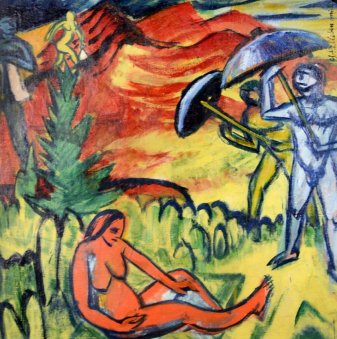
Max Pechstein, Untitled Palau Landscape (detail). Oil on canvas. From the estate of Vance E. Kondon and Elisabeth Giesberger.
This report is sliced and diced as the big headline in every news source around the world. Will it get a decent listen and bring about much-needed action? This is from CNN: “Earth is warming faster than previously thought, scientists say, and the window is closing to avoid catastrophic outcomes .”
As the world battles historic droughts, landscape-altering wildfires and deadly floods, a landmark report from global scientists says the window is rapidly closing to cut our reliance on fossil fuels and avoid catastrophic changes that would transform life as we know it.
The state-of-the-science report from the United Nations’ Intergovernmental Panel on Climate Change says the world has rapidly warmed 1.1 degrees Celsius higher than pre-industrial levels, and is now careening toward 1.5 degrees — a critical threshold that world leaders agreed warming should remain below to avoid worsening impacts.
Only by making deep cuts to greenhouse gas emissions, while also removing carbon dioxide from the atmosphere, can we halt the precipitous trend. “Bottom line is that we have zero years left to avoid dangerous climate change, because it’s here,” Michael E. Mann, a lead author of the IPCC’s 2001 report, told CNN.
Unlike previous assessments, Monday’s report concludes it is “unequivocal” that humans have caused the climate crisis and confirms that “widespread and rapid changes” have already occurred, some of them irreversibly.

“Burning Landscape”
Jackson Pollock, 1943
This from NPR cited in the Warren Tweet above.
The authors — nearly 200 leading climate scientists — hope the report’s findings will be front and center when world leaders meet for a major climate conference in November.
The effects of that warming are obvious and deadly around the world. Heat waves, droughts and floods are killing people and disrupting lives around the world this summer. Wildfires are burning with unprecedented frequency and intensity, including in places that used to rarely burn. Smoke and smog are choking people in cities and towns from Asia to the Arctic. Ocean heat waves are threatening entire ecosystems and supercharging hurricanes and typhoons.
The science is clear: Human-caused emissions of carbon dioxide and other greenhouse gases are the primary driver of such changes.
One of the biggest recent advances in climate research is in the field of so-called attribution science, which ties global warming to individual weather events such as hurricanes or heat waves. Scientists can now say with certainty that humans are causing more extreme weather, including heavy downpours and extended heat waves and droughts.
“This whiplash — this increase in both extreme wet and dry events — is projected to increase through the 21st century,” says Kim Cobb, one of the report authors and a paleoclimate scientist at Georgia Institute of Technology.
This is the first time that paleoclimate researchers, who study the climate of the past to understand how Earth will change in the future, have helped write every chapter of the report. Their work helps put today’s climate in perspective. “We can now say global surface temps are reaching levels not seen in 100,000 years,” says Cobb. “The rate of warming since 1970 is higher than any 50-year period in the last 2,000 years.”
The report also confirms that global sea level rise is accelerating. Globally, sea levels rose about 8 inches on average between 1901 and 2018, although the water rose much more in some places, including in some cities on the East Coast and Gulf Coast of the United States.
Sea level rise is primarily driven by melting glaciers, and Arctic ice. There’s a lag between emissions and ice melting, which means even if humans were to stop all greenhouse gas emissions today, sea levels would continue to rise for a few decades, the report notes.
“Sea level change through the middle of this century has largely been locked in,” says Bob Kopp, one of the report’s authors and the director of the Institute of Earth, Ocean and Atmospheric Sciences at Rutgers University. That means no matter what, people living in coastal areas will need to adapt to higher seas.
This tweet links to the reports.

“The Rainy Season in the Amazon Rainforest ” , Kazuya Akimoto. ‘2008
Of course, nothing changes if we can’t get the world to change or even change things at the local level. My state’s politics are somewhat driven by the priorities of the Oil and Gas industry. They throw money around to ensure it stays that way. This is from Forbes. “Fugitive Methane Worsens Warming: New Assessments Point To Urgent Oil And Gas Fix.” Methane is the third leg of this discussion.
The word fugitive methane conjures up the Harrison Ford movie, where the hero was always running and hiding. It’s a good concept for methane leakages that occur in all phases of natural gas production and processing, except they are not heroes.
Methane has also been hiding from the press which has paid most attention to controlling carbon dioxide (CO2), the main greenhouse gas (GHG). But the poor sister has now awakened to tell us she is responsible for 25% of present global warming. The world should have had a second Paris Agreement for methane back in 2015.
But its not too late as the “methane lever” can still be moved to make a substantial change to current warming by global GHG emissions.
Methane is the second important greenhouse gas. Methane emissions are surreptitious and really bad. The global warming effect of methane is 20-80 times that of carbon dioxide, depending on duration (how many warming years are counted).
The amount of methane in the atmosphere has more than doubled in the past 250 years since the industrial revolution
Fossil fuels, agriculture, and waste management comprise the big three sources of man-made methane. In the US, methane emissions from oil and gas are almost half of all man-made methane emissions.
So, that’s a lot to read and think about so I’ll leave the down thread shares to you as well as the discussion.
What’s on your reading and blogging list today?
Friday Reads: The War on Vaccines and Masks (i.e Health)
Posted: August 6, 2021 Filed under: Afternoon Reads | Tags: coronavirus pandemic Covid-19 35 Comments
“JAN 14 1956, JAN 15 1956; Nurse Cuca Martinez (Left) does her best to soothe Elizabeth Tarrant, 7, of 881 S. Umatilla St., Dr. Rosalind Ting (right) readies the needle for child’s first polio injection. Elizabeth received her inoculation at the last free public clinic of the current series. Which was stopped because of a shortage of Salk vaccine.; Credit : Denver Post (Photo By Cloyd Teter/The Denver Post via Getty Images) – . GettyGetty”
Good Morning Sky Dancers!
I’ve spent the early morning basically hearing one colleague after another at LSU beg their President and Board to take this 4th surge of Covid-19 seriously. They were interrupted because the Board just had to listen to a sportscaster. They are not going to test students, staff, and faculty. They are not even taking the State’s order of indoor masking seriously. We’ve done all of this before and politics and idiots are making things unsafe.
I remember getting in the station wagon, Daddy drove us to the gymnasium of Herbert Hoover Elementary school where everyone from my toddler sister and kindergartner me waved and smiled at all our friends and neighbors and got shots. I had the measles, the chickenpox, and enough of those diseases that Me–the mother–took both my kids to get what vaccines were available. While Dr. Daughter had about as bad of chickenpox experience as I did, Baby daughter got into the trials for the chickenpox vaccine and had exactly one of the crusty little things show up near the injection site and no misery. I had a wallet-sized record of vaccines that I had to show whenever I went to a new school or university. No big deal. I’m pretty sure that was a nearly universal experience. Anyone who lived through any pandemic or massively deadly outbreak of something just did what they should do. Roll up your sleeve and be thankful you’re not going to be the next person sick.
WTF has happened?
I’m watching this thread of Robert Mann who has basically said that he’s resigned himself to getting covid-19 even though he’s vaccinated because there will be massive numbers of unmasked, unvaccinated people on campus all crammed into rooms with inadequate ventilation. The only ones the President and the board seem concerned about are the damn football players.

“Children receiving diphtheria immunization, New York City, 1920s
Metropolitan Life Insurance company promoted diphtheria immunization in New York in the 1920s. The children lined to up receive what at that time would have been toxin-antitoxin mixture from school nurses.”
UNO–no longer part of the LSU system but the LU system–still plans to open up too. I’m not teaching there this fall and frankly, I see that as a good thing for me. I can’t believe that everything will not be shut down again by September because of deliberately stupid people’s politics. Meanwhile, the private sector is stepping up.
Michael M. Grynbaum / New York Times: CNN fires three employees who went into the office unvaccinated.
Alison Sider / Wall Street Journal: United Airlines to Require All U.S. Employees to Get Covid-19 Vaccines
Jake Harris / WFAA-TV: Back to School: Here’s what to know about vaccination requirements
Christa Emmer / Our Community Now: Disney to Reinstate Mask Requirements at US Parks
Meanwhile, President Biden is getting more creative about ways to get the country vaccinated. This is from WaPo: “Biden administration considers withholding funds and other measures to spur vaccinations.”
The Biden administration is considering using federal regulatory powers and the threat of withholding federal funds from institutions to push more Americans to get vaccinated — a huge potential shift in the fight against the virus and a far more muscular approach to getting shots into arms, according to four people familiar with the deliberations.
The effort could apply to institutions as varied as long-term-care facilities, cruise ships and universities, potentially impacting millions of Americans, according to the people, who spoke on the condition of anonymity to discuss sensitive conversations.
The conversations are in the early phases and no firm decisions have been made, the people said. One outside lawyer in touch with the Biden administration on the issue is recommending that the president use federal powers sparingly.
There is a particular focus in the discussions on whether restrictions on Medicare dollars or other federal funds could be used to persuade nursing homes and other long-term-care facilities to require employees to be vaccinated, according to one of the people familiar with the talks.If the Biden administration goes forward with the plans, it would amount to a dramatic escalation in the effort to vaccinate the roughly 90 million Americans who are eligible for shots but who have refused or have been unable to get them.
The discussion at the highest level of government also signals a new phase of potential federal intervention as the White House struggles to control the delta variant of the virus, which is spreading more rapidly than even some of the more dire models predicted.

Elvis Presley receives a polio vaccination from doctors at the CBS studios, New York, in 1956. Photograph: Seymour Wally/NY Daily News via Getty Images
Headlines on the Delta surge from Republicans are beyond ridiculous including DeSantos blaming the Delta surge on Biden and refugees at the Southern Border while totally ignoring his mismanagement of Florida’s Public Health. This is from the Miami Herald: “Incredibly, DeSantis blames Florida COVID surge on Biden, immigrants. Scapegoat much?” This is an Op Ed by Fabiola Santiago.
Florida Gov. Ron
DeSantis has failed to protect Floridians from COVID-19.
That fact alone is grounds for condemnation, but this week he’s throwing into the mix a little xenophobia for political effect.
Instead of supporting common-sense, expert-guided public health measures to deal with highly transmissible variants in Florida, the governor bet on GOP-branded rhetorical rubbish about “freedom of choice” on life-saving masks and vaccines.
And we lost.
Florida continues to lead the nation in COVID cases and hospitalizations, breaking most of the coronavirus statistical records that chronicle the sickness and suffering residents were, and still are, enduring. It doesn’t get any more gut-wrenching and infuriating than to see cases of children infected with the deadly delta variant soaring in Florida hospitals, more so than in any other state.
These lying bags of conspiracy shit are killing people. It’s insane because it’s mostly their voters that listen to the nonsense but it drags innocent people along for the ride to the cemetery. Los Angeles is looking for ways to mandate vaccines.
Here’s our crazy republican Attorney General shaming the Bishop of Layfette Diocese’s Catholic Churches
Texas and Louisiana are now facing the Lambda variant and it’s uglier than the Delta,

On April 18, 1955, 8-year-old Ann Hill of Tallahassee, Fla., received one of the first Salk polio vaccine shots.
I’m beginning to feel like we’re a group of Cassandras here.
The new COVID Lambda variant has been detected in Louisiana, doctors told WBRZ Thursday.
It was first reported in the U.S. in Houston and health care officials believe since Texas and Louisiana share a border, the virus variant was easily spread.
“I do know that with the proximity with Texas, there have been a few cases detected in North Louisiana with the Lamda variant. But we don’t know whether this is going to be a more aggressive or less aggressive virus,” Dr. Aldo Russo, the medical director at Ochsner said.
Dr. Russo said the Lambda variant has not been detected in the capital region yet, but health care professionals are testing for it.
“We are monitoring this very closely. Our teams are sequencing the different variants,” Dr. Russo said.
The Lambda variant was first reported in Peru in December and has become the dominant strain of the virus there. It’s concerning for the country because the vaccine used in Peru is not effective against this new variant.
“They have stated that there may be some resistance to the vaccine, but that it was a different vaccine that they were using. They were using the Chinese vaccine,” Dr. Russo said.
Meanwhile, the unemployment rate was down in July with big gains in employment for Black and Latinx workers. This is via the AP. The entire economy rests on getting through this Delta variant. Maybe that’s why Employers are getting a lot more serious about testing and vaccines than Republican stooges.
U.S employers added 943,000 jobs in July and drove the unemployment rate down to 5.4% in another sign the economy is bouncing back with surprising vigor from COVID-19. But there is growing fear the fast-spreading delta variant will set back the recovery.
The worry is that the resurgent virus could discourage people from going out and spending and trigger another round of shutdowns or other restrictions.
“That is a definite downside risk,” said Rubeela Farooqi, chief U.S. economist at High Frequency Economics. “The risk is from a more cautious consumer, if they don’t want to engage in outside activities. … You’re also hearing about big companies that are delaying a return to work. That might be something that slows things down.’’
The Labor Department collected its data for the report in mid-July before the Centers for Disease Control and Prevention last week reversed course and recommended that even vaccinated people resume wearing masks indoors in places where the variant is pushing infections up.
Still, the July numbers looked good. They exceeded economists’ forecast of more than 860,000 new jobs. Encouraged by their prospects, 261,000 Americans returned to the job market in July. And the unemployment rate fell from 5.9% in June.
I think most people prefer mitigation and vaccinated neighbors and workers to another potential shutdown. However, I’m staying put here in Lousyana where our Republican Stooges like everyone miserable but themselves. Here’s so more on the struggle to get folks vaccinated.
Peter Slevin / New Yorker: The Struggle to Vaccinate Springfield, Missouri
Heather Long / Washington Post:‘We’re back to panicking’: Moms are hit hardest with camps, day cares and schools closing again
Nicole Carroll / USA Today: The Backstory: My brother is one of millions who won’t get the COVID-19 vaccine. I asked why. Here are his reasons, my responses.
So, have you made any lifestyle changes yet? More open or back to staying mostly home?
What’s on your reading and blogging list today?
Monday Reads: The Biden Republic
Posted: August 2, 2021 Filed under: morning reads, Voting Rights and Voter Suppression | Tags: Biden Republic, The Big Lie, Weimar Republic 12 Comments
Jeanne Mammen (1890-1976). Brüderstrasse (Free Room), 1930. Watercolour, ink, and graphite on vellum, 475 x 345 mm. The George Economou Collection © DACS, 2018.
Good Day Sky Dancers!
It was perhaps wishful thinking that made us think that just electing someone other than Trump would ever give us a semblance of a “normal” America. I’m not even sure I know what our normal is these days. I’m sitting here in a 4th surge plague-ridden New Orleans and realize that just like you can lead that horse to water, you can’t make him drink, that you can also give folks vaccines and the promises of better schools and roads, but you can make them embrace it.
BB has me very interested in artists doing”magical realism.” I realized many of the artists I’ve enjoyed recently actually fall into that category without knowing it. So, between what I hinted at above and my search for a sense of “magical realism” in things, I found that the Weimar Republic was a hotbed of the artform. I daily harken back to that period of a hapless democracy driven by a crazy few into a fascist world-destroying war. So, let me give you some sense of why this rainy morning has brought me back to the Weimar Republic and history repeating.
Many today’s journalists are joined in the sense of cult outrage at the idea that Former President Obama might actually want a 60th birthday bash and believe it has to be a super-spreader event of Trump Rally proportion. This side-car circus may distract from some fascinating journalism in other places. Let’s go to those other places.

Otto Dix Reclining Woman on a Leopard Skin 1927 © DACS 2017. Collection of the Herbert F. Johnson Museum of Art, Cornell University. Gift of Samuel A. Berger; 55.031.
First up, Jane Mayer of The New Yorker follows the “Big Lie” money. No surprises here, but this is essentially the funding of continued insurrection. Here’s the headline: “The Big Money Behind the Big Lie. Donald Trump’s attacks on democracy are being promoted by rich and powerful conservative groups that are determined to win at all costs.” Go read the entire article and read the narrative about the Republican crusade to ensure that only old white guys vote.
Although the Arizona audit may appear to be the product of local extremists, it has been fed by sophisticated, well-funded national organizations whose boards of directors include some of the country’s wealthiest and highest-profile conservatives. Dark-money organizations, sustained by undisclosed donors, have relentlessly promoted the myth that American elections are rife with fraud, and, according to leaked records of their internal deliberations, they have drafted, supported, and in some cases taken credit for state laws that make it harder to vote.
Senator Sheldon Whitehouse, a Democrat from Rhode Island who has tracked the flow of dark money in American politics, told me that a “flotilla of front groups” once focussed on advancing such conservative causes as capturing the courts and opposing abortion have now “more or less shifted to work on the voter-suppression thing.” These groups have cast their campaigns as high-minded attempts to maintain “election integrity,” but Whitehouse believes that they are in fact tampering with the guardrails of democracy.
One of the movement’s leaders is the Heritage Foundation, the prominent conservative think tank in Washington, D.C. It has been working with the American Legislative Exchange Council (alec)—a corporate-funded nonprofit that generates model laws for state legislators—on ways to impose new voting restrictions. Among those deep in the fight is Leonard Leo, a chairman of the Federalist Society, the legal organization known for its decades-long campaign to fill the courts with conservative judges. In February, 2020, the Judicial Education Project, a group tied to Leo, quietly rebranded itself as the Honest Elections Project, which subsequently filed briefs at the Supreme Court, and in numerous states, opposing mail-in ballots and other reforms that have made it easier for people to vote.
Another newcomer to the cause is the Election Integrity Project California. And a group called FreedomWorks, which once concentrated on opposing government regulation, is now demanding expanded government regulation of voters, with a project called the National Election Protection Initiative.
These disparate nonprofits have one thing in common: they have all received funding from the Lynde and Harry Bradley Foundation. Based in Milwaukee, the private, tax-exempt organization has become an extraordinary force in persuading mainstream Republicans to support radical challenges to election rules—a tactic once relegated to the far right. With an endowment of some eight hundred and fifty million dollars, the foundation funds a network of groups that have been stoking fear about election fraud, in some cases for years. Public records show that, since 2012, the foundation has spent some eighteen million dollars supporting eleven conservative groups involved in election issues.

At the Shooting Gallery by Jeanne Mammen (1929). Photograph: The George Economou Collection © DACS, 2018
This is well-funded and quite coordinated. We saw a lot of this as state after state magically rolled out the same voter suppression laws. This is the true threat to our current Biden Republic.
Alexander Vindman writes for The Atlantic today on that little matter of Trump’s Ukraine shakedown. Here’s the headline for that: “What I Heard in the White House Basement. I knew the president had clear and straightforward talking points—I’d written them.” Again, this is a long, worthwhile read. This happened in the same room where Obama and Clinton watched the raid on Osama Bin Laden. (This is a preview from his upcoming book.)
By the time I sat down at the table in the basement conference room on July 25, preparing to listen to Trump’s call with President Zelensky, my workdays had become consumed by the Oval Office hold on funds. On July 18, I’d convened what we call a Sub-Policy Coordinating Committee, a get-together of senior policy makers for the whole community of interest on Ukraine, from every agency and department, to work up a recommendation for reversing the hold on the funds. By July 21, that meeting had been upgraded to a Policy Coordination Committee, requiring even more administrative and intellectual effort, which convened again two days later. We even scheduled a higher-level Deputies Committee meeting for the day after the Zelensky call. Chaired by the deputy national security adviser, these meetings bring together all of the president’s Cabinet deputies and require an enormous amount of advance research and coordination.
Many of us were operating on little sleep, working more than the usual NSC 14-hour days. I’d barely seen my wife, Rachel, or my 8-year-old daughter, Eleanor, in weeks.
In the week leading up to the call, I’d discerned a potentially dangerous wrinkle in the Ukraine situation. Actions by the president’s personal attorney Rudy Giuliani suggested a hidden motive for the White House’s sudden interest in Ukraine. Operating far outside normal policy circles, Giuliani had been on a mysterious errand that also seemed to involve the U.S. ambassador to the European Union, Gordon Sondland, and the White House chief of staff, Mick Mulvaney. Just a few weeks earlier, I’d participated in a meeting at the White House at which Sondland made a suggestion to some visiting top Ukrainian officials: If President Zelensky pursued certain investigations, he might be rewarded with a visit to the White House. These proposed investigations would be of former Vice President and current Democratic candidate Joe Biden and his son Hunter.
Sondland’s proposal was clearly improper. Little could have been more valuable to the new, young, untested leader of Ukraine—the country most vulnerable to Russia—than a one-on-one meeting with the president of the United States. A bilateral visit would signal to Russia and the rest of the world a staunch U.S. commitment to having Ukraine’s back as well as U.S. support for Zelensky’s reform and anti-corruption agenda, which was crucial to Ukraine’s prosperity and to closer integration with the European Union. That’s what all of us in the policy community wanted, of course. But making such a supremely valuable piece of U.S. diplomacy dependent on an ally’s carrying out investigations into U.S. citizens—not to mention the president’s political adversary—was unheard of. Before I’d fully picked up on what was going on, that meeting with the Ukrainians had been abruptly broken up by Bolton. But in a subsequent meeting among U.S. officials, at which Sondland reiterated the idea, I told him point-blank that I thought his proposition was wrong and that the NSC would not be party to such an enterprise.
I wanted to believe Sondland was a loose cannon, floating wild ideas of his own, with support from a few misguided colleagues. But he wasn’t a freelancing outlier like Giuliani. He was an appointed government official. His maneuverings had me worried.
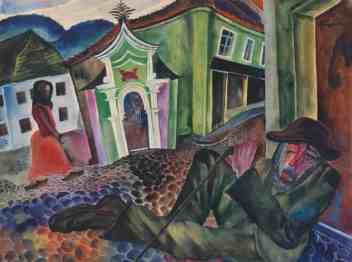
The Beggar of Prachatice by Conrad Felixmüller (1924). Photograph: The George Economou Collection © DACS, 2018
So, let’s try something from The Guardian. Sidney Blumenthal writes: “Want to make Jim Jordan sing about the Capitol attack? Ask Jefferson Davis’. This throws us way back to John Brown’s Raid, believe it or not.
After a bloody insurrection was quelled, a congressional committee was created to investigate the organization of the insurrection, sources of funding, and the connections of the insurrectionists to members of Congress who were indeed called to testify. And did.
…
Within hours of the assault Brown and his band were cornered in the engine room of the armory, surrounded by local militia. Then the marines arrived under the command of Col Robert E Lee and Lt Jeb Stuart. At Brown’s public trial, his eloquent statements against slavery and hanging turned him into a martyr. John Wilkes Booth, wearing the uniform of the Richmond Grays and standing in the front ranks of troops before the scaffold on which Brown was hanged on 2 December, admired Brown’s zealotry and composure.
Nearly two weeks later, on 14 December, the Senate created the Select Committee to Inquire into the Late Invasion and Seizure of the Public Property at Harpers Ferry. Senator James M Mason of Virginia, the sponsor of the Fugitive Slave Act, was chairman. He appointed as chief prosecutor Jefferson Davis of Mississippi.
Davis was particularly intent on questioning Senator William H Seward of New York, the likely Republican candidate for president.
“I will show before I am done,” Davis said, “that Seward, by his own declaration, knew of the Harpers Ferry affair. If I succeed in showing that, then he, like John Brown deserves, I think, the gallows, for his participation in it.”
In early May 1858, Hugh Forbes, a down-at-heel soldier of fortune, a Scotsman who fought with Garibaldi in the failed Italian revolution of 1848, a fencing coach and a translator for the New York Tribune, knocked on Seward’s door with a peculiar tale of woe. He had been hired by Brown to be the “general in the revolution against slavery”, had written a manual for guerrilla warfare, but had not been paid. Seward sent him away and forgot about him.
Forbes wandered to the Senate, where he told his story to Henry Wilson, a Republican from Massachusetts. Wilson, who later became Ulysses S Grant’s vice president, was alarmed enough to write to Dr Samuel Gridley Howe, a distinguished Boston physician and reformer, founder of the first institution for the blind, and Massachusetts chairman of the Kansas committee. Wilson relayed that he had heard a “rumor” about John Brown and “that very foolish movement” and that Howe and other donors to the Kansas cause should “get the arms out of his control”.
But Howe, a member of the Secret Six, continued to send Brown money.
The investigating committee called Seward and Wilson. On 2 May 1860, Seward testified that Forbes came to him, was “very incoherent” and told him Brown was “very reckless”. Seward said he offered Forbes no advice or money, and that Forbes “went away”.
Davis pointedly asked Seward if he had any knowledge of Brown’s plan to attack Harpers Ferry.
Seward replied: “I had no more idea of an invasion by John Brown at that place, than I had of one by you or myself.”

Self-Portrait with Model in the Studio by George Grosz (1930-37). Photograph: © Estate of George Grosz, Princeton, N.J. 2018
Again, this is a long read but fascinating. I took many trips as a Girl Scout and Elementary school kid to John Brown’s cave in Nebraska City. I never actually read this account of the senate investigation with the soon-to-be insurrectionists to our Republic in charge.
If you want some real clickbait on places not to hold your next Birthday Bash, check out this from The Hill and Albert Hunt: “‘Freedom-loving’ conservatives stoked the latest round of infection and death.”
I write columns about politics and government, occasionally indulging as a frustrated sports writer; I don’t write about business or leisure activities except:
- I would avoid any cruise ships embarking from Florida. The state barred these ships from requiring passengers and staff to be vaccinated. That was upheld by a conservative appeals court.
- I’d think twice about locating or expanding a business in Texas. The state prohibits most private concerns from requiring customers to be vaccinated. There are severe punishments for avoidance.
- I’d skip any August vacation plans to Branson, Mo., or Nashville, Tenn. In Taney County, where Branson is located, the Ozark destination spot for country music and other entertainment, fewer than 40 percent of residents are vaccinated following state resistance efforts. Tennessee fired its top public health officials — apparently for encouraging teenagers to get vaccinated; a Nashville area evangelical pastor threatened to evict any parishioners who wear masks.
Hopes that the misery of the pandemic is over are diminishing. There are more than 75,000 new infections daily, six times greater than a month earlier, overwhelmingly from the Delta variant and almost all among the unvaccinated.
Hospital intensive care units face overcrowding, again. If the spread isn’t stopped, new variants — perhaps more lethal — will emerge.
There are a few unvaccinated for religious reasons, and people of color who have historical reasons to distrust public health workers and the CDC.
But chiefly, the vaccination failure is because Coronavirus has been politicized among conservatives, with right-wing politicians, judges, think tanks and activists charging it’s all about personal liberty. This ignores the fact that exercising those personal liberties risks the liberties — and lives — of others.
Accordingly, there is a pressing need for a more forceful public and private response to a looming crisis brought about largely through conservative hypocrisy.
Conservative Republicans used to argue that government should only sparingly dictate practices to private companies; Florida Gov. Ron DeSantis and Texas Gov. Greg Abbott are ignoring that philosophy. Republicans also used to argue that the government closest to the people governs best; their updated version adds the caveat: ‘unless local governments are run by liberals or minorities and the state government by Republicans.’
There’s the politicized judiciary. in a speech to the Federalist Society late last year — after the election — Supreme Court Justice Samuel Alito lashed out at the social distancing, mask wearing and other COVID measures: “We have never before seen restrictions as severe, extensive and prolonged as those experienced for most of 2020.” Of course, we actually have: rationing for food, gas and other resources during World War II; pervasive wage and price controls from 1971 to 1973.

Gert Wollheim, Untitled (Couple), 1926.
Ah, America, confuzzled and misinformed.
And, this kinda takes the cake for Trumpian Delusion: “Mark Meadows: Trump meeting with his ‘cabinet’ (despite not having one).” When BB told this to me, I was speechless. This is from CNN.
Former Trump White House Chief of Staff Mark Meadows told Newsmax that the former president has been holding meetings with his “cabinet” despite not being president.
There’s a video interview with Maggie Haberman if you want to go there.
This is way longer than I assumed it would be but hope you can find some time to read some of these.
What’s on your reading and bloggling list today?

 peej
peej Carissa
 bostonboomer
 dakinikat
 ecocatwoman
 mablue2
 Mama Lopez
 peggysue22
 quixote
 skydancingguestblogger
 Mona (aka Wonk the Vote)



 Sky Dancing
Recent Comments