
Friday Reads: To Sir, with Love
Posted: January 7, 2022 Filed under: January 6 Committe, Joe Biden, Senate, SOTU, The filibuster, U.S. Economy 9 Comments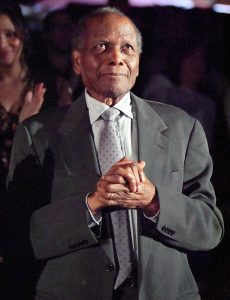 Good Day Sky Dancers!
In the last few years, we’ve seen the loss of the cultural and historical icons of the twentieth century. I’m pretty convinced that we’ve seen the end of American dominance since the World Wars, so this just seals the deal. We’re losing the last of heroes of the American Century. Sidney Poitier was a fixture in the Civil Rights Movement and one of the stars of the Golden Age of Cinema and TV. He passed quietly yesterday at the age of 94.
I loved many of his movies, but my most vivid memory of him was watching ‘In the Heat of the Night’ in a small downtown theatre in Estes Park, Colorado, with my parents and sister. It was probably the first serious adult movie I’d ever seen with its themes of violence and racism. Here is an excerpt from his New York Times Obit.
In 1967 Mr. Poitier appeared in three of Hollywood’s top-grossing films, elevating him to the peak of his popularity. “In the Heat of Night” placed him opposite Rod Steiger, as an indolent, bigoted sheriff, with whom Virgil Tibbs, the Philadelphia detective played by Mr. Poitier, must work on a murder investigation in Mississippi. (In an indelible line, the detective insists on the sheriff’s respect when he declares, “They call me Mr. Tibbs!”) In “To Sir, With Love,” he was a concerned teacher in a tough London high school, and in “Guess Who’s Coming to Dinner,” a taboo-breaking film about an interracial couple, he played a doctor whose race tests the liberal principles of his prospective in-laws, played by Spencer Tracy and Katharine Hepburn.
Throughout his career, a heavyweight of racial significance bore down on Mr. Poitier and the characters he played. “I felt very much as if I were representing 15, 18 million people with every move I made,” he once wrote.
Mr. Poitier grew up in the Bahamas, but he was born on Feb. 20, 1927, in Miami, where his parents regularly traveled to sell their tomato crop. The youngest of nine children, he wore clothes made from flour sacks and never saw a car, looked in a mirror, or tasted ice cream until his father, Reginald, moved the family from Cat Island to Nassau in 1937 after Florida banned the import of Bahamian tomatoes.
When he was 12, Mr. Poitier quit school and became a water boy for a crew of pick-and-shovel laborers. He also began getting into mischief, and his parents, worried that he was becoming a juvenile delinquent, sent him to Miami when he was 14 to live with a married brother, Cyril.
Mr. Poitier had known nothing of segregation growing up on Cat Island, so the rules governing American Black people in the South came as a shock. “It was all over the place like barbed wire,” he later said of American racism. “And I kept running into it and lacerating myself.”
In less than a year he fled Miami for New York, arriving with $3 and change in his pocket. He took jobs washing dishes and working as a ditch digger, waterfront laborer and delivery man in the garment district. Life was grim. During a race riot in Harlem, he was shot in the leg. He saved his nickels so that on cold nights he could sleep in pay toilets.
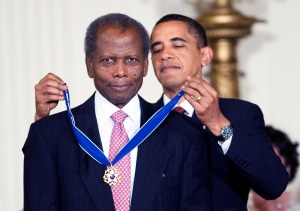
US President Barack Obama awards American actor Sidney Poitier the 2009 Presidential Medal of Freedom, America’s highest civilian honor, during a ceremony in the East Room of the White House in Washington, DC, USA, on 12 August 2009.
Sir Sidney was a leading figure in the Civil Rights Movement. He holds a place in the International Civil Rights: Walk of Fame.
Born February 20, 1927, Sidney Poitier’s pioneering career has had a tremendous impact on American culture. In the early ’50s, he was the top and virtually sole African-American film star—the first black actor to become a hero to both black and white audiences. Poitier was also the first black actor to win a prestigious international film award. With his unique career, Sidney Poitier helped change many stubborn racial attitudes that had persisted in this country for centuries. He has built the bridges and opened the doors for countless artists in succeeding generations. He is an actor who stood for hope, for excellence, and who has given happiness to millions of people around the world. Paying tribute to Sidney Poitier in 1967, Dr. Martin Luther King, Jr. said, “He is a man of great depth, a man of great social concern, a man who is dedicated to human rights and freedom.”
Many things are going on in our country’s governance today. There are discussions about expanding the number of judges on the Supreme Court, reforming the filibuster, the economic boom with the accompanying price increases, and the incredible amount of information the January 6 Committee has received from a variety of former staffers to all levels of Republican Insurrectionists. Let me highlight some of them.
There are many big lies told by Trumperz and Trumpists.
Just one month after the attack, Meadows appeared on Fox News’s “Sunday Morning Futures” and made this claim: “As many as 10,000 National Guard troops were told to be on the ready by the secretary of defense. That was a direct order from President Trump.”
Fact Checkers at the Washington Post fact checked reporting by a Vanity Fair reporter who was there at the time of the discussion. Fox and Meadows are caught in another big lie. It never went anywhere.
It’s always dismaying when false claims that were previously debunked turn up as accepted facts months later. Yet, increasingly, Fox News hosts and their guests appear to live in a world untethered by the truth.
As we have documented before, President Donald Trump never requested 10,000 National Guard troops to secure the Capitol that day. He threw out a number, in casual conversation, that is now regarded by his supporters as a lifeline to excuse his inaction when a mob inspired by his rhetoric invaded the Capitol.
This is an exciting read. I’ve never completely understood the filibuster other than it’s basically a relic of the old south its ongoing problems with slavery and racism.
People often overestimate the depth of the filibuster’s roots. When the Senate voted in 2013 to invoke the “nuclear option” to approve presidential nominees, then-Sen. Lamar Alexander (R-Tenn.) wrote in The Washington Post that sidestepping the filibuster was “the most dangerous restructuring of Senate rules since Thomas Jefferson wrote them.” More recently, Sen. Joe Manchin (D-W.Va.) defended the filibuster in the Charleston Gazette-Mail by saying, “Our founders were wise to see the temptation of absolute power and built in specific checks and balances to force compromise that serves to preserve our fragile democracy.”
True — but the filibuster was not one of these checks and balances. The Senate did not have any provision for a supermajority on legislation for its first 17 years. Like the House, its rules allowed a “motion for the previous question,” where a majority could move directly to vote. That provision was taken out in 1806, when Vice President Aaron Burr cleaned up what he regarded as extraneous provisions in the Senate’s cluttered rule book. For decades after the change, the status quo largely prevailed — until the 1840s, when John C. Calhoun exploited the motion’s absence to stall anti-slavery action by talking at length on the floor, joined by allies. His adversaries had no ability to stop the talk. From the 20th century on, the rules changed multiple times, always to make it easier for the majority to overcome a filibuster and move to action.
Biden will have some great information on the economy to share but will it really convince those of us that are experiences the challenges of the Covid-19 economy? Economist Noah Smith calls this the “Biden Boom”.
The official numbers aren’t in yet, but In the 4th quarter of 2021, the United States economy is believed to have grown by about 5.5% or 6% (annualized rate). That’s a pretty incredible number, when you consider that the consensus forecast for China is only 3.5% in the same quarter. But things get even more impressive when you look at the employment numbers. The unemployment rate probably fell to 4.1% in December — a number below what we used to think to think of as the “natural rate” of unemployment.
If you told me in April 2020 that unemployment would be 4.1% by December 2021, I’d have laughed in your face. And yet here we are.
Of course, after the Great Recession, we all got very used to looking past headline unemployment numbers, to see who is actually working. But now when we do that, we see that all the other numbers tell the same story. U6, the broadest measure of unemployment plus underemployment, is down to the level of 2018 or 2006. And my personal favorite labor market indicator, the prime-age employment-to-population ratio, is back to the level of late 2017.
Other indicators also show an extremely healthy labor market. While some have interpreted rising quits as a sign of a “Great Resignation”, the truth is that this mostly just reflects job churn; people are quitting in order to get better jobs, because the opportunities are so good. To see that, check out this graph from the Economic Policy Institute, showing that hires are greater than quits pretty much everywhere:
He’s got some wonky FRED graphs to back up the analysis. And, this folks explains why we see some inflation. But, that’s not a problem; the Fed needs to bump the interest rates up to more normal levels and out of historical lows. This is an economy we haven’t seen for a long time, and it’s kind’ve exciting!
The hearing to sentencing for the three murderers of Ahmaud Arbery is in court right now. Read more at the ABC link.
Well, I think that’s enough for me today. Happy Carnival Season!
What’s on your reading and blogging list today?
Oh, it’s so on this year! There are sights to see and
this song to sing!
Monday Reads: As the Insurrection Turns
Posted: January 3, 2022 Filed under: Afternoon Reads, January 6, January 6 Committee, Senate, Voter Ignorance, Voting Rights and Voter Suppression 9 Comments
The Magpie, Claude Monet,1868–1869
Happy New Year Sky Dancers!!
It’s the first Monday of the year! The country is stilled mired by Covid-19 and the ongoing insurrection. The Trumps and the pandemic dominate the news so far.
Jim McGovern–writing for The Boston Globe— has this Op-Ed headline: “The coup is still underway. Make no mistake — an aspiring dictator, egged on by his allies in Congress, failed to hold on to power this time. But those very same people haven’t given up.”
But a year later, a fundamental question remains: Will the Jan. 6 insurrection be swept under the rug, or seen for what it could be — the beginning of the end of American democracy as we know it.
Many of the people who failed to overturn the election are now using the levers of power at the state level to rig future campaigns.
They’ve introduced more than 440 bills across 49 states designed to hijack the election process and suppress the right to vote. This represents a dagger to the heart of the American experiment: that the people get to decide who is in charge. Chillingly, 34 of those bills have become law in 19 states.
Those who manufactured the crusade to steal the 2020 election know how and why they failed. They are laying the groundwork to overturn the next election successfully. The coup is still underway.
Make no mistake — an aspiring dictator, egged on by his allies in Congress, failed to hold on to power this time. But those very same people haven’t given up — they are analyzing their failures and will continue their brazen attempts to seize power by any means necessary. This is not some academic debate: In future elections, they might succeed in the unthinkable.

The Fox Hunt, Winslow Homer., 1893
Another Op-Ed in The Philladelphia Inquirer–written by Will Bunch–has this lede: “Is the ‘smoking gun’ in Trump’s Jan. 6 attempted coup hiding in plain sight? Trump insider Bernie Kerik claims ex-president drafted a letter to involve the Insurrection Act on Jan. 6. The American people need to see this.”
Thanks to a somewhat surprising source — the disgraced former New York police commissioner Bernard Kerik, a Team Trump insider — we now know the name of a document with the potential to become a “smoking gun.” Just its title suggests Trump was planning an unprecedented abuse of presidential power — to use the Big Lie of nonexistent 2020 election fraud to undo the results of a free and fair vote.
On the eve of the one-year anniversary of the insurrection that disrupted Congress and left five people dead or dying, the question that looms large over 2022 is whether the American people will ever get to see this proof, or the other evidence of the 45th president’s involvement in election tampering, in inciting those who violently rioted on Capitol Hill — and whether the endgame was an autocoup to seize power and deny Joe Biden the White House.
According to a letter from Kerik’s attorney, the document is called “DRAFT LETTER FROM POTUS TO SEIZE EVIDENCE IN THE INTEREST OF NATIONAL SECURITY FOR THE 2020 ELECTIONS” — and it’s believed to have been written on Dec. 17, 2020. That was a critical time for the Trump insiders who were accelerating their schemes to deny the presidency to Biden, even after the Democrat won 7 million more popular votes and the Electoral College by a 306-232 margin.
Here’s the catch: While Kerik, a longtime close associate of Trump’s personal attorney Rudolph Giuliani, last week turned over some election-related materials to the House Select Committee tasked with getting to the bottom of Jan. 6, the draft letter from Trump is on a list of records that Kerik is refusing to turn over — claiming that the document is shielded as “attorney work product.” While some legal experts are already throwing cold water on that claim, the reality is that Team Trump has been remarkably successful for months in stonewalling — in keeping both key records and important witnesses out of investigators’ reach. In an echo of Richard Nixon’s Watergate scandal, the future of democracy may hinge on Trump’s ability to thwart the probe.
Understanding why the 12/17/20 document could be a “smoking gun” means understanding where the concept of a national emergency and “seizing evidence,” which could include paper ballots or voting machines from the 2020 election, fits into the growing body of data showing both that an attempted Trump coup was afoot — and why it failed.
Many Republicans still believe the ‘big lie’, disregard the nature of the insurrection, as well as cling angrily to a huge set of lies about Covid-19. What can you do when so many people live in alternative reality? This is from the NPR Tweet above.
Fewer than half of Republicans say they are willing to accept the results of the 2020 election — a number that has remained virtually unchanged since we asked the same question last January.
“There is really a sort of dual reality through which partisans are approaching not only what happened a year ago on Jan. 6, but also generally with our presidential election and our democracy,” said Mallory Newall, a vice president at Ipsos, which conducted the poll.
“It is Republicans that are driving this belief that there was major fraudulent voting and it changed the results in the election,” Newall said.
Nearly two-thirds of poll respondents agree that U.S. democracy is “more at risk” now than it was a year ago. Among Republicans, that number climbs to 4 in 5.
Overall, 70% of poll respondents agree that the country is in crisis and at risk of failing.
The country can’t even decide what to call the assault on the Capitol. Only 6% of poll respondents say it was “a reasonable protest” — but there is little agreement on a better description. More than half of Democrats say the Jan. 6 assault was an “attempted coup or insurrection,” while Republicans are more likely to describe it as a “riot that got out of control.”
Americans are bitterly divided over the events that led to Jan. 6, as well.

Breton Village in the Snow by Paul Gauguin, 1894
Politico‘s Kyle Cheney asks “Could Jan. 6 happen again? The Capitol Police has made progress under a new chief. But many on the Hill don’t have an easy answer.”
But the political blight that contributed to the attack has only worsened, inside and outside the Capitol. So while leaders feel readier today than they did on Jan. 5, no one is rushing to declare the threat has passed.
“The last thing that I want to do is say, ‘this could never happen again’ and have it sound like a challenge to those people,” said Capitol Police Chief Thomas Manger, who took over the department in August after his predecessor’s ouster following the siege. “I’m not trying to be overconfident. We are much better prepared.”
The story of that preparation is only partially written, though. Capitol Police officers remain overtaxed and exhausted, logging crushing amounts of overtime as they grapple with a depleted force. Threats against members of Congress are still spiking. A Sept. 18 rally to support certain insurrectionists drew an overwhelming police presence that dwarfed the smattering of demonstrators, raising questions about an overcorrection and quality of intelligence.
And with the atmosphere under the dome as personally corrosive as ever, it’s tough to say the Capitol has moved forward from Jan. 6. Many of those who fled from or responded to the violence are indelibly scarred.
“My concern about the Capitol Police is that we’re making them work too hard and too long,” Missouri Sen. Roy Blunt, the top Republican on the Senate committee that oversees Capitol security, told reporters recently. “And we need to figure out a way to shift some of those responsibilities … or to figure out a way to recruit more people.”

January by Grant Wood.1940
The wheels of justice are moving albeit slowly. Here are so updates. This is from The New York Times: “New York A.G. Seeks to Question Trump Children in Fraud Inquiry. The attorney general, Letitia James, has subpoenaed Donald Trump Jr. and Ivanka Trump as part of a civil investigation.”
The New York State attorney general’s office, which last month subpoenaed Donald J. Trump as part of a civil investigation into his business practices, is also seeking to question two of his adult children as part of the inquiry.
The involvement of the children, Donald Trump Jr. and Ivanka Trump, was disclosed in a court document filed on Monday as the Trump Organization sought to block lawyers for the attorney general, Letitia James, from questioning the former president and his children.
The subpoenas for the former president and two of his children were served on Dec. 1, according to a person with knowledge of the matter. Eric Trump, another of Mr. Trump’s sons, was already questioned by Ms. James’s office in October 2020.
The attorney general’s effort to interview Mr. Trump under oath became public last month, but it was not previously known that her office, which has been conducting a civil investigation into the former president’s business practices for almost three years, was also looking to question Donald Trump Jr. and Ivanka Trump.

Winter Landscape by Edvard Munch (1915)
Lisa Mascaro of the Associated Press reports: “Schumer: Senate to vote on filibuster change on voting bill.”
Days before the anniversary of the Jan. 6 attack on the Capitol, Majority Leader Chuck Schumer announced the Senate will vote on filibuster rules changes to advance stalled voting legislation that Democrats say is needed to protect democracy.
In a letter Monday to colleagues, Schumer, D-N.Y., said the Senate “must evolve” and will “debate and consider” the rules changes by Jan. 17, on or before Martin Luther King Jr. Day, as the Democrats seek to overcome Republican opposition to their elections law package.
“Let me be clear: January 6th was a symptom of a broader illness — an effort to delegitimize our election process,” Schumer wrote, “and the Senate must advance systemic democracy reforms to repair our republic or else the events of that day will not be an aberration — they will be the new norm.”
The election and voting rights package has been stalled in the evenly-split 50-50 Senate, blocked by a Republican-led filibuster and leaving Democrats unable to mount the 60-vote threshold needed to advance it toward passage.
Democrats have been unable to agree among themselves over potential changes to the Senate rules to reduce the 60-vote hurdle, despite months of private negotiations.
The breaking news on this is pretty intensive, This is from the NPR tweet above. “Schumer tees up vote on rules change if voting rights legislation is blocked.” It’s a new year and a new dawn.
“Much like the violent insurrectionists who stormed the U.S. Capitol nearly one year ago, Republican officials in states across the country have seized on the former president’s ‘Big Lie’ about widespread voter fraud to enact anti-democratic legislation and seize control of typically non-partisan election administration functions,” Schumer wrote in the letter.
Democrats say last year’s insurrection was propelled by former President Trump’s false claims that the election was stolen from him and that election fraud was rampant, allegations that spurred Republican state legislatures to implement new voting restrictions.
Democrats argue passing The Freedom to Vote Act and the John Lewis Voting Rights Act, which would, among other things, ensure that states have early voting, make Election Day a public holiday and secure the availability of mail-in voting, are necessary measures to combat the actions taken by somestate legislatures.
The GOP is expected to once again reject the bills, arguing they’re a form of federal overreach. In a 50-50 Senate, Democrats need 10 Republicans to join them to advance the legislation because of the 60-vote threshold required under Senate rules. But uniform Republican oppositionhas led voting rights advocates to urge Senate Democrats to abolish the filibuster, or carve out an exception for voting rights legislation.
In order for that to happen, all Democrats need to be on board. Sen. Joe Manchin of West Virginia and Sen. Kyrsten Sinema of Arizona have repeatedly defended the filibuster and may not be open toamending it, despite supporting the voting legislation itself.
Manchintook part in a series of meetings on potential rules changes with other Democratic senators during December, which continued through the holidays.
Senators have been discussing two different approaches to altering Senate rules: either setting up a “talking filibuster” that would give the minority the ability to block action on legislation or creating a carve out that would provide a path for Democrats to pass voting rights legislation with a simple majority, according to a source familiar with the discussions.
I’ll try to post updates as we get them. Meanwhile, what’s your reading and blogging list?
Rockin’ New Year’s Eve Reads: Goodbye to a Year of Silencing Women
Posted: December 31, 2021 Filed under: just because | Tags: I am Speaking, New Year's Eve 2021, Silencing women 22 Comments Happy Friday Sky Dancers!
I’ve had to adult during my one solid week off a year and it’s been a series of having to do some training, pay bills, and work with FEMA. I had a great experience with my FEMA inspector yesterday and hopefully can get enough to get this very old kathouse an electrician to figure out why I have what seems like random electricity. I’d really like a functional laundry room again for one. I should get a response within 10 days and I’m crossing everything possible.
The Guardian has the story of Julie K. Brown and the work she did to “bring down Jeffrey Epstein”. It’s a great read.
The town of Palm Beach in Florida, the crime writer Carl Hiaasen has observed, “is one of the few places left in America where you can still drive around in a Rolls-Royce convertible and not get laughed at.” It’s an unironic island, filled with the super-rich and famous, plastic surgeons and, of course, the former US president, Donald Trump, who holds court at his ostentatious Mar-a-Lago resort.
A satellite of Miami, the island prides itself on its many flamboyant charity balls, but no amount of good-cause fundraising can remove the whiff of corruption that hangs heavy in the subtropical air. If money talks in most places, in Palm Beach it speaks with a confident authority that’s seldom questioned. Never has that understanding been more egregiously demonstrated than in the case of the inscrutable financier and sex offender Jeffrey Epstein.
n 2008 Epstein was sent to prison, having pleaded guilty to the charge of procuring for prostitution a girl below the age of 18. It was the culmination of a three-year investigation, involving first state and then federal authorities. The local police had uncovered evidence that Epstein had sexually coerced and abused scores of young women and girls, some as young as 13 or 14. There were also a number of testaments to rape.
But all throughout the prosecution seemed reluctant to take Epstein to court and the police were always one step behind their target. For a start, Epstein appeared to be tipped off that he was going to be arrested. When the police arrived at his Palm Beach mansion, six computer hard drives had been removed, along with video recordings from his internal closed circuit system. The police were never able to gain access to this potential evidence.
Florida is notorious for its harsh prison system and lengthy sentencing. Someone accused of Epstein’s alleged crimes might have been looking at 20 years in a gang-dominated penitentiary. Instead he received an 18-month sentence, of which he served less than 13 months in a private wing of the county jail. He was granted immunity for himself and four assistants for any related charges, was awarded daily work release, in which he was driven to his office by his own driver, and at night he was allowed to sleep with his jail door open. He also had access to another room where a television had been installed for him.
How did he get off so lightly? And how was he able to return to his gilded world of billionaire friends and celebrity playmates without any real stigma attached to his name? These were the questions that Julie Brown, an overworked and underpaid investigative journalist at the Miami Herald, kept asking herself towards the end of 2016.
“I wanted to do a story on sex trafficking,” she recalls on a Zoom call from New York, “but every time I googled Florida and sex trafficking, a story about Jeffrey Epstein came up.”
As she delved deeper, she realised just how far the authorities had bent over backwards to accommodate Epstein and his battery of well-paid lawyers. Although they seemingly had enough evidence to support his prosecution for much more serious crimes, they offered him a “sweetheart deal” on a relatively minor charge. Brown’s intrepid work led to a three-part Herald series in 2018 on Epstein that would encourage federal authorities to reopen the investigation and to arrest the financier.
 Along with the three-part Herald series, Brown delves into how Epstein kept getting away with rape and sex trafficking. Brown published a book this year that’s a compilation of her research. Here’s the NYT review of Perversion of Justice.
Epstein today is so universally reviled that it is easy to forget that things were not always so. Less than a year before he died in a Manhattan jail cell in 2019, awaiting trial on federal sex-trafficking charges, the self-proclaimed financier had many of the world’s richest, smartest and most powerful men on speed dial. He hopscotched the planet on his private Gulfstream. He owned an island in the Caribbean. He bankrolled pie-in-the-sky science projects, longing for immortality.
Journalists were among those who allowed themselves to be snookered. Epstein was a savvy manipulator, and many of us (including at The New York Times) were wowed by access to him and blinded by the cadre of famous men who encircled him. Too often, we viewed Epstein as a source to cultivate rather than as a predator to investigate. It was a big mistake.
Thankfully, there were exceptions. In November 2018, Julie K. Brown, a reporter at The Miami Herald, published an explosive three-part investigation into Epstein. Brown focused on how, a decade earlier, Epstein had wriggled out of a federal criminal investigation by pleading guilty to two state charges of soliciting prostitution. Florida and federal authorities, Brown reported, delivered one favor after another to the politically connected suspect and his politically connected lawyers, overruling investigators and keeping victims in the dark.
Brown’s bombshell shook prosecutors and politicians out of their yearslong stupor. Federal prosecutors in New York opened a new criminal investigation, which culminated in Epstein being arrested and charged the following summer. R. Alexander Acosta, who as the U.S. attorney in Miami had helped cut the sweetheart deal with Epstein in 2008, resigned as labor secretary.
Now, nearly two years after Epstein was found hanging in his cell in what authorities concluded was a suicide, Brown is revealing how she landed the story of a lifetime. Her book, “Perversion of Justice,” is a warts-and-all retelling of what it took to expose not just Epstein but also a badly broken justice system.
Having read the Miami Herald series, I already knew the basic plotline, but that didn’t make it any less maddening to see how Epstein’s fixers — including lawyers like Ken Starr and Alan Dershowitz — worked the system to catastrophic effect.
 The press continues to be snookered on many accounts for this and other cases involving rich old white men. I was horrified to hear that Alan Dershowitz was party to a BBC interview as an “impartial observer”. How do these things happen? Here’s the coverage from WAPO of that journalistic sin. Capturing Epstein’s powerful friends may be next on the agenda.
The BBC says it is investigating how Alan Dershowitz was allowed on its airwaves to talk about the conviction of Ghislaine Maxwell without mentioning that the constitutional lawyer is implicated in the case and accused of having sex with an alleged victim of financier Jeffrey Epstein.
Shortly after Maxwell was convicted Wednesday of sex-trafficking charges for assisting Epstein in abusing young girls, BBC News brought on Dershowitz to analyze the guilty verdict of Epstein’s longtime paramour. But the network failed to mention that Dershowitz not only previously served as Epstein’s attorney but that he is accused of having sex with Virginia Roberts Giuffre when she was as young as 16. Dershowitz has denied the allegations.
Dershowitz used his time on the “BBC World News” to slam Giuffre for supposedly not being a credible witness in the Maxwell case — claims that went unchallenged by the show’s anchor. He also claimed the case from Giuffre against him and Britain’s Prince Andrew, who has also been accused of sexual assault and has denied the allegations, was somehow weakened after Maxwell’s guilty verdict.
“The government did not use as a witness the woman who accused Prince Andrew, who accused me, accused many other people because the government didn’t believe she was telling the truth,” he said. “In fact she, Virginia Giuffre, was mentioned in the trial as somebody who brought young people to Epstein for him to abuse. And so this case does nothing at all to strengthen in any way the case against Prince Andrew.”
 Even Fox News acknowledges the connections between Dershowitz and Epstein. This New York Magazine article written by Joshua Kendall shows once again, how rich white guys can silence women. “She Tweeted That Alan Dershowitz Might Be Acting Crazy. So Yale Fired Her. The strange free-speech case of Bandy Lee.”
“I think I’ll order only a bowl of the New England clam chowder,” Bandy Lee said to me one afternoon several months ago, as we settled in at a restaurant overlooking the Boston Common. “I have just completed a 40-day fast when all I consumed was water and powdered electrolytes. So it will take a couple of days before I am ready to eat a full meal.”
When I asked her if fasting was a regular part of her dietary regimen, she said, “I’ve fasted a few times before for various reasons. On this occasion, I wanted to think through the direction of my life.”
The trajectory of Lee’s life had indeed taken a strange turn of late. A widely respected scholar who has authored over 100 peer-reviewed articles and either written or edited a dozen academic books on violence, Lee was an assistant clinical professor in the law and psychiatry department at Yale for 17 years until the summer of 2020, when Yale declined to renew her contract. The precipitating offense? Tweeting about the retired Harvard law professor Alan Dershowitz.
Lee claims it was all Dershowitz’s doing: “Dershowitz’s pressure seems to be the reason why everything changed.” But Lee had long been one of her department’s most controversial members, thanks to her outspoken, boundary-pushing commentary about Donald Trump. Still, while her department chair, John Krystal, had never liked the public attention her comments attracted, he had tolerated them as long as she made it clear that she was not speaking on behalf of the department. As he noted in a 2018 talk: “We are an academic institution which respects free speech, but the department and the medical school do not issue statements regarding the mental status of public officials. We are committed to living with this tension.”
Lee has always been driven, she says, by a “sense of social mission,” reflected in her years of work on violence prevention. She strongly identifies with Greta Thunberg and other social-justice advocates. But Lee paid little attention to domestic politics until 2016. “The morning after Trump was elected president, I decided to do something because I was convinced that his administration was likely to increase violence,” she said. The following spring, Lee organized a conference at Yale titled “Does Professional Responsibility Include a Duty to Warn?” on the subject of Trump’s mental state and the ethics of psychiatrists diagnosing him from afar. She respected the Goldwater Rule — the ethical guideline designed to prevent psychiatrists from rendering a professional opinion of a public figure without first receiving permission and conducting an examination — but she also worried about “the risk of remaining silent.”
The conference led to a 2017 book, The Dangerous Case of Donald Trump, which argued that Trump’s lack of “mental fitness” made him a threat to the nation. As Lee and Harvard Medical School psychiatrist Judith Herman put it in their introduction: “Delusional levels of grandiosity, impulsivity, and the compulsions of mental impairment, when combined with an authoritarian cult of personality and a contempt for the rule of law, are a toxic mix.” With contributions from 27 mental-health experts, the book, which sold more than 100,000 copies, claims that Trump likely suffers from a grave personality disorder such as malignant narcissism. Lee then began writing op-eds and emerged as a nationally prominent Trump critic. Being a Trump critic at Yale was not unusual, of course, but what raised eyebrows was the assertion that her critique had the weight of medical expertise behind it.

I’d like to point to another woman denied tenure at UNC because her research became a right-wing hysteria misadventure. Remember Nikole Hannahah-Jones? “Nikole Hannah-Jones’ delayed UNC tenure offer highlights political battle over critical race theory. Her 1619 Project is at the center of a debate about what public-school students can learn about race in America.” If anything, we should characterize 2021 as the year of silencing women. This is especially true of women of color.
The University of North Carolina at Chapel Hill’s board of trustees voted on Wednesday to grant tenure to Nikole Hannah-Jones after initially delaying the customary job protection for the incoming journalism professor, who is best known for her award-winning work reexamining how slavery shaped the United States’ founding.
The board’s vice chair, R. Gene Davis Jr., who was among those who voted to offer tenure to Hannah-Jones, said that UNC “is not a place to cancel people or ideas. Neither is it a place for judging people and calling them names, like woke or racist.”
“In this moment at our university, in our state, and in our nation, we need more debate, not less. We need more open inquiry, not less. We need more viewpoint diversity, not less. We need to listen to each other and not cancel each other, or call each other names. If not us, who?” Davis added in remarks after the 9-4 vote.
I still remember the women denied jobs in the Biden administration and treated horribly including one of my senators from the gret swampland of Republican Lousyanna. This was just a month ago! This wasn’t back in the McCarthy Era. But wait, another McCarthy and another McCarthy Era. This coverage is from Politico.
Saule Omarova, tapped to be comptroller of the currency, was met with resistance from Republicans over her advocacy for a dominant role for government in finance. One GOP lawmaker questioned the Cornell law professor, who was born in the former Soviet state of Kazakhstan, about her previous affiliation with a communist youth organization and asked if he should refer to her as “comrade.” Omarova vigorously denied having any sympathy with communist views.
This is from Roll Call published in early August. “Sexist comments followed by silence mar Alabama Senate race. Trump, congressman belittle female former Senate chief of staff.”
While Republicans are still celebrating electing a record number of women to the House in 2020, former President Donald Trump and a sitting member of Congress have resorted to sexist attacks in a Senate primary that won’t take place for another 10 months. Yet no one seems to care enough to condemn the comments publicly.
Katie Britt is one of a handful of Alabama Republicans running to replace GOP Sen. Richard C. Shelby, her former boss, who is not seeking reelection. Britt clearly touched a nerve among her competitors when she raised $2.2 million in less than a month after entering the race.
“I see that the RINO Senator from Alabama, close friend of Old Crow Mitch McConnell, Richard Shelby, is pushing hard to have his ‘assistant’ fight the great Mo Brooks for his Senate seat,” Trump said in a July 10 release, just a few days after Britt announced her second-quarter fundraising. “She is not in any way qualified and is certainly not what our Country needs or not what Alabama wants.”
Britt has compiled a serious résumé on and off Capitol Hill. The 37-year-old progressed from Shelby’s deputy press secretary to press secretary, earned her law degree and practiced law, then returned to the Hill as Shelby’s communications director and finally his chief of staff from 2016 to 2018. She was subsequently president and CEO of the Alabama Business Council before joining the Senate race. Calling Britt an “assistant” was clearly meant to belittle her.
“I was called that and assumed to be that more times than I can count,” said former chief of staff Kristin Nicholson, who ascended to the top job with Democratic Rep. Jim Langevin of Rhode Island at age 28. “But I never heard one of my male counterparts mistaken for a secretary.”
 This warning was published in April of this year by The Centre for International Governance Innovation. It’s written by Marie Lamensch. “When Women Are Silenced Online, Democracy Suffers.”
“I would never ever, ever subject myself to that again. It has damaged my mental health. It has made me fear for the safety of my family. It has made me fear for my safety,” says former television anchor and political candidate Tamara Taggart.
In April, during a virtual discussion on cyber harassment of journalists and politicians, Taggart recounted the avalanche of online insults and disparaging comments she received during the 2019 federal elections. As a former journalist, she was not a stranger to working in a toxic environment, but the situation worsened dramatically when she decided to run for office. “If I had known how much abuse I would face, I would not have run,” she stated.
Taggart’s experience online is not an exception. Around the world, online violence against women is pervasive and endemic. Understanding its impact on women is fundamental to our understanding of the consequences for democracy.
We know that technologies are double-edged swords. Social media platforms such as Twitter have become de facto tools for politicians, journalists and activists, and there is no denying that participation in these spaces has many benefits, for women in particular. A global report by #ShePersisted, an organization that seeks to tackle gendered disinformation and online attacks against women in politics, shows that women involved in politics benefit from an online presence, particularly since traditional media remains biased toward them. Female politicians use these platforms to connect with communities, build an identity, and shape policies and political discourse.
However, social media platforms can also silence and delegitimize women who speak out. Whether in Canada, India and Pakistan, the Philippines, or the United Kingdom and the United States, it is well documented that women, particularly those in positions of leadership or activism, are subject to more online abuse than men. In 2018, a project by Amnesty and Element AI titled “Troll Patrol” found that female politicians and journalists in Britain and the United States are abused on Twitter every 30 seconds.
 I’ve not even discussed violence or threats of violence here. We may see the end of access to the full constitutional rights of reproductive rights by mostly old white men on the Supreme Court. State Regulation of our bodies and choices and when and how to give birth is the ultimate silence of women’s moral agency. Suppression and silencing of women continue. This is an example from Australia
It is widely understood that gender-based violence disproportionately impacts Indigenous populations compared to other population groups. Why are their lives not honoured or mourned or valued in the same way?
This is from Ms. Magazine from last month. “Obstructing Black Women’s Voices Is a Form of Race-Based Violence” and was written by Michelle Duster. “Two murals commemorating suffrage are underway in Chicago. But they’re being met with resistance from—you guessed it—white men. For centuries, white men have wielded power over Black women’s ability to be respected as equals.”
Last year, a group of six women formed the Chicago Womxn’s Suffrage Tribute Committee to celebrate local suffragists and tell the unique suffrage history of the state of Illinois, which granted women restricted suffrage in 1913—seven years before the 19th Amendment was passed. It was the first state east of the Mississippi to do so.
The group secured two walls for murals through the Wabash Arts Corridor, that are perpendicular to each other. One piece by Diosa (Jasmina Cazacu) would feature portraits of seven white and three Black women leaders; the other large horizontal piece by Dorian Sylvain to accompany would have text-based wording of “I’m Speaking” with attribution to Vice President Kamala Harris. Substantial funding was secured from a few large organizations and smaller donations came from individuals. The owners of the buildings approved of the artwork to grace their walls and October 2021 installation dates were set.
Unfortunately, the white male owner of the parking lot adjacent to the building where the text-based artwork was to be painted took issue with the work and aggressively refused to rent spaces that were needed for installation equipment. This obstruction of “I’m Speaking” was reminiscent of the centuries-long dynamic of white men wielding power over Black women’s ability to be heard and respected as equals. It illustrated an attitude some white men still believe: that they have a right to determine when and where a Black woman can speak and need to approve of what she says.
 “I am speaking”–when said by a black woman of power–is evidently quite threatening to some men.
Missing and Murdered Indigenous Women and Girls (MMIWG) are victims of pervasive violence that began centuries ago, one that has gone unrecognized by governments, institutions, and society as a whole. To fight this silencing, Native communities have come together to decolonize the narrative, advocate for MMIWG, and honor the lost lives of their daughters, sisters, and matriarchs. We provide an overview of the history of MMIWG, the lack of response by the US government, and the decolonial action and advocacy by Native communities. However, we also go far beyond the typical academic article, in that we present both the factual information behind MMIWG and the emotional weight that each of the authors and those we know carry. We have incorporated stories, pictures, art, and the names of MMIWG to illustrate the ongoing reality of the attempted genocide of Native women and girls. We pray that this article aids in the honoring of our lost sisters and their families while bringing awareness of this tragedy to the eyes of those who can join us in fighting the silence.
So you might be able to guess what one of my New Year’s Eve resolutions is: Listen when Women Speak!
Happy New Year!
What’s on your reading and blogging list today?
Tuesday Reads: Surry Down!
Posted: December 28, 2021 Filed under: 2021 Insurrection, 2022 Elections, 2024 Elections, racism, Reproductive Rights, Treason and Sedition Republican Style, Voting Rights and Voter Suppression 18 Comments
Claude Monet – Luncheon on the Grass (1865-6)
Good Day Sky Dancers!
This isn’t a particularly newsy day. I’m actually thinking that might be a good thing if only most of the headlines I see weren’t about Covid-19 and the upcoming anniversary of the sedition insurrection. I’m going to take the time to dig into some other things. That’s an accidental hint because the first thing I’m going to share appeals to the kid in me that wanted to be an archeologist and you know, digging up bones and pottery of some lost tribes.
This is from NPR and involves the “big” finds of 2021 as determined by members of Trowelblazers which is “a group of four female archaeologists of different specialties dedicated to highlighting the historic and integral role of women in the “digging sciences”.” The first discovery is that of a family group of Neandertals–including children–whose footprints show that gathering may have been a family business. Is this a precursor to the family picnic?
While these aren’t the first Neanderthal footprints to be discovered, they are very special.
“This is especially nice, because it’s a group – mixed age, including children, some of which are quite young. They seem to be sort of foraging around on the edge of a lagoon,” Wragg Sykes said.
The diversity in age is key here and actually helps to challenge a common assumption that Neanderthals foraged in solitude, with the adults peeling off from the group to find food for the children.
The discovery instead gives support to the theory that hunting and gathering might have been a family affair, involving a collaborative and intergenerational effort.
Adorably, the paper also noted that some of the footprints which belonged to children were “grouped in a chaotic arrangement,” as if they were playing.
“That’s an angle on the Neanderthal life that we don’t often get to see,” Wragg Sykes said, adding that the discovery helps give a sense of humanity to this not-so-distant human relative.

Pieter Bruegel the Elder – The Harvesters (1565)
Other finds include powerful women in ancient Spanish society, a million-year-old mammoth, and early tracks in Tanzania that were previously thought to belong to bears but instead, the prints “are an estimated 3.6 million years old, are the oldest evidence of bipedal locomotion of a human ancestor.” It’s a really interesting set of reads.
We lost another American feminist icon this week. “Sarah Weddington, Who Successfully Argued Roe v. Wade, Dies at 76. She went before the U.S. Supreme Court at 26 with almost no legal experience and won one of the most consequential cases in American history.” This is from her NYT Obit.
The Supreme Court first heard appeals on Dec. 13, 1971, with Ms. Weddington making the oral arguments.
“Weddington enjoyed the public stage as much as Coffee disliked it,” Joshua Prager, a journalist, wrote in Vanity Fair in 2017. “Moreover, despite her brilliance, Coffee could come across as bedraggled. And optics mattered. ‘She was younger than I was,’ Coffee said of Weddington. ‘She was blond, blue-eyed.’”
Jay Floyd, who was representing Texas, opened his argument with what commentators have called the “worst joke in legal history.” “It’s an old joke,” Mr. Floyd told the court, “but when a man argues against two beautiful ladies like this, they are going to have the last word.”
As it happened, only seven of the nine justices heard the arguments that day — two others had retired and had not yet been replaced. The justices then decided that the case should be reargued before the full court. All justices were sitting when Ms. Weddington came back on Oct. 11, 1972, and reargued the case.
Their 7-2 decision held that Texas had violated Roe’s constitutional right to privacy as outlined in the First, Fourth, Ninth and Fourteenth Amendments.
The decision was widely praised at the time. But with the rise of the religious right a few years later, abortion became a volcanic political issue, and it remains one of the most divisive in American society. Ms. Weddington received death threats and often traveled with security.

Renoir – Luncheon of the Boating Party (1880-81)
An important case in voting rights today will be heard in the Ohio Supreme Court. It concerns the highly gerrymandered new congressional districts. Governor DeWine’s son is on the bench and refused to recuse himself. Given the Governor is one of the parties being sued by the ACLU the people there should be outraged. The hearing is being broadcast live here.
Today’s Oral Arguments: 2021-1428/ Regina C. Adams, et al. v. Governor Mike DeWine, et al. 2021-1449 League of Women Voters of Ohio, et al. v. Ohio Redistricting Commission, et al.
This article discusses how Ohio Supreme Court Justice Pat DeWine’s refusal to recuse himself from the lawsuit involving his father may be unprecedented. It’s from Cleveland.com. It is written by Cory Schaffer.
Ohio Supreme Court Justice Patrick DeWine’s refusal to recuse himself from trio of redistricting lawsuits, in which his father — Gov. Mike DeWine — is a defendant who will testify as a witness, might be unprecedented.
Cleveland.com and The Plain Dealer set out to find a case where the Ohio Supreme Court’s chief justice considered whether a judge, at any court level, should be allowed to preside over a case in which his or her parent or child was a participant. The outlet searched through dozens of cases where the chief justice was asked to force a judge off of a case. Cleveland.com also spoke with multiple attorneys, all of whom declined to comment for this story.
Okay, one article on what we’re learning about what could’ve happened on sedition day. This is from TPM: “EXCLUSIVE: There Was ANOTHER Rally Planned On Jan. 6 … At The Supreme Court. The same people who organized Trump’s fateful rally on the Ellipse had something else in store on Jan. 6: a rally planned in front of the Supreme Court.” Josh Kovensky has the byline.
The same people who organized Trump’s fateful rally on the Ellipse had something else in store on Jan. 6: a separate, previously unreported rally planned in front of the Supreme Court.
According to text messages and invoices obtained by TPM and provided to the House Jan. 6 Committee, the rally outside of the Supreme Court was set for the afternoon of Jan. 6 with some of the same speakers scheduled to appear.
The plan for a Supreme Court rally after the event at the Ellipse reveals a new and different perspective on the geography and timing of the attack on the Capitol.
We already knew that President Trump amassed supporters at the Ellipse, at the White House end of Pennsylvania Avenue, and dispatched them toward the Capitol end of Pennsylvania Avenue, declaring that he would walk with them before promptly returning to the White House. But whether the rally at the Ellipse was planned as a march on the Capitol, even though it was never issued a march permit, remains a hotly contested issue. Regardless, rioters penetrated the Capitol even as the President was still speaking at the Ellipse.
But now TPM’s reporting suggests that the Ellipse rally organizers intended to hold a separate 2 p.m. ET event on the steps of the Supreme Court, across the street from the Capitol, where Congress began certifying the Electoral College vote at noon ET. It suggests that organizers wanted to keep up the pressure on Congress through an event far closer to the Capitol.
And to get there, Big Lie supporters would have had to walk past the Capitol building, traversing a geographic bit of irony: Constitution Avenue.

It’s a long read but try to skim through it at least. The Augusta Chronicle reports that the county is closing 7 of 8 polling places in Lincoln County Georgia. The county is deep in rural Georgia. Officials argue that one location will make it more convenient for people to vote. The county is heavily black and has no public transportation.
Lincoln County is trying to close all but one polling place for next year’s elections, a move opposed by voting and civil rights groups.
Relocating voters from the county’s seven precincts to a single location will make voting “easier and more accessible” and eliminate the need to transport voting equipment and staff the remaining sites, according to a news release. Community members disagreed.
“Lincoln County is a very rural county. Some people live as far as 23 miles from the city of Lincolnton,” said Denise Freeman, an activist and former Lincoln County school board member. “This is not about convenience for the citizens. This is about control. This is about the good old boys wanting to do what they’ve always done, which is power and control.”
The move was made possible after the Georgia General Assembly passed legislation earlier this year disbanding the Lincoln County Board of Elections. The chief sponsor of Senate bills 282 and 283 was Sen. Lee Anderson, R-Grovetown, whose district includes Lincoln County. The newly-appointed board agreed to move forward with the “consolidation” plan and was expected to vote on it last week, but appeared to lack a quorum, several said.
I imagine they will keep trying just like the Radical Republican Right did in Texas. I intend to keep my jaded eyes on gerrymandering cases and voting rights and that is my new year’s resolution. Oh, that and spending a lot more time in my PJs with a cuppa!
So, that’s enough for me today. Thanks to BB for helping me out yesterday! I made it through my last dentist appointment for the year. I intend to continue to stay in my pjs doing exactly what I want this week.
What’s on your reading and blogging list today? Meanwhile, surry down to a Stoned Soul Picnic!
Friday Reads: May Peace Abide!
Posted: December 24, 2021 Filed under: Voting Rights and Voter Suppression | Tags: The 12 Days of Yule 35 Comments
Yule log
Good Day Sky Dancers!
Gosh there are so many headlines today that it’s hard to find any major theme other than we’re all dealing with chaos right now. As BB wrote yesterday, the Omicron Virus is proving to be more dangerous than we thought and a huge surge is on the way. Most of the surge will be in the unvaccinated and a serious mask is indicated if you’re out and about. (Via. NPR.)
With another coronavirus variant racing across the U.S., once again health authorities are urging people to mask up indoors. Yes, you’ve heard it all before. But given how contagious omicron is, experts say, it’s seriously time to upgrade to an N95 or similar high-filtration respirator when you’re in public indoor spaces.
“Cloth masks are not going to cut it with omicron,” says Linsey Marr, a researcher at Virginia Tech who studies how viruses transmit in the air.
Omicron is so much more transmissible than coronavirus variants that have come before it. It spreads at least three times faster than delta. One person is infecting at least three others at a time on average, based on data from other countries.
“It’s very contagious,” says Dr. Robert Wachter, chair of the Department of Medicine at the University of California, San Francisco. “And the kind of encounter that you could have had with prior versions of the virus that would have left you uninfected, there’s now a good chance you will get infected from it.
 WAPO reports “White House reporters ask for virtual press briefings during the latest covid surge.” The list of vaccinated Senators and Congress members with COVID-19 positive tests is amazing.
The White House Correspondents’ Association has proposed holding the daily briefings on Zoom or some other online platform to avoid face-to-face contact in the White House’s cramped briefing room.
The WHCA is concerned that reporters face an elevated risk of being infected with the highly contagious omicron variant — or infecting their colleagues with it — while congregating in the 49-seat briefing room or the narrow workspaces behind it.
In a memo sent to members on Tuesday, the group’s president, Steven Portnoy, noted that President Biden himself had said in a speech earlier in the day that omicron cases are likely to be widespread in many workplaces, including at the White House.
This is what a Republican used to look like. I’ve never really been into this guy but this is a nice move on his part.

Brigit hugs one of her beloved hares
Then there is this story from Rolling Stone. I really wish Krampus would’ve of drug all these people off in his wooden cart. “MAGA Diehards Melt Down Over Trump’s Pro-Vax Push. Anger and confusion reign as Trump endorses vaccines many followers believe are poison”
In fairness to the boo birds, the pro-booster message was an about-face for Trump, for whom consistency has never been a virtue. Over the summer he dismissed the notion of a third jab as “a money-making operation for Pfizer.” This message vibed with the anti-vax fever swamps, which have long decried Big Pharma for raking in profits by pushing vaccines that (they believe against all evidence) poison patients, instead of protecting them.
As the president’s new, unabashed booster endorsement rippled out across right-wing social media, it was met with an combustible mix of anger, confusion, contorted excuses, and denial so pure it’s as if the former president had never uttered a word.
For a sign of just how severely Trump wrong-footed himself with his base by endorsing boosters, look no further than the editorial cartoonist Ben Garrison. The doodler’s devotion to the 45th president has been slavish, but Garrison’s opposition to the vaccine has also been stalwart. His latest cartoon opus shows Trump riding aboard on the “Big Pharma Vaccine Bandwagon” as he’s booed by the MAGA-hatted masses.
There’s a lot of other weirdness in the news today!
The LAPD have proved themselves craven again. This is from the NYT.
 They couldn’t have just nabbed the guy without shooting up a retail store during the last-minute holiday shopping crowd?
The teenager had been in the dressing room with her mother, the Los Angeles Police chief, Michel R. Moore, told LAist.com, adding that the shooting was the “worst thing anyone can imagine.” The police did not immediately release the girl’s name.
Chief Choi described the encounter as a “tragic and unfortunate sequence of events” and said it remained under investigation. He said that the investigation had indicated that the girl had been fatally shot by the police.
“Preliminarily, we believe that round was an officer’s round,” he said.
He said investigators had not yet reviewed body-camera video or the store’s security-camera footage, although it appeared the dressing room had been in the officer’s line of fire.
Orange Caligula has taken his plea for hiding his complicity in the Insurrection to SCOTUS. The committee has zeroed in on his stalling during the insurrection and is considering criminal charges. This is from MSNBC: In bid for Jan. 6 secrecy, Trump asks Supreme Court for help. Two weeks ago, Donald Trump said he has “nothing to hide” about Jan. 6. Today, he asked the Supreme Court to help him hide Jan. 6 materials. This was written by Steve Benen.
A couple of weeks ago, Donald Trump appeared on Fox News and was asked about the investigation into the Jan. 6 attacks. “Honestly, I have nothing to hide,” the former president said. “I wasn’t involved in that.”
For a guy who has nothing to hide, the Republican continues to invest a lot of effort into keeping Jan. 6 materials hidden. NBC News reported this afternoon:
Lawyers for former President Donald Trump on Thursday asked the Supreme Court to block the National Archives from turning over White House records to the House committee investigating the Jan. 6 riot at the Capitol. In a petition filed with the high court, lawyers for Trump said the Washington, D.C., Court of Appeals erred in its ruling earlier this month directing the records to be turned over, and urged the Supreme Court to intervene.
For those who may need a refresher about how we arrived at this point, it was two months ago when the bipartisan House committee investigating the Jan. 6 attack requested extensive materials from the White House, prompting Trump to demand absolute secrecy.
In fact, the former president and his team have tried to exert “executive privilege” to block the select committee’s requests. As NBC News recently noted, as a matter of tradition, sitting presidents have shielded White House materials at the request of their predecessors. But not this time: President Joe Biden and his team concluded that there are “unique and extraordinary circumstances” surrounding the insurrectionist attack on the Capitol.
Trump and his team sued both the committee and the National Archives, which houses presidential records.
In November, a federal district court ruled against the Republican, reminding him, “Presidents are not kings.” Two weeks ago, a unanimous federal appeals court came to the same conclusion.
As regular readers may recall, the ruling was unsparing in its rejection of the former president’s arguments. “President Trump bears the burden of at least showing some weighty interest in continued confidentiality that could be capable of tipping the scales back in his favor…. He has not done so,” the three-judge panel wrote. “He has not identified any specific countervailing need for confidentiality tied to the documents at issue, beyond their being presidential communications. Neither has he presented arguments that grapple with the substance of President Biden’s and Congress’s weighty judgments. Nor has he made even a preliminary showing that the content of any particular document lacks relevance to the Committee’s investigation.
 Ed Pilkington–writing for The Guardian–sums up a report showing just how much Republicans in state and local governments are trying to destroy democracy
The Republican assault on free and fair elections instigated by Donald Trump is gathering pace, with efforts to sabotage the normal workings of American democracy sweeping state legislatures across the US.
A year that began with the violent insurrection at the US Capitol is ending with an unprecedented push to politicize, criminalize or in other ways subvert the nonpartisan administration of elections. A year-end report from pro-democracy groups identifies no fewer than 262 bills introduced in 41 states that hijack the election process.
Of those, 32 bills have become law in 17 states.
The largest number of bills is concentrated in precisely those states that became the focus of Trump’s Stop the Steal campaign to block the peaceful transfer of power after he lost the 2020 presidential election to Joe Biden. Arizona, where Trump supporters insisted on an “audit” to challenge Biden’s victory in the state, has introduced 20 subversion bills, and Georgia where Trump attempted to browbeat the top election official to find extra votes for him has introduced 15 bills.
Texas, whose ultra-right Republican group has made the state the ground zero of voter suppression and election interference, has introduced as many as 59 bills.
“We’re seeing an effort to hijack elections in this country, and ultimately, to take power away from the American people. If we don’t want politicians deciding our elections, we all need to start paying attention,” said Joanna Lydgate, CEO of the States United Democracy Center which is one of the three groups behind the report. Protect Democracy and Law Forward also participated.
One of the key ways that Trump-inspired state lawmakers have tried to sabotage future elections is by changing the rules to give legislatures control over vote counts. In Pennsylvania, a bill passed in the wake of Trump’s defeat that sought to rewrite the state’s election law was vetoed by Democratic governor Tom Wolf.
Anyway, I don’t go back to the podium until next year and I’m celebrating my 4th day in pjs. I hope you get a chance to relax and that the expectations of what should be this time of year don’t overwhelm you! Whatever your plans are, be kind to yourself and the ones around you.!
What’s on your reading and blogging list today?

 peej
peej Carissa
 bostonboomer
 dakinikat
 ecocatwoman
 mablue2
 Mama Lopez
 peggysue22
 quixote
 skydancingguestblogger
 Mona (aka Wonk the Vote)



 Sky Dancing
Recent Comments