
What the Socialists just said …
Posted: December 12, 2010 Filed under: just because, The Media SUCKS, the villagers | Tags: Comrade Obama, democratic socialism., socialism 38 Comments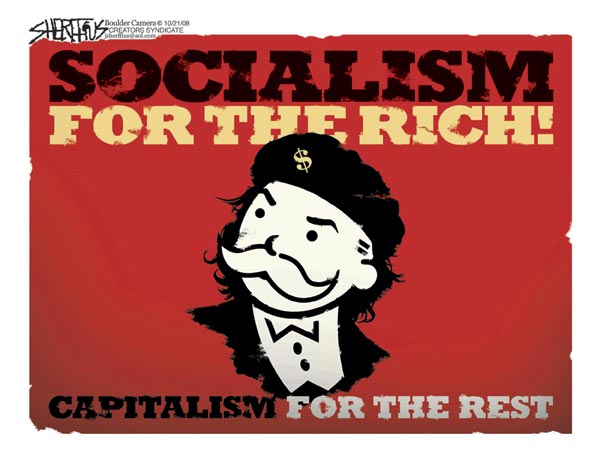 Well, here goes my shot at ever working again. I’ve not only proclaimed this week ‘I love Senator Bernie Sanders Week’, I’m going to quote the World Socialist Web Site and agree with socialist Barry Grey.
To be honest, the U.S. really doesn’t have an active Socialist movement or anything close to the socialist left in Europe let alone other places. WSWS is one voice of socialism. Glenn Beck and the Tea Party are regaling themselves as mainstream and the dude they’re reading these days thought President Dwight Eisenhower was a communist agent. If that’s the new normal, then, maybe I am a Marxist by that silly ruler. But, anyway, at the risk of being labeled a red, here we go.
Grey’s article talks about Progressive (TM) hand wringing over Obama’s supposed lurch to the right. There was no lurching involved imho. Obama is just one of those pols that says one thing and does another. I frankly have no idea what he actually thinks. So, the fun part of this blog post is reading Grey dissect what is “more repugnant”, the villager’s “stupidity or their cynicism”. Grey cites a bunch of whiny, disillusioned villagers in the process. He identifies their central theme as:
The general theme of these commentaries—amidst the pleading, scolding and whelps of despair—is that Obama must reclaim his “core values” and start fighting the Republican right. It is summed up by Adam Green, co-founder of the Progressive Change Campaign Committee, who writes: “At this point, the strategy is to shame [Obama] into fighting.”
So, this is my first issue. I just was talking to BB earlier and I personally believe that Obama has no “core values’. He just says what’s expedient for the moment that gets him where he wants to be. He’s like the ultimate pragmatist; whatever works for the moment. I even wrote a post to that effect years ago here that accused Obama of always “doing the chameleon”. It’s his past MO that convinced me of this two years back. There are way too many ‘present’ votes in the Illinois legislature and tales of Obama hiding in the bathroom to avoid votes for there to be evidence that he’ll fight for anything other than a chance to get to higher office in a shorter period of time. He seems to have joined and ditched groups–ask Jeremiah Wright–more for the connections than for the higher purpose. As my post notes, he flip flopped all over the place during 2008. Why should we expect anything different?
The article cites lots of examples of villagers looking for Obama redemption.
Among the notable examples of such lamentations is Frank Rich’s column in the December 5 New York Times, which makes the tongue-in-cheek suggestion that Obama has been taken hostage by the Republicans and his behavior is best explained by reference to the Stockholm Syndrome.
Rich writes: “The captors will win this battle [over extending Bush-era tax cuts for the top 2 percent of US households], if they haven’t already by the time you read this, because Obama has seemingly surrendered his once-considerable abilities to act, decide or think.”
Liberal economist Paul Krugman, in a December 2 New York Times column written in response to Obama’s announcement of a two-year freeze on federal workers’ pay, is harsher:
“After the Democratic ‘shellacking’ in the mid-term elections, everyone wondered how President Obama would respond. Would he show what he was made of? Would he stand firm for the values he believes in, even in the face of political adversity?…
“It’s hard to escape the impression that Republicans have taken Mr. Obama’s measure—that they’re calling his bluff in the belief that he can be counted on to fold. And it’s also hard to escape the impression that they’re right.”
David Corn, the Washington bureau chief of Mother Jones and a columnist for PoliticsDaily.com, writes, more in sorrow than in anger:
“President Obama, in the instance of this apparent tax cut compromise, seems to be settling without waging a principle-driven battle, and that is puzzling many of his progressive loyalists… His reasons for eschewing a showdown remain a mystery… A deal like this … will drive many progressives crazy, for they’re looking to Obama to lead a charge against the Republicans, not yield to their threats.”
Michael Lerner, the editor of Tikkun, suggests that the best way to “get Obama to become the candidate whom most Americans believed they elected in 2008” is to challenge him from the left for the Democratic presidential nomination in 2012. The idea is not to defeat the incumbent, but to “pressure Obama toward much more progressive positions and make him a more viable 2012 candidate.”
As Eleanor Clift notes in Newsweek, “MoveOn.org is running ads with the theme ‘Bring Obama Back,’ calling on the president to ‘be the president we fought to elect’ and to hold firm on his promise to end tax breaks for the richest Americans… It’s a chance to reclaim his convictions, and Obama should seize it.”
Katrina vanden Heuvel, editor and publisher of the Nation, bemoans “Obama’s Disastrous Path” in her December 7 column in the Washington Post. Defining herself as a “progressive supporter” of Obama, she lists the president’s right-wing moves since the mid-term election debacle, ranging from his abject apologizing to the Republicans to effectively abandoning his July 2011 date for beginning to withdraw troops from Afghanistan.
Vanden Heuvel objects to Obama’s leaning toward the notion that “we should impose austerity now, instead of working to get the economy going.” The operative word here is “now,” as it implies her agreement with the official line of the administration that whether sooner or later, austerity must be imposed.
Absurdly inflating Obama’s stature, she declares: “This president has a historic mandate. Just as Abraham Lincoln had to lead the nation from slavery and Franklin Roosevelt from the Depression, this president must lead the nation from the calamitous failures of three decades of conservative dominance.”
This, she continues, “is the necessary function of a progressive president… If he shirks it, [Obama] risks a failed presidency.”
I still don’t know what some of these people have been smoking or drinking. I don’t see anything in Obama’s past history that would give me the impression he would wage a “principle-driven battle” on anything. He says he supports GLBT rights and then he shows up with some of the most notorious homophobic religious nuts in the country and expands their role in ‘faith driven’ government GOTV grants. He doesn’t appear to be using his bully pulpit or his pen to remove DADT. The most he appears to be doing is a few symbolic finger waggings. He says he supports a woman’s choice on reproductive health and then immediately sells every women’s uterus to the Stupakistan terrorist groups to drive through Romney/DoleCare; the healthcare reform that was less liberal than Richard Nixon’s plan. He says he doesn’t support War or torture, but then sends Holder on an endless mission to defend the Dubya policies and people at every turn.
What core values? What principled actions?
I even read an Ismael Reed Op-ed this morning that says that Obama can’t afford to get angry without being tagged a militant black man. Was any one ever intimidated or upset when Steven Urkel got really mad? Even the Steven Urkel character had scripted moments when he took principled stands. No one wrote any thing about intimidation into the script and TV scripts love stereotypes. We can’t get a little righteous anger from our Nerd-in Chief?
Better questions come from Grey:
They all proceed from the premise that Obama is a “progressive.” Why? On what basis? There is nothing in his political career either before or after his election that suggests anything other than a conventional—i.e., right-wing—American bourgeois politician.
In the end, they brand Obama a progressive on the grounds that he is Democrat and an African-American. Here on full display is the political bankruptcy of the rejection of social class as the basic criterion in politics and its replacement by race and other forms of personal identity.
Yes, yes, yes. That is it. (Well, except I wouldn’t call him an “American bourgeois politician” since I really am not a socialist by nature.) The richest among us slice and dice us into neat little angry groups of Tea Partiers and New Black Panthers so that we get more mad at the idea of Raj in Bangalore taking a job or the idea that civil rights can cause ‘reverse discrimination’ against white men or that we’re being invaded by Mexicans who are driving all of our wages down or all white people are natural born racists. It’s all the poison flowers of the same ugly little divide and keep them in corporate serfdom seeds.
Continue on with Grey. He’s so worth reading.
What are the “core principles” that Obama has supposedly abandoned and must now reclaim? The only principles he has evinced are the defense of the global interests of US imperialism and the wealth and power of the American financial aristocracy. Aside from occasional cheap demagogy, he has shown nothing but indifference and contempt when it comes to the American people.
The apotheosizing of Obama by this political milieu is ultimately a function of their own social being. They represent a very privileged, comfortable and complacent layer of the upper-middle class, and their pro-Obama, pro-Democratic Party politics reflects very real, material interests—interests that are sharply at odds with those of the working class.
One need only ask, in precisely what does their “progressiveness” consist? They do not advocate serious social or political reforms, let alone socialist policies. On the contrary, they tenaciously uphold a political system dominated by two utterly corrupt and reactionary parties of the American plutocracy.
They do not, for the most part, even call for an end to the US wars of aggression that are killing hundreds of thousands and destroying entire societies in the Middle East and Central Asia.
The people who are writing these words are–as Grey writes–writing from the comfort of their own social being. Dana Millbank and the other villagers are the constituents defending the Obama tax cave-in because they will be some of the few beneficiaries. Check out this FDL Diary from Blue Texan and check out the comments. You can check out more on this vapid Dana Millbank column at Economist’s View. Krugman, Thoma, and Dean Baker all take a punch at Millbank who just loves him some hippy punching. Krugman has a statement about the topic here too.
So look at how the Village constructs its mythology. The real story, of pretend moderates stalling action by pretending to be persuadable, has been rewritten as a story of how those DF hippies got in the way, until the centrists saved the day.
The worst of it is that I suspect Obama’s memory has gone down the same hole.
Grey states it eloquently.
What really upsets them about the crass manner in which Obama prostrates himself before the Republicans and Wall Street is how thoroughly it exposes their own role in promoting him and aiding the marketing campaign that was used to get him elected. They are terrified that their political dog and pony show built around Obama has so quickly and ignominiously collapsed.
So, this is what REAL socialists say about Obama. Actual socialist thought is not the Glenn Beck/Rush Limbaugh fantasy philosophy that scares working class whites into seeing brown people as the threat. It’s not found at all in progressivism (TM) that has warped like some magical Madison Avenue Marketing brand enshrouding Obama and the village into enabling the misguided notion that it’s only white men that can prevent liberty and justice for all. Ultimately, socialism asks people to look at how the very rich and the very powerful use divisive tactics to stop us little people from realizing who is taking the fruits of our labor from us. Even if you aren’t a socialist, this is an exercise worth entertaining. Now, comrades, have fun with those links!!!
Saturday Night Treats
Posted: December 11, 2010 Filed under: Treats 28 Comments Okay, it’s cold here and stormy. I know I sound down right whiny and wimpy compared to those of you way north of me, but in my 15 years here I’ve acclimated to the tropical zone. It’s a flannel pj kinda night for me even though the temp outside reads 63. It’s been in the 40s all week. I’m here with some hot green tea and there’s a pot of something hearty and bubbly on the stove.
Let’s share cold weather comfort food tonight!!!
Boullet Fricassee de Vieux Temps
(old fashioned meatball stew)
Yup, it’s Cajun.
MEATBALLS
2 lbs ground meat
1 tbs. salt
1 tsp. red pepper
1/2 tsp garlic salt
1 egg
3 tbs. salad oil
1 tbs. well chopped parsley
1 tbs. well chopped green onions
STEW:
2 quarts water
1/2 cup chopped parsley
1/2 cup chopped green onion tops … if you like them, you can also use leeks here
ROUX:
1 cup flour
1 cup salad oil
Mix all the meatball ingredients and shape them into about 2 dozen meatballs. Brown the meatballs in a heavy poit in about two cups of oil. Remove the meatballs and put them in a covered dish.
Make the roux by browning the flour in the oli in that same heavy pot. (We use Dutch ovens down here.) When the roux is a golden brown, add two quarts of cold water. Then add the meatballs. Simmer about an hour. You’ll be able to tell it’s done by the consistency of the sauce. About 45 minutes into the process, add the chopped parsley and the green onion tops or leeks.
You probably will want to adjust the seasoning a little. I’m heavy handed with cayenne and I like to put a little savory in this too. You can actually adjust the type of spice used and make it taste completely different.
I usually put this over rice but it’s okay with potatoes or pasta too.
The Hive Mentality
Posted: December 11, 2010 Filed under: just because | Tags: Charles Stross, Corporations are not People, Paul Krugman 42 Comments Wow, I get to cross reference Paul Krugman and Charles Stross in one blog post. It’s a nerd’s delight!! I also get to speak out on I why opted out of corporate life and married life despite the obvious financial benefits of both. That would be the “Hive Mentality”. I hated working in large corporations. I gradually couldn’t stand my husband more and more because he wasn’t the sweet kid that I married who adored John Lennon and Science Fiction. He is how I come to know writers like Charles Stross. The ex turned into a soldier bee that I couldn’t stand to be around. If you love your freedom and your identity more than money and power, you will die a slow, painful, agonizing spiritual death as a corporate minion. They will get to you one way or another.
Stross talks about why our politics, our society, and our people are so frigging messed up these days. He also looks at why we feel–like my neighbor Antwoine–like we vote people into office that come from various backgrounds and they invariably turn on us. Tell me truthfully, when is the last time you felt like your vote did any good?
Stross argues that the “The rot set in back in the 19th century, when the US legal system began recognizing corporations as de facto people“. I’ve actually had similar thoughts. That and I believe the recent Supreme Court decision giving them Constitutional rights essentially assigns us all to a form of serfdom. Here’s the quote that Krugman lifted from Stross’ blog that caught my attention too.
Corporations do not share our priorities. They are hive organisms constructed out of teeming workers who join or leave the collective: those who participate within it subordinate their goals to that of the collective, which pursues the three corporate objectives of growth, profitability, and pain avoidance. (The sources of pain a corporate organism seeks to avoid are lawsuits, prosecution, and a drop in shareholder value.)
Corporations have a mean life expectancy of around 30 years, but are potentially immortal; they live only in the present, having little regard for past or (thanks to short term accounting regulations) the deep future: and they generally exhibit a sociopathic lack of empathy.
I do think that my exhusband’s 20 year stint as an investment officer at Mutual of Omaha turned him into something of a Pod Person. He became part of that collective hive and its goals became his goals. He would forget to replace the milk in the refrigerator for our two small children. This would force me into the minivan–yes I had a MAZDA minivan–with hungry, whiny kids needing bundling up and buckling where I would drive miles to replace it. At they same time, he would risk life and limb to get to the Hive Collective Office that’s eaten most of historic, central Omaha in blizzards and 6 foot snow drifts. What started out as my panicked young parent self, thinking, sheesh he could die doing that eventually became, wow, he could die, I’d get the life insurance, and I’d move me and my kids to London where I could get a doctorate from the London School of Economics and they’d attend pre-school with the future kings of England. I might even wind up in Oxford with some nice Hugh Grant type tottie and a title. You can see how he eventually got on the losing side of that what-if exercise.
Even worse, however, was being part of a Hive itself. I thought–because that’s how every one thought in the 1980s–that being in my suited skirt, carrying a brief case, and being in a field surrounded with men that I would become the uberWoman role model and change the world. (Yeah, you know how THAT worked out.) What I found was a situation akin to either being oppressed or being rewarded for being the oppressor. I couldn’t take either. In my years in a corporate Hive, and then later as a consultant in Dr. Deming’s methods to some of the biggest of them (e.g. AT&T and Ford) and then state and government agencies, I found that corporations suppress innovation, data, and the human spirit in search of more power, more market, and more profit. Believe me, between my consulting and Katrina experiences, I’d turn my life over to the US Air Force or any set of government workers any day over ANY private corporation. Hence, I totally agree with Stross on this final point.
We are now living in a global state that has been structured for the benefit of non-human entities with non-human goals. They have enormous media reach, which they use to distract attention from threats to their own survival. They also have an enormous ability to support litigation against public participation, except in the very limited circumstances where such action is forbidden. Individual atomized humans are thus either co-opted by these entities (you can live very nicely as a CEO or a politician, as long as you don’t bite the feeding hand) or steamrollered if they try to resist.
In short, we are living in the aftermath of an alien invasion.
My question to you is how do we humans defeat this particularly nasty form of aliens?
Note: I’ve been over to Memorandum where they’ve featured this post and I seem to be outnumbered among those bloggers who to a man don’t agree with Stross. Typically enough of the naysayers, one is a corporate attorney, one is a Hayek fetishist, and then there’s Krugman who blames greedy individuals like the Koch brothers. Frankly, I wonder if my response is a from a mother/woman viewpoint unlike the others. Go read them. I don’t think corporations have contributed much. I think individuals contributed much until their contributions become corporations themselves. (i.e. G.E. isn’t the contributor to society; Thomas Alva Edison was) OR maybe it is JUST me.
Bernie Sanders Love Fest Open Thread
Posted: December 10, 2010 Filed under: open thread, Populism | Tags: Bernie Sanders 41 CommentsIf you didn’t catch the ‘Filabernie’ today, here’s some more! Enjoy!! Billionaires on the Warpath with greed that has no end!!!
Sen. Bernie Sanders became a sensation on cable television and new media outposts like Twitter with his filibuster Friday of a proposal to extend the Bush-era tax cuts to all Americans.
Twitter lit up with highlights from Sanders’ (an Independent from Vermont) prolonged and sometimes angry speech, decrying an agreement between President Obama and Republicans to allow the breaks even for millionaires, while he said many of his constituents are going hungry.
The filibuster, from a Dutch word meaning “pirate,” has a long and not so proud history in the U.S. Senate. Those in the majority have tried for more than two centuries to make it go away. They have failed.
Vice President Aaron Burr paved the way for the filibuster with a seemingly innocuous move in 1805 to simplify the Senate’s rules. He argued that the Senate debate guidelines were too complex and that one rule, allowing “previous question” motions, should be stricken.
The previous question rule had allowed lawmakers to end debate and call for a vote. But the Senate went along with Burr and dumped the rule. It wasn’t until more than three decades later, in 1837, that a filibuster stalled Senate action for the first time.
Bernie on Tavis Smiley: The President “is not going to sell this to me’. The costs of caving-in to Republicans will become higher in the future. They’ll come back and ask for more.
From Politico: Bernie Sanders Last Stand
The left’s been looking for a new hero. Tonight they latched onto one: Sen. Bernie Sanders.
The Vermont independent took progressive fury over President Obama’s tax-cut deal with Republicans to the floor of the Senate Friday, bringing the chamber to a standstill for eight hours with a filibuster-style speech that set the liberal Twitterverse ablaze.
“Let me conclude,” said Sanders. “It has been a long day. Let me simply say that I believe a proposal that was developed by the president and the Republicans are nowhere as good as we can achieve.”
Open Thread and Open Celebration for Truth Spoken to Power!!!
Social Security: Why mess with an American Success Story?
Posted: December 10, 2010 Filed under: Catfood Commission, legislation, POTUS, The Bonus Class, U.S. Economy, Voter Ignorance | Tags: Clinton Obama presser, payroll tax holiday, Social Security 54 Comments
I spent most of the day listening to the Bernie Sanders show, but stories of the joint Clinton/Obama presser that turned into the Bill Clinton show grabbed my interest. I have more than a passing interest in Social Security. I haven’t paid into it for about 15 years, but I have an exhusband who has and I have 20 years worth of dibs on his account. I’m a tailend boomer with a much smaller nest egg post Financial Crisis than pre Financial Crisis. Ex Hubby’s social security and his pension plan loom on my horizon. They stop me from having bag lady nightmares.
So, what’s all this talk about a payroll tax holiday and why, all the sudden, is the Cat Food Commission’s foray into social security creeping me out? Well, for one I think that a lot of people–including the President–don’t seem to get social security, its history, its issues, and its challenges and that always irks me. For another, I think it opens this trap door to having more of my future Shanghaied. I don’t want any more of anything related to my future going off to Shanghai.
So, since the President–among others–is spreading disinformation about the Social Security program, I thought I’d take the time to remind you that I wrote a four part series on Social Security in May 2009. If you want a little background and perspective, you can go check it out. (Fortunately, it’s here in the file cabinet portion of Sky Dancing.) It is all based on Academic work and people that do active research on the program, its solvency, and its issues.
First, here’s a list of links to those old posts of mine:
Social Security: Reform, Refund or Opt-Out (Part 1) Introduction
Social Security: Reform, Refund or Opt-Out (Part 2) Public Pension Concepts and Alternatives
Social Security: Reform, Refund or Opt-Out? (Part 3) Lessons from the World
Social Security: Reform, Refund, or Opt Out? (Part 4) What to do when Pensions are out of balance
I wanted to point these out since I don’t want to completely reinvent the conversation here. The government has a website that it dedicated solely to the Social Security Act of 1935. There are still many, many people that do a lot of research in the area. Here is a link to one of the new studies that looks at the impact of increasing the level of maximum earnings subject to Social Security and its impact on the program. This is one of the things that is being suggested to increase funding for social security. Here is a brief from the National Academy of Social Insurance that looks at various funding formulas. This group is actually associated with actuaries so it is quite statistics intensive. Findings specific to this brief are:
- The number of Social Security beneficiaries per 100 covered workers will increase from 30 in 2005 to 46 in 2030 and to 50 in 2050.
- Social Security benefits will rise from 4.3 percent as a share of the total economy today to 6.1 percent in 2030.
- When baby boomers are retired, the total number of people each worker supports(including workers themselves, children, retirees, and other nonworking adults) will not be as large as it was when the baby boomers were children.
- As a share of the total economy, spending for Social Security benefits when baby boomers are retired will grow less than spending for public education grew when baby boomers were children.
- While baby boomers may have been a surprise when they turned up in record numbers to enroll in kindergarten in the 1950s, their retirement six decades later is not. Policymakers began to plan as early as 1983, when Congress lowered the cost of Social Security benefits for boomers and later generations by raising the age at which unreduced retirement benefits will be paid.
- Workers’ wages are projected to grow in real terms (that is, faster than inflation). By 2030, real wages will increase 33 percent. Even if policymakers chose to balance Social Security’s finances solely by a tax rate increase, workers’ net wages (after paying the higher tax) would still be 28 percent higher than they are today.
- While earnings that are taxed to pay for Social Security represent 38 percent of the total economy, other national income is not taxed for Social Security purposes.
- Broadening the tax base, reducing scheduled benefits, raising the Social Security tax rate, or allocating other kinds of revenue to Social Security are ways to improve Social Security finances.
So, you can see this isn’t an urgent issue right now. I guess my point is that the ‘sudden’ urgency we seem to have with social security is not something out of the blue and it’s not something that hasn’t been discussed, planned for, or actually worked on. As recently as August, the President himself gave a speech saying just these things which is why I am so confused about the Cat Food Commission’s dalliance with the program.
President Obama said Social Security is not in crisis and only modest changes are needed to keep it solvent.
The president acknowledged at a small town hall gathering in Columbus, Ohio, Wednesday that the pension fund “has to be tweaked because the population is getting older” but said Republicans’ plans to drastically overhaul the program are wrong.
“Social Security is not in crisis,” Obama said. “We’re going to have to make some modest adjustments in order to strengthen it.”
I also wanted to bring up a little bit on the idea of Payroll Tax Holidays and that bizarre Clinton/Obama presser today. I’m even more confused by this sudden urge to create a payroll tax holiday. This is an odd thing.
The tax deal reached between President Obama and congressional Republicans could mean a higher tax bill for roughly one in three workers as a result of the Social Security tax cut Republicans pushed as a replacement for the current Making Work Pay tax credit.
The Making Work Pay credit gives workers up to $400, paid out at 8 percent of income, meaning that anybody making at least $5,000 gets the full amount — and gets as much as anybody else. Its replacement knocks two percentage points off the payroll tax cut, meaning a worker would need to make $20,000 to get a $400 break. Of the nation’s roughly 150 million workers, around 50 million make less than $20,000 and will see at least some increase as a result.
Additionally, roughly a quarter of 20 million state and local workers pay no payroll tax, because they have a separate pension system. Some of those workers with children will benefit from the extension of other tax credits, but overall will have less money in their pocket.
Rep. Raul Grijalva (D-Ariz.), co-chair of the Congressional Progressive Caucus, said many House liberals were opposed to the payroll tax cut because of its effect on the poorest workers. Progressives are also concerned that the tax cut will become permanent and undermine Social Security’s funding stream and political support over time.
Social Security is a stand alone program. Mixing it as part of a goodie bag with other tax things doesn’t strike me as a very good idea from a political standpoint. It’s not part of the general budget. It’s a form of insurance. We (or in my case, my exhusband mostly) paid into it. Why mix it up with other tax give aways?
I did go hunting about for information on Payroll Tax Holidays to see if they really could stimulate the economy effectively. One of my issues is that I know that the FICA taxes are regressive because of the maximum income ceiling so I thought that the spending impact couldn’t be very large. So, it seems like getting rid of some of those taxes really gives more to the rich than the poor. Rich folks really aren’t very reliable spenders. Turns out, my hunch was studied and released in early 2009 at CBPP. They basically say that the biggest benefits would go to workers least likely to spend the money. That also seems to be every one’s take on this program. Also, there are people like me who worked for states and municipalities that don’t do Social Security. We don’t get a thing from this.
A payroll tax holiday, however, would both be costly — a two-month suspension could cost about $120 billion, for example — and likely relatively ineffective as a stimulus measure. Public resources would be better spent on stimulus measures with a higher “bang for the buck,” such as the Making Work Pay tax cut that President-elect Obama has proposed.
Economic stimulus measures aim to encourage an immediate increase in aggregate demand by boosting consumer spending. The most efficient way to boost consumer spending is to put money into the hands of people who will spend it quickly rather than save it; tax cuts focused on moderate- and low-income households are more effective as stimulus than tax cuts that are larger for people with higher incomes, because people at low-income levels spend a larger share of tax cuts they receive than people at higher income levels do.
A payroll tax holiday does not score well on this front — too little of the benefit goes to lower-income households struggling to make ends meet and too much goes to higher-income taxpayers, who are likely to save a significant fraction of any new resources they receive. Under the payroll tax, employees pay tax of 6.2 percent on earnings up to $106,800. So, for example, a worker earning $10,000 would receive a tax cut of just $103 from a two-month payroll tax holiday, while a worker earning ten times as much ($100,000) would receive a tax cut ten times as big — $1,030. Indeed, the highest-income fifth of households could receive more than half of the benefits that would go to workers from a two-month payroll tax holiday.
So, when President Clinton got up to day in a presser with Obama to support this comprise deal, I was really confused. It seemed like a double play triangulation move with a snagglepuss type-exit stage-left by POTUS. You can say a lot about Clinton–both good and bad–but he does understand his economic theory. Why would he support this?
Clinton comfortably outlined how the pending package of tax cuts, business incentives and unemployment benefits would boost the economy – even though it included tax help for the wealthy that Obama had to swallow.
“There’s never a perfect bipartisan bill in the eyes of a partisan,” Clinton said. “But I really believe this will be a significant net-plus for the country.”
When he finished his pitch, Clinton played the role of humble guy, saying, “So, for whatever it’s worth, that’s what I think.”
So, it all boils down to what can we get something past the Republicans? This entire deal puts Social Security in an awkward light. It also uses money for a payroll tax holiday that probably isn’t as efficacious as it could be if put to other uses. It also plays into the idea that giving taxes back to rich people stimulates the economy enough (VOODOO economics). It also indicates that playing up to adherents of VooDoo economics is worth adding to the deficit and to the problems with the deficit and the challenges social security faces in the future. It sets them up to make bigger arguments down the line.
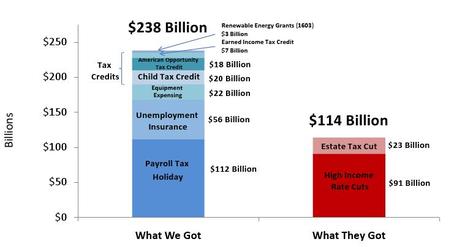
I guess after reviewing everything, I just don’t see how this is worth it. Passing all of this because it’s the best you can do given the state of the Republican Klan in Kongress just isn’t good enough for me. It opens up too many issues in other areas. However, this is the graph they’re circulating as a White House talking point to show how Obama got the better deal. This is the graph that has Charles Krauthammer’s tie in a too tight double Windsor knot so much that Clinton brought it up.

 peej
peej Carissa
 bostonboomer
 dakinikat
 ecocatwoman
 jjlo
jjlo mablue2
 Mama Lopez
 peggysue22
 quixote
 skydancingguestblogger
 Mona (aka Wonk the Vote)





Recent Comments