
Suing Donald Rumsfeld
Posted: August 4, 2011 Filed under: just because | Tags: Donald Rumsfeld, ehanced interrogation, Torture 16 Comments There’s been little justice for innocent folks scooped up as enemy combatants in the never-ending, costly War on Terror. Who could forget those pictures of US marines dragging naked men around by dog leashes? Instead of opening the sordid affair to daylight, the Obama administration adopted the posture of putting it all behind us. This includes defending Donald Rumsfeld. Rumsfeld is one of the architects of enhanced interrogation techniques. He recently has been out on the talking head circuit with a book and an image boosting tour. News today says that he may have retired by he can’t run away from his decisions as Secretary of Defense. A judge has allowed an US Army veteran to sue Donald Rumsfeld over torture. The veteran claims that he was tortured and unjustly imprisoned. The man was a translator and is unnamed in the law suit.
Lawyers for the man, who is in his 50s, say he was preparing to come home to the United States on annual leave when he was abducted by the U.S. military and held without justification while his family knew nothing about his whereabouts or even whether he was still alive.
Court papers filed on his behalf say he was repeatedly abused, then suddenly released without explanation in August 2006. Two years later, he filed suit in U.S. District Court in Washington arguing that Rumsfeld personally approved torturous interrogation techniques on a case-by-case basis and controlled his detention without access to courts in violation of his constitutional rights.
Chicago attorney Mike Kanovitz, who is representing the plaintiff, says it appears the military wanted to keep his client behind bars so he couldn’t tell anyone about an important contact he made with a leading sheik while helping collect intelligence in Iraq.
“The U.S. government wasn’t ready for the rest of the world to know about it, so they basically put him on ice,” Kanovitz said in a telephone interview. “If you’ve got unchecked power over the citizens, why not use it?”
The Obama administration has represented Rumsfeld through the U.S. Justice Department and argued that the former defense secretary cannot be sued personally for official conduct. The Justice Department also argued that a judge cannot review wartime decisions that are the constitutional responsibility of Congress and the president. And the department said the case could disclose sensitive information and distract from the war effort, and that the threat of liability would impede future military decisions.
At the heart of the suit are personal damages claim against Rumsfeld for approving interrogation methods of US army at Camp Cropper.
District judge James Gwin rejected those arguments and said US citizens were protected by the constitution at home or abroad during wartime. “The stakes in holding detainees at Camp Cropper may have been high, but one purpose of the constitutional limitations on interrogation techniques and conditions of confinement even domestically is to strike a balance between government objectives and individual rights, even when the stakes are high,” he ruled.
In many other cases brought by foreign detainees, judges have dismissed torture claims against US officials for their personal involvement in decisions over prisoner treatment. But this is the second time a federal judge has allowed a US citizen to sue Rumsfeld personally.
District judge Wayne Andersen in Illinois last year ruled that Donald Vance and Nathan Ertel, Americans who worked in Iraq as contractors and were held at Camp Cropper, could pursue claims that they were tortured using Rumsfeld-approved methods after they suspected the security firm they worked for of engaging in illegal activities.
The US supreme court sets a high bar for suing high-ranking officials, requiring they be tied directly to a violation of constitutional rights and must have clearly understood their actions crossed that line.
There may be little chance for justice for all the victims of the enhanced interrogation program. I am sure this will again stir up the hornet’s nest of how fascist methods are justified in the face of unmitigated acts of terrorism. I’m not a lawyer so I can’t really speak for the merits of the case itself. I do, however, feel that Benjamin Franklin said it best.
Those who would give up Essential Liberty to purchase a little Temporary Safety, deserve neither Liberty nor Safety.
BTW, I hope you noticed that Mittens Romney has hired the torture lawyer Steven Bradbury along with the nasty Robert Bork as campaign advisers. Romney also went to Harvard Law School. Haven’t we had enough Harvard idiots already for one century?
Balanced Budget Amendments are Bad Policy
Posted: August 3, 2011 Filed under: U.S. Economy, U.S. Politics, voodoo economics | Tags: balanced budget amendments, business cycles, Debt, deficits, Federal Deficit, fiscal rules, GDP, John Maynard Keynes, macroeconomics, Michele Bachmann, recessions, social services, taxes, US Congress 9 Comments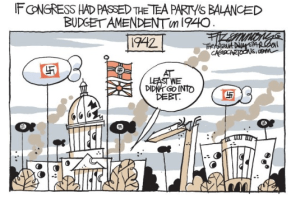 I always have to cover this topic in any introductory macroeconomics class I teach because usually one nutjob or another running for office always brings this up and people fall for it. The arguments are usually based on complete fallacies and misunderstanding of the math of economics, but hey, for some reason balanced budgets sound ‘reasonable’ when they are anything but.
I used to talk theoretically about how balanced budget amendments will kill state economies when the next real recession hits. Well, it hit a few years ago and we’re there. States continue to make their own economies worse day in and day out but there’s still those people that insist that if a family has to balance its budget, then so should the country. That’s even stupid considering most families have mortgages and car payments and probably student loans. Take Michele Bachmann as an example. She’s got all of the above plus farm subsidies and government grants. Even the President is guilty of that false equivalency. No person or family exists in perpetuity. No person or family can print money. No person or family has the power of taxation. Because of these three things, you cannot compare government to a family. Nor can you compare government to a business. Businesses exist to make a profit. Government exists to provide services and goods that the private sector will not provide or provides at an outrageous cost. It exists to administer justice and ensure level playing fields and fair play exists. Everything about a government is unique and is no way comparable to either businesses or households.
Macroeconomists know from years of study that the federal government can influence the economy at large. It does so through its spending and taxing priorities and policies. This is called fiscal policy. We have found several economic laws that guide the relationship between taxes and government spending and the behavior of Gross Domestic Product (GDP) which roughly measures all the legal and reported spending by households, governments, foreigners, and businesses. In our economy, household spending comprises about 68% of all GDP.
Investment or purchases by businesses is the smallest and most erratic component of GDP. Keynes said that it is easily spooked and subject to animistic spirits. Because it’s an unreliable source of growth, Keynes argued that in down turns, government should use its power to spend. Business investment usually only does fine in good economies. Please note, Keynes said deficit spend in recessions. Keynes’ prescription also said that Federal governments should run balanced budgets during times when the economy is fully employed and surpluses during bubble or boom times to relieve inflationary pressure. As usual, conservative politicians completely lie about the nature of Keynes and his highly proven and credible theories on fiscal policy. A lot of what we know about Monetary Policy comes from Milton Friedman, however, that is not the subject today. What I want to emphasize is that both men spent a lot of time analyzing panics and the Great Depression and are very much at the heart of accepted theory. We are seeing a classical lack of aggregate demand today. It is what’s driving the budget deficit. It is what’s driving the joblessness. It is what’s driving the slow recovery. Government must and will by automatic stabilizers be in a deficit position during downturns. It is simple math. More revenues come in during good times than bad. More safety net spending increases during bad times than good. We naturally run towards deficit in bad economies and towards surplus in good.
However, show me an economy that’s booming with high revenues and lower safety net spending and I will show you a group of politicians spending wildly. This tends to create inflation and can lead to bubbles. However, you never hear them complain at that point in time. That’s because it should be relatively easy to balance a budget then, but they do not do so or if they do its by expanding programs that cannot be sustained without borrowing during bad economies.
With that short explanation, let me cite you some folks that tell you why balanced budget amendments are bad policy. This first quote is from Simon Johnson who is the former chief economist for the IMF. He asks us to keep in mind that GDP is a measurement that is fraught with problems. He also mentions the fact that a balanced budget amendment makes the government make recessions worse.
Second and more seriously, imagine that this constitutional amendment were in place and that federal spending were roughly at its limit relative to the size of the economy. Then, what happens should the financial sector blow up again — either through no fault of its own (which, believe it or not, is the current prevailing myth on Wall Street about 2007-9) or because of some toxic combination of malfeasance and malpractice (the current predominant view of 2007-9 among many other people)?
The blame game is irrelevant when G.D.P. drops 10 percent; the issue is how to prevent a Great Depression. But note that with such a decline in G.D.P., a level of nominal spending that was 18 percent of G.D.P. is suddenly 20 percent, and now a constitutional crisis awaits – even before we get to the question of whether tax cuts or other forms of stimulus might be appropriate.
It makes no sense to take aim, as a matter of constitutional process, at two numbers that are both outcomes of deeper economic processes.
And to be frank, sometimes it makes a great deal of sense to apply an economic stimulus to an economy in free fall. One such moment was 1930 (and 1931 and 1932), when no stimulus was applied. Other moments were 2008 and 2009; both President Bush and President Obama initiated stimulus packages. When credit for and confidence in the private sector evaporates, do you really want the government sector to be forced to make quick cuts — or to raise taxes?
James Ledbetter at Reuters argues that even conservatives should oppose a balanced budget amendment (BBA). His reasons are more pragmatic. He argues that it won’t work.
Historically, conservatives have opposed extending government authority in places where it is not effective. You can find all the evidence you need to conclude that balanced budget requirements are useless by simply investigating the oft-repeated claim that 49 states have laws requiring a balanced budget. Leave aside the falsity of the claim and just consider the logic: if so many states are required to balance their budgets, why are so many states in the red?
The answer is that requiring state governments to annually balance their books simply encourages them to find clever ways to disguise debt and deficits. For example: California has both a Constitutional and a statutory requirement that its budgets be balanced. Would any sane person maintain that the state’s books have been anything resembling healthy for at least a decade? This year, after some brutal spending cuts, the governor’s office found that the state still had a short-term deficit of more than $9 billion and $35 billion in long-term debt. The governor’s budget report noted that California’s “massive budget deficits for most of the past decade…have been largely the result of a reliance on one-time solutions, borrowing, accounting maneuvers, and cuts or revenues that were illusory and therefore did not materialize.”
If that sounds familiar, it may be because, as Richard Quest pointed out on CNN Sunday evening, we’ve witnessed numerous Congressional attempts in recent decades to rein in federal deficits—including Gramm-Rudman in 1985 and the Budget Enforcement Act of 1990—all of which fell victim to legislative legerdemain. Why would a federal balanced budget amendment be any different?
Here’s something from The Economist on “Fiscal Rules”. Some fiscal rule–rather than a balanced budget amendment–would better stop congress from spending during booms and full employment cycles rather than balancing its budget via a BBA. This would be a rule that attaches the spending mandates to what’s going on in the economy. But again, I doubt they’d follow it since they’ve ignored a good portion of the Keynesian prescription for years any way.
It is difficult for Congress to tie its own hands. Any law that can pass Congress can later be undone or changed. In the rare cases that Congress puts together a near-perfect piece of legislation, that’s a bad thing. In the vastly more common occurrence that Congress passes highly imperfect legislation in need of significant future tweaks, that’s a very good thing. Support for an amendment to the constitution is a spectacular vote of confidence in the ability of a legislature to design near-perfect legislation, because the only thing rarer than an amendment to the constitution is a subsequent amendment undoing or clarifying a previous amendment.
I see the argument for a well-designed, over-the-business-cycle balanced-budget amendment. But the idea of enshrining this Congress’ pathologies into the constitution is terrifying. Let’s see Congress design some quality fiscal rules using the normal legislative process first, and then we can talk about adding those to the constitution.
Bruce Bartlett has some excellent analysis up for the current go round of balanced budget amendments. Mark Thoma explains how a BBA is a very bad idea. His analysis includes looking at the destabilizing effects that states’ BBAs have had on their economies. There’s a nifty graph that I did not include here if you’d like to go view it.
I’ve argued on many occasions that one of the big lessons we need to learn from this recession is that state-level balanced budget requirements are highly destabilizing. When a recession hits, spending goes up for social services and taxes fall as income, sales, property values, and other sources of revenue for state and local governments decline.
The result is a big hole in state and local government budgets, and that forces either increases in taxes or cuts in spending both of which make things even worse. And though some state and local governments were an exception to this, far and away the choice is to cut spending. We can see this in the state and local government employment statistics:
That’s not what we want to have happening when we are trying to recover from a recession. It would be much better if states had rainy day funds to rely upon, and if the rainy day funds fall short, the federal government could backfill the budget holes to prevent the destabilizing downsizing.
So have we learned the lesson? Nope, at least not if you are a Republican. They’d like to impose the same destabilizing rules on the federal government:
You really would have to search high and low for an economist that actually supports a BBA. The more conservative ones go for the fiscal rule that attaches spending to business cycles but even they believe that it would be unenforceable and easy to avoid. Can you imagine some District Judge trying to look over a complex macroeconomic model and figure out if the government forecast was correct or not?
A group of leading economists, including five Nobel Laureates in economics, today publicly released a letter to President Obama and Congress opposing a constitutional balanced budget amendment. The letter outlines the reasons why writing a balanced budget requirement into the Constitution would be “very unsound policy” that would adversely affect the economy. Adding arbitrary caps on federal expenditures would make the balanced budget amendment even more problematic, the letter says. The Economic Policy Institute and the Center on Budget and Policy Priorities organized the letter.
“A balanced budget amendment would mandate perverse actions in the face of recessions,” the letter notes. By requiring large budget cuts when the economy is weakest, the amendment “would aggravate recessions.”
The signatories of the letter are Nobel Laureates Kenneth Arrow, Peter Diamond, Eric Maskin, Charles Schultze, William Sharpe and Robert Solow; Alan Blinder, former Vice Chair of the Federal Reserve System’s Board of Governors and former member of the Council of Economic Advisors; and Laura Tyson, former Chair of the Council of Economic Advisors and former Director of the National Economic Council.
I’ll let former Reagan economist Bruce Bartlett have the last word here. He looks at the recent debate in Congress on the BBA.
Next week, House Republicans plan to debate a balanced budget amendment to the Constitution. Although polls show overwhelming public support, it is doubtful that many Americans realize that the measure to be debated is not, in fact, a workable blueprint to enforce a balanced budget. In fact, it’s just more political theater designed to delight the Tea Party.
We really need improved economic literacy in this country. I genuinely can’t get over what some of the morons in congress can get away with saying. Economists call them on it but it appears no one every listens.
Way to Go Boys and Girls: Countdown to Recession
Posted: August 2, 2011 Filed under: Domestic Policy, Economy, Federal Budget and Budget deficit, U.S. Economy, We are so F'd | Tags: economy killing debt deal, low growth, recession 6 Comments
So, I’m watching the US stock market plummet and laughing to myself in a most unhealthy way. NOW, they’re worried about no growth and jobs. What a buncha marroons! But hey, we maintained that AAA rating so the flight to safety has begun. Gold any one?
“We have a stubbornly slow economy,” Hank Smith, chief investment officer at Haverford Trust Co. in Radnor, Pennsylvania, said in a telephone interview. His firm manages about $6.5 billion. “The economy is stuck in a very slow growth mode, which means that it’s more susceptible to any external shocks.”
Harvard University economics professor Martin Feldstein said he sees a 50 percent chance that the U.S. will relapse into another recession.
“Nothing has given us much growth,” Feldstein said today in a Bloomberg Television interview on “Surveillance Midday” with Tom Keene. Feldstein is a member of the committee that dates recessions for the National Bureau of Economic Research.
Today’s retreat brought the S&P 500 to within 1 percentage point of its low for the year on March 16 and trimmed its year- to-date gain to about 0.5 percent. All 10 industry groups fell, led by a 2.4 percent slump in industrial companies. General Electric Co. lost 3.7 percent to lead declines in 29 of 30 stocks in the Dow Jones Industrial Average.
Archer Daniels Midland Co., the world’s largest grain processor, tumbled 2.4 percent as earnings trailed projections after corn and tax expenses rose. MetroPCS Communications Inc., the pay-as-you-go mobile-phone carrier, lost 35 percent for the biggest decline in the S&P 500 as sales fell short of analysts’ forecasts.
What if they gave a recovery and nobody came? So, What’s missing from the debt ceiling debate? Jobs. In an aggregate demand led recession, what gives us growth is healthy government spending, not tax cuts, and certainly not austerity. Welcome to the new anti-growth fiscal policy.
The unemployment rate, currently above 9 percent, is projected to remain high for a long time. For example, the current Blue Chip Economic Indicators consensus forecast puts the average unemployment rate for 2012 at 8.3 percent. The agreement to raise the debt ceiling just announced by policymakers in Washington not only erodes funding for public investments and safety-net spending, but also misses an important opportunity to address the lack of jobs. The spending cuts in 2012 and the failure to continue two key supports to the economy (the payroll tax holiday and emergency unemployment benefits for the long term unemployed) could lead to roughly 1.8 million fewer jobs in 2012, relative to current budget policy.
The agreement would reduce spending by at least $1 trillion over 10 years through budget caps on non-mandatory programs, with additional reductions under discussion in a second phase. While the bulk of the cuts are back-loaded – coming more in the future – the near-term cuts would still have an immediate impact. Applying conventional multipliers, the reduction of $30.5 billion in calendar year 2012 would reduce GDP by 0.3%, and result in roughly 323,000 fewer jobs (as depicted in the table below).
In addition to the immediate cuts to spending, the debt ceiling agreement fails to continue two major policies which had been part of broad agreements in the past. The payroll tax holiday and extended unemployment insurance were passed last December along with the two-year extension of the Bush-era tax cuts; but are set to expire at the end of 2011. While Congress could still extend these policies between now and the end of the year, that scenario is looking much less likely today. (Any economic support subsequent to this deal would have to be offset by other tax increases or spending cuts in 2012 or a further increase in the debt ceiling, neither of which seems politically viable.)
But wait, didn’t the know-it-all in chief just say jobs were priority one now? Well, let me just laugh. Even Andrea Mitchell knew enough to ask the dmbest person in nearly every room–Valerie Jarrett–with what money are you going to be doing that?
“As we go through the package, and members are beginning to learn what’s in the package, they’re seeing,” the reaction is “better and better,” White House senior adviser Valerie Jarrett said on MSNBC’s “Andrea Mitchell Reports.”
“I’ve been on many of these calls since last evening with a wide variety of people who were initially skeptical,” she said. “But when they see the details of the package, they’re becoming increasingly comfortable.”
The deal reached by the president and congressional leaders is “not perfect,” Jarrett said, and is “not the package that the president would have wanted.”
Even so, she said, “it is a package that stays true to his values and his goals, No. 1, long-term certainty, and No. 2, making sure that the people who can least afford to suffer are protected.”
The Economic Policy Institute, a top nonpartisan think tank, estimates that the deal struck this weekend to raise the nation’s debt limit will end up costing the economy 1.8 million jobs by 2012. Today the Senate is expected to approvethe package passed yesterday by the House and send it to President Obama. But while the unemployment rate remains above 9 percent, the deal does nothing to address chronic joblessness.
The agreement would reduce spending by at least $1 trillion over 10 years, but even the near-term cuts could shrink already sluggish GDP growth by 0.3% in 2012. According to EPI, the plan “not only erodes funding for public investments and safety-net spending, but also misses an important opportunity to address the lack of jobs.” In particular, the immediate spending cuts and the “failure to continue two key supports to the economy (the payroll tax holiday and emergency unemployment benefits for the long term unemployed) could lead to roughly 1.8 million fewer jobs in 2012.”
What we should be worrying about is all the news that Washington has ignored while it was doing the debt ceiling shuffle. Most importantly, the economy has almost stopped growing and unemployment is again on the rise.
On Friday, the commerce department released data showing the economy grew just 1.3% in the second quarter. Even worse, it revised down the first quarter growth number from 1.9% to just 0.3%. This means that the economy was growing at just a 0.8% annual rate over the first half of 2011. This is well below the 2.5% pace that is necessary just to keep unemployment from rising.
Of course, unemployment has been rising, with the June figure hitting 9.2%. That is up from a post-recession low of 8.8% in March. The unemployment rate does not give the whole story, since many of people have lost hope of finding a job and given up looking for work altogether. The employment to population ratio (EPOP) – the percentage of the population with jobs – has fallen back almost to its low point for the downturn. The EPOP for African Americans has hit new lows in each of the last three months.
The revisions also provided other interesting pieces of information. For example, corporate profits were revised sharply higher for both 2009 and 2010. The share of profits in corporate sector output hit a new record high, more than a full percentage point above its previous peak. Finance was the biggest winner within the corporate sector, accounting for 31.7% of corporate profits, also a record high.
In short, we now have an economy that is stuck in the doldrums. It is operating well below its potential level of output. Furthermore, instead of catching up, it appears to be falling further behind. We are seeing a growth rate far below the economy’s potential, when we should be seeing growth that is far above potential. And the Wall Street guys are fat and happy.
Believe me, an economy “stuck in the doldrums” will look good this time next year. If Mitch McConnell wanted to over throw or throw over the country, he sure succeeded. Some one needs to whip his sorry ass.
Rep. Gabrielle Giffords Returns to Vote
Posted: August 1, 2011 Filed under: just because | Tags: Gabrielle Giffords 13 CommentsA standing ovation was given to recovering shooting victim Rep. Gabrielle Giffords from Arizona.
Republicans won the vote, but Democrats stole the show when Rep. Gabrielle Giffords, D-Ariz., appeared on the House floor for the first time since a January shooting.
There was no hint of what was about to happen, when suddenly, as the debt-ceiling vote was proceeding, Giffords could be seen being escorted onto the floor by Rep. Debbie Wasserman Schultz, D-Fla., a close personal friend.Giffords, wearing close-cropped brown hair and glasses, walked with a slight limp and wore a glove on her right hand.

Of course, Joe Biden has to make it all about him.
Vice President Joe Biden, with a big smile on his face, walked to the House floor and said, “I came to see Gabby, that’s why I’m here.”
In the hallway just outside, Giffords’ husband Mark Kelly was all smiles as well.
“It feels good,” he said as his wife was casting her first vote since the tragedy. “Great actually.”
Giffords spokesman C.J. Karamargin told Tucson Weekly in an email that “the congresswoman insisted on participating.”
“Congresswoman Giffords has been following this debate closely over the past two weeks,” she said. “Like the vast majority of Americans, she is extremely disappointed at Washington’s inability to confront the debt ceiling issue in a timely and thoughtful manner.”
Escorted by her husband and Rep. Debbie Wasserman Schultz, D-Fla., Giffords exited the House floor slowly, giving a small wave to people as she left. She left the Capitol in an SUV shortly thereafter.
When Biden was asked about what he spoke with Giffords about, he joked, “She’s now a member of the cracked head club like me.”
Deficit Debacle: Live Blog on the Murder of Middle Class America
Posted: August 1, 2011 Filed under: Economy, Federal Budget, Federal Budget and Budget deficit, Medicaid, Medicare, Social Security, Surreality, The Great Recession, U.S. Economy, U.S. Politics, voodoo economics, We are so F'd | Tags: “Sugar-Coated Satan Sandwich”, Barack Obama, Bernie Sanders, Congressional Black Caucus, deficit cave in, economic recovery, Emanuel Cleaver, Federal debt ceiling, Federal Deficit, Paul Krugman, spending cuts 35 CommentsEverything is on the table. Except taxes. WTF?
 I’m watching Bernie Sanders trying defend our precious safety nets right now. The debate over this horrible capitulation to right wing extremists is carried on CSPAN . Sanders is reminding the president that all the polls call for shared sacrifice. He’s saying the proposal is bad and unfair. He’s just announced on the floor he will not vote for the package. What were getting is sacrificed on the alter of greed. At least some one recognizes this.
They’re taking a senate quorum call right now.
Here’s some headlines for you to think about.
From former Biden economic adviser Jared Bernstein: Lousy Negotiation skills are not the problem.
What did we just go through and what does it mean for our national politics, our fiscal and economic policy?
–First, a small but influential group of extreme conservatives are so intent on shrinking the federal government that they would credibly threaten national default;
–Second, Democrats, including the president, do not have a strategy to counteract such extremism, so they accepted a plan far less balanced than they would have liked—the final deal could well turn out to be $3 trillion in spending cuts over ten years, with no revenue increases to offset the cuts.
–Third, and perhaps most importantly, like every debate about the size of government, it’s impossible for normal people, if not the “experts,” to figure out what anyone is really talking about and therefore to judge the deal.
What does it mean to cut $3 trillion in government spending? How will it affect retirement security? Education? Jobs in the short run and investment over the long run? Does it put us on a sustainable fiscal path.
We’re about to agree to cut $1 trillion from something called discretionary spending. That probably sounds great to some folks and bad to others. But what does it mean?
The President bragged on this very point last night, telling America that discretionary spending as a share of the economy will come down to its lowest level since Eisenhower. As if we’ve all been walking around thinking, “if only we could get this budget category down to Ike levels, everything would fall into place.”
In fact, these cuts will hurt our ability to pursue what I view as most positive aspects of the President’s economic agenda—investment in infrastructure, clean energy, research, education. They will pinch programs that are already budget constrained…programs that help low income people with child care, housing, and community services. (One piece to watch for here—defense spending is also in this category, and is supposed to account for about one-third of the cuts…that helps, of course, take pressure of these other parts.)
Then, in part two of the deal, we unleash the gang-of-twelve who are assigned to come up with $1.5 trillion more in deficit savings.
They’ll be hitting the entitlements—Social Security, Mcare, Mcaid—and more defense, but if they deadlock—a non-trivial probability—automatic cuts ensue.
My thought is that the political game has become all important in this negotiation and no one is really thinking about the outcome. The Teabots are insane so they can be discounted, but all of this fall-in by senators and representatives that know what’s going on has got to be the most painful thing I’ve ever watched. Can’t some of them use their brains and consciences for a change instead of checking their labels and owner dog tags?
Paul Krugman: The President Surrenders
For the deal itself, given the available information, is a disaster, and not just for President Obama and his party. It will damage an already depressed economy; it will probably make America’s long-run deficit problem worse, not better; and most important, by demonstrating that raw extortion works and carries no political cost, it will take America a long way down the road to banana-republic status.
Start with the economics. We currently have a deeply depressed economy. We will almost certainly continue to have a depressed economy all through next year. And we will probably have a depressed economy through 2013 as well, if not beyond.
The worst thing you can do in these circumstances is slash government spending, since that will depress the economy even further. Pay no attention to those who invoke the confidence fairy, claiming that tough action on the budget will reassure businesses and consumers, leading them to spend more. It doesn’t work that way, a fact confirmed by many studies of the historical record.
Indeed, slashing spending while the economy is depressed won’t even help the budget situation much, and might well make it worse. On one side, interest rates on federal borrowing are currently very low, so spending cuts now will do little to reduce future interest costs. On the other side, making the economy weaker now will also hurt its long-run prospects, which will in turn reduce future revenue. So those demanding spending cuts now are like medieval doctors who treated the sick by bleeding them, and thereby made them even sicker.
And then there are the reported terms of the deal, which amount to an abject surrender on the part of the president. First, there will be big spending cuts, with no increase in revenue. Then a panel will make recommendations for further deficit reduction — and if these recommendations aren’t accepted, there will be more spending cuts.
They are killing any hope we have of a decent recovery. We don’t have one now. The US Manufacturing Index just fell to a two year low. This is one of the first leading indicators to show a looming recession. One of the most telling signs this morning about this is that the stock market is going down and now there is a flight to safety. Oddly enough, the flight to safety is to US Treasury bonds.
“We’ve turned from budget crisis to economic crisis,” said Paul Horrmann, a broker in New York at Tradition Asiel Securities Inc., an interdealer broker. “We’ve gone from worrying about a budget and default to the economy long term. Higher prices are bringing in buyers, not sellers.”
Still, what about the JOB crisis?
Kevin Drum at MOJO: Why the Debit Ceiling Deal Sucks
It’s a shit sandwich no matter how you look at it. And it’s a shit sandwich in at least two very specific ways: (1) It means we’ll continue to live in a fantasyland that says we don’t need any tax increases even though our population is aging and we’re plainly going to need higher revenues to support this demographic reality; and (2) we’ll continue to live in a fantasyland that says our problems are primarily caused by discretionary spending. This is, of course, exactly the opposite of reality, which means we’re going to screw the poor and do nothing serious about the long-term deficit. Nice work, adults.
Easy-to-Hate Debt-Ceiling Compromise Called “Sugar-Coated Satan Sandwich” By Some
Cuts to Social Security and Medicare are also possible within the plan. Representative Emanuel Cleaver (D-MO), the chairman of the Congressional Black Caucus, called the deal a “sugar-coated Satan sandwich,” which itself deserves $1.2 trillion.
We’re seriously f’d on this one folks.
Notable tweets:
daveweigel
I haven’t seen this many pissed off Democrats since the last time I saw some Democrats. #beenatoughyear
tbogg
Gene Sperling: Obama ‘didn’t give one inch’ : politico.com/news/stories/0… So Obama’s people say he owns this shit sandwich. Jesus. #Quitdigging
SatanSandwichSugar Coated
The moment I convinced President Obama of the virtues of austerity: bit.ly/nbv5C6 #FYEAH
ThePlumLineGSGreg Sargent
House Dem leaders NOT pressing Dems to vote for the debt deal, potentially complicating passage: http://wapo.st/o3wyDP
nytimes The New York Times
How the Debt Plan Would Work
Read this CBO letter to Congressional Leaders. They’re putting discretionary funding caps on Social Security, Medicare, SCHIP, Medicaid, et. Iraq and Afghanistan are exempt from spending caps. This is AWFUL!!! Worse than I thought … Please read this analysis from the CBO to congress!!!
House DEBATE and vote on package: running here at CSPAN. They are voting on the debate rules right now at 3:30 pm cst. Progressive Caucus leaders talking right now saying they will not support the deal because it’s incredibly wrong and worse than the Reid Compromise. Lynn Woolsey and Barbara Lee announcing they will vote no.
Please report on who you know is voting for or against below so we can keep track of who needs to face a real democrat in a primary,

 peej
peej Carissa
 bostonboomer
 dakinikat
 ecocatwoman
 jjlo
jjlo mablue2
 Mama Lopez
 peggysue22
 quixote
 skydancingguestblogger
 Mona (aka Wonk the Vote)





Recent Comments