
Blowback against Specific acts of Religious Intolerance seeking legal status is not a War against Religion
Posted: February 8, 2012 Filed under: 2012 primaries, religion, religious extremists, right wing hate grouups, science, U.S. Politics 10 Comments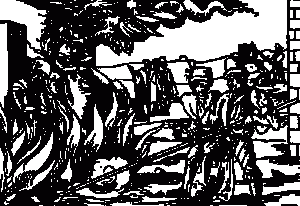 For a group of people obsessed about the possibility that Shari’a law might creep into US Law, christofascists sure seem to thrive on forcing their own brand of it. All the while, there’s this claim of a “war against religion”. Forcing other people to suffer from unjust and unconstitutional laws in the name of religion is not the kind of religious freedom the founders had in mind when they penned the first amendment. Religious status does not give any person or institution the ability to ignore law. Asking for enforcement of law against narrow religious doctrine does not constitution a war against religion. Our country is not suppose to favor any one religion or enshrine its pet biases into law. However, it seems every major Republican candidate hates our Constitution. How can these people truly seek an office where they are sworn to uphold it yet desire to twist the Age of Reason right out of it?
These are the same folks that have declared jihad on women’s reproductive health, science, and mathematics. Yes, remember Copernicus who had the audacity to discover that the earth revolved around the sun JUST, FINALLY got a proper burial in 2010. It only took him 600 years and hundreds of years of science to get his ticket out of hell for heresy. Meanwhile, Rick Santorum–who swept a round of beauty contests with record low turnouts–is still proving there are people out there that probably think that Galileo and Copernicus are wrong. Galileo got his apology in 1992 nearly 600 years after his death. He died in 1642. Let’s not forget the persecution and stalking of Jean-François Champollion whose Rosetta stone proved that Egypt had existed straight through the supposed dating of the great flood. That’s just a few examples from science. The use of religious texts to support slavery, ownership of all married women and children, persecution of GLBT populations around world, and wars and acts of terrorism is omnipresent. Standing against these things and creating laws to make them illegal does not mean you’re against religion. It means you are for the constitutional separation of church and state and ensuring the basic constitution granted rights of all individuals. No one’s “God” wrote the Constitution. Men afraid of religious dictatorships and intolerance did.
Why wouldn’t rational, freedom loving people want to stop the creep of christofascist biblical law wherever possible? It’s not a war against religion. It’s blowback against those who are trying to force narrow religious doctrine onto the rest of us and into law. Luckily, even Antonin Scalia has written about the complete unconstitutionality of all this.
As conservative (and Catholic) Justice Antonin Scalia explained in a Supreme Court opinion more than twenty years ago, a law does not suddenly become unconstitutional because someone raises a religious objective to it — if this actually were true, anyone at all could immunize themselves from paying taxes or from any other law simply by claiming they have a religious objection to being a law-abiding citizen.
We have all just about had it with the Catholic Bishops, Pat Robertson, and all that crap that seems to have come to culmination in the candidacy of Rick Santorum. Where’s that trademarked Santorum outrage about Cardinal Edward Egan who withdrew his apology for illegally covering up instances of pedophilia on his watch? Nope, don’t wait for it. Santorum’s too busy insisting that President Obama wants to force the Catholic Church to accept women priests. The one thing that I’ve really learned in this primary election is that Republican politicians feel so emboldened by the current hatefest in the base that they will lie about anything and know that Fox News will repeat it every chance they can.
For weeks, Republicans have pretended that President Obama is waging some kind of war on religion because his administration recently approved regulations requiring insurers to cover contraceptive care — spurred on in large part because the conservative U.S. Conference of Catholic Bishops opposes the contraceptive care regulations. Their claim is utterly absurd. The new rules exempt churches from the requirement to offer insurance that covers contraception. And they align closely with the beliefs of actual Catholics, 58 percent of whombelieve that employers should be required to provide insurance that cover contraception.
On Fox News this morning, GOP presidential candidate Rick Santorum doubled down on this bizarre claim that Obama is going after religion — falsely claiming that the president wants to tell Catholics who they can hire as priests:
What they’ve done here is a direct assault on the First Amendment, not only a direct assault on the freedom of religion, by forcing people specifically to do things that are against their religious teachings. . . . This is a president who, just recently, in this Hosanna-Tabor case was basically making the argument that Catholics had to, you know, maybe even had to go so far as to hire women priests to comply with employment discrimination issues. This is a very hostile president to people of faith. He’s a hostile president, not just to people of faith, but to all freedoms.
Again, if the first amendment was really serious about that then as a Buddhist, I’d like all my war tax money back now. I’d also like to argue that Rastafarians should be allowed all the legal pot they want for their sacraments. Then, let’s just go back to letting all those Mormons have multiple child brides. Religious organizations do not get to exempt themselves from laws. Again, check the Scalia reference above.
The deal is that Santorum and the Bishops and some of these other full time misogynists posing as Pharisees have had trouble with every law that’s given women the ability to make adult decisions about their own selves. This includes the SCOTUS decision giving women the constitutional right to birth control and abortion. Ron Paul has pretty much said that he doesn’t believe it’s possible for a husband to rape a wife. That falls under the laws that existed in this country prior to 1882 when women were literally written in as an appendage of the husband. Married women were not considered separate individuals which is why in many states they couldn’t own property.
It gets worse. Paul hangs around with Christian Reconstructionists. These folks are truly scary.
Reconstructionism, the right-wing religious-political school of thought founded by Rousas John Rushdoony. The ultimate goal of Christian Reconstructionists is to reconstitute the law of the Hebrew Bible — which calls for the execution of adulterers and men who have sex with other men — as the law of the land. The Constitution Party constitutes the political wing of Reconstructionism, and the CP has found a good friend in Ron Paul.
When Paul launched his second presidential quest in 2008, he won the endorsement of Rev. Chuck Baldwin, a Baptist pastor who travels in Christian Reconstructionist circles, though he is not precisely a Reconstructionist himself (for reasons having to do with his interpretation of how the end times will go down). When Paul dropped out of the race, instead of endorsing Republican nominee John McCain, or even Libertarian Party nominee Bob Barr, Paul endorsed Constitution Party presidential nominee Chuck Baldwin (who promised, in his acceptance speech, to uphold the Constitution Party platform, which looks curiously similar to the Ron Paul agenda, right down to the no-exceptions abortion proscription and ending the Fed).
At his shadow rally that year in Minneapolis, held on the eve of the Republican National Convention, Paul invited Constitution Party founder Howard Phillips, a Christian Reconstructionist, to address the crowd of end-the-Fed-cheering post-pubescents. (In his early congressional career, Julie Ingersoll writes in Religion Dispatches, Paul hired as a staffer Gary North, a Christian Reconstructionist leader and Rushdoony’s son-in-law.)
At a “Pastor’s Forum” at Baldwin’s Baptist church in Pensacola, Florida, Paul was asked by a congregant about his lack of support for Israel, which many right-wing Christians support because of the role Israel plays in what is known as premillennialist end-times theology. “Premillennialist” refers to the belief that after Jesus returns, according to conditions on the ground in Israel, the righteous will rule. But Christian Reconstructionists have a different view, believing the righteous must first rule for 1,000 years before Jesus will return.
They also believe, according to Clarkson, “that ‘the Christians’ are the ‘new chosen people of God,’ commanded to do what ‘Adam in Eden and Israel in Canaan failed to do…create the society that God requires.’ Further, Jews, once the ‘chosen people,’ failed to live up to God’s covenant and therefore are no longer God’s chosen. Christians, of the correct sort, now are.”
Responding to Baldwin’s congregant, Paul explained, “I may see it slightly differently than others because I think of the Israeli government as different than what I read about in the Bible. I mean, the Israeli government doesn’t happen to be reflecting God’s views. Some of them are atheist, and their form of government is not what I would support… And there are some people who interpret the chosen people as not being so narrowly defined as only the Jews — that maybe there’s a broader definition of that.”
Again, if you hang around folks that basically want to tear apart the constitution and insert their own religious views in place of secular law, you’re not a conservative. You’re not a libertarian. Hell, you’re not even really supporting our Constitution and basic shared American Values. Again, these are the people that say there is a religious war because they’ve basically started one. They and their Republican Toadies need to be stopped.
I wont even get into the Romney/Mormon thing because BostonBoomer has already covered a lot of that. These are not just simply pious folks that you meet at your local church potluck. They are all fanatics and they deserve all the blowback we can muster. It would be one thing if they all weren’t so politically active and they didn’t have such a huge impact on one political party. Again, this isn’t just the practice of religion, this is the practice of a zealotry akin to political terrorism. We need to recognize and call it exactly that before our rights are crushed by their very narrow interpretations of what’s science, what’s American, and what’s moral.
The Kenyan Muslim Socialist Usurper is just a Run of the Mill Moderate-to-Conservative Pol
Posted: February 7, 2012 Filed under: 2012 elections, 2012 presidential campaign, Barack Obama, Voter Ignorance, War on Women, We are so F'd | Tags: Barrack Obama, Moderate, Willard Romney Liar extraordinaire 30 Comments Yup, Obama is a run of the mill moderate. We’ve been saying this for years but Keith Poole’s Voteview has a better methodology for estimating presidential positions on a left-right scale since 1945. Every one in left blogistan is talking about that and not our joint intuitions and research. The VoteView site actually has an interesting way to look at Political Polarization of elected officials and shows that the Republican Party has been moving rapidly to an ultra right position recently. We’ve also said this. I can’t believe how many Birch Society positions are now “mainstream” in Republican circles. However, the Republican party asked for it when they courted Dixiecrats and the KKK away from the old style Dem party and were simultaneously usurped by religious radicals. State Republican parties make the Taliban look reasonable. Just come down here to the South or go to the middle of the country. You would think the good old days of slavery were back in vogue. The current crop of primary tap dancers only shows how extreme the party’s base has become. Mitt Romney and Newt Gingrich can’t lie about their past lives fast enough. They also seem to subscribe to the idea that when you repeat lies enough, they become truth.
Our findings here echo those discussed in a prior post that Republicans have moved further to the right than Democrats to the left in the contemporary period. Indeed, as seen below, President Obama is the most moderate Democratic president since the end of World War II, while President George W. Bush was the most conservative president in the post-war era.
So, this result is interesting on many levels. First, Dubya has to be the most hated president since Nixon if not for longer than that. His policies were and still are extremely unpopular. That’s why the right is running on Reagan’s supposed rhetoric but not Reagan’s more liberal policies. Remember, Reagan rescued social security. Dubya wanted to privatize it. Reagan engaged the Soviets. Dubya bombed the shit out of two countries he didn’t like. The other thing this shows is that moderate Obama is being labelled things that are outright lies. This probably indicates the power of Fox News, the Koch Brothers money, and the current Republican fascination with denial of reality and truth. Obama has basically stayed out of congressional politics. Ezra Klein paraphrases some of Poole’s findings. DW-Nominate is Poole’s methodology for sorting out votes via measuring political coalitions.
DW-Nominate rates presidents by processing Congressional Quarterly’s “Presidential Support” index, which tracks roll-call votes on which the president has expressed a clear position. The system then rates the president by looking at the coalitions that emerged in support of his legislation. In essence, it judges the president’s ideology by judging the ideology of the president’s congressional supporters. So how, in an age of incredible congressional polarization, could this system rank Obama as a moderate?
There are a few answers. One, says Poole, is that Obama is very careful about taking positions on congressional legislation. In the 111th Congress, he only took 78 such positions. Compare that with George W. Bush, who took 291 positions during the 110th Congress, or Bill Clinton, who took 314 positions during the 103rd Congress. So part of the answer might be that, with the exception of high-profile bills such as health-care reform, Obama is hanging back from most of the congressional squabbling.
I wanted to share others’ thoughts on the Poole analysis. Digby basically says the findings confirm “why liberals are frustrated”. In deed, the real left wing of the Green and Democratic Parties do not like Obama’s policies at all. This is something completely lost on Republicans in la la land.
Paul Krugman–ever the wonk–focuses on Poole’s methodology. This is something that bears reviewing. It shows how Nixon’s southern strategy and the politicization of christofascists has changed party dynamics.
I’ve long been a great admirer of the work done by Poole and his collaborators. What they do is use roll-call votes to map politicians’ positions into an abstract issue space. You can think of this as a sort of iterative process: start with a guess about how to rank bills from left to right, use that ranking to place politicians along the same spectrum, revise the ranking of bills based on the politicians, and repeat until convergence. What they actually do is more complicated and flexible, and allows for multiple dimensions; but that sort of gets at the general idea.
And it turns out that US politics really is one-dimensional, that once you know where politicians stand on a scale that clearly has to do with taxation and the size of the welfare state, you can predict their votes very well. There used to be a second dimension, clearly corresponding to race; but once the Dixiecrats became Republicans, that dimension collapsed into the first.
Exzra Klein does some longer analysis of the findings along with his usual Beltway Bob spin. Can’t he just quit the man crush thing for a bit?
Obama’s financial rescue effort was largely a continuation of the Bush administration’s policies. He resisted calls to nationalize or break up the big banks, modeled his health-care reform bill after legislation that Republicans had proposed in Congress and Mitt Romney had passed in Massachusetts, extended the Bush tax cuts once and intends to make most of them permanent, signed legislation cutting domestic discretionary spending to its lowest level in decades, and supported the same sort of cap-and-trade plan that John McCain once introduced in the Senate. Obama’s presidency has been ambitious and it’s been polarizing, but in terms of the policy it has produced, it’s been much closer to the market-based approach of Clinton than the forthright reliance on government of LBJ.
Republicans, however, can and should take partial credit for this. Obama is so moderate in part because the Republicans are so extreme. Politicians are ideological, of course, but they are also opportunistic. And the GOP, in closing ranks against almost every major initiative Obama has attempted, has taken away most of his opportunities to be truly liberal. The fight to get to 60 votes in the Senate has ensured, over and over, that Obama must aim his legislation at either the most conservative Democrats or the most moderate Republicans. In this, Obama has only been as liberal as Sens. Ben Nelson and Scott Brown have permitted him to be. And that’s not very liberal.
That’s left Obama a moderate president in an immoderate time. For progressives, that moderation has been a continued frustration. For conservatives, it’s been obscured by a caricature of the president as a free-enterprise-hating socialist. And for the White House, it’s been a calculated strategy. We’ll know in November whether it was the right one.
I’m probably an archetypical independent these days. I’m gravitating towards Obama not because I like anything he’s done, but because Mitt Romney can’t seem to speak with out lying and Gingrich, Paul, and Santorum represent what is undoubtedly the WORST thing about this country. All of their positions are straight from either the christofascist or Confederate states of America playbooks. I can’t for the life figure out what it is–other than personal promotion–that drives Mitt Romney. His do anything, say anything brand of politics frankly makes Obama look like a reasonable choice. Plus, the more I find out about Romney’s personal decisions–like baptizing his outspoken atheist father-in-law post mortem–is horrifying. The dog on the roof struck me as the most inhumane act I’d ever heard until I read about his Stake President lectures to women in Vanity Fair. The man seems capable of speaking out and out lies with no sign of remorse or self-realization at all.
So, here we are together between the Barack and the Willard Hard Place. We’ve got the shallow boyfriend who offers us promises he never intends to keep and the preppy boyfriend who’ll tell us anything if we just give him that blow job. What a freakin’ choice that is.
Monday Morning Reads
Posted: February 6, 2012 Filed under: morning reads | Tags: Behavioral Economics vs the Spockos of Chicago, Egypt after the Fall, Komen for the Greed, Ron Paul Wrong on Everything 42 Comments Good Morning!
There’s been so many outrageous things in the news recently that I hardly know where to begin. We talked a lot about the next two subjects but I think there’s some follow-up analysis worth reviewing. First, Ron Paul’s assertions about “honest” rapes and his implication that third trimester “abortions” are every day happenstance is beyond reality and the pale. Here’s some analysis on “The 2 Most Dangerous Things Ron Paul Gets Wrong about Honest Rape”.
1. Women do get raped by their husbands and partners. That’s not some out-there hypothetical. Intimate partner rape is a major problem — and yes, it happens to well-to-do women like Ron Paul’s daughters too.
2. Although Paul keeps going back to women seeking abortions late in their pregnancies, the reality is that 90 percent of abortions occur in the first trimester. So his focus on late-term abortions is disproportionate to the number of women actually seeking late-term abortions.
Paul seems to think married women are still property. I think his exposure to the press this particular election cycle has shown him for the neoconfederate he truly is. Hopefully, he’ll go crawl back under his rock in Texas and leave us in peace soon.
The more we find out about Komen for the Cure, the more appalled we become. It’s apparent that Brinker sees the Foundation as her personal ATM and influence pet and continues to stack the board with Republican Droogies. Brinker’s husband is a huge GOP donor. Surrender the Pink!
A review of the board of directors of Komen by BuzzFlash at Truthout reveals that Brinker has the likely votes to control board decisions at any given time, and that those votes are either Republican stalwarts or individuals personally loyal to her. For instance, one of the members of the relatively small nine-person board – given its nearly half-billion dollars in annual revenue – is Brinker’s son, Eric Brinker. Another is Brinker herself, although, to be fair, many non-profit boards have the CEO as a member.
Linda Law, an apparently extremely accomplished real estate developer and consultant, includes in her Komen board biography that she is an “RNC regent.” This means she is a top bundler and fundraiser for the Republican National Committee, an odd detail to be included in a non-profit board bio. Komen board member Linda Custard, a Dallas social insider, and her husband, William, are listed on opensecrets.org as giving more than 95% in significant contributions to Republicans.
Connie O’Neill is a Dallas socialite, who headed the Junior League there and numerous charity balls, has been on the board and working with Brinker on developing Komen over many years. Although there is no opensecrets.org record of her political giving, unless something has changed she appears to be a Brinker friend and insider.
That’s not to impugn the integrity of Komen board members, despite Brinker’s apparent de facto control of the board and the partisan leanings of some key board members. Indeed, there are some members, such as the chair, Dr. LaSalle D. Leffall, Jr., who is a nationally distinguished oncologist — also a medical professor at Howard University — who appear non-partisan in terms of their roles on the board. So to for Brenda Lauderback, a cancer survivor, and Elyse Gellerman (also a breast cancer survivor), who represents the Komen affiliates.
Komen board member John D. Raffaelli, though, is a lobbyist who swings both sides of the aisle –although he started as a Democrat and has given donations to Dems — is now a full-fledged K Street operative. Raffaelli showed his K Street colors when he told the New York Times (NYT) that “Komen was bitterly disappointed that Planned Parenthood was using Komen’s decision to raise money.” In another NYT article he played the self-pity card: “”Why are they [Planned Parenthood] going nuts?” Mr. Raffaelli asked rhetorically. “And the answer is that they want to raise money, and they’re doing it at the expense of a humanitarian organization that shares their goals and has given them millions of dollars over the years.” Whether or not Raffaelli’s lobbying firm also has contracts with Komen could not be ascertained from the IRS filings online.
From some other of Raffaelli’s statements, it appears entirely possible that along with Karen Handel, he played a key role in coming up with the “congressional investigation” excuse for cutting off Planned Parenthood in the future (before the so called “mea culpa”).
Here’s a headline that’s worth a chuckle or two from Politico: “Trump endorsement a net negative for Romney”. Really? Ya Think? This is some weird polling methodology but I think it probably reflects a degree of reality.
Donald Trump’s endorsement of Mitt Romney may have consumed the news cycle on Thursday, but Nevada Facebook users see the endorsement as a net negative for Romney, according to a Facebook/POLITICO poll.
Forty-one percent of those surveyed said Trump’s endorsement gave them a more negative view of Romney, compared with just 10 percent who said they now view him more positively. Forty-nine percent said the endorsement had no effect.
The results only represent the sentiments of Nevada users on Facebook, not registered voters or likely GOP caucus voters that tend to be more reliable barometers of caucus elections. The Facebook poll, for instance, doesn’t exclude Democrats or independents.
Daniel Kahneman—who recently won the Noble Prize in Economics–is the subject of an interesting interview up at The Economist on the relationship between economic decision-making and psychology. It’s all about trusting instincts.
If you assume that economic agents are completely rational, two immediate conclusions follow. One is people don’t need to be protected against their own choices—and that has been very explicitly the line of the Chicago economists, as illustrated by their opposition to social security. I think the evidence against perfect rationality is overwhelming. A large proportion of the population wants to save more than they do and they have firm intentions to start saving next year. Helping them do this will actually help them make the decision they wish they would make.
Another pernicious implication of the assumption of consumer rationality is that individuals need little protection from the firms with which they interact. For example, the law requires truthful disclosure, but there are no regulations about the clarity of the disclosure or about the size of the print. The assumption is that rational agents will make the effort to read the small print where it matters but, in fact, most of us don’t. Nobody reads the disclosures that roll down your computer screen. You click ‘I agree’ but you don’t know what you’re agreeing to. In the United States, especially under the influence of Cass Sunstein, the White House regulatory chief, firms are required to produce information for their clients in a form the clients can understand. I don’t see that this has any drawbacks, except for the corporations. Those changes in, for example, mortgage and credit card regulations have been fought by the industry, which means the industry thinks it is to its advantage to keep customers poorly informed.
I have a real uphill battle in my field because I don’t buy rational or efficient markets hypotheses. There are just too many frictions and too many examples of behavioral paradoxes. I’ve noticed that the few women in the financial economics field tend to be more behavioralists than not. Perhaps if we ever get to actually dominate the field, we can get rid of that Chicago School nonsense started by the likes of Fama and perpetrated by his son-in-law Cochrane who are buddies of Paul Ryan and other Republican acolytes.
It’s been a year since the Egyptian uprising. This Der Spiegal article asks of Egypt will be able to make democracy work in light of the outcomes of recent elections and violence.
One year after the revolution, Egypt has a new parliament, one that was elected more freely and fairly than ever before. More than two-thirds of its members are Islamists, who now hold as many seats as the former state party, the NDP, once held. There are eight women in this parliament, 13 former NDP members and only a handful of young revolutionaries. Together, they are charged with drafting a constitution, and at the end of June, when the president has been elected, the military council is slated to transfer power to a civilian government. That, at least, is the plan.
It is a double experiment, and the outcome will have an impact throughout the entire Arab world. Can a country, and an Islamic one at that, find its way to democracy through free elections alone? Or does it need a second revolution to sweep aside all corrupt institutions, including the police, state-run television and government agencies that still operate according to the old rules?
If the members of parliament join forces, and if, with the support of the people, they exert pressure on the military council, the generals will hardly be able to resist. But if they prefer to push their own agendas and reach an accommodation with the military to that end, the parliament could remain what it always was: a place where representatives of the people have met for 146 years without ever actually representing the people.
The revolution is now in the hands of the delegates. El-Eleimy, a social democrat, is one of them, a man who is conscious of his own power and filled with the desire to bring about change. But there are also men like Khaled Hanafi, 50, a member of the Muslim Brotherhood who has waited almost 20 years for a seat in parliament. And then there is the Salafist Ahmed Khalil, 33, who was not allowed to teach at his own private school because of his beard.
They have nothing in common, except for the fact that all three demonstrated on Tahrir Square, and yet they must now define important issues together: What kind of a country do we want? And what do we understand as democracy?
So, that’s just a few stories that I dug out. Hard to find much these days because there appears to be so few things that attract the press outside of football and the Newt/Willard battle. Oh well, hopefully you can add some more. What’s on your reading and blogging list this morning?
Open Thread: Soul Train Salute
Posted: February 4, 2012 Filed under: just because | Tags: RIP Don Cornelius 11 CommentsJust wanted to post a thread that says good bye to Don Cornelius and recognizes his contribution to music. Here’s a few Soul Train Moments for you.
The drummer in Lady Marmalade is an old bf of mine. He used to tell me stories about being sewn into his costume. I actually really truly HATE this song which is really odd given how much it put some New Orleans folks on the map. Every boy in my high school over used the song and I got really tired of it.
Anyway, enjoy. Sincerely hope Cornelius finds the peace that the last few years of his life failed to give him. I learned a lot of moves from the Soul Train Dancers when I was a kid.
Saturday Reads: Dismal Science Edition
Posted: February 4, 2012 Filed under: Economy, income inequality, morning reads, poverty, unemployment, We are so F'd | Tags: Paul Krugman, social safety net, unemployment 62 Comments Good Morning!
I’m going to concentrate on the economy this morning. You better grab some coffee.
The unemployment rate dropped yesterday for a variety of reasons. I thought I’d talk a little about that first. The job growth was fairly strong this month in every sector but government. This improved the labor outlook for some of the workers hardest hit by the last recession. However, it was a mixed report–although you wouldn’t know that from the stock market–in that it still showed a number of people who are working part time that don’t want to be and again, a large number of people simply disappeared from the labor force. Temp jobs surged. Wage growth is “meager” as shown by graphs in this blog post by Tim Duy. He also notes that the employment to population ratio remains at a levels not seen since the early 1980s. This is an interesting situation. We’re still in a huge hole. At this growth rate, it will take us until 2019 just to gain back the jobs we had in 2008.
One interesting trend pointed out at Zero Hedge by Tyler Durden is that older workers are increasing the number of hours worked. There appears to be a basic shift in many of the ‘normal’ labor habits. Durden calculates an alternative measure to the unemployment rate by including workers that the BLS ignores. He uses the long-term average labor force participation rate instead of the number of people that are participating now which is shrinking in a very odd way.
… do the following calculation with us: using BLS data, the US civilian non-institutional population was 242,269 in January, an increase of 1.7 million month over month: apply the long-term average labor force participation rate of 65.8% to this number (because as chart 2 below shows, people are not retiring as the popular propaganda goes: in fact labor participation in those aged 55 and over has been soaring as more and more old people have to work overtime, forget retiring), and you get 159.4 million: that is what the real labor force should be. The BLS reported one? 154.4 million: a tiny 5 million difference. Then add these people who the BLS is purposefully ignoring yet who most
certainly are in dire need of labor and/or a job to the 12.758 million reported unemployed by the BLS and you get 17.776 million in real unemployed workers. What does this mean? That using just the BLS denominator in calculating the unemployed rate of 154.4 million, the real unemployment rate actually rose in January to 11.5%. Compare that with the BLS reported decline from 8.5% to 8.3%. It also means that the spread between the reported and implied unemployment rate just soared to a fresh 30 year high of 3.2%.
So, the deal is that the labor force participation rate is at a 30 year low. That’s still the number that puzzles and bothers me despite the good looking job growth. Why are people leaving the job market? As shown in Durden’s numbers, it’s not baby boomers. Here’s some speculation by Edward Harrison of Credit Write Downs who is concerned like me. Look at the graph on the right from Durden that shows why reason number three isn’t the explanation right now. The blue line is the participation rate by the older workers (55+) and as you can see it’s headed straight up.
My take on this: A declining labor force participation rate is a bad thing. It says people are dropping out of the labor force. So despite the bullish headline figure, the question still remains as to how robust the jobs market is.
Here are three things to consider:
- Cyclical: that’s the point I made above. Low participation is a negative signal.
- Structural: A lot of people have been pointing to long-term unemployment as a sign that the jobs market is weak. This makes sense and it should put downward pressure on the participation rate as people drop out of the labor force. The difference here is that if the problem is structural and not cyclical, the so-called output gap will continue to be large as throngs of people remain out of the labor force.
- Secular: The first cohorts of boomers started to retire last year. I know many people that were close to retirement when the recession began in 2007 that have had to change plans. Some have delayed retirement because of financial turmoil. But many others have accelerated retirement unwillingly because they were forced out of the labor force. Expect the loss of boomers to put downward pressure on the labor force for years to come.
My guess is that all three factors are affecting the labor force participation rate here. But I am beginning to think that the structural and secular forces are starting to predominate.
I’m still thinking that younger people may be holding up in school for awhile until things get better but I’d have to do some research to see if the university population is up. I also think that there’s the discouraged worker factor too. I actually know a lot of folks that are just hanging in there and cashing in their IRAs or have gone back to school and are living on student loans and or going back and forth between short term jobs and contract work. I guess we’ll see if the trend holds, but to me it’s a worrisome one. If things were really getting better, those folks should be entering the job market now driving the participation rate up. Since I’m a financial economist and not a labor economist, I really don’t know the flows well enough to speculate on anything beyond a theoretical level. It’s not my research area.
Thomas Fran has written an interesting post at Alternet on “Why We Got Ayn Rand Instead of FDR”.
An appropriate metaphor for the conservative revival is the classic switcheroo, with one fear replacing another, theoretical emergencies substituting for authentic ones, and a new villain shuffling onstage to absorb the brickbats meant for another. The conservative renaissance rewrites history according to the political demands of the moment, generates thick smokescreens of deliberate bewilderment, grabs for itself the nobility of the common toiler, and projects onto its rivals the arrogance of the aristocrat. Nor is this constant redirection of public ire a characteristic the movement developed as it went along; it was present at the creation. Indeed, redirection was the creation.
…
Here, in one sentence, was a key to the amazing success the Right would shortly enjoy. They had an answer to the bailout outrage, and it was not modulated by lawyerly subtleties or votes-taken-with-nose-held, like the House Democrats who had voted for the TARP. “Let the failures fail”: it was a line that would allow the revived Right to depict itself as an enemy of big business, rooting for the collapse of the megabanks. The Tea Partiers may have looked ridiculous in their costumes, but their central demand was anything but.
Not all “failure” is the same, however. What the newest Right has in mind is something philosophical, something both personal and sweeping. It demands liquidation across the board, a sort of deserved doomsday for the borrowing-based way of life. But in the great die-off it delights in imagining, the real culprits of 2008 have a way of disappearing from view.
If we watch closely, we can see the cards being switched. Whenever our tea-partying friends warm to the subject of letting-the-failures-fail—and they do so often—sooner or later they inevitably turn from the bailed-out banks to those spendthrift “neighbors” identified by Santelli, those dissolute people down the street who borrowed in order to live above their station.
This could be why the Republican Presidential Wannabes sound so down right Dickensian. We’ve had school children offered up as janitorial help. We’ve had Willard talking about enjoying a good firing and ranting on about how he’s not worried about the poor because they are safe in their safety nets. Instead of pointing to the business welfare queens, we’ve got poor children being held up as not having the fortitude and values. As Krugman says, Willard doesn’t feel any one’s pain.
Now, the truth is that the safety net does need repair. It provides a lot of help to the poor, but not enough. Medicaid, for example, provides essential health care to millions of unlucky citizens, children especially, but many people still fall through the cracks: among Americans with annual incomes under $25,000, more than a quarter — 28.7 percent — don’t have any kind of health insurance. And, no, they can’t make up for that lack of coverage by going to emergency rooms.
Similarly, food aid programs help a lot, but one in six Americans living below the poverty line suffers from “low food security.” This is officially defined as involving situations in which “food intake was reduced at times during the year because [households] had insufficient money or other resources for food” — in other words, hunger.
So we do need to strengthen our safety net. Mr. Romney, however, wants to make the safety net weaker instead.
Specifically, the candidate has endorsed Representative Paul Ryan’s plan for drastic cuts in federal spending — with almost two-thirds of the proposed spending cuts coming at the expense of low-income Americans. To the extent that Mr. Romney has differentiated his position from the Ryan plan, it is in the direction of even harsher cuts for the poor; his Medicaid proposal appears to involve a 40 percent reduction in financing compared with current law.
So Mr. Romney’s position seems to be that we need not worry about the poor thanks to programs that he insists, falsely, don’t actually help the needy, and which he intends, in any case, to destroy.
Still, I believe Mr. Romney when he says he isn’t concerned about the poor. What I don’t believe is his assertion that he’s equally unconcerned about the rich, who are “doing fine.” After all, if that’s what he really feels, why does he propose showering them with money?
The New York Review of Books has an entire list of economics books up that have to do with austerity and income inequality. The heading basically sums it up. We’re more unequal than you think. Here’s a review of two that I found particularly interesting.
Robert Frank’s The Darwin Economy and Thomas Edsall’s The Age of Austerity provide much-needed information and analysis to explain why so much of the nation’s money is flowing upward. Frank, an economist at Cornell, draws on social psychology to shatter many myths about competition and compensation. While he doesn’t explicitly cite the classical French economist Jean-Baptiste Say, much in his exposition echoes Say’s axiom that “supply creates demand.” This doesn’t mean that if items are put on display, people will automatically buy them. Consumers decide what or if they’ll purchase, and clearly can only do so if they have the credit or money. Even so, the items they decide they want have been created by the suppliers, who put things on the shelves.
Frank carries this a step further. In recent years, he argues, the products and enjoyments set before us have become increasingly enticing—including houses, vacations, television programs, video games, electronic devices, and the attractions of the Internet. In many cases, the rich acquire them first; since what they have and do becomes widely known, emulation descends down the line.
Nor are these just Tiffany trinkets. Frank’s most vivid examples are newly built houses. As the very rich installed grander entrance halls and rarely used bathrooms, the professional classes felt they should have a semblance of such amenities. “By 2007,” Frank writes, “the median new single-family house built in the United States had an area of more than 2,300 square feet, some 50 percent more than its counterpart from 1970.” Indeed, it’s revealing that this expansion was happening as people were having fewer children. However, these homes—along with more elaborate wardrobes, holidays, and technical gear—are costly. If they were to be bought, salaries needed to keep pace.
Hence, I would argue, an unstated but still real compact was made between the employers and the new upper-middle class. Their pay would be raised to support their ascending status. As the samplings in Table B show, while real earnings for the overall workforce have risen only 7 percent since 1985, professions like physicians and professors have done several times better. Incomes of lawyers and executives, for their part, have soared much further than anyone would have forecast a few decades ago.2
One of the reasons the poor do so poorly is that the states have tax structures that are very regressive. If you didn’t see me link to this down thread yesterday, take a look at how regressive state taxes really are. Kevin Drum includes a table where you can check on how bad your state treats you.
And then there are state taxes. Those include state income taxes, property taxes, sales taxes, and fees of various kinds. How progressive are state taxes?
Answer: They aren’t. The Corporation for Enterprise Development recently released a scorecard for all 50 states, and it has boatloads of useful information. That includes overall tax rates, where data from the Institute on Taxation and Economic Policy shows that in the median state (Mississippi, as it turns out) the poorest 20 percent pay twice the tax rate of the top 1 percent. In the worst states, the poorest 20 percent pay five to six times the rate of the richest 1 percent. Lucky duckies indeed. There’s not one single state with a tax system that’s progressive.
So, hopefully, you’re still awake! What’s on your reading and blogging list today.

 peej
peej Carissa
 bostonboomer
 dakinikat
 ecocatwoman
 jjlo
jjlo mablue2
 Mama Lopez
 peggysue22
 quixote
 skydancingguestblogger
 Mona (aka Wonk the Vote)





Recent Comments