
RIP Levon Helm (1940-2012)
Posted: April 19, 2012 Filed under: just because | Tags: Levon Helm 7 Comments Levon Helm performed a lot of songs that I really liked as a young teen. They were easy to sing and play on the guitar so I learned them fairly early on. I most recently remember him tooling around New Orleans when he opened his restaurant and performing venue in the French Quarter. It didn’t do well, but it was fun while it lasted.
The only non-Canadian member of the Band, Levon Helm was known for his deeply soulful, country-accented voice and his creative drumming style, which was highlighted on many of the Band’s recordings, including “The Weight,” “Up on Cripple Creek,” “Ophelia” and “The Night They Drove Old Dixie Down.”
Helm was born in Marvell, Arkansas, and grew up in Turkey Scratch, a hamlet west of Helena, Arkansas. He saw Bill Monroe and His Blue Grass Boys when he was six and decided to become a musician. He began playing the guitar at the age of eight, and he took up drums shortly thereafter. After graduating from high school, Helm was invited to join rockabilly star Ronnie Hawkins’ band, the Hawks. Shortly after Helm joined the Hawks, the group moved to Toronto, Canada, where, in 1959, it signed with Roulette Records. In the early 1960s, Helm and Hawkins recruited an all-Canadian lineup of musicians: guitarist Robbie Robertson, bassist Rick Danko, pianist Richard Manuel and organist Garth Hudson. In 1963, the band parted ways with Hawkins and started touring under the name Levon and the Hawks and, later, as the Canadian Squires before finally changing back to the Hawks. Then, in 1965, Bob Dylan asked the group to be his backing band. Disheartened by fans’ negative response to Dylan’s new electric sound, Helm returned to Arkansas. Then, in 1967, he was asked to rejoin the group, which at this point was simply being called the Band.
Levon Helm died today at age 71, just a day or so after his family announced that he was in the late stages of battling cancer. For many of us of a certain age, it seemed like he was always there: a true American original (born in Turkey Scratch, Arkansas), both a great singer and drummer, driving force behind The Band, who had made a strong comeback in recent years, winning three Grammys and many new fans.
I never did get to one of his Midnight Rambles up the river in Woodstock but I did interview Levon’s mentor Ronnie Hawkins. I also visited the iconic Big Pink, and even wrote an unpublished novel set there.
Of course, I saw The Band play numerous times, including with Dylan on his first “comeback” tour in 1973, and before that in 1969 in Buffalo at what still ranks as one of the greatest shows I’ve ever attended (see video below). But now, allow me to recall my first, but far from last, experience in the same room with him. Sad to say, I was so much younger then, I’m older than that now.
More than forty-five years ago, I attended my first rock concert. Many others naturally followed, from Blind Faith to Springsteen, the Clash, The Wailers, U2, Lucinda Williams, Steve Earle and beyond, many while I served as an editor at the legendary Crawdaddy. But that first concert remains vivid, and historic, as it was one stop on what many consider the most significant (and craziest) tour ever—Bob Dylan’s first full road trip after going electric.
Charles P. Pierce at Esquire: Whip to Grave: Levon Helm, the Real Voice of America
It was a hot summer night very long ago, when my career in this racket was brand-new and distinctly alternative. I was in a beneath-the-sidewalk joint in Harvard Square called Jonathan Swift’s, and I was listening to Levon Helm play with the Cate Brothers, who were formidable players in their own right, and old friends of Levon’s from Arkansas. We were all deep into the howl of the evening when it occurred to my friend and I that we were enjoying the show so much that we really ought to buy Levon a beer. So we ordered one up, and the waitress brought it out to the stage and Levon took a long pull, looked down at the two of us, touched his drumstick to his forehead and said, “Thank you, neighbor.”
It was what they were all about, Levon and the rest of The Band, in 1968, when the country was coming apart at the seams. Nothing was holding, least of all Mr. Yeats’s center. There were tanks in Prague and there was blood on a balcony in Memphis, Tennessee. The traditional American values of home and family and neighborhood were being fashioned into cheap weapons to use against the people who saw the death and gore as the deepest kind of betrayal of the ideals that made those values worth a damn in the first place. The music was disparate and fragmented; the Beatles were producing masterpieces that they couldn’t or wouldn’t take on the road. Brian Wilson was long gone, spelunking through the canyons of what was left of his mind. Jim Morrison, that tinpot fraud, was mixing bullshit politics with kindergarten Freudian mumbo-jumbo and his band didn’t even have a damn bass player. Elsewhere, there was torpid, silly psychedelia. The British were sort of holding it together, but, in America, even soul was coming apart. Nothing seemed rooted. Nothing abided. Nothing seemed to come from anything else. The whole country was bleeding from wounds nobody could find.
Then, Capitol released Music from Big Pink. It didn’t sound like anything on the radio. It didn’t sound like anything on earth. The lyrics were dense and allusive, as dense as Dylan’s, but drawn from a different place, a bleached-out roadhouse in Fort Smith, not a folk club in the Village, the kind of place where, as Levon once said, you had to puke twice and show them your knife before you could get in.
So, here’s to one of the guys who wrote the soundtrack to my dream-filled youth and my fun-filled middle age.
Some of my Best Friends have been Excommunicated Mormons
Posted: April 17, 2012 Filed under: just because, Mitt Romney | Tags: From Housewife to Heretic, misogyny, Mormon Churchmen's voice, patriarchy, Sonia Johnson 20 CommentsI keep threatening to take some old DVD tapes of me as an 1980s rabble rousing women’s activist to some place where they can be digitized and sanctified into the 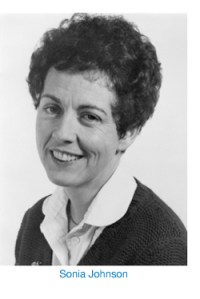 Great Eternal Internet Byteland Nirvana. There’s me–barely pregnant–talking motherhood, pregnant teenagers, and teaching with Maya Angelou. There’s me sitting between Betty Friedan and Kate Millet–brokering a cease fire and discussing International Women’s day–about ready to give birth to Doctor Daughter. Then, there’s me, dancing with Sonia Johnson who always said that my music made her weep.
Doctor Daughter is on her way to the big 30 and a big fat Bollywood Wedding next month so it’s on my mind a lot. It’s been over thirty years since Sonia told me about her life as a Mormon wife. Wow. We also have that stanky, regurgitated taste of the Mommy Wars that I thought I’d left behind in Doctor Daughter’s toddlerhood brought back by Willard and wife. That ignites something in me too. I didn’t leave Doctor Daughter’s side until she was way over the big ONE. I was a SAHM when I met all these legendary feminists. But, when Doctor Daughter weaned herself from my breast and took her first steps, I finished my Masters and decided to teach college. I made decisions for myself. But again, we’re in an age where men want women that let men make decisions for them.
I have a first edition signed copy of “From Housework to Heretic”. It’s not only signed, it’s inscribed by Sonia Johnson to the very young me. My music made her weep while her story made me scream. The picture that I glued into to the book of us is so early 80s. It’s a reminder of the last days of the fight for the ERA. It reminds me of treks and phone calls to Missouri and Oklahoma.
I have a lot of memories of these days including that of a friend who died not that long ago who had the audacity to marry a Catholic women. He was a mentor and a good friend I met while teaching my first college gig. He’s got a lot in common with Sonia. They both were excommunicated from the LDS church after a life of knowing nothing else. Yup, some of my best friends were excommunicated Mormons.
I also had Mormon friends in high school. I remember them as being really wild. Omaha was the winter stake or some such thing. The LDS temple was not even a block from my house. I know it really well because my Mom used to do genealogy research there. I had to chase her down in their microfiche room frequently and I heard them occasionally attach the title “sister” to her. Any Mormon woman can tell you what that means. Oh, btw, this is the room where they chased down all those dead relatives who get baptized post-mortem. Yup, no consent, no conversion, and no compliance is required for that. That’s the same treatment that Ann Romney gave her outspoken, feisty atheist dad.
When my own mom died, my Dad gave all her research to that LDS church. I was not a happy camper. I wanted all references and pictures of me removed. It’s the only thing surrounding my mother’s death that really upsets me. The thought that any one I loved might be subjected to spiritual kidnapping gives me the supreme willies. As my Mom lay dying, I read the verses of the Bardo of Dying and kept thinking that I really hoped the Mormons didn’t try to kidnap our Karma. I’d say “soul” to convey the importance of that to you, but that’s not a Buddhist concept at all.
Because of all of this, I believe it’s a really big mistake to give Willard Romney a pass on his religion.
I hate to join the likes of fundie christians, but there it is. I know excommunicated Mormons. I also know that any one who really takes this religion seriously should not be setting policy for women and children. The stories from Sonia that I remember best are the ones about “the voice”. I’m going to quote from my copy of From Housewife to Heretic and I want you all to think about this. It’s the story of a woman that knows male dominance and abuse. This excerpt comes from a point in a senatorial hearing where Senator Birch Bayh asks Ms. Johnson “what percentage of the people within the Mormon church share your views” as a Mormon for the ERA. Just like today, the sensibilities of equality and civil rights are subject to a man’s personal mythology.
“When Senator Hatch spoke to me, his voice changed. He put on his churchmen’s voice for me–unctuous, condescending; I was not alone hearing it. Several people asked me afterwards whether I had noticed. Indeed, I had, and said to myself incredulously at the time, “For heaven’s sake, Sonia. Do you mean to say that men in the church have been speaking to you like that for forty-two years and you’ve never noticed it?” It is incredible how we blind and deafen ourselves so we will not see the truth of how men really feel about us and really treat us.
I suppose the only reason I heard it that day was that such a tone was wildly inappropriate in the marble chambers of the Senate Office Building, so out of place that even I, whose ears had become inured to that insufferably patronizing tone from hearing it since birth, was shocked into awareness. This was not church, he was not my spiritual superior in this room, and he was not supposed to be functioning as if he were-that is, as if he were a Mormon Male. But he forgot himself and related to me as pompously and arrogantly as he must have related to women in the church all his life, this style came to him with such ease and naturalness.
At the time, Sonia believed the “churchmen’s voice” had given her a unique power
“Hatch, on the other hand, being the sort of patriarchal male who tends to view women as so much alike that one approach will work for all, prepared to assert in his usually successful ways his innate male superiority.
This faulty judgement always gives women the upper hand when dealing with patriarchs, because such men usually have not developed alternative strategies, and are left defenseless and foolish when their stereotypes fail them–as they are increasingly failing them.
“Mrs. Johnson,” he intoned down his shiny Boy Scout nose, “you must admit that nearly one hundred percent of Mormon women oppose the Equal Rights Amendment.” (Here’s where Bayh allowed the Relief Society sisters from Hatch’s ward and stake to applaud and stomp.)
When the tumult subsided, I replied “oh my goodness, I don’t have to admit that. It simply isn’t true.”
When one has just been spoke in one’s churchman’s voice, one does not expect to be answered back like that and Hatch, chagrined, began his serious work of intimidation and humiliation. Ironically, however, the harder he worked, the more ruffled he himself became and the calmer I felt. We began to have a delightfully brisk dialogue–at least, I enjoyed it:
Hatch: I notice in your letter to the legislature that you had twenty women listed.
Johnson: There were not just women on that list … The point here is that the numbers of adherents have never proved an issue true or false. You yourself belong to a church of only three million members which purports to be the only true church in the world. That is a pretty precarious position.
I remember well the role of the LDS church and its corporate cronies–like the Marriott Hotels–and what they did to the ERA. This Vanity Fair article has been quoted on this blog by Boston Boomer and me. I’m going to do it again.
The Romneys’ Mormon faith, as Mitt and Ann began their life together, formed a deep foundation. It lay under nearly everything—their acts of charity, their marriage, their parenting, their social lives, even their weekly schedules. Their family-centric lifestyle was a choice; Mitt and Ann plainly cherished time at home with their children more than anything. But it was also a duty. Belonging to the Mormon Church meant accepting a code of conduct that placed supreme value on strong families—strong heterosexual families, in which men and women often filled defined and traditional roles. The Romneys have long cited a well-known Mormon credo popularized by the late church leader David O. McKay: “No other success can compensate for failure in the home.”
So, again, what does this personal belief have to do with public office? Let’s continue with the Vanity Fair article.
The Church of Jesus Christ of Latter-Day Saints is far more than a form of Sunday worship. It is a code of ethics that frowns on homosexuality, out-of-wedlock births, and abortion and forbids pre-marital sex. It offers a robust, effective social safety net, capable of incredible feats of charity, support, and service, particularly when its own members are in trouble. And it works hard to create community, a built-in network of friends who often share values and a worldview. For many Mormons, the all-encompassing nature of their faith, as an extension of their spiritual lives, is what makes belonging to the church so wonderful, so warm, even as its insularity can set members apart from society.
But a dichotomy exists within the Mormon Church, which holds that one is either in or out; there is little or no tolerance for those, like so-called cafeteria Catholics, who pick and choose what doctrines to follow. And in Mormonism, if one is in, a lot is expected, including tithing 10 percent of one’s income, participating regularly in church activities, meeting high moral expectations, and accepting Mormon doctrine—including many concepts, such as the belief that Jesus will rule from Missouri in his Second Coming, that run counter to those of other Christian faiths. That rigidity can be difficult to abide for those who love the faith but chafe at its strictures or question its teachings and cultural habits. For one, Mormonism is male-dominated—women can serve only in certain leadership roles and never as bishops or stake presidents. The church also makes a number of firm value judgments, typically prohibiting single or divorced men from leading wards and stakes, for example, and not looking kindly upon single parenthood.
The portrait of Romney that emerges from those he led and served with in the church is of a leader who was pulled between Mormonism’s conservative core views and practices and the demands from some quarters within the Boston stake for a more elastic, more open-minded application of church doctrine. Romney was forced to strike a balance between those local expectations and the dictates out of Salt Lake City. Some believe that he artfully reconciled the two, praising him as an innovative and generous leader who was willing to make accommodations, such as giving women expanded responsibility, and who was always there for church members in times of need. To others, he was the product of a hidebound, patriarchal Mormon culture, inflexible and insensitive in delicate situations and dismissive of those who didn’t share his perspective.
So, the question I pose is which etcha-sketch Romney POV is the one that would be president? Personally, I do not care what Romney does in his temples, his many houses, or his car elevator. All I know is I do not want to hear that churchman’s voice coming from behind a podium with the Presidential Seal.
Exposing and Dismembering ALEC and its Kleptocracy Agenda
Posted: April 16, 2012 Filed under: American Gun Fetish, Big Pharma, Civil Liberties, Civil Rights, collective bargaining, Corporate Crime, corporate greed, corporate money, corporatism, corruption, Domestic Policy, Economy, education, Environment, New Orleans, We are so F'd | Tags: ALEC 13 Comments I have a personal interest in seeing ALEC dismembered. My governor Bobby Jindal has adopted and enacted some of its worse cookie cutter laws. There are three progressive interests that are leading actions to defund and defang this supposedly “nonpartisan individual membership organization of state legislators which favors federalism and conservative public policy solutions”. They are the Urban League, Common Cause, and ColorofChange. I would hope that many more groups will join in.
Many of ALEC’s corporate sponsors have quit funding the organization which seeks to remove oversight and regulation of all kinds of industry, privatize public services and goods, and deprive minority communities and women of basic voting rights and civil rights. They seek tort reform that would limit corporate exposure to liability from unsafe products and practices. They like to remove laws providing consumer protection and information. They are not nonpartisan and are responsible for some of the most heinous, radical legislation of the last few years. Woe to those of you whose governors or legislators belong to this organization for you will live in a world with very little protection from big money and big business and your tax dollars will be used to line their coffers.
The American Legislative Exchange Council describes itself as a nonpartisan champion of free markets. But if you spend some time at an ALEC conference (Bloomberg Businessweek did, for an article last year) you will be hard-pressed to find many Democrats. And when the entire conference meets for lunch, you will hear from the podium nothing that would seem out of place in a press release from Eric Cantor’s office. Last year in New Orleans, for example, Bobby Jindal, governor of Louisana, told an ALEC annual meeting, “Defeating the president is crucial to defending our economy,” and “Obama has been a disaster.” I didn’t hear anyone boo. What I did hear was the sound of fevered applause when the conference played a videotaped greeting from Ronald Reagan.
I’m not saying it’s wrong to feverishly applaud Ronald Reagan. I am saying that only in the most thinly defensible, legalistic sense can ALEC call itself “nonpartisan.” And the council doesn’t really support free markets, either. It supports the companies that fund it. This is an important distinction, because the corporations that donate to ALEC aren’t doing so to protect markets. They’re protecting favored tax treatments and pushing regulations that lock in their market positions. As best as we were able to determine in reporting our piece last year, corporations propose bills at the state level and then push them up to ALEC, which has both corporate and legislative members. ALEC pushes the legislative members to the foreground, stamps the bills as “model legislation,” and then the corporations push them back out to other state legislatures. This may not be the case with all ALEC legislation, but it certainly was with the bill we followed.
So ALEC is not what it says it is. That’s not extraordinary: Few advocacy groups are what they say they are. In ALEC’s case, however, the fingers-crossed-behind-its-back description of itself is definitional. If the American Legislative Exchange Council operated with complete openness, it couldn’t operate at all. ALEC has attracted a wide and wealthy range of supporters precisely because it does its real work in a black box. Membership lists are secret. The origins of the model bills are secret. Deliberations and votes on model bills are secret. The model bills themselves are secret. The council has designed its entire structure to disguise industry-backed legislation as grassroots work from state legislators. If this becomes clear to everyone, there’s no reason for corporations to use it. And that is exactly what has been happening.
Minority advocacy groups have been most active in the fight against ALEC. ALEC is responsible for the legislation that requires specific picture ids to vote and they are responsible for the Stand Your Ground Laws. Both of these issues have been front and center in Civil Rights Groups. The Trayvon Martin case is important in two key ways. First, it is bringing to light the institutional racism implicit in the criminal system. Second, it has exposed the role of ALEC in sneaking through legislature in states that most voters do not support or like. The vigilante-empowering Stand Your Ground laws are now seeing daylight.
The tension in corporate boardrooms over the case is the latest example of the pitfalls companies can sometimes face when they donate to political and lobbying groups, even those that seem safely below the radar of public consciousness.
The ALEC controversy is now sparking a broader debate about corporate participation in politics and the polarized state of political discourse. At a minimum, it has strengthened calls for companies to develop clear policies explaining their spending.
“I would caution companies to be very aware of where their money is going,” says Nell Minow, director of GMI Ratings, which provides corporate governance information to investors, corporate auditors and regulatory agencies. “Companies are going to realize they can take a real reputational hit with this kind of affiliation.”
She and others recall the tempest that erupted in 2010 around Target after the company donated to a nonprofit group supporting a Minnesota gubernatorial candidate who was known for opposing gay rights initiatives.
Like Louisiana, many Arizona politicians are in cahoots with ALEC. ALEC likes to use laws to funnel public money into corporate income statements. This isn’t free market promotion, this is more like being given the ability to loot public resources.
Legislators in Arizona continue to advance extremist legislation inspired by the American Legislative Exchange Council (ALEC) and its out-of-state corporate backers, according to a new analysis by People For the American Way Foundation, Common Cause, the Center for Media and Democracy and Progress Now. This report shines a new light on the Arizona Legislature’s unprecedented ties to the secretive organization, which recently drew nationwide fire for its role in implementing radical policies across the country like “Shoot First” laws and voter suppression laws, and anti-worker measures. ALEC’s extreme agenda has recently led companies such as Pepsi, Coca-Cola, McDonalds, Wendy’s, KRAFT and Intuit to withdraw from the organization. The Bill and Melinda Gates Foundation on Monday also withdrew its support from ALEC.
The comprehensive report found that Arizona’s large concentration of ALEC-member legislators, working hand-in-hand with the corporate leaders who make up ALEC’s membership, are continuing to endorse special interest legislation that harms ordinary people by limiting consumers’ rights, privatizing education and dismantling unions.
The report, ALEC in Arizona: The Voice of Corporate Special Interests in the Halls of Arizona’s Legislature, updated for the Fiftieth Legislature, second regular session is available here.
“Recent polling shows that Arizonans are appalled by the out-of-touch and extremist agenda at their State Legislature. This report shows that agenda is no accident,” said John Loredo, a member of Arizona Working Families and a former Arizona House Minority Leader. “Unfortunately, Arizona has one of the highest concentrations of ALEC legislators in the country, and that makes us a petri dish for anti-worker legislation and a host of other bad ideas.”
“ALEC-member legislators are unabashedly continuing to push legislation straight from corporate headquarters to Arizona’s lawbooks,” said Marge Baker, Executive Vice President at People For the American Way Foundation. “Well-heeled special interests are circumventing the democratic system and bypassing Arizona’s citizens, who can’t match the level of access that ALEC provides. As a result, Arizonans are facing an endless assault from laws that serve the interests of the rich and powerful instead of everyday people.”
You can find ALEC’s model bills and reports on its activities in many states at the site ALEC Exposed. ALEC is responsible for the horrible school voucher and privatization plan that Bobby Jindal has ramrodded through our state. It is also responsible for some of the worst climate change denial propaganda. The source of this funding is big oil, big coal, and the Koch Brothers.
$375,858 received from Koch foundations 2005-2010 [Total Koch foundation grants 1997-2010: $708,858]
American Legislative Exchange Council (ALEC) is one-stop shopping for state elected officials interested in perusing the wares of an array of Koch-funded opposition organizations including IER, ACCF, Mercatus and other sources. ALEC has successfully peddled corporate-written legislation to numerous states attacking the Kyoto Protocol, undermining climate science education in schools and numerous other anti-environmental legislation. ALEC has close ties to Koch Industries, which helped bail the organization out of financial troubles with a half-million dollar grant.
ALEC publishes its own materials as well, including a “Climate Change Overview for State Legislators” which downplays the science and risks of global warming and exaggerates the costs of addressing it. The Overview was written by Daniel Simmons, who moved from ALEC to become AEA’s Director of State Affairs. Simmons was at the Mercatus Institute before ALEC and is a graduate of the George Mason University School of Law.
Here’s some of the background information on the laws that ALEC creates with the intended purpose of “starving Public Schools“.
ALEC’s most ambitious and strategic push toward privatizing education came in 2007, through a publication called School Choice and State Constitutions, which proposed a list of programs tailored to each state. That year Georgia passed a version of ALEC’s Special Needs Scholarship Program Act. Most disability organizations strongly oppose special education vouchers—and decades of evidence suggest that such students are better off receiving additional support in public schools. Nonetheless, Louisiana, Oklahoma, Florida, Utah and Indiana have passed versions of their own. Louisiana also passed a version of ALEC’s Parental Choice Scholarship Program Act (renaming it Student Scholarships for Educational Excellence), along with ALEC’s Family Education Tax Credit Program (renamed Tax Deductions for Tuition), which has also been passed by Arizona and Indiana. ALEC’s so-called Great Schools Tax Credit Program Act has been passed by Arizona, Indiana and Oklahoma.
ALEC’s 2010 Report Card on American Education called on members and allies to “Transform the system, don’t tweak it,” likening the group’s current legislative strategy to a game of whack-a-mole: introduce so many pieces of model legislation that there is “no way the person with the mallet [teachers’ unions] can get them all.” ALEC’s agenda includes:
§ Introducing market factors into teaching, through bills like the National Teacher Certification Fairness Act.
§ Privatizing education through vouchers, charters and tax incentives, especially through the Parental Choice Scholarship Program Act and Special Needs Scholarship Program Act, whose many spinoffs encourage the creation of private schools for specific populations: children with autism, children in military families, etc.
§ Increasing student testing and reporting, through more “accountability,” as seen in the Education Accountability Act, Longitudinal Student Growth Act, One-to-One Reading Improvement Act and the Resolution Supporting the Principles of No Child Left Behind.
§ Chipping away at local school districts and school boards, through its 2009 Innovation Schools and School Districts Act and more. Proposals like the Public School Financial Transparency Act and School Board Freedom to Contract Act would allow school districts to outsource auxiliary services.
ALEC is also invested in influencing the educational curriculum. Its 2010 Founding Principles Act would require high school students to take “a semester-long course on the philosophical understandings and the founders’ principles.”
Perhaps the Brookings Institute states the mission most clearly: “Taken seriously, choice is not a system-preserving reform. It is a revolutionary reform that introduces a new system of public education.”
The passage of radical public school defunding in Louisiana is leading to a recall Jindal effort. We’ve already had some of this type of reform in New Orleans and it’s clearly not working well at all unless you count teacher union busting and lowering teacher salaries progress. Here are some of the things we will now be suffering in Louisiana. I personally am opposed to the state funding religious indoctrination hiding under the guise of education. These laws funnel public money into any thing that deems itself a school, it seems.
A vast expansion of charter schools, an overhaul of teacher tenure and establishment of a statewide program to pay private school tuition with public dollars moved within one step of final passage Thursday, as the Louisiana Senate Education Committee endorsed the headliner components of Gov. Bobby Jindal’s education agenda without changes or dissent.
I know this thread wanders around through many topics but the number of right wing bills pressured cooked into law by ALEC and their toadies is just as wandering and perverse. Check out the site and be aware of which politicians supposedly representing the people of your state that are ALEC cronies. The movement to get corporations to defund the organization should be paramount. Ordinary Americans have already lost a lot to their agenda. It’s time to stop them. Put pressure on organizations to join in the effort. Let’s defang this beast together.
Monday Reads
Posted: April 16, 2012 Filed under: morning reads | Tags: Michelle Bachmann still crazy after all this year, Tea Party, Tigers, WSJ misogny 38 Comments Good Morning!
It’s still the silly season. This means you really shouldn’t trust anything coming out of the beltway. Still, political junkies can’t help watching. At least I could find a few signs that some of the crazier fads of the last few years might go the way of the dodo. If we’re really lucky, we’ll be rid of the Tea Party and its adherents shortly.
Whither the Tea Party?
A major force in the 2010 midterm elections, the movement has stalled in public popularity, its support well below a majority and decidedly lukewarm. And Americans by a broad 23-point margin say the more they hear about the Tea Party movement, the less they like it, rather than liking it more.
That negative buzz has worsened from a 9-point gap in an ABC News/Washington Post poll as the movement was gathering speed two years ago. And its avenues for resurgence may be limited: Interest in learning more about Tea Party is down 7 points from spring 2010.
This poll, produced for ABC by Langer Research Associates, finds that six in 10 Americans aren’t particularly interested in additional information about the Tea Party, and 41 percent aren’t interested “at all.” Thirty-nine percent have at least some interest, but just 9 percent are very interested. Among those with interest, moreover, more than six in 10 already support it.
All told, 41 percent of Americans identify themselves as supporters of the movement, compared with a high of 47 percent last September. Forty-five percent oppose it; 14 percent have no opinion. Support has dropped disproportionately among young adults in that period, down 20 points from 51 percent to 31 percent.
While overall support is roughly balanced with overall opposition, “strong” opponents outnumber strong supporters by 2-1. But perhaps most damaging is the buzz: Fifty percent of Americans say the more they hear about the Tea Party, the less they like it; just 27 percent say they like it more. That compares with a much closer (albeit still negative) 43-34 percent split on this question in April 2010.
These views have grown more negative particularly among young adults, seniors, women, moderates and people in the $50,000 to $100,000 income range, all with 10- to 17-point increases in “like it less” responses as they hear more about the Tea Party movement.
Whacky Michelle Bachmann has been one of my favorite punching bags. Here’s a new one from her very sick mind: “Anti-Abortion Bachmann Says Women Need To Make Their Own Decisions About Their Bodies”. Doesn’t the state of Minnesota have enough straight jackets to deal with this menace? Bachmann is closely aligned with the Tea Party too. I wonder if there is a connection? Oh, and she’s still crazy after all this year and she’s conveniently forgetting that she and her party want to take over every uterus in the country.
Rep. Michele Bachmann (R-MN) argued that women should be allowed to make choices over their own bodies, while blasting Obamacare on Meet The Press. Without noting the irony of the GOP war on women targeting Planned Parenthood, abortion services, and contraception coverage, Bachmann said women need to be allowed control over their own bodies:
BACHMANN: What we want is women to be able to make their own choices […] We want women to make their own choices in healthcare. You see that’s the lie that happens under Obamacare. The President of the United States effectively becomes a health care dictator. Women don’t need anyone to tell them what to do on health care. We want women to have their own choices, their own money, that way they can make their own choices for the future of their own bodies.
Have you been following Roseanne Barr on Twitter? She’s running for President on the Green Ticket and is taking on big banks and Wall Street. I love third party candidates and have been following both Roseanne and Buddy Roehmer. They have strikingly similar concerns.
Comedian Roseanne Barr, running for president as a Green Party candidate, isn’t too keen on her early fundraising prospects.
“I admit I need help,” Barr told POLITICO via Twitter.
And with good reason: Since formally launching her bid in early February, Barr raised just $31,500 through March 31, federal disclosures out today show.
Of that, $25,000 came from a loan Barr made to her campaign on March 1.
“FEC rules limit what one can contribute to one’s own campaign, but staff needs to be paid,” Barr explained.
Just one person — Eric Weinrib of Brooklyn, N.Y., who gave $2,500 and listed his occupation as “unemployed” — made a cash donation of more than the itemized reporting threshold of $200.
Most of Barr’s expenditures have funded accounting and legal services, a staffer and pedestrian office supplies, such as a Hewlett-Packard laptop computer and bank checks.
Barr has been an outspoken advocate for the Occupy Wall Street movement and explains her interest in Green Party politics as a rejection of both Republicans and Democrats.
“They both suck and they’re both a bunch of criminals,” Barr said.
I’d just like to put in a word for Tigers as an alum of the LSU system and a mother of an LSU alum and a current LSU student. Specifically, we should start focusing on saving Tigers of all sorts. We should save all tigers including Tony the Tiger at the Truck stop between Baton Rouge and Lafayette. Here’s some links to find out about this gorgeous cat and its endangered status.
The tiger population has plunged 95% in the last century and there are perhaps just over 3,000 remaining on the entire planet. Two stories are presented in the video below.
First, there is Tony the Tiger at the Tiger Truck Stop in Grosse Tete, Louisiana. Tony is “privately owned” and caged for a commercial venture. Carole Baskin, founder and CEO of Big Cat Rescue, advocates rescuing Tony from lifetime captivity. Michael Sandlin, President of Tiger Truck Stop, counters, “…every American should have the right to own an animal of their choice”.
Second, there is the Buddhist Tiger Temple in Thailand, Wat Pa Luang Ta Bua Temple on the River Kwai, which cages not only tigers but other animals for tourists. Jane Garrison, an animal welfare advocate, describes tourists having their photo taken with drugged tigers. Almost one hundred tigers are kept in “tiny, barren cages” with inadequate provision (water, food, medical). Garrison maintains these tigers are part of the illegal “tiger parts” trade and it is a “horrific scene”. Tourists, by visiting the Tiger Temple, are in effect supporting a ‘lifetime of torture” for these caged tigers. The Thailand Department of National Parks says they have carried out a thorough investigation and found no evidence of involvement in illicit trade or maltreatment of the tigers. Garrison counters that Care for the Wild (CWI) says up to 75 tigers have “disappeared” from the facility and the Tiger Temple keeps renaming the tigers the same name.
Tigers are amazing big cats. Here’s some links to organizations committed to saving the species.
 Free Tony the Tiger! (Blog)
Save Tigers Now (WWF)
Big Cat Rescue (BCR)
Care for the Wild (CWI)
Exploiting the Tiger (Care For the Wild) pdf download
Click on the Tiger to go to Sarasota Tigers: a big cat habitat on the Gulf Coast.
The Wall Street Journal has been running op-eds that have been really misogynistic. They’ve been on the attack for about 2 weeks now. They either say that the war on women is fake or being “won” by the Republican Party. I’ve linked to them recently even though I hate to quote what they say. The WSJ must really take that 20 point gender gap seriously because its op ed page is nonstop “pro-women”. Here’s the Mahablog with a retort.
The Wall Street Journal wants us to know that Republicans can win the War Against Women. Seriously. I like this headline so much I screen captured it before some dweeb at WSJ wakes up and realizes what it says
It seems they’re riding the “marriage tax” train again. It’s the same old same old. Go check the best of the War on Women series at the link and become very annoyed. But, only do it after you’ve had adequate coffee and gathered up a pillow or two to punch.
So, that’s my suggestions this morning. What’s on your reading and blogging list today?
Who’s Zooming Who?
Posted: April 15, 2012 Filed under: War on Women, Women's Healthcare, Women's Rights 36 CommentsI’m still brooding about the disingenuous way the political class has reignited the Mommy Wars. There are so many hypocrisies at play in this conversation that it’s easy to forget that what this is really about are narratives that reinforce stereotypes of women. It’s also about the ways politicians manipulate the insecurities of women–especially in their mother roles–to ensure that we are divided as they conquer. We’ve been told that all those laws passed and introduced in the last two years that severely restrict women’s access to abortion, health care, equal pay and protection and now birth control are not part of a concerted effort by one of the parties to remove our progress to achieve equal access to jobs, society, and autonomy. Now, we’re once again being regaled on that marble column with the label “Mom: Most Important Job Holder in the World”. However, in their world and their laws, it appears some mothers are more equal than others. There is no where this double standard is more true than how they bestow sainthood on stay-at-home wealthy women while they assign poor mothers of children the role of lazy slut who breeds to stay home, live off the government, and do nothing. After all, welfare allows one to live such a life of luxury that big screen tvs and bons bons automatically come with each public housing unit.
Yup, the same group of folks that fought the family leave act, that are defunding all education-related expenses except ones associated with religious indoctrination and really hate family planning and pre-natal care are all in for all sainted moms. I’ve had about all the faux outrage I can take about poor Sainted Stay-at-Home Mom, Ann Romney, who has that well-defended full time, most important job while her husband’s been out on the republican speaking circuit saying that welfare moms need the “dignity of work”. So, Mrs. Romney has the dignity of being a stay home mom that can spend all that time doing the hardest job on the planet, but welfare moms don’t have the dignity of work unless they have a job? What kind of hypocritical nonsense is this?
Poor women who stay at home to raise their children should be given federal assistance for child care so that they can enter the job market and “have the dignity of work,” Mitt Romney said in January, undercutting the sense of extreme umbrage he showed when Democratic strategist Hilary Rosen quipped last week that Ann Romney had not “worked a day in her life.”
The remark, made to a Manchester, N.H., audience, was unearthed by MSNBC’s “Up w/Chris Hayes,” and aired during the 8 a.m. hour of his show Sunday.
Ann Romney and her husband’s campaign fired back hard at Rosen following her remark. “I made a choice to stay home and raise five boys. Believe me, it was hard work,” Romney said on Twitter.
On Sunday, Romney spokeswoman Amanda Henneberg told The Huffington Post in an email, “Moving welfare recipients into work was one of the basic principles of the bipartisan welfare reform legislation that President Clinton signed into law. The sad fact is that under President Obama the poverty rate among women rose to 14.5 percent in 2011, the highest rate in 17 years. The Obama administration’s economic policies have been devastating to women and families.”
Mitt Romney, however, judging by his January remark, views stay-at-home moms who are supported by federal assistance much differently than those backed by hundreds of millions in private equity income. Poor women, he said, shouldn’t be given a choice, but instead should be required to work outside the home to receive Temporary Assistance for Needy Families benefits. “[E]ven if you have a child 2 years of age, you need to go to work,” Romney said of moms on TANF.
Recalling his effort as governor to increase the amount of time women on welfare in Massachusetts were required to work, Romney noted that some had considered his proposal “heartless,” but he argued that the women would be better off having “the dignity of work” — a suggestion Ann Romney would likely take issue with.
So, who has dignity here and who doesn’t and what are the rules? It seems to me to put an awful lot of women in a no win situation.
The Romney campaign, hoping to make up its deficit among women voters, jumped on the comment. “I happen to believe that all moms are working moms,” said Romney.
It turns out he doesn’t. If you’re a poor mother in Massachusetts and you go to sign up for TANF, you’ll see you need to fulfill a “work requirement.” And you cannot fulfill it by being “a mom.” And that’s because of policy that Romney signed into law in Massachusetts, and Bill Clinton signed into law nationally.
That law has seen some real successes: The poverty rate for single mothers is lower now than before the legislation passed in 1996, and the labor-force participation rate is higher. Both parties brag about it routinely. But those numbers are only successes if you believe, as both parties do, that being a stay-at-home mother is not the same as working.
Over the past week, both parties decided to pander to stay-at-home mothers by forgetting this policy consensus and claiming they have always believed being a stay-at-home mother is “work.” But while they certainly believe parenting is toil, they don’t believe it is, in any real sense, work. And you can see that in the laws they’ve made.
After all, it’s not just TANF that doesn’t recognize parenting as “work.” Social Security doesn’t count parenting as “work.” The tax code doesn’t count parenting as “work.” The Bureau of Labor Statistics doesn’t count parenting as “work.”
Obviously, poor women don’t have the same routes to dignity that upper class women do. In other words, I small a hypocrite.

 peej
peej Carissa
 bostonboomer
 dakinikat
 ecocatwoman
 jjlo
jjlo mablue2
 Mama Lopez
 peggysue22
 quixote
 skydancingguestblogger
 Mona (aka Wonk the Vote)





Recent Comments