
Say Goodnight Karl!!!
Posted: November 10, 2012 Filed under: 2012 elections, 2012 presidential campaign | Tags: Karl Rove 61 Comments
So, I’ve tried really hard not to gloat over all the karma trickling down on Karl Rove but I’m having no luck whatsoever suppressing it. Sometimes you really do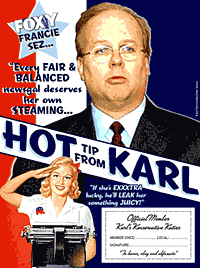 have to celebrate when all those chickens come home to roost. That gushing sound you hear is all the hot air leaving Karl Rove’s tires.
The money boys are not happy with ol’ Turd Blossom.
The face of the historic $1 billion plan to unseat President Barack Obama and turn the Senate Republican, Rove now finds himself the leading scapegoat for its failure. And he’s scrambling to protect his status as a top GOP money man by convincing disappointed donors to his Crossroads groups that he did the best he could with their $300 million.
Sources tell POLITICO that some donors have called Crossroads officials to ask how their polling could have been so far off, while others are openly grumbling that the groups should have spent more on the ground game. Rival operatives — long frustrated by Rove’s dominance of big GOP money — are seizing on the discontent, questioning whether he’s hurting the cause and privately urging donors to shut him out.
During a secret Thursday afternoon conference call with his benefactors, Rove laid out the analytics behind his assertions to donors that a massive late-game advertising push would expand the electoral map into Pennsylvania and deliver the White House and the Senate.
The call was civil, focusing on questions like, “‘where was my strategy, was it right, was it wrong? What did we find out that we didn’t know before?’ That kind of thing — nothing negative, no recriminations or blame,” said Minnesota media mogul Stan Hubbard.
Donors “weren’t saying anything like, ‘Hey, you dumb son of a b——,’” added Hubbard, who has donated to both the Rove-conceived American Crossroads super PAC and its secret-money nonprofit affiliate Crossroads GPS. “It was all very businesslike. It was as if you were in a business conference and you were a retailer and ‘why didn’t this product sell better?’”
The Flim Flam man that brought us 8 years of the disastrous Bush administration couldn’t put the spin to what was a seriously flawed candidate running on a reheat of the Bush Doctrines and Policies with no specifics and promises based on really bad math. All of that was wrapped up in misogyny, homophobia and racism. Very bad things are happening to Karl Rove whose national meltdown on Fox has become a youtube lesson in scrambling for nonexistent higher ground. Nothing worse than delivering the worst results in the election to those who made the biggest investments.
Researchers at the watchdog group the Sunlight Foundation found that Rove’s American Crossroads super PAC came in second to last, ahead of only the NRA, in terms of how much “bang for their buck” they got in this election. The American Prospect explains:
[T]he biggest money-waster of all, you will be eternally gratified to hear, was Karl Rove’s American Crossroads super PAC, which forked out a whopping $104 million and had a “desired result” rate of 1.29 percent. That’s right, folks: The great genius of American Republicanism wasted more of his donors’ money than anyone else. (His non-profit group, Crossroads GPS, did marginally better—a 14-percent “desired result” rate.) Looked at one way, though, American Crossroads had a kind of perfect score: The super PAC supported zero candidates who won on Tuesday.
Yes, that’s right. Karl’s super PAC had a success rate of ZERO. Excuse me while I dance naked in the streets as they tar and feather the snake oil salesman. This is revenge I can believe in. Here’s CBS Boston calling him the “most overrated person in politics”.
The two best words to describe Karl Rove are OVER and RATED.
Rove has managed to spin himself a personal fortune in national politics despite his work in the field. His reputation, however, does not match his accomplishments.
First, there was the George W. Bush primary campaign in 2000. Under Rove’s expert hand Bush lost New Hampshire to John McCain’s maverick, insurgent campaign. Despite all the insider advantages Bush had by January of 2000, Rove’s strategy was a loser.
It was only by running a vicious negative and personal campaign that even went after McCain’s youngest daughter that Turd Blossom, as Bush like to call Rove, was rescued from himself. The negative campaign made up for Rove’s miscalculations and was able to pull Bush from looming defeat.
Lest we forget ….
And Rove’s tenure as White House political director was defined by scandals in the White House involving Rove. Those include the exposure of the identity of a CIA agent, Valerie Plame, as political retribution; scandals at the Justice Department over dismissal of U.S. Attorneys; and a secret political email program set up in the White House.
Let’s dance some more on the man’s grave. CNN’s Howard Kurtz writes that Karl Rove “rejects reality”. Isn’t that what Fox News pays all of its employees to do?
As televised theater, it was hard to beat. As political prognostication, it was a head-scratching moment. As partisan warfare, it was nothing short of audacious.
But Karl Rove’s insistence that Barack Obama had not carried Ohio — despite the call by his own network, Fox News, that the president had done just that — represented something larger. It captured, for some long and awkward moments, the refusal of some in the media-and-politics game to accept reality.
And that has been a recurring pattern this year.
We’re not talking here about a bad judgment call by a pundit. Everyone in the commentary business, including yours truly, has made those. If failed predictions were a felony, the jails would be filled with media folks.
 Kenneth Walsh at USN asks if Karl Rove’s Political Career is Over? To which, we pull a Meg Ryan and shout YES YES YES a few times with emphasis.
Many Republicans had been sold on Rove as a brilliant strategist who not only led George W. Bush’s two successful presidential campaigns but could also lead the GOP to better days this year and in the future.
“He over-promised and under-delivered,” says a former senior adviser to President Ronald Reagan. “He seems to have just become a spin artist.”
There’s a lot of things George Bush sold us that were so wrong it’s not even funny. Karl Rove ranks right up there with the invasion of Iraq. Thankfully, his damage this time up seems limited to Republicans who deserve it.
Just one more. I just love wallowing in a good gloat. This is from the AJC: It’s time for Karl Rove to float away in a balloon.
Of course, the real Wizard of Oz moment came Election Night on Fox, when Rove performed his epic meltdown over the numbers coming out of Ohio. If that did not permanently damage his reputation more than the losses themselves, it certainly cemented it.
You see, a good political strategist has to be willing to listen dispassionately to what the data tell him. He does not yell angrily at that data, like a distraught husband refusing to believe that his wife just left him. In that moment, Rove exposed himself as the petty figure that he is.
As Dorothy Gale, D-Kansas, famously put it, “Why, you’re not a wizard at all, you’re just a man! And you’re a very bad man for pretending to be a wizard.”
And after that, as I recall, the defrocked wizard floated away in a balloon, unable to steer a new direction because “I don’t know how it works!”
We’ll know the real verdict by his employment status at Fox News. That’s where all the washed up wingers go to hypnotize the feeble-minded. Frankly, it’s about time Fox finds some more believable Flim Flammers anyway. Bye bye Turd Blossom! Bye Bye!!
Faustian Bargains and other deals
Posted: November 9, 2012 Filed under: Economy | Tags: Faustian bargains, fiscal cliff 14 Comments
There’s been a series of signals today–in the form of pressers–on what will be the grand bargaining and scheming of partisan politics for the souls and future of American citizens. The Grand Bargain is obviously foremost on the minds of any one looking social security and medicare in the face. But, another set of bargains appears to be characterizing the Republicans desire to be relevant to Hispanic voters. The lame duck congress just might turn into the immigration reform congress. Republicans just signaled they’re ready for immigration reform. Wow, that was fast. There’s already some blowback on from the extraordinary bloviating right which basically wants to police state its way to white supremacy. But, they’ve all looked at the demographics now. Whither thou goest Speaker Boehner?
Fresh off an election in which Hispanic voters largely sided with Democrats, Speaker John A. Boehner said Thursday that he was “confident” Congress and the White House could come up with a comprehensive immigration solution.
Immigration reform is “an important issue that I think ought to be dealt with,” Mr. Boehner, an Ohio Republican, said in an interview with Diane Sawyer on “ABC World News.”
“This issue has been around far too long,” he said, “and while I believe it’s important for us to secure our borders and to enforce our laws, I think a comprehensive approach is long overdue, and I’m confident that the president, myself, others, can find the common ground to take care of this issue once and for all.”
The words conveyed a new sense of urgency from Mr. Boehner, who said earlier this year that he thought it would be politically impossible to tackle a Republican proposal on the Dream Act, which sought to open a path to citizenship for some students in the United States illegally.
According to exit polls by Edison Research, President Obama won 71 percent of the Hispanic vote compared with Mitt Romney’s 27 percent, a gap greater than Mr. Obama’s 36-point advantage with those voters over John McCain in 2008.
Republicans were also on the losing on the issues of marijuana decriminalization, gay marriage, and women’s reproductive health. Obviously, they’re going to try to shore up the Hispanics before they give any ground to any one else. There’s an entire list of right wing blogs–including The Daily Caller–on memorandum where you can just go drown yourself in seething xenophobia, if you so desire. Frankly, I’ve had enough racism for awhile so I’m just going to drop that discussion.
Back to the fiscal cliff and the Grand Bargain where the MSM has been laying bets all day. Boehner just offered up more Republican trickle down crap and the Romney/Ryan/Norquist budget plan this morning. Never say die!!
Boehner expressed hope that “2013 is finally the year” the government can agree on a grand bargain on spending and debt. “When the President and I have been able to come to an agreement,” he said, “there’s been no problem getting it passed in House.”
Regarding a tax deal specifically, the Speaker argued that “raising tax rates will slow down our ability to create the jobs that everyone says they want.” Reinforcing an often-cited Republican argument, Boehner said the problem with raising taxes on the wealthiest “is that more than half are small business owners.”
What part of raise the damn taxes didn’t Boehner get from the election results on Tuesday? The President appears to have gotten the message. He retorted “Americans agree with my approach”.
President Barack Obama, laying down his marker for grueling “fiscal cliff” negotiations, said Friday he won’t accept any approach to federal deficit reduction that doesn’t ask the wealthy to pay more in taxes.
“This was a central question during the election,” Obama said in his first postelection comments on the economy. “The majority of Americans agree with my approach.”
During the question-and-answer portion, Boehner was also asked about immigration. Noting he was “not going to get any details,” he said, “on an issue this big, the president has to lead.”
Speaking more broadly about the Republican party itself, Boehner said the principles of the party are sound, but: “It’s clear that as a political party we have some work to do.”
Following up, Obama’s spokesman said later that the president would veto any legislation extending tax cuts for families making $250,000 or more.
The president, speaking in the White House East Room, said he wasn’t wedded to every detail of the plans he outlined during the election, adding, “I’m open to compromise.” But he offered no indication that he was willing to back down.
Republicans stood their ground. At the Capitol, Republican House Speaker John Boehner said he remains unwilling to raise tax rates on upper-income earners. But he left open the possibility of balancing spending cuts with new revenue that could be achieved by revising the tax code to lower rates but also eliminate some tax breaks.
Again, Boehner went straight for the heart of Medicare and Social Security. He’s made it clear that he expects cuts to programs that the American people support. The key is not to panic about goes on down in January. There’s quite a few months after that for things to work themselves out. The only thing that is likely to happen is incredible variance in stock market returns which has been fairly typical of the market recently anyway.
Republicans say raising tax rates on the wealthiest Americans is a non-starter. Boehner said it would hurt small businesses while they are still struggling to recover from the recession.
“I’m proposing that we avert the fiscal cliff together in a manner that ensures that 2013 is finally the year that our government comes to grips with the major problems that are facing us,” Boehner said Friday. He said cuts to Medicare, Medicaid and food stamps, known as entitlement programs, have to be part of the equation.
Boehner also indicated that raising the debt limit, which the government will reach sometime in the spring, should be part of any negotiations. Pressed for details beyond that framework, he said he didn’t want to limit ideas to address the problem. He said the burden is on Obama.
“This is an opportunity for the president to lead,” Boehner said. He repeated a version of that phrase four times during the 11 minutes he spoke. “This is his moment to engage the Congress and work toward a solution that can pass both chambers.”
Some analysts believe that the “cliff” is more like a fiscal slope, that the economy could weather a short-term expiration of the Bush-era tax cuts and the government could manage a wave of automatic spending cuts for a few weeks. But at a minimum, failure to reach some resolution would mean delays in filing taxes and obtaining refunds and would rattle financial markets as the economy struggles to recover.
My guess is that all the tax cuts will be allowed to expire. Then, the president will return to the table to ask for cuts for the middle classes. This will allow the Republicans to say that they didn’t increase taxes although I’d say that Norquist and a lot of wealthy Republican donors will consider doing nothing akin to treason. That should be an interesting moment. Then, the return to the issue of the coming need to increase the debt ceiling and do a budget will go back on the table. This is the time to watch what spending cuts will be offered up by the President and what will be agreed to by the Democrats in congress. I just hope the President doesn’t start the negotiations by offering a centrist proposal straight off the bat. He hasn’t got much to lose at this point by holding firm.
The basic deal is this. The press and many pols are selling the fiscal cliff as a way to drive an austerity agenda. Economists are aware of the potential disaster that lays ahead should this occur. We have a worse chance of going the way of the UK with its flailing economy than going the way of Greece that really has no taxable assets to speak of.
In fact, the problem with the fiscal cliff is precisely the opposite: The tax hikes and automatic spending cuts that would kick in after Dec 31 would sharply curb our federal deficit through enacting major, sudden austerity measures that would save the U.S. government about $720 billion in 2013 alone, according to the Bank of America’s estimates, which would be about 5.1 percent of GDP.
“If we let all of those changes [happen], there would be a sharp reduction in the budget deficit—in decline in debt to GDP, falling deficits as a share of GDP,” says Chad Stone, chief economist at the Center for Budget and Policy Priorities. “It’s all a dream for people who want really sharp austerity.”
So the reason that the fiscal cliff could push us into another recession in 2013 is because it enacts too much deficit reduction upfront, not too little. By contrast, the reason that Europe became mired in a fiscal crisis in the first place is because profligate nations haven’t done enough to curb their spending and raise revenue to their more fiscally responsible neighbors’ satisfaction.
The folks who want to avoid the fiscal cliff for fear of its impact on a still-faltering economy are effectively arguing that now isn’t the time to enact austerity measures: Instead of taking money out of government programs and people’s paychecks, the government should be putting that money into the economy. And certain parts of the fiscal cliff bring more bang for the buck than others, CBBP’s Stone points out: Payroll tax cuts and unemployment benefits are more effective way to boost economic growth in the short-term than the Bush tax cuts for upper-income Americans, according to a new report from the Congressional Budget Office.
So if it’s immediate austerity that we want to avoid, and stimulus that should take its place, why is there so much talk about the need for major deficit reduction as a solution to the fiscal cliff? It’s because lawmakers decided months and years ago that they wanted this austerity crisis to happen as a way of creating leverage for more sensible, long-term deficit reduction measures.
I still think this means the president will go for the expiration of the tax cuts and then ask to return tax cuts to the middle class. We’ll see who will take that bargain. Then, the give-and-take on the longer term issues will start. The question to me is who will be Faust and who is the Devil?
The shrill one offers up some advice to Democrats: Let’s not Make a Deal.
In saying this, I don’t mean to minimize the very real economic dangers posed by the so-called fiscal cliff that is looming at the end of this year if the two parties can’t reach a deal. Both the Bush-era tax cuts and the Obama administration’s payroll tax cut are set to expire, even as automatic spending cuts in defense and elsewhere kick in thanks to the deal struck after the 2011 confrontation over the debt ceiling. And the looming combination of tax increases and spending cuts looks easily large enough to push America back into recession.
Nobody wants to see that happen. Yet it may happen all the same, and Obama has to be willing to let it happen if necessary.
Why? Because Republicans are trying, for the third time since he took office, to use economic blackmail to achieve a goal they lack the votes to achieve through the normal legislative process. In particular, they want to extend the Bush tax cuts for the wealthy, even though the nation can’t afford to make those tax cuts permanent and the public believes that taxes on the rich should go up — and they’re threatening to block any deal on anything else unless they get their way. So they are, in effect, threatening to tank the economy unless their demands are met.
Obama essentially surrendered in the face of similar tactics at the end of 2010, extending low taxes on the rich for two more years. He made significant concessions again in 2011, when Republicans threatened to create financial chaos by refusing to raise the debt ceiling. And the current potential crisis is the legacy of those past concessions.
Well, this has to stop — unless we want hostage-taking, the threat of making the nation ungovernable, to become a standard part of our political process.
So what should he do? Just say no and go over the cliff if necessary.
I’d say that’s what will happen.
Friday Reads
Posted: November 9, 2012 Filed under: Elections, Elizabeth Warren Campaign, Gun Control, morning reads | Tags: Elizabeth Warren, fiscal cliff, NRA, Planned Parenthood 88 Comments
Good Morning!
Much is being made of the election results that delivered a sound thumping to Republicans and their agenda to restrict the rights of women and minorities and to provide benefits to the wealthy and powerful. A record number of women will be serving in the US Senate. Five new women will be headed there. Of all the significant races, Senator-elect Elizabeth Warren appears to have garnered the most hope and angst. Simon Johnson considers her election “important”.
Senator Warren is well placed, not just to play a role in strengthening Congressional oversight but also in terms of helping her colleagues think through what we really need to make our financial system more stable.
We need a new approach to regulation more generally – and not just for banking. We should aim to simplify and to make matters more transparent, exactly along Senator Warren’s general lines.
We should confront excessive market power, irrespective of the form that it takes.
We need a new trust-busting moment. And this requires elected officials willing and able to stand up to concentrated and powerful corporate interests. Empower the consumer – and figure out how this can get you elected.
Agree with the people of Massachusetts, and give Elizabeth Warren every opportunity.
Laura Gottesdiener thinks Warren’s election may usher in the end of the Tea Party.
Warren, who beat out the incumbent Republican Scott Brown in a bitter election, ran a campaign centered on connecting the dots between economic policies and personal values. A Harvard bankruptcy-law professor, Warren trumpeted a platform that called for economic reform, financial regulation and the protection of Social Security, Medicare and other safety-net programs.
“We said this election is about whose side you’re on,” Warren told The Huffington Post . “I think of this as an election where we stuck to our values: Make sure Social Security and Medicare benefits are protected, and millionaires and billionaires pay their fair share. To me, that’s the heart of it. That’s really where the basic social contract is reaffirmed.”
This type of populist platform became increasingly risky after Citizens United allowed for the infusion of billions of dollars into state elections. Warren was already well disliked on Wall Street for her role in creating and heading the Consumer Financial Protection Bureau, a watchdog agency that seeks “to make markets for consumer financial products and services work for Americans — whether they are applying for a mortgage, choosing among credit cards, or using any number of other consumer financial products.”
Warren may be given a seat on the powerful senate banking committee which has to be worrying Wall Street.
Senior Senate Democratic aides, speaking on condition of anonymity, said the Massachusetts senator-elect is a logical fit for the committee, even though it is rare for a freshman senator to get such a plum assignment.
If she gets the slot, Warren’s bully pulpit would be replaced with real power.
The bipartisan panel can greatly influence policy decisions through its oversight of financial services, international trade, insurance, housing, securities and economic issues.
Warren, who has called for breaking up the big banks, could move to block legislative tweaks to the 2010 Dodd-Frank financial oversight law that would blunt the full impact of profit-pummeling reforms.
She would also be able to forcefully push for regulators to use all the powers available to them to write strict interpretations of rules.
That could mean stronger curbs on Wall Street trading, higher capital buffers and rules that would compel mega-banks to shrink.
Warren and other Senators will have to watch the President and Speaker of the House as they battle of the so-called fiscal cliff before getting their say in the budget.
While no can say for sure how the negotiations to avoid the so-called “fiscal cliff” — the expiration of the Bush tax cuts and impending across-the-board spending cuts — will unfold, the betting here is it will get ugly before it gets better.
First, virtually no one believes what happened last time will happen this time: President Obamawon’t cave on extending tax cuts for upper income earners.
So will House Republicans come to the table voluntarily, before the first of the year? Or will it require all hell breaking loose — an expiration of the income and payroll tax cuts, sequestration, the estate tax, and the AMT kicking in, cap gains and dividend rates rising — before they are forced to come kicking and screaming to an agreement?
The president holds a lot of leverage here — not just because he just won, Democrats expanded their majority in the Senate, and gained seats in the House. He holds leverage because, structurally, we’re talking about tax cuts that are expiring. His position is clear: The rate for the wealthiest will be allowed to go up. If he is willing to go to the wall and let the the lower rates expire, pressure shifts to House Speaker John Boehner to make a deal before his conference is isolated by the business community, which more than anything wants D.C. to just cut a deal, and Senate Republicans, who cut a deal and sold Boehner out last time. Add to that a tanking market and mounting economic hysteria, and that’s a lot of pressure on the House GOP true believers, Allen West or no Allen West.
The conventional wisdom is that Obama and Republicans will make a short term deal on taxes and sequestration — kicking that can down the road yet again — contingent on agreement on a “framework” for tax reform to be done in the first part of 2013.
There is incentive for Boehner to try and make an early deal, before the first of the year. The question, as always, is will he have the votes to allow tax rates on the wealthy to rise? Seems doubtful. He would have to be a pretty firm and big commitment from Obama on tax and entitlement reform to get them to go along.
Is it a matter of who will blink first? Here’s a conversation between Ramesh Ponnuru and Margaret Carlson. This is Ponnur’s take.
Does Boehner mean that tax reform should raise money by cutting tax breaks more than it cuts tax rates? Or does he mean that it should raise money just by encouraging economic growth?
If it’s the first, Boehner is going to have a problem with conservatives — especially Grover Norquist, the party’s anti- tax enforcer. If it’s the second, he’s not talking about much revenue.
That’s a bargain that sounds grand to me, but liberals who just won an election might disagree, don’t you think? My guess is he’s being ambiguous so he can gauge the reaction.
Another question: What leverage does Boehner have, and what leverage does he think he has? Obama doesn’t have to cut any deal to get a lot of extra revenue. He can let taxes go up as scheduled and challenge the Republicans to cut them only for the middle class. Republicans can either go along or decide not to and then blame him for the resulting middle-class tax hikes. Who likes their odds better in that fight?
Republicans have another bit of leverage, beyond the threat of blaming Democrats for tax increases: We’re getting close to hitting the debt ceiling again, and in the normal order of thingsHouse Republicans would have to agree to lift it.
Carlson has this to say.
In an election that was otherwise a debacle for Republicans, the House held its majority, and Boehner holds the gavel as long as he coddles his most extreme members. So he will.
Meanwhile, the president (unless you see something in him, Ramesh, that I don’t) still believes in this hope-y, change-y stuff Republicans consider a joke. He still sees himself as a historic figure that can bridge the partisan divide.
It is Boehner’s tiny, eensy-weensy bit of openness to dealing with Obama that is enraging conservatives. At the same time, it is playing to Obama’s view of himself. The president’s signature trait is an inability to negotiate from strength. He leads with his best offer. If Obama were buying a car, he’d probably pay full price and leave without radial tires.
In fairness to Obama, it’s foolish to call the bluff of an opposition that’s already shown it will allow the U.S. to default on its debt.
You’re right, Ramesh, that Obama doesn’t have to do anything at all to raise revenue. But he can’t risk raising taxes on the working and middle classes when the economy is still shaky. Republicans, by contrast, are willing to risk anything.
One of the quiet victories of the election is the failure of the NRA whose candidates didn’t do well this election.
The Sunlight Foundation, a campaign watchdog group, found that the NRA’s Political Victory Fund – the political arm of the nation’s largest gun lobbying organization – spent almost $11 million for or against individual candidates in the general elections, but got less than a 1 percent return on its investment.
The NRA, for instance, spent more than $7.4 million in opposition to President Obama and almost $1.9 million in support of Mitt Romney, according to Sunlight. But Obama was the victor on Tuesday, and the NRA had similar bad luck trying to influence Senate and House races.
For example, the group put almost $538,000 behind Indiana Senate contender Richard Mourdock (R), who lost, and spent more than $512,000 to oppose Sen. Sherrod Brown (D-Ohio), who won, according to Sunlight.
Conversely, Planned Parenthood did an outstanding job!
Planned Parenthood’s political wing trounced other groups with a near perfect return on its election spending, according to a new numbers review.
The Sunlight Foundation found that Planned Parenthood’s advocacy arm and super-PAC spent about $5 million and $7 million, respectively, to oppose Republicans and support Democrats in the general election.
In the end, the two groups saw returns on investment of about 98 and 99 percent, according to Sunlight.
The figures come as election-watchers pick apart the most expensive cycle in history. Republicans’ loss in the presidential race and failure to claim the Senate came as a surprise to outside donors, many of whom spent millions to ensure GOP victories.
Planned Parenthood’s political wing played an outsized role in the general election, compared to cycles past. The flood of political activity came as Republicans vowed to end Planned Parenthood’s federal funding as a healthcare provider for low-income women. Conservatives argue that while the law technically bans public funds from supporting abortions, taxpayer money need not flow to a group that performs the procedures.
The election covered a wide range of women’s health issues in addition to public funds for Planned Parenthood, giving the group ample chance to advocate in favor of abortion rights and access to free birth control.
The only outside groups that came close to beating Planned Parenthood’s return on investment were Majority PAC, which fought for Democratic Senate candidates, with a success rate of about 88 percent, and the Service Employees International Union PEA-Federal, with about an 85 percent success rate.
I’ll end with offering some beautiful finds in a Thracian burial site in Bulgaria.
The researchers found fragments of a wooden box, containing charred bones and ashes, along with a number of extremely well-preserved golden objects, dated from the end of the 4th and the beginning of the 3rd century B. C.. They include four spiral gold bracelets, and a number of intricate applications like one which shows the head of a female goddess adorned with beads, applications on horse riding gear and a forehead covering in the shape of a horse head with a base shaped like a lion head. The objects weigh 1.5 kg, but the excavations continue.The precious find also contains a ring, buttons and beads. Gergova explains that it seemed the treasure was wrapped in a gold-woven cloth because a number of gold threads were discovered nearby.
The Professor says these were, most likely, remnants from a ritual burial, adding the team expects to discover a huge burial ground, probably related to the funeral of the Gath ruler Kotela, one of the father-in-laws of Philip II of Macedon. She notes this is a unique find, never before discovered in Bulgaria.

What’s on your reading and blogging list today?
Mr Reid, Tear Down This Filibuster
Posted: November 8, 2012 Filed under: U.S. Politics | Tags: Filibuster, Filibuster Reform, gridlock, Harry Reid, Mr Smith Bill 42 Comments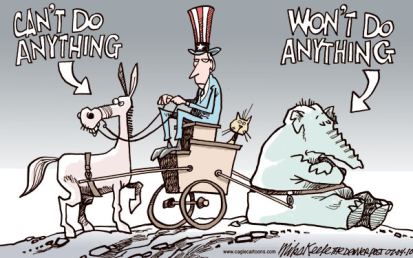 One of the most frustrating things that’s happened in the last few years has been the overuse and misuse of the filibuster. Senate Majority Leader Harry Reid--see the morning post–has decided that one of his top priorities will be to pass legislation to tighten rules on the use of the filibuster in the legislative chamber. The overuse of the lazy Senator’s filibuster has stymied nearly every attempt to get Democratic legislation through the Senate.
Bloomberg has an excellent article on the changes that will be proposed and what impact this could have on an Obama second term. The bill is called “The Mr Smith” bill. It’s be reintroduced by Sen. Frank (D-NJ). The bill would require those who want to filibuster a nomination or a bill to appear on the floor and actually speak. This means that Republican senators can’t just scream filibuster and the go home to dinner and cocktails. The bill was first introduced in 2011.
“The filibuster is being abused to create gridlock and prevent the Senate from doing the people’s business. Instead of being a deliberative body, the Senate has become a deadlocked body,” Lautenberg said in a press release Wednesday. “The ‘Mr. Smith Bill’ would help break the obstruction in Washington, bring transparency to lawmaking and hold senators accountable for their actions. This bill will stop senators from launching a filibuster and then skipping off to dinner, leaving our work in a stalemate.”
The bill — co-sponsored by Sens. Dick Durbin, D-Illinois, and Kirsten Gillibrand, D-New York — also would require that the Senate move for an immediate vote once debate ends and those conducting the filibuster give up the floor.
“Right now, senators are allowed to filibuster and force the Senate to use up a week or more on a single nomination or bill, even if there is no debate occurring on the floor,” Lautenberg’s office said. “Under the Lautenberg proposal, that time could be reduced significantly.”
Typically, a Senate rule change requires a super majority of 67 yes votes, something that will be difficult for Democrats, with their narrow 53-seat majority, to achieve. However, on the first legislative day of a new Congress, a simple majority of senators, just 51 votes, can approve new rules.
According to Lautenberg’s office, 91 cloture votes were taken in the 111th Congress — almost “four times the 24 cloture votes taken 20 years ago and almost double the 54 cloture votes required in the 109th Congress (2005-2006), when Republicans were last in the majority.”
This is the first item that would reform the procedure that became infamous in the Jimmy Stewart movie. It has moved from being a true expression of frustration with a piece of legislation or a process to a systematic way to gridlock. It has increased the polarization that characterizes Congress these days. It isn’t used to either protect the rights of the minority or to force debate. It’s used for pure political gain. The Bloomberg article states that “there were more filibusters between 2009 and 2010 than there were in the 1950s, 1960s, and 1970s combined”. This will give you an idea of what’s become of a symbol of democracy. It’s became a way for Mitch McConnell to hold back progress including help for the unemployed, veterans, victims of domestic abuse, and judicial appointments. Newly elected Senators appear to be on board for reform.
Chris Murphy, the incoming Democratic senator from Connecticut, couldn’t have been clearer: “The filibuster is in dire need of reform,” he told Talking Points Memo. “Whether or not it needs to go away, we need to reform the way the filibuster is used, so it is not used in the order of everyday policy, but is only used in exceptional circumstances.”
Angus King, the independent senator-elect from Maine, said, “My principal issue is the functioning of the Senate.” He backs a proposal advanced by the reform group No Labels that would end the filibuster on motions to debate, restricting filibusters to votes on actual legislation. The group also wants to require filibustering senators to physically hold the Senate floor and talk, rather than simply instigate a filibuster from the comfort of their offices.
And it’s not just the new guys. In an election-night interview on MSNBC, Senator Dick Durbin ofIllinois, the Democrats’ second-in-command, emphasized the importance of filibuster reform. Senate Majority Leader Harry Reid is a committed guardian of institutional prerogatives who put the kibosh on filibuster reform in the previous Congress. But even he has given up protecting the practice. “We can’t go on like this anymore,” he told MSNBC’s Ed Schultz. “I don’t want to get rid of the filibuster, but I have to tell you, I want to change the rules and make the filibuster meaningful.”
That doesn’t go nearly far enough. The problem with the filibuster isn’t that senators don’t have to stand and talk, or that they can filibuster the motion to debate as well as the vote itself. It’s that the Senate has become, with no discussion or debate, an effective 60-vote institution. If you don’t change that, you haven’t solved the problem.
Common Cause actually sued the US Senate this year to end the filibuster.
Enter Common Cause. It argues that a minority in the Senate has used the filibuster to hold up all manner of legislation, including (most importantly, for this suit), the
DISCLOSE Act (to tighten electioneering disclosure requirements in the wake of Citizens United) and the DREAM Act (to create a path to U.S. citizenship for certain aliens). It argues that the 60-vote requirement in Senate Rule XXII violates the default parliamentary majority-takes-all rule, the careful balance of powers in the legislative branch and between the three branches, and the power of the Senate itself to changes its own rules (because along with Rule V (which continues the Senate rules from Senate to Senate) Rule XXII seems to require that 3/5 of Senators vote to change Rule XXII). In particular, Common Cause argues that the filibuster violates the Quorum Clause, the Presentment Clause, the power of the VP to break a Senate tie, the Advice and Consent Clause, and the equal representation of the states in the Senate–all of which in different ways assume majority rule. It also argues that the filibuster is in tension with the eight constitutional exceptions to majority rule.
Again, the Bloomberg article says it best and btw, it’s written by Ezra Klein.
Party polarization has turned the filibuster into a noxious obstacle. Filibusters are no longer used to allow minorities to be heard. They’re used to make the majority fail. In the process, they undermine democratic accountability, because voters are left to judge the rule of a majority party based on the undesirable outcomes created by a filibustering minority.
Ideally, a bipartisan majority of senators would end the filibuster — either immediately or with a delayed trigger six years after a deal is struck — so neither party would know which is poised to benefit. But doing away with the filibuster in the next Congress has some appeal, too. Democrats control the Senate and Republicans control the House; there will be no instant power grab leading to one-party dominance.
So, go Harry. If they’re going to cause gridlock, then at least make them stand on the Senate floor until they drop. The American people deserve explanations instead of secretive political maneuvers.
The Cult of Pat Robertson Culls the Herd
Posted: November 7, 2012 Filed under: 2012 elections | Tags: Pat Robertson, the whacky right 61 Comments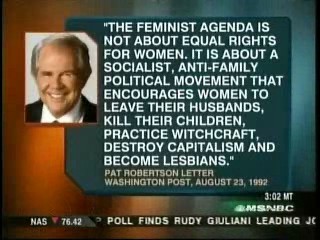 The shocked look of Fox Newsbots that believed all the pap they spooned out and were fed during 2012 has been replaced by the quiet realization that attacking every group of people in the country just isn’t going to get your freaks into office. However, late last night as the returns came in, the biggest predators of the Republican Party were already looking for what they considered the weakest links in the voters that rejected them yesterday. I took my eye off the Chicago Celebration long enough to hit FOX news, CNBC, and CBN.
CBN broadcasters did not share that shell shocked look given by a demographic shellacking that characterized the CNBC and FOX news commentariat. It was evident that Robertson and his US version of the Taliban are not going stop their religious war on women, GLBT, science, and reason. They’re going to try another tactic. They were signalling their intent to be more sensitive to immigration issues. They’ve decided that it’s possible to still go after the civil rights of others by loosening up on their kill the brown invader approach to immigration.
Robertson’s group has looked at Hispanics before with their greedy, little soul snatching eyes. John McCain and the Bush brothers have enjoyed decent support by segments of the Hispanic population which isn’t–as they say–monolithic. Cuban Americans have always trended Republican insisting that US policy towards Castro and Cuba stay in Cold War mode. Cubans, however, can stay in the country as long as they can put a foot on US soil. This is not how the country approaches the immigrants of other Hispanic nations.
As Hispanic voters grow in number and influence (Hispanics are the fastest-growing segment of America’s electorate), some conservatives wonder why Republican candidates don’t spend more time reaching out to them instead of joking about an electric fence.
According to Jennifer Korn, with the Hispanic Leadership Network, although most Latinos identify themselves as Democrats, “when you ask about the specific issues they all trend conservative. We’re talking about issues in the economy, smaller government, even religion.”
Rev. Samuel Rodriguez, president of the National Hispanic Christian Leadership Conference, appeared on “The 700 Club” today to talk to Pat Robertson about why Republicans need the Latino vote, educating undocumented teenagers, and the way he believes Jesus would have Christians approach immigration reform.
As I said, Robertson seems to know more about target marketing and recruiting than your average Republican Zealot. Last night, he was talking loosening up on immigration policy. This morning, we begin to see that this may indeed by the way the Republicans try to become relevant again.
Mitt Romney and the Republican Party’s tremendous difficulty appealing to Latino voters dealt a significant blow to their chances of winning in 2012.
Romney got off on the wrong foot with Latino voters early in the campaign. During the GOP primary, he took a hard line on immigration, endorsing the concept of “self-deportation” that would implement immigration crackdown policies to spur undocumented immigrants to leave the country on their own.
The Republican candidate tried to moderate his rhetoric over the next several months, but the damage was already done. According to the national exit polls, Obama won 71 percent of the Latino vote while Romney won 27 percent. That’s an improvement over Obama’s 2008 performance when Latinos backed him 67-31 percent over Republican John McCain and the largest Democratic margin since 1996. To give you an idea of how badly the GOP’s Latino support has eroded, just eight years ago, George W. Bush won around 40 percent of the Latino vote.
Obama faced questions about higher-than-average unemployment among Latino voters and a lack of progress on immigration reform during his first term. But he was able to energize Latino voters, especially after he enacted a program over the summer to provide a temporary reprieve from deportation to young undocumented immigrants.
Conservative Democrats even believe that the issue of immigration reform may be one of the first items where Republicans may actually reach across the aisle to save  their skins. Tim Kaine believes Republicans will become more willing to discuss immigration reform.
“There’s so much bad that’s going to happen if we go over this fiscal cliff and I think that’s going to bring both parties together for a solution that’s going to springboard into a bigger picture budget deal,” Kaine said the morning after Election Day. “I do think the Republican Party’s going to look in the mirror and decide that they need to work hand-in-hand on issues like immigration reform.”
“In the future of the Republican party, they’re not going to be able to continue to put such a hard face toward Latino voters and so that’s going to provide an opportunity for another significant issue where we can build bridges early in 2013,” he said.
President Obama has repeatedly listed immigration reform as something he believes Democrats and Republicans could find agreement on after the presidential election. The president has said avoiding the fiscal cliff would be his top priority after the election and has said he believes he could find support for immigration reform in his second term.
Obama’s victory on Election Night was aided in part by his strong edge among Latino voters, who broke for the president 69 percent to 29 for GOP challenger Mitt Romney.
This jaded attempt to maintain the Republican party’s core commitment to rolling back the rights of women, GLBT, and minorities may fail. But, it could very well succeed. The Republican Party was generally quite successful when it used code words–instead of blatant dog whistles–to signal to Ralph Reed’s army of zombies or the Chamber of Commerce that they would be amenable to gutting the rights of workers, women, and minorities. I’m afraid the lessons of this election will be that they need to go back to their subtle approach. The key will be how susceptible the Tea Party nuts will be to the suggestion they roll back their rhetoric. The worst Republican defeats–and ones where the demographics played in their favor–were districts where over-the-top rhetoric scared off the electorate. Believe me, the rhetoric won’t stop in party offices. They’ll just try to go back to the day when they can signal their own that they hate affirmative action and birth control. Can they gussy up their weirdos enough to make them camera-friendly in two years?
As Republican after Republican made crackpot comments about rape, contraception, and abortion, the GOP’s rightwing brain trust unfailingly followed up and said, yeah, that’s what we believe, that’s what we’ve always believed.
And because the conventional wisdom had always been that autonomous, sexually active women and the men who love them are just a fringe constituency, instead of questioning the wisdom of attacking them, the big brains questioned the wisdom of having Sandra Fluke speak at the Democratic Convention.
I always knew this issue was a winner for the Democrats, but now I’m beginning to think that it affected everything else as well. That is, Romney’s crackpot economic and environmental policies might have had more traction with voters if so many of them were not convinced that he represented and was listening to a bunch of lunatics who were totally out of touch with how human beings live. In tough times, you might go for a small-government reformer who says he has a plan to turn things around if you trust him. Americans have bought bigger grifters than Romney; a lot of them haven’t even figured that the nice old man who unleashed the markets in the 1980s set them up for the hard times we have now.
Who knows what a Romney campaign might have achieved if he’d decisively cut loose the Erick Erickson contingent and run like a man trying to be governor of Massachusetts?
The likes of Pat Robertson, Pat Buchannan, Michelle Bachmann, and Allen West–who wear their emotional and mental issues on their sleeves with pride instead of seeking help–always tend to scare off the electorate in fairly predictable cycles. These aren’t eccentrics. These are people with serious issues that have managed to become successful despite their obvious need for some kind of help. George Will is an asshole. Michelle Bachmann needs help. There’s a distinct difference. Americans viscerally react to these people in the same way they react to folks that wander our streets and talk to themselves. We know there’s something off there. There’s some brain chemistry that needs correcting or some therapy that should be applied. Republicans, however, don’t get these people the help they need, they try to keep them below the camera as much as possible to help their coalition. The trouble comes when they sneak into the public view and become the latest Barnum act on You Tube or The Daily Show. Democrats send their Anthony Weiners off to rehab. Republicans let their persons with issues smolder and fester and work to subvert. They harness the crazy to plow the fields.
I turned on TV this morning long enough to see that there was the usual punditry hand wringing and pearl clutching going on about the future of the Republican Party. They actually think this will make the party change. This same conversation happened the last time Obama got elected, and yet, we did not see any course correction. We saw the nascent obstruction agenda.
Republicans got worse and they came back during the midterms to win back the House of Representatives at a time when they could gerrymander districts. West may be gone, but the underlying district structure is still there. The same agenda with a different mask and the toned-down approach of a different grifter just might keep the party from a much needed session on a couch. Fred Barnes has already shown that denial is a really potent ego defense and he’s in no mood to change the party platform.
As hard as Republicans tried, they were unable to upset the balance of political forces.
What’s their problem? In Senate races, it’s bad candidates: old hacks (Wisconsin), young hacks (Florida), youngsters (Ohio), Tea Party types who can’t talk about abortion sensibly (Missouri, Indiana), retreads (Virginia), lousy campaigners (North Dakota) and Washington veterans (Michigan). Losers all.
And those are just the Senate contests decided yesterday.
See those words I put in bold? This leads me to believe they just will not get it. The problem is the packaging. We just need a few more folks that know how to sell the flim flam without scaring teh good womenz and teh civilized brown people. So, mark my word. We’re about to get a new face on the same old package. We’re about to see the grand appeal to as many Hispanics as they can cull from what they perceive as a ‘herd’. The Republican party is basically a group of extremely old, rich white men that manipulate and use true believers in guns, gawd, jingoism, and white exceptionalism to get more money and assets. I wish I could believe they’ll change, but I don’t.

 peej
peej Carissa
 bostonboomer
 dakinikat
 ecocatwoman
 jjlo
jjlo mablue2
 Mama Lopez
 peggysue22
 quixote
 skydancingguestblogger
 Mona (aka Wonk the Vote)





Recent Comments