
Monday Reads
Posted: April 29, 2013 Filed under: morning reads | Tags: Black voter turnout, Brown-Vitter, congressional lap dogs, Dodd Frank, hairless cats that look like Putin, scrambling for the rich, West Fertilizer Co. 29 Comments Good Morning!
It has really been raining here in New Orleans. I mean really raining. Yesterday there was a series of downpours and it I don’t recall seeing the sun. I am trying to tell myself to not complain too much because this is better than the horrible hot heat of summer. But, I would like to feel like it is daytime some time during a day. This is making it very hard for me to think about posting political news. Some days the last thing you need is more doom and gloom. So let me give you a scattering of good, bad, and interesting.
Black voter turnout passed white turnout this past election. This is a historical event. My guess is that all the active voter suppression attempts caused black Americans to get out to protect their voting rights.
America’s blacks voted at a higher rate than other minority groups in 2012 and by most measures surpassed the white turnout for the first time, reflecting a deeply polarized presidential election in which blacks strongly supported Barack Obama while many whites stayed home.
Had people voted last November at the same rates they did in 2004, when black turnout was below its current historic levels, Republican Mitt Romney would have won narrowly, according to an analysis conducted for The Associated Press.
Census data and exit polling show that whites and blacks will remain the two largest racial groups of eligible voters for the next decade. Last year’s heavy black turnout came despite concerns about the effect of new voter-identification laws on minority voting, outweighed by the desire to re-elect the first black president.
William H. Frey, a demographer at the Brookings Institution, analyzed the 2012 elections for the AP using census data on eligible voters and turnout, along with November’s exit polling. He estimated total votes for Obama and Romney under a scenario where 2012 turnout rates for all racial groups matched those in 2004. Overall, 2012 voter turnout was roughly 58 percent, down from 62 percent in 2008 and 60 percent in 2004.

Did you know the Koch Brothers had a huge portion–in fact the largest portion–of the fertilizer business? Have you also noticed how we continue to see an under-reporting of the West Fertilizer Co. explosion? Why have there been no arrests made? Bangaldesh sure got their man pretty quickly when it came to those responsible for unsafe work conditions killing people.
The West Fertilizer Co. explosion last week in West, Texas, took the lives of at least 14 and left scores injured and homeless. But the story was largely obscured by blanket coverage of the Boston Marathon bombing. More than that, says legendary EPA whistleblower Hugh Kaufman, a guest on this week’s CounterSpin, what coverage there was often obscured the real story. Here’s a transcript of Kaufman’s appearance:
CounterSpin: In his recent piece on the Nation‘s website, Greg Mitchell interviews you about the explosion in the town of West, Texas. Before we get to what’s missing in the coverage of the West disaster, tell us what the media is reporting.
Hugh Kaufman: The media is reporting the case as if it’s some sort of an industrial accident, when in fact the town of west Texas is blown off the face of the earth. The material that did all that damage was the same material that Timothy McVeigh used to blow up the Oklahoma City building — the fertilizer, ammonium nitrate.
CS: Two hundred seventy tons of it.
HK: That’s correct. So the amount of people harmed and the ramifications are incredible. Thousands of people every year die who work in dangerous industries, whereas only a few people die because of a terrorist bombing. And yet, there is nothing but a wall-to-wall coverage of Boston disaster around the same time as a town in Texas is blown off from the face of the earth.
Both situations are frightening but what’s more frightening is that the terrorists seem to be winning the war of the TV coverage. But there are thousands more people harmed and killed because of lax law enforcement of dangerous industries. The fertilizer industry is a dangerous industry.
CS: But you’re saying that this fertilizer explosion wasn’t just a matter of some regulatory oversight. You claim in Greg Mitchell’s piece that there’s perhaps criminal activity here.
HK: The company lied to EPA when they said that there is no risk of fire or explosion at the facility, but at the same time they told EPA that, they were honest with the state because they know the state wouldn’t do anything in saying that they had 270 tons of fire and explosive material, the ammonium nitrate. So they were honest with the state because they knew the state wasn’t going to do anything, but to the federal government and the Obama administration, they lied. And of course, the local fire department — not equipped to handle the type of emergency that that entailed — they didn’t have any respirators, they didn’t have any training how to handle that type of fire.
CS: They did not know not to squirt water on that type of fire, even.
HK: Exactly. And they didn’t even know there was such a risk of an explosion.
CS: You also give some praise but many media outlets got the story wrong. Let’s have the bad first.
HK: I think the worst was the New York Times. The New York Times claimed that the company notified EPA that they had 270 tons of this explosive ammonium nitrate, but they did not notify EPA of that. In fact, they told EPA that the facility posed no fire or explosion hazard. The New York Times did not say that, and I think that’s probably the biggest problem.
Interestingly, Texas is a Republican state — a red state — and in fact, many of the leaders want to secede from the union, and they despise EPA — they want the EPA abolished. And yet the Republican newspaper, the Dallas Morning News, has probably has the best environmental coverage of the case, which makes it very ironic to me.
 My scourge-of-the-country senator is still trying to tank Dodd Frank. He and three others are being sneaky about it. Course, Diaper David Vitter’s used to being sneaky about things. Here’s a story where he’s the hooker.
First, the Brown-Vitter legislation, which was introduced April 24, changes everything. The news isn’t that Brown wants to make the financial system safer. That has been a top priority of his since the spring of 2010, when he co-wrote the Brown-Kaufman amendment, which would have imposed a binding size cap on the largest banks. (It failed on the Senate floor.)
Now, however, he has a Republican co-sponsor, and they have converged on a strong message. Vitter, who is on the right of the political spectrum, articulates well the case for ending the implicit subsidies that exist because creditors understand that the government and the Federal Reserve won’t allow a megabank to fail. This broad and sensible message resonates across the political spectrum.
Second, small banks are increasingly focused on the ways megabanks have achieved an unfair competitive advantage — primarily through implicit government subsidies.
The most compelling voice at the forum last week was Terry Jorde, a senior executive vice president of the Independent Community Bankers of America. She made clear that small banks are being undermined by the reckless behavior of megabanks that are seen as “too big to fail.” There is no market at work here, just a hugely unfair and inefficient government-subsidy scheme. The U.S. economy wasn’t built on megabanks and there is no good reason to continue to accept the risks they pose.
The megabanks have more money to spend on politics than the community banks. And as the biggest banks become even larger, they acquire more clout, spreading branches and other largesse across congressional districts. But for the moment, in all 50 states, community bankers are strong enough — both directly and as leaders in their communities — to effectively stand up to the six largest banks that are at the heart of the problem.
I found this analysis in the NYT compelling. Congress get all kinds of things done for the powerful quickly. But, when it comes to doing things for ordinary people, the entire process stalls. It’s an op ed by their editorial board.
Congress can’t pass a budget or control guns or confirm judges on time, but this week members of both parties found something they could agree on, and in a big hurry: avoiding blame for inconveniencing air travelers. The Senate and House rushed through a bill that would avert furloughs to air traffic controllers, which were mandated by Congress’s own sequester but proved embarrassing when flights began to back up around the country.
Then lawmakers scurried out of town, taking a week’s vacation while ignoring the low-income victims of the mandatory budget cuts, who have few representatives in Washington to protest their lost aid for housing, nutrition and education. Though they are suffering actual pain, not just inconvenience, no one rushed to give them a break from the sequester, and it is clear that no one will.
Catering to the needs of people with money, such as business travelers, is the kind of thing the country has come to expect in recent years from Congressional Republicans. But Democrats share full responsibility for this moment of cowardice. The Senate version of the bill passed by unanimous consent. That means not a single Democrat opposed bailing out travelers while poor kids are getting kicked out of Head Start or nutrition programs.
Even worse, the White House said President Obama would sign the bill. Apparently the ridicule pouring out of Republican offices — with Twitter hashtags like #ObamaFlightDelays — was extremely effective.
In the House, only 29 Democrats voted against the gift to travelers, which was made possible by switching some funds for airport improvement into the controllers budget. One of the few willing to brave the Republican attack machine was Steny Hoyer, the Democratic whip, who said he could not support repealing a piece of the sequester while preserving its harmful impact. “Seventy thousand children will be kicked out of Head Start,” he said. “Nothing in this bill deals with them.”
As I said, I found this article compelling because I’ve noticed that they’ve scrambled to ensure that small airports–home to private jets and planes–are getting priority over children, cancer patients, and all kinds of things that benefit people What kind of country has those kind of priorities?
Foreign Policy has decided it wants to see more lists like in Gawker and Buzzfeed. You know those buzzfeed lists with items like the top 12 reasons why Justin Beieber annoys us or the ten reasons George Bush and Dick Cheney should share cell in prison. So, as a last little morning laugh, go check out the link and see great suggestions like this one:
Seriously, it’s a good idea.
So, what’s on your reading and blogging list today?
Friday Reads: Bad Boys, Bad Boys …
Posted: April 26, 2013 Filed under: morning reads | Tags: austerity, cheetah extinction, deregulation, nectar robbery, Philly Perry, slut slamming, unemployment in Spain 30 Comments Good Morning!
So, I’ve had a long week of saying “wtf is wrong with these people?” Here’s a link to one story in Arizona that went straight straight to the top of the list.
A student holding a sign that read “You deserve rape” ignited outrage across campus Tuesday, on the same day of a sexual assault awareness event, but administrators declined requests to remove him or his sign.
Dean Saxton — also known as Brother Dean Samuel — regularly preaches on the UA Mall in front of Heritage Hill and the Administration building. On Tuesday, his sermon drew the attention of onlookers, several of whom either personally confronted him or complained to the Dean of Students Office.
The Dean of Students Office received stacks of written complaints, emails and multiple phone calls regarding Saxton’s sermon about women, said Kendal Washington White, interim dean of students.
Saxton has never directly threatened anyone in particular, and his language has been general enough that he isn’t targeting a particular person, White said. However, a university attorney was contacted to discuss the situation.
“We find it to be vulgar and vile,” White said. “However, it is protected speech. He has yet to, at this point, violate the student code of conduct.”
Saxton, a junior studying classics and religious studies, said his sermon was meant to convey that “if you dress like a whore, act like a whore, you’re probably going to get raped.”
“I think that girls that dress and act like it,” Saxton said, “they should realize that they do have partial responsibility, because I believe that they’re pretty much asking for it.”
Saxton’s sermon came ahead of the “Take Back the Night” event held Tuesday night, which aims to unite people against sexual violence. He said his decision to create the sign and display it was tied to the event and to the fact that April is Sexual Assault Awareness Month.
So, I guess every critter on the planet has its share of bad behavior. Ours just seems to be so much worse. For bees, it’s nectar robbery.
TO MOST people, bumblebees are charming, slightly absurd creatures that blunder through garden and meadow with neither the steely determination of the honeybee nor the malevolent intention of the wasp. If you are a plant, though, things look rather different—for from the point of view of some flowering plants many bumblebees are nothing more than thieves. They rob them of their nectar and give nothing in return.
Nectar robbery, in which a bumblebee carves a hole in the side of a flower as a bank robber might cut his way into a vault, was discovered by Charles Darwin. This technique lets bees get at the nectar of flowers whose shapes have evolved to encourage their pollination by insects with long tongues, which can reach down narrow tubes.
Some bumblebees do have such tongues. But some do not. Short-tongued bees are, however, unwilling to deny themselves the bounty of nectar inside these flowers. Hence the hole-cutting. By breaking in in this way, though, a bumblebee nullifies the 100m-year-old pact between flowering plants and insects: that the plant feeds the insect in exchange for the insect pollinating the plant.
The question about nectar robbery that has intrigued biologists from Darwin onwards is whether the behaviour is innate or learnt. Darwin, though he originated the idea that many behaviour patterns are products of evolution by natural selection, suspected that it is learnt. Insects, in other words, can copy what other insects get up to. Only now, though, has somebody proved that this is true.
The observations were made by David Goulson (then at the University of Stirling, now at the University of Sussex), and his colleagues. To test his ideas he had to go from Britain to Switzerland, for only there could he find a flower of the correct shape to conduct the study.
His crucial observation was that when the flowers of an alpine plant called the yellow rattle are robbed, the entry holes—because of the structure of the flower—tend to be unambiguously on either the right-hand side or the left-hand side. Moreover, preliminary observation suggested that the holes in flowers in a single meadow are often all made on the same side. This led him to speculate that bumblebees in a particular area do indeed learn the art of nectar robbery from one another, and then copy the technique with such fidelity that they always attack a flower from the same side.
Nectar robbery still doesn’t sound as bad as a slut slamming religious studies student. We all know the evil done by Dick Cheney, but did you watch Chris Hayes and hear about his son-in-law?
MSNBC host Chris Hayes on Thursday night explained the key role Dick Cheney’s son-in-law played in keeping chemical plants free of regulations.
Concerns were raised in 2002 that chemical plants in populated areas — like the one that recently exploded in West, Texas — were vulnerable to terrorist attacks.
The heads of Department of Homeland Security and Environmental Protection Agency had planned to regulate the security of chemical sites, but Dick Cheney’s son-in-law Philip Perry stepped in and informed them they lacked the authority to do so without congressional legislation.
At the time, Perry was serving as the general counsel of the Office of Management and Budget at the White House.
“Basically, the Bush administration from above pulled support for that bill because the chemical industry does not want to be regulated by the EPA,” Hayes said.
“Fast forward to 2007, and Philip Perry — again, Dick Cheney’s son-in-law — is at the Department of Homeland Security as general counsel. What he managed to do in an appropriations rider is slip in industry friendly language into the bill that moves the task of regulating chemical plants from the Environmental Protection Agency to the Department of Homeland Security. But DHS is given none of the tools it would need to do that.”
It looks like wild populations of cheetahs may go extinct because of habitat encroachment. It’s estimated that wild cheetahs may have less than 20 years left. Here’s a heartwarming story about a good dog and a cheetah. We’re ruining their habitat but a few folks are trying to help
It’s hard to fathom, a dog and a cheetah living together in a zoo? But it’s true, and it works. ”It’s a love story of one species helping another species survive,” said Jack Grisham, vice president of animal collections at the St. Louis Zoo. Of the 19 cheetahs at the zoo, 4 have canine companions who play with them, watch out for them, and teach them to be more social.
“It is all about comforting and reassuring the cheetah,” said Janet Rose-Hinostroza, animal training supervisor at the San Diego Zoo Safari Park, where there are also 4 cheetahs with dogs. Cheetahs are not social animals, which makes it difficult for them to mate, and may be their biggest threat in fighting extinction. They are by nature skittish, so having dogs with them, who are by nature social seems to be a comfort.
“In this relationship, the dog is dominant, but we look for dogs that want to be a buddy,” Rose-Hinostroza said. “The dog always has the cat’s back, but it’s never the other way around. Dogs worry about their cats. They protect their cats.” For that reason they are not always together, for example during mealtimes they are separated so the dogs eat kibble and the cats eat steak. ”The dogs are the bosses in these relationships,” Rose-Hinostroza said. “If they ate together there would be one really fat dog and a really skinny cheetah.”
The cheetahs are doing their part to help the dogs too, since most of the companion dogs are rescued from shelters for their new job. They are paired up when the cheetahs are cubs, around 3 months old. This is idea is not a new one, in Africa dogs have been used for decades to protect sheep from cheetahs. This in turn, keeps the cheetahs from being killed by farmers. ”For the first time in 30 years, the cheetah population in the wild is on the rise because ranchers don’t have to shoot them anymore. They don’t need to shoot them. The dog is that effective at keeping the cheetah away from the herd,” Rose-Hinostroza said.
Austerity policies are bringing record high unemployment to Spain while unemployment is going up all over the continent.
Spain’s unemployment rate soared to a new record of 27.2% of the workforce in the first quarter of 2013, according to official figures.
The total number of unemployed people in Spain has now passed the six million figure, although the rate of the increase has slowed.
The figures underline Spain’s struggle to emerge from an economic crisis which began five years ago.
A big demonstration in Madrid is being planned against the austerity measures.
On Friday, Prime Minister Mariano Rajoy will unveil fiscal and policy measures aimed at halting recession in the eurozone’s fourth-largest economy.
“These figures are worse than expected and highlight the serious situation of the Spanish economy as well as the shocking decoupling between the real and the financial economy,” said Jose Luis Martinez, strategist at Citi.
That is basically the same levels of unemployment that this country endured during the peak of its great depression. I really hope that these idiots seen that the lessons we learned during the Great Depression are still valid and stop causing misery through the world.
What’s on your reading and blogging list today?
Assad, Syria and Sarin
Posted: April 25, 2013 Filed under: Foreign Affairs, Syria | Tags: chemical weapons, Sarin Gas, Syria 26 CommentsEvidence has emerged that the Assad Regime in Syria has crossed Obama’s red line and that Sarin Gas has been used. 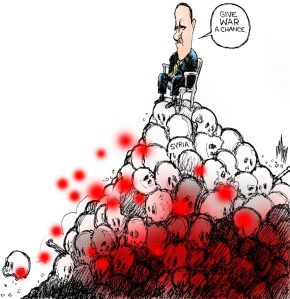 Is this a game changer?
The U.S. intelligence community has uncovered strong evidence that chemical weapons have been used in Syria. Several blood samples, taken from multiple people, have tested positive for the nerve agent sarin, an American intelligence source tells Danger Room. President Obama has long said that the use of such a weapon by the Assad regime would cross a “red line.” So now the question becomes: What will the White House do in response?
In March, the Assad regime was accused of using chemical weapons during an attack on the city of Aleppo. The blood samples were taken by Syrian opposition groups from alleged victims of that strike. But American analysts can’t be entirely sure where the blood came from or when the precisely exposure took place.
“This is more than one organization representing that they have more than one sample from more than one attack,” the source tells Danger Room. “But we can’t confirm anything because no is really sure what’s going on in country.”
What’s clear is that the samples are authentic, and that the weapons were almost certainly employed by the Assad regime, which began mixing up quantities of sarin’s chemical precursors months ago for an potential attack, as Danger Room first reported.
“It would be very, very difficult for the opposition to fake this. Not only would they need the wherewithal to steal it or brew it up themselves. Then they’d need volunteers who would notionally agree to a possibly lethal exposure,” the source adds.
SOD Chuck Hagel held a presser and the war of words between the administration and its critics has begun.
With intelligence showing that chemical weapons have probably been used in Syria, the pressure from the political right for decisive action by the president will only intensify.
Sen. John McCain, R-Ariz., who has long advocated a no-fly zone to stem the bloodshed in Syria that has left more than 70,000 dead, groused to reporters after being notified by the White House of the intelligence that sarin, a lethal nerve agent, has probably been deployed.
“Everything that the non-interventionists said that would happen in Syria if we intervened has happened,” McCain said. “The jihadists are on the ascendancy, there is chemical weapons being used, the massacres continue, the Russians continue to be assisting Bashar Assad, and the Iranians are all in. It requires the United States’ help and assistance.”
The shadow of the war in Iraq looms large for Obama. Without uttering the “I” word, the White House was quick on Thursday to recall the later-debunked intelligence that showed Saddam Hussein had weapons of mass destruction — the central underpinning of George W. Bush’s rationalization for going to war.
An Iraq-styled boots-on-ground intervention, of course, is not under serious consideration.
But Obama aides make clear that the intelligence community’s physiological evidence that indicates Syria’s use of chemical weapons is a bar too low to merit military action, such as implementing a no-fly zone.
“Given the stakes involved, and what we have learned from our own recent experience, intelligence assessments alone are not sufficient — only credible and corroborated facts that provide us with some degree of certainty will guide our decision-making, and strengthen our leadership of the international community,” Miguel Rodriguez, Obama’s liaison to Congress, wrote in a letter to lawmakers on Thursday.
The Obama administration is still pushing for a United Nations-led investigation into allegations and aides to the president on Thursday renewed the call for Assad to give the UN more direct access into Syria—something the Syrian president has thus far resisted.
Concerns about the way forward are also coming from Democrats. Sen. Diane Feinstein, D-Calif., the chairman of the Senate Intelligence Committee, said on Thursday it was “clear that red lines have been crossed and action must be taken to prevent larger scale use.” But Feinstein also offered concerns about a doomsday scenario emerging as a result of the administration’s decision verifying its suspicion.
“I am very concerned that with this public acknowledgement, President Assad may calculate he has nothing more to lose and the likelihood he will further escalate this conflict therefore increases,” Feinstein said in a statement.
Pundits are also weighing in. This is from The Atlantic’s Jeffrey Goldberg.
If you recall, President Barack Obama drew a “red line” for you: no use of chemical weapons in your brutal attempt to put down the uprising against your regime. Any use of such weapons (even any “moving around” of such weapons) would “change my calculus,” Obama said, “change my equation.” In other words, welcome to the day in which the calculus might just be changing.
Hagel, speaking to reporters in Abu Dhabi, said that U.S. intelligence has come to believe — like the Israelis, the French and the British before them — that President Bashar al- Assad’s regime seems to have used sarin “on a small scale.”
I spoke with Representative Mike Rogers, the Republican chairman of the House Intelligence Committee, who said that he thinks the Obama administration is hesitant to face the truth that the Assad regime has already used these sorts of weapons. “Clearly the administration doesn’t want to see this,” he said. “We have lost the confidence of the Arab League and the Syrian opposition because of our inaction.” Rogers said he was convinced at least a month ago that Syria had used a small quantity of chemical weapons against civilians.
Before we get to the meaning and potential consequences of this horrifying news, a brief primer on sarin, which was invented in Nazi-era Germany for use as a pesticide, and which was most famously used in the Tokyo subway attack by the Aum Shinrikyo cult in 1995 and against Kurdish Iraqis during Saddam Hussein’s genocide campaign.’
Descriptions of the chemical’s assault on the body follows the section that I highlighted from the Goldberg piece. Another point of view is expressed in the CSM here.
The US reluctance to join with three key allies – Britain, France, and now Israel – in concluding that Syria’s Bashar al-Assad has used chemical weapons in his country’s civil war confirms President Obama’s consistent wariness about US intervention in the two-year-old conflict.
Beyond that point, however, former officials and analysts are split over why Mr. Obama is so cautious about the issue – he even refused to answer a reporter’s question on the topic Tuesday – and what the apparently high bar the administration has set for evidence of chemical weapons use means.
“It’s a hard call as to whether the administration is trying to avoid something, or if they just don’t have the evidence,” says Wayne White, a former State Department official with experience in Middle East intelligence.
Obama has said repeatedly since last August that Syria’s use of chemical weapons is a US “red line” and would be a “game changer” for the US. But now some critics say the president’s caution suggests a moving or “fuzzy” red line.
For some, the president is simply being prudent, especially if the evidence presented so far is “inconclusive,” as a number of senior administration officials, including Defense Secretary Chuck Hagel, have said. Obama, they add, wants to avoid a rush to judgment that turns out to be mistaken – and which could appear to the world like a repeat of the 2003 US decision to invade Iraq over weapons of mass destruction that didn’t exist.
White House spokesman Jay Carney said Tuesday that the US is being “extremely deliberate” in investigating and evaluating the reports of chemical weapons use. And on Wednesday in Cairo, Secretary Hagel suggested the US would not be rushed to judgment by allies, saying, “Suspicions are one thing. Evidence is another.” He then added, “I think we have to be very careful here before we make any conclusions.”
But for others, the reason Obama is setting the bar high – in a situation where incontrovertible evidence could remain very difficult to come by – is because he has no desire to ratchet up US involvement in the Syrian conflict unless forced to.
The danger of this approach, critics say, is that it encourages an increasingly desperate President Assad to test the limits of US reluctance – perhaps even with limited, hard-to-prove use of some chemical weapons.
It seems like these hard choices keep popping up. There is total carnage in Syria on one hand. There is a war-weary US on the other. We’ve seen this president draw lines in the sand before. My best example is when Obama swore he would not extend the Bush tax cuts for those incomes about $250k. He signed the law that extended them above $450k. This history makes it difficult to say exactly what kind of hope the Syrians will have for regime change.
Monday Reads
Posted: April 22, 2013 Filed under: Austerity, Catfood Commission, cyber security, Domestic Policy, Foreign Affairs, morning reads, Myanmar | Tags: cat food commission, CISPA, CNN: Media Fail, ethnic cleansing, Myanmar, Rohingya, Simpson-Bowles 32 Comments Good Morning!
Last week, I wrote about the debacle behind the study that was used to promote fiscal austerity in a time when just the opposite policy is prescribed by economic theory. One of the big questions I had was if the results of study’s hypothesis was now insignificant–which in scientific method means the conclusions were not proven–would we see a stop to these crazy austerity policy pushers. We’ve learned the answer is no. Dumber and Dumber–heads of the so-called cat food commission–who couldn’t lead their committee to a written conclusion are on the road touting their call to deficit hysteria based on the always controversial and now highly flawed study.
On April 19, just after I had written about how the key academic research used to bolster austerity policies was exposed by a 28-year-old grad student at U Mass-Amherst, I got a surprise in my email inbox: Erskine Bowles and Alan Simpson giddily announced their new deficit-reduction plan, which includes, among other things, a recommendation to increase the eligibility age for Medicare. Their plan would reduce debt as a share of GDP below 70 percent by 2023, and as the Washington Post reports, “seeks far less in new taxes than the original, and it seeks far more in savings from federal health programs for the elderly.”
What’s incredible is that over the last week, the study by Harvard economists Carmen Reinhart and Ken Rogoff that famously warned of the dangers of government debt has been proven to be riddled with errors and questionable methodology. To recap: R&R’s paper purported to show that countries with public debt in excess of 90 percent of gross domestic product suffered negative economic growth. Austerity hawks everywhere used it to justify cuts that have cost people jobs and vital services. The original spreadsheet used by R&R was obtained by a U Mass grad student, who found that in addition to the mistakes already noted by several economists, there was a coding error in their Excel spreadsheet that significantly changed the results of their study.
As New York magazine’s Jon Chait has pointed out, that same discredited research has been used by Bowles and Simpson to formulate their deficit-reducing austerity plans.
You simply cannot get these tools of the plutocracy to come clean. They’re going to go down with the stupidity and are trying to bring the rest of the country with them.
I promised myself to make sure we pointed to injustice and suffering around the world as well as our own home towns. Today I want to provide information about Myanmar–a country I’ve spent time studying and a country trying to change–with a history of brutal ethnic cleansing of its Muslim minority population.
Ethnic cleansing and crimes against humanity have been committed against Myanmar’s ethnic Rohingya people, according to a new report by Human Rights Watch (HRW), a New York-based nongovernmental organisation.
According to the report released on Monday, entitled All You Can Do is Pray, more than 125,000 ethnic Rohingya have been forcibly displaced since two waves of violence in May and October 2012.
Satellite images show almost 5,000 structures on land mostly owned by Muslim Rohingya have been destroyed, says the report.
The October attacks, the report states, were coordinated by Myanmar government officials, an ethnic Rakhine nationalist party and Buddhist monks. The deadliest attack took place on October 23, in which witnesses say at least 70 Rohingya – including 28 children – were massacred in Mrauk-U township.
The UN has described the Rohingya as one of the most persecuted minorities in the world.
Most Rohingya who live in Myanmar’s western Rakhine state are denied citizenship by the Myanmar government, which claims they are illegal immigrants from neighbouring Bangladesh and often refers to them as “Bengali”.
The Myanmar government has done nothing to prevent the violence, alleges the report, and at times government forces have joined in the attacks on the Rohingya.
“The Burmese government engaged in a campaign of ethnic cleansing against the Rohingya that continues today through the denial of aid and restrictions on movement,” Phil Robertson, HRW’s deputy Asia director, said.
“The government needs to put an immediate stop to the abuses and hold the perpetrators accountable or it will be responsible for further violence against ethnic and religious minorities in the country.”

I am so ashamed to read that Buddhist monks may have been participants. They have been targets themselves and this behavior violates the most important teaching of the Buddha which is the vow of non harming. No real Buddhist would participate in such horrors.
I also wanted to mention the return of CISPA and its impact on internet users in this country. This was slipped back into Congress while we were all watching Boston.
Described as “misguided” and “fatally flawed” by the two largest US privacy groups, the Cyber Intelligence Sharing and Protection Act (CISPA) threatens the online privacy of ordinary US residents more so than any other Bill since Congress amended the Foreign Intelligence Surveillance Act in 2008.
Its sole purpose is to allow private sector firms to search personal and sensitive user data of ordinary US residents to identify this so-called “threat information”, and to then share that information with each other and the US government — without the need for a warrant.
By citing “cybersecurity”, it allows private firms to hand over private user data while circumventing existing privacy laws, such as the Wiretap Act and the Stored Communications Act. This means that CISPA can permit private firms to share your data, such as emails, text messages, and cloud-stored documents and files, with the US government.
It also gives these firms legal protection to hand over such data. There is no judicial oversight.
To make matters worse, because there is little transparency and individual accountability, those who have had their data handed to the US government may not even know about it or be given a chance to challenge it.
Norway’s ruling party is pushing for drilling around environmentally sensitive areas in the Arctic Circle. Could this impact a return to attempts to drill the area by US Oil companies? I hope this doesn’t lead to a race to destroy ANWR
Norway took a major step towards opening up an environmentally sensitive Arctic area to oil and gas exploration when the ruling Labour Party gave the go-ahead on Sunday for an impact study.
Exploration in the waters around the Lofoten islands just above the Arctic circle is becoming one of the most contentious issues for parliamentary elections in September.
The picturesque area had been off limits because it is home to the world’s richest cod stocks, with environmental groups and the tourism industry opposed to any development.
The Labour party voted for the study, a precursor to any exploration, but also said it would take another vote in 2015, before actual drilling could begin.
Oil is the Norwegian economy’s lifeblood – the nation is the world’s seventh-biggest oil exporter and western Europe’s biggest gas supplier.
Its sprawling offshore energy sector continuously needs new areas to explore to halt the decline in production and energy firms have argued that they should be allowed to investigate the Lofoten islands.
Norway’s oil production will fall to a 25-year low this year as North Sea fields mature. Even a series of recent big finds, like the giant Johan Sverdrup field, which could hold over 3 billion barrels of oil, will only arrest the decline.
Waters off Lofoten are estimated to hold 8 percent of Norway’s undiscovered oil and gas resources with seismic tests identifying 50 prospects that could hold recoverable reserves or around 1.27 billion barrels of oil equivalent, the petroleum directorate said earlier.
With Labour’s support, Norway’s top three parties now favor exploration in the area, raising the chance that the next government would begin the process.

Teamsters from Local 25 in Boston will protect the family of bombing victim Krystle Campbell during her funeral tomorrow morning. Members of the Westboro Baptist Church are expected to protest.
The Associated Press reports,
Family and friends are saying final good-byes to Krystle Campbell, one of the three people who lost their lives in the bombing at the Boston Marathon finish line.
A wake for Campbell is being held Sunday at a funeral home in Medford, where the 29-year-old restaurant manager was raised and graduated from high school in 2001. A private funeral is scheduled for Monday at St. Joseph Church.Local 25 was contacted by some concerned citizens of Medford asking for help to keep members of the Westboro Baptist Church from protesting the funeral of Krystle Campbell, scheduled for tomorrow morning at 10 AM in Medford.
Local 25 President Sean O’Brien asked all off-duty Teamsters to participate:
Teamsters Local 25 will be out in full force tomorrow morning at St. Joseph’s Church in Medford to form a human shield and block the Westboro Baptist Church from protesting the funeral of Krystle Campbell. The Campbell family and friends have already endured immeasurable amounts of heartache and tragedy this week, and deserve a peaceful funeral with time to grieve privately.
Westboro Baptist Church should understand that we will go to great lengths to make sure they don’t protest any funerals of the victims of the past week’s tragedies, and that those we lost receive a proper burial.
Teamsters Local 25 represents 11,000 hardworking men and women from the Boston area.
There are three dead from the bombing. Westboro is also connected to a law firm that makes money from the antics of these folks. They usually claim their first amendment rights were violated and then collect government money defending their case.
And just because I’ve quit watching CNN around a year ago after watching the station for years, I thought I’d end with this: “Last Week, CNN Itself Became the Poop Cruise”. Frankly, I’ve thought they were full of it and lacking substance for some time.
As reactions to the media’s handling (or rather, mishandling) of breaking news during a busy week continue to flow in, perhaps none is more condemning than David Carr’s latest column in The New York Times. The media critic came down hard on correspondent John King, newly appointed chief Jeff Zucker and the rest of the CNN news team that famously fumbled during the aftermath of the Boston bombing and hunt for the suspects. Most notably, the network erroneously reported the arrest of a suspect on Wednesday, when everybody now knows that a suspect wasn’t arrested until Friday when police found Dzokhar Tsarnaev hiding in the back of a boat.
Carr has an analogy for that. In discussing the mistake, one that more than one person described as “devastating,” Carr reminded us of the most recent moment that CNN’s stolen the limelight — perhaps not in a good way:
It was not the worst mistake of the week — The New York Post all but fingered two innocent men in a front-page picture — but it was a signature error for a live news channel. … Until now, the defining story in the Zucker era had been a doomed cruise ship that lost power and was towed to port, where its beleaguered passengers dispersed. This week, CNN seemed a lot like that ship.
Zing. Inevitably, Carr’s piece comes off almost as apologetic. In his parting words, the veteran journalist points out how even the president “wants CNN to be good.” So when it’s bad, it’s hard to watch.
I’m just praying for a better week and that we can get some attention on the small town of West Texas that really needs our help.
What’s you your reading and blogging list today?
More Bad News for People that Want Real News
Posted: April 21, 2013 Filed under: The Media SUCKS, We are so F'd | Tags: plutocracy propaganda, propagand, The press will suck MORE shortly 3 Comments We’ve certainly seen how the corporate media in the US has turned into tabloid journalism quite quickly with the influence of the likes of Rupert Murdoch in the business of buying everything up. Get ready for more propaganda and less news if this goes through. The Koch Brothers are going after the Tribune family.
Three years ago, Charles and David Koch, the billionaire industrialists and supporters of libertarian causes, held a seminar of like-minded, wealthy political donors at the St. Regis Resort in Aspen, Colo. They laid out a three-pronged, 10-year strategy to shift the country toward a smaller government with less regulation and taxes.
The first two pieces of the strategy — educating grass-roots activists and influencing politics — were not surprising, given the money they have given to policy institutes and political action groups. But the third one was: media.
Other than financing a few fringe libertarian publications, the Kochs have mostly avoided media investments. Now, Koch Industries, the sprawling private company of which Charles G. Koch serves as chairman and chief executive, is exploring a bid to buy the Tribune Company’s eight regional newspapers, including The Los Angeles Times, The Chicago Tribune, The Baltimore Sun, The Orlando Sentinel and The Hartford Courant.
By early May, the Tribune Company is expected to send financial data to serious suitors in what will be among the largest sales of newspapers by circulation in the country. Koch Industries is among those interested, said several people with direct knowledge of the sale who spoke on the condition they not be named. Tribune emerged from bankruptcy on Dec. 31 and has hired JPMorgan Chase and Evercore Partners to sell its print properties.
The papers, valued at roughly $623 million, would be a financially diminutive deal for Koch Industries, the energy and manufacturing conglomerate based in Wichita, Kan., with annual revenue of about $115 billion.
Politically, however, the papers could serve as a broader platform for the Kochs’ laissez-faire ideas. The Los Angeles Times is the fourth-largest paper in the country, and The Tribune is No. 9, and others are in several battleground states, including two of the largest newspapers in Florida, The Orlando Sentinel and The Sun Sentinel in Fort Lauderdale. A deal could include Hoy, the second-largest Spanish-language daily newspaper, which speaks to the pivotal Hispanic demographic.
They are looking to buy the 8 newspapers owned by Tribune’s company.
Charles and David Koch’s money has been instrumental in getting anti-climate politicians into office, and in funding anti-climate science studies. The brothers have also funded with the secretive conservative network ALEC (the American Legislative Exchange Council), which has crafted “model legislation” for voter ID laws that limit voting rights, particularly for low-income people of color. The group was also responsible for the so-called “Stand Your Ground” law that temporarily allowed Trayvon Martin’s killer, George Zimmerman, to walk free.
The brothers also tried to influence the latest election by warning some 45,000 employees that there would be “consequences” if they didn’t vote for Republicans.
The Koch Brothers believe that the ‘conservative’ voice has not been represented in the media. That is an unbelievable statement in the day of 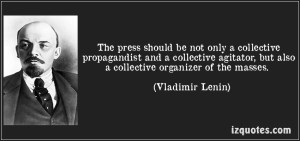 Fox, the WSJ, and the NYP which are a little more than propaganda networks that peddle vast right wing conspiracy theories and right wing memes. There are an increasing number of papers I refuse to read and tv news stations that I refuse to watch because they have turned into Pravda of the plutocracy. Then, there is the likes of CNN who is so overly influenced by its need for ratings that it uses similar strategies and voices to ‘compete’.
It’s a sad day for truth, justice and the American Way, folks! Let’s just cross out the word “masses” in that quote from Lenin and put in “plutocracy” and I think we got the message.

 peej
peej Carissa
 bostonboomer
 dakinikat
 ecocatwoman
 jjlo
jjlo mablue2
 Mama Lopez
 peggysue22
 quixote
 skydancingguestblogger
 Mona (aka Wonk the Vote)





Recent Comments