
Tuesday Night Updates
Posted: September 24, 2013 Filed under: open thread | Tags: iran, Pakistan earthquake, Senate Whacko Birds, UN Nations, US 11 CommentsJust thought I’d put a few of the day’s significant news stories up. One story is pure theatre. The other one is actually significant because it’s a signal that the  U.S. and Iran may approach their relationship differently from now on out. The Iranian President portrays himself as a moderate and the Obama Administration is encouraging the change!
President Barack Obama’s speech Tuesday to the United Nations was his most significant foreign policy statement since becoming president. It showed he had clearly learned something from the recent “red line” fiasco in Syria. The speech also displayed what has always been the most attractive feature of Obama’s foreign policy, one that clearly sets him off from his predecessor—his willingness to court erstwhile enemies and adversaries, or to put it in negative terms, his not possessing what my former colleague Peter Scoblic called an “us versus them” view of the world.
The speech was a departure in one very obvious way. Two years ago, the Obama administration had announced a “pivot to Asia” in its foreign policy, but Obama’s speech to the U.N. was almost entirely devoted to the greater Middle East with a footnote here or there to Africa. Obama mentioned China only once—as one of the nations engaged in nuclear weapons talks with Iran—and didn’t mention Japan or South Korea at all. That reflects the way the world is: The Middle East is oil—still the lifeblood of the global economy—and the Middle East continues to suffer from tectonic fault lines created by the Age of Empire in Europe.
There were specific departures in the speech from positions that Obama has taken in the past. The one that will get the most attention, and rightly so, is American policy toward Iran, but the speech also included departures in American policy toward Syria, Israel and the Palestinians, and Egypt and the Arab Spring.
Obama declared his willingness to pursue a diplomatic solution with Iran over its nuclear program. Of course, he had done that before, but it was usually punctuated by a threat of military action if Iran did develop a nuclear weapon. That threat lingered in the background in his speech; in the foreground, he acknowledged Iranian fears of the United States, dating from our helping to overthrow Iran’s government in 1953; he welcomed Iranian President Hassan Rouhani’s overtures to the United States; and he said he was instructing Secretary of State John Kerry to meet with Iran’s foreign minister—the first such meeting between the country’s leading diplomats since 2007. The White House has also said it is “keeping the door open” to a meeting between Obama and Rouhani.
The thaw in relations was not subtle but it also wasn’t substantive.
Obama said that if the UN security council failed to pass a strong resolution enforcing the dismantling of the Syrian regime’s chemical weapons arsenal, then the institution would show itself “incapable of enforcing the most basic of international laws”.
However, in his UN speech Obama made clear that the US saw the Iranian nuclear programme as a much more immediate and serious threat to its core interests, and he responded to the overtures of the newly-elected leadership in Tehran by putting Kerry in charge of the coming critical weeks of intense negotiations.
“Given President Rouhani’s stated commitment to reach an agreement, I am directing John Kerry to pursue this effort with the Iranian government, in close coordination with the European Union, the United Kingdom, France, Germany, Russia and China,” the president said.
The move mirrored Rouhani’s decision to put his own foreign minister, Mohammad Javad Zarif, in charge of the talks, breaking from the practice of the past eight years of abortive negotiations of assigning them to senior officials. The foreign ministers of all seven countries are due to meet for the first time at the UN on Thursday.
“Directing Secretary Kerry to lead this signals that the negotiations may be elevated to the foreign minister level, which would be very good news,” said Trita Parsi, the head of the National Iranian American Council, and the author of a book on US-Iranian negotiations, A Single Roll of the Dice.
“This means that far greater political will is being invested into the diplomatic process, which in turn increases the cost of failure. That is exactly what is needed to overcome the political obstacles to a deal.”
Obama acknowledged the difficulties ahead. “The roadblocks may prove to be too great, but I firmly believe a diplomatic path must be tested,” he said.
The theatrical news came from a weird show in the US that was supposed to pass for a filibuster on the funding of the Affordable Health Care Act by Ted Cruz and the other notorious Senate Republican Whacko Birds. There were some seriously comical and crazy moments. Let me just say that none of these idiots are Wendy Davis!
During a floor speech Tuesday aimed at reviving the already-dim prospects for his effort to defund Obamacare, Sen. Ted Cruz (R-TX) likened his doubters to Nazi appeasers.
“If you go to the 1940s, Nazi Germany,” Cruz said. “Look, we saw in Britain, Neville Chamberlain, who told the British people, ‘Accept the Nazis. Yes, they’ll dominate the continent of Europe but that’s not our problem. Let’s appease them. Why? Because it can’t be done. We can’t possibly stand against them.'”
“And in America there were voices that listened to that,” he continued. “I suspect those same pundits who say it can’t be done, if it had been in the 1940s we would have been listening to them. Then they would have made television. They would have gotten beyond carrier pigeons and beyond letters and they would have been on tv and they would have been saying, ‘You cannot defeat the Germans.'”
Cruz said at the outset that he intends to speak until he is “no longer able to stand” in an effort to force Senate Majority Leader Harry Reid (D-NV) to agree to a 60-vote threshold for any motion that removes the defunding language from the House-passed continuing resolution.
But because Senate procedure limits how long he may speak before the initial vote to invoke cloture on Wednesday, Cruz is actually not staging a filibuster.
 Just one further story that shows the power of Mother Nature. There was a deadly earthquake in Pakistan that has killed many people and produced a new island.
It struck at 16:29 local time (11:29 GMT) at a depth of 20km (13 miles), 66km north-east of Awaran in Balochistan province, the United States Geological Survey said.
It was felt as far away as Karachi, Hyderabad, and India’s capital, Delhi.
Balochistan is Pakistan’s largest but least populated province.
A major earthquake hit a remote part of western Pakistan on Tuesday, killing at least 45 people and prompting a new island to rise from the sea just off the country’s southern coast.
Tremors were felt as far away as the Indian capital of New Delhi, hundreds of miles to the east, where buildings shook, as well as the sprawling port city of Karachi in Pakistan.
The United States Geological Survey said the 7.8 magnitude quake struck 145 miles southeast of Dalbandin in Pakistan’s quake-prone province of Baluchistan, which borders Iran.
The earthquake was so powerful that it caused the seabed to rise and create a small, mountain-like island about 600 meters (yards) off Pakistan’s Gwadar coastline in the Arabian Sea.
Television channels showed images of a stretch of rocky terrain rising above the sea level, with a crowd of bewildered people gathering on the shore to witness the rare phenomenon.
So, the real earth-shattering news was not made by Senator Cruz even though he probably thinks he was the big deal of the day.
Monday Reads
Posted: September 23, 2013 Filed under: morning reads | Tags: Hillary Clintont, Income Inequality in the US, Kenya Mall Shooting, Robert Reich 18 Comments Good Morning!
You probably should start today’s reading with the New York Magazine interview with Hillary Clinton.
There’s a weightlessness about Hillary Clinton these days. She’s in midair, launched from the State Department toward … what? For the first time since 1992, unencumbered by the demands of a national political campaign or public office, she is saddled only with expectations about what she’s going to do next. And she is clearly enjoying it.
“It feels great,” she says, “because I have been on this high wire for twenty years, and I was really yearning to just have more control over my time and my life, spend a lot of that time with my family and my friends, do things that I find relaxing and enjoyable, and return to the work that I had done for most of my life.”
Relaxing, for a Clinton, especially one who, should she decide to run, is the presumptive Democratic nominee for president in 2016, does not seem exactly restful. The day before we speak, she was awarded the Liberty Medal by the National Constitution Center in Philadelphia—presented by Jeb Bush, another politician weighted with dynastic expectations and family intrigue, who took the opportunity to jest that both he and Clinton cared deeply about Americans—especially those in Iowa, New Hampshire, and South Carolina.
Afterward, Clinton stepped backstage, a red-white-and-blue ribbon around her neck pulled taut by a saucer-size gold medal. “It is really heavy,” she said, with that plain-home midwestern tone she deploys when she wants to not appear the heavy herself. In the room with her were some of her close advisers—Nick Merrill, a communications staffer and acolyte of Hillary’s suffering top aide, Huma Abedin; and Dan Schwerin, the 31-year-old speechwriter who wrote all the words she had spoken moments ago. Local policemen with whom Clinton had posed for photos milled about behind her.
Outside was the usual chorus accompanying a Clinton appearance, befitting her status as the most popular Democrat in America: news helicopters buzzing overhead and protesters amassed across the street who raised signs that read benghazi in bloodred paint and chanted antiwar slogans directly at her as she spoke at the outdoor lectern.
You may also want to check out this blog radio cast of an interview with digby and Susie Madrak on Virtually Speaking Sundays, You’ll recognize many of the VS panel names too.
Political & social commentators digby and Susie Madrak, offer a counter point to the Sunday morning talk shows. They compare notes from their observations, investigations and considerations of the past week. Culture of Truth satirizes the Sunday Morning talk shows. Sherry Reson moderates.
Chuck Todd – the relationship between gov’t, citizens and media
Grand bargain rising: Defunding Food stamp, Obamacare
Debt Ceiling Trainwreck
Guns as Acts of God
Robert Reich is out giving us a taste of the movie ‘Inequality for All”.
As the above chart suggests, the U.S. enjoyed a Golden Age from 1945 to roughly 1975 when the economy was growing strongly (as measured
in Gross Domestic Product and stock market prices) while at the same time, inequality fell steadily. Some of this prosperity was sheer luck: the U.S., thanks to being separated by two oceans from the battlegrounds of World War II, had the only industrial capacity in the world that hadn’t been bombed into smoking ruins.
But, Reich points out, inequality fell as productivity rose for several reasons: Workers had strong negotiating power through unions. Globalization had yet to pit U.S. workers against low-cost foreign labor. Higher education (the key to economic advancement) was very affordable. And taxes at the top brackets were high: as much as a 70 percent marginal rate for much of this period.
But starting around 1980, much of this changed. Globalization and anti-union legislation drove down wages. College costs rose much faster than inflation. Marginal income tax rates at the top came down fast. Meanwhile, the taxes that mostly fall on the middle class (such as sales taxes and payroll taxes) went up.
As a result, all but the highest earners saw a decrease in inflation-adjusted take-home pay:
Robert Reich @RBReich21 Sep
Most Americans now agree that poor aren’t lazy; they work for a living, and are poor because their wages are lousy.
Here’s a recent study showing the impact of growing inequality and our billionaire bail-out mentality on this country.
We conclude that living standards in the middle of the distribution were and are falling during the Great Recession . Moreover, with faint prospects of a rapid recovery, the losses of the Great Recession increasingly mount. The forecast is that unemployment will not return to 6.5 percent levels for another three years or longer. While the trend in inequality i n the United States has been ever upward, we believe that i t will be politically and socially difficult for U.S. inequality to continue to grow at the top at the expense of the collapsing middle class, the majority of whom believe , perhaps rightly so, that their children will be worse off economically than they are. If so, we might expect some moderation in the growth of United States inequality in the next decade.
Go read the executive summary. It’s really talks about how wages have been falling steeply while all gains in productivity have gone to capital while showing the actual numbers.
Sounds like Senator Ted Cruz is making a rather bad impression on his Republican colleagues in the beltway. Look at this headline from Mediate: “Fox’s Wallace Stunned: GOP Leaders Sent Me Opposition Research on Ted Cruz“. Ouch!
Fox News Sunday host Chris Wallace said Sunday morning that he’d received opposition research from other Republicans about SenatorTed Cruz (R-TX) in advance of Cruz’s appearance this morning, a serious indication of how upset the GOP is with the Senator leading the risky charge to defund ObamaCare.
“This has been one of the strangest weeks I’ve ever had in Washington,” Wallace said. “As soon as we listed Ted Cruz as our featured guest this week, I got unsolicited research and questions, not from Democrats but from top Republicans, to hammer Cruz.”
“This was a strategy laid out by Mike Lee (R-UT) and Ted Cruz without any consultation with their colleagues,” said Karl Rove. “With all due respect to my junior Senator from Texas, I suspect this is the first time that the end game was described to any Republican Senator. They had to tune in to listen to you to find out what Ted’s next step was in the strategy.”
 I’m not sure if you’ve been following the mall take over and shootings in Kenya. Some of the information coming out of thereis very disturbing including a link to citizens of Canada, the US, and the UK.
Late Sunday, the Kenyan military announced that it had retaken “most” of the Westgate mall — the attackers had been confined to the third floor since their initial assault on Saturday — and freed more hostages, though details could not be confirmed. Helicopters circled the mall building through the night, and occasional explosions and bursts of gunfire were heard above a rainstorm in the area.
“This will end tonight — our forces will prevail,” the police command center said in a Twitter post. “Kenyans are standing firm against aggression, and we will win.”
The Shabab, a militant group mostly based in neighboring Somalia, answered with messages of their own, including warning that “Kenyan forces who’ve just attempted a roof landing must know that they are jeopardizing the lives of all the hostages at #Westgate.”
Later, officials said that at least four members of the security forces had been wounded. But there were no other details about additional casualties on either side.
The attack on the mall deeply distressed Kenya, a nation that has grown in stature as a force against terrorism in East Africa. As the toll mounted — at least 68 were reported dead by late Sunday, with several people still unaccounted for — the potential for even greater loss of life seemed tangible.
So, that’s my suggested reads this morning. What’s on your reading and blogging list today?
Friday Reads
Posted: September 20, 2013 Filed under: just because | Tags: chemical weapons, hunger in the US, Neanderthal diets, Pope Francis, Republicans, SNAP, Syria 13 Comments Good Morning!
Well, House Republicans did in fact vote to cut SNAP by $40 Billion. They seem to think that it’s easy to find a job in country with a persistent unemployment rate about 7.5%.
Right now, there are roughly 47.7 million Americans on food stamps — a number that swelled during the recession and has only recently started to decline.
The House GOP bill would kick about 3.8 million people off the food-stamp rolls over the course of the upcoming fiscal year that begins in October. That includes 1.7 million unemployed, childless adults aged 18-50. It also includes another 2.1 million families and seniors who have incomes just slightly above the federal food-stamp limits. (In recent years, states have been able to extend food-stamp aid to these households.)
Thereafter, the House GOP bill would reduce the rolls by about 2.8 million people each year compared with current law.
Check the graphic at Wonk Blog for the details on how they intend to get folks out of SNAP eligibility keeping in mind that about 1/2 of the folks on SNAP are children and an additional good portion are elderly on limited incomes that were already impacted by cuts in meals on wheels.
I’m not Catholic so the actual things that Popes say has no impact on my personal faith. I also wasn’t raised Catholic so I have no nostalgia or lingering scars or good memories from the growing up Catholic experience that I hear about from so many friends. I really don’t have many kind things to say about Popes in general since most of them recently have made life very difficult for women and gays and have been shown to enable some pretty bad stuff in their priesthood. Will this new Pope usher in a new opinion from me and others? Will he be able to reach out to folks that feel an attachment to the church but a searing disappointment in some of its recent actions and policies?
Six months into his papacy, Pope Francis sent shock waves through the Roman Catholic church on Thursday with the publication of his remarks that the church had grown “obsessed” with abortion, gay marriage and contraception, and that he had chosen not to talk about those issues despite recriminations from critics.
His surprising comments came in a lengthy interview in which he criticized the church for putting dogma before love, and for prioritizing moral doctrines over serving the poor and marginalized. He articulated his vision of an inclusive church, a “home for all” — which is a striking contrast with his predecessor, Pope Benedict XVI, the doctrinal defender who envisioned a smaller, purer church.
Francis told the interviewer, a fellow Jesuit: “It is not necessary to talk about these issues all the time. The dogmatic and moral teachings of the church are not all equivalent. The church’s pastoral ministry cannot be obsessed with the transmission of a disjointed multitude of doctrines to be imposed insistently.
“We have to find a new balance,” the pope continued, “otherwise even the moral edifice of the church is likely to fall like a house of cards, losing the freshness and fragrance of the Gospel.”
The pope’s interview did not change church doctrine or policies, but it instantly changed its tone. His words evoked gratitude and hope from many liberal Catholics who had felt left out in the cold during the papacies of Benedict and his predecessor, John Paul II, which together lasted 35 years. Some lapsed Catholics suggested on social media a return to the church, and leaders of gay rights and gay Catholic groups called on bishops to abandon their fight against gay marriage.
But it left conservative and traditionalist Catholics, and those who have devoted themselves to the struggles against abortion, gay marriage and artificial contraception, on the defensive, though some cast it as nothing new.
That part of the Pope’s interview was the most newsworthy. However, the part about the Pope’s personal faith was perhaps the most interesting to me. It’s actually been a long time since I’ve heard a church leader actually sound like he’s gotten in touch with the Jesus I remember reading about in the Bible as a kid. This Pope appears to actually like women for a change. The analysis is by Andrew Sullivan of The Dish.
This is the core message of the Second Vatican Council that John Paul II and Benedict XVI did their utmost to turn back in favor of papal authority. The hierarchy is not the whole church, just a part of it, in community with all the faithful. And he uses the example of the Blessed Virgin to buttress his point:
This is how it is with Mary: If you want to know who she is, you ask theologians; if you want to know how to love her, you have to ask the people. In turn, Mary loved Jesus with the heart of the people, as we read in the Magnificat. We should not even think, therefore, that ‘thinking with the church’ means only thinking with the hierarchy of the church.
And how we live is the only true expression of what we believe. Here is the rebuke to the theocons and their project:
If the Christian is a restorationist, a legalist, if he wants everything clear and safe, then he will find nothing. Tradition and memory of the past must help us to have the courage to open up new areas to God. Those who today always look for disciplinarian solutions, those who long for an exaggerated doctrinal ‘security,’ those who stubbornly try to recover a past that no longer exists—they have a static and inward-directed view of things. In this way, faith becomes an ideology among other ideologies.
And where is real faith?
I see the holiness in the patience of the people of God: a woman who is raising children, a man who works to bring home the bread, the sick, the elderly priests who have so many wounds but have a smile on their faces because they served the Lord, the sisters who work hard and live a hidden sanctity. This is for me the common sanctity. I often associate sanctity with patience: not only patience as hypomoné [the New Testament Greek word], taking charge of the events and circumstances of life, but also as a constancy in going forward, day by day. This is the sanctity of the militant church also mentioned by St. Ignatius. This was the sanctity of my parents: my dad, my mom, my grandmother Rosa who loved me so much. In my breviary I have the last will of my grandmother Rosa, and I read it often. For me it is like a prayer. She is a saint who has suffered so much, also spiritually, and yet always went forward with courage.
 While many journalists appear to be disappointed by the lack of yet another US intervention in the Middle East, most Americans are relieved. What does this new diplomatic effort between the US and Russia on Syrian Chemical Weapons mean for similar efforts in the future?
It is important not so much for what it could mean on the ground – which remains to be seen as inspectors begin to flow into Syria and, we hope, chemical-weapons stockpiles begin to be destroyed. Rather, the agreement’s main significance consists in the fact that it was struck at all: US Secretary of State John Kerry met with his Russian counterpart, Sergei Lavrov, in Geneva, that most traditional of diplomatic venues, and cut a deal on an issue of intense mutual interest.
In the days, weeks, and months ahead, the arrangements to remove chemical weapons from Syria will, one hopes, begin a new era in which the US and Russia work together on other pressing global issues as well. A cooperative US-Russia relationship is essential if the international system, now almost dysfunctional, is to work properly in the future.
The agreement on Syria could accomplish something else: Americans might recognize that, lo and behold, there are other ways to solve problems than by dropping bombs. Russian President Vladimir Putin’s clumsy foray into the American debate infuriated many Americans (including me), but it was certainly a teachable moment. Many outside the US thought it was high time that someone offered America a taste of its own paternalism – and even better that that someone was Putin, a politician who has, to put it gently, his own set of foibles.
So Americans might want to tone down their anti-Putin rhetoric. As a practical matter, Putin certainly does not seem to be suffering any adverse domestic political consequences from his bashing in the US. More broadly, America’s supply of moralistic – and even churlish – advice to the rest of the world has greatly exceeded international demand for it. And its willingness to engage militarily as an early step, rather than as a last resort, has alienated many around the world. No amount of “Muslim outreach” and other public diplomacy alone will change that.
Support for insurgencies is a case in point. Many countries – Syria qualifies as a poster child in this regard – suffer under miserable, brutal governments. But backing an armed rebellion is a major step, especially when the rebels whom one is backing have, as in Syria, started something that they may not be able to finish.
This is not to say that the US should never support insurgencies against established governments; but doing so is almost always a lonely affair, without any realistic expectation of enlisting many partners in the process. Such policy choices should be made rarely, and with a clear understanding that support for the violent overthrow of a government is not very popular around the world.
We are learning more and more about Neanderthals and how they may have been a lot more sophisticated than previously thought. It was thought they may not have been smart enough to figure out how to fish. However, recent research shows they had fish in their diets.
It has been thought that the varied diet of modern humans may have contributed to an evolutionary advantage over Neanderthals, who were thought to have survived on eating large, herbivorous mammals. But an international team of scientists has been working together at a cave in the Caucasus Mountains, where they have foundevidence that suggests Neanderthals ate fish. To rule out the possibility that the large salmon in the cave had been eaten by the cave bears and cave lions that were also found there, the bones of the large predators were analyzed. The results show that the cave bears were vegetarian, and that the cave lions ate land-dwelling herbivores. “This study provides indirect support to the idea that Middle Palaeolithic Hominins, probably Neanderthals, were able to consume fish when it was available, and that therefore, the prey choice of Neanderthals and modern humans was not fundamentally different,” explained Hervé Bocherens of the University of Tübingen.
It seems that the more that Homo Sapiens try to make themselves exceptional, the more we find out that we are not.
What’s on your reading and blogging list today?
Slash and Burn Republicanism is not Good for the Country, our Children, and other Living Things
Posted: September 18, 2013 Filed under: Fiscal Cliff, right wing hate grouups, Rush Limbaugh, The Bonus Class, U.S. Economy, U.S. Politics | Tags: budget woes, fiscal cliff, SNAP 12 Comments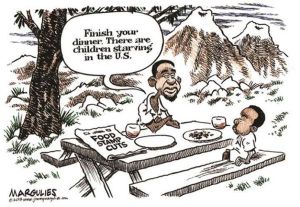 Some time during the Reagan campaign, our government became the enemy of a huge number of people in this country. Paranoia over a democratically elected government enshrined by voters and a sophisticated legal and political system is usually confined to a groups of paramilitary paranoids that call themselves preppers, read too much Ayn Rand, and never emotionally develop beyond, say high school. Through the money of the Koch Brothers, the pulpit connivings of Pat Robertson and the paranoid shrieking of folks like Glenn Beck and Rush Limbaugh that have failed at every endeavor but snake oil peddling on the radio, we now have entire sections of the country that gerrymander legislators to send these freaks to Congress.
Perry and like-minded Republican governors subscribe to the slash-and-burn economic philosophy — a belief that “less” will somehow become “more.” In Texas, he has implemented this vision with gusto, cutting taxes and slashing funding for critical middle-class priorities such as public schools, higher education, health care and infrastructure. The results? Texas ranks 49th in high school graduation, 10th in the rate of poverty and 50th in the percent of residents with even basic health insurance.
And while Perry likes to promote the job creation in Texas during his time in office, he leaves out a critical point: The jobs “miracle” he touts is driven by low-paying, non-sustainable jobs. This year, Texas — tied with Mississippi — leads the nation for the percentage of hourly paid workers earning equal to or less than the minimum wage. More than one in 10 workers nationwide earning at or below the minimum wage works in Texas.
Let’s not even go into the social costs of letting Texas businesses operate however they want to. Just ask the towns and farms that no longer have water and are nsubjected to earthquakes due to fracking. We can also mention the town that mostly disappeared from a fertilizer plant explosion that killed 14 people. Wait until Texas property owners and taxpayers get the bills for those kinds of preventable disasters. I’m fairly certain that northern Texas will soon be paying more for water than the world will pay for its oil. In fact, I’ll stake all my years drawing supply and demand graph on it.
Then, there is a new kick-the-can down the road effort on the 2013 Farm Bill that’s going to leave a lot of American children starving. Republican members of Congress appear to still think that folks live large off of Food Stamps. It’s the old untrue Welfare Queen canard peddled by Reagan back in the 1980s come back to haunt us.
An extension does not solve problems. Congress is currently engaged in a philosophical debate about federal nutrition programs, namely, the farm bill’s Supplemental Nutrition Assistance Program (SNAP). Some members of Congress believe the program and its current level of benefits and eligibility requirements are appropriate, particularly in this challenging economic time. Others erroneously believe the program is fraught with waste, fraud and abuse and want to cut funding and benefits to vulnerable families.
Regardless of where one falls on this issue, it is clear that an extension of the current farm bill is inadequate from both perspectives. Members wanting to preserve existing funding for this vital safety net program should welcome the long-term policy certainty provided by a five-year comprehensive bill, rather than leaving SNAP vulnerable to cuts year after year. And members interested in cutting funding from SNAP won’t achieve any of the so-called reforms they desire without the passage of a new five-year bill; an extension merely perpetuates the status quo.
Rather than waste time on a nutrition-only bill to be brought up in the House next week that would leave between 4 and 6 million Americans ineligible for full SNAP benefits, according to an analysis by the Center on Budget and Policy Priorities, or pass an extension that merely kicks the can down the road, Congress must instead preserve the historic coalition between farmers and consumers in need and pass a comprehensive five-year farm bill that includes both farm and nutrition programs.
Then, here we go again on shutting down the budget process, a debt ceiling increase, and vital services over providing more health care to individuals through the Affordable Health Care Act. Once again, I remind every one that this act is basically the Heritage Institute Plan of the 1990s. It was the Republican answer to “HillaryCare”. How far down the path of slash and burn have we gone that today’s Republican’s reject their “conservative” plan of less than 20 years ago? Here’s an argument for a shutdown.
I’m quickly coming to the conclusion that a government shutdown may be the only way to deal with the coming budget bedlam and #cliffgate.
Let’s start by reviewing the situation.
- As of today there are less than two weeks before fiscal 2014 begins.
- None of the FY14 appropriations have been enacted; none have any chance of being enacted.
- There are no formal negotiations going on between Congress and the White House, between the House and Senate or between Democrats and Republicans.
- The only discussions that seem to be taking place are between the two main factions in the House GOP…and the best thing that can be said about them is that they appear to be going nowhere.
- The original plan suggested by the House Republican leadership was flatly rejected by the tea partiers in the House GOP caucus. The tea partiers were energized by their success.
- House Speaker John Boehner (R-OH) and Majority Leader Eric Cantor (R-VA) haven’t put a new plan on the table since their last plan was rejected by members of their own party a week ago. Boehner has even indicated publicly that he’s not sure whether there is a plan than is acceptable to his caucus.
- Meanwhile, in keeping with the tradition that the House goes first on CRs, Senate Majority Leader Harry Reid (D-NV) has said he is going to wait for the House to act before moving forward. What happens when/if he moves forward is anyone’s guess
- Senate Minority Leader Mitch McConnell (R-KY) has far less room to maneuver compared to previous budget fights because he is being challenged in the GOP Kentucky primary by a tea partier.
- House Democrats, who in the past have provided the votes to help the House GOP pass budget-related bills when the Republican caucus couldn’t decide what to do, this time seem hell bent on not doing it again.
- The White House has far less sway over congressional Democrats now than it did before the 2012 election. Needless to say, it has almost none over congressional Republicans.
- The extremely negative political impact of the 1995-96 shutdowns is such a distant (or nonexistent) memory for so many House Republicans that it’s not at all clear they have any fear of it happening again in 2013.
- To top it all off, this year’s budget debate is less about the budget than it is about defunding Obamacare and that makes a compromise far harder on the budget issues.
Two things usually help with a political stalemate like this (although I’m not really sure there ever has been a situation exactly like this one):
- A charismatic leader who can overcome the partisan warfare
- A crisis that substantially changes the politics
It’s hard to see any leader emerging in the short-term In the current hyper partisan environment. And while there are many charismatic politicians, at least right now none have the stature with both parties to negotiate a budget peace plan.
That leaves a crisis, and baring a military or foreign policy disaster, the only one with the potential to create enough political pain in a relatively short period of time is a federal shutdown.
That makes a shutdown a better option for Boehner, Cantor, McConnell and Reid than it might otherwise seem.
A shutdown also may work for Boehner because (1) it will show his tea partiers that he was willing to allow it to happen as they wanted, (2) it will change the politics as many voters go from being amused to being furious and (3) the tea partiers may be able to use the shutdown with their own voters to prove their political testosterone.
As usual, there’s a group of greedy billionaires behind the shutdown mentality. It seems they all make lots of money just from all the hooplah.
Club for Growth and other extremist groups consider a record like his an unforgivable failure, and they are raising and spending millions to make sure that no Republicans will take similar positions in the next few weeks when the fiscal year ends and the debt limit expires.
If you’re wondering why so many House Republicans seem to believe they can force President Obama to accept a “defunding” of the health care reform law by threatening a government shutdown or a default, it’s because these groups have promised to inflict political pain on any Republican official who doesn’t go along.
Heritage Action and the Senate Conservatives Fund have each released scorecards showing which lawmakers have pledged to “defund Obamacare.” When a senator like Tom Coburn of Oklahoma refuses to pledge, right-wing activists are told: “Please contact Senator Coburn and tell him it’s dishonest to say you oppose Obamacare, but then vote to fund it. Tell him he swore an oath to support and defend the Constitution.”
Mr. Schock and 10 other lawmakers considered suspiciously squishy by the Club for Growth were designated as RINO’s (Republicans in name only), and the club has vowed to find primary opponents and support them with cash — a formidable threat considering that it spent $18 million backing conservative candidates in the 2012 cycle. Americans for Prosperity, a Koch brothers group that has already spent millions on ads fighting health reform, is beginning a new campaign to delay the law’s effects.
These groups, all financed with secret and unlimited money, feed on chaos and would like nothing better than to claim credit for pushing Washington into another crisis. Winning an ideological victory is far more important to them than the severe economic effects of a shutdown or, worse, a default, which could shatter the credit markets.
They also have another reason for their attacks: fund-raising. All their Web sites pushing the defunding scheme include a big “donate” button for the faithful to push. “With your donation, you will be sending a strong message: Obamacare must be defunded now,” saysthe Web site of the National Liberty Federation, another “social welfare” group that sees dollar signs in shutting down the government.
Brian Walsh, a longtime Republican operative, recently noted in U.S. News and World Report that the right is now spending more money attacking Republicans than the Democrats are. “Money begets TV ads, which begets even more money for these groups’ personal coffers,” he wrote. “Pointing fingers and attacking Republicans is apparently a very profitable fund-raising business.”
What always seems odd in all of this is the number of people that fall for these rich, ideological loudmouths whose slash and burn policy is killing every one. It seems to me that it’s an offshoot of xenophobia, misogyny and racism. It appears easier for some folks to believe that women, minorities, and other ethnic groups are more responsible for their economic demise than their bosses and overlords in the pulpits, in elected office, and the bosses chair. Why some one doesn’t question the patriotism and birth certificate of the likes of Ted Cruz is beyond me. He’s really the poster boy for everything that’s removing the greatness from our country imho.
Monday Reads
Posted: September 16, 2013 Filed under: morning reads | Tags: Koch Brothers, Larry Summers, Maya Grave Site, obesity studies 26 Comments
Good Morning!
I’ve not been in a very good mood the last few days. I’m trying to get my manuscript camera ready and have found that the adjustments to the font size and smaller margins have just about done me in. It’s really messed up the pagination and my seemingly endless tables of statistics. I am about ready to chew off all my nails and pull out quit a bit of hair. It’s very nerve wracking.
Here’s a few links to get you start this morning. I’ve been trying to read some interesting things in the hopes of finding some inner calm.
The best news of the weekend came when Larry Summers withdrew his name from consideration for FED chair. The last thing we needed was yet another financial market sycophant in position that matters as much as that one. The Fed has been one of the few functional institutions and thankfully, it looks like even congress respected the need for its independence.
The decision marks a disappointing turn of events for the renowned economist, who had operated at the highest levels of academia and government. But he has been dogged by controversies. Summers has come under fire for his support for deregulating parts of the banking sector while he was Treasury secretary under President Bill Clinton. While president of Harvard University in 2005, he also sparked controversy for his comments on women’s aptitude in math and science.
People close to the White House said Summers faced not only a rebellion among liberal Democrats but also other challenges, including a debate over whether to launch a military strike against Syria that stretched out the Fed process and gave more time for opposition to build.
The major opposition for Summers came from Democratic Senators.
Summers was a top initial candidate for the Fed job among senior current and former White House officials. Obama was also inclined to appoint Summers to the post, people close to the White House said. But the longer time dragged on without a nomination, the more liberal groups and some Democratic senators were able to organize to oppose Summers, who many on the left viewed as too close to Wall Street and not strong enough on financial regulation.
Opposition to Summers among Senate Democrats has been obvious for weeks but it escalated on Friday when Sen. Jon Tester (D-Mont.) announced he would vote against Obama’s former economic adviser if he was nominated.
At least three other Democrats on the Senate Banking Committee were expected to oppose Summers — Sherrod Brown (D-Ohio), Jeff Merkley (D-Ore.) and Elizabeth Warren (D-Mass.) – raising the politically uncomfortably scenario of Obama needing to rely on Republican votes just to get his choice for a Fed chief out of committee.
Obama has said the other candidates for the job are Fed Vice Chair Janet Yellen and former Fed Vice Chair Donald Kohn. But Summers was said to be the president’s first choice and it’s unclear if he will fall back on one of these two candidates or look elsewhere.
There are some interesting studies on obesity and the way different people process food. I found this article while reading my copy of The Economist. Links to  the studies are provided in the article. A lot of the differences may have to do with bacteria found in your digestive tract.
Even more intriguing is the notion that the same diet may be treated differently by different people. Four recent papers explored this theme. In one, published in Science in July, Joseph Majzoub, also of Boston Children’s Hospital, deleted in mice a gene called Mrap2. Dr Majzoub and his colleagues showed that this helps to control appetite. Surprisingly, however, even when the mutant critters ate the same as normal mice, they still gained more weight. Why that is remains unclear, but it may be through Mrap2’s effect on another gene, called Mc4r, which is known to be involved in weight gain.
The second and third papers, published as a pair in Nature in August, looked at another way that different bodies metabolise the same diet. Both studies were overseen by Dusko Ehrlich of the National Institute of Agricultural Research in France. One examined bacteria in nearly 300 Danish participants and found those with more diverse microbiota in their gut showed fewer signs of metabolic syndrome, including obesity and insulin resistance. The other study put 49 overweight participants on a high-fibre diet. Those who began with fewer bacterial species saw an increase in bacterial diversity and an improvement in metabolic indicators. This was not the case for those who already had a diverse microbiome, even when fed the same diet.
Jeffrey Gordon, of Washington University in St Louis, says these two studies point to the importance of what he calls “job vacancies” in the microbiota of the obese. Fed the proper diet, a person with more vacancies may see the jobs filled by helpful bacteria. In the fourth paper, by Dr Gordon and recently published in Science, he explores this in mice. To control for the effects of genetics, Dr Gordon found four pairs of human twins, with one twin obese and the other lean. He collected their stool, then transferred the twins’ bacteria to sets of mice. Fed an identical diet, the mice with bacteria from an obese twin became obese, whereas mice with bacteria from a thin twin remained lean.
So,BB found this great article on a discovery of a Mayan mass grave site.
Archaeologist Nicolaus Seefield found the gravesite in an “artificial cave,” which he explains to LiveScience had likely functioned as a water reservoir before the burial “since the cave’s floor was perfectly clean.”
The skeletons found there were not “in their original anatomical articulation,” he says. “The observed hatchet marks on the cervical vertebra are a clear indication of decapitation”; most had their lower jaw detached, and the “spatial pattern” of the bones is consistent with dismemberment.
The archaeologists believe the dead were either prisoners of war or Uxul nobles; they hope upcoming isotope analysis will reveal whether they were from Uxul — which is near what is now the Guatemala border — or elsewhere. Neat fact from LiveScience: “Uxul” means “at the end.”
It wasn’t the only Mayan discovery of the summer: A “lost” Maya city was discovered in June.
 There are many things that depress me about how eager Republicans are to punish poor people for whatever their perverse reasons. What really gets me is how they continue to ensure that poor children will have no chance. Early childhood education has usually be the one program that every one agrees on because it’s efficacy is amazing. The sequestration has led to a large number of children being tossed out of Head Start. I find this beyond troubling. Early childhood education has been shown to be one very effective way to fight inequality. Here’s yet another article on how this country has started to do things all wrong.
In many ways, we do education backwards in this country. We skimp and shortchange the poor children who need education the most, while at the same we lavish public moneys on those who need it least. Take, for instance,this article about the outrageous practice of taxpayer subsidies for the legacy admits of rich alumni of elite colleges.
In this context, advocacy for educational programs that alleviate, rather than exacerbate, inequality is particularly welcome. That’s why I especially appreciated today’s New York Times’ Opinionator blog, in which economist James Heckman writes a great op-ed about the dramatic impact of early childhood education in the lives of poor children. Heckman, as you may know, is a Nobel Prize winning economist from the University of Chicago. He’s a typical University of Chicago economist in that yes, he’s a free market true believer type. But he’s been studying pre-K programs for poor kids for years, and he supports them for conservative reasons: because they are economically rational. Early childhood education for at-risk kids is one of those (relatively) rare government programs that the free market types like because it produces not just equity, but also efficiency.
Here’s an interesting piece on the connections between the Koch Brothers and the Tea Party. It seems the Kochs just have their nasty little fingers in every thing that is unraveling our democracy.
Politico.com, the Washington insider website, has the money-in-politics scoop of the year: It has unmasked a previously unknown political money laundering operation, set up by the energy billionaires and libertarian Koch brothers, that raised $256 million and secretly spent almost all of it last year against Democrats.
The “Koch brothers’ secret bank,” which is what the website calls the Virginia-based group, whose formal name is Freedom Partners, is the glue that has been holding together the right-wing pantheon of pro-corporate, anti-regulatory, anti-Obama, anti-labor front groups that are against everything from healthcare reform to labor unions to financial market reform to progressive taxation.
“The group has about 200 donors, each paying at least $100,000 in annual dues,” Politico reported, saying Freedom Partners would soon be filing papers with the IRS disclosing its existence. “It raised $256 million in the year after its creation in November 2011, the [IRS] document shows. And it made grants of $236 million—meaning a totally unknown group was the largest sugar daddy for conservative groups in the last election, second in total spending only to Karl Rove’s American Crossroads and Crossroads GPS, which together spent about $300 million.”
The fact that secretive right-wingers could amass and spend a quarter-billion dollars in a presidential election cycle and go undetected under federal campaign finance law is an astounding indictment of the American electoral system, revealing that all the laws intending to inform the public about who is slinging political mud are meaningless. The mockery goes even further when considering the section of the federal tax code the group is operating under: 501(c)6. That designation is for trade associations, which lets the group conceal its donors.
Trade asociations, like trade unions, were created to represent single industries or crafts. Freedom Partners’ “trade” is the business of political assassination. What follows is Politico’s list of the groups, causes and amounts received from the Kochs’ cartel. The group’s members are drawn from the energy barons’ semiannual political conferences, which feature speeches by Congress’ Republican leadership.
So, that’s a little this and that from me this morning. What’s on your reading and blogging list today?

 peej
peej Carissa
 bostonboomer
 dakinikat
 ecocatwoman
 jjlo
jjlo mablue2
 Mama Lopez
 peggysue22
 quixote
 skydancingguestblogger
 Mona (aka Wonk the Vote)





Recent Comments