
New Year’s Day Reads: The Lousy Deal
Posted: January 1, 2013 Filed under: Fiscal Cliff, morning reads, U.S. Economy, U.S. Politics | Tags: 2013, Barack Obama, Joe Biden, John Boehner, Mitch McConnell, The Lousy Deal 35 Comments
First Night fireworks against the Boston skyline
Good Morning and Happy New Year!!!
Sorry to be late with this post. I got so discouraged last night with our dysfunctional government that I went to bed completely disgusted. After a good night’s sleep, I’m feeling slightly more optimistic, if not truly hopeful. If I have any hope, it’s that perhaps the American people will rise up and let the president and Congress know what a horrible job they are doing.
So, what’s happening this morning? We officially went over the fiscal cliff at midnight even though the Senate approved a half-baked, crappy “deal.” Politico reports:
Congress lost a mad, New Year’s Eve dash to beat the fiscal cliff deadline, cinching a deal with President Barack Obama to raise taxes on the wealthy and temporarily freeze deep spending cuts but failing to get it through both chambers before midnight.
So over the cliff the country went — though perhaps for only a day or two and, assuming no snags, without incurring the double whammy of another recession and higher unemployment.The measure, which would raise tax rates for families making more than $450,000 and delay deep across-the-board spending cuts for two months, cleared the Senate by an overwhelming 89-8 vote shortly after 2 a.m. The Republican-controlled House could take up the pact in a rare New Year’s Day session, though the timing of that chamber’s vote was not clear.
The $620 billion agreement was a major breakthrough in a partisan standoff that has dragged on for months, spooking Wall Street and threatening to hobble the economic recovery. It turned back the GOP’s two-decade-long refusal to raise tax rates, delivering a major win for the president.
The bill also canceled pay raises for members of Congress and averted an expected hike in the price of milk by extending expiring dairy policy.
Wow, they cancelled their own pay raises? That was big of them–not. They probably did that out of fear of an angry populace. And of course, we still have to watch the shameful spectacle of the tea party House wrangling over a deal that basically give them everything they wanted and more than they ever dreamed of.
From TPM, the Senators who voted against the deal:
The eight senators voting no were Michael Bennet (D-CO), Tom Carper (D-DE), Charles Grassley (R-IA), Tom Harkin (D-IA), Mike Lee (R-UT), Rand Paul (R-KY), Marco Rubio (R-FL), and Richard Shelby (R-AL).
Robert Reich calls it “A Lousy Deal on the Edge of the Fiscal Cliff.” I’m thinking that could be the new logo for this administration–“The Lousy Deal” as opposed to Roosevelt’s “New Deal.” Reich writes:
Details of the agreement reached by the president and congressional Republicans are still forthcoming, but from the look of it, Obama gave ground where he need not have.
What else is new?
Yes, the deal finally gets Republicans to accept a tax increase on the wealthy, but this is an inside-the-Beltway symbolic victory. If anyone believes this will make the GOP more amenable to future tax increases, they don’t know how rabidly extremist the GOP has become.
The deal also extends unemployment insurance for more than 2 million long-term unemployed. That’s important.
But I can’t help believe the president could have done better than this. After all, public opinion is overwhelmingly on his side. Republicans would have been blamed had no deal been achieved.
More importantly, the fiscal cliff is on the president’s side as well. If we go over it, he and the Democrats in the next Congress that starts later this week can quickly offer legislation that grants a middle-class tax cut and restores most military spending. Even rabid Republicans would be hard-pressed not to sign on.
I hate to say it, but it really looks like Obama pushed for this so he could give more away that he would have had to if we had just gone over the cliff without all the fake deal making.
Noam Scheiber writes at The New Republic: Democrats’ Cliff Compromise Is Bad; But the Strategic Consequences Are Disastrous.
I think the president made a huge mistake by negotiating over what he’d previously said was non-negotiable (namely, the expiration of the Bush tax cuts on income over $250,000). Then the White House compounded that mistake by sending Biden to “close” the deal when Harry Reid appeared to give up on it. As a practical matter, this signaled to Republicans that the White House wouldn’t walk away from the bargaining table, allowing the GOP to keep extracting concessions into the absolute final hours before the deadline….
I think a reasonable person can defend the bill on its own terms. The fact is that nudging up the tax threshold to $450,000 only sacrifices $100-200 billion in revenue over the next decade (against the $700-800 billion the administration would have secured with its original threshold), while allowing unemployment benefits to lapse would cause real pain to both the 2 million people directly affected and, indirectly, to the economy. Yes, Obama could have gotten the latter without giving up the former had he just waited another few days—at which point what the GOP considers a tax increase suddenly becomes a tax cut. But these things are always easier to pull the trigger on when you, er, don’t actually have to pull the trigger. I can’t begrudge Obama his wanting to avoid some downside risk for only a marginally better deal.
My far bigger gripe with the whole fiscal-cliff exercise has always been the strategic dimension—how it affects the next showdown with the GOP, and the one after that. Coming into the negotiation, Obama had two big problems: First, no matter how tough he talked, Republicans always assumed he’d blink in the end, for the simple reason that he pretty much always had. (This is one of the major themes of my book about his first term.) Second, despite the results of the most recent election, in which Obama won a fairly commanding victory on a platform of raising taxes on wealthy people, the GOP continued to believe that public opinion was mostly on its side. House Republicans cited the preservation of their majority—never mind that their own candidates received fewer total votes than House Democratic candidates—and polls showing most Americans still think government is too big.
No kidding. And I disagree that we shouldn’t begrudge Obama for not sticking to his promise to hold the line at $250,000. As I’ve written previously, Obama should not be involved in negotiations, because he either wants to lose to the Republicans or his need to please the people who hate him is just too strong. I don’t know which is the real problem, and it really doesn’t matter for practical purposes. He’s just a horrible negotiator, period. Now we have to watch another repulsive display of childish squabbling in a couple of months. Is this going to be the extent of what happens in Obama’s second term? With this incompetent, useless Congress, it’s entirely possible.
And of course we still have to wait and see what Boehner and his gang do.
In a joint statement late Monday, House GOP leaders promised to keep their commitment to act on the measure if it passes the Senate. But they say they won’t decide whether to accept the measure or to amend it and send it back to the Senate until lawmakers and their constituents have a chance to review the legislation.
Give me a frickin’ break! I’m going to end here, because there doesn’t seem to be much other news. What are you reading today. I look forward to clicking on your links.
Whatever else happens, I hope everyone has a great day today and a very happy new year in spite of the idiocy in Washington DC!!
Her Life Was The Ultimate Lifetime Movie
Posted: December 31, 2012 Filed under: Crime, Criminal Justice System | Tags: 2012 notable deaths, Herman Tarnower, Jean Harris, Norah Ephron, Scarsdale Diet, women in prison 10 Comments
Jean Harris
Is it just me, or have we lost an unusual number of cultural icons in 2012? When someone who has affected you dies, it can bring back a wave of nostalgia for an earlier time.
Some of the deaths that had that effect on me this year were those of Etta James, Doc Watson, Earl Scruggs, Dick Clark, Dave Brubeck, Gore Vidal, Johnny Pesky, George McGovern, Ravi Shankar, Henry Hill, and Norah Ephron.
Recently I learned of the death of one of those cultural icons: Jean Harris. She was the headmistress of an exclusive girls’ school who was convicted of killing her famous lover Herman Tarnower, creator of the popular “Scarsdale Medical Diet.”
The March 10, 1980, shooting of Tarnower — which she claimed throughout her life was her own suicide gone awry — was one of the most sensational crimes of its era.
It riveted the nation, not only because of its titillating combination of sex and violence. It raised what many experts said were important sociological issues, with some feminists rallying to Harris as a symbol of society’s disregard for the plight of older women and others arguing that her case had nothing at all to do with feminism.
Women’s movement icon Betty Friedan dismissed Harris as a “pathetic masochist” for staying with a man who mistreated her. But author Shana Alexander, who wrote a book on the case, described Harris as the “psychological victim of a domineering person.”
Whether morality play or soap opera, the case inspired two TV movies: “The People vs. Jean Harris” (1981), in which Harris was portrayed by Ellen Burstyn, and “Mrs. Harris” (2005), which starred Annette Bening.
In 1980, Harris was the 56-year-old headmistress of the fancy, private Madeira School overlooking the Potomac River in McLean, Va. Tarnower was a 69-year-old cardiologist and best-selling author of a book on a high-protein, low-fat diet that he developed for heart patients at his medical center in well-to-do Scarsdale, N.Y.
While she was in prison, Harris managed to accomplish quite a bit.
Mrs. Harris was sentenced to 15 years to life, and spent 12 of those years at the Bedford Hills Correctional Facility in Westchester County, N.Y. But she managed to salvage that seemingly wasted period through a remarkable prison life. She counseled fellow female prisoners on how to take care of their children, and she set up a center where infants born to inmates can spend a year near their mothers. Then, after her release in 1993 following a grant of clemency by Gov. Mario M. Cuomo, she set up a foundation that raised millions of dollars for scholarships for children of women in prison in New York State.
She also lectured about her often incongruous experiences with inmates.
“They looked at me as a rich white woman, even though some of the call girls earned six times what I did as a headmistress,” she told an interviewer.
She also wrote two books in longhand on legal pads while she was incarcerated, Stranger in Two Worlds, the earnings from which she used to start her foundation and They Always Call Us Ladies: Stories From Prison. There’s a lengthy piece about Harris’ good works at The Daily Beast, and here’s another long read about the case written for NY Magazine in 1980 by Anthony Haden-Guest.
The best thing I read about Harris was this short article by Norah Ephron who also died in 2012:
…on March 12, 1980, when all of New York awoke to the news, this was what we knew: that Jean Harris, 57, the headmistress of the Madeira School, had driven from Virginia to Scarsdale, New York, and killed her former boyfriend, a best-selling diet doctor named Herman Tarnower, 69, by shooting him four times.
There it was: socialite held in doc slaying. It was a tabloid dream. The doctor lived in an “exclusive” Westchester home, the socialite headed a “posh” girls’ school.
We were thrilled. When I say we, I mean me, but I also mean every woman who has ever wanted to kill a bad boyfriend.
There was a kind of giddy exhilaration that passed through the city. I’m not just projecting. Everyone called everyone up. The day was completely blown discussing it. We were all thinking, You go, girl, even though that expression had not yet been invented.
It was clear there would turn out to be another woman (there was), and that she would be younger, prettier, blonde, and probably his receptionist (all true). But as it turned out, Jean Harris did not want to be a celebrity murderess like Roxie Hart, or even a poster child for women whose antidepressant supplies run low. She was a proud, prickly woman, a classic headmistress. The night of the murder, she’d worn a headband. She insisted to police that she hadn’t meant to kill Tarnower; she’d brought the gun to Scarsdale only to kill herself. She claimed that Tarnower had tried to take the gun away from her, and she’d accidentally shot him.
Yes, that was how so many of us reacted the the news–secretly cheering Harris on for getting revenge on a manipulative, cheating lover. And, truthfully, it was a better story if she shot him deliberately.
Here are a few links to lists of people we lost in 2012.
U.S. News list of notable deaths
TV Guide photo gallery of celebrity deaths
Which ones affected you most?
Saturday Reads: A Fiscal Cliff-Free Zone
Posted: December 29, 2012 Filed under: Barack Obama, morning reads, Psychopaths in charge, social media, U.S. Politics, Violence against women, War on Women | Tags: Adam Serwer, American Communist Party, Arthur Miller, communism, FISA, gang rape protests, Glenn Greenwald, India, Marilyn Monroe, Pope Benedict, Twitter, warrantless wiretapping, wild turkeys 15 Comments
Good Morning!!
Several months ago, I wrote about seeing a gathering of wild turkeys as I drove down my street in a western suburb of Boston. I was very surprised, but when I got home and googled I learned that the giant, not-very-bright birds have been invading communities all over Massachusetts–including the city of Boston!
Yesterday, as I drove down a street in Cambridge, I had to come to sudden stop as a lone wild turkey meandered into my path. I managed to get around the bird, but the car behind me didn’t make it I could see in my rear view mirror that the driver was forced to sit there as the turkey wandered around in the middle of the road. So apparently the turkey invasion is continuing apace.
From CBS News, December 7: Wild turkeys terrorize Massachusetts town residents
Aggressive turkeys are coming after some Massachusetts residents, prompting one town to consider seeking approval to trap and kill the birds.
In particular, three large male turkeys seem to be leading the assault in Brookline, CBS station WBZ in Boston reported. A meeting was held on Dec. 6 at the Brookline Police Station to discuss the poultry problem.
Karen Halvorson told WBZ that the turkeys have chased her on two occasions, banging on her front door and scratching her as she took her daily walk. She’s taken precautions including buying a hiking stick to ward off the creatures and carrying her phone on her at all times. Halvorson was at the meeting.
“I can’t believe we’re living this way,” she said.
Her husband has made piles of sticks around their house so they can throw them at the turkeys and run for cover. He’s been attacked four times in the last three years.
Jeeze, I’m glad they’re not hanging around in my front yard! BTW, Brookline is basically in Boston. It’s an urban area.
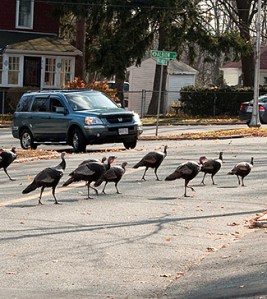
Here’s more from The Boston Globe in late November:
In Brookline, a roving band of wild turkeys is terrorizing residents, stalking some as they walk down the street and ambushing others as they try to exit their cars. They’re pecking backsides, scratching necks, and flapping powerful wings in the faces of passersby.
For those whose primary experience with the grand bird is when it’s sliced up on a plate, the problem may sound funny. And to those living in rural areas who have found ways to peacefully coexist with wild turkeys for years, the problem may sound overblown. But to residents of Brookline, where the presence of roughly two dozen 3- to 4-foot-tall birds is a relatively new phenomenon, the menace is anything but humorous or normal. Over the past few months, the number of encounters with the increasingly brazen birds — not to mention calls to public safety officials — has risen.
According to the state agency MassWildlife, trapping and relocating the turkeys would be impractical: The best trapping methods aren’t suited for urban and suburban areas, and relocated turkeys often return or find new human populations to annoy. The better option, then, is to teach humans how best to deal with the birds. Brookline officials should get to work educating the town’s residents about best anti-turkey practices, which are available on MassWildlife’s website.
The birds are even invading Martha’s Vineyard: Oak Bluffs police bean rampaging turkey.
Oak Bluffs police officers Saturday used a bean bag shotgun to knock the stuffing out of an aggressive turkey that had run afoul of residents in the Hidden Cove Road neighborhood, where the big Tom attempted to rule the roost.
Lieutenant Tim Williamson said police were called to the neighborhood, located in the Major’s Cove subdivision, on several occasions for reports of turkeys harassing humans. In one instance, a turkey chased an elderly woman who tripped and fell and scraped her knee. “This turkey has been a menace in the neighborhood for at least a month or so,” Lieutenant Williamson said.
On Saturday at noon, police officer Jeffrey LaBell received a call at the station from a resident who police would not identify. The man told police a wild turkey was on his front porch and, according to the police report, “was keeping him and his wife from entering their residence. [The man] explained the turkey is aggressive and has attacked people in the neighborhood in the past on several occasions. [The man] demanded that something be done before the turkey causes harm to someone in the neighborhood.”
Now for some slightly more serious news, please follow me after the page break.
Thursday Reads: Fiscal Cliff Crashes into Debt Ceiling, Villagers Blame Old People….And Other News
Posted: December 27, 2012 Filed under: 2012 presidential campaign, Barack Obama, Fiscal Cliff, morning reads, Surreality, U.S. Economy, U.S. Politics, We are so F'd | Tags: Chained CPI, Charles Pierce, Debt Ceiling, fiscal cliff, John Boehner, Mitt Romney, Piers Morgan, Social Security, Tagg Romney, Tim Geithner 26 Comments
Good Morning!!
The storm has moved into New England, but it’s mostly rain up here–very hard, windy, noisy rain. I’m very grateful it isn’t snow, but I feel for all the people down south of me who are getting hit harder. Take care, everyone!!
Yesterday Tim Geithner announced that the U.S. will hit the debt ceiling on December 31. He sent a letter (pdf) (also posted on the Treasury Department website)to Harry Reid with cc’s to other Congresscritters informing them that the Treasury can fiddle around and keep things going for at the most two months before the U.S. defaults on its debts for the first time in history.
Meanwhile, no negotiations on the “fiscal cliff” took place yesterday. John Boehner appears to have abdicated all responsibility and has announced that it’s up the the Senate to act; but Senators are in no hurry to rush back to Washington DC and clean up the House Republicans’ mess.
U.S. House of Representatives Speaker John Boehner on Wednesday urged the Senate to pass its version of legislation to avert the “fiscal cliff,” in a sign that congressional efforts to avoid a budget crisis are coming back to life days ahead of the year-end deadline.
In a statement issued by Boehner and his top lieutenants, the Republican leadership team said “the Senate must act first” to revive efforts to avert the $600 billion in automatic tax hikes and spending cuts due to be triggered on Jan. 1.
They promised that the House would weigh whatever legislation the Senate produced.
What are we paying these incompetent idiots for anyway? But of course no one is talking about cutting Congresspeople’s salaries–the pressure is all on Social Security recipients. Yesterday, Ruth Markus wrote a column in support of cutting benefits because seniors and disabled people (including disabled veterans) are getting too much money (the average SS check is $1,200 per month). She thinks everyone should gratefully embrace the Chained CPI.
Here’s how the CPI works. When taxes are being calculated, brackets, standard deductions, personal exemptions and the like are ratcheted up with inflation, protecting taxpayers from being forced to pay higher taxes for what is essentially the same amount of income they had previously.
Benefits — everything from Social Security to veterans’ benefits to federal pensions — are similarly adjusted upward to protect beneficiaries’ buying power from being relentlessly eroded.
Such indexing makes eminent sense. The difficulty — and the money-saving opportunity — arises because, in the view of most economists, the current method of calculating changes in the CPI overstates the inflation rate.
It fails to account for what economists call upper-level substitution bias, and what my mother would call plain common sense: If the price rises for a certain commodity in the basket of goods used to measure inflation, consumers will choose a cheaper alternative. In my house, when the price of beef soars, we substitute chicken.
The CPI doesn’t and, as a result, taxpayers are undercharged and beneficiaries are overpaid — a lot. The overestimate is small — less than 0.3 percentage points annually but, much like compound interest, it adds up over time.
What Marcus doesn’t seem to understand is that when your income is that low, beef and chicken are are both too expensive and you substitute peanut butter and dried beans. Except that peanut butter prices have skyrocketed–what’s the next step down, cat food?
Two economists responded to Markus. Dean Baker at the CEPR: Ruth Marcus Is Outraged by Overly Generous Social Security Checks.
Well, who can blame her? After all, we have tens of millions of seniors living high on Social Security checks averaging a bit over $1,200 a month at a time when folks like the CEOs in the Campaign to Fix the Debt are supposed to subsist on paychecks that typically come to $10 million to $20 million a year.
Anyhow, her main trick for cutting benefits is to adopt the chained consumer price index as the basis for the annual cost of living adjustment. This would have the effect of reducing benefits by 0.3 percentage points for each year of retirement. This means a beneficiary would see a 3 percent cut in benefits after 10 years, a 6 percent cut after 20 years and a 9 percent cut after 30 years. This is real money. Since Social Security is more than half the income for almost 70 percent of retirees and more than 90 percent of the income for 40 percent of retirees, the hit to the affected population would be considerably larger than the hit to the top 2 percent from ending the Bush era tax cuts.
But Marcus insists this cut must be done first and foremost in the name of accuracy, since the chained CPI is supposed to provide a better measure of the cost of living. She notes but quickly dismisses the evidence from the Bureau of Labor Statistics (BLS) consumer price index for the elderly (CPI-E), which shows that the rate of inflation seen by the elderly is somewhat higher than the overall rate of inflation.
Read Baker’s upteenth explanation of why the Chained CPI doesn’t accurately reflect spending for seniors at the link. He argues for continuing development of a CPI that takes into account that seniors spend greater proportions of their income on health care and basic necessities that can’t necessarily be replaced with cheaper substitutes.
Next, Jared Bernstein says he’s “convinced the Chained CPI is coming” and it is a benefit cut. He agrees with Baker that an elderly CPI would be a good thing, but says that Markus’ argument we should cut benefits now and deal with the injustices later makes no sense.
…as Dean notes, it would make a lot of sense to invest in a chained-weighted CPI that accounts for the notably different buying patterns of the elderly. Ruth Marcus critiques this point today but for reasons that don’t make sense to me. For example, she criticizes an elderly price index that would more heavily weight health care spending because “the burden of higher health costs falls unevenly among the elderly. Average costs are skewed upward by a minority who face very high out-of-pocket expenses…”
But a) all the commonly used price indexes use average costs and are thus “skewed” up and down when the underlying distribution is uneven, and b) there’s little question that the ‘old’ elderly—the ones most hurt by the switch to the chain-weighted measure—face high out-of-pocket medical costs.
Marcus goes on to endorse, as do we at CBPP, [immediately switching to the Chained CPI but protecting “vulnerable people from the impact”] and this is clearly the administration’s view as well—in fact, they’ve built in offsetting benefits to the poor, old elderly into their plan. That’s very important and salutary and one reason why I nervously support the switch.
But I’m more concerned than Ruth appears to be with the possibility that the current politics get us the chained CPI without the necessary protections.
It certainly looks like President Obama will go down in history as the Democrat who cut the New Deal off at the knees unless he suddenly realizes his legacy matters to him. Remember way back when Social Security was “off the table” because it doesn’t contribute to the deficit? Oh wait–that was only two weeks ago.
Christmas Day Reads
Posted: December 25, 2012 Filed under: morning reads | Tags: historical Jesus, history of Christianity, Palestinians, Santa Claus, St. Paul, White Jesus myth, winter weather, wrapping paper 79 Comments
Boston Common Christmas Tree
Good Morning! Merry Christmas and Happy Holidays, Everyone! However you choose to celebrate the return of the light, may your days be happy and bright!
We’ve got a tiny bit of snow in the Boston area this morning–not enough for a white Christmas, just a dusting with a few flakes still coming down. I guess the real stormy weather today will be in the South and Southeast. I hope everyone down there stays safe!
To be honest, I’m very glad that I don’t have to go anywhere today and I’m going to spend my day peacefully alone, except for talking to loved ones on the phone. I do have a few suggested reads for you this morning and a couple of videos to watch if you have the time.
Most Americans have grown up with an image of a Jesus savior with white skin and light brown hair. We don’t know for sure if there was a historical Jesus, but if so, he probably had dark skin and hair. From The Final Call: Color struck: America’s White Jesus is a global export and false product, by Wesley Muhammed.
What color was Jesus? Most American Christians—Black and White—would dismiss this question as both irrelevant and unanswerable as the Gospels fail to give us a physical description.
The irony is that most of these same Americans in their heart of hearts are pretty confident any way that they know what color Jesus was. They attend churches with images of a tall, long haired, full bearded White man depicted in stained glass windows or painted on walls, and they return home to the same depictions framed in their living room or illustrating their family Bibles.Further compounding the irony is the fact that America actually has an obsession with the (presumed) color of Christ and has exported her White Americanized Savior around the world, as recently documented by Edward J. Blum and Paul Harvey in their book, The Color of Christ: The Son of God and the Saga of Race in America (2012).
In fact, the world’s most popular and recognizable image of Christ is a distinctly 19th-20th century American creation. It is true that versions of the “White Christ” appear in European art as early as the 4th century of the Christian era, but these images coexisted with other, nonwhite representations throughout European history. The popularity of the cult of the Black Madonna and Black Christ throughout Europe is evidence of the fact that the European ‘White Christs’ never acquired the authority and authenticity that the White Christ now has globally. This Christ and his authority are American phenomena. As a predominantly Protestant nation Early America rejected the imaging of Christ that characterized European Catholicism.
Much more at the link. And from Alternet, This Christmas, Let’s Remember, Jesus Was A Palestinian, by Gideon Polya.
On Christmas Day this year the World will again celebrate the birth of Jesus but needs to loudly and publicly proclaim the truth that Jesus was a Palestinian. Goodhearted and honest Christians, Muslims, Hindus, Buddhists, Sikhs, Jains, Jews, Animists, Agnostics and Atheists would all agree that Jesus was a wonderful humanitarian, and an outstanding moral philosopher.
All of us, from Atheists to Zoroastrians, recognize Jesus as the most renowned Indigenous Palestinian. Today under US-, UK-, Canada- and Australia-backed and racist Zionist-run Apartheid Israel the land of Palestine has been 90% ethnically cleansed of Indigenous Palestinians, 75% of Christian Palestinians have fled the Occupied West Bank, and Palestine, one of the oldest civilizations in the world, is peculiar in being denied de facto statehood and remains violently occupied by a nuclear terrorist, rogue state run by genocidally racist European colonizers.
Palestine is the land west of the Jordan River and derives its name from the Philistine sea people who settled the coastal region in circa 1200 BC and are referred to from that time onwards by the Egyptians and thence by the Assyrians in circa 740BC. Canaanite, the name given to Palestinians in the Old Testament of the Holy Bible, refers to people trading in the purple cloth of the great Semitic Phoenician civilization. The great 5th century Greek historian Herodotus (c irca 484 – 425 BC) referred to ”These Phoenicians… now inhabit the sea coast of Syria; that part of Syria and as much of it as reaches Egypt, is all called Palestine”. The Jewish Roman historian connected with the Hasmonean Jewish aristocracy, Josephus (37-circa 100 CE), was involved in the First Jewish Roman War (67-33 CE) but thence rejected rebellion against Rome as inspired by fanatics. Josephus referred to Jews as among the inhabitants of Palestine (see “The International Standard Bible Encyclopaedia”, volume 3).
The forebears of the Indigenous Palestinians were the Semitic inhabitants of Palestine and participants in the agrarian revolution in the Fertile Crescent that was one major nucleus of human agrarian civilization.
It’s a long read, but check it out if you have some extra time.
From the Grio: Christmas 2012: The burden of being a black Santa, by Brittany Tom.
Although they’re only employed for about two months of the year, it certainly doesn’t stop these dedicated men to don long white beards and red velvet jumpsuits.
But a few men across the U.S. are attempting to challenge the iconic image of Santa Claus, with the simple phrase: “Why can’t Santa be black?”
Dion “Santa Dee” Sinclair has started an entire business around the image of the African-American Santa Claus. Sinclair along with his two other black Santa Clauses, Santa Bob and Santa Tee, have provided the same Santa magic to children in multicultural communities in Atlanta, Georgia. Sinclair believes it’s important for children, especially minorities, to have a prominent icon they can culturally identify with.
“A black Santa is something that they can associate with. It’s black Santa, and I’m a black person.” Sinclair told theGrio in a phone interview. “[These kids] can associate with having a black Santa or a black angel on the Christmas tree because they’re black. There shouldn’t always be a white angel or a white Santa.”
Having grey hair since he was a child and a”salt and pepper” beard in high school, Sinclair said that becoming the iconic role of Santa Claus was his destiny. Now, this southern Santa has turned his ‘destiny’ into a family-run business hiring everyone in his family from his mother who plays Mrs. Claus to his youngest daughter who stars as Elf Gigi.
At The Daily Beast, James D. Tabor asks, “Should Christians Celebrate the Birth of Jesus or Paul?”
Millions celebrate the birth of Jesus without realizing that it was the Apostle Paul, not Jesus, who was the founder of Christianity. Jesus was a Jew not a Christian. He regularly went to the synagogue on the Sabbath day, read from the Torah, observed the Jewish festivals such as Passover and Yom Kippur, and quoted the Shema: “Hear O Israel, The Lord our God is One Lord.” In Jesus’ day the closest holiday to Christmas was the Roman celebration of the Saturnalia.
The Romans crucified Jesus for sedition in the year 30 AD, but his apostles, led by James his brother, continued his movement, believing that Jesus would return from heaven as the triumphant Messiah. They were called Nazarenes and lived as Jews alongside other Jewish sects of the time such as the Pharisees, Sadducees, or Essenes.
Paul never met Jesus. He was not one of the original apostles. He was a zealous Pharisee who initially opposed Jesus’ followers and supported moves to repress them. His opposition to the movement dramatically reversed about seven years after Jesus’ death when he began to experience a series of clairvoyant visions—“revelations of Jesus Christ” he called them. Paul adamantly insisted that the message he preached did not derive from the apostles before him. He refers to James, Peter, and John, as the “so-called pillars of the church,” but quickly adds—“what they are means nothing to me,” insisting on his independence, based on his direct visionary access to Jesus. Over a span of three decades Paul had contact with the apostles in Jerusalem on only two or three visits, during which tensions were high. He operated independently in Asia Minor and Greece, preaching his message to non-Jews.
What Paul preached—his “gospel” as he called it—forms the basis of Christianity today. Paul taught that Christ was the divine Son of God who became incarnate, “born of a woman,” as he puts it. Jesus lived a sinless life and died as an atoning sacrifice for the sins of the world. He was raised from the dead and exalted to the right hand of God in heaven, soon to return to judge the world. Those who accept Christ and his offer of salvation by faith will be saved, and those who reject it will be condemned. The reason this message sounds so familiar, so “Christian,” is that this gospel Paul preached became the basis of the major Christian creeds—from the early Apostles creed to the Nicean creed in the time of the emperor Constantine.
Whether or not there was a historical Jesus, everything we know about him is based on folklore. A few years ago I watched a fascinating documentary called The God Who Wasn’t There. It’s all about the history of Christianity. I watched it again last night on Youtube and found it just as compelling as my first viewing. It’s about an hour long and well worth the time if you’re interested in religious history. I can’t get it to embed, but you can watch it here.
At the Atlantic, Megan Garber offers Wrappers’ Delight: A Brief History of Wrapping Paper
There will likely come a day, sometime in the not-too-distant future, when we look back on wrapping paper with the kind of retrospective condescension we reserve for the most naive elements of our history. Wasting precious paper — killing trees — for decoration! Spending money on a total frivolity! How ridiculous people were back then!
And it is true: The money we spend on it notwithstanding — $2.6 billion annually, per one estimate — there is something quite trivial about wrapping paper. As much as half of the 85 million tons of paper products Americans consume each year, apparently, goes toward packaging, wrapping, and decorating objects — and wrapping paper and shopping bags on their own account for about 4 million tons of the trash we create annually in the U.S. In Britain, per one estimate, people throw away 226,800 miles of wrapping paper over the holidays alone — enough to stretch nine times around the world….
But where did the wrapping tradition come from? Why do we, each time we give a gift, ritually wrap that offering in decorative tree pulp? The short answer is that wrapping, as a practice, has been around for ages — literally, ages. The Japanese furoshiki, the reusable wrapping cloth still in use today, is a pretty faithful rendition of the version that’s been around since the Edo period. The Korean bojagi dates from the Three Kingdoms Period, possibly as early as the first century A.D. In the west, using paper as a covering for gifts has been a longstanding, if largely luxury-oriented, practice: Upper-class Victorians regularly used elaborately decorated paper — along with ribbons and lace — to conceal gifts. In the early 20th century, thick, unwieldy paper gave way to tissue (often colored in red, green, and white) that would similarly work to conceal offerings until they were opened. The practice was echoed in a slightly more practical form by stores, which would wrap customers’ purchases in sturdy manila papers.
Learn more at the link.
I’ll end with the Obamas’ Christmas card, posted on the White House website, and a video of the First Lady reading The Night Before Christmas as Bo steals the show.


 peej
peej Carissa
 bostonboomer
 dakinikat
 ecocatwoman
 mablue2
 Mama Lopez
 peggysue22
 quixote
 skydancingguestblogger
 Mona (aka Wonk the Vote)



 Sky Dancing
Recent Comments