Posted: January 7, 2026 | Author: bostonboomer | Filed under: just because | Tags: Donald Trump, fascism, Heather Cox Richardson, January 6 2001 5th anniversary, mafia state, Peter Thiel, Stephen Miller |
Good Morning!!
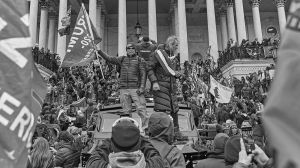 Yesterday was the 5th anniversary of the January 6 insurrection. There were serious efforts to mark the occasion, as well as unserious efforts by the White House to convince Americans to ignore the evidence of their own eyes and ears.
A couple of reads on the significance of the January 6 anniversary:
Andrew Egger at The Bulwark: January 6th Never Ended.
Five years! Half a decade ago today, Donald Trump summoned his angriest, most loyal fans from across America to Washington, D.C., with a call to arms and a fervent plea: They’re trying to steal the country from us, and they’ll get away with it, unless we stop them. They assembled on the National Mall, their frustration and rage crackling in the air, waiting to be told what to do. Trump whipped them into a frenzy, sent them marching down to the Capitol, and waited.
Last week, an excellent New York Times editorial described the insurrection of January 6th as a riot that never ended—“a turning point, but not the one it first seemed to be.” To some, it felt like an ending, the final, violent death spasms of the cult of Trump—so much so that the Senate Republicans who could have slammed the door on him forever deluded themselves into thinking he would stay gone without their having to lift a finger.
Instead, it proved to be the dawn of Trump’s total liberation. He had stress-tested his own theory of his base: that they would swallow insane, ludicrous election lies simply because he asked them to, would march themselves into felonies because they thought he wanted them to, and would then sit in their jail cells, not disillusioned but unshaken in their faith in him, patiently awaiting the day of his return and their reward. Eventually, they got it.
Ever since, Trump has lived his life in accordance with the lessons he learned that day. There was no act of selfishness or vindictiveness too grotesque for him to survive, provided he kept his people adequately juiced in the belief that their enemies were worse—and provided he could claw his way back to actual, hard power.
So it’s true: We’ve never left the January 6th era. But what’s most staggering is how many people would prefer to pretend we never entered it in the first place. Outside the core of Trump’s zealot base, which celebrates the patriotic heroes of that day, sits a larger faction of more grudging GOP supporters, for whom the Capitol insurrection is an unpleasant memory repressed as a matter of mental hygiene. These people wouldn’t flat-out deny that January 6th happened, but they’ve mentally sequestered its memory and significance, refusing to allow it to force them into any uncomfortable conclusions. They’d laugh you out of the room for suggesting, for instance, that what happened just five years ago could plausibly happen again.
Three years from today, Donald Trump may well find himself in a familiar situation: asked to leave the White House and preferring not to. The strong odds are, of course, that he won’t be on the ballot himself. But if a Democrat wins the presidency in 2028, he’ll have far more compelling reasons not to let the transfer of power go ahead smoothly than he ever did in 2020. Back then, it was mostly a matter of arrogance and pride: He simply couldn’t accept that he’d lost to Joe Biden. This time, the personal stakes will be much higher. Wrapped in the powers of the presidency, he’s acted as a law unto himself for too long not to dread going back into private life, where long-delayed legal consequences might be lurking, waiting for him.
We can only hope the Democrats take over the House and Senate and manage to impeach him.
Russell Payne at Salon: We learned nothing from Jan. 6.
After a mob of President Donald Trump’s supporters stormed the Capitol on Jan. 6, 2021, it appeared the attack would result in a rare moment of reckoning in American politics — at least for a moment. Even hardline GOP politicians had distanced themselves from Trump, then President Joe Biden was in charge and Congress and the Department of Justice were investigating both the attack and the plot to overturn the 2020 election behind it.
Five years later, any accountability, political or legal, that Trump and his allies faced has been erased.
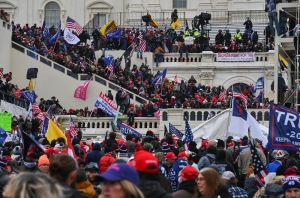 One of Trump’s first acts after assuming office in his second term was to pardon the nearly 1,600 people who had either already been convicted or were awaiting trial for crimes related to Jan. 6. Many of these people had prior criminal records including sexual assault and domestic violence, many were part of far-right organizations like the Proud Boys and many have been charged with additional, unrelated crimes following their release. None of them, however, will have to serve their sentences for storming the Capitol in an attempt to overturn the election results and allow Trump to cling to power.
Likewise, Trump has avoided both legal and political accountability. Trump has effectively excised any Republicans willing to stand up to his false claims that the election was stolen from the party. He easily won the GOP nomination for president in 2024, though he faced multiple prosecutions over the plot to overturn the 2020 election, the first coming in the form of his second impeachment, for which he was acquitted. He was later indicted in Georgia, in a state-level racketeering case and again in Washington D.C. on charges of defrauding the U.S. and obstructing an official proceeding. Both cases stalled out in court and were not tried before the 2024 election.
Since winning re-election, any chance of legal accountability for Trump or the rest of the people who crafted the plot to deny the election results has dissolved. Bennet Gershamn, a law professor at Pace University, said that in his opinion, delay tactics from Trump’s lawyers and his victory in the 2024 election are the primary reasons why Trump has been able to escape any legal consequences.
“Trump was able to escape prosecution because he was elected,” Gershman told Salon. “If you want to say that Merrick Garland dragged his feet a little bit, maybe. If you want to say that the prosecution’s investigation took a little bit more time, I don’t know. I was a prosecutor for a long time, and these investigations are very, very complicated … But at the end of the day, the indictments that were handed down were very strong indictments. The evidence was overwhelming.”
Read the rest at Salon.
Trump responded to the anniversary by publishing a pack of outrageous lies.
Amy B. Wang at The Washington Post: White House publishes website that rewrites history of Jan. 6 attack.
The White House published a website Tuesday with a false telling of the Jan. 6, 2021, attack, underscoring President Donald Trump’s years-long effort to reshape the narrative surrounding the day when a mob of his supporters violently overran the U.S. Capitol to stop the certification of Joe Biden’s electoral college victory.
 The White House website criticizes Democrats and some Republicans for engaging in what Trump has called a “witch hunt” against him after the Jan. 6 attack. Trump was indicted by a federal grand jury in August 2023 on four criminal counts, including conspiracy to defraud the United States, in a case investigating his involvement in the Jan. 6 attack and his efforts to overturn the 2020 election results….
The White House website also falsely claims — as Trump has for years — that the 2020 presidential election was “stolen,” and that Pence had the power to “return disputed electoral slates to state legislatures for review and decertification” but chose not to “in an act of cowardice and sabotage.”
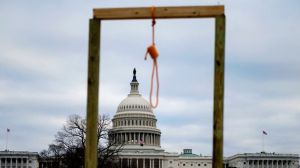
Pence, who presided over the certification of the electoral votes following the attack, has steadfastly defended his actions on Jan. 6, saying to do otherwise would have been unconstitutional. Trump’s former vice president was inside the Capitol during the attack and had to be evacuated from the Senate floor with his family as rioters stormed the complex. Many in the mob chanted “Hang Mike Pence!” on the misguided belief that Pence could have stopped Congress from certifying Biden’s victory….
The new White House website also repeats a claim made often by Trump and his allies — that Rep. Nancy Pelosi (D-California), who was speaker of the House at the time of the attack, is to blame for “security lapses” at the Capitol. Pelosi has vehemently rejected those accusations, saying again Tuesday that Trump resisted appeals to intervene in the attack for more than three hours.
“For over three hours we begged [Trump] to send the National Guard! He never did it. He took joy in not doing it. He was savoring it. … What he’s saying today is an insult to the American people,” Pelosi said at a Tuesday House event.
Taxpayers’ money paid for Trump lying website.
So much for the past. As usual, Historian Heather Cox Richardson’s commentary on our current situation at Letters from an American is very helpful:
“They say that when you win the presidency you lose the midterm,” President Donald J. Trump said today to House Republicans. “I wish you could explain to me what the hell is going on with the mind of the public because we have the right policy. They don’t. They have a horrible policy. They do stick together. They’re violent, they’re vicious, you know. They’re vicious people.”
“They had the worst policy. How we have to even run against these people—I won’t say cancel the election, they should cancel the election, because the fake news will say, ‘He wants the elections canceled. He’s a dictator.’ They always call me a dictator. Nobody is worse than Obama. And the people that surrounded Biden.”
And there you have it: in a rambling speech in which he jumped from topic to topic, danced, and appeared to mimic someone doing something either stupid or obscene, Trump explained the ideology behind his actions. He and MAGA Republicans have absorbed the last 40 years of Republican rhetoric to believe that Democratic policies are “horrible” and that only Republicans “have the right policy.” If that’s the case, why should Republicans even have to “run against these people?” Why even have elections? When voters choose Democrats, there’s something wrong with them, so why let them have a say? Their choice is bad by definition. Anything that they do, or have done, must be erased.
That is the ideology behind MAGA, amped up by the racism and sexism that identifies MAGA’s opponents as women, Black Americans, and people of color. In their telling, the world Americans constructed after World War II—and particularly after the 1965 Voting Rights Act protected Black and Brown voting—has destroyed the liberty of wealthy men to act without restraint. Free them, the logic goes, and they will Make America Great Again.

Trump with Peter Thiel
As tech entrepreneur Peter Thiel wrote in 2009: “I no longer believe that freedom and democracy are compatible.” He continued: “The 1920s were the last decade in American history during which one could be genuinely optimistic about politics. Since 1920, the vast increase in welfare beneficiaries and the extension of the franchise to women—two constituencies that are notoriously tough for libertarians—have rendered the notion of ‘capitalist democracy’ into an oxymoron.”
“Because there are no truly free places left in our world,” he wrote, Thiel called for escaping into cyberspace, outer space, or seasteading.
While tech leaders are focusing on escaping established governments, Trump’s solution to an expanded democracy appears to be to silence the voters and lawmakers who support the “liberal consensus”—the once-bipartisan idea that the government should enable individuals to reach their greatest potential by protecting them from corporate power, poverty, lack of access to modern infrastructure, and discrimination—and to erase the policies of that consensus.
On Trump’s version of January 6 history:
Nowhere does Trump’s conviction that he, and he alone, has the right to run the United States show more clearly than in the White House’s rewriting of the history of the January 6, 2021, attack on the U.S. Capitol. The insurrectionists who stormed the Capitol were Trump supporters determined to overthrow the free and fair election of Democrat Joe Biden by more than 7 million votes in 2020, replacing him with Trump by virtue of their belief that no Democrat could be fairly elected.
But the official White House website reversed that reality today, claiming that the insurrectionists who beat and wounded at least 140 police officers, smeared feces on the walls of the Capitol building, and called for the hanging of Vice President Mike Pence were “peaceful patriotic protesters.” The real villains, the White House wrote in bold type, were “the Democrats who staged the real insurrection by certifying a fraud-ridden election, ignoring widespread irregularities, and weaponizing federal agencies to hunt down dissenters.”
In reality, modern Republican policies have rarely served everyday people, while the policies enacted by Democratic president Joe Biden demonstrably did. Biden rejected the ideology that called for cutting taxes, regulations, and social services in the name of liberty. Instead, he urged Congress to invest in public infrastructure, creating jobs, and he shored up the social safety net.
Read the rest at the link.
Bill Kristol reacted to Richardson’s piece at The Bulwark: The Spirit of Fascism.
MAGA is a vulgar, cartoonish, cultish, and incoherent movement.
So, a century ago, was fascism.
And as today’s MAGA more openly and explicitly embraces the spirit of yesteryear’s fascism, it’s perhaps worth noting that it is the era of the rise of fascism to which MAGA looks back with nostalgia and yearning.
In her most recent newsletter, the historian Heather Cox Richardson reminds us of this 2009 statement by Peter Thiel, who as much as anyone could be considered the theorist of Trumpism as an intellectual movement.
“I no longer believe that freedom and democracy are compatible. The 1920s were the last decade in American history during which one could be genuinely optimistic about politics. Since 1920, the vast increase in welfare beneficiaries and the extension of the franchise to women . . . have rendered the notion of “capitalist democracy” into an oxymoron.”
The first sentence is a bit startling. But there is, to be fair, a long tradition of worrying about various tensions between freedom and democracy. Thiel, one could say, has simply adopted the radically pessimistic view that those tensions can no longer be managed or resolved.
Far more striking is the rest of Thiel’s statement, his yearning for the pre-welfare-state and pre-women’s-franchise 1920s, “the last decade during which one could be genuinely optimistic about politics.”
Thiel’s history is not striking just because it is wrong—the Nineteenth Amendment was ratified in the summer of 1920, making the general election that fall the first to feature the mass participation of women, though some states had granted women full suffrage even earlier.
It’s striking because we do now know, after all, what followed the decade of the 1920s: A 1930s that featured a worldwide Great Depression, and the rise of fascism—which, while unsuccessful in America, came closer here than we often remember, and was dominant overseas. All of that culminated in the horrors of World War II. The terrible events from 1929 to 1945 followed on—followed from—the economic and foreign policies of the decade for which Thiel is so nostalgic.
Kristol on Stephen Miller:
If Peter Thiel is a MAGA theoretician, Stephen Miller is MAGA’s chief propagandist. On Sunday, in the wake of Trump’s Venezuelan intervention, Miller posted:
“Not long after World War II the West dissolved its empires and colonies and began sending colossal sums of taxpayer-funded aid to these former territories (despite have [sic] already made them far wealthier and more successful). The West opened its borders, a kind of reverse colonization, providing welfare and thus remittances, while extending to these newcomers and their families not only the full franchise but preferential legal and financial treatment over the native citizenry. The neoliberal experiment, at its core, has been a long self-punishment of the places and peoples that built the modern world.”
So Britain and France should not have dissolved empires and colonies, but rather have fought to hold countries like, say, India and Vietnam? And the United States’ openness to immigrants from, say, India and Vietnam, has been an exercise in self-punishment?
Apparently so. On Monday, Miller extended his critique of the modern world, going on television to decry “This whole period that happened after World War II where the West began apologizing and groveling and begging.”
Miller is terrifying.
MILLER: The US is using its military to secure our interests unapologetically in our hemisphere. We're a superpower. It's absurd we'd allow a nation in our backyard to become a supplier of resources to our adversariesTAPPER: Sovereign countries shouldn't be able to do what they want?M: *yells*
— Aaron Rupar (@atrupar.com) 2026-01-05T23:32:50.945Z
Katie Rogers at The New York Times (gift link): Stephen Miller Offers a Strongman’s View of the World.
Stephen Miller has spent the bulk of his White House career furthering hard-right domestic policies that have resulted in mass deportations, family separations and the testing of the constitutional tenets that grant American citizenship.
Now, Mr. Miller, President Trump’s 40-year-old deputy chief of staff for policy and homeland security adviser, is casting his hard-right gaze further abroad: toward Venezuela and the Danish territory of Greenland, specifically.
Mr. Miller is doing so, the president’s advisers say, in service of advancing Mr. Trump’s foreign policy ambitions, which so far resemble imperialistic designs to exploit less powerful, resource-rich countries and territories the world over and use those resources for America’s gain. According to Mr. Miller, using brute force is not only on the table but also the Trump administration’s preferred way to conduct itself on the world stage.
“We live in a world in which you can talk all you want about international niceties and everything else, but we live in a world, in the real world, Jake, that is governed by strength, that is governed by force, that is governed by power,” Mr. Miller told Jake Tapper of CNN on Monday, during a combative appearance in which he was pressed on Mr. Trump’s long-held desire to control Greenland.
“These are the iron laws of the world since the beginning of time,” he said.
This aggressive posture toward Greenland — and in turn, the rest of the world — is a perfect encapsulation of the raw power that Mr. Trump wants to project, even against Denmark, the NATO ally that controls Greenland. The moment also illustrates how people like Mr. Miller have ascended to the inner circle of a leader who has no interest in having his impulses checked, and how they exert their influence once they arrive there.
The moment also shows just how differently Mr. Trump has operated in his second term from how he did in his first.
About midway through his first term, the president began joking with his aides about his desire to buy Greenland for its natural resources, like coal and uranium. At the time, his advisers humored him with offers to investigate the possibility of buying the semiautonomous territory. They did not think Mr. Trump was serious, or that it could ever actually happen. Those advisers are gone.
Flash forward to the second term. Mr. Miller has the president’s complete trust, a staff of over 40 people, and several big jobs that include protecting the homeland and securing territories further afield. A first-term joke made in passing about purchasing Greenland for its natural resources is now a term-two presidential threat to attack and annex the Danish territory by force if necessary, under the guise of protecting Americans from foreign incursions.
TAPPER: Can you rule out the US is going to take Greenland by force?MILLER: Greenland should be part of the US. By what right does Denmark assert control over Greenland? The US is the power of NATOT: So force is on the table?M: Nobody is gonna fight the US militarily over future of Greenland
— Aaron Rupar (@atrupar.com) 2026-01-05T23:26:13.910Z
One more from Jan-Werner Müller at The Guardian: The Trump doctrine exposes the US as a mafia state.
When a bleary-eyed Trump explained the kidnapping of Nicolás Maduro this past Saturday, he invoked the Monroe doctrine: while the US president sounded like he was reading about it for the first time, historians of course recognized the idea of Washington as a kind of guardian of the western hemisphere. Together with the national security strategy published in December, the move on Venezuela can be understood as advancing a vision for carving up the world into what the Nazi jurist Carl Schmitt called “great spaces”, with each effectively supervised by a great power (meaning, in today’s world, Washington, Moscow and Beijing). But more is happening than a return to such de facto imperialism: Trump’s promise to “run the country” for the sake of US oil companies signals the internationalization of one aspect of his regime – what has rightly been called the logic of the mafia state. That logic is even more obvious in his stated desire to grab Greenland.
The theory of the mafia state was first elaborated by the Hungarian sociologist Bálint Magyar in 2016. Such a state is less about corruption where envelopes change hands under the table. Instead, public procurement is rigged; large companies are brought under the control of regime-friendly oligarchs, who in turn acquire media to provide favorable coverage to the ruler. The beneficiaries are what Magyar calls the “extended political family” (which can include the ruler’s natural family). As with the mafia, unconditional loyalty is the price for being part of the system.
As so often with Trump 2.0, practices that other regimes try to veil have been unashamedly in the open: the “pausing” of the Foreign Corrupt Practices Act signaled that the US is not only open for business but also bribing (be it with a jet or a fake prize from Fifa); not only do pardons appear to be for sale; and not only can companies curry favor by financing a grotesque ballroom – but also the president’s political family, which includes billionaires like Steve Witkoff and Howard Lutnick, seems poised to profit handsomely, including from foreign deals, and now foreign military adventures: according to the investigative reporter Judd Legum, the Trump oligarch Paul Singer, owner of the oil company Citgo, is to set to do very well with a Trump-controlled government in Caracas.
This does not mean that the US’s “special military operation” in Venezuela is entirely a matter of “it’s the oil, stupid”; there is an argument that it helps push back against Iran, China and Russia (even if the precedent that killing 40 people and kidnapping sets also legitimizes interventions by other powers, as those lamenting the weakening of international law have rightly pointed out). There is also the old-style neoconservative justification for removing a tyrant from power, something that the former self of Marco Rubio, before bending the knee, would have favored – though leaving a decapitated regime in place has made talk of democracy and human rights protection a tad implausible. But the point is not regime change, as long as a regime is fine with Trumpian exploitation. The alternative is extortion: if the US oil companies get “total access”, the rulers of what is also a mafia state of sorts can stay in place; if not, it’s a bigger boss talking to a minor boss along the lines of: “Nice country you have there; pity if we had to do a full-scale invasion.”
Read the rest for an exploration of Trump’s Greenland obsession.
That’s it for me today. What’s on your mind?
Did you like this post? Please share it with your friends:
Posted: January 3, 2026 | Author: bostonboomer | Filed under: just because | Tags: attack on Venezuela, Donald Trump, Nicolas Maduro, U.S. is a rogue nation |
Good Afternoon!!

Fire at Fuerte Tiuna, Venezuela’s largest military complex, is seen from a distance after a series of explosions in Caracas on January 3, 2026.Getty images
I’m still in shock and still processing Trump’s latest shocking act. Overnight, he attacked Venezuela and kidnapped its elected president Nicolás Maduro. News and opinion stories are still breaking.
I really don’t know where to begin. So I’ll just start with this report from NPR:
U.S. hit Venezuela with ‘large-scale strike,’ captured Nicolás Maduro, Trump says.
President Trump claimed overnight that the United States carried out airstrikes in Venezuela and “captured” President Nicolás Maduro and his wife, following a series of explosions and fires reported around Caracas in the early hours of the morning.
In a post on Truth Social published early Saturday morning, Trump said the U.S. had “successfully carried out a large-scale strike against Venezuela and its leader, President Nicolas Maduro,” adding that Maduro and his wife had been “captured” and flown out of the country. Trump said the operation was conducted “in conjunction with U.S. Law Enforcement” and announced a news conference for 11 a.m. EST at Mar-a-Lago.
U.S. Attorney General Pam Bondi said in a post on X that Maduro and his wife, Cilia Flores, have been indicted in the Southern District of New York on drug, arms and conspiracy charges.
“They will soon face the full wrath of American justice on American soil in American courts,” she said.
The Justice Department unsealed a superseding indictment against Venezuela’s president and his wife, adding to previous indictments from 2020.
In an interview on Fox News, Trump said Maduro had tried to negotiate with the U.S. in the final days before his capture — a request Trump says he refused. “I didn’t want to negotiate,” Trump said. “I said, ‘Nope, we got to do it.'”
Trump described the strike as “unbelievable.”
“And to have a few injuries, but no death on our side, is really amazing,” he said.
“I think we had nobody killed, I have to say, because a couple of guys were hit, but they came back in. They’re supposed to be in pretty good shape.”
Trump added “we were prepared to do a second wave … but this was so lethal … but didn’t have to.”
The Venezuelan government swiftly accused the U.S. of launching what it called a “grave military aggression” against the country. In a statement posted on Telegram, the government said U.S. forces targeted civilian and military locations in Caracas as well as in the nearby states of Miranda, Aragua, and La Guaira, calling the attacks a “flagrant violation” of the United Nations Charter.
Read more Venezuelan reaction at the link.
The Guardian–along with many other news sites–is providing live updates. Here’s the latest, but they are updating frequently.
The US president has claimed at the press conference now under way in Florida that the United States is going to run Venezuela for the time being, although it’s unclear how that would be done.
“We’re going to run the country until such time as we can do a safe, proper and judicious transition,” Trump said. He has given no details.
He just called Maduro a dictator and a drug kingpin.
Trump said Maduro’s leadership was “both horrible and breathtaking”.
“We want peace, liberty and justice for the great people of Venezuela, and that includes many from Venezuela that are now living in the United States and want to go back to their country, it’s their homeland,” the US president said.
“We can’t take a chance that somebody else takes over Venezuela that doesn’t have the good of the Venezuelan people in mind [after] decades of that. We’re not going to let that happen.”
He continued: “We’re there now … We’re going to stay until such time as a proper transition can take place.”
He then added, about Venezuela’s vast oil reserves: “We’re going to have our very large US oil companies, the biggest anywhere in the world, go in, spend billions of dollars, fix the badly broken infrastructure, the oil infrastructure, and start making money for the country and we are ready to stage a second and much larger attack if we need to do so. So we were prepared to do a second wave.” Trump said the US military was prepared to make a second wave of attacks in the latest action overnight into Saturday but that was not needed.
The details of how or on what authority or with what kind of agreements, if any, that the US intends to “run” Venezuela in transition are unclear at this time.
The presidential press conference in Florida continues, with the chair of the joint chiefs talking about the operation itself overnight, and our live feed continues. But just as Trump was beginning the presser, the United Nations secretary general, António Guterres, had issued a statement via his spokesperson, so now seems a good time to bring that to our readers, via the Reuters news agency.
The secretary general is deeply alarmed by US military action in Venezuela, his spokesperson has said, and considered the US intervention “a dangerous precedent”.
A number of nations have called for an emergency meeting of the UN security council, in New York, today, as a result of the US’s unilateral action.
The UN spokesperson Stephane Dujarric said:
The secretary general continues to emphasize the importance of full respect – by all – of international law, including the UN charter. He’s deeply concerned that the rules of international law have not been respected.
The Guardian is going a good job of posting updates, so check back there–no paywall.
Moulton: "When we had briefings on Venezuela, we asked, 'Are you going to invade the country?' We were told no. 'Do you plan to put troops on the ground?' We were told no. 'Do you intend regime change in VZ?' We were told no. So in a sense, we have been briefed, we've just been completely lied to"
— Aaron Rupar (@atrupar.com) 2026-01-03T18:01:52.815Z
The latest from The New York Times:
We’ll obviously learn more throughout the weekend, but it seems clear that what Trump has done is illegal. The U.S. is acting as a rogue state. Here are some reactions:
The New York Times Editorial Board: Trump’s Attack on Venezuela Is Illegal and Unwise.
Over the past few months, President Trump has deployed an imposing military force in the Caribbean to threaten Venezuela. Until now, the president used that force — an aircraft carrier, at least seven other warships, scores of aircraft and 15,000 U.S. troops — for illegal attacks on small boats that he claimed were ferrying drugs. On Saturday, Mr. Trump dramatically escalated his campaign by capturing President Nicolás Maduro of Venezuela as part of what he called “a large scale strike” against the country.
Few people will feel any sympathy forMr. Maduro. He is undemocratic and repressive, and has destabilized the Western Hemisphere in recent years. The United Nations recently issued a report detailing more than a decade of killings, torture, sexual violence and arbitrary detention by henchmen against his political opponents. He stole Venezuela’s presidential election in 2024. He has fueled economic and political disruption throughout the region by instigating an exodus of nearly eight million migrants.
If there is an overriding lesson of American foreign affairs in the past century, however, it is that attempting to oust even the most deplorable regime can make matters worse. The United States spent 20 years failing to create a stable government in Afghanistan and replaced a dictatorship in Libya with a fractured state. The tragic consequences of the 2003 war in Iraq continue to beset America and the Middle East. Perhaps most relevant, the United States has sporadically destabilized Latin American countries, including Chile, Cuba, Guatemala and Nicaragua, by trying to oust a government through force.
Mr. Trump has not yet offered a coherent explanation for his actions in Venezuela. He is pushing our country toward an international crisis without valid reasons. If Mr. Trump wants to argue otherwise, the Constitution spells out what he must do: Go to Congress. Without congressional approval, his actions violate U.S. law.
The nominal rationale for the administration’s military adventurism is to destroy “narco-terrorists.” Governments throughout history have labeled the leaders of rival nations as terrorists, seeking to justify military incursions as policing operations. The claim is particularly ludicrous in this case, given that Venezuela is not a meaningful producer of fentanyl or the other drugs that have dominated the recent epidemic of overdoses in the United States, and the cocaine that it does produce flows mostly to Europe. While Mr. Trump has been attacking Venezuelan boats, he also pardoned Juan Orlando Hernández, who ran a sprawling drug operation when he was president of Honduras from 2014 to 2022.
A more plausible explanation for the attacks on Venezuela may instead be found in Mr. Trump’s recently released National Security Strategy. It claimed the right to dominate Latin America: “After years of neglect, the United States will reassert and enforce the Monroe Doctrine to restore American pre-eminence in the Western Hemisphere.” In what the document called the “Trump Corollary,” the administration vowed to redeploy forces from around the world to the region, stop traffickers on the high seas, use lethal force against migrants and drug runners and potentially base more U.S. troops around the region.
Venezuela has apparently become the first country subject to this latter-day imperialism, and it represents a dangerous and illegal approach to America’s place in the world. By proceeding without any semblance of international legitimacy, valid legal authority or domestic endorsement, Mr. Trump risks providing justification for authoritarians in China, Russia and elsewhere who want to dominate their own neighbors. More immediately, he threatens to replicate the American hubris that led to the invasion of Iraq in 2003.
Moulton: "The parallels with Iraq are unmistakeable. Bush said there was WMD in Iraq. Turns out that was a lie. Trump just made up fentanyl being WMD, which doesn't even come from Venezuela, just to justify this war. We said this wasn't about regime change, but it is."
— Aaron Rupar (@atrupar.com) 2026-01-03T18:05:18.892Z
Jennifer Rubin at The Contrarian: Updated: Headfirst Into War.
Americans probably still can be shocked and horrified. An undeclared, unprovoked, and illegal war designed to, well, we can only guess—though Donald Trump and JD Vance have seemed to concede this was a war for oil—puts the United States on the same moral and legal footing as Russia, which invaded its neighbor in a war of pure aggression. The U.S. president this weekend attacked a sovereign nation, killed its citizens, and kidnapped its leader.
Rep, Jim Himes, ranking Democrat on the Intelligence Committee, said in a statement:
Maduro is an illegitimate ruler, but I have seen no evidence that his presidency poses a threat that would justify military action without Congressional authorization, nor have I heard a strategy for the day after and how we will prevent Venezuela from descending into chaos. Secretary Rubio repeatedly denied to Congress that the Administration intended to force regime change in Venezuela. The Administration must immediately brief Congress on its plan to ensure stability in the region and its legal justification for this decision.
Sen. Andy Kim (D-N.J.) aptly explained the constitutional outrage. “Trump rejected our Constitutionally required approval process for armed conflict because the Administration knows the American people overwhelmingly reject risks pulling our nation into another war,” he declared on social media. “This will further damage our reputation—already hurt by Trump’s policies around the world—and only isolate us in a time when we need our friends and allies more than ever.” Indeed, Mexico already denounced the action. Others are sure to follow.
Any and all regime officials who insisted in congressional briefings that the boat strikes were about drugs, not regime change, lied to Congress as Kim and others have pointed out, and participated in a wholly unconstitutional war. Even Susie Wiles condeded in a recent Vanity Fair article that attacking the mainland would require congressional assent. So much for that.
The U.S. attorney general declared that the United States had indicted Venezuelan President Nicolás Maduro and his wife, Cilia Flores, on narcotics charges and will be tried in federal court. That outlandish proposition opens the seizure to scrutiny and raises the interesting possibility that Trump claims he enjoys immunity but not other heads of state.
Sen. Ruben Gallego (D-Ariz.), an Iraq War veteran, posted a sobering warning: “I fought in some of the hardest battles of the Iraq War. Saw my brothers die, saw civilians being caught in the crossfire all for an unjustified war. No matter the outcome we are in the wrong for starting this war in Venezuela.” He added, “Second unjustified war in my life time. This war is illegal, it’s embarrassing that we went from the world cop to the world bully in less than one year. There is no reason for us to be at war with Venezuela.”
It is hard not to conclude that the action is a “wag the dog moment” aimed at distracting the public from the Epstein files, the rotten economy, and Trump’s declining health. It very well could supercharge Trump’s lawless and violent domestic policies against migrants, civil society groups, and others on grounds that they are authorized by wartime powers. His rickety tower of constitutional rubbish will continue to build.
This is so unbelievable that I just don’t know how to deal with it.
Trump: "We're going to have our very large United States oil companies go in, spend billions of dollars, fix the badly broken infrastructure and start making money for the country. And we are ready to stage a second and much larger attack if we need to do so."
— Aaron Rupar (@atrupar.com) 2026-01-03T16:49:24.092Z
Axios: World leaders denounce U.S. operation to capture Maduro.
Countries including Brazil, Colombia, Mexico, Russia and Iran condemned the
Trump administration’s intervention in
Venezuela on Saturday after the U.S. “captured” President Nicolás Maduro and his wife and flew them out of the country.
The big picture: The attacks overnight in Caracas follow months of pressure from the Trump administration, including a $50 million bounty on Maduro for alleged narco-terrorism, strikes on alleged drug boats and the seizures of tankers carrying Venezuelan oil.
What they’re saying: Brazilian President Luiz Inácio Lula da Silva
wrote on X: “Bombings on Venezuelan territory and the capture of its president cross an unacceptable line.”
- “These acts represent a most serious affront to Venezuela’s sovereignty and yet another extremely dangerous precedent for the entire international community,” Lula wrote, according to a translation.
- “Attacking countries, in flagrant violation of international law, is the first step toward a world of violence, chaos, and instability, where the law of the strongest prevails over multilateralism.”
Zoom out: “Latin America and the Caribbean is a zone of peace, built on the basis of mutual respect, the peaceful settlement of disputes and the prohibition of the use and threat of force, so any military action seriously jeopardizes regional stability,” Mexico’s Ministry of Foreign Affairs said in a news release translated from Spanish to English.
- Colombian President Gustavo Petro shared on X what he described as “deep concern” about the reports of explosions. He said Colombia “reiterates its conviction that peace, respect for international law, and the protection of life and human dignity must prevail over any form of armed confrontation.”
- Russia’s Foreign Minister accused the U.S. of “an act of armed aggression against Venezuela,” while Iran called the attack a “flagrant violation” of Venezuelan sovereignty.
China’s foreign ministry said it was “deeply shocked” and condemned the US intervention as a “blatant use of force.”
Trump: "We're going to have our very large United States oil companies go in, spend billions of dollars, fix the badly broken infrastructure and start making money for the country. And we are ready to stage a second and much larger attack if we need to do so."
— Aaron Rupar (@atrupar.com) 2026-01-03T16:49:24.092Z
Geraldine McKelvey at The Guardian: Explainer: Is there any legal justification for the US attack on Venezuela?
Donald Trump said on Saturday morning that troops had carried out a “large-scale strike” on Venezuela and captured its president, Nicolas Maduro, and his wife, Cilia Flores. The couple has now been indicted in New York on terrorism and drugs charges. Trump has accused Maduro of running a “narco terrorist organisation”.
However, the legality of the operation has been called into question – with even some of Trump’s allies suggesting it violated international law.
The Guardian spoke to leading experts in the field of international law to ask for their view on the unfolding events in Venezuela.
Is the US operation in Venezuela justified under international law?
The experts the Guardian spoke to agreed that the US is likely to have violated the terms of the UN charter, which was signed in October 1945 and designed to prevent another conflict on the scale of the second world war. A central provision of this agreement – known as article 2(4) – rules that states must refrain from using military force against other countries and must respect their sovereignty.
Geoffrey Robertson KC, a founding head of Doughty Street Chambers and a former president of the UN war crimes court in Sierra Leone, said the attack on Venezuela was contrary to article 2(4) of the charter. “The reality is that America is in breach of the United Nations charter,” he added. “It has committed the crime of aggression, which the court at Nuremberg described as the supreme crime, it’s the worst crime of all.”
Elvira Dominguez Redondo, a professor of international law at Kingston university, described the operation as a “crime of aggression and unlawful use of force against another country”. Susan Breau, a professor of international law and a senior associate research fellow at the Institute of Advanced Legal Studies agreed that the attack could have only been considered lawful if the US had a resolution from the UN security council or was acting in self-defence. “There is just no evidence whatsoever on either of those fronts,” Breau said.
How is the US likely to defend its actions?
The US may try to argue that it attacked Venezuela in self-defence, to counter the alleged threat from the “narco terrorist organisation” it accuses Maduro of leading. Both the UN charter and its own domestic laws make some provision for the use of military force in self-defence.
However, Robertson said: “There is no conceivable way America can claim, although no doubt it will, that the action was taken in self-defence. If you are going to use self-defence you have to have a real and honest belief that you are about to be attacked by force. No one has suggested that the Venezuelan army is about to attack the United States … The idea that [Maduro] is some sort of drug supremo cannot prevail against the rule that invasion for the sake of regime change is unlawful.”
“You would have to prove those drug traffickers were threatening the sovereignty of the United States,” Breau added. “The United States is going to argue vigorously that drug trafficking is a scourge and it’s killing many people, and I agree. But a lot of international law experts have been looking at this and there wasn’t even clear evidence that those drug traffickers were from Venezuela, let alone that they were governed by Maduro in any sense.”
What sanctions could the US face for its actions?
The UN security council can impose sanctions on countries in an attempt to maintain peace. These can include trade restrictions, arms embargos and travel bans. However, five members of the council – the US, China, Russia, the UK and France – have a veto on this, meaning any action taken against the US is unlikely to come into force.
“Sanctions have to be imposed by the security council and America is a member with a veto,” Robertson said. “This is important, because it shows the security council is a worthless body. A country which breaks international law can avoid condemnation simply by vetoing it … the only body that can act will be eviscerated by the American veto.”
Dominguez Redondo described the situation as “impossible”. “If the security council cannot decide on sanctions, the countries can choose whether or not to follow them,” she said. “Because the US has veto power, the sanctions are never going to be decided there.”
I’m going to end here, because keeping up with what’s happening is completely unmanageable. Trump has really gotten us into the shit now. Once again, we are a rogue country ruled by an insane, demented monster.
Please post updates in the comment thread if you can. Take care everyone.
Did you like this post? Please share it with your friends:
Posted: December 31, 2025 | Author: bostonboomer | Filed under: just because | Tags: CIA strike in Venezuela, Donald Trump, ICE as Trump secret police, Kennedy Center, Marijuana, New Year's Eve 2025, Trump crushing dissent, U.S. Constitution, Venezuela boat strikes |
 Good Day!!
The endless “holiday season” will be over soon, and it will be 2026. Nothing will have changed. We’re still stuck with Trump and he is still a psychopathic malignant narcissist with dementia. Here are the stories leading the news on this final day of 2025.
Trump and Venezuela
Trump blabbed about a secret CIA strike inside Venezuela. He just can’t keep his mouth shut.
The Independent: CIA carries out first drone strike on Venezuelan soil in latest escalation of Trump admin’s attacks on ‘narco terrorists.’
The CIA reportedly carried out a drone strike earlier this month on a dock in Venezuela that the United States has alleged is a port for trafficking drugs, marking a major escalation of the Trump administration’s military actions in the Caribbean.
The U.S. government believed the site was used by members of Venezuelan gang Tren de Aragua to store and ship drugs overseas, according to CNN.
No one was present at the port at the time of the strike, according to the network’s source. Still, the operation allegedly destroyed the facility, even if it represented just one of many such docks along Venezuela’s coastline that might be used by smugglers. The strike is the first known U.S. operation inside the country.
President Donald Trump appeared to acknowledge the operation during an interview Friday, saying U.S. military assets struck a “big facility where ships come from.”
Asked again on Monday, the president said American forces had attacked “the dock area where they load the boats up with drugs.”
“So we hit all the boats, and now we hit the area,” the president added. “It’s the implementation area, that’s where they implement, and that is no longer around.” [….]
The episode marks the latest escalation of tensions between the United States and Nicolas Maduro’s regime after the Coast Guard seized a second sanctioned oil tanker last week and pursued a third, following months of deadly strikes on alleged drug boats in the Caribbean and eastern Pacific that have killed more than 100 people.
Read more at the link.
Analysis by Stephen Collinson at CNN: CIA strike brings Trump closer to grave new year decisions on Venezuela.
President Donald Trump has thrust the country into a significant new phase in his showdown with Venezuela with a CIA strike on a port facility.
But as he approaches grave new decisions on even greater escalations, his team has not yet spelled out a clear consistent public rationale for its actions.
Nor has it prepared the country for what might come next.
Top officials haven’t explained how long the massive naval buildup in the Caribbean will last or what US service members will be asked to do in an operation that is already raising legal and constitutional alarms.
Neither Trump nor his top foreign policy aides have sketched a preferred endgame for the confrontation, which has climbed a ladder of escalation: from diplomatic pressure to strikes against alleged drug-trafficking boatsin the Caribbean to a blockade against oil tankers to, now, a land attack.
If the goal really is to overthrow President Nicolás Maduro, as recent comments from top officials and the logic of the deployment imply, there’s been no White House effort to show Americans the administration is planning for the aftermath. This is an especially relevant point given the quagmires that developed after US military action to topple the rulers of Iraq, Afghanistan and Libya.
Trump doesn’t recognize any responsibility to inform the American people of is plans, if there are any. He sees himself as a dictator.
A bit more from Collinson:
Rep. Adam Smith, the top Democrat on the House Armed Services Committee, told CNN’s Brianna Keilar Tuesday that the CIA attack was a significant sharpening of US pressure and raised a knot of thorny questions.
“Where it goes from here, I think, is the thing to be concerned about, because Trump clearly wants to drive Maduro from power,” Smith said, arguing that boat strikes and other means of duress didn’t seem like they would have the intended effect. If they don’t, Smith continued, “What is Trump prepared to do next? How far is he willing to take this effort at regime change in Venezuela?”
Perhaps Trump’s fogginess is deliberate. If the buildup and steady escalations are part of a psychological operations campaign to wrong-foot Maduro or to persuade his regime cronies they’d be safer without him, confusion and disorientation could act as weapons. Even from the outside, it’s obvious the CIA strike on the port facility — in which, sources said, no one was killed — is a performative warning that far greater US capabilities can be brought to bear.
Yet the more serious the situation gets — especially now the US has crossed the threshold into land attacks — the more acute is the obligation to inform Americans of the administration’s plans. The founders never envisaged presidents being able to wage war on a whim. And large and intractable conflicts have sometimes started with discrete actions that mushroom into consequences that can cascade out of control. Take Vietnam as an example.
Read the rest at CNN.
One more on Trump’s illegal Venezuela operations from The New York Times (gift link): Grim Evidence of Trump’s Airstrikes Washes Ashore on a Colombian Peninsula.
A thunderous boom rang out through the windless late-afternoon air. Seconds later, smoke began rising out of the sea as if the horizon were on fire.
Watching from the shore on Nov. 6, Erika Palacio Fernández whipped out her phone, she said, unwittingly recording the only verified and independent video known to date of the aftermath of an airstrike in the Trump administration’s campaign against what it calls “narco-terrorists.”
Two days later, on that same shore, a scorched 30-foot-long boat itself would wash up. Then, two mangled bodies. Then charred jerrycans, life jackets and dozens of packets that were observed by The New York Times and were similar to others that have been found after anti-narcotics operations in the region. Most packets were empty, though traces of a substance that looked and smelled like marijuana were found in the lining of a few.
The assortment of singed flotsam appears to be the first physical evidence of the U.S. campaign, which has destroyed 30 vessels and killed more than 100 people in the Caribbean and eastern Pacific. Every other struck boat is presumed to have sunk along with its crew and cargo. The U.S. military has offered no evidence that the boats it has destroyed were transporting illicit substances or belong to criminal networks.
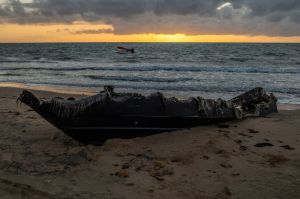
Remains of a burned boat on the beach near Puerto López on the Guajira Peninsula in Colombia.
A Times analysis matched the wreckage of the boat to the one in a video posted by Defense Secretary Pete Hegseth on the night of Nov. 6, hours after Ms. Palacio took her video. Mr. Hegseth described the strike as having targeted a vessel in the Caribbean operated by an unnamed “designated terrorist organization.” He said the strike killed three people and took place in international waters.
The Times analysis of Ms. Palacio’s video indicates the strike took place in the Gulf of Venezuela, where Colombia and Venezuela have long disputed their maritime boundary. The analysis could not determine the exact location of the strike.
The shape of the wreckage, a slender design typical of speedboats, matches that of the boat targeted in the video shared by the Defense Department, the Times analysis found, and shows damage to the boat’s hull and interior structure consistent with the impact of an airstrike. The military video shows the boat exploding and on fire beneath a large plume of smoke.
That such rare, tangible evidence is coming to light nearly two months after the early November strike is a testament both to the remoteness of the Guajira Peninsula, where the wreckage was found, and the lack of a sizable presence of the Colombian state in the area. The region is governed semiautonomously by an Indigenous community, the Wayuu, whose more than half a million people straddle the border between Colombia and Venezuela.
So Trump and Hegseth are blowing up boats carrying Marijuana–a substance that is legal in 24 states and more for medical use.
Trump’s takeover of the Kennedy Center
The Independent: More events planned for the Kennedy Center are canceled in protest of Trump adding his name to the building.
More artists have announced they are backing out of upcoming dates at the Kennedy Center in Washington, D.C., in protest of President Donald Trump’s takeover, and recent potentially illegal renaming of the institution as the Trump-Kennedy Center.
Jazz supergroup The Cookers announced on its website it will not be performing across a series of two New Year’s Eve concerts.
“Jazz was born from struggle and from a relentless insistence on freedom: freedom of thought, of expression, and of the full human voice,” the group wrote in a statement. “Some of us have been making this music for many decades, and that history still shapes us.”
“I would never even consider performing in a venue bearing a name (and being controlled by the kind of board) that represents overt racism and deliberate destruction of African American music and culture,” Billy Harper, a saxophonist in the group, reportedly added in a statement to Jazz Stage.
The Doug Varone and Dancers troupe on Monday added that it will not carry out a planned April performance at the center.
The group wrote in a statement on Instagram that while it opposed the president’s decision to replace the center’s bipartisan board in February with a group of allies who later installed him as chairman, it initially still planned to carry out the engagement. That changed when center’s board voted earlier this month to rebrand the institution the Trump-Kennedy Center, according to the statement.
“We can no longer permit ourselves nor ask our audiences to step inside this once great institution,” the statement said. “The Kennedy Center was named in honor of our 35th President who fervently believed that the arts were the beating heart of our nation, as well as an integral part of international diplomacy. We hope in three-year’s time, that the Center and its reputation will return to that glory.” [….]
The wave of cancellations follows the news that drummer and vibraphonist Chuck Redd canceled a longstanding Christmas Eve jazz concert at the center in protest of the name change.
The Washington Post: Kennedy Center changed board rules months before vote to add Trump’s name.
The Kennedy Center adopted bylaws earlier this year that limited voting to presidentially appointed trustees, a move that preceded a unanimous decision this month by board members installed by President Donald Trump to add his name to the center.
The current bylaws, obtained by The Washington Post, were revised in May to specify that board members designated by Congress — known as ex officio members — could not vote or count toward a quorum. Legal experts say the move may conflict with the institution’s charter.
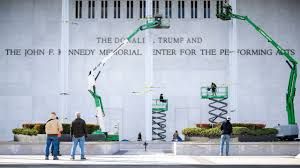 Trump took over the Kennedy Center in February, purging its board of members he had not appointed. The months that followed saw struggling ticket sales and programming changes that began to align the arts complex with the Trump administration’s broader cultural aims, culminating with the annual Kennedy Center Honors hosted by the president.
Days later, on Dec. 18, the board voted to add the president’s name to the institution, and within 24 hours it was on the website and the building itself: “The Donald J. Trump and The John F. Kennedy Memorial Center for the Performing Arts.” [….]
The Kennedy Center lists 34 presidentially appointed board members, including Trump himself as chair, and 23 ex officio seats. The center’s president, Richard Grenell, is also an officer of the board.
The federal law that established the Kennedy Center designates specific government and federal positions — including the librarian of Congress; the mayor of Washington, D.C.; the secretary of the Smithsonian Institution; and the majority and minority leaders of the Senate — to serve as ex officio members.
The law identifies them as part of the board of trustees, which it directs to maintain and administer the facility as a living memorial. But it does not distinguish between voting and nonvoting members, which has been a point of ambiguity in the days following the vote to rename the Kennedy Center….
A former Kennedy Center staffer with knowledge of board proceedings, who spoke on the condition of anonymity out of fear of retribution, told The Post that ex officio members were “always included in debate and discussion” during their tenure, but the person did not recall a time when those members’ votes were counted.
“Theoretically they could vote, but our practice was not to have them vote or count toward quorum,” the person said, noting they were not aware of the new leadership’s practices at the center.
Trump’s secret police force
The Washington Post (gift link): ICE plans $100 million ‘wartime recruitment’ push targeting gun shows, military fans for hires.
U.S. Immigration and Customs Enforcement officials are planning to spend $100 million over a one-year period to recruit gun-rights supporters and military enthusiasts through online influencers and a geo-targeted advertising campaign, part of what the agency called a “wartime recruitment” strategy it said was critical to hiring thousands of new deportation officers nationwide, according to an internal document reviewed by The Washington Post.
The spending would help President Donald Trump’s mass-deportation agenda dominate media networks and recruitment channels, including through ads targeting people who have attended UFC fights, listened to patriotic podcasts or shown an interest in guns and tactical gear, according to a 30-page document distributed among officials in this summer detailing ICE’s “surge hiring marketing strategy.”

Uncle Sam looms large on ICE’s recruitment site.
The Department of Homeland Security has spoken publicly about its fast-tracked effort to significantly increase ICE’s workforce by hiring more than 10,000 new employees, a surge promoted on social media with calls for recruits willing to perform their “sacred duty” and “defend the homeland” by repelling “foreign invaders.” The agency currently employs more than 20,000 people, according to ICE’s website.
But the document, reported here for the first time, reveals new details about the vast scale of the recruitment effort and its unconventional strategy to “flood the market” with millions of dollars in spending for Snapchat ads, influencers and live streamers on Rumble, a video platform popular with conservatives. Under the strategy, ICE would also use an ad-industry technique known as “geofencing” to send ads to the phone web browsers and social media feeds of anyone who set foot near military bases, NASCAR races, college campuses or gun and trade shows.
The document was also distributed among ICE officials in the days after the agency published a request for bids seeking contractors who could use “precise audience targeting, performance media management, and results-driven creative strategies” to “accelerate the achievement of [its] recruiting goals.” The language in the published bid closely mirrored language in the strategy document. That same month, DHS awarded two marketing firms nearly $40 million to support ICE’s public affairs office “recruitment campaign,” according to federal awards data.
It’s unclear how much of the spending and strategy have been carried out. But the plans outlined in the document have coincided with a rush of recruitment ads online seeking Americans who will “answer the call to serve.”
The rapid-recruitment approach is unlike anything ICE has ever pursued, said Sarah Saldaña, a director of ICE during the Obama administration, who recalled the agency filling its open positions through local police departments and sheriff’s offices with appeals to officers’ interests in federal public-safety work.
Use the gift link to read the rest.
Trump wants to cancel the Constitution
Heather Cox Richardson at Letters from an American: December 30, 2025
The hallmark of the first year of President Donald J. Trump’s second term has been the attempt of the president and his cronies to dismantle the constitutional system set up by the framers of that document when they established the United States of America. It’s not simply that they have broken the laws. They have acted as if the laws, and the Constitution that underpins them, don’t exist.
As soon as the 2024 election results were clear, billionaire Elon Musk, who had supported Trump’s campaign both through his purchase of Twitter—now X—and with $290 million in cash, posted on social media: “Novus Ordo Seclorum,” Latin for “New World Order.” Although he won with less than 50% of the vote, Trump announced that he had an “unprecedented and powerful mandate.” Musk would head a new “Department of Government Efficiency” that Musk vowed would cut at least $2 trillion from the federal budget.
Musk and his operatives muscled their way into government offices and gained access to computer systems. With strokes of a keyboard they eliminated jobs and programs, including, as Musk put it, feeding “into the wood chipper” most of the U.S. Agency for International Development, the government agency aimed at combating disease and malnutrition around the globe. That dismantling has caused the deaths of hundreds of thousands of people.
The Cato Institute, a libertarian think tank, recently concluded that while the Department of Government Efficiency did not actually reduce spending, it did cut almost 10% of federal employees, a key goal of Office of Management and Budget director Russell Vought, a key author of Project 2025.
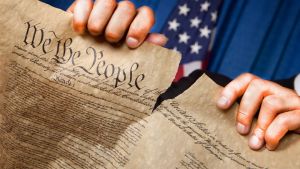 And, crucially, it put operatives in virtually all government departments and agencies, where they gained access to privileged information about Americans, including citizens, legal residents, and undocumented immigrants.
Musk and DOGE also established the idea that the unelected officials in the Trump administration could do whatever they wished, without regard to the laws or the Constitution. The Constitution, judicial precedent, and the 1974 Impoundment Control Act all make it very clear that the power of the purse belongs to Congress. As the elected representatives of the American people, only members of the House of Representatives and the Senate can determine how the nation’s money is spent. Then the president must “take Care that the laws be faithfully executed.”
Democrats objected to the administration’s dramatic usurpation of the power of Congress, but Republicans did not complain. Most backed the administration’s claims it was eliminating “waste, fraud, and abuse.”
Although Republicans controlled both chambers of Congress, meaning that Trump should have been able to get any legislation he wanted, he continued to try to get around the Constitution by declaring nine “emergencies” that would permit him to act without congressional oversight. This reliance on emergencies reflected the ideas of Nazi political theorist Carl Schmitt, whose writings were followed by right-wing leaders, including billionaire Peter Thiel and the man who influenced him, Curtis Yarvin. Schmitt argued that power belongs to the leader who can exploit emergencies that create exceptions to the constitutional order, enabling him to exercise power without regard to the law.
Click the link to read the rest.
Nora Benavidez at The New York Times (gift link): I Counted Trump’s Censorship Attempts. Here’s What I Found.
“We took the freedom of speech away.”
That was part of President Trump’s explanation in October of his executive order that purports to criminalize burning the American flag. Though his words fail as a constitutional rationale, they inadvertently distill many of his efforts at smothering dissent during the past 11 months.
Since returning to office, Mr. Trump and his administration have tried to undermine the First Amendment, suppress information that he and his supporters don’t like and hamstring parts of the academic, legal and private sectors through lawsuits and coercion — to flood the zone, as his ally, Steve Bannon, might say.
Some examples are well known, such as when ABC briefly took Jimmy Kimmel off the air after Brendan Carr, the chairman of the Federal Communications Commission, objected to a reference in one of Mr. Kimmel’s monologues about the killing of Charlie Kirk. Other examples received less attention, but by my count, this year there were about 200 instances of administration attempts at censorship, nearly all of which I outline in a new report.
Mr. Trump’s playbook isn’t random. It employs several recurring modes of attack.
The president has tried to cow the press. His administration banned Associated Press reporters from certain parts of the White House and Air Force One because the outlet uses “Gulf of Mexico” rather than the term Mr. Trump prefers, “Gulf of America.” It tried and failed to force some of the nation’s biggest news organizations to agree to restrictions on coverage of the Pentagon. He has said critical coverage of his initiatives is “really illegal.”
A journalist from El Salvador, Mario Guevara, was arrested while reporting on a No Kings protest in Georgia; he was detained for more than three months, then deported. At an Oval Office meeting between Mr. Trump and Crown Prince Mohammed bin Salman of Saudi Arabia, an ABC News correspondent, Mary Bruce, asked about the killing of the Saudi journalist Jamal Khashoggi and about the Jeffrey Epstein files. Mr. Trump replied by berating her at length, at one point describing one of her questions as “insubordinate” — a characterization that upends the entire notion of a free press.
The administration has used immigration status to try to suppress political speech. In March, Mahmoud Khalil, a green card holder and a leader of pro-Palestinian demonstrations on the Columbia campus, was arrested and detained by immigration officials for several months. That month, Rumeysa Ozturk, a student visa holder, was arrested by immigration officials and detained for several weeks, apparently because she was an author of an opinion essay criticizing Tufts University for its response to the Israel-Hamas war.
It seems almost no one is beyond the scope of administration efforts to muzzle views or decisions that conflict with Mr. Trump’s agenda: After Federal District Court Judge James Boasberg ruled against the administration in a case involving the deportation of Venezuelans to El Salvador, Mr. Trump called for the judge to be impeached. A trainee was dismissed from the F.B.I.’s academy, apparently for having displayed an L.G.B.T.Q. Pride flag. The F.B.I. also appears to have fired agents for kneeling during George Floyd protests.
Use the gift link to read the rest.
Those are my recommended reads for today. I still can’t see very well, so please forgive any mistakes. Take care everyone!
Did you like this post? Please share it with your friends:
Posted: December 27, 2025 | Author: bostonboomer | Filed under: just because | Tags: 1%, 2, 3, 4, 5, Donald Trump, Kennedy Center, marble armrests, Ron Filipkowski, Russia, strikes on Nigeria, Top 25 Trump administration villains, Trump class battleships, U.S. Economy, Ukraine |
Good Afternoon!!

By Hiroki Takeda
I’m having some serious eye problems that I’m being treated for. I can’t see that well on the computer, but I’m going to do my best to post a few stories along with some lovely watercolor cat art.
Yesterday, Ron Filipkowski of Meidas+ posted a list of his choices for the 25 worst villains of the Trump administration. It drew quite a bit of attention on social media. Here are the top 5:
#5. TODD BLANCHE. Most of the worst abuses in multiple areas by DOJ are orchestrated by Blanche. While Bondi and Patel have gotten most of the public blame and scrutiny, Blanche is the architect of it all. Blanche was Trump’s criminal defense lawyer before he became president, and has acted as his criminal defense lawyer while running DOJ. He met privately with Ghislaine Maxwell in prison, then had her moved to a minimum security Club Fed. He has repeated lies about the contents of the Epstein files and is the point person for covering them up with delays and redactions. He ended investigations and dropped charges against some of America’s worst criminals for political reasons. While Bondi and Patel are bad, Blanche is even worse.
#4. RUSS VOUGHT. The man who orchestrated the comprehensive right-wing policy blueprint for this admin called ‘Project 2025’, this zealot keeps a lower profile than others – preferring tangible results with ruthless efficiency behind the scenes as OMB Director. Vought is the brains behind Stephen Miller’s evil bombast, organizing the policy agenda that controls the administration. During the 4 years Trump was out of office, Vought organized and drafted 350 different executive orders and regulations to implement if Trump got a second term – most of the ones he issued came from Vought – including the plan to invoke emergency powers and national security to justify bypassing Congress in a variety of areas. In fact, most of the agenda Vought devised was specifically intended to find ways an authoritarian-minded president could implements things while ignoring Congress, or reversing legislative acts by executive order.
#3. PETE HEGSETH. Chaos ensuedalmost immediately after the drunken fool former Fox host took over an office that he was unfit and unqualified for. He divulged war plans and classified info in a Signal chat which included a reporter, but then tried to cover himself by claiming he declassified it. He fired his own senior advisors because of his paranoia over press leaks, then ousted the Pentagon press corps with onerous rules that abused their first amendment rights. He gleefully released videos of nearly 100 people on boats he has murdered, without providing any evidence of their guilt or due process. He alienated allies with an insane speech in Europe that resulted in the admin sidelining him from giving any more. He ousted seasoned career officers and made it clear he has no use for women serving in the military in any role other than support positions, or for rules of engagement designed to minimize collateral damage and civilian casualties. He summoned hundred of Generals and Admirals from their commands around the world to DC so he could give them a deranged speech they found utterly ridiculous and juvenile. He constantly gives partisan political speeches to active-duty troops in violation of laws and regulations, which he mixes with a healthy dose of christian nationalism. It is hard to imagine how Trump could have found a worse person for one of the most important jobs on the planet.

Cat’s Promenade Yuliya Podlinnova
#2. HOWARD LUTNICK. The architect of so many corrupt, shady and misguided policies of the Trump admin while serving as Commerce Secretary – including tariffs and selling citizenship in the form of ‘Trump Gold Cards’. Lutnick is a shameless habitual liar and flip-flam huckster, constantly hyping his policies with fantastical claims while moving the goalposts weekly on his predictions. In a different century he’d be selling miracle cures out of tent at a carnival. In this century, he’s a billionaire. Lutnick is the prime mover behind the admin’s embrace of data centers, AI, and Stalinist moves like the government ownership of companies. Even Trump has grumbled behind the scenes to aides that Lutnick is a “manipulator”, but despite that he continues to adopt each of his worst ideas. Trump constantly had to reverse himself on catastrophic tariff announcements after disastrous consequences ensued – which resulted in the moniker ‘TACO’ for caving so much. All of those disastrous announcements came directly from Lutnick, with Bessent, Musk and others seeking reversal from Trump.
Note – I fully realize Bessent should probably be in this Top 25 somewhere, but I left him off simply because there is a lot of reporting that he has reversed some of the worst ideas behind the scenes despite his repugnant public persona. Go ahead and yell at me if you want – I personally can’t stand the guy either. But I have read comments from a lot of people I respect who say that without Bessent pushing back on some things behind the scenes we would be far worse off economically than we already are because everyone else is much worse. I guess I will buy that he might be the voice of reason behind the scenes, but time will tell.
#1. STEPHEN MILLER. This was the easiest selection, and there was probably never any doubt from most of you that he would be first. He is the WH policy director who is really running the US govt while Trump plays golf, receives awards, puts gold of everything, trolls social media, and builds his ballroom. Most of the policies aren’t Miller’s original ideas because he really isn’t that smart, but he knows how to implement them with a ruthlessness not seen since 1930s Germany. He has made the 2nd most TV appearances this year after Homan, much to the chagrin of Republicans running for election in swing districts. We know all the things that make Miller the worst person to ever serve in a senior position in US history, so there is no point in cataloguing them or this column would go on forever. The hate, the racism and bigotry, the phobias – he’s the personification of political evil. Trump is the only person who would even consider putting this twisted misfit in a position of authority. But he has, and as dementia takes hold and the old man plays with this trophies, ballrooms and golden baubles, Stephen Miller is running the country. Trump is President In Name Only.
God help us.
Check out the rest at the Meidas+ Substack.
Filipkowski’s next project: “Tomorrow, I will begin my list of the ‘500 Worst Things Trump Did in 2025’, with my first 100 in chronological order beginning with things he did in January 2025 and continuing to present.”
Some News:
Ukraine President Volodymyr Zelenskyy plans to meet with Trump today at Mar-a-Lago. Russia responded by attacking Ukraine. AP: Russia attacks Kyiv with missiles and drones, killing 1 and wounding many ahead of Ukraine-US talks.
KYIV, Ukraine (AP) — Russia attacked Ukraine’s capital with missiles and drones early Saturday morning, killing one person and wounding 27, a day before talks between Ukraine and the U.S., authorities said.

Porter and Sully, by Dora Hathazi Mendes
Explosions boomed across Kyiv for hours as ballistic missiles and drones hit the city. The attack began in the early morning hours Saturday and was continuing as day broke.
Ukrainian President Volodymyr Zelenskyy prepared to meet with U.S. President Donald Trump in Florida on Sunday for further talks on ending the nearly 4-year-old war. Zelenskyy told reporters he was on a plane en route to Florida on Saturday afternoon, and would stop in Canada on the way to meet Prime Minister Mark Carney.
Zelenskyy said he and Trump plan to discuss issues including security guarantees and territorial issues in the Donetsk and Zaporizhzhia regions….
Poland scrambled fighter jets and closed airports in Lublin and Rzeszow near the border with Ukraine for several hours during the Russian attacks, the country’s armed forces command said on X. There was no violation of Polish airspace, it said. Civil aviation authority Pansa said the two airports had since resumed operations. It was unclear what caused the alert in Poland when the Russian attacks were focused on Kyiv, which is far from the border.
The New York Times: Some G.O.P. Senators Join Democrats in Urging Trump to Adopt Hard Line With Putin.
As President Trump prepares for an expected meeting with President Volodymyr Zelensky of Ukraine on Sunday, he is facing some pressure from within his party to take a tough approach to President Vladimir V. Putin of Russia.
Three Republican senators joined five of their Democratic colleagues in issuing a statement on Thursday that described Mr. Putin as a “ruthless murderer who has no interest in peace” and who “cannot be trusted.” It decried Russian attacks on Ukraine that continued over the Christmas holiday.
The statement was signed by the Republican senators John Barrasso of Wyoming, Jerry Moran of Kansas and Thom Tillis of North Carolina. It did not criticize Mr. Trump’s handling of the peace talks between Russia and Ukraine, and it was not joined by the chairman of the Foreign Relations Committee, Senator Jim Risch, Republican of Idaho and a close Trump ally, nor by most of the G.O.P. members on that committee. (Mr. Risch’s office did not immediately reply to a request for comment.) Senator Jeanne Shaheen of New Hampshire, the top Democrat on the committee, led the statement.
Still, the statement took a harsher tone toward Mr. Putin than Mr. Trump has often used. Although Mr. Trump has at times berated Mr. Putin on social media, urging him to stop his military assault on Ukraine, he has also boasted about their positive relationship, saying he gets along well with the Russian leader. He has repeatedly threatened severe sanctions on the Russians to urge them to make peace, but he has followed through only occasionally.
“It bears repeating that President Zelensky agreed to a Christmas truce, but Putin declined, yet he directs soldiers to continue to commit brutal crimes of aggression on one of Christianity’s holiest days,” said the statement, which was also signed by Senator Angus King, a Maine independent, and by Senators Jacky Rosen of Nevada, Chris Coons of Delaware, Jeff Merkley of Oregon and Chris Van Hollen of Maryland, all Democrats.
Some folks in Nigeria are confused about why Trump bombed their homes. CNN: Fear and confusion in Nigerian village hit in US strike, as locals say no history of ISIS in area.
Abuja, Nigeria — A day after part of a missile
fired by the United States hit their village, landing just meters from its only medical facility, the people of Jabo in northwestern Nigeria are in a state of shock and confusion.
Suleiman Kagara, a resident of this quiet and predominantly Muslim farming community in Tambuwal district of Sokoto state, told CNN he heard a loud blast and saw flames as a projectile flew overhead at around 10 p.m. on Thursday.
Soon after, it came crashing down, exploding on impact with the ground and sending the villagers fleeing in fear.
“We couldn’t sleep last night,” Kagara said. “We’ve never seen anything like this before.”

White Liza, by Roman Franta
Kagara did not realize it at the time, but what he was witnessing was part of a US strike that President Donald Trump would later refer to as a “Christmas present” for terrorists.
Not long after the impact in Jabo, Trump declared on Thursday that the US had carried out a “powerful and deadly strike” against ISIS militants in the region, who he accused of “targeting and viciously killing, primarily, innocent Christians, at levels not seen for many years, and even centuries!”
According to US Africa Command, the operation neutralized multiple ISIS militants.
But Trump’s explanation has left Kagara and his fellow villagers scratching their heads.
While parts of Sokoto face challenges with banditry, kidnappings and attacks by armed groups including Lakurawa – which Nigeria classifies as a terrorist organization due to suspected affiliations with Islamic State – villagers say Jabo is not known for terrorist activity and that local Christians coexist peacefully with the Muslim majority.
But Trump is supposedly the “peace president.”
Trump’s plan to build giant battleships is being panned by folks who actually know what they are talking about.
Miliatry.com: Trump Announces New Class of Battleships Despite Century of Evidence Proving the Large Warships Are Obsolete.
President Donald Trump announced Monday the Navy will build a new class of battleships called the Trump class, with the first ship to be named USS Defiant (BBG-1).
The ship will displace more than 35,000 tons and be capable of speeds exceeding 30 knots, according to the Navy. The battleship will carry nuclear-armed sea-launched cruise missiles, hypersonic weapons, electromagnetic railguns and directed energy weapons. Navy Secretary John Phelan said Trump plans to begin with two ships and eventually build 20 to 25 battleships.
The announcement marks the first battleship construction plan since 1944, when the USS Missouri was delivered to the Navy. The Missouri was the last active battleship in U.S. service before it was decommissioned in 1992.
Trump claimed the new battleships will be “the fastest, the biggest, and by far 100 times more powerful than any battleship ever built.” The claim is factually incorrect. In fact, the American Iowa-class battleships of World War II were larger by 15,000 to 20,000 tons.
Japan’s battleship Yamato, launched in 1940, displaced 72,000 tons and remains the largest warship ever constructed and put to sea. Trump’s proposed battleship is less than half Yamato’s size. American carrier aircraft sank Yamato in 1945, proving bigger is not better.
Historically speaking, battleships have been obsolete since at least 1921, when a simple bombing demonstration off Virginia’s coast proved the large warships are vulnerable to air attack. That vulnerability has been validated repeatedly through World War II and ever since as aircraft, submarines and cruise missiles systematically demonstrated that bigger and more expensive warships are easier to sink.
CNBC: The ‘Trump-class’ battleship faces a large obstacle in its way: Reality.
Once symbols of naval might with their massive guns, battleships have long since been eclipsed by aircraft carriers and modern destroyers armed with long-range missiles.
While labeling the new surface combatants as “battleships” could be a misnomer, defense experts say that there remain several gaps between Trump’s vision and modern naval warfare.
Mark Cancian, a senior adviser at the Center for Strategic and International Studies, dismissed the idea, writing in a Dec. 23 commentary that “there is little need for said discussion because this ship will never sail.”

Cats and Fruit by Mary Fedden, 1990
He contended the program would take too long to design, cost far too much and run counter to the Navy’s current strategy of distributed firepower.
“A future administration will cancel the program before the first ship hits the water,” Cancian said.
Bernard Loo, senior fellow at Singapore’s S. Rajaratnam School of International Studies, described the proposal as “a prestige project more than anything else.”
He compared it to Japan’s World War II super-battleships Yamato and Musashi — the largest ever built — which were sunk by carrier-borne aircraft before playing a significant role in combat….
He added that the size of the proposed battleship — displacing more than 35,000 tons and measuring more than 840 feet, or a little over two football fields long — would make it a “bomb magnet.”
“The size and the prestige value of it all make it an even more tempting target, potentially for your adversary,” Loo said.
The “president” is a moron. But we already knew that.
Trump apparently thinks his economy will win the 2026 midterms for Republicans.
Politico: Trump to POLITICO: Midterm elections will be about ‘pricing.’
President Donald Trump says he believes the 2026 midterm elections will center on “pricing” as Republicans head into a critical period with control of Congress on the line.
And he told POLITICO Friday night that he is confident Americans will be receptive to his economic message: that his administration is cleaning up the mess he inherited from former President Joe Biden.
“I think it’s going to be about the success of our country. It’ll be about pricing,” Trump said in an exclusive interview. “Because, you know, they gave us high pricing, and we’re bringing it down. Energy’s way down. Gasoline is way down.”
Trump’s comments follow a string of favorable economic reports over the last two weeks showing inflation is cooling and the economy is hotter than expected. The White House is keen to tout the latest data as it confronts cost-of-living concerns that have underpinned a string of Democratic overperformances across the country.
Still, polls show Americans are struggling. Nearly half of respondents said they find groceries, utility bills, health care, housing and transportation difficult to afford, according to The POLITICO Poll conducted last month by Public First.
Trump’s acknowledgment that 2026 will focus on “pricing” underscores the administration’s concern that the Democrats have, for the moment, a popular message. After insisting that affordability was a Democratic “con job”, Trump over the last few weeks has repeatedly sought to reframe the issue, arguing that it was the Democrats under Biden who caused prices to increase and that he is bringing them down.
Meanwhile, reality raises its ugly head.
The Washington Post: Bankruptcies soar as companies grapple with inflation, tariffs.
Corporate bankruptcies surged in 2025, rivaling levels not seen since the immediate aftermath of the Great Recession, as import-dependent businesses absorbed the highest tariffs in decades.
At least 717 companies filed for bankruptcy through November, according to data from S&P Global Market Intelligence. That’s roughly 14 percent more than the same 11 months of 2024, and the highest tally since 2010.
Companies cited inflation and interest rates among the factors contributing to their financial challenges, as well as Trump administration trade policies that have disrupted supply chains and pushed up costs.
But in a shift from previous years, the rise in filings is most apparent among industrials — companies tied to manufacturing, construction and transportation. The sector has been hit hard by President Donald Trump’s ever-fluid tariff policies — which he’s long insisted would revive American manufacturing. The manufacturing sector lost more than 70,000 jobs in the one-year period ending in November, federal data shows.

By Hiroki Takeda
Consumer-oriented businesses with “discretionary” products or services, such as fashion or home furnishings, represented the second-largest group. This contingent usually tops the list and includes many retailers, and its retrenchment is a signal that inflation-weary consumers are prioritizing essentials….
Economists and business experts say the trade wars have pressured import-heavy businesses, which are reluctant to raise prices by too much for fear of alienating consumers. The White House did not respond to requests for comment.
Though inflation is currently lower than many economists expected — prices climbed at an annual pace of 2.7 percent in November — many businesses still are eating new costs themselves to hold the line on prices for buyers, experts say. That’s leading to a certain culling of the herd as already-fragile companies struggle to keep up.
“These companies are acutely aware of the affordability crisis confronting the average American,” said Jeffrey Sonnenfeld, a professor at Yale University’s school of management. “They are doing their best to offset the cost of tariffs and higher interest rates but can only do so much. Those with pricing power will pass on the costs over time … others will fold.”
One more from The Daily Beast: Billionaire Trump Threatens Kennedy Center With Tacky Marble Makeover.
Not content with completing his takeover of the Kennedy Center by slapping his own name on the building, President Donald Trump has revealed the next phase of his current redesign obsession.
The 79-year-old president hinted on Truth Social that the ’60s modernist building in Washington, D.C., would be getting the Mar-a-Lago special with a gold and marble interior refit, starting, of course, with the theater’s armrests.
“Potential Marble armrests for the seating at The Trump Kennedy Center. Unlike anything ever done or seen before!” Trump announced on Friday evening.
Accompanying images show the hard-stone armrest examples that Trump apparently wants to install in the chairs of the center’s three main theaters.
It’s just the latest round in the president’s ongoing commandeering of the John F. Kennedy Center for the Performing Arts, a “living memorial” to the 35th president, who was assassinated in 1963.
See photos of the ugly proposed armrests at the link.
That’s it for me today. I hope you found something worthwhile to read here.
Did you like this post? Please share it with your friends:







 peej
peej Carissa
 bostonboomer
 dakinikat
 ecocatwoman
 mablue2
 Mama Lopez
 peggysue22
 quixote
 skydancingguestblogger
 Mona (aka Wonk the Vote)



 Sky Dancing
Recent Comments