
Finally Friday Reads: Perpetual Fresh Hells
Posted: March 6, 2026 Filed under: #FARTUS, #MAGAnomics, #We are so Fucked, just because, kakistocracy, Kristi Noem, MAGA Assholes, Trump's Wars | Tags: @johnbuss.bsky.social John Buss, Cadet Bonespur's Iran War, Ecuador, Kristi Noem Sociopath and Cunt, Markwayne Mullin, Trump's Economy Sux, Trump's Wars 7 Comments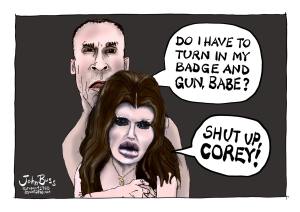
“Meanwhile, in the newly acquired Homeland Security luxury jet’s bedroom…” John Buss, @repeat1968
Good Day, Sky Dancers!
There’s so much news to cover today that I don’t even know where to start. We’ve got information that we’re the ones who struck the elementary school in Iran, killing all those little girls. We’ve also found out that the Russians are helping Iran target us. This sure feels like the start of World War 3. Additionally, the job picture is bleak as stats show that jobs are being eliminated. Finally, don’t start celebrating Kristi Noem’s demise quite yet. She’s headed to another job, and her replacement is a bimbo with some odd kink. Orange Caligula and his Incompetence Legion continue to wreck everything. Steven Miller must be thrilled.
So, how goes the war? My bad, wars. We’ve got yet another frontline in another country as of 2 days ago. We’re now staging attacks in Ecuador. This is from Time Magazine. “Why Is the U.S. Launching Military Operations in Ecuador?” This analysis and reporting is by Chantelle Lee.
The United States and Ecuador announced this week that they’ve begun a joint military operation to combat narcoterrorism in the South American country.
The U.S. Southern Command (Southcom), which oversees the nation’s military activity in Latin America and the Caribbean, said in a press release on Tuesday that Ecuadorian and American military forces had started operations that day “against Designated Terrorist Organizations in Ecuador.”
“The operations are a powerful example of the commitment of partners in Latin America and the Caribbean to combat the scourge of narco-terrorism,” Southcom said in the press release. “Together, we are taking decisive action to confront narco-terrorists who have long inflicted terror, violence, and corruption on citizens throughout the hemisphere.”
Southcom also shared on X a short video in which a helicopter can be seen taking flight and picking up service members. The command didn’t explain what the video was depicting, though, or how it was tied to the operation in Ecuador.
Officials have so far shared little information about the military operation. But here’s what we do know.
Ecuadorian President Daniel Noboa said in a post on X this week that the country will be conducting “joint operations with our regional allies, including the United States” in March. He didn’t provide any details about the scale of the operation or the intended targets.
“The security of Ecuadorians is our priority, and we will fight to achieve peace in every corner of the country,” he said in his post. “To achieve that peace, we must act forcefully against criminals, wherever they may be. The pursuit of justice and national dignity will never be persecution, but rather a promise that we will keep to Ecuadorians.”
The Trump Administration hasn’t publicly shared how the U.S. military is involved in the operation in Ecuador. But one American official, speaking to the New York Timeson the condition of anonymity, said that, in the months leading up to this week’s announcement, U.S. Special Forces have been assisting Ecuadorian soldiers in preparing for raids. American service members, the official told the Times, have been deployed to support the Ecuadorian military with the operation, which is reportedly targeting drug facilities led by violent gangs. U.S. troops, though, will not be directly involved in the operation, the official told the Times.
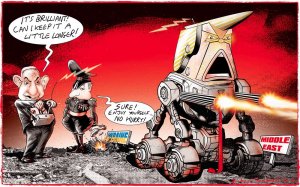 Dalia Dassa Kaye, reporting for Foreign Affairs, has this analysis. “The Mirage of a New Middle East. War With Iran Won’t Reshape the Region the Way America Wants.”
Eager to show that he can do what no American leader has done before, President Donald Trump has chosen conflict over diplomacy and gone to war with Iran. The Islamic Republic, knowing that this fight is existential, retaliated quickly with deadly missile and drone attacks on Israel, U.S. bases in the Middle East, and targets in Gulf states and beyond. This is now a regional war with global impact, disrupting oil and financial markets, supply chains, maritime commerce, and air travel. Threats to Americans and the death toll in Iran mount by the hour. These growing risks were predictable long before the war became reality, which might help explain why no previous president took the United States down this perilous path.
How this war will end remains uncertain. But when it does, the United States will have to face what comes next. To the extent that the Trump administration has considered plans for “the day after,” it seems to have made a series of overly optimistic assumptions about how the war might reshape Iran and the Middle East. For one, the Trump administration has insisted—including in Trump’s social media post on February 28 announcing the war—that a relentless degradation of Iranian leadership and military capabilities would weaken the regime enough that the Iranian people could rise up and “take over the government.” Even if that doesn’t happen, the administration’s logic goes, Iran would be defanged and so preoccupied with internal problems that it could no longer pose a threat to the region or American interests. Taking the current Iranian regime out of the equation, Washington assumes, would remove one of the largest sources of regional instability and usher in a new Middle East more to the United States’ liking.
But the outcome of this war will likely fall far short of these rosy expectations. After the bombing ends, Iran and the region could look worse, or at least not better, than they did before the war. The fighting could create a power vacuum in Tehran, sour U.S. allies on their partnerships with Washington, and produce ripple effects on conflicts elsewhere in the world, all without removing sources of regional strife that have nothing to do with the regime in Iran. The risks increase the longer the war goes on, so Congress and U.S. allies must press for a cease-fire now if there is to be any hope of mitigating these day-after dangers.
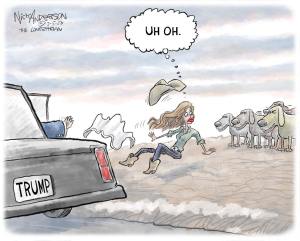 More analysis of the likely deadly results over time, which include the rise of terrorism once more, can be found at the link. Eric Cortellessa has more analysis about “Trump’s War” at Time Magazine.
In short, if Trump campaigned as a President of peace, he has governed as the opposite. Now he has drawn the U.S. into the kind of conflict he long pledged to avoid. Having ousted the tyrannical ruler of Iran’s theocracy, he has committed the U.S. anew to regime change in the Middle East, telling TIME he intends to play a role in shaping the next government of a regional powerhouse home to some 90 million people. “One of the things I’m going to be asking for is the ability to work with them on choosing a new leader,” he says. “I’m not going through this to end up with another Khamenei. I want to be involved in the selection. They can select, but we have to make sure it’s somebody that’s reasonable to the United States.”
It’s impossible to know how all this will unfold. There was little sympathy internationally for the Ayatollah, who reigned over a brutal Islamist regime; throughout Tehran and across the Iranian diaspora, crowds have rejoiced in the streets upon hearing the news of his demise. To some, Trump’s attacks are historic in the best sense, eliminating an avowed adversary who sought to destroy the U.S. and whom Washington has long viewed as the head of the world’s foremost state sponsor of terrorism.
But the gambit carries extraordinary risks—for Trump’s presidency, for Iran’s fragile political future, for regional stability, and for the safety of Americans at home and abroad. The gravest decision a President can make is whether to send American troops into harm’s way. Trump, who once defined himself in opposition to foreign entanglements, has pivoted with astonishing alacrity toward open-ended confrontation across multiple theaters.
In his interview with TIME, Trump says his goals are to eliminate Iran’s nuclear threat once and for all, to dismantle its ballistic-missile program, and to install a Western-friendly government. “We have to be able to deal with sane and rational people,” he says. Yet Trump launched a war before making a case to the country or to Congress, and his Administration has offered unclear—and at times contradictory—explanations of the mission’s objectives. The most unnerving possibility is that Operation Epic Fury is not the culmination of his shift toward a war presidency, but rather the beginning of a new chapter.
The path to war with Iran was paved by a pair of meetings, one year apart, with Benjamin Netanyahu.
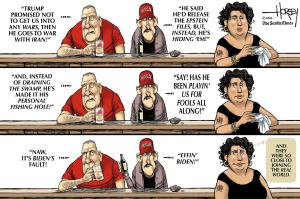 As usual, Trump is easily manipulated by his counterparts with selfish and bad intentions.
On Feb. 4, 2025, the Israeli Prime Minister visited the White House for the first time since Trump’s return to power. Seated at a long table in the Cabinet Room, Netanyahu began with a bracing reminder, according to U.S. and Israeli officials present at the meeting: Iran, he noted, had plotted to assassinate Trump during the 2024 campaign. Law-enforcement officials disclosed that they had disrupted what they described as two Iranian plots to kill Trump. (Tehran denied the allegations.) Trump has long fused geopolitics with grievance, and Iran’s clerical leadership occupied a singular place on his list of adversaries. When TIME asked him in a November 2024 interview about the prospect of war with Iran, Trump did not dismiss it. “Anything can happen,” he said.
Sensing an opening, Netanyahu walked through a slide deck. It showed stockpiles of highly enriched uranium climbing, centrifuges spinning faster, inspectors reporting gaps. Ever since Trump withdrew from President Barack Obama’s nuclear accord in 2018, Tehran had incrementally expanded its enrichment program, moving closer to breakout capacity. By the time Trump was inaugurated a second time, international inspectors assessed that Iran possessed enough weapons-grade uranium to place it mere weeks from assembling a bomb. “Look, Donald,” Netanyahu said, leaning in, “this has to be tackled, because they’re racing forward.” He paused, locking eyes with the President. “You can’t have a nuclear Iran on your watch.”
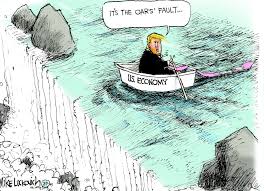 I wanted to mention the economy signalling a meltdown. This is from Jeff Cox writing for CNBC. “Economy: U.S. payrolls unexpectedly fell by 92,000 in February; unemployment rate rises to 4.4%.”
-
Nonfarm payrolls in February fell by 92,000, compared with the estimate for 50,000 and below the downwardly revised January total of 126,000. It was the third time in five months that the economy lost jobs.
-
Health care, the primary growth driver in payrolls, saw a loss of 28,000, due largely to a strike at Kaiser Permanente that sidelined more than 30,000 workers in Hawaii and California.
-
Wages rose more than expected. Average hourly earnings increased 0.4% for the month and 3.8% from a year ago, both 0.1 percentage point above forecast.
I want to mention a few things about this. Generally, this would indicate that the Fed’s Board of Governors may loosen interest rates. However, we’re still on the high end of the inflation rate target, considering that wages rose by more than expected, the Fed may be reluctant to move on that. Wars generally stimulate an economy but that remains to be seen on the various military advantages Trump has undertaken. There is still concern about the supply inventory needed to support the war. Moving to a wartime economy can create shortages in the consumer sector. International markets are already pricing in oil shortages.
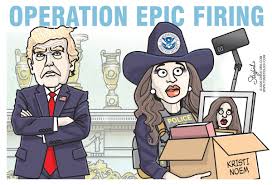 As usual, I am ever the economist. I’m just weirded out about all the Kristi Noem and her likely replacement news. These people are all bimbos and freaks. Noem’s replacement, Senator Markwayne Mullin, appears to have a really odd kink. This is from MEDIAite. It’s a headline from 2023. “Markwayne Mullin Reportedly Fingered Nostrils of Colleagues and Their Spouses During Visit to Israel.” I certainly want the committee hearing to ask about this, but I really don’t want to hear the details.
I do want to know more about Noem’s new job, however. This is from The Hill. WTH is the Shield of the Americans anyway? Ashleigh Fields has this headline. “What we know about Noem’s new ‘Shield of the Americas’ role.”
While the soon-to-be former secretary will no longer head up immigration and other national security agencies under DHS, her work for “Shield of the Americas” will hit on similar topics, including immigrants in the country illegally, transnational trafficking and border crossings.
Here’s what we know about the role: What is ‘Shield of the Americas’?
The regional coalition of countries in Latin America will work together on ideology and policy initiatives that help secure the Western Hemisphere, according to the White House.
The Shield of the Americas will be guided in part by the president’s foreign policy initiatives dubbed the “Donroe Doctrine,” fashioned after the Monroe Doctrine. The administration has described the doctrine as enlisting “established friends” in the Western Hemisphere to pursue U.S. aims and expanding ties by “cultivating and strengthening new partners.”
Since Trump returned to office last year, he directed the renaming of the Gulf of Mexico to the “Gulf of America,” announced plans to “take back” the Panama Canal, and pushed efforts to acquire Greenland and make Canada the 51st state.
A summit making the Shield of the Americas official is set to take place this weekend in Miami, and it may largely focus on counterterrorism measures in the region as a group of Latin American leaders assemble on American soil.
Noem will work with foreign leaders in both North and South America. The Trump administration has maintained a heavy interest in connecting with Latin American leaders to combat human smuggling, drug trafficking and undocumented immigration.
Thirteen heads of Latin American countries are expected to be present at the Miami summit this weekend. Some notable names, according to the White House, include: Argentine President Javier Milei, Chilean President-elect José Antonio Kast, Salvadoran President Nayib Bukele Ortez and Honduran President Nasry “Tito” Asfura.
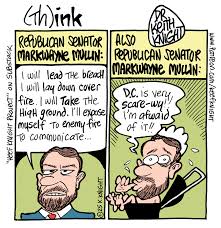 NPR has the go-to list on “What you need to know about Sen. Markwayne Mullin, Trump’s new pick to lead DHS.”
-
Mullin was first elected to the House in 2012 and was sworn in the following January.
-
A decade later he won a special election to fulfill the term of former Sen. James Inhofe, a fellow Republican who resigned due to health issues.
-
Mullin is an enrolled member of the Cherokee nation. He is the first tribal citizen in the Senate since Ben Nighthorse Campbell left in 2005.
-
Mullin has been a reliable defender of President Trump in Congress, including just this week, backing the president’s decision to launch strikes against Iran.
-
Mullin serves on several committees, including Appropriations, Armed Services, Indian Affairs and Health, Education, Labor and Pensions.
-
In his role on the Appropriations Committee, he helps write and negotiate federal funding, including the ongoing talks to fund DHS, the agency he has been tapped to lead.
-
DHS has been operating without annual appropriations funding since February 14.
-
Mullin has frequently defended President Trump’s approach to immigration enforcement.
Anyway, he has a background in construction. He’s from Oklahoma. Evidently, he and Rand Paul don’t get along, and since Paul is the head of the committee that will approve his appointment, it should be interesting.
So, that’s enough weird Trump news for the day. I need to return to doing something more worthwhile, like the laundry and dishes.
What’s on your Reading, Blogging, and Action list today?

 peej
peej Carissa
 bostonboomer
 dakinikat
 ecocatwoman
 jjlo
jjlo mablue2
 Mama Lopez
 peggysue22
 quixote
 skydancingguestblogger
 Mona (aka Wonk the Vote)



 Sky Dancing
Recent Comments