One more on Jackson’s influence b Jennifer Rubin at The Contrarian: Jesse Jackson’s Passing Should Stir the Democracy Movement.
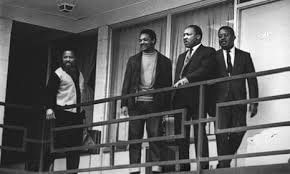
With Rev. Jesse Jackson Jr.’s passing, we lose one of the dwindling number of direct links to Martin Luther King, Jr. and to the mid-20th century Civil Rights generation. From the Lorraine Motel to stewardship of Rainbow/PUSH to his own presidential campaigns to his successful hostage negotiations to Barack Obama’s election to the Black Lives Matter movement, he was front and center in racial justice fights, a symbol of both the tremendous progress and the enduring, at times exhausting, presence of White supremacists who seek to erase history and undo decades of hard-won gains.
While the country lacks a singular figure to lead the racial justice movement, the number of organizations and plethora of elected figures (including the likely next House Speaker) are part of Jackson’s legacy, a permanent army of civil rights activists who stand in opposition to the Make America White Again ideology at the heart of Trumpism. The challenge that was at the heart of Jackson’s work — the creation of a true multi-racial democracy — has never been more acute in the modern era.
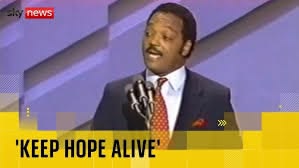
It is always worth recalling Jackson’s iconic lines from his speech to the 1984 Democratic Convention:
Our flag is red, white and blue, but our nation is a rainbow — red, yellow, brown, black and white — and we’re all precious in God’s sight.
America is not like a blanket — one piece of unbroken cloth, the same color, the same texture, the same size. America is more like a quilt — many patches, many pieces, many colors, many sizes, all woven and held together by a common thread. The white, the Hispanic, the black, the Arab, the Jew, the woman, the native American, the small farmer, the businessperson, the environmentalist, the peace activist, the young, the old, the lesbian, the gay and the disabled make up the American quilt. (Applause)
Even in our fractured state, all of us count and all of us fit somewhere. We have proven that we can survive without each other. But we have not proven that we can win and progress without each other. We must come together.
The Trump regime presents the greatest attack on that vision of pluralistic democracy and racial justice in the modern era. Should the MAGA partisan hacks on the Supreme Court succeed in eviscerating the Voting Rights Act in Louisiana v. Callais, the political map will resemble the political landscape in the Jim Crow era in which Black and Hispanic voting power was minimal to nonexistent, representatives at all levels of government were overwhelmingly White, and one party rule prevailed in the South.

Jesse Jackson as a young man.
Jackson would certainly recognize The SAVE Act, which would impose onerous proof of citizenship requirements to vote, as the latest MAGA disenfranchisement project, part of the never-ending assault to deprive communities of color access to the polls. The Leadership Conference on Civil and Human Rights and 130 organizations have decried the assault on voting rights as being driven by “unprecedented disinformation campaigns and intrusions on the ability of states to make sound decisions on how to run their elections.” The effort to now require a birth certificate or passport to establish qualification to vote would be the culmination of a voter suppression drive begun over decade ago:
Since the Supreme Court’s decision in Shelby County v. Holder (2013), 31 states have enacted 114 restrictive voting laws, which disproportionately burden voters of color. The harm has been palpable: Racial disparities in voter turnout have been increasing, particularly in areas formerly protected by the Voting Rights Act’s preclearance provision, which the Court dismantled.
The object of the new burdens on voting is obvious. “Approximately half of American adults do not have a passport, and two-thirds of Black Americans do not.…Nationwide, 69 million married women do not have a birth certificate matching their legal name.” Transferring sensitive voter information to a federal database would only “increase the likelihood that citizens will see their registrations wrongly purged or their personal information compromised.”
All of this smacks of the literacy and poll tests imposed in the Jim Crow South, a set of mechanisms designed to make the electorate unrepresentative of the general population in order to maintain white dominance.
Even voter ID requirements amount to a poll tax.
The rest of the news is not that inspiring, but here a few significant stories to check out.
Odette Yousef at NPR: Extremist rhetoric is often found in government messaging. Who’s the target?
A recent social media post from an account belonging to President Trump prompted enough outcry over its use of a familiar racist trope that the White House deleted it. The Truth Social post included an image of former President Barack Obama and former first lady Michelle Obama as apes. Despite removing the post, Trump has deflected blame to an aide….
For scholars and civil rights advocates steeped in the language and aesthetics of white nationalism, Trump’s post was remarkable only because of how overtly racist the trope is. But they say that it fits into a pattern of extremist rhetoric, visual material and other media that have overtaken public messaging from federal agencies over the past year. They say that much of that messaging may not have been detectable to most Americans who are not immersed in the study of extremism. But to those who are, the dog whistles and coded words have been unmistakable.
“If this were just one racist image or one bad post, it wouldn’t matter much,” said Eric Ward, executive vice president of Race Forward, a civil rights organization. “What matters is that over the last year, the Trump administration [is] abusing federal authority, and the federal government has increasingly learned to speak in the emotional language of white nationalism.”
While the latest controversy is over a post from a Trump social media account, Ward and others say the Department of Homeland Security has been behind the most, and the most notable, examples of extremist themes in federal messaging. In its effort to recruit large numbers of new immigration enforcement agents, the federal agency has generated a body of propaganda that has raised alarm over its echoes of extremist movements.
“A lot of this was very much wrapped up in this kind of Norman Rockwell-style imagery of white Americana and … this idea that we need to ‘defend the homeland’ from migrants arriving from the Global South,” said Caleb Kieffer, a senior research analyst with the Southern Poverty Law Center. “And I think that one thing it’s worth noting, and what we really were alarmed by, [is] that we’ve seen this rhetoric for decades be prevalent in white nationalist circles, in anti-immigrant circles, claiming that there’s this migrant invasion happening and that we need to stop it.”
Read the rest at the link.
Kyle Cheney at Politico: DOJ acknowledges violating dozens of recent court orders in New Jersey.
The Trump administration acknowledged violating court orders issued by New Jersey’s federal judges more than 50 times over the past 10 weeks in cases stemming from the Trump administration’s mass deportation push.
Associate Deputy Attorney General Jordan Fox, who was tapped in December to help lead the Justice Department’s New Jersey office after temporary pick Alina Habba was forced out, said those violations were spread across more than 547 immigration cases that have flooded the courts since early December, straining both prosecutors and judges.
The violations include a deportation to Peru that occurred in violation of a judge’s injunction, as well as three missed deadlines to release ICE detainees.

A general view of the Delaney Hall Detention Facility in Newark on June 16, 2025, in New Jersey. Stefan JeremiahAP
There were also six missed deadlines to respond to court orders, 12 missed deadlines to provide bond hearings to ICE detainees, 17 out-of-state transfers after judges had issued no-transfer orders, three instances of imposing release conditions in violation of court prohibitions and 10 instances of failing to produce evidence demanded by courts.
“We regret deeply all violations for which our Office is responsible. Those violations were unintentional and immediately rectified once we learned of them,” Fox wrote in a letter accompanying the report. “We believe that [the Department of Homeland Security’s] violations were also unintentional.”
Fox’s conciliatory approach stood in stark contrast with previous statements from the Justice Department and ICE that have blamed “rogue judges” for the administration’s noncompliance.
DOJ produced the catalog of violations in response to an order by U.S. District Judge Michael Farbiarz.
Derek Hunter at The Hill: Something is very wrong at the FDA.
It’s not very often an editorial from anywhere, let alone the Wall Street Journal, stops you in your tracks, but one titled “Vinay Prasad’s vaccine kill shot” did just that for me. Not normally known for bomb-throwing, the Journal’s editors went in very hard against someone you’ve probably never heard of — the chief medical and scientific officer and director of the Center for Biologics Evaluation and Research at the U.S. Food and Drug Administration.
The damning sub-headline reads, “Does the White House know the harm he’s doing to public health?” And no, this is not some random question based on spasmodic, Trump-deranged leftist opposition to everything going on in Washington. This is serious.
The Journal editors write of Prasad — previously forced out of the FDA and then hired back within two weeks — that “it’s hard to recall a regulator who has done as much damage to medical innovation in as little time … In his latest drive-by shooting, the leader of the Food and Drug Administration’s vaccine division rejected Moderna’s mRNA flu vaccine without even a cursory review. This is arbitrary government at its worst.”
But is it arbitrary? In 2022, Prasad tweeted that he was “a Bernie Sanders liberal” who has “been surprised by ad hominem claims I am right wing. I am pro-universal health care. Pro wealth tax. Pro choice. Etc. Read my books.”
The same day as the editorial, the Wall Steet Journal reported on the FDA’s rejection of a new flu shot from Moderna for unclear reasons. Career staff reportedly objected and “argued that refusing to even consider the vaccine was the wrong approach to address any concerns about the product.” They were overruled.
And other drugmakers reported multiple cases of surprising and seemingly arbitrary decisions by Prasad, many of them connected to treatments for rare diseases.
Read the rest at The Hill.
Megan O’Matz at ProPublica: Chlorine Dioxide, Raw Camel Milk: The FDA No Longer Warns Against These and Other Ineffective Autism Treatments.
The warning on the government website was stark. Some products and remedies claiming to treat or cure autism are being marketed deceptively and can be harmful. Among them: chelating agents, hyperbaric oxygen therapies, chlorine dioxide and raw camel milk.
Now that advisory is gone.
The Food and Drug Administration pulled the page down late last year. The federal Department of Health and Human Services told ProPublica in a statement that it retired the webpage “during a routine clean up of dated content at the end of 2025,” noting the page had not been updated since 2019. (An archived version of the page is still available online.)
 Some advocates for people with autism don’t understand that decision. “It may be an older page, but those warnings are still necessary,” said Zoe Gross, a director at the Autistic Self Advocacy Network, a nonprofit policy organization run by and for autistic people. “People are still being preyed on by these alternative treatments like chelation and chlorine dioxide. Those can both kill people.”
Chlorine dioxide is a chemical compound that has been used as an industrial disinfectant, a bleaching agent and an ingredient in mouthwash, though with the warning it shouldn’t be swallowed. A ProPublica story examined Sen. Ron Johnson’s endorsement of a new book by Dr. Pierre Kory, which describes the chemical as a “remarkable molecule” that, when diluted and ingested, “works to treat everything from cancer and malaria to autism and COVID.”
Johnson, a Wisconsin Republican who has amplified anti-scientific claims around COVID-19, supplied a blurb for the cover of the book, “The War on Chlorine Dioxide.” He called it “a gripping tale of corruption and courage that will open eyes and prompt serious questions.”
The lack of clear warning from the government on questionable autism treatments is in line with HHS Secretary Robert F. Kennedy Jr.’s rejection of conventional science on autism and vaccine safety. Last spring, Kennedy brought into the agency a vaccine critic who’d promoted treating autistic children with the puberty-blocking drug Lupron. And in January, Kennedy recast an advisory panel on autism, appointing people who have championed the use of pressurized chambers to deliver pure oxygen to children, as well as some who support infusions to draw out heavy metals, a process known as chelation.
Kennedy is almost as scary as Trump.
That’s all I have for you today. What stories are you following?




 peej
peej Carissa
 bostonboomer
 dakinikat
 ecocatwoman
 jjlolatina
 mablue2
 Mama Lopez
 peggysue22
 quixote
 skydancingguestblogger
 Mona (aka Wonk the Vote)



 Sky Dancing
Recent Comments