“Upon further reflection, the Rededicate 250 National Prayer thing now makes huge sense. He Is Risen!” John Buss, @repeat1968
Good Day, Sky Dancers!
The one thing you can depend on every time Orange Caligula gets the reins of government is that things will always get worse, except for democracy backsliding. It’s just a matter of how shocking the next thing is. How many of us are in a constant state of being stunned that we aren’t the least bit surprised by the news, even though we still find the actions stomach-churning? Well, hang on! It’s been a week of WTF moments.
Today’s Tit-for-Tat announcement shows just how brazen the entire administration has gotten. This is from Time Magazine. It’s reported by Rebecca Schneid. What kind of monster thinks these things up?
President Donald Trump has withdrawn his $10 billion lawsuit against the Internal Revenue Service (IRS) amid reports that he struck a deal with his own Justice Department to create a $1.7 billion fund to compensate political allies who claim they were wrongly targeted by the Biden Administration.
The alleged plan, first reported by the New York Times and ABC News, would be paid for with taxpayer funds and is being fast-tracked, but has yet to be officially approved. If approved, the fund would be used to pay damages to people who say they were harmed by the Biden Administration’s “weaponization” of the legal system, including the nearly 1,600 people charged in connection with the Jan. 6, 2021, insurrection.
Court documents showed Trump withdrew his lawsuit against the IRS, a move that could herald a private deal between the president and the agency he controls, while skirting legal oversight of the deal.
In a lawsuit filed in a Miami federal court in January, Trump and other plaintiffs accused federal agencies of failing in their duty of stopping a former IRS contractor from illegally obtaining and disclosing tax returns to the New York Times, ProPublica, and “other left-wing media outlets,” between May 2019 and September 2020.
The funds would also be used to settle his request for $230 million in legal claims from the Justice Department for the 2022 search of his Mar-a-Lago estate and investigation into alleged ties between his campaign and Russia
As part of the settlement, Trump would also reportedly ask the IRS to public1pologize for the disclosure of his personal financial records and to waive an IRS audit
According to the Times, the Justice Department would model the program after the historic $760 million settlement fund stemming from the Keepseagle v. Vilsack class-action lawsuit, settled in 2011, which alleged that the U.S. Department of Agriculture (USDA) systematically discriminated against Native American farmers and ranchers in its farm loan and loan servicing program.
We know someone who can sum this up nicely. This is how Hillary put it this morning.
Trump didn’t just pardon his followers who stormed the U.S. Capitol. He’s now set them up for payments through a slush fund he created to reward his allies—out of your tax dollars. You could not make this up.
Robert Reich had some additional thoughts and analysis. He elucidated them on his SubStackthis morning. “Has Trump’s Republican Party Become a Criminal Enterprise? Trump’s purge of all political opponents, including Senator Bill Cassidy, leaves it with no purpose other than helping Trump achieve his lawless goals.” Trump puts us in a Mafia State every time he’s elected. Grifting is his only talent, and he’s been rich and influential enough to find ambitious and greedy toadies to carry out his wishes. We’ve known this forever here.
On Saturday, Trump took revenge on Louisiana senator Bill Cassidy for Cassidy’s vote five years ago to convict Trump, in his second impeachment, for instigating an attack on the U.S. Capitol.
Cassidy thereby became the first GOP senator defeated by a Trump-endorsed candidate in a Republican primary. (Other Republican senators who have stood up to Trump — such as North Carolina’s Thom Tillis and Utah’s Mitt Romney — saw the writing on the wall and didn’t seek reelection.)
Trump’s purge of Cassidy comes in the wake of Trump’s purges of House Republicans who stood up to him, such as Wyoming’s Liz Cheney.
Trump’s next Republican target in the House is Kentucky representative Thomas Massie, who had the guts to oppose U.S. military involvement in Iran, demand release of the Epstein files, and criticize Trump’s spending bills for adding to the national debt. Massie appears likely to be defeated by a Trump-backed opponent in Tuesday’s Kentucky primary.
Trump has also purged state legislators who have refused to do his bidding, such as the seven Indiana Republicans who refused to redistrict the state as Trump demanded they do, and who Trump insured were defeated in their recent primaries.
The message is clear to every current or aspiring Republican politician: Be a toady to Trump, or you’re out.
In his concession speech Friday night, Cassidy stated the obvious reference to Trump:
“Our country is not about one individual. It is about the welfare of all Americans, and it is about our Constitution. And if someone doesn’t understand that and attempts to control others through using the levers of power, they’re about serving themselves. They’re not about serving us. And that person is not qualified to be a leader.”
Nicely put but sadly irrelevant because Trump — who’s clearly serving himself rather than the American public — now possesses all levers of power in the official Republican Party.
As Republican senator Lindsey Graham said yesterday on Meet the Press,“There’s no room in this party to destroy [Trump’s] agenda.”
There’s more at the link. My question is, what the hell can the rest of us who don’t support him do? I voted Saturday morning, wondering which candidate I had voted for would even have a chance under the new gerrymandering. That doesn’t even consider that we couldn’t even vote for our Congressional representatives, given the Supreme Court decision and the quick fix redraw of our map to ensure maybe one black person will retain their seat. The only good news to come out of the election was that all five constitutional amendments proposed by Governor Klandry were voted down.
Will these latest bits of news set up another J-6 self-coup? There will certainly be a rabid MAGA candidate sitting in Cassidy’s seat come next January. This is from NPR. “Louisiana senator who voted to convict Trump loses Republican primary.”
Sen. Bill Cassidy of Louisiana, one of seven Republican senators who voted to remove President Trump from office after the January 6th insurrection at the U.S. Capitol, lost his bid for reelection.
Louisiana’s Senate primary on Saturday was the latest test of Trump’s hold on his party. The president recruited a challenger, Rep. Julia Letlow, and urged supporters to defeat Cassidy over his vote.
“His disloyalty to the man who got him elected is now part of legend,” Trump wrote in a Truth Social post about Cassidy. “And it’s nice to see his political career is OVER.”
Cassidy finished third in a three-way race, according to the Associated Press. Letlow and another candidate, state Treasurer John Fleming, will advance to a June 27 runoff.
In conceding the race, Cassidy hinted that he would not finish his second term quietly. But in an apparent dig at Trump, he also said he wouldn’t contest his loss.
“You don’t pout, you don’t whine, you don’t claim that the election was stolen,” Cassidy told supporters on Saturday night. “You thank the voters for the privilege of representing the state or the country for as long as you’ve had that privilege. And that’s what I’m doing right now.”
Cassidy told voters they should cast their ballot based on the present and the future, not the past, a subtle discouragement from re-litigating the 2020 election six years on. But for many primary voters, Cassidy’s move to convict felt like a betrayal, and Trump’s endorsement was paramount.
“I’m the type of person, if you cross me, I probably won’t trust you anymore,” retired sheriff deputy Kevin Dupree said earlier this month. “I think his political career in Louisiana is finished.”
My friend Robert Mann, a former Journalism Professor at LSU, has something poignant to say about the loss. This is from his SubStack. “Enjoy your tarnished legacy, Bill Cassidy. You earned it.” It’s a good lesson: while all politics is local, it can be influenced by a cult of personality.
Although he pandered shamelessly to Trump and MAGA to the bitter end, Sen. Bill Cassidy could have written a different ending to his political career.
He could have left office with his head held high, proud and satisfied that he’d remained true to his principles and the Hippocratic Oath.
He could have protected our families by blocking Trump’s efforts to destroy our public health system.
He could have legislated (and campaigned) as the moderate he told me and others he truly was.
He could have put the state of Louisiana — and the nation — ahead of his desire for another U.S. Senate term.
He could have been our senator, not Donald Trump’s.
He could have done all this and more, but Cassidy lacked the courage, the imagination, and the decency to put you and me ahead of his political ambition.
What Cassidy received in return for his soul is eternal shame and a well-earned legacy of cravenness.
I hope Cassidy enjoys his earnings.
I hope he also feels the harsh judgment of history that will be reserved for a Trump critic turned shameless toady who sold out to the worst, most corrupt president in American history—and still lost.
Bill Cassidy could have written a different story for himself and his state, but he just didn’t have it in him.
Speaking of Mafia-like behavior, here’s a little something on the Don’s Greenland Grab. This is from the New York Times. “In Closed-Door Talks, U.S. Demands a Major Role in Greenland. Greenlandic officials worry about the direction of the negotiations aimed at defusing President Trump’s threats to seize their island. But they have little leverage.” The story has a number of contributing reporters.
With the conflict in Iran still smoldering, President Trump’s obsession with Greenland seems like a forgotten sideshow.
But for the past four months, negotiators from the United States, Greenland and Denmark, which controls Greenland’s foreign affairs, have been holding confidential talks in Washington about Greenland’s future.
The talks were meant to give Mr. Trump an offramp to his threats of a military takeover of Greenland and to scale back a crisis that risked breaking apart the NATO alliance. But Greenlandic leaders are worried about what is being proposed, which is a much larger U.S. role on the Arctic island. And they fear that if the conflict with Iran winds down, the president will swing his aggression back on them.
Some Greenlandic politicians say they have even circled a date on their calendars to be wary: June 14, Mr. Trump’s birthday.
An investigation by The New York Times, based on interviews with officials in Washington, Copenhagen and Greenland, has discovered:
The United States is trying to modify a longstanding military arrangement to ensure American troops can stay in Greenland indefinitely, even if Greenland becomes independent. The notion is basically a forever clause, and Greenlanders do not like it.
The United States has pushed the talks beyond military matters and wants effective veto power over any major investment deals in Greenland to box out competitors like Russia and China. Greenlanders and Danes strongly object to this.
The United States is discussing cooperation with Greenland on natural resources. The island is loaded with oil, uranium, rare earths and other critical minerals, though much of it is buried deep beneath Greenland’s ice.
The Pentagon is rapidly moving ahead on plans for a military expansion and recently sent a Marine Corps officer to Narsarsuaq, a town in southern Greenland, to inspect the World War II-era airport, the harbor and places where American troops could be housed.
The American demands are so steep, Greenlandic officials fear, that they amount to a major imposition on their sovereignty. Despite all of the talk from Danish and American officials that Greenland’s future is up to the island’s 57,000 people, Greenlandic officials said the American demands would tie their hands for generations.
If the Americans get everything they want, said Justus Hansen, a member of Greenland’s Parliament, there will never be any “real independence.”
“We might as well raise our own flag halfway,” he said.
There’s a lot more at that gifted link. Jeer Heeter has this description of our Grifter-in-Chief in his article in The Nation. “Trump Gloats About “Making a Fortune” While Americans Suffer. As his war in Iran wreaks havoc, Trump is fixated on personal glory and enrichment.”
Donald Trump is annoyed that he can’t celebrate the massive profits oil companies are making due to the war he launched in the Middle East. Left to his own druthers, Trump would be exulting in the hundreds of billions of dollars produced by skyrocketing oil prices—if it weren’t for the pesky fact that it comes at the expense of ordinary Americans, who are now paying roughly 40 percent more every time they fill up the gas tank than they were before Trump started bombing Iran nearly three months ago.
We know this thanks to Trump’s endless dedication to saying the quiet part out loud. Speaking with Sean Hannity of Fox News on Thursday, Trump chortled that because far less oil was coming out of the Middle East, “people are finding other places to buy oil, like Texas.” Trump added, “So I don’t want to say we’re making a fortune, you understand that? Because if I say that, they’re going to say ‘oh, he forgets about the little man with the $4 gasoline.’”
The juxtaposition between “making a fortune” and the “little man” suffering at the gas station underscores just how obtuse Trump and his allies have become in their economic message. Their response to the harm caused by Trump’s policies is not to reverse those policies, or even to appear sympathetic about their effects. It’s to express their total indifference to the suffering of the American people. At the same time, Trump is obsessively focused on his real priorities: enriching himself and his family, and creating gaudy monuments to himself such as a new White House ballroom and a Triumphal Arch that will squat in the middle of Washington, DC. In response to a reporter’s query as to whom the arch would celebrate, Trump pointed to himself and said “me.”
Trump twice won the White House on a message of economic populism, promising in his 2025 inauguration that he would “bring prices down.” Today, he sings a very different tune, with a message that amounts to the apocryphal words misattributed to the French Queen Marie Antoinette: “Let them eat cake.”
Speaking to reporters last Monday, Trump said, “I don’t think about Americans’ financial situation. I don’t think about anybody. I think about one thing: We cannot let Iran have a nuclear weapon. That’s all.” He also said that concern for the financial suffering of Americans would not be a factor in making a deal with Iran “not even a little bit.”
Under normal political circumstances, the Republican Party would be wise to separate itself from Trump’s callousness. But the GOP has become a hollowed-out operation mainly concerned with tending to Trump’s cult of personality. On Saturday, Trump won a major victory against critics in the party when Louisiana Senator Bill Cassidy came in third in his party’s Senate primary race, losing to a candidate Trump had supported. Cassidy’s loss underscores a lesson Trump has taught the GOP again and again over the last decade: There is no future in the party for anyone who defies his will.
So, rather than distancing themselves from Trump’s “let them eat cake” message, Republicans are embracing the president’s self-defeating rhetoric. On Thursday, Ohio Representative Jim Jordan told CNN that oil prices were “were coming down until we had to deal with this situation, but, you know, that’s life, that’s dealing with…the world we live in.”
It’s going to take hard work and a lot of voting to get rid of this monster and all the dregs of humanity he’s put in charge of the country. It appears they have all been profiting from insider news on the Iran War.
1. What I found in Trump's new 113-page financial disclosure report. It doesn't look good.
This is from Jude Legum’s SubStack. “The smoking guns in Trump’s new financial disclosure, Trump publicly praised companies the same day he bought their stock.”
On March 11, President Trump took a tour of a manufacturing facility in Reading, Ohio, owned by Thermo Fisher Scientific, a medical supply company. During the tour, Trump lavished praise on Thermo Fisher which uses the facility to manufacture prescription drugs on a contract basis. “It’s a great honor being here. It’s a great company,” Trump said, appearing alongside CEO Marc Casper. “You have done a fantastic job and I’d like to congratulate you.”
Later, Trump asked another Thermo Fisher executive to share “some great information about this incredible company.” The executive talked about how Thermo Fisher is producing drugs for Merck and others at the facility. Trump then explicitly encouraged other pharmaceutical companies to contract with Thermo Fisher to “on-shore” more jobs. He claimed that some pharmaceutical companies were building their own U.S. manufacturing facilities but said “they can get here a lot faster by using this great company.”
Trump did not mention that, the same day of the tour, March 11, he purchased between $15,000 and $50,000 of Thermo Fisher stock. (Federal disclosure rules only require filers to list their transactions in broad ranges.) Trump did not publicly disclose the purchase until May 14. It was listed on page 38 of a 113-page document cataloging Trump’s stock purchases in 2026.
Trump also purchased between $51,000 and $115,000 worth of Thermo Fisher stock about one month before his visit on February 12. He made another purchase of Thermo Fisher valued between $15,000 and $50,000 on March 2. So at the time of Trump’s effusive remarks about Thermo Fisher, he had purchased as much as $215,000 worth of the company’s stock over the previous month.
The fact that Trump visited a Thermo Fisher facility on the same day he purchased the company’s stock — and bought Thermo Fisher stock repeatedly in the weeks before his visit — has not previously been reported.
The disclosures reveal that Trump has been a highly active trader in 2026, executing thousands of transactions — many in individual stocks impacted by his administration’s policies. In response to criticism, a spokesperson for the Trump Organization claimed that the trades were completely separate from Trump’s official duties and managed by an independent outside financial advisor. “President Trump’s investment holdings are maintained exclusively through fully discretionary accounts independently managed by third-party financial institutions with sole and exclusive authority over all investment decisions,” the spokesperson said. “Trades are executed and portfolios are balanced through automated investment processes and systems administered by those institutions.”
The fact that Trump purchased stock in Thermo Fisher the same day that he toured its facility undercuts this claim. Further, the March 11 purchase of Thermo Fisher stock was marked “UNSOLICITED” in the document. An “unsolicited” trade is one that is not recommended by a broker, but initiated by the customer.
At least three immigrant children were taken into custody and restrained with zip ties at the San Antonio Immigration Court. The children were between the ages of 9 and 12.www.mysanantonio.com/news/local/a…
Brookings reminds us that there are still thousands of families with children experiencing horrible detentions and deportations because of the MAGA obsession with keeping America as white as possible. “The administration has detained 400,000 immigrants: What do we know about their children?” Is this really the kind of country you want to live in and that you thought you grew up in?
The Trump administration has made detention and deportation the centerpieces of its immigration policy. Around 60,000 people are being held in detention currently, and around 400,000 people have been booked into Immigration and Customs Enforcement (ICE) detention from an interior arrest since the administration began. Detention capacity is likely to expand, with $45 billion allocated to expanding detention facilities in the One Big Beautiful Bill Act.
Though it is mostly adults who are detained and deported, many children are impacted by separation from their parents. However, there are no reliable data on how many detainees or deportees have children in the U.S., nor on what happens to them once their parent is taken into custody. Here we focus on detainees, about whom we have better information than deportees. Even a short separation from a parent is likely traumatic for a child, but a majority of detentions are not short-lived separations. A ProPublica study following ICE arrests of mothers of U.S. citizen children over the first seven months of the administration found that 60% had been removed and 17% remained in custody at the study’s conclusion.
To estimate the number of children affected by parental detention, we rely on demographic characteristics of detainees matched with likely unauthorized immigrants in the American Community Survey. Our analysis (detailed below) suggests that more than 145,000 U.S. citizen children have likely experienced a parent booked into detention since the administration began, with more than 22,000 of those experiencing detention of all their co-resident parents. In the accompanying interactive, we allow users to explore how the estimates change when the underlying assumptions are varied. Regardless of the assumptions used, it is clear that tens of thousands of children have faced parental detention since January 2025.
Please use the link to read the details. The time and research it took to find out all this was amazing and hard to believe.
What’s on your Reading, Action, and Blogging list today?
I can’t even explain what kind of crush I had on Cat Stevens in ninth grade. I could basically play his entire songbook. He’s an amazing songwriter and musician.
Did you like this post? Please share it with your friends:
“It’s now safe to go out to dinner in The Nation’s Capital!” John Buss, @repeat1968
Good Day, Sky Dancers!
The chaos surrounding voting rights continues to play out across many southern states. I’ve shared the craziness going on down here in Lousyana. Today’s news on voting rights and gerrymandering shenanigans was handled by judges in Virginia’s Supreme Court. It’s looking like Orange Caligula and his Republican enablers will be getting the Midterm Election chaos they seek. Our primary election is coming up in 8 days. Our U.S. Congressional representatives are not on the ballot as they should be.
Will the Virginia Supreme Court Decision impact more than just Virginia? That seems to be the question being asked in the national conversation. David A. Lieb and Geoff Mulvihill report the story for the AP. “Virginia Supreme Court strikes down Democrats’ redrawn US House maps, giving Republicans a win.” It’s difficult to believe that so much disruption can happen in modern times.
The Virginia Supreme Court on Friday struck down a voter-approved Democratic congressional redistricting plan, delivering another major setback to the party in a nationwide battle against Republicans for an edge in this year’s midterm elections.
The court ruled 4-3 that the state’s Democratic-led legislature violated procedural requirements when it placed the constitutional amendment on the ballot to authorize the mid-decade redistricting. Voters narrowly approved the amendment April 21, but the court’s ruling renders the results of that vote meaningless.
Writing for the majority, Justice D. Arthur Kelsey wrote that the legislature submitted the proposed constitutional amendment to voters “in an unprecedented manner.”
“This violation irreparably undermines the integrity of the resulting referendum vote and renders it null and void,” he wrote.
Democrats had hoped to win as many as four additional U.S. House seats under Virginia’s redrawn U.S. House map as part of an attempt to offset Republican redistricting done elsewhere at the urging of President Donald Trump. That ruling, combined with a recent U.S. Supreme Court decision severely weakening the Voting Rights Act, has supercharged the Republicans’ congressional gerrymandering advantage heading into this year’s midterm elections.
Redistricting could change the House Map. This is the next question the article addresses.
Mid-decade redistricting so far has resulted in 14 more congressional seats that Republicans believe they could win and six more seats that Democrats think they could win, putting the GOP up by eight. But some of those seats could be competitive in the November election, making the results uncertain. Redistricting is still being litigated in several states.
There is a map showing the general changes that have occurred following the Supreme Court decision, which has disrupted the entire concept of gerrymandering and its illegality. The Guardian reports today on the situation in Tennessee, which could eliminate its one black majority Congressional seat. We worry about that here in Louisiana. “Tennessee Republicans redraw maps to erase last Democratic, Black-majority district. Move comes days after supreme court ruling weakened Voting Rights Act protections against racial gerrymandering.” George Chidi has the analysis.
Tennessee’s Republican-dominated legislature passed redistricting maps on Thursday, eliminating the state’s one Democratic, Black-majority congressional district a week after the US supreme court effectively gutted a major section of the Voting Rights Act.
The move cracks Tennessee’s ninth congressional district, which covers Memphis, into three pieces, each of which contains almost exactly a third of the city’s Black voters. The new maps mean that all nine of Tennessee’s congressional districts are Republican-leaning.
The district had closely occupied the south-west corner of the state. Now three districts snake out from Memphis’ dense center, with two crossing the Tennessee River to reach Nashville’s suburbs 200 miles away.
“If Republican policies are so great, why are we changing the lines to rig elections?” asked Vincent Dixie, a state representative from Nashville, during debate on Thursday, pleading for Republicans to refrain. “Where is your humanity in this?”
As Democratic lawmakers spoke, the house speaker directed state troopers to remove a section of the audience in the gallery, which had begun shouting.
Justin Jones, a state Democratic representative, described Cameron Sexton, the Tennessee house speaker, as the “grand wizard in chief”, and handed a Republican lawmaker a Confederate flag. Jones offered amendments to the bill, which the speaker ruled had been submitted in an untimely manner. Jones described that as a “Jim Crow process”.
The redistricting comes eight days after the supreme court’s landmark Callais v Landry decision, which invalidated swaths of the Voting Rights Act which had restrained state governments from drawing congressional districts that left Black voters at a political disadvantage.
Despite demands from Donald Trump for conservative states to conduct mid-decade redistricting, Tennessee had refrained from taking action before the court’s ruling. But Sexton said the redraw will “ensure the state’s representation in Washington reflects its conservative values”.
Khaya Himmelman has more information about the Virginia situation in Talking Points Memo. “Virginia State Supreme Court Strikes Down Dem Redistricting Proposal.”
In a major loss for Democrats on Friday, the Virginia state Supreme Court rejected, in a 4-3 decision, the state’s recently approved redistricting proposal, which could have given Democrats four additional congressional seats, improving their chances of taking control of the U.S. House this year.
The proposal, which was introduced as a way to offset the impact of the Trump administration’s mid-cycle gerrymandering blitz, was narrowly approved by voters in a special election earlier this month.
The Supreme Court ruled that the process by which lawmakers moved forward the redistricting proposal violated the state’s constitution.
“In this case, the Commonwealth submitted a proposed constitutional amendment to Virginia voters in an unprecedented manner that violated the intervening-election requirement in Article XII, Section 1 of the Constitution of Virginia,” the state Supreme Court’s majority opinion read.
“This violation irreparably undermines the integrity of the resulting referendum vote and renders it null and void,” it continued. “For this reason, the congressional district maps issued by this Court in 2021 pursuant to Article II, Section 6-A of the Constitution of Virginia remain the governing maps for the upcoming 2026 congressional elections.”
Election analysts underscored that this is a major victory for Republicans, though the political environment could still be a considerable drag on their midterms changes.
G. Elliott Morris has an analysis up today that breaks down the statistical assumptions the Supreme Court used. This comes from his site Strength in Numbers. “The simple statistical error Republican Supreme Court justices used to gut the VRA. The Court says vote dilution can be proven only after controlling for “controlling” racial polarization rather than partisan polarization. This is a nonsensical and impossible test.” For a kid who hated her algebra classes, I sure live in the realm of statistical and econometric analysis now. It helps to understand the numbers, believe me.
The six Republican-appointed justices on the United States Supreme Court have found a magical solution to political polarization. All you have to do is take a partisan election result and subtract out the effects of party loyalty on the result.
That, more or less, is what the Court wrote when it invalidated the Voting Rights Act last week. In Louisiana v. Callais, decided 6-3 on April 29, 2026, the conservative majority told voting-rights plaintiffs they must now “control for party affiliation” before their evidence of racial bloc voting will count under Section 2.
That sounds like a neutral statistical fix, but in reality, it’s a bad control — an error called “conditioning on a mediator variable“ that would get your paper sent back to you with lots of red ink in statistics 101. The problem is that in modern America, party isn’t a variable that operates independently of race. Rather, political party is largely downstream of one’s race. If you subtract the effects of political party from the analysis of polarization, you are subtracting away the very evidence of polarization you are trying to study!
This is important (not just a piece for nerds) because Republican legislatures are already moving ahead with new partisan and racial gerrymanders based on SCOTUS’s new theory. Tennessee passed a 9-0 GOP map this week that splits Memphis’s majority-Black and solidly Democratic 9th District into three majority-white, Republican-leaning seats. Mississippi’s governor has called a special session for May 20. Louisiana is losing at least one of its majority-Black districts. And Alabama, Georgia, and South Carolina could be next. (On this week’s podcast, David and I recap these new gerrymandering efforts that are unfolding with unprecedented haste.)
This week’s Chart of the Week is: a simple table (and one causal diagram) that shows how the Court’s new test makes racial polarization vanish on paper, while it is very much still alive in real life.
This is the decision that will dilute the vote of New Orleans and every black citizen of Louisiana. Again, here’s the link to the Governor’s site announcing the decision to gerrymander the state prior to voting for our Congressional Representatives. “Governor Jeff Landry Suspends Only U.S. House Primary Elections Following Supreme Court Ruling.” My mind boggles every time I read anything on this.
Governor Jeff Landry issued an executive order suspending Louisiana’s closed party primary elections only for offices of U.S. Representative in response to the recent decision by the United States Supreme Court in Louisiana v. Callais. EO attached.
“The best way to end race-based discrimination is to stop making decisions based on race,” said Governor Jeff Landry. “Here in Louisiana, we’re proud to lead the nation on this charge. Allowing elections to proceed under an unconstitutional map would undermine the integrity of our system and violate the rights of our voters. This executive order ensures we uphold the rule of law while giving the Legislature the time it needs to pass a fair and lawful congressional map. I would like to thank Attorney General Liz Murrill for her hard work throughout this process”
The ruling issued on April 29 found Louisiana’s current congressional district map, enacted under SB 8 during the 2024 First Extraordinary Session, to be an unconstitutional gerrymander. The decision effectively reinstates a lower court injunction prohibiting the state from conducting congressional elections under the invalidated map.
As a result, the state’s closed party primary elections for U.S. House seats, previously scheduled for May 16, 2026, and the second primary set for June 27, 2026, are suspended. Early voting for the May election was set to begin May 2. Other offices and ballot measures scheduled for May 16 will continue as planned. This suspension will only apply to the U.S. House races.
I do feel like I’ve been disenfranchised. And again, please remember the impact the SAVE Act will have on Women and Transexual individuals. Democracy Dockethas this analysis of the Tennessee situation. “‘Jim Crow on steroids’: Tennessee gerrymander included nixing rule that voters must be notified about new districts.” The analysis is provided by Jacob Knutson.
In the aggressive congressional gerrymander they adopted Thursday, Tennessee Republicans also removed a provision in state law requiring the government to alert voters about changes to their designated polling places when electoral lines are redrawn.
Transparency groups and state lawmakers have warned that the change is likely to exacerbate voter confusion caused by state Republicans’ abrupt adoption of new congressional maps just months before the 2026 midterm elections.
One leading democracy advocate called it “Jim Crow on steroids.”
Before Thursday, state law required county election commissions to “immediately” notify voters by mail when their polling place or precinct changed because of redistricting. Among other notices, alerts also had to be published in newspapers. The law was meant to ensure that voters know where to cast their ballots during early voting or on election day.
But in their bill repealing a five-decade prohibition on mid-decade redistricting, Republicans included an amendment that only requires county election commissions to post a notice about redrawn congressional districts on their “official website, if one exists.”
Under the repeal, which is expected to be signed into law by Gov. Bill Lee (R), the secretary of state also has to publish a notice, but mail and newspaper notices are no longer required to inform voters about changed boundaries.
Deborah Fisher, the executive director of the Tennessee Coalition for Open Government (TCOG), a nonpartisan transparency group, said in a release Thursday that the change was likely meant to reduce costs, though she warned that the voting public will be harmed when it takes effect.
“When polling places or precincts are changed, more effort should be made to reach affected voters, not less,” Fisher said.
Republicans had to repeal the prohibition on mid-decade redistricting before they pushed through their new congressional map, which cracks the state’s only majority-Black district between three separate districts.
Because of the new map, several local voting areas were shifted into new congressional districts. That means polling places likely changed for hundreds of voters across the state.
While debating the map in the Tennessee Senate Thursday, Sen. Heidi Campbell, a Democrat who represents Nashville, accused Republicans of intentionally misleading voters through the notice change.
“We’re not just redrawing the map. We’re making sure people don’t have to be told the map changed,” Campbell said.
Reacting to the notice change Thursday, Norman Ornstein, a prominent political scientist formerly with the American Enterprise Institute, called it “Jim Crow on steroids” in a social media post.
It’s clear to me that we really have something to worry about. We’re busy here in Greater New Orleans with actions. Please consider how you can help improve our country’s voting system.
What’s on your Reading, Action, and Blogging list today?
Did you like this post? Please share it with your friends:
The Sky Dancing banner headline uses a snippet from a work by artist Tashi Mannox called 'Rainbow Study'. The work is described as a" study of typical Tibetan rainbow clouds, that feature in Thanka painting, temple decoration and silk brocades". dakinikat was immediately drawn to the image when trying to find stylized Tibetan Clouds to represent Sky Dancing. It is probably because Tashi's practice is similar to her own. His updated take on the clouds that fill the collection of traditional thankas is quite special.
You can find his work at his website by clicking on his logo below. He is also a calligraphy artist that uses important vajrayana syllables. We encourage you to visit his on line studio.


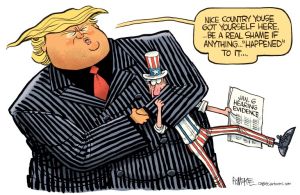 There’s more at the link. My question is, what the hell can the rest of us who don’t support him do? I voted Saturday morning, wondering which candidate I had voted for would even have a chance under the new gerrymandering. That doesn’t even consider that we couldn’t even vote for our Congressional representatives, given the Supreme Court decision and the quick fix redraw of our map to ensure maybe one black person will retain their seat. The only good news to come out of the election was that all five constitutional amendments proposed by Governor Klandry were voted down.
 My friend Robert Mann, a former Journalism Professor at LSU, has something poignant to say about the loss. This is from his SubStack. “Enjoy your tarnished legacy, Bill Cassidy. You earned it.” It’s a good lesson: while all politics is local, it can be influenced by a cult of personality.
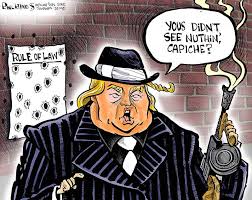 Speaking of Mafia-like behavior, here’s a little something on the Don’s Greenland Grab. This is from the New York Times. “In Closed-Door Talks, U.S. Demands a Major Role in Greenland. Greenlandic officials worry about the direction of the negotiations aimed at defusing President Trump’s threats to seize their island. But they have little leverage.” The story has a number of contributing reporters.
 There’s a lot more at that gifted link. Jeer Heeter has this description of our Grifter-in-Chief in his article in The Nation. “Trump Gloats About “Making a Fortune” While Americans Suffer. As his war in Iran wreaks havoc, Trump is fixated on personal glory and enrichment.”

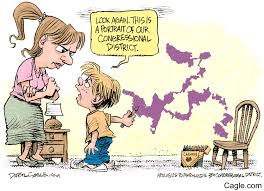 Redistricting could change the House Map. This is the next question the article addresses.
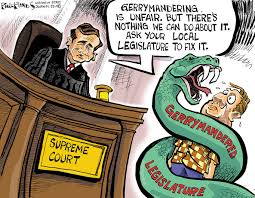 Khaya Himmelman has more information about the Virginia situation in Talking Points Memo. “Virginia State Supreme Court Strikes Down Dem Redistricting Proposal.”
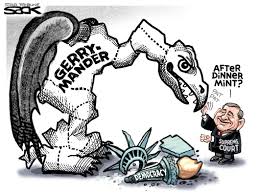 G. Elliott Morris has an analysis up today that breaks down the statistical assumptions the Supreme Court used. This comes from his site Strength in Numbers. “The simple statistical error Republican Supreme Court justices used to gut the VRA. The Court says vote dilution can be proven only after controlling for “controlling” racial polarization rather than partisan polarization. This is a nonsensical and impossible test.” For a kid who hated her algebra classes, I sure live in the realm of statistical and econometric analysis now. It helps to understand the numbers, believe me.
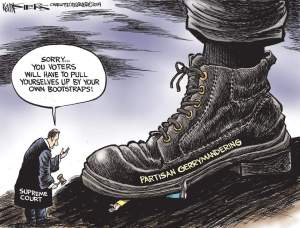 This is the decision that will dilute the vote of New Orleans and every black citizen of Louisiana. Again, here’s the link to the Governor’s site announcing the decision to gerrymander the state prior to voting for our Congressional Representatives. “Governor Jeff Landry Suspends Only U.S. House Primary Elections Following Supreme Court Ruling.” My mind boggles every time I read anything on this.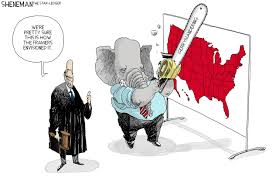

 peej
peej Carissa
 bostonboomer
 dakinikat
 ecocatwoman
 jjlo
jjlo mablue2
 Mama Lopez
 peggysue22
 quixote
 skydancingguestblogger
 Mona (aka Wonk the Vote)



 Sky Dancing
Recent Comments