
Mostly Monday Reads: The February 2026 Blues
Posted: February 2, 2026 Filed under: #FARTUS, Broligarchy, ethics, kleptocracy | Tags: Black History Month, Corrupt SCOTUS, Department of UnJustice, ICE Crimes Against Humanity, Welcome Home LIam!!! 6 Comments
“Groundhog Day is serious business for our illustrious Homeland Security Secretary.” John Buss, @repeat1968
Good Day, Sky Dancers!
This year has started out with violence and erasure of those members of our diverse nation that are deemed inconvenient to the old white christian nationalist me. Trump and his Klan have forsaken everything promised in our laws and Constitution. They’ve replaced it completely with identity politics and allegiance to an orange guy who likely has never read an entire verse of the Bible in his lifetime. The headlines lack substance and describe horror.
I’ve two rather nerdy articles that will impact all of us if we don’t pay attention. The third is basically more deadly results of Trumpian incompetence. The Groundhog and the annual celebration of Black excellence are on the calendar, but not the news desks today. Let’s focus on why justice and equality of been taken off the American agenda and replaced with mayhem and hatred.
 First up is an article at the New York Times. It’s written by Jodi Kantor. “How the Supreme Court Secretly Made Itself Even More Secretive. Amid calls to increase transparency and revelations about the court’s inner workings, the chief justice imposed nondisclosure agreements on clerks and employees.” There’s enough injustice nowadays to go around for everyone but rich old men and the traditional sellout members of disenfranchised Americans.
In November of 2024, two weeks after voters returned President Donald Trump to office, Chief Justice John G. Roberts Jr. summoned employees of the U.S. Supreme Court for an unusual announcement. Facing them in a grand conference room beneath ornate chandeliers, he requested they each sign a nondisclosure agreement promising to keep the court’s inner workings secret.
The chief justice acted after a series of unusual leaks of internal court documents, most notably of the decision overturning the right to abortion, and news reports about ethical lapses by the justices. Trust in the institution was languishing at a historic low. Debate was intensifying over whether the black box institution should be more transparent.
Instead, the chief justice tightened the court’s hold on information.Its employees have long been expected to stay silent about what they witness behind the scenes. But starting that autumn, in a move that has not been previously reported, the chief justice converted what was once a norm into a formal contract, according to five people familiar with the shift.
Over the years, journalists and authors have sought to penetrate the court, and the justices have tried varying methods to guard its secrets. Some generations of clerks, but not others, said they were asked tosign a different kind of confidentiality pledge.
The New York Times has not reviewed the new agreements. But people familiar with them said theyappeared to be more forceful and understood them to threaten legal action if an employee revealed confidential information. Clerks and members of the court’s support staff signed them in 2024, and new arrivals have continued to do so, the people said.
A spokeswoman for the court declined to comment about the nondisclosure agreements. She also did not respond to a question about whether the justices have been asked to sign the contracts.
The people who described the agreements spoke on the condition of anonymity because they were not authorized to speak publicly about court matters.
The justices are accustomed to controlling what the public knows about their work, sealing nearly everything but their oral arguments and written opinions behind a high wall of secrecy. Courts are excluded from the open records laws that require many other government bodies to maintain and make available internal information.
The justices claim their papers belong to them, not the government or the public, and generally arrange to have them locked away until long after their deaths. The court releases no visitor logs to reveal who meets with the justices.
 This comes after a series of leaks and reports about the Court’s inner workings. We’re entering a period where it will take some real balls to be a whistleblower, knowing what kind of misfortune comes to those in any branch of government who dare question the wannabe king and his court of sycophants. The second article on liberty and justice comes from Steve Vladeck’s Substack One First. “207. The Justice Department Beclowns Itself (Again). The denouement of DOJ’s misconduct complaint against Chief Judge Boasberg provides useful lessons relating to both the Department’s continuing misbehavior and the emptiness of calls for impeachment.”
There is, as ever, too much court- (and Court-)adjacent news to cover, including this morning’s New York Times double-feature on the Chief Justice’s move to have Court employees sign non-disclosure agreements and on the Times’s own expanding coverage of the Court. But I wanted to use today’s “Long Read” to come back to a post I wrote last July—shortly after the Department of Justice submitted (and then Attorney General Bondi tweeted about) an unprecedented judicial misconduct complaint against the chief judge of the D.C. federal district court, James E. Boasberg. As I wrote at the time, DOJ’s complaint was “almost laughably preposterous.” The gravamen of its charge was that Boasberg had violated the Code of Conduct for United States Judges by relaying (at a private breakfast with the Chief Justice and a group of other district judges before a meeting of the Judicial Conference of the United States) that several of his colleagues were worried about the Trump administration potentially defying their rulings.
That complaint is back in the news because late last week, we finally learned about its outcome. After a bit of procedural shuffling that I’ll explain below, it was dismissed, quite cursorily, by Sixth Circuit Chief Judge Jeffrey Sutton in a … brusk … seven-page memorandum and order. Not only did Sutton pour cold water on DOJ’s theor(ies) of Boasberg’s misconduct, but he also expressed understandable frustration with the fact that DOJ never produced the document that it claimed memorialized Boasberg’s alleged misconduct—even after it was specifically told that it needed to do so to substantiate its claims.
In other words, after filing an unprecedented complaint against a sitting federal judge, making a big public stink about it (which, by the way, was itself a violation of the law), and having its complaint invoked as one of the grounds for the proposed impeachment charges against Chief Judge Boasberg, DOJ … never followed through. It turns out, it was never about adjudicating Boasberg’s behavior; it was about making splashy headlines and fueling right-wing attacks on the judiciary without regard to whether DOJ’s specious charges would withstand meaningful scrutiny.
The obvious takeaway is that the Department of Justice has once again beclowned itself. I’d say it has shredded even more of its credibility, but when you’re publicly soliciting for new lawyers to apply via Twitter (with the primary qualification being that they “support President Trump”), there may not be any credibility left to shred. Instead, the more significant takeaway is that this really ought to be the final nail in the coffin of congressional Republicans’ breathless efforts to gin up impeachment charges against a judge whose only actual sin, as it turns out, was to decline to roll over when the government defied one of his orders, and then lied about it.
Read more details on the case at the link. Watching a war within the Judicial Branch is not something I had on my bingo card. This tragic headline is reported by Stephanie Kothan, writing for the San Antonio Current.”Source: Measles outbreak reported at ICE’s Dilley family detention facility. ICE officials informed members of the Senate Judiciary Committee about the outbreak, immigration attorney Eric Lee said.”
After a week of public outcry over the South Texas Family Residential Center’s treatment of young children behind its walls, the Dilley facility is experiencing a measles outbreak, according to immigration attorney Eric Lee.
Lee, who went viral last week for capturing the moment a protest broke out inside the facility, told the Current that Immigration and Customs Enforcement (ICE) informed Senate Judiciary staff of the outbreak over the weekend. At least two cases have been confirmed at the facility as of press time, the attorney said.
Over 400 children are detained at the Dilley facility, which currently holds approximately 1,200 detainees.
Speaking with the Current on the phone, Lee detailed the harsh conditions families already experience inside, including “food with worms, bugs in it.” Lee also described the putrid smell of the water families are forced to drink, which they also have no choice but to mix with baby formula.
Lee represents a family of six inside the facility, including several small children.
One of the children, all of whom have spent a birthday in the facility, suffered from appendicitis and was told by staff to take a pain reliever. He was later rushed to the hospital to have his appendix removed after his condition had worsened.
“He nearly died,” Lee said.
Speaking at a press conference outside of San Antonio City Hall on Wednesday, Congressman Joaquin Castro, D-San Antonio spoke of a 2-month old baby detained at the facility “for four or five days.”
Measles was declared eliminated in the Unites States in 2000, but it is again circulating in parts of the country.
“[I]ncreasing numbers of measles infections — driven by misinformation about vaccines and reduced vaccination rates in some communities — have been reported over the last five years,” according to report by University of Chicago Medicine.
 CBS News has this follow-up. “ICE halts all movement at Texas detention facility due to measles infections.” This story is reported by Camilo Montoya-Galvez.
U.S. Immigration and Customs Enforcement halted “all movement” at a detention center in Texas for families and quarantined some migrants there after medical staff confirmed two detainees had “active measles infections,” the Department of Homeland Security said Sunday.
The measles cases at the Dilley Immigration Processing Center were detected Friday, Department of Homeland Security spokesperson Tricia McLaughlin said in a statement to CBS News. The ICE facility houses parents and children taken into federal custody over alleged violations of immigration law. It is located in south Texas, roughly an hour drive from San Antonio.
“ICE Health Services Corps immediately took steps to quarantine and control further spread and infection, ceasing all movement within the facility and quarantining all individuals suspected of making contact with the infected,” McLaughlin said.
McLaughlin said medical officials were monitoring detainees and taking “appropriate and active steps to prevent further infection.”
“All detainees are being provided with proper medical care,” she added.
Before McLaughlin’s statement on Sunday, immigration lawyers had reported concerns about a potential measles outbreak at the Dilley center.
Neha Desai, a lawyer for the California-based National Center of Youth Law, which represents children in U.S. immigration custody, said she hopes the measles infections at Dilley are not used to “unnecessarily” prevent lawmakers and attorneys from inspecting the detention center in the near future, citing broader concerns about the facility.
“In the meantime, we are deeply concerned for the physical and the mental health of every family detained at Dilley,” Desai said. “It is important to remember that no family needs to be detained — this is a choice that the administration is making.”
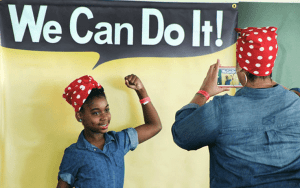 This neat link shows that at many levels of the Federal Government, our Federal Workers are still trying to make it work! “February is Black History Month. The Library of Congress, National Archives and Records Administration, National Endowment for the Humanities, National Gallery of Art, National Park Service, Smithsonian Institution, and United States Holocaust Memorial Museum join in paying tribute to the generations of African Americans who struggled with adversity to achieve full citizenship in American society.” It covers many topics, including the role of Black Americans in the Military,
More than 400 years of Black history and heritage are preserved in national parks and communities around the country. Discover stories shared by people who formed powerful connections with these places of history, nature, and enjoyment. Inspire others by sharing your “park story”!
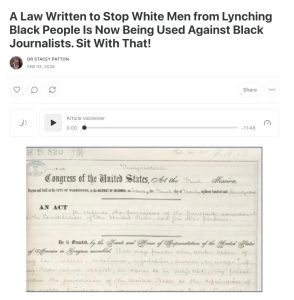 Here is one sad example of the backsliding today, as reported by Dr. Stacey Patton on SubStack. “A Law Written to Stop White Men from Lynching Black People Is Now Being Used Against Black Journalists. Sit With That!”
The Klan was not a disorder problem. It was not a public nuisance. It was a domestic terror machine built to erase Black citizenship through fear, spectacle, and mass killing.
And now, more than 150 years later, that same legal architecture is being aimed in the opposite direction. Not at racial terror networks. Not at organized white nationalist violence. Not at the groups openly fantasizing about civil war and racial cleansing online. At Black journalists documenting racial injustice in real time. That is not irony. That is the goddamn strategy!
Because American racial power has never only been about domination. It has always been about narrative control. Who defines violence. Who defines disorder. Who defines threat. And one of the most reliable tools in that playbook is inversion.
Inversion is when civil rights law becomes “reverse discrimination.” Anti-lynching language becomes “law and order.” Voting rights enforcement becomes “election interference.” Anti-racist speech becomes “racial division.” And now, a Reconstruction-era anti-terror statute becomes a tool to criminalize Black documentation of racial injustice.
The pattern is brutally consistent. Civil rights protections are not just attacked. They are eventually repurposed. Not immediately. Not clumsily. But strategically. Once enough historical distance exists for the original bloodstains to be blurred, sanitized, or erased. And that erasure is not accidental.
Because you cannot weaponize civil rights law against Black people unless you first strip it of memory. You have to remove the smoke. The photographs. The testimonies. The written admission that white citizens once terrorized Black ones while state governments stood aside.
Once you erase that, you can do anything.
 Orange Caligulia cannot keep his hands off our National Treasures. We’ve already lost the historic East Wing of the White House. Are we about to see the Kennedy Center be the next disaster brought on by Trump’s nasty taste and love for wrecking real estate? This is from the AP. “Kennedy Center will close for 2 years for renovations, Trump says, after performers’ backlash.” This seems to be the destiny of some of our most important Federal and Heritage sites.
President Donald Trump said Sunday he will move to close Washington’s Kennedy Center performing arts center for two years starting in July for construction, his latest proposal to upturn the storied venue since returning to the White House.
Trump’s announcement on social media follows a wave of cancellations by leading performers, musicians and groups since the president ousted the previous leadership and added his name to the building. Trump made no mention in his post of the recent cancellations.
His proposal, announced days after the premiere of “Melania, ” a documentary of the first lady was shown at the center, he said was subject to approval by the board of the Kennedy Center, which has been stocked with his hand-picked allies. Trump himself chairs the center’s board of trustees.
“This important decision, based on input from many Highly Respected Experts, will take a tired, broken, and dilapidated Center, one that has been in bad condition, both financially and structurally for many years, and turn it into a World Class Bastion of Arts, Music, and Entertainment,” Trump wrote in his post.
Neither Trump nor Kennedy Center President Ric Grenell, a Trump ally, have provided evidence to back up their claims about the building being in disrepair, and last October, Trump had pledged the center would remain open during renovations. In Sunday’s announcement, Trump said the center will close on July 4th, when he said the construction would begin.
So, that’s it for me today! Take care of yourselves and remember that there are more of us than them. We just need to continue to remind them of it!
What’s on your Reading, Action, and Blogging list today?
Monday Reads: How is this even a Thing? I try to fully Celebrate Black History Month this year
Posted: February 4, 2019 Filed under: 2018 elections, 2020 Elections, morning reads | Tags: Black History Month 72 Comments
RL Barnes, Ph.D. @DigitalHistory_ 24 Oct 2018 More “In 1828, T.D. “Big Daddy” Rice, a struggling white actor, made his New York stage debut. With a single dialectical song performed in blackface, his routine radically transformed the cultural landscape of North America.”
Well, it’s Monday Sky Dancers and it’s never too late to learn new things unless you’re Donald Trump.
The appalling way women have been historically treated was one of the hallmarks of the last two years. The #MeToo movement led to a very differently looking congress in 2018. The #BlackLivesMatter movement went back front and center yesterday at the Super Bowl.
It’s Black History month and it’s time to find teachers and take lessons. It’s also evidently time to relearn a few lessons some people failed to get the first million times out.
I’m fully beginning to think that the next election will be about the historically shameful way that Black people have been treated up to and way pass the Emancipation Proclamation and the enfranchisement of Black men into the voting populace in 1870 with the passing of the 15th Amendment. Virginia has once again taken center stage.
How can a man my age think that participating in any form of black face as an adult in any manner during–at the very least–the back half of the 20th century forward think that’s not an offense that should cause you to resign your position as Governor of the state that basically was ground zero for American slavery? How can a Democratic leader who relied on votes from African Americans not do the right thing? When will Virginia Governor Ralph Northram resign?
The drumbeat spread to the state’s public universities. The College of William and Mary on Monday announced that Northam would not attend Friday’s inauguration of new president Katherine Rowe, saying in a statement that “the Governor’s presence would fundamentally disrupt the sense of campus unity we aspire to and hope for with this event.”
University of Virginia president James Ryan issued a statement Sunday suggesting that Northam should resign, saying that if a leader’s “trust is lost, for whatever reason, it is exceedingly difficult to continue to lead. It seems we have reached that point.”
On Sunday night, the governor met with senior staffers of color to discuss his future following two days of defiance against the national clamor that he should resign. People familiar with that meeting said Northam had not reached a decision.
It was unclear who was present, but the group did not include Lt. Gov. Justin Fairfax (D), who would become governor if Northam resigned, the people said. One Democratic official said the meeting was emotional in tone.
Calling the Sunday night meeting was a clear signal of Northam’s effort to weigh support within the administration as he evaluates his options. Although he pledged Saturday to stand his ground, he also said he would reconsider if he thought he could no longer be effective.
https://twitter.com/DigitalHistory_/status/1091782769708011522
Though blackface was the No. 1 entertainment form throughout the United States in the 19th century, it has a particularly notable legacy in Virginia. The first globally famous minstrel troupe hailing from New York City rebranded itself as the Virginia Minstrels in 1843. Dan Emmett, the group’s founder, understood his minstrel troupe needed to project a sense of authentic, stereotypical blackness. Virginia, a state that imported enslaved Africans as a colony as early as 1619, embodied the complex relationship between blackface entertainment, slavery and American culture in a single word. The troupe did not just borrow Virginia’s brand, but shaped it: Its song “Dixie” became the unofficial Confederate anthem.
That legacy can be seen in the history of blackface at the University of Virginia, founded and designed by another Virginia governor: Thomas Jefferson. Virginia was a state built on enslaved labor, and U-Va. was no different. Beginning in 1830, the university would “hire out” enslaved people from the surrounding area. Eventually, U-Va. purchased humans like “Big Lewis” Commodore in 1832 at auction for $580, permanently separating him from his family.
Virginia’s slave empire ended when African American slaves fought for their freedom in the Civil War. After 1865, Lewis Commodore was free. But when slavery disappeared, fundraising with amateur blackface minstrel shows and city minstrel parades emerged. They featured fictionalized blackface slaves and their Klansman counterparts — a pairing on display in the Northam photo — to sustain Virginia’s infrastructure and segregated economy, as well as to inculcate new generations into a form of white supremacy associated with collegiality, school spirit and patriotism.
Over the weekend, BB introduced me to Dr RL Barnes and her area of research which is basically the not so subtle and the subtle ways that the Institutions of this country remind every one of what racists think is the “place” of Black Americans in their own country. It’s also about how some of us passively, stupidly, and naively go along with it and internalize it.
I remember poring over literature, laws, and popular culture in the 1970s discovering how language, pictures, stories, and culture all work together to keep women in their “place”. As a teenager and young adult, it became very freeing to be able to point these things out and to discover it wasn’t all in your head that menfolk and their enabling women were out to get you.
I knew there was similar things in place for people of color including all the stereotypes of Native Americans, Hispanics, and African Americans that culture, the law, and society can feed you. I’m beginning to read stories of friends much the same way I read stories of friends screaming Me Too.
There was also a history of casually tossing bags of them on to the lawns of “inconvenient” neighbors which seems a bit like something the KKK would do. How is this a thing?
Bridging that gap requires unpacking why, for many black people and people of color, raw cotton is a symbol of racial terror.
Cotton represents the product of a system that required slave labor to function. More recently, perpetrators of racial intimidation have used cotton as a symbol of their hatred. Before white robes became the uniform, some KKK members wore ceremonial hornsstuffed with cotton. Two white men seeking to intimidate and unsettle members of the University of Missouri’s Black Culture Center littered the front lawn of the Center with cotton balls. The word even fills the mouths of students who bully their black peers by calling them “cotton pickers.”
Jasmine Gales, a black woman and social activist in Nashville, explains how this context translates into the contemporary mindset of many people of color:
“Black people’s association with the cotton plant is an obvious one of trauma and suffering,” she wrote for The Tennessean. “In being culturally sensitive to the history of African-Americans which includes slavery and the free labor of cotton harvesting, an institution wouldn’t choose to display it at a dinner meant to uplift the black experience.”
The individuals who reacted defensively or dismissively to the cotton complaints either ignored this context or were ignorant of it entirely. If there wasn’t an explicitly racist motive behind the design choice, they reasoned, then it wasn’t a problem.
Neither perception reflects an absolute truth. But the chorus of naysayers trying to drown out the voices of two black women reflects a power dynamic that must inform a culturally responsive interpretation.
So, I was horrified back in 1986 when the CJ Howell movie “Soul Man” came out. Haven’t seen it. Wouldn’t see it. Still can’t believe some one released and funded it and filmed it. It had obvious implications for my generation because of the Bakke Supreme Court decision in 1978 and my experience with busing and integration prior to that in and around 1973. There were mad white people every where about those decisions but I kind’ve wrote it all off to crazy white uneducated southern white trash and didn’t really explore it. Well, I’m exploring it now and finding that my assumptions were naive. Well, stupid if you really want the truth
There is, of course, no acceptable way for deeply unacceptable films to reach their merciful conclusions. But Soul Man manages to confound even one’s worst expectations. Before Mark’s big reveal to the campus, Gordon assumes the role of a pseudo-defense attorney, flipping the script on the product-of-his-environment argument. Mark, he argues, was brought up to be selfish and entitled, the product of an upper-crust white family in the suburbs. “Can you blame him for the color of his skin?”
For some reason, James Earl Jones’s character agrees with the assessment, and is even amused by Mark’s stunt. “You must have learned a great deal more than you bargained for through this experience,” he remarks, grinning. “I didn’t really know what it feels like, sir,” adding, “If I didn’t like it, I could always get out.”
That line is the movie’s nauseating coup de grâce, intended to justify the fact that Mark gets off with little more than a slap on the wrist for his deception. He tells Jones’s character that he wants to finish his law degree to “do some work that might be of use to someone.”
Mark’s happy ending prefigures a new era of racist film: the 21st-century white savior flick, a future constant in multiplexes and on Oscar ballots.
The deal is this. The blackface thing in that Virginia med school during the 1980s wasn’t an outlier. It was evidently another one of those “things” that I had no clue was a thing. I’m fortunate to know many New Orleans Writers and bloggers including a young black woman whose outrage at a cottonball decoration introduced me to more subtle ways that white culture continues to terrorize Black Americans.
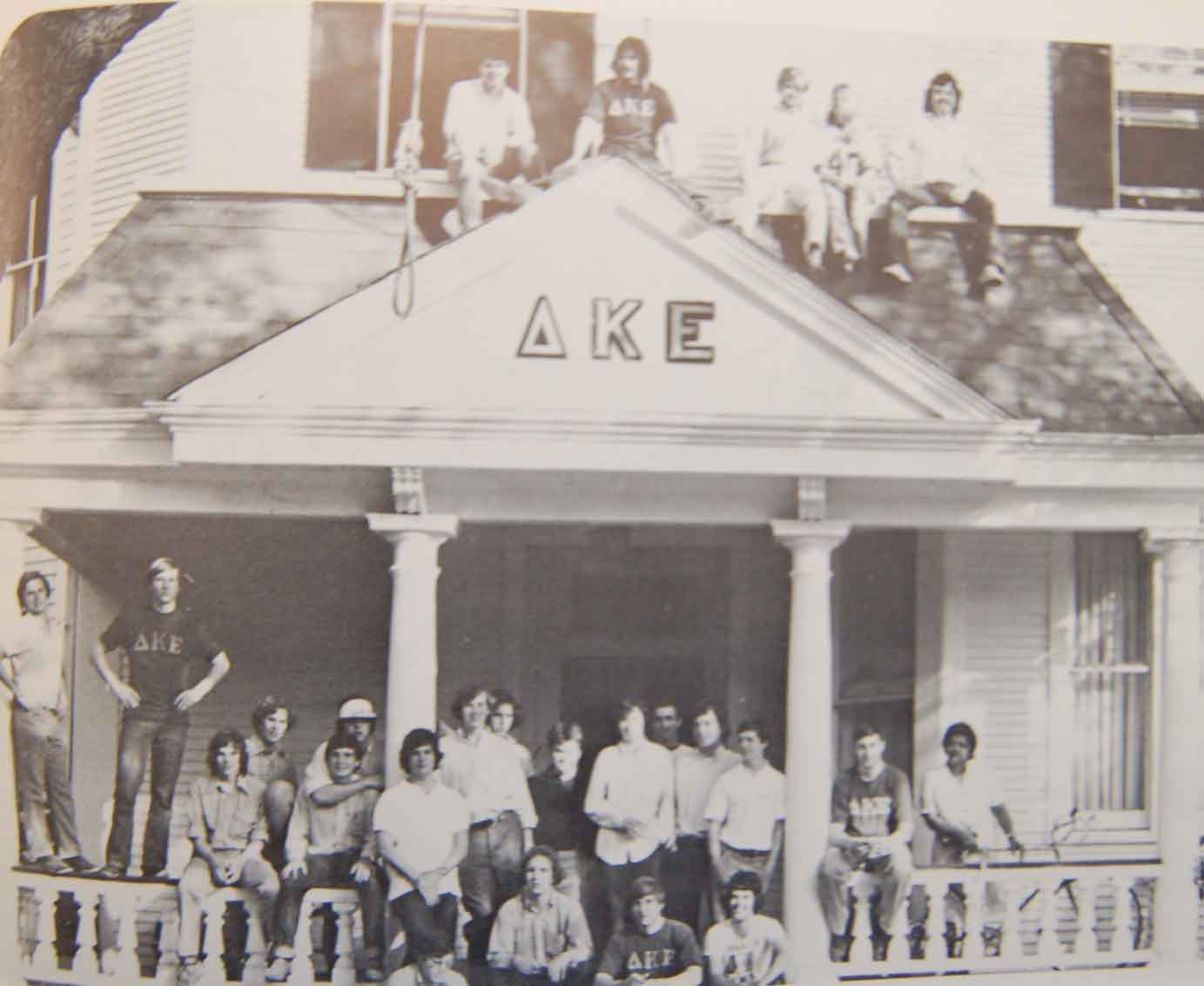
I thought it prescient to repost this story today to remind folks that institutionalized racism is still alive and thriving behind the closed doors of collegiate fraternities throughout the South. Also to point out that the universities themselves should not be blamed. As evident in my story, Tulane struggled for years to separate the DKE’s from the school’s namesake going so far as to kick them off campus and not recognize them as an official fraternity. They existed as an independent entity living off-campus until the cancer finally died out around the late 90’s, or at least it went into remission. I would hope it’s dead but judging by the impenitent attitudes of the former DKE’s in the comment section of my post I would assume an entire new generation of kids are now carrying their fathers’ prejudices with them under alternate letters of the Greek alphabet.
My favorite dodge in that comment section was the DKE alum who tried to convince me that the noose in the 1975 yearbook picture was actually a tire swing sans tire:
A “tire swing sans tire” hanging twenty-something feet in the air would lead me to believe all these guys were on the Tulane pole vaulting team. And how, exactly, did the tire disappear from the noose? The tire split before the rope did? No one thought to ask, “Hey…you know…we have a noose hanging in our yearbook picture…should we take that down?” What a load of shit.University of Oklahoma president David Boren voiced his distaste with the actions of the SAE’s but he may have a hard time eradicating the fraternity from the campus if he so chooses. Once again, I don’t want to blame the educational institution itself, the actions of these fraternities do not represent the morals of the body wh ole. Anyway, here’s the story, reposted:

State Sen. Ernie Chambers (2017)
You may read Jason Brad Berry’s 2010 story at this link. I was in college at the University of Nebraska at the time. I was in grad school at the time of Northram’s adventure. I personally know of no one in my circle that would’ve done anything remotely like that even though I did witness a number of horrifying angry white people during the Omaha Public Schools “busing” policy’s start.
I grew up knowing that Omaha purposefully designed its interstate system to isolate the black part of town that provided the only black representative in the state’s unicameral. His voice was powerful and pissed off that powers that be for decades which frankly thrilled me to pieces. Senator Ernie Chambers turned 80 in 2017 and his legacy will be a forever thing there. Still, finding all this stuff went on with me totally unwoke embarrasses me and made me extremely sad. Senator Chambers was my primary teacher on racism until I moved to New Orleans. I have found I need more teachers. I need to learn more about these things that I did not know were a thing.
https://twitter.com/DigitalHistory_/status/1092457601747636224
 As I delve more into Black history with so many motivations that it’s hard to unwind them all, I turn to this “How Frederick Douglass Harnessed the Power of Portraiture to Reframe Blackness in America”. Douglass knew the power of an image before nearly any one.
For Douglass, this was no happy accident. Today, he is remembered as an influential advocate of emancipation and civil rights, a legacy defined by his best-selling autobiographies and powerful speeches. But what has largely been forgotten is the way he deftly manipulated the power of images to advance his cause.To put it simply, Douglass was a photography buff. He penned four speeches expounding upon the medium throughout his life—one more than the man considered the Civil War era’s most prominent photo critic. He held Louis Daguerre, the inventor of the daguerreotype, in great esteem for broadening photography’s appeal beyond the upper class. Because of daguerreotypes, Douglass claimed, “the humblest servant girl may now possess a picture of herself such as the wealth of kings could not purchase fifty years ago.” He viewed photography as the most democratic of the arts.He also believed deeply in its objectivity. “For Douglass, photography was the lifeblood of being able to be seen and not caricatured, to be represented and not grotesque, to be seen as fully human and not as an object or chattel to be bought and sold,” says Celeste-Marie Bernier, co-author of Picturing Frederick Douglass: An Illustrated Biography of the Nineteenth Century’s Most Photographed American (2015).Photography was the perfect tool for a man trying to rewrite racial prejudices in the United States, and Douglass sought out every opportunity to be captured. With each portrait, he could present America with an additional image of blackness that contradicted the prevailing racist stereotypes.

Zulu 1937
The king of Zulu rides on his float.
The last time I really thought about the history of blackface was back when there was discussion of the role of Zulu and the incredible racist roots of New Orleans’ Mardi Gras. Here’s something you may want to read about the krewe and its signature looks from New Orleans investigative paper The Lens.
It’s hard to measure the scope of Zulu’s influence on what the Times-Picayune’s Doug MacCash has called the “new” Mardi Gras, and on what I have called the restoration of carnivalesque carnival, after the dark ages of the white supremacist anti-carnival ushered in by the Mystick Krewe of Comus in 1857. It’s a remarkable testament to the resilience of carnival spirit that, in the midst of the white supremacist era, when Comus, Momus, Proteus, and Rex ruled the day, the Zulu king first stepped off a banana boat in the New Basin canal wearing a lard can crown. The date: 1909.
That’s why it’s so upsetting — also a bit absurd — when people who have no understanding or appreciation for carnival aesthetics and social analysis chime in from hundreds of miles away with self-righteous finger-wagging. What they’re about is shaming traditions that are far more revolutionary than they are able to comprehend.
That’s exactly what has happened this year, when Tales of the Cocktail founder Ann Tuennerman went up on Facebook with a picture of herself in Mardi Gras regalia and since then, after taking flack for it, has been agonizing through a multi-part act of public contrition. Tuennerman’s sin is to have had the temerity to accept the great honor of riding in the Zulu parade on Mardi Gras morning, wearing the traditional mask of Zulu blackface.
I say “Zulu blackface” because the style of blackface worn by Zulu riders is distinct from other forms of blackface viewed as offensive due to their history as a tool of white supremacist ideology. One of the distinctive visual features of Zulu blackface is an enlarged white eye on one side of the face, which can be seen in depictions of the Zulu Big Shot as well as on Tuennerman’s face in her much-maligned social media posting. In the world of totalitarian expression — the opposite of carnivalesque expression — such nuances of signification go unnoticed.
A typically clueless (and arrogant) response to Ann Tuennerman’s posting came from Chicago’s Nikkole Palmatier: “I have a problem with the blackface entirely. As do most people outside of the New Orleans tradition. Just as those who live outside of Cleveland think the Indians logo is racist and the term ‘Redskins’ is racist.”
Yeah. Just let that sink in for a minute. It’s hard to conceive of a more egregiously false analogy than this. Are the Cleveland Indians and Washington Redskins actually Native American institutions, founded, owned, and staffed, at all levels, by Native Americans?
Palmatier’s argument leads us to question whether Zulu’s iconography should be practiced by anyone, not just whether Zulu should accept white riders. And that’s a whole other can of worms. It calls into question the extent to which black people should be allowed agency in representing their own experience; it also places limits on how black people themselves choose to enunciate anti-racist arguments.
There’s also the Spike Lee film “Bamboozled” for an interesting take. This film was made in 2000.
I feel this year that I need to unpack a lot more about black history and experience than reading inspirational speeches by the Rev Dr. Martin Luther King, jr. We’ve all seen the images of black stereotypes that were prevalent in the pre Civil Rights era. I’ve only used the original “Jim Crow” here but we likely all know many more. For me, it’s time to learn some of the deeper stories and to listen more about how this country continually dehumanizes our Black Americans.
I intend to fully celebrate Black History month.
What’s on your reading and blogging list today?

 peej
peej Carissa
 bostonboomer
 dakinikat
 ecocatwoman
 jjlo
jjlo mablue2
 Mama Lopez
 peggysue22
 quixote
 skydancingguestblogger
 Mona (aka Wonk the Vote)





Recent Comments