
It’s the Jobs, Stupid!
Posted: June 22, 2009 Filed under: Global Financial Crisis, U.S. Economy | Tags: Job Creation, Lost Decade, The Great Recession, unemployment Comments Off on It’s the Jobs, Stupid!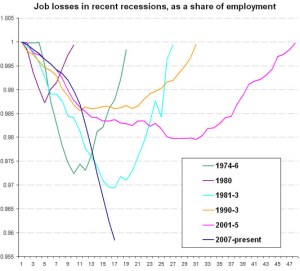 One glance at the national income accounts for the U.S. gives us the bottom line. Approximately 67 % of the spending in the country comes from households and nearly the same proportion of the source of that spending comes from wages and salaries. It may be all about oil revenue in places like Venezuela and Kuwait, but in the United States, it’s all about job creation. The job losses in this Great Recession–when compared with the other post-WW2 recessions–are much worse as you’ll see in the graphic on the left.
The news from the jobs market is bleak and that is one of the reasons I have trouble buying any green shoot hoopla. Take this headline from the Wall Street Journal “Cuts are Here to Stay, Companies Say”.
Many companies that have cut jobs, pay and benefits during the recession may not be quick to restore them.
According to a new survey, 52% of companies expect to employ fewer people in three to five years than they did before the recession began. The survey of 179 companies was conducted this month by consulting firm Watson Wyatt Worldwide Inc.
Among employers who have cut salaries, 55% expect to restore the cuts in the next year. But 20% expect the cuts to be permanent. Of employers who have increased employee contributions to health-care premiums, 46% don’t plan to reverse the increases. Of all survey respondents, 73% said they expect employees to shoulder more of the cost of health care than before the recession began.
The job market always lags the business cycle since companies are really slow to both fire and hire near the turning points. Companies like to insure they are not letting trained workers go needlessly and they don’t like to take on any costs if their revenues aren’t trending upward. Of course, recessions hit different segments of the labor market differently. A Weekly Standard headline “No Country for Burly Men” has one of the most interesting examples of the demographics of the Great Recession.
A “man-cession.” That’s what some economists are starting to call it. Of the 5.7 million jobs Americans lost between December 2007 and May 2009, nearly 80 percent had been held by men. Mark Perry, an economist at the University of Michigan, characterizes the recession as a “downturn” for women but a “catastrophe” for men.
Men are bearing the brunt of the current economic crisis because they predominate in manufacturing and construction, the hardest-hit sectors, which have lost more than 3 million jobs since December 2007. Women, by contrast, are a majority in recession-resistant fields such as education and health care, which gained 588,000 jobs during the same period. Rescuing hundreds of thousands of unemployed crane operators, welders, production line managers, and machine setters was never going to be easy. But the concerted opposition of several powerful women’s groups has made it all but impossible. Consider what just happened with the $787 billion American Recovery and Reinvestment Act of 2009.

 peej
peej Carissa
 bostonboomer
 dakinikat
 ecocatwoman
 jjlo
jjlo mablue2
 Mama Lopez
 peggysue22
 quixote
 skydancingguestblogger
 Mona (aka Wonk the Vote)





Recent Comments