
Friday Reads: Congress and its Sisyphus Heydays
Posted: December 12, 2014 Filed under: morning reads | Tags: Chromnibus 33 Comments Good Morning!
I have to keep it short today because I’ve got a lot of work to finish up within a week and I’m just about to collapse. Well, I actually I have a few times. I fell asleep mid-day for two days in a row now.
Still, I’ve kept a jaundiced eye on a lame duck congress who still hasn’t dealt with the financial obligations of the country. The same guys that vote for crap for their political sponsors and for world wide war just can’t seem to come up with the balls to pay their bills. Republican voters have condemned us to rolling rocks up mountains and just waiting for the inevitable crush. How can you hate your own country that much?
House Republican leaders are skating on thin ice with the government funding bill, facing stiff opposition from the left and the right that threatens passage just hours before a midnight deadline to avert a shutdown.
GOP leaders temporarily recessed the House and postponed a final vote scheduled for the afternoon, while informing members to be ready to vote.“Leadership teams are still talking to their respective Members. A vote is still planned for this afternoon,” a House Republican leadership aide said.
Republicans long expected some opposition from their right flank due to the fact that the $1.1 trillion spending bill doesn’t block President Barack Obama’s executive actions on immigration. What has thrown the plan into chaos is that numerous House Democrats are defecting over extraneous policy provisions that would weaken derivative trading rules on big banks and loosen campaign finance laws. The bill likely will need significant Democratic support to pass.
The Democratic opposition is being led by Rep. Chris Van Hollen (MD) and Sen. Elizabeth Warren (MA), who call the bank provision a giveaway to Wall Street.
According to multiple sources, the legislation was negotiated by GOP and Democratic leaders in the House and Senate. House Democratic leaders stress that they don’t support all the provisions in the bill but want to keep the government open. They say they are not whipping against the bill.
The White House came out for the bill after it cleared a test vote in the House by a narrow 214-212 margin earlier on Thursday. It said it objects to the weakening of Wall Street reform but signaled Obama would sign the bill anyway.
Republicans just won’t pay the bills unless Democrats agree to blow something up. It’s ridiculous. We’ve got a new political term for the lexicon. It’s a “Cromnibus” bill. It tries to tear apart what little Wall Street oversight regulation we’ve put through 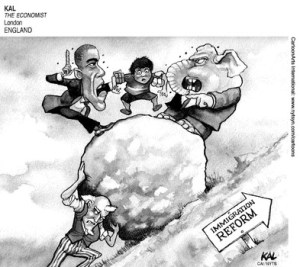 since the global financial crisis on Wall Street and Banks. It also increases the amount of money that an individual can give to a political party. So, we can either destroy our country now by not funding its debt and by not running our government or we can destroy it with more incentives to the financial gambling industry and to billionaire party sponsors.
The $1.014 trillion spending measure has been criticized for easing rules on campaign finance and the banking industry. But its supporters say it’s also a bipartisan deal that would fund most of the U.S. government until next October.
Disagreement over the bill forced the final vote to be delayed for hours Thursday. It also created unlikely alliances: The White House joined with House Speaker John Boehner to rally support for the measure, most House Democrats agreed with a small group of Republicans – including Rep. Michele Bachmann – that the bill should be rejected.
As we noted when the bill was agreed upon and published on Tuesday, the House was slated to hold the first vote on the spending bill Thursday, with the Senate to follow.
You can read the bill, broken down by government agency, on the House Appropriations Committee site.
The legislation was nicknamed “cromnibus” because it combines the traditional sweeping scope of an omnibus spending bill with a continuing resolution (CR). While it would fund most of the government until the next financial year, the Department of Homeland Security would only be funded through February, in a move that seeks to limit President Obama’s recent executive actions on immigration.
Another part of the measure would vastly increase the maximum amount of money a contributor can give to a political party.
“Right now a person can give just under $100,000 a year to a party through its various committees,” NPR’s Ailsa Chang reports on All Things Considered. “And under this bill, that cap goes up to almost $800,000.”
Shortly after noon Thursday, the bill squeezed by in the rules vote, 214-212, after Republican leaders including Speaker John Boehner and Chief Deputy Whip Patrick McHenry, walked the floor to bolster support, NPR’s Juana Summers reports.
After no Democrats voted in favor and more than a dozen Republicans defected to vote against, the House was adjourned so Boehner could organize his support.
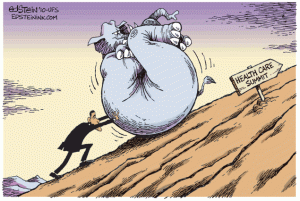 So, as of yesterday afternoon, here were the poison pills. This bill had Elizabeth Warren hopping mad. Please go check that they were basically a Grinch to the poor while giving the rich enough presents that elephants should be blushing.
In addition to spending appropriations, the bill includes changes to various laws that are known as “policy riders.” One of these is drawing sharp criticism from Democrats and financial industry watchdogs. The Dodd-Frank Wall Street reform package passed in 2010 on how banks that receive taxpayer backing can use high-risk financial instruments known as a swaps, which were a key driver of the last financial crisis. Banks and other financial companies the “swaps pushout rule,” which has been praised as a crucial component of the reform law by the White House, Sen. (D-MA), and Bush-era banking regulator .
In addition to spending appropriations, the bill includes changes to various laws that are known as “policy riders.” One of these is drawing sharp criticism from Democrats and financial industry watchdogs. The Dodd-Frank Wall Street reform package passed in 2010 put new limits on how banks that receive taxpayer backing can use high-risk financial instruments known as a swaps, which were a key driver of the last financial crisis. Banks and other financial companies hate the “swaps pushout rule,” which has been praised as a crucial component of the reform law by the White House, Sen. Elizabeth Warren (D-MA), and Bush-era banking regulator Sheila Bair.
The cromnibus repeals the swaps pushout rule. Americans for Financial Reform and the Leadership Conference on Civil and Human Rights blasted the move as “a backroom deal buried deep in a stopgap government funding measure” that will increase the risks taxpayers and the economy face. Former Rep. Barney Frank called it “a terrible violation of the procedure that should be followed on this complex and important subject, and a frightening precedent that provides a road map for further attacks on our protection against financial instability.”
Compared to repealing the swaps rule, Congress’ second gift to the financial industry is a mere stocking stuffer. But it will have long-term consequences for public oversight of risky Wall Street behavior. The bill gives the Commodity Futures Trading Commission (CFTC) a $250 million budget, which is $65 million less than what the White House asked for and $30 million less than the maximum CFTC budget that would have been allowed under last year’s long-term budget deal. While the CFTC number is an increase over previous years, the bill requires the agency to spend $50 million of the budget on information technology. The agency needs to upgrade its systems to perform its vast new responsibilities under Dodd-Frank reform, so the tech money is welcome in a sense. But it also needs way more money for staff than is allowed under the cromnibus budget. The bill won’t require layoffs at the CFTC, but it will prevent the agency from staffing up in the coming year to keep up with its growing role in regulating the financial industry, a Democratic staffer close to the negotiations told ThinkProgress. Departing CFTC commissioners have been saying for years that the agency is understaffed, and employee morale is dangerously low at the agency already according to press reports.
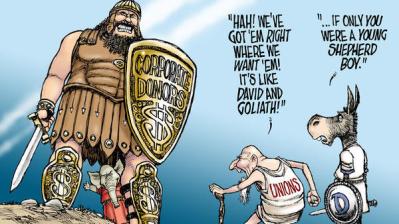
While several controversial policy riders were quickly discovered, it was the change to Dodd-Frank that generated the loudest outcry.
The provision would no longer require that big banks separate trades in financial derivatives from traditional bank accounts, which are backed by the government through the Federal Deposit Insurance Corporation (FDIC). The derivatives played a key role in the financial collapse.
Critics argue the change would leave taxpayers on the hook if trades explode. Former Rep. Barney Frank (D-Mass.) called it a “stealth attack” on his namesake achievement.
Still, it’s unclear whether the opposition from Warren, Frank and others will persuade House Democrats to risk a government shutdown by voting against the bill.
Even vocal critics in the Senate of the provision, such as Sens. Jeff Merkley (D-Ore.) and Sherrod Brown (D-Ohio), stopped short of promising to oppose it.
The White House, similarly, is not saying whether President Obama would sign the cromnibus, though White House press secretary Josh Earnest said he was “pleased” to see a bill produced.
The change to the Dodd-Frank law has enjoyed bipartisan support in the past.
Republicans and 70 House Democrats voted for a version of the tweak in 2013, with most arguing it would boost economic growth and lessen the regulatory burdens on banks.
“There’s huge misunderstandings about what this thing says,” said Rep. Jim Himes (D-Conn.), who was an early sponsor of the original House bill.
Himes argued that the most dangerous derivatives would still be kept away from government-backed banks under the provision, and that banks would only be allowed to trade “plain vanilla” interest rate swaps.
But that was yesterday afternoon, about last night ….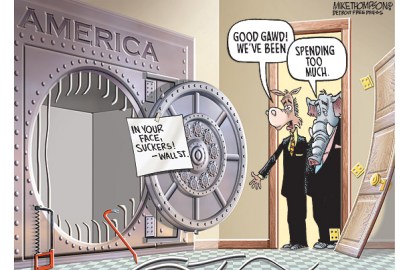
The House on Thursday approved a $1.1 trillion bill funding most of the government through September despite an outcry from Democrats and significant defections in both parties.
By a vote of 219-216, the House sent the bill to the Senate, where a similar debate may break out between liberal Democrats and the White House.
The vote split Democratic leaders, with House Minority Leader Nancy Pelosi (D-Calif.) opposing the bill and criticizing the White House, but Minority Whip Steny Hoyer (D-Md.) backing it. Fifty-seven Democrats voted for the bill, while 139 opposed it.
Hoyer said it was “better to pass it than to defeat it.”
Democrats objected to changes to the Wall Street reform bill that were included in the 1,600-page bill, and many were unswayed by a last-ditch White House lobbying push.
Conservative Republicans, meanwhile, opposed the bill for not doing more to curtail President Obama’s executive actions on immigration. While 162 Republicans voted for the bill, 67 rejected it.
For much of the afternoon and evening, the bill looked to be at death’s door as a government shutdown loomed at midnight.
The bill’s passage, as a result, was a remarkable victory for both Speaker John Boehner (R-Ohio) and President Obama, who were able to cobble together the votes for passage.
The so-called “cromnibus” included an omnibus of 11 appropriations bills funding most of the government through September, and a continuing resolution funding the Department of Homeland Security through Feb. 27.
“This plan was put together after consultation with our members,” Boehner told reporters Thursday morning. “And we worked through this process in a bipartisan, bicameral way.”
He implored his members to back it: “Listen, if we don’t get finished today, we’re going to be here until Christmas.”
GOP leaders suspended debate on the floor for hours as the White House made a push to win over Democrats.
House Democrats have long-been agitated with the White House and its outreach efforts, but they’ve largely kept the grumbling behind closed doors and off the record.
With the arrival of the “cromnibus” debate — and Obama’s backing of the package — the frustrations spilled over.
Pelosi, rarely a public critic of the president, minced no words in denouncing the “cromnibus” — and Obama’s support for it.
Yes, you read that right. The President supported and also lobbied for the cromnibus despite it containing some really really awful things. Pelosi turned on the President. It passed by 1 voted. Yup, that’s right ONE VOTE. The Senate just gave itself 2 days to pass the monster. Oh, btw, the part about giving more money to political parties? That’s the REID-Boehner Bill. You won’t believe what got slipped into this 1600 page budget bill.
If anything, Thursday’s tumult highlighted the disconnect between Obama and congressional Democrats. Nancy Pelosi, the House Democratic leader, came out in strong opposition to the measure even as Obama was pressing her members to back it.
Democrats aligned with Pelosi took issue with policy provisions added to the bill addressing campaign finance reform and a key provision of the financial overhaul.
“This bill puts a big bow on a holiday gift for the Wall Street contributors who get special treatment in the provisions of this bill,” Rep. Lloyd Doggett, D-Texas, said ahead of the vote. “It’s all about stuffing the silk stockings, and these people want to gamble with our money.”
Conservative Republicans, meanwhile, fought the bill because they were angry that it didn’t combat Obama’s executive action on immigration.
We are so screwed. What’s on your reading and blogging list today?

 peej
peej Carissa
 bostonboomer
 dakinikat
 ecocatwoman
 jjlo
jjlo mablue2
 Mama Lopez
 peggysue22
 quixote
 skydancingguestblogger
 Mona (aka Wonk the Vote)



 Sky Dancing
Recent Comments