
Finally Friday Reads: Deadly Dysfunction
Posted: December 5, 2025 Filed under: #We are so Fucked, Breaking News, Corruption and Criminal Insanity, Foreign Affairs, GOP Crimes Against Humanity, ICE Immigration and Customs Enforcement, ICE raids, New Orleans, Venezuela | Tags: @johnbuss.bsky.social John Buss, anti-vaccination twits, Attacks on Venezuala, No Quarter, RFK Jr Weirdo, The Media SUCKS 12 Comments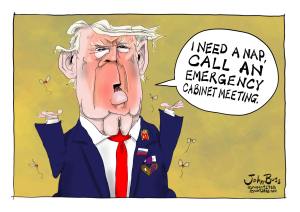
“I’m not sure, but that Cabinet Meeting may have been the most entertaining one yet. Two hours of trump fighting off sleep, like the toddler he obviously is, while his minions heaped praise upon his barely coherent body.” John Buss, @repeat1968
Good Day, Sky Dancers!
And, hello again from Occupied New Orleans. We’ve had cold rainy weather for quite some time. Perhaps it will wash aways some of the dirty ICE terrorizing the city. The stories get more horrific and we’re barely into the first week of it. The complete idiocy with which this administration operates is ruining the country and a lot of it brings unnecessary death. I only wish we had a Congress that would function the way it was designed and a much better press. Let’s dig in while my tea is still hot.
The latest maneuvering of RFK jr’s death panels is once more directed to childhood vacinations. Where are all these supposedly pro-life people when something other than a fertilized egg is involved. No one cares about actually breathing children? This is from the Washington Post. “CDC panel makes most sweeping revision to child vaccine schedule under RFK Jr.. The panel voted to eliminate a long-standing recommendation for every newborn to receive a hepatitis B shot, excluding those born to mothers testing negative.”
An influential vaccine advisory panel on Friday voted to lift a long-standing recommendation that all newborns receive a vaccine for hepatitis B, marking the most significant change to the childhood immunization schedule under Health Secretary Robert F. Kennedy Jr.
The Advisory Committee on Immunization Practices approved the change despite fierce objections from medical groups who said the recommendation had proved a successful public health strategy, nearly eradicating the dangerous virus among U.S. children.
The committee voted 8-3 to eliminate a recommendation, dating to 1991, for every child to receive a first dose of a hepatitis B vaccine shortly after birth. The panel said the newborn shot is no longer necessary for babies born to mothers who test negative for the virus. They suggested parents of those children delay the first dose for at least two months and consult with their doctors about whether or when to begin administering the three-dose series.
Supporters of the change said the universal recommendation regardless of risk was overly broad and undermined informed choice. Retsef Levi, an ACIP panelist who voted to change the language, said he believes the intention is to push parents to consider whether they want to give another vaccine to their child.
“It’s actually suggesting a fundamental change in their approach to this vaccine and maybe more broadly,” said Levi, a professor of operations management at MIT.
The recommendation from the group of outside government advisers goes to the acting director of the Centers for Disease Control and Prevention for final approval.
Medical experts have argued that it’s important to vaccinate all newborns for hepatitis B, even if their mothers test negative, because babies are at risk of infection if their mothers receive a false negative or become infected after testing. Some of the dissenting panel members pushed back on the change — one called the revised guidance on hepatitis B unconscionable, while another said the move was rooted in “baseless skepticism.”
“We will see hepatitis B infections come back,” said panelist Cody Meissner, a professor of pediatrics at the Geisel School of Medicine at Dartmouth. “The vaccine is so effective, it does not make sense in my mind to change the immunization schedule.”
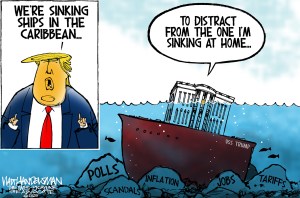 Select lawmakers were around yesterday for a hearing about the lastest, criminal act by our country against Venezuelan boats. The stories offered up by the Department of War were quite different than the story told by the film. This is from CNN. “Exclusive: Survivors clinging to capsized boat didn’t radio for backup, admiral overseeing double-tap strike tells lawmakers.”
The two men killed as they floated holding onto their capsized boat in a secondary strike against a suspected drug vessel in early September did not appear to have radio or other communications devices, the top military official overseeing the strike told lawmakers on Thursday, according to three sources with direct knowledge of his congressional briefings.
As far back as September, defense officials have been quietly pushing back on criticism that killing the two survivors amounted to a war crime by arguing, in part, that they were legitimate targets because they appeared to be radioing for help or backup — reinforcements that, if they had received it, could have theoretically allowed them to continue to traffic the drugs aboard their sinking ship.
Defense officials made that claim in at least one briefing in September for congressional staff, according to a source familiar with the session, and several media outlets cited officials repeating that justification in the last week.
But Thursday, Adm. Frank “Mitch” Bradley acknowledged that the two survivors of the military’s initial strike were in no position to make a distress call in his briefings to lawmakers. Bradley was in charge of Joint Special Operations Command at the time of the strike and was the top military officer directing the attack.
The initial hit on the vessel, believed to be carrying cocaine, killed nine people immediately and split the boat in half, capsizing it and sending a massive smoke plume into the sky, the sources who viewed the video as part of the briefings said. Part of the surveillance video was a zoomed-in, higher-definition view of the two survivors clinging to a still-floating, capsized portion, they said.
For a little under an hour — 41 minutes, according to a separate US official — Bradley and the rest of the US military command center discussed what to do as they watched the men struggle to overturn what was left of their boat, the sources said
During that time, Bradley also consulted with the uniformed lawyer on duty during the operation, he told lawmakers, according to two of the sources. The JAG officer, or judge advocate general officer, assessed it would be legal to move forward with a second strike, the sources added.
Ultimately, Bradley told lawmakers, he ordered a second strike to destroy the remains of the vessel, killing the two survivors, on the grounds that it appeared that part of the vessel remained afloat because it still held cocaine, according to one of the sources. The survivors could hypothetically have floated to safety, been rescued, and carried on with trafficking the drugs, the logic went.
 Another boat was targeted by the Pentagon in the Pacific. This is from The Guardian. “Pentagon announces it has killed four men in another boat strike in Pacific. Strike comes amid congressional turmoil over legality of US attacks on suspected drug smugglers.”
The Pentagon announced on Thursday that the US military had conducted another deadly strike on a boat suspected of carrying illegal narcotics, killing four men in the eastern Pacific, as questions mount over the legality of the attacks.
Video of the new strike was posted on social media by the US southern command, based in Florida, with a statement saying that, at the direction of Pete Hegseth, the defense secretary, “Joint Task Force Southern Spear conducted a lethal kinetic strike on a vessel in international waters operated by a Designated Terrorist Organization”.
“Intelligence confirmed that the vessel was carrying illicit narcotics and transiting along a known narco-trafficking route in the Eastern Pacific. Four male narco-terrorists aboard the vessel were killed,” the statement added.
The footage showed a large explosion suddenly overtaking a small boat as it moved through the water, followed by an image of a vessel in flames and dark smoke streaming overhead.
It is the 22nd strike the US military has carried out against boats in the Caribbean Sea and eastern Pacific Ocean, bringing the death toll of the campaign to at least 87 people since September, when the strikes began.
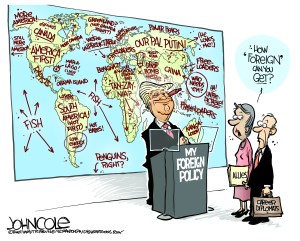
 U.S Foreign and Military policy has become so incoherent, illegal, dangerous, and likely leaked to our country’s traditional enemies, that our European partners no longer trust us. This link was shared to me by BB this morning and comes from The Economist. “Donald Trump’s bleak, incoherent foreign-policy strategy. Allies may panic; despots will cheer.”
YOU MIGHT think that in Trumpworld a new National Security Strategy (NSS) would not count for all that much. John Bolton, a national security adviser in Donald Trump’s first term, frequently laments that his boss had no strategy at all. Instead, the president worked by impulse—and without the encumbrance of too many briefings. From one day to the next, he veered in opposing directions.
Despite that, the new NSS matters. Released, weirdly, in the dead of night on December 4th/5th, it will be pored over by soldiers, diplomats and advisers in America and around the world. It is the latest and fullest statement of what “America First” means in foreign policy. It sets the terms for a soon-expected review of military power, and lays out the priorities for all those trying to interpret the president’s wishes. And, for many of its readers, it will be profoundly alarming.
For the most part, the new NSS rejects the decades-old insight that a common set of values are what cement America’s alliances. It declares that it is “not grounded in traditional, political ideology” but is motivated by “what works for America”. Instead, it embraces what it calls “flexible realism”. That means being “pragmatic without being ‘pragmatist’, realistic without being ‘realist’, principled without being ‘idealistic’, muscular without being ‘hawkish’, and restrained without being ‘dovish’.”
If that sounds like a dog’s breakfast, that is because it is. Shorn of the enlightened values that have long anchored foreign policy, America First becomes a naked assertion of power that owes more to the 19th century than the world that America built after the second world war. And that leads to a document riven by contradictions.
In some parts of the world, in particular in Asia, Mr Trump expects countries to behave as willing allies. In most others they are to submit meekly to America’s economic and military will. In one place the NSS rejects the interventionist idea of urging countries to adopt “democratic or other social change that differs widely from their traditions and histories”. That suits Russia, China and the monarchies of the Middle East. Yet in Europe, where MAGA worries about wokeism, migration and the dominance of liberal values, the NSS bluntly declares that “our goal should be to help Europe correct its current trajectory.”
When the NSS applies this formula to the world, region by region, the full consequences of this shift start to become clear.
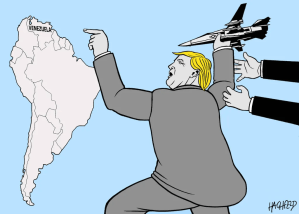
Nowhere is this more evident than in the section covering the western hemisphere. “We want to ensure that the western hemisphere remains reasonably stable and well-governed enough to prevent and discourage mass migration to the United States,” it reads. Governments in the Americas will be enlisted to control migration and curb drug flows. They are expected to grant America control of key assets, resources and strategic locations, or at least a veto over “hostile foreign” ownership of them—a clear warning to refuse Chinese investments that offer a sway over ports or such assets as the Panama Canal. Where law enforcement has failed to halt drug smuggling, America will use armed forces, the NSS warns.
This swaggering right of intervention is called a “Trump Corollary” to the Monroe Doctrine. That is a deliberate tribute to the “Roosevelt Corollary”, President Theodore Roosevelt’s assertion of gendarme-like enforcement rights over the western hemisphere in 1904.
All this seems sure to provoke angry recollections of high-handed American interventions in the region in the 20th century, from military invasions and blockades to CIA-backed coups or security pacts that saw America arming and training autocracies guilty of extra-judicial murders and torture in the cold war. With its talk of conditioning aid and trade on co-operation from Latin American governments, the NSS signals a belief that resentment will not stop Latin Americans from doing as they are told.
In Asia, by contrast, allies will read the NSS with a mixture of immediate relief and long-term gloom. The passages on Taiwan could have been worse. The nightmare scenario for such allies as Japan, the Philippines and South Korea would have involved an NSS declaring that the fate of the democratically ruled island of Taiwan is not an existential interest for America.
Instead, the NSS restates America’s position that it “does not support any unilateral change to the status quo in the Taiwan Strait”. True, there is nothing about Taiwan’s importance as a friendly, pro-Western democracy whose people overwhelmingly oppose coming under rule by China. But the strategy does make a cold-eyed realist case for Taiwan’s importance as a usefully-located redoubt in the middle of the “First Island Chain” that runs from Japan through Taiwan to the Philippines, penning in China’s navies and air forces. In addition, the NSS nods to Taiwan’s importance as the largest source of advanced semiconductors.
Accordingly, America will sustain forces capable of deterring any attempt to take Taiwan or to control the sea lanes near that island, or in the South China Sea. Asian allies must also spend much more on their own defences and grant America more access to their ports and bases. In short, the NSS demands that Asian countries risk China’s wrath by helping America contain Chinese ambitions in the Indo-Pacific. But there is not a word of criticism for China’s (or indeed Russia’s) expansionist ambitions or their desire to overthrow the post-1945 legal and multilateral order.
The NSS spares its sharpest barbs for Europe. The old world, it says, is undergoing a profound crisis, and this is not so much about economic decline or military weakness as it is about the loss of national identity, leading to the “stark prospect of civilisational erasure”.
Warning that “it is more than plausible that within a few decades at the latest, certain NATO members will become majority non-European,” the NSS warns that “it is an open question whether they will view their place in the world, or their alliance with the United States, in the same way as those who signed the NATO charter.” In other words, immigrants will corrupt the values of the societies they move to—a shocking assertion from a country that is itself built on immigration.
The NSS’s prescriptions for Europe flow from this assertion of Judeo-Christian nationalism. The NSS calls for “unapologetic celebrations of European nations’ individual character and history”, encouraging the revival promoted by “patriotic European parties”. That is a reference to the populist right, including National Rally in France, Reform UK in Britain and Alternative for Germany, which the vice-president, J.D. Vance, embraced earlier this year when he spoke at a conference in Munich. If that is the Trump administration’s programme, how are the centrist governments in Europe, who see these parties as a grave threat, supposed to treat America as an ally?
When the NSS applies this rationale to Ukraine, it draws some devastating conclusions. Suggesting that most Europeans want peace even if it means surrendering to Vladimir Putin, and asserting that their governments are standing in the way, the strategy calls for a rapid end to the war in order to prevent escalation. It says that America should curb the sense in Europe that Russia is a threat and warns that NATO cannot be “a perpetually expanding alliance”. Alarmingly, it has nothing to say about the repeated aggression and hostility of Vladimir Putin, the Russian president. To much of Europe, this sort of appeasement will only serve to set up the next conflict.
“In everything we do, we are putting America First,” reads the letter from Mr Trump to the American people that opens the NSS. But it is the preceding sentence that will be read by allies with gloom, and with glee by China and Russia, for it is hopelessly at odds with reality: “America is strong and respected again—and because of that, we are making peace all over the world.” Alas, that claim comes from an administration that is indeed feared, resented and obsessed over, but one that is less respected or trusted than any American government in decades.
 If that doesn’t give you geopolitical goosebumps, I don’t know what will. Meanwhile, we’ve been experiencing press coverage that’s not providing us the information we need. This article is from The Nation. “A New Roosevelt Institute Report Confronts the Roots of Our Media Crisis—and Calls for Breaking Up Corporate Media.” Today’s journalism crisis wasn’t inevitable, but it’s time to free journalism from the straitjacket of turning a democratic obligation into a profit-maximizing business model.” Concentration in this market is dumbing up America big time. This story is reported by Bilal Baydoun, Shahrzad Shams, and Victor Pickard
The desire to attack and ultimately control the media is a through line of modern authoritarian governance across the globe. President Donald Trump’s reign as the defining political figure of the last decade has demonstrated how quickly that tactic can take hold here. In courtrooms, agencies, and White House briefings, Trump and his allies have sought to punish and delegitimize journalists. In the second Trump term, the bully pulpit has been turned into a battering ram, with open or implied threats to withhold the broadcast licenses or block the media mergers of insufficiently loyal companies. But a singular focus on state meddling has, ironically, obfuscated how authoritarians come to wield such great power over the media system in the first place, and why a free press must be protected from both state and commercial coercion.
What we’re experiencing now is a dangerous convergence of the two.
The truth is that the administration’s threats have rippled across a media ecosystem buckling under the weight of commercial pressures—pressures that existed long before that fateful golden escalator ride more than a decade ago. It’s these longstanding commercial imperatives that Trump knows how to weaponize to manipulate media institutions. He understands that newsrooms accountable first and foremost to investors will sell out their accountability function to survive. Likewise, media conglomerates pursuing mergers cannot afford to anger the administration holding the regulatory pen. When journalism is trapped inside a commercial straitjacket, it can’t fight back.
In our oligarchic age, where billionaires can decide which fledgling outlets live or die for pennies on the dollar and even themselves command powerful roles in government, the line between state-run media and state-aligned media through private means becomes vanishingly thin. A press dependent on the whims of the ultra-wealthy cannot claim meaningful independence from the political forces its owners serve. And even though our Constitution protects the press for democratic reasons, our policy regime assumes that news organizations should behave like profit-maximizing firms.
How did we get here? As we show in our new Roosevelt Institute report, today’s media crisis wasn’t inevitable, but the consequence of policymakers embracing a corporate libertarian approach to media policy. This framework treats our information ecosystem as an ordinary market, rather than vital democratic infrastructure, resulting in a media system riddled with structural deficits. The result is a media environment that’s vulnerable to pressure from every direction, from the White House to the C-Suite.
The consequences of this policy failure have been catastrophic. Newsrooms have been gutted as advertising revenue collapsed. Local papers have closed or been absorbed by vulture capitalists whose short-term incentives are fundamentally at odds with journalism’s public mission. More than 1,000 counties now lack the equivalent of a single full-time journalist; the number of journalists per 100,000 residents has fallen 75 percent since the early 2000s. Platforms dominate news distribution, leaving publishers dependent on algorithmic systems designed to maximize engagement rather than inform the public. A handful of billionaires can bend the flow of information with the proverbial push of a button, and conglomerates continue conglomerating: Just earlier today, after a major bidding war, Netflix beat out Paramount Skydance and Comcast in a deal to acquire Warner Bros. Discovery, resulting in a merger that will further concentrate cultural and informational power in fewer hands.
Today, most Americans, and even many policymakers, take these developments and the system that led to them for granted. As the late media scholar Robert McChesney argued, media policy has been rendered invisible, designed behind closed doors in the public’s name, but without the public’s consent—placing core questions related to our information ecosystem outside the purview of democratic contestation. This invisibility has given cover to a set of neoliberal assumptions that define the boundaries of what’s possible, empowering a small set of wealthy private actors to decide, for the rest of us, what our media system looks like, and whose interests it serves.
Such invisibility obscures how our media system’s design—and the many problems ailing it—is the result of policy decisions. Over the course of decades, policymakers diluted the meaning of the media’s public interest responsibilities, refashioning them into something more akin to consumer preferences. At the same time, the media market faced a series of re-regulatory structural moves that shifted power away from the public and into the hands of corporate actors. And well before Trump dismantled the CPB, Congress resisted meaningful public media investment. All these developments were in turn legitimized by a First Amendment media jurisprudence that prioritizes unbridled commercial speech over the public’s “right to know.” Combined, these constraints created a media system that treats commercial imperatives as natural law, and democratic obligations as optional.
 I’ve probably over shared most of the excerpts and it will take you some time to get through them all. BB also wrote yesterday on the many ways our country is run by idiots with an angend American’s do not approve of and in a way that is beyond incompetent. Any of us in cities Occupied by the National Guard and Ice have horrors stories that sound more like NAZI Germany than your backyard. They have no incentive stop and they’re even ignoring court orders. This article is the view point of my home city by the BBC. “New Orleans residents in fear as immigration crackdown descends on their city.” The BBC’s North American Correspondent, Tom Bateman, is here and reports the story.
Two labourers stand on the roof of a house in Kenner, outside New Orleans, as US Border Patrol agents clamber up a ladder, getting closer.
As the agents move in, trying to arrest them, the men step to the roof’s edge, poised in an apparent act of resistance – but it’s too high to jump.
On the ground in the mostly Latino neighbourhood, an officer trains his weapon towards the rooftop while a sniper moves into position. Now, neighbours, activists, and crews of local press are gathering at the scene, watching in bewilderment: US President Trump’s new front line on immigration enforcement has just arrived.
It is day one of “Catahoula Crunch”, as the Department of Homeland Security (DHS) has labelled its operation, taking its name from an American leopard dog known for being well-muscled, powerful and territorial.
“These people came to work today to provide for their families and themselves,” said Zoe Higgins, an activist documenting the Border Patrol operation in New Orleans.
“That they could just be abducted, removed from all stability – I can’t imagine how terrifying that is,” she said, shortly after the agents coaxed the men down and detained them.
According to DHS, its agents were conducting immigration enforcement this week when “several illegal aliens climbed on the roof of a residential home and refused to comply with agent commands”.
An “illegal alien” was arrested, DHS officials told the BBC, but they did not answer questions about the immigration status of the labourers involved, nor whether agents had a warrant to access the property.
 None of this sounds lawful. I’m not a Constitutional lawyer, but I do know that everyone deserves their day in court. Disappearing people is criminal.
So, I’m going off today to see my doctor for just a normal check up. But my body tells me every day that it’s not coping well with any of this. I usually can drop my blood pressure by meditating. My skills are no longer up to this fight or fly response I feel continually. I just put my birth certificate in my purse. I still doing my whistle brigade thing. This country is not going doing on my watch. This city and every one in it is not going to be given the No Quarter treatment here; especially when they’re not really a threat to any of us in any way.
What’s on your Reading. Action and Blogging list today?


 peej
peej Carissa
 bostonboomer
 ecocatwoman
 mablue2
 peggysue22
 quixote
 skydancingguestblogger
 Mona (aka Wonk the Vote)



 Sky Dancing
What happens to people detained by Border Patrol in New Orleans sweeps? Here’s what to know.
U.S. Border Patrol agents swept through the New Orleans region this week, detaining dozens of people in operations at Home Depot parking lots, construction sites and car washes.
The detainees have ended up in Louisiana’s expansive immigration detention infrastructure, which has played a central role in the immigration crackdown launched by President Donald Trump’s administration.
Here’s a breakdown of what happens when someone is detained by immigration agents.
1. Processing
People detained by federal immigration agents are generally taken to Immigration and Customs Enforcement, or ICE, field offices for processing.
In south Louisiana, that facility is located in St. Charles Parish. ICE relocated its New Orleans Field Office last month from its longtime downtown New Orleans headquarters to a new facility on James Drive West in St. Rose.
Detainees can be held at the processing site for up to 24 hours.
2. Detention
After processing, they are generally taken to one of Louisiana’s ICE-contracted detention facilities.
In some cases, federal officials have first brought detainees to the Hancock County jail in Mississippi, which has an “intergovernmental service agreement” allowing the jail to house immigrant detainees before they move to longer-term ICE detention. That facility is run by the sheriff’s office in Hancock County, Mississippi.
An Iranian-born woman detained by ICE in June spent a night there before being taken to an ICE facility in Basile, Louisiana. So did a Mexican-born woman whose husband is both a U.S. citizen and Marine veteran from Baton Rouge.
After being held in a transitional facility like Hancock, detainees are then typically transported to one of Louisiana’s ICE-contracted detention facilities.
Louisiana has nine such facilities, including some contracted with private prison firms and others with local or state officials.
They are the Allen Parish Public Safety complex in Oberlin; the Central Louisiana ICE Processing Center in Jena; the Jackson Parish Correctional Center in Jonesboro; the Louisiana ICE Processing Center at the State Penitentiary at Angola; the Pine Prairie ICE Processing Center in Pine Prairie; the Richwood Correctional Center in Monroe; the River Correctional Center in Ferriday; the South Louisiana ICE Processing Center in Basile; and the Winn Correctional Center in Winnfield.
3. Court appearances, or deportation
(more at link)
ICE is in Kenner … school kids on bus
Please take care. I do understand how stressful it is.
Please take care. I understand how stressful this is.
JT
We’re fortunate to have a community surrounding me and that I can help the folks who need protecting because of my skin and status. It just really, can break your heart though. I slept in really late this morning surrounded by my furry family. My name or skin color shouldn’t trigger any of them.
You stay safe!
“This is a baby, you have to get out of here right now,” – Activists confront Commander Bovino in Lafayette Park in Kenner, as dozen cars follow Border Patrol honking horns and blowing whistles.
https://www.threads.com/@barbaraj.sobel/post/DR5gZmcEVKt/media
Please watch this.
i watched it. On another video, listening to the women crying and praying was heartbreaking.
It was. And the women are rising … they’re the ones resisting
Four legged fur babies are the best!!