
The White House published a website Tuesday with a false telling of the Jan. 6, 2021, attack, underscoring President Donald Trump’s years-long effort to reshape the narrative surrounding the day when a mob of his supporters violently overran the U.S. Capitol to stop the certification of Joe Biden’s electoral college victory.
The White House website criticizes Democrats and some Republicans for engaging in what Trump has called a “witch hunt” against him after the Jan. 6 attack. Trump was indicted by a federal grand jury in August 2023 on four criminal counts, including conspiracy to defraud the United States, in a case investigating his involvement in the Jan. 6 attack and his efforts to overturn the 2020 election results….
The White House website also falsely claims — as Trump has for years — that the 2020 presidential election was “stolen,” and that Pence had the power to “return disputed electoral slates to state legislatures for review and decertification” but chose not to “in an act of cowardice and sabotage.”
Pence, who presided over the certification of the electoral votes following the attack, has steadfastly defended his actions on Jan. 6, saying to do otherwise would have been unconstitutional. Trump’s former vice president was inside the Capitol during the attack and had to be evacuated from the Senate floor with his family as rioters stormed the complex. Many in the mob chanted “Hang Mike Pence!” on the misguided belief that Pence could have stopped Congress from certifying Biden’s victory….
Wednesday Reads: Trump, Miller and Their Fascist Dreams
Posted: January 7, 2026 Filed under: just because | Tags: Donald Trump, fascism, Heather Cox Richardson, January 6 2001 5th anniversary, mafia state, Peter Thiel, Stephen Miller 6 CommentsGood Morning!!
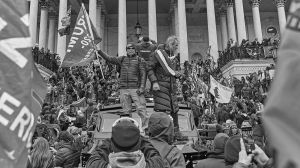 Yesterday was the 5th anniversary of the January 6 insurrection. There were serious efforts to mark the occasion, as well as unserious efforts by the White House to convince Americans to ignore the evidence of their own eyes and ears.
A couple of reads on the significance of the January 6 anniversary:
Andrew Egger at The Bulwark: January 6th Never Ended.
Five years! Half a decade ago today, Donald Trump summoned his angriest, most loyal fans from across America to Washington, D.C., with a call to arms and a fervent plea: They’re trying to steal the country from us, and they’ll get away with it, unless we stop them. They assembled on the National Mall, their frustration and rage crackling in the air, waiting to be told what to do. Trump whipped them into a frenzy, sent them marching down to the Capitol, and waited.
Last week, an excellent New York Times editorial described the insurrection of January 6th as a riot that never ended—“a turning point, but not the one it first seemed to be.” To some, it felt like an ending, the final, violent death spasms of the cult of Trump—so much so that the Senate Republicans who could have slammed the door on him forever deluded themselves into thinking he would stay gone without their having to lift a finger.
Instead, it proved to be the dawn of Trump’s total liberation. He had stress-tested his own theory of his base: that they would swallow insane, ludicrous election lies simply because he asked them to, would march themselves into felonies because they thought he wanted them to, and would then sit in their jail cells, not disillusioned but unshaken in their faith in him, patiently awaiting the day of his return and their reward. Eventually, they got it.
Ever since, Trump has lived his life in accordance with the lessons he learned that day. There was no act of selfishness or vindictiveness too grotesque for him to survive, provided he kept his people adequately juiced in the belief that their enemies were worse—and provided he could claw his way back to actual, hard power.
So it’s true: We’ve never left the January 6th era. But what’s most staggering is how many people would prefer to pretend we never entered it in the first place. Outside the core of Trump’s zealot base, which celebrates the patriotic heroes of that day, sits a larger faction of more grudging GOP supporters, for whom the Capitol insurrection is an unpleasant memory repressed as a matter of mental hygiene. These people wouldn’t flat-out deny that January 6th happened, but they’ve mentally sequestered its memory and significance, refusing to allow it to force them into any uncomfortable conclusions. They’d laugh you out of the room for suggesting, for instance, that what happened just five years ago could plausibly happen again.
Three years from today, Donald Trump may well find himself in a familiar situation: asked to leave the White House and preferring not to. The strong odds are, of course, that he won’t be on the ballot himself. But if a Democrat wins the presidency in 2028, he’ll have far more compelling reasons not to let the transfer of power go ahead smoothly than he ever did in 2020. Back then, it was mostly a matter of arrogance and pride: He simply couldn’t accept that he’d lost to Joe Biden. This time, the personal stakes will be much higher. Wrapped in the powers of the presidency, he’s acted as a law unto himself for too long not to dread going back into private life, where long-delayed legal consequences might be lurking, waiting for him.
We can only hope the Democrats take over the House and Senate and manage to impeach him.
Russell Payne at Salon: We learned nothing from Jan. 6.
After a mob of President Donald Trump’s supporters stormed the Capitol on Jan. 6, 2021, it appeared the attack would result in a rare moment of reckoning in American politics — at least for a moment. Even hardline GOP politicians had distanced themselves from Trump, then President Joe Biden was in charge and Congress and the Department of Justice were investigating both the attack and the plot to overturn the 2020 election behind it.
Five years later, any accountability, political or legal, that Trump and his allies faced has been erased.
One of Trump’s first acts after assuming office in his second term was to pardon the nearly 1,600 people who had either already been convicted or were awaiting trial for crimes related to Jan. 6. Many of these people had prior criminal records including sexual assault and domestic violence, many were part of far-right organizations like the Proud Boys and many have been charged with additional, unrelated crimes following their release. None of them, however, will have to serve their sentences for storming the Capitol in an attempt to overturn the election results and allow Trump to cling to power.
Likewise, Trump has avoided both legal and political accountability. Trump has effectively excised any Republicans willing to stand up to his false claims that the election was stolen from the party. He easily won the GOP nomination for president in 2024, though he faced multiple prosecutions over the plot to overturn the 2020 election, the first coming in the form of his second impeachment, for which he was acquitted. He was later indicted in Georgia, in a state-level racketeering case and again in Washington D.C. on charges of defrauding the U.S. and obstructing an official proceeding. Both cases stalled out in court and were not tried before the 2024 election.
Since winning re-election, any chance of legal accountability for Trump or the rest of the people who crafted the plot to deny the election results has dissolved. Bennet Gershamn, a law professor at Pace University, said that in his opinion, delay tactics from Trump’s lawyers and his victory in the 2024 election are the primary reasons why Trump has been able to escape any legal consequences.
“Trump was able to escape prosecution because he was elected,” Gershman told Salon. “If you want to say that Merrick Garland dragged his feet a little bit, maybe. If you want to say that the prosecution’s investigation took a little bit more time, I don’t know. I was a prosecutor for a long time, and these investigations are very, very complicated … But at the end of the day, the indictments that were handed down were very strong indictments. The evidence was overwhelming.”
Read the rest at Salon.
Trump responded to the anniversary by publishing a pack of outrageous lies.
Amy B. Wang at The Washington Post: White House publishes website that rewrites history of Jan. 6 attack.
The new White House website also repeats a claim made often by Trump and his allies — that Rep. Nancy Pelosi (D-California), who was speaker of the House at the time of the attack, is to blame for “security lapses” at the Capitol. Pelosi has vehemently rejected those accusations, saying again Tuesday that Trump resisted appeals to intervene in the attack for more than three hours.
“For over three hours we begged [Trump] to send the National Guard! He never did it. He took joy in not doing it. He was savoring it. … What he’s saying today is an insult to the American people,” Pelosi said at a Tuesday House event.
So much for the past. As usual, Historian Heather Cox Richardson’s commentary on our current situation at Letters from an American is very helpful:
“They say that when you win the presidency you lose the midterm,” President Donald J. Trump said today to House Republicans. “I wish you could explain to me what the hell is going on with the mind of the public because we have the right policy. They don’t. They have a horrible policy. They do stick together. They’re violent, they’re vicious, you know. They’re vicious people.”
“They had the worst policy. How we have to even run against these people—I won’t say cancel the election, they should cancel the election, because the fake news will say, ‘He wants the elections canceled. He’s a dictator.’ They always call me a dictator. Nobody is worse than Obama. And the people that surrounded Biden.”
And there you have it: in a rambling speech in which he jumped from topic to topic, danced, and appeared to mimic someone doing something either stupid or obscene, Trump explained the ideology behind his actions. He and MAGA Republicans have absorbed the last 40 years of Republican rhetoric to believe that Democratic policies are “horrible” and that only Republicans “have the right policy.” If that’s the case, why should Republicans even have to “run against these people?” Why even have elections? When voters choose Democrats, there’s something wrong with them, so why let them have a say? Their choice is bad by definition. Anything that they do, or have done, must be erased.
That is the ideology behind MAGA, amped up by the racism and sexism that identifies MAGA’s opponents as women, Black Americans, and people of color. In their telling, the world Americans constructed after World War II—and particularly after the 1965 Voting Rights Act protected Black and Brown voting—has destroyed the liberty of wealthy men to act without restraint. Free them, the logic goes, and they will Make America Great Again.
Trump with Peter Thiel
As tech entrepreneur Peter Thiel wrote in 2009: “I no longer believe that freedom and democracy are compatible.” He continued: “The 1920s were the last decade in American history during which one could be genuinely optimistic about politics. Since 1920, the vast increase in welfare beneficiaries and the extension of the franchise to women—two constituencies that are notoriously tough for libertarians—have rendered the notion of ‘capitalist democracy’ into an oxymoron.”
“Because there are no truly free places left in our world,” he wrote, Thiel called for escaping into cyberspace, outer space, or seasteading.
While tech leaders are focusing on escaping established governments, Trump’s solution to an expanded democracy appears to be to silence the voters and lawmakers who support the “liberal consensus”—the once-bipartisan idea that the government should enable individuals to reach their greatest potential by protecting them from corporate power, poverty, lack of access to modern infrastructure, and discrimination—and to erase the policies of that consensus.

On Trump’s version of January 6 history:
Nowhere does Trump’s conviction that he, and he alone, has the right to run the United States show more clearly than in the White House’s rewriting of the history of the January 6, 2021, attack on the U.S. Capitol. The insurrectionists who stormed the Capitol were Trump supporters determined to overthrow the free and fair election of Democrat Joe Biden by more than 7 million votes in 2020, replacing him with Trump by virtue of their belief that no Democrat could be fairly elected.
But the official White House website reversed that reality today, claiming that the insurrectionists who beat and wounded at least 140 police officers, smeared feces on the walls of the Capitol building, and called for the hanging of Vice President Mike Pence were “peaceful patriotic protesters.” The real villains, the White House wrote in bold type, were “the Democrats who staged the real insurrection by certifying a fraud-ridden election, ignoring widespread irregularities, and weaponizing federal agencies to hunt down dissenters.”
In reality, modern Republican policies have rarely served everyday people, while the policies enacted by Democratic president Joe Biden demonstrably did. Biden rejected the ideology that called for cutting taxes, regulations, and social services in the name of liberty. Instead, he urged Congress to invest in public infrastructure, creating jobs, and he shored up the social safety net.
Read the rest at the link.
Bill Kristol reacted to Richardson’s piece at The Bulwark: The Spirit of Fascism.
MAGA is a vulgar, cartoonish, cultish, and incoherent movement.
So, a century ago, was fascism.
And as today’s MAGA more openly and explicitly embraces the spirit of yesteryear’s fascism, it’s perhaps worth noting that it is the era of the rise of fascism to which MAGA looks back with nostalgia and yearning.
In her most recent newsletter, the historian Heather Cox Richardson reminds us of this 2009 statement by Peter Thiel, who as much as anyone could be considered the theorist of Trumpism as an intellectual movement.
“I no longer believe that freedom and democracy are compatible. The 1920s were the last decade in American history during which one could be genuinely optimistic about politics. Since 1920, the vast increase in welfare beneficiaries and the extension of the franchise to women . . . have rendered the notion of “capitalist democracy” into an oxymoron.”
The first sentence is a bit startling. But there is, to be fair, a long tradition of worrying about various tensions between freedom and democracy. Thiel, one could say, has simply adopted the radically pessimistic view that those tensions can no longer be managed or resolved.
Far more striking is the rest of Thiel’s statement, his yearning for the pre-welfare-state and pre-women’s-franchise 1920s, “the last decade during which one could be genuinely optimistic about politics.”
Thiel’s history is not striking just because it is wrong—the Nineteenth Amendment was ratified in the summer of 1920, making the general election that fall the first to feature the mass participation of women, though some states had granted women full suffrage even earlier.
It’s striking because we do now know, after all, what followed the decade of the 1920s: A 1930s that featured a worldwide Great Depression, and the rise of fascism—which, while unsuccessful in America, came closer here than we often remember, and was dominant overseas. All of that culminated in the horrors of World War II. The terrible events from 1929 to 1945 followed on—followed from—the economic and foreign policies of the decade for which Thiel is so nostalgic.
Kristol on Stephen Miller:
If Peter Thiel is a MAGA theoretician, Stephen Miller is MAGA’s chief propagandist. On Sunday, in the wake of Trump’s Venezuelan intervention, Miller posted:
“Not long after World War II the West dissolved its empires and colonies and began sending colossal sums of taxpayer-funded aid to these former territories (despite have [sic] already made them far wealthier and more successful). The West opened its borders, a kind of reverse colonization, providing welfare and thus remittances, while extending to these newcomers and their families not only the full franchise but preferential legal and financial treatment over the native citizenry. The neoliberal experiment, at its core, has been a long self-punishment of the places and peoples that built the modern world.”
So Britain and France should not have dissolved empires and colonies, but rather have fought to hold countries like, say, India and Vietnam? And the United States’ openness to immigrants from, say, India and Vietnam, has been an exercise in self-punishment?
Apparently so. On Monday, Miller extended his critique of the modern world, going on television to decry “This whole period that happened after World War II where the West began apologizing and groveling and begging.”
Miller is terrifying.
Katie Rogers at The New York Times (gift link): Stephen Miller Offers a Strongman’s View of the World.
Stephen Miller has spent the bulk of his White House career furthering hard-right domestic policies that have resulted in mass deportations, family separations and the testing of the constitutional tenets that grant American citizenship.
Now, Mr. Miller, President Trump’s 40-year-old deputy chief of staff for policy and homeland security adviser, is casting his hard-right gaze further abroad: toward Venezuela and the Danish territory of Greenland, specifically.
Mr. Miller is doing so, the president’s advisers say, in service of advancing Mr. Trump’s foreign policy ambitions, which so far resemble imperialistic designs to exploit less powerful, resource-rich countries and territories the world over and use those resources for America’s gain. According to Mr. Miller, using brute force is not only on the table but also the Trump administration’s preferred way to conduct itself on the world stage.
“We live in a world in which you can talk all you want about international niceties and everything else, but we live in a world, in the real world, Jake, that is governed by strength, that is governed by force, that is governed by power,” Mr. Miller told Jake Tapper of CNN on Monday, during a combative appearance in which he was pressed on Mr. Trump’s long-held desire to control Greenland.
“These are the iron laws of the world since the beginning of time,” he said.
This aggressive posture toward Greenland — and in turn, the rest of the world — is a perfect encapsulation of the raw power that Mr. Trump wants to project, even against Denmark, the NATO ally that controls Greenland. The moment also illustrates how people like Mr. Miller have ascended to the inner circle of a leader who has no interest in having his impulses checked, and how they exert their influence once they arrive there.
The moment also shows just how differently Mr. Trump has operated in his second term from how he did in his first.
About midway through his first term, the president began joking with his aides about his desire to buy Greenland for its natural resources, like coal and uranium. At the time, his advisers humored him with offers to investigate the possibility of buying the semiautonomous territory. They did not think Mr. Trump was serious, or that it could ever actually happen. Those advisers are gone.
Flash forward to the second term. Mr. Miller has the president’s complete trust, a staff of over 40 people, and several big jobs that include protecting the homeland and securing territories further afield. A first-term joke made in passing about purchasing Greenland for its natural resources is now a term-two presidential threat to attack and annex the Danish territory by force if necessary, under the guise of protecting Americans from foreign incursions.
One more from Jan-Werner Müller at The Guardian: The Trump doctrine exposes the US as a mafia state.
When a bleary-eyed Trump explained the kidnapping of Nicolás Maduro this past Saturday, he invoked the Monroe doctrine: while the US president sounded like he was reading about it for the first time, historians of course recognized the idea of Washington as a kind of guardian of the western hemisphere. Together with the national security strategy published in December, the move on Venezuela can be understood as advancing a vision for carving up the world into what the Nazi jurist Carl Schmitt called “great spaces”, with each effectively supervised by a great power (meaning, in today’s world, Washington, Moscow and Beijing). But more is happening than a return to such de facto imperialism: Trump’s promise to “run the country” for the sake of US oil companies signals the internationalization of one aspect of his regime – what has rightly been called the logic of the mafia state. That logic is even more obvious in his stated desire to grab Greenland.
The theory of the mafia state was first elaborated by the Hungarian sociologist Bálint Magyar in 2016. Such a state is less about corruption where envelopes change hands under the table. Instead, public procurement is rigged; large companies are brought under the control of regime-friendly oligarchs, who in turn acquire media to provide favorable coverage to the ruler. The beneficiaries are what Magyar calls the “extended political family” (which can include the ruler’s natural family). As with the mafia, unconditional loyalty is the price for being part of the system.
As so often with Trump 2.0, practices that other regimes try to veil have been unashamedly in the open: the “pausing” of the Foreign Corrupt Practices Act signaled that the US is not only open for business but also bribing (be it with a jet or a fake prize from Fifa); not only do pardons appear to be for sale; and not only can companies curry favor by financing a grotesque ballroom – but also the president’s political family, which includes billionaires like Steve Witkoff and Howard Lutnick, seems poised to profit handsomely, including from foreign deals, and now foreign military adventures: according to the investigative reporter Judd Legum, the Trump oligarch Paul Singer, owner of the oil company Citgo, is to set to do very well with a Trump-controlled government in Caracas.
This does not mean that the US’s “special military operation” in Venezuela is entirely a matter of “it’s the oil, stupid”; there is an argument that it helps push back against Iran, China and Russia (even if the precedent that killing 40 people and kidnapping sets also legitimizes interventions by other powers, as those lamenting the weakening of international law have rightly pointed out). There is also the old-style neoconservative justification for removing a tyrant from power, something that the former self of Marco Rubio, before bending the knee, would have favored – though leaving a decapitated regime in place has made talk of democracy and human rights protection a tad implausible. But the point is not regime change, as long as a regime is fine with Trumpian exploitation. The alternative is extortion: if the US oil companies get “total access”, the rulers of what is also a mafia state of sorts can stay in place; if not, it’s a bigger boss talking to a minor boss along the lines of: “Nice country you have there; pity if we had to do a full-scale invasion.”
Read the rest for an exploration of Trump’s Greenland obsession.
That’s it for me today. What’s on your mind?


 peej
peej Carissa
 ecocatwoman
 mablue2
 peggysue22
 quixote
 skydancingguestblogger
 Mona (aka Wonk the Vote)



 Sky Dancing
Have a nice Wednesday!
Been working on the house all day. Throwing all kinds of stuff out. Lots of help though or I’d never be able to do it.
https://bsky.app/profile/softtail65.bsky.social/post/3mbujoue4ps27
The woman who was killed by ICE in Mineapolis identified.