

Trump’s “America First” second-term focus purports to be principally on the home front. The deportation of millions of undocumented immigrants was one of his leading campaign pledges, and his initial appointments suggest he is serious about this priority. The proposal is fraught with practical and political questions.
Sunday Reads
Posted: January 5, 2025 Filed under: 2021 Insurrection, 2024 Elections, Donald Trump | Tags: Giorgia Meloni, House Speaker Mike Johnson, January 6 2021 insurrection, Joe Biden, Officer Daniel Hodges 5 Comments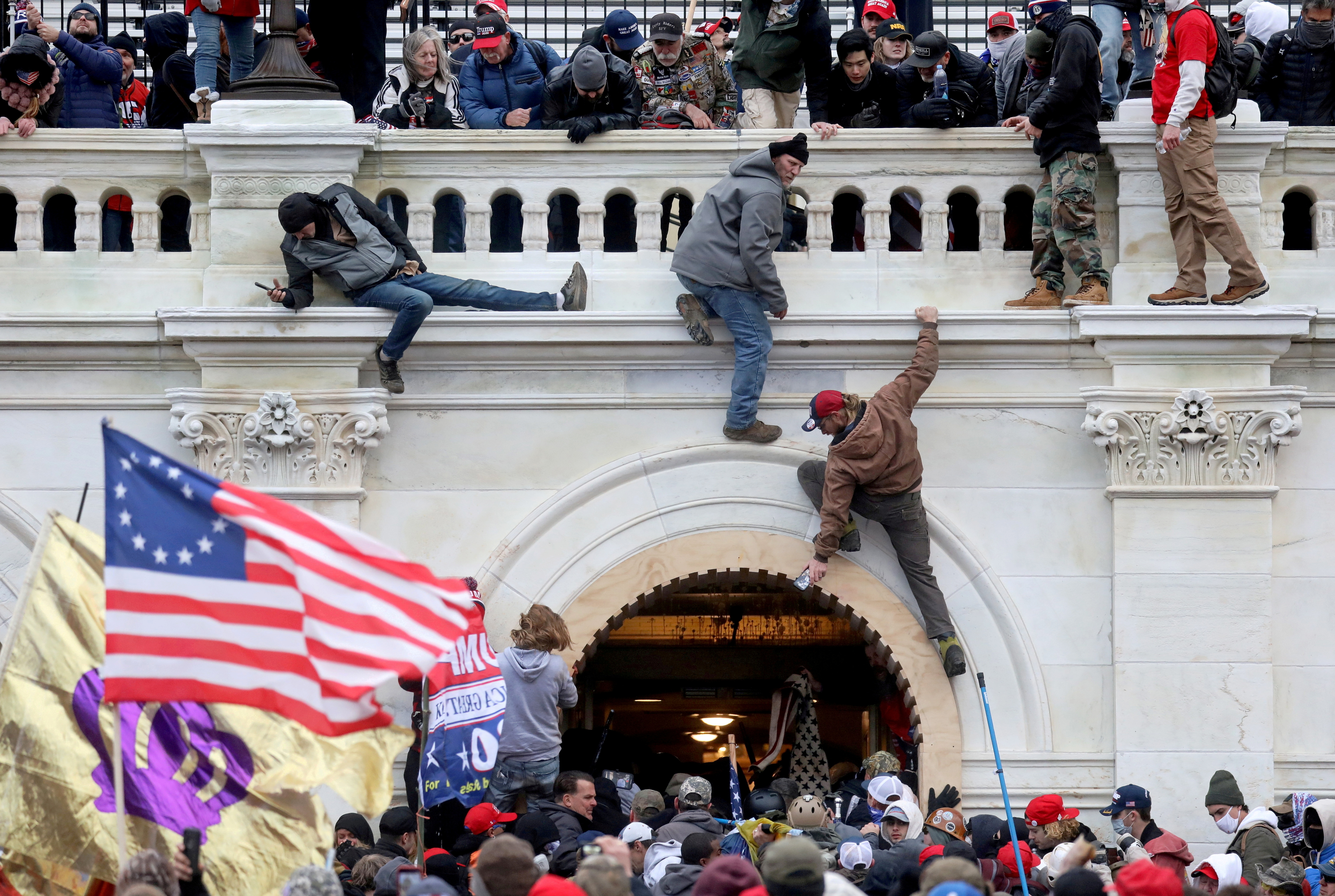
FILE PHOTO: A mob of supporters of U.S. President Donald Trump fight with members of law enforcement at a door they broke open as they storm the U.S. Capitol Building in Washington, U.S., January 6, 2021. REUTERS/Leah Millis/File Photo
Good Afternoon!!
Tomorrow is the fourth anniversary of the Capitol insurrection. Four years later, Trump will be certified as president–without the riot he sicced on Joe Biden in 2021.
Kyle Cheney at Politico: Donald Trump is about to get the Jan. 6 that he denied Joe Biden.
The transfer of power to Donald Trump is shaping up to be, well, peaceful.
No mobs are assembling to disrupt Congress’ Jan. 6 counting of electoral votes. No Democratic leaders are questioning the results of the election or concocting elaborate legal theories to thwart the outcome. The greatest risk of obstruction seems likely to come from a storm system threatening to dump a few inches of snow on the region overnight.
If all goes as expected, by late Monday afternoon, Trump’s victory will be certified in a ceremony overseen by his vanquished rival, Vice President Kamala Harris, who will preside over the proceedings in her capacity as the president of the Senate. Harris has been clear she will administer a straightforward transfer of power. In doing so, she’ll follow in the footsteps of all vice presidents before her — including Mike Pence, who resisted Trump’s pressure to refuse to count electors from states Trump lost in 2020….
It’s the utter antithesis of the carnage unleashed four years ago, under clear blue skies, by thousands of Trump supporters, goaded by lies about a stolen election. Hundreds of them bludgeoned police officers guarding the Capitol as the mob fought to stop Congress from counting the electoral votes that would make Joe Biden president.
The attack spawned the largest-ever federal criminal probe, led to a grave criminal case against Trump, spawned a failed legal effort to remove him from the ballot and defined the political climate of the last two election cycles. Democrats declared Trump a threat to democracy and the president-elect wielded the cases to rally his base and claim political persecution.
The meeting of the House and Senate this time, by contrast, is expected to be almost jarringly routine. Harris will convene the joint session at 1 p.m. Lawmakers of both parties will announce the certified electors from each state, and Harris will affirm they have been counted….
Monday’s joint session is also the first governed by a 2022 law designed to prevent efforts to corrupt the transfer of power and limit the ability of lawmakers to mount challenges to the results. That law lowers the already slim odds of any objections that could hamper the proceedings.
Still, the general atmosphere of calm in Washington belies a deep, simmering tension between those who watched the nation’s democratic institutions buckle on Jan. 6, 2021, and those who hope to whitewash it — especially as Trump attempts to rewrite the history of the attack on the Capitol and prepares to pardon many of its perpetrators. The Justice Department has charged more than 1,500 people for their involvement in the attack, and more than 1,200 have pleaded guilty or been convicted.
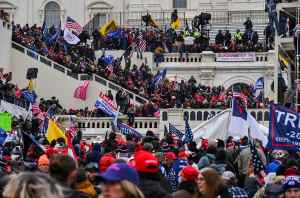 Trump has promised again and again to free the January 6 “hostages” who violently attacked the center of our government and wounded 174 police officers, and led to the deaths of 5 officers–4 of whom died by suicide.
Chris Stein at The Guardian: ‘We have our country back’: convicted January 6 rioters anticipate Trump pardons.
Brandon Fellows, who broke into the US Capitol on January 6 and smoked marijuana in a senator’s office, stood outside the Washington DC jail where he spent part of his three years’ sentence behind bars, thinking about how Donald Trump might soon help him get his life back on track.
Having served his prison sentence after being found guilty on a slew of federal charges, the 30-year-old is today on probation under terms that have prevented him from leaving the capital region to start a chimney maintenance business in New Jersey. But with Trump returning to the White House on 20 January, Fellows expects his circumstances to change dramatically.
“I’m just going to wait till after the election, make sure I don’t have to partake in a real insurrection if Trump loses, and … then I’ll decide what I’m doing after,” he said about his thinking before November’s presidential election. Now that Trump has won, Fellows is counting on the president-elect to pardon him and other January 6 defendants. “With Trump in office, yeah, I’m starting to plan and [rebuild] my life again,” Fellows said.
As soon as he is back in power, Trump has vowed, he will pardon people prosecuted over the assault on the US Capitol that took place four years ago on Monday. Carried out by a mob of Trump’s supporters after he had addressed them outside the White House, the attack brought political violence into the halls of Congress and has been linked to nine deaths among police and rioters.
“We’re going to look at each individual case, and we’re going to do it very quickly, and it’s going to start in the first hour that I get into office,” Trump told Time magazine in an interview after winning re-election. “A vast majority should not be in jail, and they’ve suffered gravely.”
The pardons would mark the end of a four-year campaign by Joe Biden and his attorney general, Merrick Garland, to hold to account the thousands of rioters who overran police lines and sent lawmakers fleeing the Capitol on the day they convened in 2021 to certify the Democrat’s election victory. The justice department has charged more than 1,500 people with offenses related to the attack in the years since, nearly 600 of whom have faced felony charges of assaulting or impeding law enforcement.
But Trump’s jailed followers are counting the days until they receive the absolution Trump has promised. For more than two years, relatives of those charged in the attack and supporters of the former president have gathered on a sidewalk outside Washington DC’s jail for a nightly vigil called “Freedom Corner”, where January 6 is viewed not as an attack on democracy, but a catalyst for unfair government repression.
Trump has used propaganda to try to change the meaning of what happened on January 6, 2001. Dan Barry and Alan Feuer at The New York Times: ‘A Day of Love’: How Trump Inverted the Violent History of Jan. 6.
In two weeks, Donald J. Trump is to emerge from an arched portal of the United States Capitol to once again take the presidential oath of office. As the Inauguration Day ritual conveying the peaceful transfer of power unfolds, he will stand where the worst of the mayhem of Jan. 6, 2021, took place, largely in his name.
Directly behind Mr. Trump will be the metal-and-glass doors where protesters, inflamed by his lie that the 2020 election had been stolen from him, stormed the Capitol with clubs, chemical irritants and other weapons. To his left, the spot where roaring rioters and outnumbered police officers fought hand to hand. To his right, where the prostrate body of a dying woman was jostled in the bloody fray.
And before him, a dozen marble steps descending to a lectern adorned with the presidential seal. The same steps where, four years earlier, Trump flags were waved above the frenzied crowd and wielded like spears; where an officer was dragged facedown to be beaten with an American flag on a pole and another was pulled into the scrum to be kicked and stomped.
Officer Daniel Hodges was crushed in a doorway by rioter Patrick McCaughey III
In the wake of the attack on the Capitol, Mr. Trump’s volatile political career seemed over, his incendiary words before the riot rattling the leaders of his own Republican Party. Myriad factors explain his stunning resurrection, but not least of them is how effectively he and his loyalists have laundered the history of Jan. 6, turning a political nightmare into a political asset.
What began as a strained attempt to absolve Mr. Trump of responsibility for Jan. 6 gradually took hold, as his allies in Congress and the media played down the attack and redirected blame to left-wing plants, Democrats and even the government. Violent rioters — prosecuted, convicted and imprisoned — somehow became patriotic martyrs.
This inverted interpretation defied what the country had watched unfold, but it neatly fit the persecution narrative that binds Mr. Trump to many of his faithful. Once he committed to running again for president, he doubled down on flipping the script about the riot and its blowback, including a congressional inquiry and two criminal indictments against him, as part of an orchestrated victimization.
That day was an American calamity. Lawmakers huddled for safety. Vice President Mike Pence eluded a mob shouting that he should be hanged. Several people died during and after the riot, including one protester by gunshot and four police officers by suicide, and more than 140 officers were injured in a protracted melee that nearly upended what should have been the routine certification of the electoral victory of Mr. Trump’s opponent, Joseph R. Biden Jr.
But with his return to office, Mr. Trump now has the platform to further rinse and spin the Capitol attack into what he has called “a day of love.” He has vowed to pardon rioters in the first hour of his new administration, while his congressional supporters are pushing for criminal charges against those who investigated his actions on that chaotic day.
Some points of view on Trump upcoming second term as “president”:
Russell Berman at The Atlantic: Bad News for Trump’s Legislative Agenda.
The success of President-Elect Donald Trump’s legislative agenda will depend on whether Republicans can close ranks in Congress. They nearly failed on their very first vote.
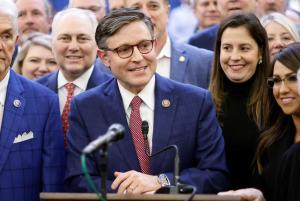
Mike Johnson won reelection as House speaker by the narrowest of margins this afternoon, and only after two Republican holdouts changed their votes at the last minute. Johnson won on the first ballot with exactly the 218 votes he needed to secure the required majority. The effort he expended to keep the speaker’s gavel portends a tough slog for Trump, who endorsed Johnson’s bid.
Johnson was well short of a majority after an initial tally in the House, which elects a speaker in a long, televised roll call during which every member’s name is called. Three Republicans—Representatives Thomas Massie of Kentucky, Ralph Norman of South Carolina, and Keith Self of Texas—voted for other candidates, and another six refused to vote at all in a protest of Johnson’s leadership. The six who initially sat out the roll call cast their votes for Johnson when their names were called a second time. But it took nearly an hour for Johnson to flip Norman and Self. After huddling with Johnson on and off the House floor, the three men walked together to the front of the House chamber, where Norman and Self changed their votes to put Johnson over the top.
The tense vote marked the second Congress in a row in which the formal, usually ceremonial opening of the House became highly dramatic. Two years ago, conservative holdouts forced Kevin McCarthy to endure 15 rounds of voting and days of horse-trading before allowing him to become speaker. With help from Democrats, the same group ousted him nine months later, leading to Johnson’s election as his replacement….
Mike Johnson elected speaker
Yet the members opposing Johnson were not as numerous or dug-in as McCarthy’s adversaries. And although Trump backed McCarthy two years ago, he was more politically invested in Johnson’s success today. A drawn-out fight for the speakership could have threatened his legislative agenda and even delayed the certification of his election. (The House cannot function without a speaker, so it would not have been able to formally open and count the Electoral College ballots as required by the Constitution on January 6.)
Even with today’s relatively swift resolution, Johnson’s struggle to remain speaker is an ominous sign for the GOP’s ability to enact Trump’s priorities in the first few months of his term. The majority that narrowly elected Johnson will temporarily become slimmer once the Senate confirms two Republican lawmakers to Trump’s Cabinet, creating vacancies pending special elections to replace them. And GOP divisions have already emerged over whether the party should launch its governing trifecta with a push to bolster the southern border or combine that effort with legislation extending Trump’s 2017 tax cuts.
Republicans have a bigger buffer in the Senate, where they control 53 seats. But in the House, the GOP edge is two seats smaller than it was at the beginning of the last Congress, and just one or two members will have the power to defeat party-line votes without support from Democrats. Johnson’s main critics, including Massie, Norman, and Self, support Trump’s agenda in the abstract, but they are not loyalists of the president-elect. (Neither Massie nor Roy backed him in the GOP primary last year.) They are far more hawkish on spending than Trump, who showed little concern for deficits in his first term and has pushed Republicans to raise or even eliminate the debt ceiling before he takes office—a move that could smooth the passage of costly tax cuts.
Dan Balz at The Washington Post: A different and more dangerous world awaits President-elect Trump.
President-elect Donald Trump will begin his second term stronger and more dominant as a player on the world stage than when he was sworn in eight years ago. The world that awaits him, however, is far different — and more threatening — than when he left the presidency four years ago.
Dealing with the domestic economy through tax and spending cuts and regulatory changes was another key promise. Polls suggest the economy — mostly inflation — counted more than other issues did in Trump’s victory over Vice President Kamala Harris. But many economists have said that Trump’s economic agenda — tariffs and an extension of tax cuts — could lead to a new round of inflation and more debt. Deportations, too, would disrupt the economy.
Trump has also pledged to bring the civil service to heel. An initiative that includes cost-cutting and finding inefficiencies will be led by multibillionaire entrepreneur Elon Musk and onetime rival Vivek Ramaswamy. The two have grand ambitions and, seemingly, the president-elect’s blessing. Nonetheless, they face multiple challenges before they will be able to deliver more than symbolic changes.
Still, Trump could quickly be drawn into foreign policy challenges. He will confront a world of chaos and conflict: a prolonged war in Ukraine with Russian President Vladimir Putin more hostile than ever, and the Middle East still in turmoil after more than 15 months of warfare, with Iran weakened, Syria without Bashar al-Assad and Israel stronger militarily but scarred internationally because of its conduct in the war in Gaza.
China presents other challenges for Trump, who has threatened major new tariffs on a country with serious economic problems and growing military ambitions. As an indication of his intentions, Trump plans to populate his incoming administration with several China hawks. Meanwhile, governments of key U.S. allies in Europe, particularly France and Germany, are weakened, with right-wing, populist parties on the rise.
Trump prides himself as a dealmaker. His approach to foreign policy in his first term appeared to be more personal than strategic. He prefers dealing with autocrats rather than working with traditional alliances. In his second term, he probably will find it more difficult to work with the likes of Putin, Chinese President Xi Jinping and the leader who sent him what Trump called “love letters,” North Korea’s Kim Jong Un.
Peter Baker at The New York Times: Trump Sees the U.S. as a ‘Disaster.’ The Numbers Tell a Different Story.
To hear President-elect Donald J. Trump tell it, he is about to take over a nation ravaged by crisis, a desolate hellscape of crime, chaos and economic hardship. “Our Country is a disaster, a laughing stock all over the World!” he declared on social media last week.
But by many traditional metrics, the America that Mr. Trump will inherit from President Biden when he takes the oath for a second time, two weeks from Monday, is actually in better shape than that bequeathed to any newly elected president since George W. Bush came into office in 2001.
For the first time since that transition 24 years ago, there will be no American troops at war overseas on Inauguration Day. New data reported in the past few days indicate that murders are way down, illegal immigration at the southern border has fallen even below where it was when Mr. Trump left office and roaring stock markets finished their best two years in a quarter-century.
Jobs are up, wages are rising and the economy is growing as fast as it did during Mr. Trump’s presidency. Unemployment is as low as it was just before the Covid-19 pandemic and near its historic best. Domestic energy production is higher than it has ever been.
The manufacturing sector has more jobs than under any president since Mr. Bush. Drug overdose deaths have fallen for the first time in years. Even inflation, the scourge of the Biden presidency, has returned closer to normal, although prices remain higher than they were four years ago.
“President Trump is inheriting an economy that is about as good as it ever gets,” said Mark Zandi, chief economist of Moody’s Analytics. “The U.S. economy is the envy of the rest of the world, as it is the only significant economy that is growing more quickly post-pandemic than prepandemic.”
Of course Trump will promptly take credit for the good economy as soon as he gets into office.
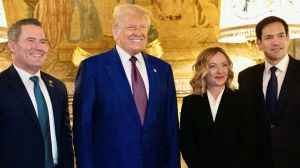
Trump hails Italy’s Giorgia Meloni
Since the election, Trump has been behaving as if he is already president. For example, he has met with several foreign leaders–all autocrats–at his private club in Florida. Another one showed up at Mar-a-Lago yesterday. Emma Bubola at The New York times: Italy’s Prime Minister Visits Trump in Mar-a-Lago.
Prime Minister Giorgia Meloni of Italy visited President-elect Donald J. Trump on Saturday at his Florida golf club for an informal meeting.
The trip to the club, Mar-a-Lago, came only a few days before Ms. Meloni is set to welcome President Biden for an official visit to Italy and the Vatican from Jan. 9 to 12.
On Saturday, she appeared in the grand ballroom at Mar-a-Lago. Mr. Trump, according to pool reports, said he was having dinner with Ms. Meloni, whom he called “a fantastic woman,” adding, “She’s really taken Europe by storm, and everyone else.”
They, along with some potential members of the future Trump administration, including the nominee for secretary of state, Marco Rubio, and for Treasury, Scott Bessent, then watched a screening of a film titled, “The Eastman Dilemma: Lawfare or Justice.”
Ms. Meloni and Mr. Trump have expressed mutual appreciation in the past, and her trip is one of the first few visits by a foreign leader to the president-elect’s estate in Florida since his election in November. The meeting reinforces the hopes of Ms. Meloni’s supporters that the conservative Italian prime minister will become Mr. Trump’s go-to ally in Europe.
Much of that role would involve mediating tensions between other European leaders and Mr. Trump, who has threatened to start a trade war with the continent, as well as to reduce American backing for some NATO countries and for Ukraine in its war with Russia.
The agenda of the meeting was unclear on Saturday night, but observers expected the two leaders would discuss those issues.
Believe it or not, Joe Biden is still President of the United States, and he has some plans for his remaining time in the White House. Carol Lee and Kristin Welker at NBC News: Biden to deliver two major speeches in his final days in office.
President Joe Biden plans to deliver two major speeches before leaving office as part of an effort to outline what he sees as key parts of his legacy from more than 50 years in public service, according to two people familiar with the plans.
The first speech is set to focus on foreign policy and is expected to be delivered sometime after Biden returns on Jan. 12 from a trip to Italy, these people said. They said Biden then plans to close out his final days in the White House with a farewell address to the country.
Neither speech has been fully drafted, the sources familiar with the president’s plans said, but the contours and themes of both have been developed.
In his farewell address, Biden is expected to offer a message to Americans for the future and reflect on his decades in public office, including his four years in the White House, according to the people familiar with the president’s plans.
The traditional address is expected to channel a similar spirit to the parting sentiments offered by some of Biden’s recent predecessors, including former Presidents George W. Bush and Bill Clinton, who delivered their farewell speeches from the White House, and former President Barack Obama, who opted to speak to the nation from his hometown of Chicago in front of a large audience of supporters….
Biden’s foreign policy speech is set to focus on his belief that America is stronger when it invests in its alliances across the world, according to the people familiar with the president’s speeches. Biden is expected to highlight his efforts to broaden and strengthen the North Atlantic Treaty Organization and U.S. relations in the Indo-Pacific, as well as his administration’s military and financial support for Ukraine since Russia’s invasion in 2022.
It’s unclear how much the speech might touch on Biden’s decision to order the U.S. withdrawal from Afghanistan in 2021, which has been widely criticized and resulted in the deaths of 13 American service members.
Biden is likely to reference his administration’s efforts to combat terrorist groups, including ISIS, but the speech is not expected to dwell on domestic terrorism threats following the New Year’s Day attack in New Orleans, the people familiar with the president’s plans said.
That’s all I have for you today. It’s still kind of quiet as we wrap up the holiday season.


 peej
peej Carissa
 ecocatwoman
 mablue2
 peggysue22
 quixote
 skydancingguestblogger
 Mona (aka Wonk the Vote)



 Sky Dancing
I am really not looking forward to Trump in office. My feelings of dread are becoming more powerful as the days pass.
I am extremely anxious. I feel like I’m about to have some major test ahead and I’m not prepared. I have the proverbial knot in my stomach. The fact Thune says Hegseth will be confirmed means that Republicans just want power. This will be a grand mess.
Biden Signs Social Security Fairness Act: When Do Higher Payments Start?
https://www.newsweek.com/biden-signs-social-security-fairness-act-higher-payments-2010012
In September, the Congressional Budget Office (CBO) estimated that eliminating the WEP would increase monthly payments for affected beneficiaries by an average of $360 by December 2025.
CLOSE X
Pause
Unmute
Current Time 0:41
/
Duration 0:51
Quality
Fullscreen
Will Joe Biden Sign the Social Security Fairness Act? Here’s What We Know
By Gabe Whisnant
Deputy Weekend Editor
FOLLOW
3
Millions of Americans will now see their Social Security benefits increase after President Joe Biden signed the Social Security Fairness Act into law on Sunday.
The bill, which abolishes the Windfall Elimination Provision (WEP) and Government Pension Offset (GPO), passed both chambers of Congress with bipartisan support.
Newsweek has emailed the Biden administration for additional comment on Sunday evening.
When to Expect Higher Social Security Payments
In September, the Congressional Budget Office (CBO) estimated that eliminating the WEP would increase monthly payments for affected beneficiaries by an average of $360 by December 2025.
Ending the GPO would raise monthly benefits by December 2025 by an average of $700 for 380,000 recipients with benefits based on living spouses, according to the CBO. For 390,000 surviving spouses receiving widow or widower benefits, the increase would average $1,190.
These amounts would continue to rise over time due to Social Security’s regular cost-of-living adjustments (COLA). The changes would apply to payments from January 2024 onwards, resulting in the Social Security Administration owing back-dated payments.
The measure passed by Congress states that the Social Security commissioner “shall adjust primary insurance amounts to the extent necessary to take into account” changes in the law.
It remains unclear how this adjustment will be implemented or whether affected individuals will need to take any action.
https://www.nbcnews.com/news/us-news/new-orleans-attacker-meta-glasses-prior-visits-rcna186293
New Orleans attacker recorded visits to city weeks earlier, wore Meta smart glasses during attack
The attacker wore the glasses to record video as he rode a bicycle through the French Quarter during a trip before the Bourbon Street attack, the FBI said. The glasses weren’t recording during the actual incident.
“The explosive material recovered at Jabbar’s home in Houston resembles common explosives such as RDX, which are widely available in the United States, Joshua Jackson, the special agent in charge of the ATF’s New Orleans field division, said at Sunday’s news conference.
Federal authorities initially said Friday that field tests detected a rare explosive compound, R-Salt, in the two homemade bombs in New Orleans and in the home where Jabbar stayed. R-Salt is a very rare compound that has not been used before in terrorist attacks in the United States or Europe.
Jackson said the FBI will conduct additional testing of the explosive compound found in New Orleans. He said officials believe additional tests in an FBI lab will show that the explosive compound is, in fact, pure RDX. “
Well, that’s a relief.