
“The response shall address the legal propriety of using an out-of-district grand jury proceeding to continue to investigate and/or to seek post-indictment hearings on matters pertinent to the instant indicted matter in this district,” Cannon wrote.
Tuesday Reads: A Tale of Two Judges
Posted: August 8, 2023 Filed under: Afternoon Reads, Crime, Donald Trump, just because | Tags: Garcia hearing, grand jury, January 6 case, Judge Aileen Cannon, Judge Tanya Chutkan, protective order, Stanley Woodward, stolen documents case, Walt Nauta 16 Comments Good Afternoon!!
As usual, I’m riveted to the coverage of Trump’s criminal cases. It’s not particularly surprising that he plans to follow his usual method of defense: delay, delay, delay. He hopes to delay the trials until after the 2024 election so that if he’s elected, he can dismiss the cases against him or pardon himself.
In Florida, Judge Aileen Cannon seems willing to help Trump slow down the stolen documents case as long as possible.
In DC, Judge Tanya Chutkan is less likely to accept his delay tactics in the January 6 case, but, at the moment, he has succeeded in slowing down the discovery process–probably for a couple of weeks.
Here’s the latest on the two cases.
On August 2, Special Counsel Jack Smith asked Judge Cannon for a Garcia hearing to evaluate a possible conflict of interest involving Walt Nauta’s defense attorney Stanley Woodward. Nauta is a co-defendant with Trump in the stolen documents case. NBC News: Special counsel cites potential conflicts for Mar-a-Lago defense attorney.
The special counsel prosecuting former President Trump for his alleged mishandling of government secrets has asked for a hearing to discuss whether the defense attorney for a co-defendant has a conflict of interest stemming from his multiple clients.
According to a court filing on Wednesday, attorney Stanley Woodward’s current and past clients include three people who could be called to testify against Walt Nauta, Trump’s aide who is charged with conspiring to obstruct the government’s efforts to reclaim classified documents.
Woodward’s clients include two aides who worked for Trump at the White House and into his post-presidency, and a Mar-a-Lago IT director identified as “Trump Employee 4” in the updated indictment. The Washington, D.C.-based lawyer also represents at least seven other people who have been questioned by prosecutors in the case. He declined to comment when reached by NBC News.
Trump’s Save America PAC has spent $20 million on legal fees in the first half of this year, according to FEC filings. Woodward’s firm was paid more than $200,000 in the first six months of the year.
In defending Nauta, Woodward may need to cross-examine a witness with whom he has had privileged discussions, which raises the risk of an “attorney’s improper use or disclosure of the client’s confidences during the cross-examination,” or “may cause the attorney to pull his punches during cross-examination, perhaps to protect the client’s confidences or ‘to advance the attorney’s own personal interest,’” the motion filed by special counsel Jack Smith’s office argues.
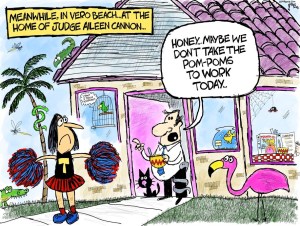 Woodward was previously defending Yuscil Taveras, who has now hired a new attorney and appears to be cooperating with the government.
“Employee 4, who is unnamed in the indictment but was identified by NBC News as Yuscil Taveras, secured a new lawyer in July, and did not waive the conflict, according to the motion. Roughly three weeks later, a grand jury charged Trump, Nauta, and Carlos De Oliveira, a Mar-a-Lago property manager, over their efforts to have Taveras delete Mar-a-Lago surveillance footage.
Prosecutors told Woodward earlier this year that they believed Taveras had information that would incriminate Nauta, and that representing both clients at the same time raised a potential conflict of interest. Woodward said he advised both clients of the government’s position, but that he was unaware of anything the employee could say to incriminate Nauta and did not see a conflict, according to the filing.
Judge Cannon was unconvinced, and instead has revealed the existence of secret grand jury still investigating this case in DC., thus delaying the case for who knows how long.
Perry Stein at The Washington Post: Judge asks prosecutors to justify use of 2 grand juries in Trump documents case.
Judge Aileen M. Cannon on Monday asked federal prosecutors to explain the use of grand juries in Florida and Washington in the classified documents case against Donald Trump even though charges were filed in South Florida.
Cannon, the federal judge in South Florida assigned to the case, posed the question in a court filing Monday and told federal prosecutors to respond by Aug. 22.
Trump and two aides — Waltine “Walt” Nauta and Carlos De Oliveira — were charged this summer in a 42-count indictment that accuses the former president of improperly retaining 32 classified documents at Mar-a-Lago, his Florida residence and private club, and seeking to thwart government attempts to retrieve them….
For many months, Justice Department prosecutors had questioned witnesses in the Florida case before a federal grand jury in Washington. The secret proceedings yielded much of the evidence at the crux of the case. But in May, the grand jury activity appeared to continue at a federal courthouse in Miami. Ultimately, prosecutors filed charges in a West Palm Beach courthouse — a courthouse in the same district as Miami and the area where Mar-a-Lago is located.
Prosecutors said in a court filing last week that they continued to use the grand jury in Washington after they initially charged Trump in June to investigate alleged instances of obstructing the investigation. The focus of the July superseding indictment was on obstruction, alleging that all defendants tried to delete security footage that the government wanted as evidence in the case.
“The grand jury in this district and a grand jury in the District of Columbia continued to investigate further obstructive activity, and a superseding indictment was returned on July 27, 2023,” prosecutors wrote in the filing.
 Judge Cannon apparently disapproves, and decided to reveal the information the Special Counsel had given her under seal.
Prosecutors included that revelation in a motion asking the judge to consider holding a hearing to determine whether Nauta’s attorney has too many conflicts of interest to provide his client with adequate legal advice.
The government lawyers said Stanley Woodward — the Nauta attorney — has represented at least seven other clients whom prosecutors have interviewed about Trump’s alleged efforts to keep classified documents in defiance of the government’s demand they be returned. Two of Woodward’s clients could be called as government witnesses in the trial, the filing by the government said.
If that happens, Woodward may need to cross-examine his other clients as part of defending Nauta, said the prosecutors leading the Justice Department investigation.
The requested hearing — known as a Garcia hearing — is fairly common in legal proceedings. At the hearing, prosecutors said Cannon should inform Nauta and the two witnesses, whose names have not been made public, of their legal rights and the potential conflicts their attorney poses. Lawyers are generally required to flag to a judge any potential conflicts of interest they encounter.
Cannon said Nauta’s lawyers are expected to respond to the judge’s question about the two grand jury locations and the prosecutors’ request for the Garcia hearing.
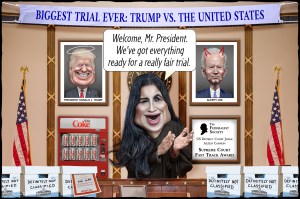 So it’s a normal request, but Cannon is going to drag the process out as long as she can, and, instead of keeping the existence of the secret grand jury under seal, she decided to announce it to the world.
Here’s a longer discussion of Cannon’s behavior by Adam Unikowsky’s Substack legal newsletter: It begins. Today’s order in United States v. Trump does not bode well.
Today [August 7] in the Southern District of Florida’s version of United States v. Trump, Judge Aileen Cannon issued an order denying the Justice Department’s motion to seal and requesting supplemental briefing. While seemingly insignificant, today’s order raises troubling concerns regarding her administration of the case….
Judge Cannon became nationally known in August and September 2022, when, in a civil case brought by Donald Trump, she issued a series of unusual orders blocking the Justice Department from reviewing documents seized at Mar-a-Lago and appointing a special master to oversee the Justice Department’s work. The Eleventh Circuit reversed Judge Cannon’s ruling, holding that the court lacked jurisdiction to interfere with the Justice Department’s review of lawfully-seized documents.
Unikowsky argues that it is important in dealing with Trump’s cases to be scrupulous in following norms. He doesn’t yet see any basis for asking for Judge Cannon to be removed from the case. It isn’t unusual for Judges to have rulings reversed and still continue to preside in the cases. I hope you’ll read the whole post if you’re interested in Unikowsky’s views on the case, but for this post, I’ll just cut to the chase.
The Justice Department’s motion notes: “The Government has advised Mr. Woodward of its intent to file this motion requesting a Garcia hearing and its reasons for doing so. Mr. Woodward has indicated that as a general matter he does not oppose the Court informing his client of the client’s rights or inquiring into potential waivers, but that he will not consent to this motion without seeing it in advance, and he requests the opportunity to respond.” This is a reasonable position for Woodward to take—he can’t possibly object to a hearing intended to safeguard his own client’s constitutional rights, but he wants to see the motion before taking a position.
So, this motion is a hanging curveball for Judge Cannon. It’s obvious how Judge Cannon should respond to this motion. She should wait to hear Woodward’s position on it!
If Woodward agrees a Garcia hearing is warranted, Judge Cannon should hold the hearing to ensure that Nauta’s rights are protected. Maybe there’s some discretionary reason to deny the hearing even if everyone agrees it’s warranted? I can’t think of one, but maybe. But clearly, Judge Cannon should wait until she hears from Woodward before deciding what to do….
Instead, Judge Cannon does something intensely weird. Two things, actually.
First, she denies the Justice Department’s motion to seal.
Second, she requests that Nauta file a response brief to the Justice Department’s motion addressing, among other things, “the legal propriety of using an out-of-district grand jury proceeding to continue to investigate and/or to seek post-indictment hearings on matters pertinent to the instant indicted matter in this district.” She also says Trump and De Oliveira “may, but are not required to” file a brief addressing this issue.
First, the court denies the Justice Department’s motion to seal, and strikes the motion for leave to file under seal, as well as the secret information itself, from the docket.
Here’s the court’s rationale: “The Special Counsel states in conclusory terms that the supplement should be sealed from public view ‘to comport with grand jury secrecy,’ but the motion for leave and the supplement plainly fail to satisfy the burden of establishing a sufficient legal or factual basis to warrant sealing the motion and supplement.”
Seriously?
Grand jury proceedings are supposed to be secret, and the Justice Department is disclosing the identity of grand jury witnesses and the substance of their testimony, so it wants to keep that information secret. That’s not a “legal or factual basis to warrant sealing the motion and supplement”?
There’s a lot more, and it’s pretty useful if you are interested in this case.
 The January 6 Case – Judge Tanya Chutkan
I’m sure you’re familiar with what has happened so far. Trump has been threatening Jack Smith, President Biden, the DOJ, and Judge Chutkan on social media and in speeches, even after he was warned not to commit crimes or tamper with witnesses or the jury pool. Smith requested a protective order before turning over discovery to the Trump team. He is concerned–with good reason–that Trump will release secret grand jury material and other evidence to the public so he can try the case in the media.
Here’s the latest.
Kyle Cheney at Politico: Trump objects to strict limits on sharing evidence in election interference case.
Former President Donald Trump argued Monday that he should be allowed to share evidence in his latest criminal case with “volunteer attorneys” and other unpaid advisers as he prepares to defend himself against charges related to his effort to subvert the 2020 election.
“The government cannot preclude the assistance of those individuals, nor should President Trump be required to seek permission from the Court before any such individual assists the defense,” Trump’s attorney John Lauro wrote in a filing that seeks to govern the handling of the mountains of evidence prosecutors have gathered and are preparing to share with Trump’s team.
“Such a limitation or requirement would unduly burden President Trump and impede the efficient preparation of his defense,” Lauro continued.
In a Sunday email between Trump’s lawyers and prosecutors, appended to Trump’s filing, assistant special counsel Thomas Windom raised concerns about Trump’s plan to broaden the group of legal advisers who might be permitted to review evidence in the case, worrying that the language Lauro proposed was “boundless.”
The dispute is one of several between Trump’s legal team and the special counsel over the handling of evidence in the case and how significantly to restrict Trump’s ability to publicly disclose any of the evidence he receives. Prosecutors have proposed a so-called “protective order” that would prohibit Trump or his legal team from publicly sharing any evidence produced by prosecutors. They say that they can’t begin sharing evidence with Trump and his team until a protective order is in place.
The matter now falls to U.S. District Court Judge Tanya Chutkan, who ordered Lauro to respond to prosecutors’ proposed protective order by Monday at 5 p.m. She may either rule on the matter or seek additional argument at a hearing in the case. Prosecutors are due to propose a trial date by Thursday.
Lauro said the blanket restriction on disclosing any evidence prosecutors provide is draconian and should be narrowed to limit the treatment only of materials deemed “sensitive” — such as those containing personally identifying information, grand jury subpoena returns, sealed search warrant returns and recordings or transcripts of witness interviews.
 The government asked the judge to simply grant the protective order, which is usually a routine decision. But instead, she ordered the parties to hash it out in a hearing this week–probably on Friday. Again the upshot is more delay, which is just what Trump wants.
Former President Donald Trump’s legal team says that a protective order proposed by special counsel Jack Smith would infringe on Trump’s right to free speech.
Trump’s attorneys made the argument in their response Monday to the special counsel’s motion for a protective order over the discovery evidence in the case against Trump for allegedly seeking to overturn the 2020 election.
Trump has pleaded not guilty to charges of undertaking a “criminal scheme” to overturn the results of the 2020 election by enlisting a slate of so-called “fake electors” targeting several states; using the Justice Department to conduct “sham election crime investigations”; and trying to enlist the vice president to “alter the election results” — all in an effort to subvert democracy and remain in power.
The former president has denied all wrongdoing and has dismissed the probe as politically motivated.
Monday’s filing argues for narrower limits on the protective order, which Trump’s attorneys say would protect sensitive materials while ensuring Trump’s right to free speech.
“In a trial about First Amendment rights, the government seeks to restrict First Amendment rights,” Trump’s attorneys wrote in their filing. “Worse, it does so against its administration’s primary political opponent, during an election season in which the administration, prominent party members, and media allies have campaigned on the indictment and proliferated its false allegations.”
Of course, the trial is not about First Amendment rights. Trump is charged with three criminal conspiracy counts.
Smith asked the judge for the protective order on Friday, referencing a social media post Trump made Friday afternoon in which he said, “IF YOU GO AFTER ME, I’M COMING AFTER YOU!”
The proposed protective order submitted by Smith does not seek to bar Trump from commenting on the case in its entirety, but would restrict Trump and his attorneys from disclosing evidence such as materials returned from grand jury subpoenas and testimony from witnesses and other exhibits shown to the grand jury. It does not limit Trump from discussing materials that were already available to the public separate from the government’s investigation.
Smith’s attorneys have said the proposed order is largely modeled after similar protective orders issued in other cases.
But in their filing on Monday, Trump’s attorneys accuse Smith’s team of asking Judge Tanya Chutkan to “assume the role of censor and impose content-based regulations on President Trump’s political speech that would forbid him from publicly discussing or disclosing all non-public documents produced by the government, including both purportedly sensitive materials, and non-sensitive, potentially exculpatory documents.”
This is the crap we are going to have to deal with, folks. None of these trials is going to be quick or easy.
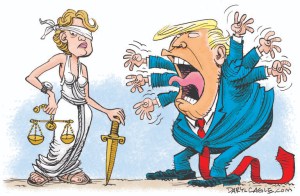 Meanwhile, because of Trump’s threats, Judge Chutkan needs more protection. CNN: Security increases for the judge assigned to Donald Trump’s January 6 criminal case.
Security for the federal judge assigned to oversee the criminal case against former President Donald Trump over his attempts to overturn the 2020 election has been increased in the federal courthouse in Washington, DC.
CNN has observed more security detailed to Judge Tanya Chutkan, and deputy US Marshals discussed security plans for the judge on Monday. The US Marshals Service handles security at the DC District Court and a spokesman for the service said it “take(s) that responsibility very seriously.”
“Ensuring that judges can rule independently and free from harm or intimidation is paramount to the rule of law, and a fundamental mission of the USMS,” spokesperson Drew J. Wade told CNN. “While we do not discuss our specific security measures, we continuously review the measures in place and take appropriate steps to ensure the integrity of the federal judicial process.”
The uptick in security inside the courthouse comes after security measures, including fencing and yellow tape, were taken down following Trump’s arraignment last week. That hearing, where Trump pleaded not guilty, was presided over by a magistrate judge. Chutkan takes the case from there.
Trump has already said he will be asking for Chutkan to recuse herself from the case, writing on social media in all caps: “There is no way I can get a fair trial with the judge ‘assigned’ to the ridiculous freedom of speech/fair elections case.”
So that’s what’s happening in the two federal cases against Trump. It’s going to be a long road, and there will be a lot of stupidity to deal with, but we can get through it together!
Mostly Monday Reads: Splendid Isolation
Posted: August 7, 2023 Filed under: 2016 elections, 2024 presidential Campaign | Tags: Hillary Rodham Clinton, Loneliness Epidemic, Trump lawyers, Trump World, Trump's High Crimes and Misdemeanors 9 Comments
The TV at Vaugh’s taunts us with this week’s highs. 101, 99, 99, 100,100, 100, and 98. I’m afraid to watch for the “feels like” temperatures.
Good Day, Sky Dancers!
It’s another week of incredible heat here. Temple and I arrived at Vaughn’s last night to discover their new window units blasting cold air. At least one corner of the bar was cold. I was told it’s not so good over there on the opposite side. It was pretty quiet but much cooler than my house. There were quite a few moments last night when Temple and I were alone in the bar while others went out to smoke whatever. I’ve never experienced that before.
I go for short, quick walks with Temple, then scurry her home. I’ve noticed how many of the usual dog walkers do the same. The National Weather Service tells us to stay inside. Plus, there’s a surge in Covid. The kids have just started school, and I hope they don’t have to isolate again. It’s not good for kids. I’ve started to wonder if isolation is a new reality. I already go to places where I’m least likely to find a raging Trumper or a Piety Performance. I’ve been talking to a long-time friend about how worn-out and anxious that makes us. It’s just safer alone or with close friends or family if they’re nearby.
So, it was interesting that I woke up to this article in The Atlantic by Hillary Rodham Clinton. I stayed awake just long enough to read it in my ritual cold water bath with a fan blasting. Once cooled, I went back to sleep. This is an exciting take on the isolation that Covid and the Trump years have brought to us. “THE WEAPONIZATION OF LONELINESS. To defend America against those who would exploit our social disconnection, we need to rebuild our communities.”
I have to admit that loneliness is not something in my emotional range. I like that safe feeling of being by myself, knowing that I can’t be interrupted by any outbursts or nonsense. I know how to entertain myself for long periods of time. That was a skill my mother taught me. I do realize that we’re more isolated now and that it’s bound to have differing impacts on different people. It’s a long read. It’s also an interesting one.
The question that preoccupied me and many others over much of the past eight years is how our democracy became so susceptible to a would-be strongman and demagogue. The question that keeps me up at night now—with increasing urgency as 2024 approaches—is whether we have done enough to rebuild our defenses or whether our democracy is still highly vulnerable to attack and subversion.
There’s reason for concern: the influence of dark money and corporate power, right-wing propaganda and misinformation, malign foreign interference in our elections, and the vociferous backlash against social progress. The “vast right-wing conspiracy” has been of compelling interest to me for many years. But I’ve long thought something important was missing from our national conversation about threats to our democracy. Now recent findings from a perhaps unexpected source—America’s top doctor—offer a new perspective on our problems and valuable insights into how we can begin healing our ailing nation.
In May, Surgeon General Vivek Murthy published an advisory, warning that a growing “epidemic of loneliness and isolation” threatens Americans’ personal health and also the health of our democracy. Murthy reported that, even before COVID, about half of all American adults were experiencing substantial levels of loneliness. Over the past two decades, Americans have spent significantly more time alone, engaging less with family, friends, and people outside the home. By 2018, just 16 percent of Americans said they felt very attached to their local community.

Prison Paintings 9 1972 Gulsun Karamustafa born 1946 Purchased with funds provided by the Middle East North Africa Acquisitions Committee 2019 http://www.tate.org.uk/art/work/T15189
I feel very attached to my community, but recently, it’s just been easier to just stay home. Am I the only one here?
An “epidemic of loneliness” may sound abstract at a time when our democracy faces concrete and imminent threats, but the surgeon general’s report helps explain how we became so vulnerable. In the past, surgeons general have at crucial moments sounded the alarm about major crises and drawn our attention to underappreciated threats, including smoking, HIV/AIDS, and obesity. This is one of those moments.
The rate of young adults who report suffering from loneliness went up every single year from 1976 to 2019. From 2003 to 2020, the average time that young people spent in person with friends declined by nearly 70 percent. Then the pandemic turbocharged our isolation.
According to the surgeon general, when people are disconnected from friends, family, and communities, their lifetime risk of heart disease, dementia, depression, and stroke skyrockets. Shockingly, prolonged loneliness is as bad, or worse, for our health as being obese or smoking up to 15 cigarettes a day. Researchers also say that loneliness can generate anger, resentment, and even paranoia. It diminishes civic engagement and social cohesion, and increases political polarization and animosity. Unless we address this crisis, Murthy warned, “we will continue to splinter and divide until we can no longer stand as a community or a country.”
The paintings today come from Artnet News. “Lonely Days Can Make for Great Art. Here’s How 10 Artists Found Inspiration in Isolation, From a Bedridden Frida Kahlo to a Jailed Egon Schiele. Whether in imprisonment or exile, these artists channeled their isolation into creative fuel.” I find this true for me whether it’s writing, composing music, or putting my paintbrushes to a blank sheet.
Back to Hillary.
What does all of this loneliness and disconnection mean for our democracy?
Murthy carefully connects the dots between increasing social isolation and declining civic engagement. “When we are less invested in one another, we are more susceptible to polarization and less able to pull together to face the challenges that we cannot solve alone,” he wrote in The New York Times.
It’s not just the surgeon general who recognizes that social isolation saps the lifeblood of democracy. So do the ultra-right-wing billionaires, propagandists, and provocateurs who see authoritarianism as a source of power and profit.
There have always been angry young men alienated from mainstream society and susceptible to the appeal of demagogues and hate-mongers. But modern technology has taken the danger to another level. This was Steve Bannon’s key insight.
Long before Bannon ran Donald Trump’s presidential campaign, he was involved in the world of online gaming. He discovered an army of what he later described as “rootless white males,” disconnected from the real world but highly engaged online and often quick to resort to sexist and racist attacks. When Bannon took over the hard-right website Breitbart News, he was determined to turn these socially isolated gamers into the shock troops of the alt-right, pumping them full of conspiracy theories and hate speech. Bannon pursued the same project as a senior executive at Cambridge Analytica, the notorious data-mining and online-influence company largely owned by the right-wing billionaire Robert Mercer. According to a former Cambridge Analytica engineer turned whistleblower, Bannon targeted “incels,” or involuntarily celibate men, because they were easy to manipulate and prone to believing conspiracy theories. “You can activate that army,” Bannon told the Bloomberg journalist Joshua Green. “They come in through Gamergate or whatever and then get turned onto politics and Trump.”
Egon Schiele, Prisoner! (April 24, 1912). Courtesy of the Albertina.
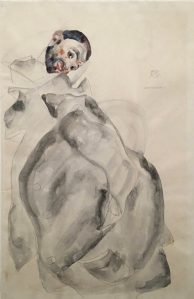
Clinton’s analysis is just what you would expect. Full of research, examples, and elucidation of where this might lead. It’s a heavy read but fully worth it.
This is typical Trump stuff. The lawsuit-happy Trump just keeps on trying to convince himself he isn’t the problem. This is from CNBC. “Trump counterclaim against E. Jean Carroll dismissed, DA can get deposition.”
A federal judge on Monday dismissed a defamation counterclaim by Donald Trump against the writer E. Jean Carroll in her pending lawsuit that accuses the former president of defaming her after she wrote that he had raped her.
Judge Lewis Kaplan, in a separate order made public Monday, ruled that Carroll’s lawyers can give the Manhattan District Attorney’s office a videotape and transcript of their deposition of Trump that they took last fall for the lawsuit.
That order raises the chance that Trump’s sworn testimony in Carroll’s case could be used against the former president as part of the DA’s pending criminal prosecution.
DA Alvin Bragg Jr. charged Trump, 77, earlier this year with falsifying business records related to a 2016 hush money payment to porn star Stormy Daniels. That case, in which Trump has pleaded not guilty, is set to go to trial next May.
Trump’s counterclaim in the Carroll suit focused on what he argued were her false statements, which he alleged badly harmed his reputation, a day after a jury verdict in May in her favor for $5 million for sexual abuse and defamation in a related civil lawsuit in U.S. District Court in Manhattan.
Carroll during a CNN interview said that she thought in her head, “Oh, yes, he did — oh, yes, he did” — after jurors in that case did not find that Trump had raped her.
In the same interview, Carroll described her encounter in court with Trump’s lawyer Joseph Tacopina right after the jury verdict, when Tacopina shook hands with her attorney, Roberta Kaplan, who is not related to the judge.
“Well, Joe Tacopina is very likeable. He’s sort of like an 18th Century strutting peacock,” Carroll said on CNN. “So, he sticks out his hand — first he congratulated Robbie. And then, he was congratulating people on the team. And as I put my hand forward, I said, ‘He did it and you know it.’ Then we shook hands, I passed on.”
Judge Kaplan, in dismissing the counterclaim, wrote that Carroll’s statements repeating a claim that Trump had raped her were “substantially true” because the jury had found he digitally penetrated her, even if it did not find that he had penetrated her with his penis, as is required for a rape charge under New York law.
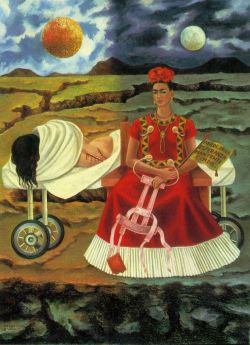
Frida Kahlo, Tree of Hope (1946).
Sometime this week, it appears we will have an indictment for Trump in Georgia. “Fulton County insiders expect former President Donald Trump to be indicted this week in Georgia. It would be a state indictment and could be the most significant out of all the indictments since someone can only be pardoned on federal charges.” This is from Channel 11 in Atlanta, as reported by Dawn White.
Many people in Fulton County are preparing for Fulton County District Attorney Fani Willis to announce an indictment against former U.S. President Donald Trump for allegedly trying to overturn the results of the 2020 Presidential Election in Georgia.
This would be Trump’s fourth indictment this year.
An Atlanta-area lawyer tells 11Alive he believes Willis could indict Trump this coming week. It would be a state indictment and could be the most significant out of all the indictments since someone can only be pardoned on federal charges.
“I just want to find 11,780 votes, which is one more than we have.”
That infamous phone call between the then president and Georgia Secretary of State Brad Raffensperger happened on January 2, 2021. Almost three years later, bright barriers surround the perimeter of the Fulton County Courthouse in preparation for Trump’s possible indictment for election interference in Georgia.
“We’ve never had this happen before, so no one quite knows what’s going to happen,” attorney Darryl Cohen said.
Cohen is a former Fulton County assistant district attorney and said while there’s a lot we don’t know, there’s certain things that are likely to happen.
“There are going to be Trump supporters that love him. There’s going to be Trump haters that hate him, and we don’t know if they’re going to be together or if they’re going to clash,” Cohen said. “We don’t know how many people are going to turn out, so this could all be the beginning of a story that we cannot begin to understand until it unravels.”
Normally someone goes to Fulton County Jail after an arrest, but Cohen believes that’s unlikely for the former president.
“I think that he will be mug shot and fingerprinted at the Fulton County Courthouse. We have a serious, really serious security problem,” Cohen said.
Cohen said if Willis announced an indictment against Trump, it would be assigned to a Fulton County superior judge.

Barbara Ess, Fire Escape [Shut-In Series] (2018-19). Courtesy of Magenta Plains.
Donald Trump blared Sunday morning that his legal team would be “immediately asking for recusal” of U.S. District Court Judge Tanya Chutkan from his latest criminal case, proclaiming (but not revealing) “very powerful grounds” for the demand.
Hours later, his attorney John Lauro would publicly walk back that plan, saying Trump was speaking with a “layman’s political sense” and reacting primarily because Chutkan was nominated to the bench by a Democrat. (She was confirmed 95-0 by the Senate in 2014 after Barack Obama nominated her).
“We haven’t made a final decision on that issue at all,” Lauro said on a podcast hosted by Florida defense attorney David Markus. “I think as lawyers we have to be very careful of those issues and handle them with the utmost delicacy.”
On Monday morning, Trump was again hammering on the recusal issue, calling Chutkan “the Judge of [special counsel Jack Smith’s] ‘dreams’ (WHO MUST BE RECUSED!).”
The back-and-forth on public airwaves and social media underscores the familiar tension between Trump and his legal team, which has been rocked by infighting, departures and conflicting advice in recent months. All of it, however, is secondary to Trump’s own whims and instincts, which have served him politically but are grating against the rules and norms of behavior for those charged with serious federal crimes.

Paul Sérusier, Solitude, Huelgoat Landscape, c.1892, Musée des Beaux-Arts de Rennes, Rennes.
We’ve already learned that Lawyer Lauro has odd predilections about the law himself. This is from Adam Edelman for NBC News. “If Trump committed ‘a technical violation of the Constitution,’ it’s not a crime, his lawyer says.” Later on NBC’s “Meet the Press,” Rep. Jamie Raskin, who sat on the House panel that investigated the Capitol riot, said Lauro’s argument was “deranged.”
If former President Donald Trump committed a “technical violation of the Constitution,” it doesn’t mean he necessarily broke any criminal laws, John Lauro, Trump’s criminal defense attorney, argued Sunday on NBC’s “Meet the Press.”
Lauro appeared to signal how he’d defend the former president in a trial that will stem from the four-count criminal indictment returned last week by a federal grand jury that had been examining Trump’s possible role in the Jan. 6, 2021, Capitol riot and his alleged attempts to overturn the 2020 election.
Pressed by NBC’s Chuck Todd about Trump’s alleged pressure campaign to get former Vice President Mike Pence to reverse the election, Lauro claimed that Trump and Pence had merely disagreed over whether a vice president could constitutionally take actions that could lead to a presidential election’s being overturned.
“A technical violation of the Constitution is not a violation of criminal law,” Lauro contended, saying it was “just plain wrong” to suggest that Trump had pressed Pence to break the law.
“And to say that is contrary to decades of legal statutes,” he continued.
“These kinds of constitutional and statutory disagreements don’t lead to criminal charges,” Lauro said. “And one thing that Mr. Pence has never said is that he thought President Trump was acting criminally.”
In response to the latest indictment, Pence said he believes “that anyone who puts himself over the Constitution should never be president of the United States.” He said Wednesday that Trump surrounded himself after the 2020 election with “crackpot lawyers” who told him only what his “itching ears” wanted to hear.
My thought is that’s a very good way to get all those unindicted co-conspirators on the people’s side because it sure looks like they’re getting the fickle finger of blame from the Trump Team
Anyway, I’m going to go eat a fresh peach and yogurt with some honey in the coldest spot in the house.
What’s on your reading and blogging list today?
Lazy Caturday Reads
Posted: August 5, 2023 Filed under: cat art, Cats, caturday, Criminal Justice System, democracy is threatened, Donald Trump, just because | Tags: cult psychology, Department of Justice, Judge Tanya Chutken, Special Counsel Jack Smith, Trump threats 7 Comments
Bazon, the artist’s cat, by Odilon Redon
Happy Caturday!!
Donald Trump has now been indicted three times, and there could be a fourth indictment coming soon in Georgia. Trump was arraigned for his conspiracies to overturn the 2020 election on Thursday.
At the end of that hearing, U.S. Magistrate Judge Moxila Upadhyaya warned him not to commit further crimes by attempting to influence witnesses with threats or bribes.
Trump swore he would follow instructions, but a little later he reneged.
One day later, Trump issued a threat on Truth Social, writing in all-caps ““IF YOU GO AFTER ME, I’M COMING AFTER YOU!”
From Joyce Vance at Civil Discourse: “If you go after me…”
Today, Donald Trump issued what can only be construed as a shot across the bow, after the Magistrate Judge Moxila Upadhyaya admonished him during arraignment yesterday that he must not commit any new crimes while on a pre-trial bond—the thing that’s keeping him out of jail before trial—and that efforts to influence or intimidate witnesses, jurors or others involved in the case were illegal….
It couldn’t be more clear that this is a threat to Jack Smith and the prosecutors and investigators involved in the case against him. It’s readily construed as a threat against state court prosecutors like Alvin Bragg in New York and Fani Willis in Georgia and could even be seen as a threat to people like E. Jean Carroll who have the temerity to hold him accountable for civil misconduct.
That’s a threat, made by a defendant in a criminal case, after being warned by a judge that there were consequences for violating conditions of release. Trump may think he can be cute and deny it if confronted. Maybe he’ll use his usual line: it’s just a joke. But we can all see it for what it is.
Girl with Cat, by Berthe Morisot, 1892
The special counsel’s office alerted the Judge to the post tonight, as part of its motion seeking a protective order for the discovery materials it will be releasing to Trump in the case.The government wants assurances, in the form of a protective order, that Trump won’t make the discovery materials public.
There is good reason for this. Some of the discovery contains personal identifying information for witnesses. If publicly disclosed, that could put them at risk of doxxing, identity theft or other harm. There is also grand jury testimony from witnesses, who might be put at risk if they find themselves suddenly in the public spotlight. As the government explains in its motion, “If the defendant were to begin issuing public posts using details—or, for example, grand jury transcripts—obtained in discovery here, it could have a harmful chilling effect on witnesses or adversely affect the fair administration of justice in this case.”
Prosecutors haven’t asked the court, at least not yet, to revoke Trump’s bond. That, of course, would be a step that would trigger prolonged litigation and possibly delay the trial. That seems to be the one thing Jack Smith is trying to avoid at all costs. He has made strategic decisions, for instance, only indicting Trump and leaving the co-conspirators unindicted, that streamline the process. He clearly wants his trial before the election.

Trump continued his threatening behavior during a speech in Alabama last night.
Alander Rocha at the Alabama Reflector (via MSN.com): Trump lashes out at prosecutors, Biden and DeSantis in Alabama speech.
Former President Donald Trump said in a speech in Montgomery Friday night that he wears his recent indictment on charges of attempting to subvert the 2020 presidential election as “a badge of honor.”
In a nearly-hourlong speech at a fundraising dinner for the Alabama Republican Party, Trump attacked Florida Gov. Ron DeSantis, his rival for the Republican nomination for president and President Joe Biden, who he accused of using the Department of Justice as a political weapon.
“They want to take away my freedom because I will never let them take away your freedoms. They want to silence me because I will never let them silence you,” Trump said.
Raminou, 1922, by Suzanne Valadon
The speech was the former president’s first extended public remarks since a federal grand jury Tuesday indicted the former president on four counts, including conspiracy to defraud the United States; conspiracy to obstruct an official proceeding; obstruction of, and attempt to obstruct, an official proceeding; and conspiracy against rights….
In his speech Friday, Trump called U.S. Department of Justice Special Counsel Jack Smith, who brought the indictment, “deranged.” At times he called prosecutors “communists” and “corrupt Marxist prosecutors.” He called the indictment “fake charges” that are an “outrageous criminalization of political speech,” even as he suggested it would help his presidential campaign.
“This is a ridiculous indictment against us — it’s not a legal case. It’s an act of desperation by a failed and disgraced crooked Joe Biden and his radical left thugs,” Trump said.
Trump also repeated election lies and claimed that Biden rigged the election in 2020 and suggested that the current president will interfere with the next election.

Also last night, federal prosecutors in the case called the judge’s attention to Trump’s threatening social media post and requested a protective order. Kyle Cheney and Josh Gerstein at Politico: Feds alert judge to Trump’s ‘If you go after me, I’m coming after you!’ post.
Prosecutors on Friday night called a judge’s attention to a social media post from Donald Trump — issued hours earlier — in which they say the former president appeared to declare that he’s “coming after” those he sees as responsible for the series of formidable legal challenges he is facing.
Attorneys from special counsel Jack Smith’s team said the post from Trump “specifically or by implication” referenced those involved in his criminal case for seeking to subvert the 2020 election.
In a court filing just before 10 p.m. Friday, Senior Assistant Special Counsels Molly Gaston and Thomas Windom alerted the judge in Trump’s latest criminal case — U.S. District Court Judge Tanya Chutkan — to a combative post Trump sent earlier in the day.
“If you go after me, I’m coming after you!” Trump wrote in all caps Friday afternoon on Truth Social, which is run by a media company he co-owns.
Cat with her Kittens (1913) by Julius Adam
The prosecutors said Trump’s post raised concerns that he might improperly share evidence in the case on his social media account and they urged that he be ordered to keep any evidence prosecutors turn over to his defense team from public view.
“All the proposed order seeks to prevent is the improper dissemination or use of discovery materials, including to the public,” Gaston and Windom wrote. “Such a restriction is particularly important in this case because the defendant has previously issued public statements on social media regarding witnesses, judges, attorneys, and others associated with legal matters pending against him. … And in recent days, regarding this case, the defendant has issued multiple posts—either specifically or by implication—including the following, which the defendant posted just hours ago.”
Smith’s office has not sought a gag order in either of the criminal cases it is pursuing against Trump: one in Florida focused on his retention of classified documents and the other in Washington over his efforts to interfere with the certification of the 2020 presidential election. The filing Friday night does not make any request to bar Trump or his attorneys from discussing the D.C. case publicly or with the media.
However, prosecutors in that case have indicated they’re prepared to share a “substantial“ volume of evidence with Trump as soon as Chutkan approves an order governing the handling of evidence. Chutkan is slated to bring attorneys for both sides to court on Aug. 28 to discuss setting a trial date. It’s unclear if Trump’s post will prompt her to seek more immediate efforts to implement a protective order or to impose a gag order, which can be issued under D.C. federal court rules.

Trump then got an anonymous “spokesperson” to put up a mealy-mouthed excuse for the threatening post.
https://twitter.com/BrianKarem/status/1687685417154342912?s=20
The Judge in the January 6 case, Tanya Chutken has ordered Trump to respond to the prosecutors’ request for a protective order:
Of the historic day when a former president was charged with serious crimes against the United States, CNN’s Stephen Collinson wrote this analysis: Trump’s surreal arraignment day in Washington augurs ominous days ahead.
As former President Donald Trump left Washington after answering charges of trying to subvert democracy, it felt like all the previous trauma and divisions of his eight-year journey into the nation’s psyche were just the start.
America now faces the prospect of an ex-president repeatedly going on trial in an election year in which he’s the Republican front-runner and is promising a new White House term of retribution. He is responding with the same kind of extreme rhetoric that injected fury into his political base and erupted into violence after the last election. Ominous and tense days may be ahead….
The entire day was surreal, but given its historic implications – after Trump became the first ex-president formally charged in relation to alleged crimes committed in office – also sad.
Thursday was a day when the country crossed a point of no return. For the first time, the United States formally charged one of its past leaders with trying to subvert its core political system and values.
It was Trump who forced the country over this dangerous threshold. A man whose life’s creed is to never be seen as a loser refused to accept defeat in a democratic election in 2020, then set off on a disastrous course because, as Smith’s indictment put it, “he was determined to stay in power.”
Trump is steering a stormy course to an unknown destination. If he wins back the White House, the already twice-impeached new president could trigger a new constitutional crisis by sweeping away the federal cases against him or even by pardoning himself. Any alternative Republican president could find themselves besieged by demands from Trump supporters for a pardon that, if granted, could overshadow their entire presidency. And if Trump is convicted, and loses a 2024 general election, he risks a long jail term, which would likely become fuel for him to incite his supporters to fresh protest.
Conservative legal scholar J. Michael Luttig tweeted after Trump’s latest indictment on Tuesday that it was a day made “all the more tragic and regrettable because the former president has cynically chosen to inflict this embarrassing spectacle on the Nation – and spectacle it will be.” Luttig warned that the world would no longer consider American democracy to be the same inspiration as it has been for almost 250 years.
Read the rest at CNN.
At The New York Times, Charlie Savage writes: How Jack Smith Structured the Trump Election Indictment to Reduce Risks.
In accusing former President Donald J. Trump of conspiring to subvert American democracy, the special counsel, Jack Smith, charged the same story three different ways. The charges are novel applications of criminal laws to unprecedented circumstances, heightening legal risks, but Mr. Smith’s tactic gives him multiple paths in obtaining and upholding a guilty verdict.
“Especially in a case like this, you want to have multiple charges that are applicable or provable with the same evidence, so that if on appeal you lose one, you still have the conviction,” said Julie O’Sullivan, a Georgetown University law professor and former federal prosecutor.
Study of Cats Flowers and Woman-1910-14, by Odilon-Redon
That structure in the indictment is only one of several strategic choices by Mr. Smith — including what facts and potential charges he chose to include or omit — that may foreshadow and shape how an eventual trial of Mr. Trump will play out.
The four charges rely on three criminal statutes: a count of conspiring to defraud the government, another of conspiring to disenfranchise voters, and two counts related to corruptly obstructing a congressional proceeding. Applying each to Mr. Trump’s actions raises various complexities, according to a range of criminal law experts.
At the same time, the indictment hints at how Mr. Smith is trying to sidestep legal pitfalls and potential defenses. He began with an unusual preamble that reads like an opening statement at trial, acknowledging that Mr. Trump had a right to challenge the election results in court and even to lie about them, but drawing a distinction with the defendant’s pursuit of “unlawful means of discounting legitimate votes and subverting the election results.”
While the indictment is sprawling in laying out a case against Mr. Trump, it brings a selective lens on the multifaceted efforts by the former president and his associates to overturn the 2020 election.
“The strength of the indictment is that it is very narrowly written,” said Ronald S. Sullivan Jr., a Harvard Law School professor and former public defender. “The government is not attempting to prove too much, but rather it went for low-hanging fruit.”
For one, Mr. Smith said little about the violent events of Jan. 6, leaving out vast amounts of evidence in the report by a House committee that separately investigated the matter. He focused more on a brazen plan to recruit false slates of electors from swing states and a pressure campaign on Vice President Mike Pence to block the congressional certification of Joseph R. Biden Jr.’s victory.

Read the rest at the NYT. It’s interesting, and Savage is a serious writer–not a both-sideser.
One more by neuroscientist Seth Norrholm at Raw Story:
I was dying…It was just a matter of time. Lying behind the wheel of the airplane, bleeding out of the right side of my devastated body, I waited for the rapid shooting to stop.
—Former Representative Jackie Speier in her memoir Undaunted: Surviving Jonestown, Summoning Courage, and Fighting Back recounting her experience after being shot five times during an ambush during her fact-finding visit to Jonestown, Guyana where Jim Jones and his cult, Peoples Temple, had built a compound.
It, combined with everything else that was going on, made it difficult to breathe…Being crushed by the shield and the people behind it … leaving me defenseless, injured.
—Metropolitan police officer, Daniel Hodges, describing being crushed in a doorway during the January 6, 2021, attack by Trump supporters on the U.S. Capitol.
Horatio Henry Couldery, Curiosity
In both of the examples above, the individual speaking was the victim of extreme violence perpetrated by followers of a single person whose influence had spread to hundreds of people (in the January 6th case, thousands of people). In fact, Speier’s experience with the Jim Jones followers was part of the single greatest loss of American life (918 people) prior to 9/11/2001. These followings have been given an umbrella name, cult, and have involved what has been traditionally called “brainwashing.” The cult leader receives seemingly undying support as the Dear Leader or Savior. However, the term brainwashing suggests that indoctrinated members are robots without free will – behavioral scientists argue that this is not the case. It’s an oversimplification.
Rather than being seen as passive victims to an irresistible force, psychiatrist Robert Lifton argues that there is “voluntary self-surrender” in one’s entrance into a cult. Further, the decision to give up control as part of the cult process may actually be part of the reason why people join. Research and experience tell us that those who are “cult vulnerable” may have a sense of confusion or separation from society or seek the same sort of highly controlled environment that was part of their childhood. It has also been suggested that those who are at risk for cult membership feel an enormous lack of control in the face of uncertainty (i.e., economic, occupational, academic, social, familial) and will gravitate more towards a cult as their distress increases. I would argue that many of these factors are at play when we see the ongoing support of Trumpism and MAGA “theology.”
Psychologist Leon Festinger described the phenomenon of cognitive dissonance in which there is a disconnect between one’s feelings, beliefs, and convictions and their observable actions. This dissonance is distressing and, in order to relieve the anxiety, people may become more invested in the cult or belief system that goes against who they are individually. As such, cult members become more “dug-in” and will cling to thoughts and beliefs that contradict available evidence. In other words, they are no longer able to find a middle ground or compromise.

Norrholm argues that the Trump cult has changed our politics drastically–that there is no longer a “middle ground” between Republicans and Democrats/Independents.
Although members of the GOP still refer to themselves as a political party with principled stances, the reality is they have now morphed into a domestic terror organization and to use the umbrella term, a cult – the largest and most dangerous cult in American history.
Cult thinking includes ardent adherence to group thinking such as – clinically speaking, in the face of distorted thinking we ask about one’s strength of conviction by querying, ”Can you think of other ways of seeing this?” Sadly, what we are seeing publicly is ‘No’ from those who still subscribe to Trumpism/MAGA.
Read the rest at Raw Story. Norrholm really knows what he’s talking about.
What is happening in this country is really frightening, but I continue to believe that we will get through this somehow.
Finally Friday Reads: Trump Faces 641 Years in Jail
Posted: August 4, 2023 Filed under: 2024 Elections, 2024 presidential Campaign | Tags: Grump Old Man, They Call me Mister Grump, Trump Indictments, Trump lawyers 8 Comments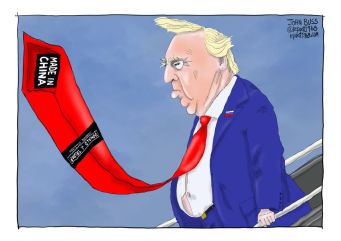
“Yesterday was a bad hair day.” John Buss, @Repeat1968
Happy Indictment Week Three, Sky Dancers!
We anticipate Fulton County, Georgia’s DA, will give us a week 4 shortly! So, I’ll start right out! What the fuck is wrong with one-third of the country? Tal Axelrod of ABC News reports on this new poll. “Nearly two-thirds of Americans think Jan. 6 charges against Trump are serious: POLL — Trump was indicted for the third time on Tuesday and has pleaded not guilty.”
A majority of Americans (51%) think Tuesday’s federal indictment of former President Donald Trump related to Jan. 6 and his efforts to overturn the 2020 election is very serious, marking the highest figure yet of the three indictments he’s faced, according to a new ABC News/Ipsos poll.
Overall, 65% of adults think the charges are serious, including 51% who said they are very serious and 14% who said they are somewhat serious.
Only 24% said they are not serious, including 17% who said they are not serious at all.
Just over half — 52% — think Trump should have been charged with a crime in this case, while 32% said he should not have been. And a plurality of Americans (49%) said Trump should suspend his presidential campaign, while 36% said he shouldn’t.
At the same time, 46% think the charges against Trump are politically motivated, while 40% do not, per the ABC News/Ipsos poll conducted using Ipsos’ KnowledgePanel.
The results show that the public believes the latest charges are more serious than those in two other indictments: one federal case in Florida concerning Trump’s alleged mishandling of and refusal to return government secrets after leaving office and the other state case in New York City over his hush money payments to an adult film actress in the days before the 2016 election, for which he is accused of falsifying business records.
He has pleaded not guilty in both of those cases and denies all wrongdoing.
In ABC News/Ipsos polls in the wake of the previous indictments, 42% of Americans said the documents-related charges were very serious and 30% saw the hush money-related charges as very serious, compared to 51% in this most recent indictment.
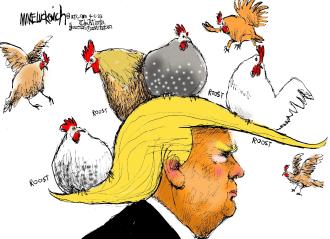 The asshole staged a violent coup attempt at the People’s House. WTF are these complacent assholes thinking? It was televised! Some of his droggies are in jail for Seditious Conspiracy. What will it take to wake these jerks up? I agree with this Congress Critters. Let the Trial be televised! Let them resee how all the freaking witnesses against him are Republicans. Trump even got charged under the KKK Act and will now face a tough Black Woman as judge. How is that a political set-up by Democrats! Rebecca Shabad of NBC News has this story. “House Democrats call for live broadcasts of court proceedings in Trump criminal cases.”
More than three dozen House Democrats are calling on the policymaking body for federal courts to permit live broadcasting of court proceedings in the Justice Department’s cases charging former President Donald Trump with federal crimes.
In a letter led by Rep. Adam Schiff, D-Calif., who served on the House select committee that investigated the Jan. 6, 2021, insurrection, Democrats asked that the Judicial Conference “explicitly authorize the broadcasting of court proceedings in the cases of United States of America v. Donald J. Trump.”
“It is imperative the Conference ensures timely access to accurate and reliable information surrounding these cases and all of their proceedings, given the extraordinary national importance to our democratic institutions and the need for transparency,” the lawmakers wrote in the letter, sent Thursday to Judge Roslynn R. Mauskopf, the secretary of the Judicial Conference.
The letter, whose signatories also included other members who served on the former Jan. 6 committee, noted that the Judicial Conference has “historically supported increased transparency and public access to the courts’ activities.”
“Given the historic nature of the charges brought forth in these cases, it is hard to imagine a more powerful circumstance for televised proceedings,” the letter said. “If the public is to fully accept the outcome, it will be vitally important for it to witness, as directly as possible, how the trials are conducted, the strength of the evidence adduced and the credibility of witnesses.”
The letter was sent on the same day that Trump was arraigned at the federal courthouse in Washington during a proceeding that was not televised or live-streamed. He pleaded not guilty to four federal counts over his alleged efforts to overturn the 2020 presidential election, which led to the Jan. 6 attack on the U.S. Capitol. Federal prosecutors filed the grand jury indictment Tuesday.
Trump’s next court hearing in the case is set for Aug. 28. A trial date has not yet been set.
 Before I continue, I should mention that the headline contains the number of years Trump could face so far, as calculated by the Washington Post‘s Philip Bump. You can get a great list of all the indictments and charges there with their individual number of maxium years for conviction.
Dan Ladden-Hall writing at The Daily Beast had this interesting color from the courtroom. “Trump Was Seriously Salty About the Way a Judge Addressed Him. PRESIDENT GRUMP!”
Donald Trump was in a massive huff Thursday after he entered his not guilty plea to four charges stemming from his attempts to overturn the 2020 election, according to CNN. Sources told the outlet the former president was “pissed off” after departing the courthouse in Washington, D.C., and that he had been especially annoyed by one particular aspect of the hearings: namely, being referred to by Magistrate Judge Moxila Upadhyaya as “Mr. Trump.” He’s apparently grown accustomed to still being called “Mr. President” by supporters at his Bedminster golf club and Mar-a-Lago, despite being turfed out of the Oval Office over two years ago.
We also have this reporting from CNN’s Caitlin Collins. “Trump was in a sour and dejected mood following his arraignment, sources say.”
Trump was “pissed off” after he motorcaded through traffic, the sources said.
After the 27-minute legal proceeding, the former president did not take questions as he had planned to do at Ronald Reagan Washington National Airport before his return flight to New Jersey.
Trump did speak briefly to the media, criticizing the charges and claiming he was being persecuted because he was running for office.
Trump had been fingerprinted and processed at the E. Barrett Prettyman Courthouse before he pleaded not guilty to four criminal charges related to his efforts to overturn the 2020 presidential election.
One aspect of the hearing that irked the former president — who is still referred to by his former title when at his Bedminster golf club or Mar-a-Lago resort — was when Magistrate Judge Moxila Upadhyaya referred to him as simply “Mr. Trump.”
 I just hope it has serious agita from the experience and chokes on a grizzly, greasy over-cooked Big Mac.
Lawrence O’Donnell had me glued to the screen last night discussing two press concerence held by Trump Lawyer John Lauro. Instance one had his panel talking about a mistep. The second instance had them stumped. Was this simply a PR stunt to help find a hold out Trumper in the Jury? This is from The Daily Beast. “MSNBC Panel Stunned by Trump Lawyer’s ‘Admission’ on Fox News. Attorney John Lauro appeared on Fox News Thursday night to discuss the events of Trump’s latest indictment—but analysts say he said too much.” This is reported by William Vaillancourt.
An MSNBC panel was shocked by a pair of television interviews Thursday where Donald Trump lawyer John Lauro seemed to confirm an allegation contained within the Jan. 6-related indictment of the former president.
Lauro had told Fox News host Laura Ingraham earlier in the evening that, leading up to Jan. 6, Trump voiced his approval for Pence to send the election back to the states rather than have the Electoral College vote be certified.
“What President Trump said is, ‘Let’s go with option D,’” Lauro said on The Ingraham Angle. “Let’s just halt, let’s just pause the voting and allow the state legislatures to take one last look and make a determination as to whether or not the elections were handled fairly. That’s constitutional law. That’s not an issue of criminal activity.”
Lauro said basically the same thing on Newsmax a bit later.
MSNBC anchor Lawrence O’Donnell was surprised at the revelation.
“That is a Trump criminal defense lawyer quoting Donald Trump committing a crime,” he said. “Donald Trump’s criminal defense lawyer tonight added information to Jack Smith’s 42-page description of Donald Trump’s crimes. The conversation that John Lauro just described appears on page 34 of the indictment against his client.”
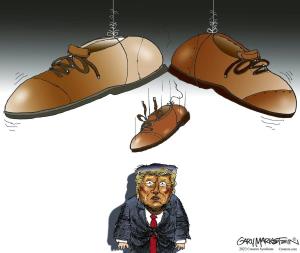 There was fun to be had when two Former Federal Prosecutors had to figure out what they had just seen.
MSNBC contributor and former Department of Justice lawyer Andrew Weissman considered Lauro’s statements to be “an admission,” as he wrote in a tweet.
“So, I don’t know why a defense lawyer is going to start giving facts about a critical moment,” he said on air, prompting O’Donnell to exclaim: “It’s the whole case!”
Weissman added: “It is such a damning thing when you put it in context because remember what the indictment alleges…[that] the reason this had to be done with the vice president is because prior to that, all the efforts that Donald Trump took with respect to the secretaries of state did not work.”
“I just don’t know why John, who is a good lawyer, didn’t just zip it and not say anything,” he continued.
“They don’t teach TV in law school,” O’Donnell quipped.
Former federal prosecutor Glenn Kirschner, also an MSNBC contributor, was stunned as well, saying bluntly, “It makes no sense.”
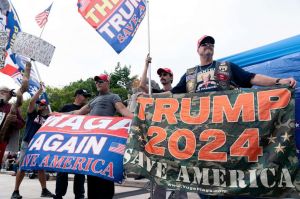
A few cartoon characters preening like stereotypical white men with big signs and not much else. Why do they all look alike?
My additional favorite headline came from The Washington Post. “Among MAGA extremists, Trump charges draw big talk, small crowds. The threat of pro-Trump political violence isn’t gone but has shifted from organized movements, analysts say.” They are all afraid of getting time in the Big House and that ain’t Mar-a-Lardo.
“Many people have really given up,” said Steve Corson, 66, of Fredonia, Ariz., standing alone outside the courthouse in a “We the People” hat, a starkly different experience from Jan. 6, 2021, when he marched to the U.S. Capitol alongside thousands of other Trump fans.
For all the online outrage, only a handful of Trump supporters turned out to protest the latest charges against the former president, continuing a shift in the right-wing fervor that once drew thousands to D.C. rallies, clogged lakes with boat parades and mobilized a de facto “MAGA militia” in the armed groups that took his extremist rhetoric to the streets.
So, that’s it for me today. I’m trying to beat the heat and do what I can around the house. Right now, it’s my ritual cold bath and blasting fan and something to read. Stay safe out there! Cross the street if you see any dude in his maga militia playsuit!
What’s on your reading and blogging list today?
Thursday Reads: We Desperately Need a Better Media
Posted: August 3, 2023 Filed under: just because | Tags: mainstream media 14 Comments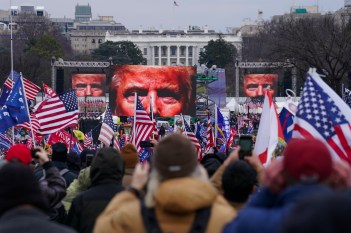 Good Afternoon!!
Yesterday, the two most important newspapers in the U.S. published articles in which they “both-sided” the indictment of Donald Trump in the January 6 case. Reporters Michael Schmidt and Maggie Haberman at the New York Times and Devlin Barrett and Josh Dawsey at The Washington Post published articles that–at least in their headlines and the early paragraphs characterized Jack Smith’s case against Trump as a First Amendment case even though Smith explained very clearly in his statement announcing the indictments that it is a conspiracy case–based on lies that led to actions.
This is exactly what Republicans want Americans to believe–that Trump is being prosecuted for lying about the results of the 2020 election or even for his belief that the election was stolen from him. I’m not even going to quote from the two articles, but here are the links if you want to read them.
The New York Times: Trump Election Charges Set Up Clash of Lies Versus Free Speech.
The Washington Post: Heart of the Trump Jan. 6 indictment: What’s in Trump’s head.
David Kurtz spells this out clearly at Talking Points Memo: No, The Jan. 6 Indictment Of Trump Is Not A First Amendment Case.
As soon as I saw the headline, I knew this NYT story was going to be bad: “Trump Election Charges Set Up Clash of Lies Versus Free Speech.” No. No, it does not.
Both-sides coverage in politics is toxic; in legal coverage it’s so bad it becomes almost funny. But of course in typical legal matters we rarely get both-sides coverage. Instead, it skews heavily in favor of the narrative of law enforcement and prosecutors. But when a politician (let alone Trump) is the defendant, suddenly there’s a detached remove from the underlying facts. Conspiracy to overthrow the government or just political puffery in the spirit of stump speaking? Who can say, really? We’ll leave to you, dear reader, to decide.
Take the core graph of the story:
The indictment and his initial response set up a showdown between those two opposing assertions of principle: that what prosecutors in this case called “pervasive and destabilizing lies” from the highest office in the land can be integral to criminal plans, and that political speech enjoys broad protections, especially when conveying what Mr. Trump’s allies say are sincerely held beliefs.
Trust me, folks. This is not going to be a showdown over the limits of the First Amendment. How do I know? Well, one way is by reading the bottom half of the same NYT story, where legal experts shred the Trump defenses.
Kurtz recommends reading this thread on Twitter, which I read yesterday.
There’s a bit more on Twitter.
Kurtz notes (at TPM) that the Wall Street Journal did the same thing:
Another example of covering a criminal prosecution like it’s politics, courtesy of the WSJ: “Trump Is Being Prosecuted, but Justice Department Is on Trial, Too”
Oh boy, this sentence: “On the issue of whether it can persuade the public of the righteousness of its prosecution, the Justice Department has taken on a huge and politically polarizing target in an atmosphere already ripe with mistrust over its motivations.”
Not literally untrue. But notice the way this turns it all into a messaging contest, like a political campaign
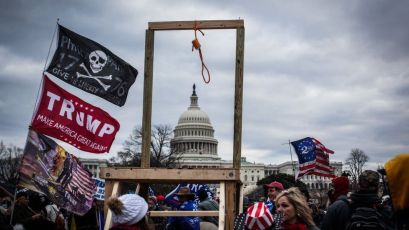
This is from Lisa Needham at Aaron Rupar’s Public Notice: Trump’s J6-related indictment isn’t about his words. It’s about his deeds.
Special Counsel Jack Smith’s indictment distills the whole of the January 6 investigation into 45 pages. The story it tells is already familiar. There is the sheer number of lies told by Trump and his allies, such as that over 10,000 dead people voted in Georgia, that there was a suspicious late-night “vote dump” in Michigan, and that Pennsylvania issued 1.8 million absentee ballots but processed 2.5 million.
Smith makes clear that the issue here isn’t Trump’s lies as such, particularly right after the election. In fact, the indictment states that Trump “had a right, like every American, to speak publicly about the election and even to claim, falsely, that there had been outcome-determinative fraud during the election and that he had won.” Nor is the issue the dozens of unsuccessful court cases Trump brought. Instead, the issue is that Trump worked with his co-conspirators to disenfranchise voters by interfering with the collection, counting, and certifying of votes.
Put another way, Trump isn’t being indicted for what he said. He’s being indicted for what he did.
The indictment tells the story of the fake elector scheme, where swing states, at the behest of Trump and his conspirators, put forth GOP electors in states won by Biden. It also details the pressure put on Mike Pence to throw out the election while Trump whipped his supporters into a frenzyuntil they attacked the Capitol.
The indictment reveals that even after the January 6 rioters were finally cleared from the Capitol, Trump and his co-conspirators were pounding the phones and sending emails late into the evening trying to reach elected officials who would agree to block certification. Around 7 pm on the 6th, one of Trump’s co-conspirators called five US senators and a House rep, all within 20 minutes, and left a voicemail for one senator asking them to “try to just slow it down” and saying that “the only strategy we can follow is to object to numerous states.”
Even as the joint session of Congress finally met at 11:35 pm on the 6th to certify the election, one of Trump’s co-conspirators emailed Mike Pence’s counsel, urging Pence to violate the law and adjourn for 10 days to “allow the legislatures to finish their investigations as well as to allow a full forensic audit of the massive amount of illegal activity that has occurred here.”
Read the rest at the link.
Marcy Wheeler has been ranting about this for a couple of days. Today, she wrote: The Elements of Offense in the January 6 Indictment.
In the last day, Maggie and Mike and Devlin and Dawsey came out with twin pieces that purport to assess the legal strength of the indictment
against Trump, but instead simply say, “well, Trump believes his bullshit and so do we and so the charged conduct may be First Amendment protected.”
Neither of these articles even mention that 18 USC 371, conspiracy to defraud the US, is about lying to the US, even though one of the lawyers cited by WaPo attempted to explain that to them.
Here’s why all those claims that Trump knew he was lying are in the indictment: because his false claims were the means Trump used to carry out the conspiracy to defraud.
The Defendant widely disseminated his false claims of election fraud for months, despite the fact that he knew, and in many cases had been informed directly, that they were not true. The Defendant’s knowingly false statements were integral to his criminal plans to defeat the federal government function, obstruct the certification, and interfere with others’ right to vote and have their votes counted. He made these knowingly false claims throughout the post-election time period, including those below that he made immediately before the attack on the Capitol on January 6:
This indictment will be measured not by what Maggie and Mike and Devlin and Dawsey claim about legal statutes they haven’t bothered to explain.
It will be measured by whether the government presents evidence to prove the elements of offense for each charge beyond a reasonable doubt.
Read the details on the Emptywheel blog.
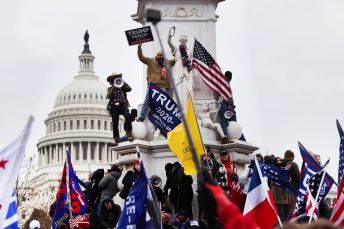 This afternoon, at 4:00, Trump will be arraigned for the third time. Kyle Cheney at Politico: Donald Trump returns to Washington. Just not the way he’d planned.
Two and a half years after a mob attacked the Capitol in his name, Donald Trump is making the trip down Pennsylvania Avenue he promised he’d make — but never did — on Jan. 6, 2021.
But this time, it’s to be arraigned in federal court.
Trump’s expected arrival on Thursday afternoon in Washington — to face charges that he sought to derail the transfer of power to Joe Biden — will bring him to the federal courthouse that sits just across the street from the Capitol his supporters defaced on Jan. 6. He’s expected to plead “not guilty” to four criminal charges leveled by special counsel Jack Smith.
Smith has accused Trump of orchestrating a breathtakingly broad campaign to unravel American democracy and cling to power despite decisively losing the 2020 election. In service of that goal, Smith says, Trump deputized six co-conspirators — including attorneys Rudy Giuliani, John Eastman, Sidney Powell and Kenneth Chesebro — to carry out a campaign of disinformation, cloaked in legal action, to convince state legislatures, Congress and then-Vice President Mike Pence to block Biden’s election.
Smith alleges that Trump used his unique platform as president to stoke false claims about election fraud and rile up supporters, harnessing their energy to pressure Republican elected officials to attempt to undo Biden’s victories in a handful of states. When that failed, Trump helped assemble slates of false presidential electors who would be used to stoke a conflict in the certification of Biden’s victory. Then, Trump and Eastman leaned on Pence — who would soon preside over Congress’ counting of electoral votes — to assert unprecedented authority to reject Biden’s electors or postpone the count altogether. The failure of that effort culminated in a burst of rage, with thousands of Trump’s faithful storming past police barricades and into the Capitol, while Trump — according to Smith — exploited the violence to continue salvaging his schemes.
As his supporters rioted, Trump wanted to join them, according to evidence amassed by the Jan. 6 select committee. Several witnesses described a heated altercation with Secret Service agents after they refused to take him to the Capitol because of security concerns. Instead, the Secret Service insisted he return to the White House, where he watched the attack unfold on television….
His arraignment on Thursday is scheduled for 4 p.m. Trump, represented by attorneys Todd Blanche and John Lauro, is expected to face Magistrate Judge Moxila Upadhyaya, who received the initial indictment from prosecutors on Tuesday. It will be Trump’s third arraignment on criminal charges since April but his first in Washington, D.C. There’s little of substance likely to occur beyond Trump’s initial plea in the case, but officials at the federal courthouse and the Capitol are bracing for crowds and potential security threats.
Cheney is one of the good guys, even though he writes for Politico.
That’s all I have for you today. I’m still dealing with the aftermath of my mother’s death, and it has been difficult and exhausting. Seeing Trump charged for trying to end our democracy might make me feel a little better.

 peej
peej Carissa
 bostonboomer
 dakinikat
 ecocatwoman
 mablue2
 Mama Lopez
 peggysue22
 quixote
 skydancingguestblogger
 Mona (aka Wonk the Vote)



 Sky Dancing
Recent Comments