
Lazy Caturday Reads: Congressional Follies
Posted: October 2, 2021 Filed under: just because 12 Comments
Woman in Pink Dress and Cat, by Teresa Tanner
Good Morning!!
President Biden made a dramatic appearance on Capitol Hill yesterday to urge Democrats to find a compromise on the infrastructure bills. His visit was apparently prompted by the progressive caucus forcing Speaker Pelosi to delay the planned Thursday vote on the bi-partisan portion of the bill separately from the budget bill that is to be passed by reconciliation.
The New York Times: Progressives Flex Muscles on Biden Agenda, Adopting New Tactics.
The nearly 100-member caucus refused to support a $1 trillion infrastructure bill that is a major piece of President Biden’s agenda, seeking leverage for a bigger fight.
Their stance forced Speaker Nancy Pelosi to delay a planned vote on the measure and ultimately prompted Mr. Biden to side with them in saying that there could be no vote on the infrastructure legislation until agreement on a far broader, multitrillion-dollar social policy and climate measure.
The maneuver drew plaudits from liberal activists who had watched with dismay in the past as their allies in Congress caved to pressure from Democratic leaders and surrendered in policy fights. And it signaled that the progressives enjoyed newfound influence, including the backing of a president long associated with his party’s moderates.
“Things only happen here when there is urgency,” Representative Pramila Jayapal of Washington, the chairwoman of the Congressional Progressive Caucus, said on Friday. “I’m just so proud of our caucus, because they are standing up for people who feel like they have not been heard in this country for a very long time.”
Still, while the progressives scored a tactical victory, negotiations continued to whittle down the size of the social policy and climate bill, which was already much smaller than the initial $6 trillion to $10 trillion that many of them had envisioned.
Their persistence also risked the collapse of both bills, angering moderates in the party who had delivered the slim majority to Democrats and are at the highest risk of losing their seats in the midterm elections.
Click the NYT link to read more.

Painting by Leslie Ann Ivory
Axios reports that: Biden floats roughly $2 trillion price tag for reconciliation.
President Biden, meeting with House Democrats on Capitol Hill on Friday, indicated they must further delay a final vote on a $1.2 trillion bipartisan infrastructure bill and scale back his $3.5 trillion social spending package to around $2 trillion range if either is to pass, lawmakers told Axios.
Why it matters: Biden made clear he wants to keep the two packages linked together and that he is optimistic there can be an agreement.
- “It doesn’t matter if it’s six minutes, six days or six weeks, we’re going to get it done,” the president told reporters on his way out of the meeting.
- Two lawmakers told Axios they anticipated it could be another month before both bills can be passed.
- While moderates don’t want to wait on the infrastructure vote and progressives don’t want to spend less on the social programs, the pause likely moves the fragile Democratic coalition closer to ultimately securing major portions of the president’s agenda ahead of the 2022 midterms….
What they’re saying: “He is the President of the United States and he says that he wants to get this done, and he basically linked them together,” Rep. Henry Cuellar (D-Texas), a moderate Democrat, told Axios.
-
“He basically said it’s not going to be $3.5 (trillion). It could be $1.9 trillion-$2 trillion. The president threw out some numbers, so I assume there was a reason why.”
-
The president discussed a range that went as high as $2.3 trillion, other sources in the room said.
-
“The president said we’re gonna get both bills done, and in order to get the rest done, we have to get this agreement on the reconciliation,” Rep. Pramila Jaypal (D-Wash.), chairwoman of the Progressive Caucus, told reporters.
Yesterday, before Biden’s visit to Congress, the Washington Post’s Greg Sargent wrote that the White House didn’t pressure progressives to vote for the infrastructure bill on Thursday. Opinion: The Biden agenda is in peril. Here’s the hidden reason it might survive.




Friday Reads: Now We Know They’re Still Traitors!
Posted: October 1, 2021 Filed under: Afternoon Reads, Right Wing Angst, Trump Trash | Tags: abortion, Racism 10 Comments
Louis Frey, Artist
Sequoia National Park Poster
Good Day Sky Dancers!
One of the weird things I’ve learned growing up in these United States was that no matter how far in the past the Civil War was fought, parts of the Deep South have never got over it or gone much beyond it. This is especially true in rural areas although there are also some Western and Mid-Western states that are mostly rural and as backasswards about stuff as much as the Deep South.
I grew up in the Heartland and spent every moment feeling like I lived in a cultural desert even though the combined area of Council, Bluffs, Iowa, and Omaha. Nebraska is fairly large in terms of middle-of-the-country cities. I’m thankful my daughters are in Denver and Seattle that are big enough population areas to drive the rural parts of their state to mostly obscurity on the state level.
So, this was no surprise to me:

Sabrena Khadija, Artist
Volcanoes National Park
I’ve heard better solutions to the red state/blue state gap and believe me, I was ready to make a movement for France to reclaim New Orleans quite a few times during the entire Hurricane Katrina period. But seriously, who wants to live near this kind of behavior? Gabrielle Hays files this story for the PBS News Hour. This happens to come from my mother’s hometown which I thought was super-sophisticated grown up in comparison to Omaha. “A pro-slavery petition is the latest racist incident at this Kansas City high school. Parents say they’ve had enough.” WTF?
An online petition to reinstate slavery that made its rounds at a high school in Kansas City this month is the latest in a series of incidents sparking outrage from parents and students who say race-related controversies at the school are an all-too-common occurence.
In an email to parents at Park Hill South High School dated Sept. 22, Park Hill School District Superintendent Jeanette Cowherd acknowledged the petition – which was brought to officials’ attention nearly a week prior – by saying many people are “hurting” because of “unacceptable and racist statements online,” adding that Board of Education “prohibits discrimination, harassment and retaliation” and that discipline could equal “suspension or expulsion.” Cowherd did not share any specifics regarding the students involved nor whether they have been disciplined. The email also noted the district will set up meetings to “give people the opportunity to share how they feel.”
But parents say the district is doing little to mitigate the ongoing problems, including individual attacks on students based on their race.
“I have a disheartening feeling about the incident that happened at Park Hill South. I don’t feel like it was addressed properly or at all,” parent Jeff Holmes said during public comment at a Park Hill school board meeting last Thursday, adding that these issues span across the school district.
“I’ve heard all of the nice, kind words and I guess that they are okay, they are what they are but they are meaningless, hollow and insincere if we don’t see action,” he said.
Park Hill South is only the latest school over the past week to make headlines for its handling of racial incidents. Just days after the petition circulated, school officials at Olathe South School, 30 minutes away from Kansas City, Missouri, are investigating a homecoming proposal poster that read “If I was Black I would be picking cotton but I’m white so I’m picking you for HOCO?” A photo of the offensive poster made its rounds on social media before school administrators caught wind of it.
National Education Association President Becky Pringle said these types of derogatory occurrences are not new.
“All students – no matter their race or place – have a right to a public education in a safe learning environment. But right now, many of our students are scared, anxious, and feeling threatened. What happened at Park Hill South High School isn’t an isolated incident nor did it happen by accident,” she said in a statement to the PBS NewsHour.
NEA, a teachers union that advocates on behalf of educators nationwide, has received reports of “hostile and hateful environments” in schools across the country, she said.

Brittney Lewis of Bybrije, Artist
Yosemite National Park
There have been threats made to school board members across the country as well as a documentary by NBC on an incident that sparked the critical race theory kerfuffle which basically erases slavery, Jim Crow, and whatever we happened to stumble across in our history books like the Tulsa Race Massacre. Greg Abbott just signed a law to make white folks feel comfy with their slave-owning, KKK klan, lynch-happy ancestors. Many southern states actually are experiencing an increase in the population of black southerners as many Black Americans are moving to the large, affluent cities of the south. This might be one way of turning more southern states blue.
Then, of course, we’ve spent lots of time on the Abbott anti-women and anti-voting rights legislature making Texas basically into something akin to Texastan with its Cristoban tyrants seeking to make women, people of color, and the LGBT community outcasts and lesser citizens. What the Hell is going on? Why do we have a tyranny of a minority?
But what about the American Outback where many states have fewer people than your normal Chicago, New York, or LA Zip codes. I watched Steve Kornacki show how much political power these states have because they all have two senators.
I mean, what we`re talking about here is the partisan distribution of voters. A couple different ways, I guess, to look at this. First, the map everybody knows. This is the 2020 election. Biden wins. There`s the electoral vote count. Here are the red states. Here are the blue states.
You see, basically, we know Democrats concentrated a lot on the West Coast, the Northeast, somewhat here in the Midwest. Biden was able to flip a couple states. But in that clip you played, you had Michael Steele talking about the county strength.
Now, the 50 states in the country, there`s more than 3, 100 counties in the United States. So this map is going to change here in a second, and you`re going to see all of the counties in the country.
This is the red/blue map for the counties. And, obviously, you see a lot more red here than blue. In the 2020 election, Donald Trump won more than 2, 500 counties. Again, there`s just over 3, 100 of them. More than 2, 500 went for Donald Trump.
Now, obviously, not every county is the exact same size. Here`s like a very dramatic example I could give you. If you were to really Zoom in here in Southern California, I`m going to circle it. What I just circled is Los Angeles County in Southern California.
This is a big blue county, the city of Los Angeles, about 10 million people. There`s about 10 million residents in Los Angeles County. Joe Biden won Los Angeles County overwhelmingly. In terms of population, though, Los Angeles County would be the same size as Utah, Idaho, Montana, Wyoming, North Dakota, South Dakota, Nebraska, roughly.
If you were to combine all of those red states, the population would be about the same as Los Angeles County. And yet obviously the number of counties, the land distribution, there`s a lot more landmass, there`s a lot more red than blue one here, land vs. population. So that gets the story this divide here that you see in the county map.
Here`s the actual number, Trump won 2, 574 counties, Biden 539. This has become — this century, at least, this has become the story of our politics. And Clinton in the 1990s won a ton of counties. He won a lot more of the interior of the country.
But this has become the story. But this, by the way, what you`re looking at here, is if you sized every state in every county relative to its population, this would be the map. But this is just a blob here. It looks like a Rorschach test.
But if you were to size the high population areas to the same scale as low end — in low population areas much lower, this would become what the red/blue map looks like. But, again, Ari, what it basically gets at here is, look, the distribution of the popular, Democrats in cities, increasingly in suburbs.
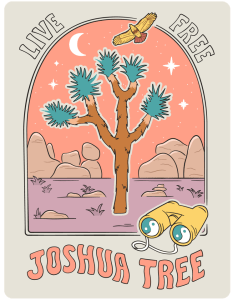
Sage Aune of Sagepizza, Artist Joshua Tree National Park
We’ve talked about Senator Joe Manchin was has been the focus of disruption in the Senate Democratic Caucus. Eyes recently on Arizona’s Krysten Sinema who is going for the complete enigma look. This is from Axios’ Hans Nicholls: “Cracking the Sinema code.”
Sen. Kyrsten Sinema’s political allies have some free advice for anyone trying to bully the wine-drinking triathlete into supporting President Biden’s $3.5 trillion budget bill: She doesn’t play by Washington’s rules — and she’s prepared to walk away.
Why it matters: For all her flash, Sinema — unlike fellow holdout Sen. Joe Manchin (D-W.Va.) — rarely telegraphs her precise intentions, leaving political adversaries guessing about her ultimate goals.
- In conversation with colleagues, she’ll suggest that her top priority is passing the $1.2 trillion bipartisan infrastructure deal she brokered this spring over late-night, wine-fueled negotiations. Beyond that, you’re piecing together clues.
- President Biden and his top aides met her four times over the course of a day this week without totally cracking the code.
- Sinema on Thursday tweeted a statement saying, “Claims that the Senator has not detailed her views to President Biden and Senator [Majority Leader Chuck] Schumer are false” and they “are fully aware of Senator Sinema’s priorities, concerns and ideas.”
Between the lines: Progressives could be forgiven for presuming that Sinema, 45, the first openly bisexual member of Congress, who’s easy to spot in her trademark sleeveless dresses, wry wigs and acrylic glasses, would share their woke politics.
- They’ve been befuddled, and increasingly enraged, when she behaves more like the late Republican Sen. John McCain, another Arizonan who didn’t mind challenging party orthodoxies.
- At her core, Sinema is something of a fiscal conservative, which disappoints progressives, leading them to whisper about a primary challenge in 2024.
- She’s unconventional (see: recent internship at a Sonoma winery) and a force to be reckoned with. She’s known to rise between 4-5 a.m. to train for her next race, and she was forced to take up aqua jogging after breaking her foot this summer in something called the “Light at the End of the Tunnel Marathon.”
The big picture: While Manchin has been intensely focused on price tag of spending, setting his limit at $1.5 trillion, Sinema has signaled she’s more concerned with the tax side of the equation, including who pays them.
-
- She’s suggested to some allies that she’s reluctant to support any increase in the corporate tax rate, but she’s more likely to accept a smaller increase to the headline rate — likely in the 24% range, well short of Biden’s proposed 28%.
- She’s raised flags about increasing the rate on corporations’ international profits, which she believes could harm their competitiveness.
- On capital gains, she’s also indicated that she’s opposed to Biden’s headline 39.6% rate but could accept a number in the mid-twenties.

Sabrena Khadija, Artist
Death Valley National Park
There are so few conservative Dems and centrist Republicans that the Senate is as split as the country. However, the right-wingers of the Republican base have more cows and coyotes for neighbors than people. The graph shown by Kornacki makes me agree with Dr. Howard Dean.
DEAN: Well, the central problem — there are several central problems.
The biggest problem of all is that the counties and the states that Michael talked about and that Steve talked about are older, getting older and whiter. And they`re terrified of the future. Their kids are leaving. They`re teaching stuff in the schools that`s not useful.
The older people don`t know how to use an Internet. They`re losing their jobs. And if they can`t use the Internet, they can`t get another job. And this is pure fear and anger that`s motivating Trump`s voters. And it`s why he`s so successful.
The problem is that the future, first of all, belongs to the blue areas, at least right now. Young people overwhelmingly vote Democratic, not because they love the Democrats, but because that horrible, pessimistic, furious vision of the Republicans is just totally unacceptable to people who are young.
And it also highlights the structural defects that we have got that are now an emergency after 250 years, the Electoral College, which doesn`t make any sense at all. The corrupt election laws that are being passed, we have had experience with that through Jim Crow.
We have the new Jim Crow in Georgia, and they still voted for two Democratic senators for the first time since segregation was broken. So, the country is really at an inflection point, a point. And the fury and anger between the red and the blue is explainable by how terrified the right-wing is and the conservatives are of the future.
Let me know return to what’s behind that first twitter with a direct link to the study.
The University of Virginia Center for Politics has partnered with Project Home Fire, a new initiative dedicated to finding common ground in American politics, on an innovative new data analytics and polling project to explore the social, political, and psychological divides between those who voted for Donald Trump and those who voted for Joe Biden in 2020.
Some of the key takeaways from today’s release are:
— Majorities of Trump and Biden voters express support for several elements of the bipartisan infrastructure and reconciliation bills being debated in Congress, but there are marked differences in their levels of support. (see Table 1 below)
— Majorities — often large majorities — of both Biden and Trump voters express some form of distrust for voters, elected officials, and media sources they associate with the other side. A strong majority of Trump voters see no real difference between Democrats and socialists, and a majority of Biden voters at least somewhat agree that there is no real difference between Republicans and fascists. (see Table 2 below)
— Significant numbers of both Trump and Biden voters show a willingness to consider violating democratic tendencies and norms if needed to serve their priorities. Roughly 2 in 10 Trump and Biden voters strongly agree it would be better if a “President could take needed actions without being constrained by Congress or courts,” and roughly 4 in 10 (41%) of Biden and half (52%) of Trump voters at least somewhat agree that it’s time to split the country, favoring blue/red states seceding from the union. (see Table 3 below)
The Center for Politics and Project Home Fire will be releasing findings from this study in the coming weeks through a series of articles in Sabato’s Crystal Ball and other publications, as well as public symposiums that will each explore major, divisive subjects in American life. Those topics include: immigration, political violence, pandemic response, and other prominent national issues.
Yup. We’ve got a bunch of secessionists out there but they are not the majority. What are we going to do with this situation?
The National Park Posters are available to purchase to help raise funds for the NPS. You can read more about them and their artists at this link at Forbes. The link is old but still interesting.
What’s on your reading and blogging list today?

 peej
peej Carissa
 bostonboomer
 dakinikat
 ecocatwoman
 mablue2
 Mama Lopez
 peggysue22
 quixote
 skydancingguestblogger
 Mona (aka Wonk the Vote)



 Sky Dancing
Recent Comments