Can I just spend the day looking at art work on Pinterest and browsing books on Amazon? The real world has become unreal. Is anyone ever going to stop this insanity? Yesterday Trump actually claimed Democrats committed treason because they didn’t cheer enthusiastically for his idiotic SOTU speech. NBC News reports:
President Donald Trump on Monday called Democrats’ stone-faced reaction to his State of the Union address last week “treasonous” and “un-American” during a visit to a manufacturing plant in Cincinnati.
Trump described Republicans as “going totally crazy wild” during his remarks last Tuesday, while expression-less Democrats remained seated for the majority of the speech. “They were like death,” Trump lamented. “And un-American. Un-American.”
But their reaction, he said, was also something much worse.
Vaguely noting that “someone” called the Democrats’ reactions “‘treasonous,'” Trump said he agreed. “I mean, yeah, I guess. Why not? … Can we call that treason? Why not? I mean, they certainly didn’t seem to love our country very much.”
Coffee And Cat, by Betty Pieper
In Trump’s mind, “our country” means *Trump.* This moron thinks he’s a dictator and he can’t understand why he doesn’t get robotic fealty like Kim Jong Un. If he could get away with it, would he murder his critics like Kim does? I don’t want to live in a tin-pot dictatorship, thank you very much.
While Trump was busy tearing down the First Amendment, the stock market that he constantly touts took a record nose dive. Oddly, he’s suddenly gone silent on that front.
After the Dow Jones industrial average index shed 1,175 points on Monday, extending a rout that began in earnest last week, investors will be wondering what size hole the market has just fallen into.
Of course, it’s impossible to tell exactly where a bottom is, but there are ways to assess whether a sell-off will gather steam or burn out.
Nearly all the economic news has been good in recent weeks, but in the often-neurotic world of investing, the news has perhaps been too good. Two reports last week that wages are growing at a solid pace, for instance, helped prompt the latest selling.
Investors fear that an increase in wages, especially at a time of low unemployment, might lead to higher inflation, which in turn could prompt the Federal Reserve to increase interest rates more quickly than expected. The higher borrowing costs would then crimp companies’ investment plans, leading eventually to lower economic growth over all. There is no evidence that this chain reaction has begun, but when the stock market is in a skittish mood, it does not wait around for the next economic release.
The sometimes-panicky global market sell-off eased somewhat on Tuesday morning, as the Standard & Poor’s 500-stock index bounced between positive and negative territory in early trading in the United States.
MARKET SNAPSHOT
S.& P. 500–0.26%
DOW+0.12%
NASDAQ+0.04%
After steep drops in Asia and significant declines in Europe, investors assessed whether Wall Street’s violent decline on Monday — when the S.&P. lost more than 4 percent, its worst decline since August 2011 — reflected actual fundamentals or was merely a long-overdue outbreak of investor jitters
For months, markets seemed to sleepwalk ever higher, as measures of volatility — the ups and downs of stock prices — hit remarkably calm levels. Investors appeared to grow accustomed to an economic backdrop of lackluster growth and inflation, a state of affairs that ensured powerful global central banks would continue to support markets with a range of policies.
But the peaceful climb ended in recent days. Investors have become worried that the solid economy in the United States could be showing early signals of inflation pressure. Those concerns drove yields on long-term Treasury bonds sharply higher in recent weeks, as economic data — such as the Labor Department’s jobs report last Friday — showed wages growing at their fastest clip in years.
President Trump and congressional Republicans have spent much of the past year trying to connect a giddy stock market rally with their economic agenda, but stocks’ precipitous plunge in the past five days has delivered a sobering reality: What goes up can come back down — quickly and with little warning.
With Monday’s steep fall, Trump has presided over the biggest stock market drop in U.S. history, when measured by points in the Dow Jones industrial average. The free fall began in earnest Jan. 30 and snowballed Friday and Monday, for a combined loss of almost 2,100 points, or 8 percent of the Dow’s value.
It is also unclear if the past week will amount to a small correction or the beginning of a painful slide that many investors said was overdue.
Trump’s economic team is largely untested in periods of economic uncertainty. Many investors and lawmakers are watching the actions of Trump’s newly sworn-in pick for Federal Reserve chairman, Jerome H. Powell, to see how quickly he is willing to raise interest rates in the face of rising inflation.
Portrait of a Lady with a Cat, Yaroshenko Nicholas Aleksandrovich, Russian
It was another crazy news week, so it’s understandable if you missed a small but important announcement from the Treasury Department: The federal government is on track to borrow nearly $1 trillion this fiscal year — Trump’s first full year in charge of the budget.
That’s almost double what the government borrowed in fiscal 2017.
Here are the exact figures: The U.S. Treasury expects to borrow $955 billion this fiscal year, according to documents released Wednesday. It’s the highest amount of borrowing in six years, and a big jump from the $519 billion the federal government borrowed last year.
Treasury mainly attributed the increase to the “fiscal outlook.” The Congressional Budget Office was more blunt. In a report this week, the CBO said tax receipts are going to be lower because of the new tax law.
The U.S. trade deficit widened to the biggest monthly and annual levels since the last recession, underscoring the inherent friction in President Donald Trump’s goal of narrowing the gap while enjoying faster economic growth.
The deficit increased 5.3 percent in December to a larger-than- expected $53.1 billion, the widest since October 2008, as imports outpaced exports, Commerce Department data showed Tuesday. For all of 2017, the goods-and-services gap grew 12 percent to $566 billion, the biggest since 2008.
The trend may extend into this year: Solid consumer spending and business investment — assuming they hold up amid the recent stock-market rout — will fuel demand for foreign-made merchandise. While improving overseas growth and a weaker dollar bode well for exports, Trump’s efforts to seek more favorable terms with U.S. trading partners remain a work in progress, and his tax-cut legislation may cause the deficit to widen further.
The next short-term government funding bill is set to run out Thursday and Congress is poised to pass a fifth stop-gap funding bill to keep the lights on.
The latest deadline looms as a deal on DACA, which in part forced the last government shutdown, has yet to emerge that will get the support of the White House….
The House is expected to vote on their version Tuesday. It would extend government funding until March 23 but fund the Defense Department for the remainder of the fiscal year, which would appease the conservative Freedom Caucus and defense hawks.
It would also fund community health centers for two years, which is something the Democrats have been demanding. It’s unclear, however, if the Senate would support the House measure.
But House Democratic Leader Nancy Pelosi was critical, calling Republicans “incompetent.”
“Republicans control the House, the Senate and the White House but they have to rely on five stop-gap spending bills in a row to keep government running? Republicans must stop governing from manufactured crisis to crisis, and work with Democrats to pass the many urgent, long overdue priorities of the American people,” Pelosi said in a statement.
Sigh . . . remember those long-ago days when we didn’t have an insane “president” who triggered three or four major crises every day? Oh wait. That was only a little more than a year ago.
Rep. Adam Schiff predicted Tuesday that the White House would not block the release of a Democratic memo related to the Russia investigation, but he warned the administration against trying to obfuscate the document by redacting portions that could embarrass President Donald Trump.
The memo, drafted by Schiff, the ranking Democrat on the House Intelligence Committee, is intended to rebut one released last week from committee Chairman Devin Nunes (R-Calif.). The Nunes memo alleges that the FBI improperly sought a surveillance warrant against former Trump campaign adviser Carter Page based on a dossier of unverified intelligence….
“What I’m more concerned about … is that they make political redactions,” the California Democrat said. “That is, not redactions to protect sources or methods, which we’ve asked the Department of Justice and the FBI to do, but redactions to remove information they think is unfavorable to the president. That could be a real problem, and that’s our main concern at this point.”
Last summer, I wrote an analysis exploring the “known unknowns” of the Russia investigation—unanswered but knowable questions regarding Mueller’s probe. Today, given a week that saw immense sturm und drang over Devin Nunes’ memo—a document that seems purposefully designed to obfuscate and muddy the waters around Mueller’s investigation—it seems worth asking the opposite question: What are the known knowns of the Mueller investigation, and where might it be heading?
The first thing we know is that we know it is large.
We speak about the “Mueller probe” as a single entity, but it’s important to understand that there are no fewer than five (known) separate investigations under the broad umbrella of the special counsel’s office—some threads of these investigations may overlap or intersect, some may be completely free-standing, and some potential targets may be part of multiple threads. But it’s important to understand the different “buckets” of Mueller’s probe.
The five “buckets” are: 1. Preexisting Business Deals and Money Laundering, 2. Russian Information Operations, 3. Active Cyber Intrusions, 4. Russian Campaign Contacts, 5. Obstruction of Justice. Read detailed explanations at Wired.
What else is happening? What stories are you following today?
Did you like this post? Please share it with your friends:
We’re in full throttle Mardi Gras mode down here and I’m laid up in bed with sinus crud. I’m a second-hander atm who is viewing all the Tu Deaux through the lens of friends. Meanwhile, I sniffle and cough on.
By the summer of 2016, Victoria Nuland’s “Spidey sense” told her something was very wrong.
That spring, Nuland, the top State Department official charged with overseeing U.S. policy toward Russia, was one of those who had “first rung the alarm bell” inside the Obama administration, warning that Russia appeared to be trying to “discredit the democratic process” in the United States as part of a concerted 2016 strategy.
Now, the Russian campaign was turning out to be even more serious than she had imagined. She had known since late 2015 that the Democratic National Committee’s email servers had been hacked; all these months later, the stolen DNC emails were being publicly released by websites known to be Russian conduits right on the eve of the Democratic convention, and the hack would soon be confirmed as a Russian operation by U.S. intelligence agencies.
“That’s when the hairs really went up on the back of our necks,” she recounted in an interview with The Global Politico, her first extensive public comments about what it was like to spend months in the middle of the U.S. government’s halting, frustrating attempts to understand the Russian attack on the U.S. electoral system — and then try to figure out how to respond to it.
While the broad contours of that response are known, hearing it viscerally described by one of those who tried to stop it is bracing. Nuland is now confirming publicly that she pushed Obama to respond more aggressively to the hacking before the election and acknowledging that she and others at the State Department were informed by “sometime in late July” about the inflammatory findings of former British intelligence officer Christopher Steele apparently linking the Russian effort to Republican candidate Donald Trump. Unbeknownst to her, the FBI, also in July 2016, had begun a secret investigation into possible ties between the Trump campaign and Russia, and the issue of whether the Steele report, paid for by Democrats, helped fuel that investigation is now the subject of heated partisan dispute on Capitol Hill.
Arthur Jones — an outspoken Holocaust denier, activist anti-Semite and white supremacist — is poised to become the Republican nominee for an Illinois congressional seat representing parts of Chicago and nearby suburbs.
“Well first of all, I’m running for Congress not the chancellor of Germany. All right. To me the Holocaust is what I said it is: It’s an international extortion racket,” Jones told the Chicago Sun-Times.
Indeed, Jones’ website for his latest congressional run includes a section titled “The ‘Holocaust Racket’” where he calls the genocide carried out by the German Nazi regime and collaborators in other nations “the biggest blackest lie in history.”
Jones, 70, a retired insurance agent who lives in suburban Lyons, has unsuccessfully run for elected offices in the Chicago area and Milwaukee since the 1970s.
He ran for Milwaukee mayor in 1976 and 13th Ward alderman on Chicago’s Southwest Side in 1987.
Since the 1990s to 2016, Jones has jumped in the GOP 3rd Congressional District primary seven times, never even close to becoming a viable contender.
The outcome will be different for Jones in the Illinois primary on March 20, 2018.
To Jones’ own amazement, he is the only one on the Republican ballot.
Rarely has a president changed his party as fast and profoundly as Donald J. Trump. Love him or hate him, you can no longer argue his ability to bend an entire party to his will.
In the two and a half years since he announced his candidacy, he has moved the party away from decades of orthodoxy on trade, Russia, deficits and more — and has helped make the law-and-order party skeptical of FBI leadership.
Perhaps the most profound thing Trump has done is show how many movement leaders and Republicans in Congress are out of touch with Republican voters:
There’s a massive cohort of Republican voters who are socially conservative and culturally reactionary but fiscally liberal, even if they don’t know it.
The base is very skeptical of trade deals — convinced that ordinary Americans have lost at globalization.
Huge swaths of Trump Country are dependent on Social Security, Medicaid and other government programs.
While much of the GOP donor class is passionate about issues like criminal justice reform and expanded high-skilled immigration, many GOP voters want the exact opposite:
The ratio between the number of Republicans who think that way, versus number of conservatives who talk that way on cable TV or at the Capitol, is way out of whack. Mike Huckabee and Rick Santorum were their lonely on-air champions.
If Trump has tapped into a silent majority, it’s those voters — the opposite of Paul Ryan voters, the opposite of Rubio, the opposite of Jeb.
The source close to GOP leadership said: “All evidence in the last two years points to the fact that the R base was never as ‘conservative’ on economic policy as we portrayed them during the Obama years.”
This, then, is the article we thought we would never write: a frank statement that a certain form of partisanship is now a moral necessity. The Republican Party, as an institution, has become a danger to the rule of law and the integrity of our democracy. The problem is not just Donald Trump; it’s the larger political apparatus that made a conscious decision to enable him. In a two-party system, nonpartisanship works only if both parties are consistent democratic actors. If one of them is not predictably so, the space for nonpartisans evaporates. We’re thus driven to believe that the best hope of defending the country from Trump’s Republican enablers, and of saving the Republican Party from itself, is to do as Toren Beasley did: vote mindlessly and mechanically against Republicans at every opportunity, until the party either rights itself or implodes (very preferably the former).
Of course, lots of people vote a straight ticket. Some do so because they are partisan. Others do so because of a particular policy position: Many pro-lifers, for example, will not vote for Democrats, even pro-life Democrats, because they see the Democratic Party as institutionally committed to the slaughter of babies.
We’re proposing something different. We’re suggesting that in today’s situation, people should vote a straight Democratic ticket even if they are not partisan, and despite their policy views. They should vote against Republicans in a spirit that is, if you will, prepartisan and prepolitical. Their attitude should be: The rule of law is a threshold value in American politics, and a party that endangers this value disqualifies itself, period. In other words, under certain peculiar and deeply regrettable circumstances, sophisticated, independent-minded voters need to act as if they were dumb-ass partisans.
For us, this represents a counsel of desperation. So allow us to step back and explain what drove us to what we call oppositional partisanship.
In a May 10 press conference, the same day McDermott was asking her staff to make sure one another were “doing OK,” then-Deputy Press Secretary Sarah Huckabee Sanders claimed that the president had “lost confidence in Director Comey” and that “the rank and file of the FBI had lost confidence in their director.” She stated that the president had “had countless conversations with members from within the FBI” in the course of making his decision to fire Comey. The following day, Sanders stated that she personally had “heard from countless members of the FBI that are grateful and thankful for the president’s decision” and that the president believed “Director Comey was not up to the task…that he wasn’t the right person in the job. [Trump] wanted somebody that could bring credibility back to the FBI.”
Trump himself blasted Comey too, stating in an interview that the former director was “a showboat. He’s a grandstander” and that the FBI “has been in turmoil. You know that, I know that, everybody knows that. You take a look at the FBI a year ago, it was in virtual turmoil—less than a year ago. It hasn’t recovered from that.” A few days later, the New York Times reported that Trump had told Russian officials visiting him in the Oval Office the day after Comey’s firing that Comey was a “nut job.”
Over the next few days, a wealth of evidence emerged to suggest that Trump and Sanders were playing fast and loose with the truth. But we now have the documents to prove that decisively. Their disclosure was not a leak but an authorized action by the FBI, which released to us under the Freedom of Information Act more than 100 pages of leadership communications to staff dealing with the firing. This material tells a dramatic story about the FBI’s reaction to the Comey firing—but it is neither a story of gratitude to the president nor a story of an organization in turmoil relieved by a much-needed leadership transition.
Within a few days of the firing, both current and former FBI officials began pushing back against the White House’s claims. Then-Acting FBI Director Andrew McCabe, testifying before the Senate Select Committee on Intelligence, said that Comey “enjoyed broad support within the FBI” and that “the vast majority of employees enjoyed a deep and positive connection to Director Comey.”
Yes, that’s me up there in 1999 with Honey and Karma parading in 007: From Barkus with Love. Good grief that was a long time ago!! We were “Bondage” Girls!!! and clearly on the side fighting the Russians!!
President Donald Trump traded insults with the top Democrat on the House Intelligence Committee Monday, a day after Democrats and Republicans said Trump was wrong to assert that a GOP-produced classified memo on FBI surveillance powers cleared him in the Russia investigation.
Trump’s attack on California Rep. Adam Schiff came before a planned meeting of the House intelligence panel Monday, where the committee is expected to consider whether to release a Democratic rebuttal memo. Democrats are seeking to push back on the Republican document, which questions the FBI methods used to apply for a surveillance warrant on a onetime Trump campaign associate.
On Twitter, Trump called Schiff “one of the biggest liars and leakers in Washington,” adding that he “must be stopped.”
Schiff quickly shot back: “Instead of tweeting false smears, the American people would appreciate it if you turned off the TV and helped solve the funding crisis, protected Dreamers or … really anything else.”
Trump also praised Committee Chairman Rep. Devin Nunes, R-Calif., on Twitter, calling him a man of tremendous courage and grit, may someday be recognized as a Great American Hero for what he has exposed and what he has had to endure!”
It is simple:
They loved the FBI when it investigated Bill Clinton.
They loved the FBI when it investigated Hillary Clinton.
They love the FBI when it reopened the Hillary email investigation just before the election.
The White House is dismissing an immigration deal brokered by a bipartisan group of lawmakers as a non-starter just hours before it is expected to be formally introduced in the Senate.
Arizona Republican Sen. John McCain and Delaware Democratic Sen. Chris Coons are slated to introduce a bill Monday that would grant eventual citizenship to young undocumented immigrants who have been in the country since 2013 and came to the US as children, but it does not address all of the President’s stated immigration priorities, like ending family-based immigration categories — which Republicans call “chain migration” — or ending the diversity visa program
It also would not immediately authorize the $30 billion that Trump is seeking to build the border wall, instead greenlighting a study of border security needs. The bill would also seek to address the number of undocumented immigrants staying in the US by increasing the number of resources for the immigration courts, where cases can take years to finish.
The bill is a companion to a piece of House legislation that has 54 co-sponsors split evenly by party.
A White House official rebuffed the effort, telling CNN that it takes “a lot of effort” to write up a bill worse than the Graham-Durbin immigration bill, but somehow “this one is worse.”
i see President Ragetweet McProjection is on the Golden Throne this morning. https://t.co/Ax4t1MGS6S
An update on a story from New Orleans that captured many hearts prior to the end of the Football Season.
Unreal response to the Jackie Wallace story. https://t.co/FXyZ9s5zog There are no real updates to report as of yet but I’m starting to get a few credible tips. Please stay tuned and prayerful. pic.twitter.com/gkSibQsLua
Oh, and this about sums up my thoughts about the latest pannem et circenses event. Well, that and WTF did Justin Timberlake think he was doing with Prince. White people! Wake the fuck up! Black people, black culture, black history, and black labor is not yours to co-op!!!
Look at all these white people rioting … over a football game! Time to ask the hard questions: Where are their fathers? How many came from broken homes? You know, all the things we ask black people when they lash out about actually being KILLED! https://t.co/WWdRyx77tc
It has often been claimed that humans learn language using brain components that are specifically dedicated to this purpose. Now, new evidence strongly suggests that language is in fact learned in brain systems that are also used for many other purposes and even pre-existed humans.
Scientists studying brain scans of people who were asked to come up with inventive uses for everyday objects found a specific pattern of connectivity that correlated with the most creative responses. Researchers were then able to use that pattern to predict how creative other people’s responses would be based on their connections in this network.
It may sound like sci-fi, but mind reading equipment are much closer to become a reality than most people can imagine. Researchers used a magnetic resonance machine to read participants’ minds and find out what song they were listening to. The study contributes to improve the technique and pave the way to new research on reconstruction of auditory imagination, inner speech and to enhance brain-computer interfaces for communication with locked-in syndrome patients.
Did you like this post? Please share it with your friends:
Original Expressionist Painting Peru Art, ‘Woman Reading with Peacock’
Good Afternoon!!
Most politics watchers spent yesterday laughing at Devin Nunes and his highly anticipated memo. But the moron in the White House thinks it completely vindicates him.
This memo totally vindicates “Trump” in probe. But the Russian Witch Hunt goes on and on. Their was no Collusion and there was no Obstruction (the word now used because, after one year of looking endlessly and finding NOTHING, collusion is dead). This is an American disgrace!
“Their” was no “Collusion” according to the barely literate “president.” Does anyone understand the Trump rules of spelling, capitalization, and the use of quotes? The moron probably spent the day watching Fox News and doesn’t even know that he and Devin Nunes were the butt of jokes everywhere else. Some reactions:
Politico: Even if You Take the Nunes Memo Seriously, It Makes No Sense, by Paul Rosenzweig (former Whitewater investigator).
Under the most fair reading of the memorandum, the argument it makes is as follows: The Steele dossier—a collection of reports filed by former British intelligence officer Christopher Steele—is a biased and flawed document produced by someone out to “get” the president; FBI and Justice Department officials knew of the bias and did not disclose it to the judges of the FISA court who approved the FISA warrant; as a result, the rights of an American citizen (Carter Page) were violated; and (more importantly, from the perspective of the Republican Party) the FBI’s reliance on the Steele dossier corrupted the FBI investigation of the Trump campaign—all of which is, in effect, the “fruit of a poisonous tree” that should no longer be credited.
Given that story line, one can only conclude that the Nunes memo fails to make its case—and fails quite badly at that.
Lost Pocketbook, by Sally Storch
Consider, first, the obvious timing problem. The Nunes memo begins with a FISA application dated October 21, 2016. That date is significant for a number of reasons. As an initial matter, coming less than 20 days before the election, it seems a particularly poor way of trying to influence the outcome of the election. A FISA application just a few days before November 9 would not actually have produced any evidence until well after the election—making Nunes’ implicit charge of a corrupted investigation chronologically implausible. In addition, the focus on this date has to deal with the uncomfortable fact that the surveillance of Page it authorized started roughly a month after Page officially left the Trump campaign—so, again, it is a poor way of effectuating a bias against Trump to collect evidence relating to the actions of a former campaign volunteer.
But the most important reason to focus on the 2016 date is that it ignores another, earlier date. We know from public reports that the FBI opened its inquiry into Page’s Russian connections as early as 2013, at which time the bureau already had probable cause to think Russian intelligence operatives might be trying to recruit him. (The Russian spies, by the way, thought that Page was “an idiot,” according to court documents.) Any story of the investigation of Page that starts in the middle is incomplete at best—and since we don’t know what was in the earlier Page application or in the rest of this October application, we can’t really know how incomplete it is. But that careful incompleteness is, by itself, grounds to doubt the memo’s conclusions.
I know. You knew that already. But it’s an interesting piece that demolishes the Nunes memo piece by piece.
Lawfare: Thoughts on the Nunes Memo: We Need to Talk About Devin, By Quinta Jurecic, Shannon Togawa Mercer, Benjamin Wittes. You’ll need to read the whole thing to follow the complete argument, but here are some brief excerpts:
…let’s briefly put aside the reality that the memo is probably neither a complete nor a fair account of the FBI’s handling of the Page matter. For a moment, let’s assume that every fact in the memo is true and that the memo contains all relevant facts on the matter—in other words, that it is entirely accurate and not selective. What would that mean?
“Reclining Woman with Book,” by Imre Goth (1893-1982). Oil on canvas, 99 x 75cm. London art market (Bonhams), 1993.
As the document tells the story, on Oct. 21, 2016, the Justice Department and FBI successfully applied for a FISA warrant against Carter Page from the FISA court. Presumably, though the memo does not state this explicitly, it did so under Title I of FISA, as Page is a U.S. citizen and the warrant seems to have been an individualized one directed at him. The initial warrant was renewed three times, once every 90 days, each time requiring renewed showing of probable cause that Page was acting as the agent of a foreign power….
To the extent that the complaint is that Page’s civil liberties have been violated, the outraged are crying crocodile tears. For one thing, it is not at all clear that Page’s civil liberties were, in fact, violated by the surveillance; the memo does not even purport to argue that the Justice Department lacked probable cause to support its warrant application. It does not suggest that Page was not, after all, an agent of a foreign power. What’s more, the only clear violation of Page’s civil liberties apparent here lies in the disclosure of the memo itself, which named him formally as a surveillance target and announced to the world at large that probable cause had been found to support his surveillance no fewer than four times by the court. Violating Page’s civil liberties is a particularly strange way to complain about conduct that probably did not violate his civil liberties.
To the extent the complaint is that the FBI relied on a biased source in Steele, the FBI relies every day on information from far more dubious characters than former intelligence officers working for political parties. The FBI gets information from narco-traffickers, mobsters and terrorists. Surely it’s not scandalous for it to get information from a Democrat—much less from a former British intelligence officer working for Democrats, even if he expresses dislike of a presidential candidate.
To the extent the complaint is that the bureau was insufficiently candid with the tribunal, that is a potentially more serious matter. But as Orin Kerr argued on Lawfare this week, it is far from clear that the allegation—even if true—would create any kind of legal defect in the warrant. And in any event, the court itself has the power to demand accountability to the extent judges feel misled. In Friday’s Lawfare Podcast, David Kris suggests that the government is likely considering how best to officially advise the FISA court of the Nunes memo and so provide the court with an opportunity to respond to the memo’s allegations.
Lempicka, Tamara de; 1898-1980. “Wisdom”, 1940/41. Oil on wood.
The court that approved surveillance of a former campaign adviser to President Trump was aware that some of the information underpinning the warrantA request was paid for by a political entity, although the application did not specifically name the Democratic National Committee or the Hillary Clinton presidential campaign, according to two U.S. officials familiar with the matter.
A now-declassified Republican memo alleged that the Foreign Intelligence Surveillance Court was duped into approving the wiretap request by a politicized FBI and Justice Department. The memo was written by House Intelligence Committee Republicans and alleged a “troubling breakdown of legal processes” flowing from the government’s wiretapping of former Trump aide Carter Page.
But its central allegation — that the government failed to disclose a source’s political bias — is baseless, the officials said.
The Justice Department made “ample disclosure of relevant, material facts” to the court that revealed “the research was being paid for by a political entity,” said one official, who spoke on the condition of anonymity because of the matter’s sensitivity.
Frankly, I’m much more concerned about another story that hasn’t gotten enough attention: a meeting between U.S. intelligence chiefs with the heads of Russian intelligence agencies. Keep in mind that we only learned about this meeting because it was covered by Russian news outlets.
Democrats want to know why the Trump administration allowed two Russian spy chiefs under U.S. and European sanctions to meet last week in Washington with American intelligence officials.
Russia’s U.S. ambassador said Sergei Naryshkin, head of the Russian Foreign Intelligence Service, was in the United States to discuss counterterrorism with his American counterparts.
By Malcolm Liepke
Naryshkin was accompanied at the meeting in Washington by Alexander Bortnikov, who directs the top KGB successor agency known as the Federal Security Service, according to two U.S. officials, who were not authorized to disclose the information and spoke on condition of anonymity.
The two Russian intelligence officials were sanctioned in 2014 in response to Russian aggression in eastern Ukraine — Naryshkin by the U.S. and Bortnikov by the European Union.
Senate Minority Leader Chuck Schumer said the timing of the meeting is suspicious because it came just days before the Trump administration decided not to issue new sanctions against Russian politicians and oligarchs over Russian interference in the election. He released a letter early Thursday demanding that Director of National Intelligence Dan Coats disclose details of the meeting by Feb. 9.
Schumer said sanctions against Naryshkin impose severe financial penalties and prohibit his entry into the U.S. without a waiver.
CIA Director Mike Pompeo on Thursday pushed back Senate Minority Leader Chuck Schumer’s suggestion that Russian intelligence officials’ visit to the United States last week may have played a role in the Trump administration’s move to hold off on new sanctions against Moscow.
Pompeo told Schumer in a letter that his meetings with Russian intelligence counterparts focused on anti-terrorism cooperation and followed similar talks held by previous administrations in both parties. Three top Russian intelligence officials held U.S. meetings last week — Alexander Bortnikov, Sergey Naryshkin, and Igor Korobov — a notably high-level presence to some observers of U.S.-Russia relations.
Pompeo did not address Schumer’s question about whether sanctions against Russia were discussed at his meeting with the Russian officials, which took place days before the Trump administration opted to forestall new penalties that Congress called for in bipartisan legislation last year.
“When those meetings take place, you and the American people should rest assured that we cover very difficult subjects in which American and Russian interests do not align,” Pompeo wrote to Schumer.
Yeah, right. We need to know a lot more about this meeting and why U.S. media and why we had to learn about it from the Russians.
Finally, a new story about what Trump may have handed over to the Russians in that meeting the day after the Comey firing. NPR: Journalist Details Israel’s ‘Secret History’ Of Targeted Assassinations. During this Fresh Air interview, Israeli journalist suggested that Trump’s betrayal of Israeli intelligence sources was much worse than has been reported.
This is FRESH AIR, and we’re speaking with Ronen Bergman. He’s a veteran investigative reporter in Israel. His new book is “Rise And Kill First: The Secret History Of Israel’s Targeted Assassinations.”
Richard Edward Miller, Miss V in Green
You know, you’ve written that the United States and the Israeli intelligence services have developed a very close set of joint operations and exchange of information. And of course earlier this year, there was a huge controversy when President Trump apparently revealed information in a meeting with the Russian foreign minister and ambassador which betrayed some Israeli sourcing. Where do things stand with these relationships between American and Israeli intelligence in the Trump administration?
BERGMAN: Well, Dave, just a year ago, I published a story that created a lot of controversy. I said – and I was surprised to hear that from my sources in the beginning – that a group of American intelligence officers, in a regular meeting with the Israeli counterparts, just before Trump was elected and before the inauguration, they suggested that the Israelis stop giving sensitive material to the White House. They said we are afraid that Trump or someone of his people are under leverage from the Russians. And they might give sensitive information to the Russians who, in their turn, would give that to Iran. They said we have evidence that part of the material that Edward Snowden stole from the CIA and NSA – and was not yet published – found its way to Iran. And we believe, of course, that he gave everything he had to the Russians.
And the Israelis were shocked. They have never been in such an occasion. They have never heard Americans say something of that kind about their chief and commander – about the president. And when, just few months after that, it turned out that everything – all the predictions that the Americans have made to the Israelis as warnings – not because they knew it was going to happen but they thought it might – everything came to be true. And President Trump apparently gave secret information. And I know the nature of that information. It is indeed delicate and very, very secret.
It just instilled a sense of miscomfort (ph) inside Israeli intelligence. And I think, if I recall something that I heard just recently, they feel – Israeli intelligence feel that the American administration is in chaos – is in havoc. It’s not function properly – not intentionally, but that lead to further leaks. And they are very hesitant with sharing everything they have, as they did in the past, with their American counterparts.
What else is happening? What stories are you following today?
Did you like this post? Please share it with your friends:
Another day! Another Constitutional Crisis! It’s Groundhog Day KKKrelim Caligula Style!
Ezra Klein of VOX has written an extensive article based on How Democracies Die. His basis is the book and an interview with the authors available in podcast.
Where Levitsky and Ziblatt make their mark is in weaving together political science and historical analysis of both domestic and international democratic crises; in doing so, they expand the conversation beyond Trump and before him, to other countries and to the deep structure of American democracy and politics.
They also offer a lesson that should ring in our minds as we watch congressional Republicans agitate to release a memo designed to smear the FBI — setting up a confrontation between a president with authoritarian impulses and the FBI that’s investigating him — and cheer lustily as Trump delivers his State of the Union address.
Demagogues and authoritarians do not destroy democracies. It’s established political parties, and the choices they make when faced with demagogues and authoritarians, that decide whether democracies survive.
“2017 was the best year for conservatives in the 30 years that I’ve been here,” Senate Majority Leader Mitch McConnell said this week. “The best year on all fronts. And a lot of people were shocked because we didn’t know what we were getting with Donald Trump.”
The best year on all fronts. Think about that for a moment. If you want to know why congressional Republicans are opening an assault on the FBI in order to protect Trump, it can be found in that comment. This was a year in which Trump undermined the press, fired the director of the FBI, cozied up to Russia, baselessly alleged he was wiretapped, threatened to jail his political opponents, publicly humiliated his attorney general for recusing himself from an investigation, repeatedly claimed massive voter fraud against him, appointed a raft of unqualified and occasionally ridiculous candidates to key positions, mishandled the aftermath of the Puerto Rico hurricane, and threatened to use antitrust and libel laws against his enemies.
And yet McConnell surveyed the tax cuts he passed and the regulations he repealed and called this not a mixed year for his political movement, not a good year for his political movement, but the best year he’d ever seen.
The Nunes memo is a document created by the staff of House Intelligence Committee Chairman Devin Nunes (R-Calif.) that alleges the FBI abused its surveillance authority, particularly when it sought a secret court order to monitor a former Trump campaign adviser. The FBI and the Justice Department had lobbied strenuously against its release. On Wednesday, the FBI had said it was “gravely concerned” that key facts were missing from the memo. President approves release of GOP memo criticizing FBI surveillance
Wow. This Nune memo is even less impressive than I thought. All these mouth-breathing idiots who called this worse than Watergate just got clowned.
President Donald Trump has declassified the GOP memo and approved its release by the House Intelligence Committee without redactions, a White House official tells ABC News.
The White House transmitted the president’s opinion to the committee in a letter this morning, the official said.
As ABC News has previously reported, the memo is critical of Deputy Attorney General Rod Rosenstein for his role in renewing a surveillance warrant on former Trump campaign aide Carter Page after Trump took office.
Trump’s Republican allies have suggested that Rosenstein — who is also overseeing the Mueller investigation — is guilty of political bias toward the president because he supported surveillance on Page based in part on information from a Democrat-funded dossier.
“Does it make you more likely to fire Rosenstein? Do you still have confidence in him after reading the memo?” a reporter asked the president in the Oval Office.
1) A FISA court judge reviewed evidence and approved a warrant to wiretap a Trump associate
In fall 2016, FBI investigators applied for a warrant with the Foreign Intelligence Surveillance Court (FISA) to wiretap Carter Page, a former Trump adviser. They presented evidence that Page may be acting as a Russian agent and the judge approved the warrant.
But the Nunes memo implies the case was primarily built on the Steele dossier — and points out that it was funded partially by a law firm on behalf of the Hillary Clinton campaign and the Democratic National Committee.
And here’s the important part: Nunes says investigators misled the judge by not saying they were relying on the Steele dossier.
This part is crucial because it is saying Rosenstein knew about the warrant and approved of it. And since Nunes believes the warrant application was mostly from a DNC- and Clinton-funded report, he is trying to imply Rosenstein has an anti-Trump bias.
This is clearly a move to remove Rosenstein and replace him with some one that will fire Mueller. It’s also beyond Nixonian.
Special counsel Robert Mueller’s Russia investigation has gathered enough steam that some lawyers representing key Donald Trump associates are considering the possibility of a historic first: an indictment against a sitting president.
While many legal experts contend that Mueller lacks the standing to bring criminal charges against Trump, at least two attorneys working with clients swept up in the Russia probe told POLITICO they consider it possible that Mueller could indict the president for obstruction of justice.
Neither attorney claimed to have specific knowledge of Mueller’s plans. Both based their opinions on their understanding of the law; one also cited his interactions with the special counsel’s team, whose interviews have recently examined whether Trump tried to derail the probe into his campaign’s Russia ties.
“If I were a betting man, I’d bet against the president,” said one of the lawyers.
The second attorney, who represents a senior Trump official, speculated that Mueller could try to bring an indictment against Trump even if he expects the move to draw fierce procedural challenges from the president’s lawyers – if only to demonstrate the gravity of his findings.
“It’s entirely possible that Mueller may go that route on the theory that, as an open question, it should be for the courts to decide,” the attorney said. “Even if the indictment is dismissed, it puts maximum pressure on Congress to treat this with the independence and intellectual honesty that it will never, ever get.”
I’m sure will hear all about this on news today. Meanwhile, share what you think and what you’re hearing!
Did you like this post? Please share it with your friends:
A woman on a bench reading a newspaper in Washington Square Park, Greenwich Village, 1955. (Getty Images)
Good Morning!!
On Tuesday morning, I wrote that Monday had to be one of the worst days in the monstrous Trump “presidency.” It was true then, but yesterday was even worse.
Trump is engaging in open warfare with his own Justice Department and the FBI. He reportedly plans to release an inaccurate memo cooked up by his number one toady in Congress Devin Nunes as early as today–even though the Director of the FBI and top officials in the Justice Department have stated publicly that the memo creates a false narrative and will pose a “grave” danger to national security, even endangering lives.
On top of all that, we got breaking news on the Russia investigation yesterday, and more came out today. There’s no way I can cover everything in this post, but here are some important articles to check out.
On Monday, House Intelligence Committee Chairman Devin Nunes (R-Calif.) moved to release a memo written by his staff that cherry-picks facts, ignores others and smears the FBI and the Justice Department — all while potentially revealing intelligence sources and methods. He did so even though he had not read the classified documents that the memo characterizes and refused to allow the FBI to brief the committee on the risks of publication and what it has described as “material omissions of fact that fundamentally impact the memo’s accuracy.” The party-line vote to release the Republican memo but not a Democratic response was a violent break from the committee’s nonpartisan tradition and the latest troubling sign that House Republicans are willing to put the president’s political dictates ahead of the national interest.
The reason for Republicans’ abrupt departure from our nonpartisan tradition is growing alarm over special counsel Robert S. Mueller III’s investigation into Russian interference in the 2016 campaign. In a matter of months, the president’s first national security adviser and a foreign policy adviser have pleaded guilty to felony offenses, while his former campaign chairman and deputy campaign manager have also been indicted. As Mueller and his team move closer to the president and his inner circle, a sense of panic is palpable on the Hill. GOP members recognize that the probe threatens not only the president but also their majorities in Congress.
In response, they have drawn on the stratagem of many criminal defense lawyers — when the evidence against a defendant is strong, put the government on trial. The Nunes memo is designed to do just that by furthering a conspiracy theory that a cabal of senior officials within the FBI and the Justice Department were so tainted by bias against President Trump that they irredeemably poisoned the investigation. If it wasn’t clear enough that this was the goal, Nunes removed all doubt when he declared that the Justice Department and the FBI themselves were under investigation at the hearing in which the memo was ordered released.
This decision to employ an obscure rule to order the release of classified information for partisan political purposes crossed a dangerous line. Doing so without even allowing the Justice Department or the FBI to vet the information for accuracy, the impact of its release on sources and methods, and other concerns was, as the Justice Department attested, “extraordinarily reckless.” But it also increases the risk of a constitutional crisis by setting the stage for subsequent actions by the White House to fire Mueller or, as now seems more likely, Deputy Attorney General Rod J. Rosenstein, an act that would echo the 1973 Saturday Night Massacre.
MSNBC reported this morning that if the memo is released, FBI Director Christpher Wray is prepared to publicly debunk the contents point by point.
The FBI issued an extraordinary statement on Wednesday, pushing back on the release of a partisan congressional memo alleging the bureau used improper evidence to obtain legal permission to surveil a Trump campaign adviser. We’ve never seen anything like it. “[T]he FBI was provided a limited opportunity to review this memo the day before the committee voted to release it,” the bureau said. “As expressed during our initial review, we have grave concerns about material omissions of fact that fundamentally impact the memo’s accuracy.”
The memo, written by Congressman Devin Nunes and barreling toward public circulation at the president’s discretion, has already created a firestorm, and it is not even out yet. Nunes fired back at the FBI hours later, claiming, “It’s clear that top officials used unverified information in a court document to fuel a counterintelligence investigation during an American political campaign.”
Benches lined with people reading newspapers with headlines of the D-Day invasion in Pershing Square Park June 6, 1944, Los Angeles, CA, John Florea, LIFE Photo Archive.
Let’s be clear about what’s happening here: This memo is the latest escalation in an eight-month effort to tarnish the Russia investigation that might be the most significant smear campaign against the executive branch since Joe McCarthy—only here, the effort is being led by the head of that branch himself. As the New York Times reported, the Nunes memo seems like a dagger aimed by President Trump at Deputy Attorney General Rod Rosenstein, who is supervising the Russia probe for the Justice Department.
Republican huzzahs over Special Counsel Robert Mueller’s appointment were still echoing when the opening salvo of this shocking campaign was launched: the claim that Mueller had disqualifying “conflicts.” Never mind that the Justice Department cleared Mueller of conflicts before he was appointed. Or that ethical standards do not remotely support disqualification over issues like Mueller’s professional acquaintance with James Comey, his employment at a firm that represented Trump associates, or even a long-ago dispute over the amount of fees Mueller owed at a Trump golf course. These meritless conflicts claims have continued to resurface like a game of whack-a-mole, popping up elsewhere after they are knocked down.
There’s much more at the link. It does seem that Trump is attempting what a number of commentators have called “a slow-motion Saturday Night Massacre.” Nixon attempted to take over the Justice Department in one dramatic night; Trump has been doing the same thing over a period of many months.
After a long day of reports on Trump’s feud with FBI Director Chris Wray and Deputy Attorney General Rod Rosenstein, CNN broke the news that Trump had made another implied request for loyalty–this time from Rosenstein.
Deputy Attorney General Rod Rosenstein visited the White House in December seeking President Donald Trump’s help. The top Justice Department official in the Russia investigation wanted Trump’s support in fighting off document demands from House Intelligence Chairman Devin Nunes.
But the President had other priorities ahead of a key appearance by Rosenstein on the Hill, according to sources familiar with the meeting. Trump wanted to know where the special counsel’s Russia investigation was heading. And he wanted to know whether Rosenstein was “on my team.”
The episode is the latest to come to light portraying a President whose inquiries sometimes cross a line that presidents traditionally have tried to avoid when dealing with the Justice Department, for which a measure of independence is key. The exchange could raise further questions about whether Trump was seeking to interfere in the investigation by special counsel Robert Mueller, who is looking into potential collusion by the Trump campaign with Russia and obstruction of justice by the White House.
At the December meeting, the deputy attorney general appeared surprised by the President’s questions, the sources said. He demurred on the direction of the Russia investigation, which Rosenstein has ultimate authority over now that his boss, Attorney General Jeff Sessions, has recused himself. And he responded awkwardly to the President’s “team” request, the sources said.”Of course, we’re all on your team, Mr. President,” Rosenstein told Trump, the sources said.
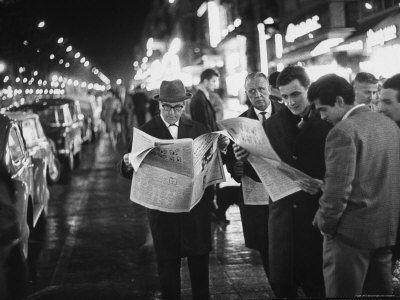
Frenchmen reading newspaper reports of JFK assassination
Mark Corallo, the former spokesman for President Donald Trump’s legal team, will reportedly tell special counsel Robert Mueller’s investigators that White House Communications Director Hope Hicks said Donald Trump Jr.’s emails about the June 2016 Trump Tower meeting with Russians “will never get out.” According to The New York Times, Corallo was concerned that Hicks “could be contemplating obstructing justice.” Hicks’ lawyer, Robert P. Trout, told the Times that Hicks “never said that.” Those emails, written by Trump Jr., appeared to show that his initial explanation for why he took the meeting with Russians was false. The emails showed that Trump Jr. accepted the meeting after being promised dirt on Hillary Clinton, even though the White House statement said the meeting centered around Russian adoptions. Corallo resigned from the Trump White House last summer.
For a time, the optimists in the president*’s camp were pitching as a worst case scenario that Robert Mueller’s investigation into the Russian ratfcking of the 2016 presidential election would end up at worst delivering obstruction prosecutions with no underlying offenses—essentially, that some underlings, in an effort to help out the president*, were too vigorous in their efforts, and less than vigorous about telling the truth. I mean, hell, it’s an argument. It’s the “third-rate burglary” argument gussied up for our times, but it’s an argument nonetheless. However, that dog no longer chooses to hunt.
Pierce summarizes the Hope Hicks story and the back and forth between Devin Nunes and Adam Schiff. Then he notes:
Is it even necessary any more to point out that, if he so desired, the president* could declassify those parts of the memo that are classified and release the thing in 10 minutes? The only people keeping the memo from being released are the people bellowing the loudest about releasing it at all.
These two stories obscured the revelations late Wednesday afternoon that open conflict had broken out between the White House and FBI director Christopher Wray over the release of the memo. It is Wray’s considered opinion that the memo is a crock. From CNN:
Wray sent a striking signal to the White House, issuing a rare public warning that the memo about the FBI’s surveillance practices omits key information that could impact its veracity. The move set up an ugly confrontation between Wray and Trump, who wants the document released. “With regard to the House Intelligence Committee’s memorandum, the FBI was provided a limited opportunity to review this memo the day before the committee voted to release it,” the FBI said in a statement. “As expressed during our initial review, we have grave concerns about material omissions of fact that fundamentally impact the memo’s accuracy.”
All of which, in combination with the complete surrender of the Republican congressional leadership to this fairy tale, leads to the inevitable conclusion that there is more going on here than political damage control. People are breaking too much rock over this matter for that to be the case. People are risking too much to keep the cover story aloft. The original Watergate cover-up was not designed to shield the burglars; it was to keep a lid on five years of crimes and dirty tricks. There is too much energy being expended in too many directions here for there not to be something seriously wrong at the bottom of this affair.
April 1942. An unknown diner reading World War 2 headlines from the Detroit News in a downtown Detroit cafe. Photo by Howard McGraw, of the Detroit News.
It might be Russian ratfcking. It might be dirty money being cleaned through the First Family’s” business. It might be a complex combination of both. But not even this president* is dumb and/or arrogant enough to risk a massive constitutional crisis simply to save himself a little embarrassment concerning the circumstances of his election. Even I give him the benefit of the doubt on that one.
Pierce is right. Trump and Nunes are risking too much with all this obvious obstruction. Trump has to be afraid of something very serious having to do with cooperating with Russia or about his finances.
Attorneys for former national security adviser Michael Flynn and the special counsel’s office told a federal court on Wednesday evening they are not ready to schedule a sentencing hearing for Flynn.
The government was set to deliver a status report on Flynn’s case to the court Thursday, but both sides have asked to delay the deadline for that report until May 1.
Previously, a status update in the case of George Papadopoulos, President Donald Trump’s former campaign adviser, which the special counsel is also overseeing was delayed from February until mid-April.
This news suggests that Mueller is still getting valuable information from Flynn and Papadopoulos.
I’ll have more links in the comment thread. What’s your take on the current situation?
Did you like this post? Please share it with your friends:
The Sky Dancing banner headline uses a snippet from a work by artist Tashi Mannox called 'Rainbow Study'. The work is described as a" study of typical Tibetan rainbow clouds, that feature in Thanka painting, temple decoration and silk brocades". dakinikat was immediately drawn to the image when trying to find stylized Tibetan Clouds to represent Sky Dancing. It is probably because Tashi's practice is similar to her own. His updated take on the clouds that fill the collection of traditional thankas is quite special.
You can find his work at his website by clicking on his logo below. He is also a calligraphy artist that uses important vajrayana syllables. We encourage you to visit his on line studio.



For months, markets seemed to sleepwalk ever higher, as measures of volatility — the ups and downs of stock prices — hit remarkably calm levels. Investors appeared to grow accustomed to an economic backdrop of lackluster growth and inflation, a state of affairs that ensured powerful global central banks would continue to support markets with a range of policies.

The next short-term government funding bill is set to run out Thursday and Congress is poised to pass a fifth stop-gap funding bill to keep the lights on.
The memo, drafted by Schiff, the ranking Democrat on the House Intelligence Committee, is intended to rebut one released last week from committee Chairman Devin Nunes (R-Calif.). The Nunes memo alleges that the FBI improperly sought a surveillance warrant against former Trump campaign adviser Carter Page based on a dossier of unverified intelligence….




 Is the current SpokesSisterWife for the Trump Family Crime Syndicate on her way to an obstruction of Justice charge? A FOIA request shows internal memos from FBI Agents reacting to the Comey firing. It’s not the one portrayed by Huckabee or Trump.









 Good Afternoon Sky Dancers!
 Speaking of Republicans who have completely sold out our country, you may read Rep. Devin Nunes (R- RUSSIA) at this link at WAPO.
 Here’s some VOX analysis of why the Republicans (RUSSIA) think the memo will destroy the credibility of Mueller and his team.9
 This is clearly a move to remove Rosenstein and replace him with some one that will fire Mueller. It’s also beyond Nixonian.
In response, they have drawn on the stratagem of many criminal defense lawyers — when the evidence against a defendant is strong, put the government on trial. The Nunes memo is designed to do just that by furthering a conspiracy theory that a cabal of senior officials within the FBI and the Justice Department were so tainted by bias against President Trump that they irredeemably poisoned the investigation. If it wasn’t clear enough that this was the goal, Nunes removed all doubt when he declared that the Justice Department and the FBI themselves were under investigation at the hearing in which the memo was ordered released.



 peej
peej Carissa
 bostonboomer
 dakinikat
 ecocatwoman
 mablue2
 Mama Lopez
 peggysue22
 quixote
 skydancingguestblogger
 Mona (aka Wonk the Vote)



 Sky Dancing
Recent Comments