Posted: March 17, 2017 | Author: dakinikat | Filed under: morning reads | Tags: Angela Merkel, Mercer, Rebekah, Republican voter suppression, Robert Mercer, Sebastian Gorka |
 Good Afternoon Sky Dancers!
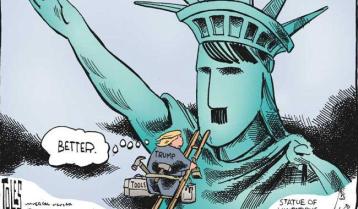
This is what happens when all the cracked eggs in the cartoon get to vote in gerrymandered elections that were the subject of Russian interference and laws specifically designed to suppress minority votes.
Yes. Please read that again because it’s a headline from Politico. I think we can all agree that the current executive branch is a force for evil and chaos in the world so it’s taken less than 2 months for us to lose whatever standing we ever had left after the entire Iraq invasion debacle. Angela Merkel is the leader of the Free World and Kremlin Caligula refused to shake hands with her.
The subhead line to this? “Angela Merkel, whether she wants the job or not, is the West’s last, best hope.” Yes. She is because every day the news on the Russian entanglements become more and more evident. We’ve basically had a bloodless coup.
The German chancellor is the only leader in Europe who even has a plausible claim to moral leadership. As a victim of Soviet communism, Merkel was always going to be listened to carefully on the question of morality. And given her longevity she was always going to be respected. But it was her unexpected decision to accept some 1 million refugees that established her moral credentials, especially since no other political leader has taken such a political risk.
The cruel irony of Trump’s election is that for many decades it was the United States that was seen as a moral leader. During the Cold War, Soviet dissidents looked to the United States. And after communism fell, it was the United States that led international actions to protect victims of repression or hardship. Whether it was the Kurds in northern Iraq, Somalia, Bosnia, Kosovo, or the spending on medicine to treat millions suffering from HIV in Africa, the United States was the country expected to act.

Yes, every day we find out more about that Russian interference. Rachel’s been on top of it probably more than any other mainstream TV media outlet. WAPO has not let it go either. Writer and friend Tim Shorrock explains how privatization has played a role in helping Wikileaks hack our systems. This is something of particular interest because if Trump and friends have their way, their billionaire friends and business interests will be the total overlords of a pay to play privatization scheme. The Cheney buddies were the beneficiaries are the clarion call of handing over public trusts, money and interests to old employers.
When WikiLeaks released more than 8,000 files about the CIA’s global hacking programsthis month, it dropped a tantalizing clue: The leak came from private contractors. Federal investigators quickly confirmed this, calling contractors the likeliest sources. As a result of the breach, WikiLeaks editor Julian Assange said, the CIA had “lost control of its entire cyberweapons arsenal.”
Intelligence insiders were dismayed. Agencies “take a chance with contractors” because “they may not have the same loyalty” as officers employed by the government, former CIA director Leon Panetta lamented to NBC.
But this is a liability built into our system that intelligence officials have long known about and done nothing to correct. As I first reported in 2007, some 70 cents of every intelligence dollar is allocated to the private sector. And the relentless pace of mergers and acquisitions in the spies-for-hire business has left five corporations in control of about 80 percent of the 45,000 contractors employed in U.S. intelligence. The threat from unreliable employees in this multibillion-dollar industry is only getting worse.
 Tim is a superb investigator and researcher. He’s been on this story for some time. Please go read it.
Trump has surrounded himself with “blow it up Billionaires”. His cabinet is filled with them. A large number of them are either trust fund babies with maybe one generation of wealth behind them or folks that made money the new-fashioned way. They gambled on Wall Street on items that are merely paper. These are not the Carnegies that built a steel industry or even the Rockefellers and their oil empire. These are folks that basically got wealthy via tax loopholes, get rich schemes, and betting against actual companies through the derivatives markets. The Mercers are a shining example of this new model and their politics are poisonous.
Mercer is a youthful-looking 70. As a boy growing up in New Mexico, he carried around a notebook filled with computer programs he had written. “It’s very unlikely that any of them actually worked,” he has said. “I didn’t get to use a real computer until after high school.” Robert went on to work for decades at IBM, where he had a reputation as a brilliant computer scientist. He made his vast fortune in his 50s, after his work on predicting financial markets led to his becoming co-CEO of Renaissance Technologies, one of the world’s most successful quantitative hedge funds. A longtime colleague, David Magerman, recalls that when Robert began working at Renaissance in 1993, he and his wife, Diana, were “grounded, sweet people.” (Magerman was suspended from Renaissance in February after making critical comments about Robert in The Wall Street Journal.) But “money changed all that,” he says. “Diana started jetting off to Europe and flying to their yacht on weekends. The girls were used to getting what they wanted.”
At Renaissance, Robert was an eccentric among eccentrics. The firm is legendary for shunning people with Wall Street or even conventional finance backgrounds, instead favoring scientists and original thinkers. Robert himself, by all accounts, is extremely introverted. Rarely seen in public, he likes to spend his free time with his wife and three daughters. When, in 2014, Robert accepted an award from the Association for Computational Linguistics, he recalled, in a soft voice and with quiet humor, his consternation at being informed that he was expected to give “an oration on some topic or another for an hour, which, by the way, is more than I typically talk in a month.” Sebastian Mallaby’s account of the hedge-fund elite, More Money Than God, describes him as an “icy cold” poker player who doesn’t remember having a nightmare. He likes model trains, having once purchased a set for $2.7 million, and has acquired one of the country’s largest collections of machine guns.
For years, Robert has embraced a supercharged libertarianism with idiosyncratic variations. He is reportedly pro-death penalty, pro-life and pro-gold standard. He has contributed to an ad campaign opposing the construction of the ground zero mosque; Doctors for Disaster Preparedness, a group that is associated with fringe scientific claims; and Black Americans for a Better Future—a vehicle, the Intercept discovered, for an African-American political consultant who has accused Barack Obama of “relentless pandering to homosexuals.” Magerman, Robert’s former colleague at Renaissance, recalls him saying, in front of coworkers, words to the effect that “your value as a human being is equivalent to what you are paid. … He said that, by definition, teachers are not worth much because they aren’t paid much.” His beliefs were well-known at the firm, according to Magerman. But since Robert was so averse to publicity, his ideology wasn’t seen as a cause for concern. “None of us ever thought he would get his views out, because he only talked to his cats,” Magerman told me.
Robert’s middle daughter Rebekah shares similar political beliefs, but she is also very articulate and, therefore, able to act as her father’s mouthpiece. (Neither Rebekah nor Robert responded to detailed lists of questions for this article.) Under Rebekah’s leadership, the family foundation pouredsome $70 million into conservative causes between 2009 and 2014.[1]
 Trump, the short fingered vulgarian, can find no solace among the truly wealthy of Manhattan. He’s done what he has to do to feed his need for endless attention, power, and money. He’s thrown in with International Thieves and local thugs. There is nothing these folks love more than to suppress the votes of minorities along with promoting the xenophobia of the White Nationalists that serve this White House and the Tea Party.
Few people in the Republican Party have done more to limit voting rights than Hans von Spakovsky. He’s been instrumental in spreading the myth of widespread voter fraud and backing new restrictions to make it harder to vote.
But it appears that von Spakovsky had an admirer in Neil Gorsuch, Donald Trump’s nominee for the Supreme Court, according to e-mails released to the Senate Judiciary Committee covering Gorsuch’s time working in the George W. Bush Administration.
When President Bush nominated von Spakovksy to the Federal Election Commission in late 2005, Gorsuch wrote, “Good for Hans!”
Read that article at The Nation. These are not nice people by any traditional or untraditional sense of the word. Here’s a nice little Georgia Cracker defending a bill designed to stop black people from voting at the same link.
Georgia’s voter-ID law was submitted to the Justice Department in 2005 under Section 5 of the Voting Rights Act, which required states like Georgia with a long history of voting discrimination to approve their voting changes with the federal government. The sponsor of the law, Republican Representative Sue Burmeister, told department lawyers, “If there are fewer black voters because of the bill, it will only be because there is less opportunity for fraud. She said when black voters in her precinct are not paid to vote, they do not go to the polls.”
Her racially inflammatory assertions set off alarm bells among the team reviewing the submission, indicating that the law may have been enacted with a discriminatory purpose. Department lawyers feared the bill would disenfranchise thousands of voters.
 Here’s another dozy appointment for you. White House Advisor Sebastian Gorka supposedly held membership in a Nazi-Allied Far-Right Hungarian Group, Historical Vitézi Rend. New York Congressman Jerry Nadler has opened a query. Gorka is a Deputy Assistant to T-Rump and has been out spoken about the travel ban. He’s among those in the government spreading blatant disinformation. You can read more about the Travel Ban, etc. on BB’ post yesterday.

So, the first thing that happened in the Trump-Merkel meeting today is that T-Rump did not shake hands with Germany’s Chancellor
during a photo op.
Trump sat next to Merkel in front of a fireplace for the brief photo-op.“Very good,” Trump said to assembled reporters when asked about what the two leaders discussed. “Lots of things.”
“Very good, thanks,” Merkel said in German.
But Trump hardly looked at Merkel and, when the photo op ended, didn’t move in for a handshake.
We’re in for an ongoing nightmare and series of national embarrassments for some time. I’m just hoping the terrorists groups don’t have a chance to get their acts together before we get rid of him. Every thing in the executive branch is extremely nonfunctional.
What’s on your reading and blogging list today?
Did you like this post? Please share it with your friends:
Posted: March 16, 2017 | Author: bostonboomer | Filed under: just because |

Good Afternoon!!
Donald tRump’s campaign against American values is heating up. With his latest Muslim ban, he seeks to destroy the separation of church and state that was enshrined in the Constitution. With Trumpcare, he hopes to kill or sicken millions of poor and elderly people by taking away their health insurance. With his new budget, he hopes to kill off any of the poor and elderly who survive his “health care” plan.
The Muslim ban was supposed to go into effect late last night,
but two federal judges (so far) have stopped it in its tracks. The New York Times:
A federal judge in Hawaii issued a nationwide order Wednesday evening blocking President Trump’s ban on travel from parts of the Muslim world, dealing a stinging blow to the White House and signaling that Mr. Trump will have to account in court for his heated rhetoric about Islam.
A second federal judge in Maryland ruled against Mr. Trump overnight, with a separate order forbidding the core provision of the travel ban from going into effect.
The rulings were a second major setback for Mr. Trump in his pursuit of a policy that he has trumpeted as critical for national security. His first attempt to sharply limit travel from a handful of predominantly Muslim countries ended in a courtroom fiasco last month, when a federal court in Seattle halted it.
Mr. Trump issued a new and narrower travel ban, affecting six countries, on March 6, trying to satisfy the courts by removing some of the most contentious elements of the original version.
But in a pointed decision that repeatedly invoked Mr. Trump’s public comments, Judge Derrick K. Watson, of Federal District Court in Honolulu, wrote that a “reasonable, objective observer” would view even the new order as “issued with a purpose to disfavor a particular religion, in spite of its stated, religiously neutral purpose.”
In Maryland, Judge Theodore D. Chuang echoed that conclusion hours later, ruling in a case brought by nonprofit groups that work with refugees and immigrants, that the likely purpose of the executive order was “the effectuation of the proposed Muslim ban” that Mr. Trump pledged to enact as a presidential candidate.
Trump threw a tantrum about the decision in Hawaii last night during his “campaign rally” in Nashville in which he publicly state that the new ban is a “watered down version” of the old one and that he’d like to have the original ban back. That’s not going to help his lawyers defend it in court. Neither did Stephen Miller’s comments.

Huffington Post: Thank Stephen Miller’s Big Mouth For Trump Travel Ban’s Latest Court Woes.
Stephen Miller, a senior policy adviser to the president, was one of Trump’s most vocal mouthpieces following the fraught rollout of the administration’s first travel ban that sparked massive protests at airports around the country. Shortly after federal judges struck down that order, Miller appeared on television to stump a watered-down version, assuring Fox News it would include only “minor technical differences.”
On February 21, Senior Advisor to the President, Stephen Miller, told Fox News that the new travel ban would have the same effect as the old one. He said: “Fundamentally, you’re still going to have the same basic policy outcome for the country, but you’re going to be responsive to a lot of very technical issues that were brought up by the court and those will be addressed. But in terms of protecting the country, those basic policies are still going to be in effect.”
Those “plainly worded statements,” it seems, helped lead U.S. District Judge Derrick Watson to issue a temporary restraining order against the ban on Wednesday. There is nothing “’secret’ about the executive’s motive specific to the issuance of the executive order,” Watson’s ruling reads.
The judge also cited Rudy Giuliani’s comments about how Trump asked him to find a legal way to do a Muslim ban.
On Paul Ryan’s wet dream “health care” plan,
tRump may be beginning to have doubts as he gradually learns from media sources what it actually involves. Heaven forbid he actually try to read the monstrosity himself. He’s much too busy worrying that Obama “wiretapped” his phone calls and is now encouraging federal employees to undercut tRump and his cronies. Since we already know what’s in the Ryancare or Trumpcare/Ryancare, here are a couple of not-so-serious articles about the GOP’s latest clusterf**k.

T.A. Frank at The Atlantic: Inside the Trump-Ryan Murder-Suicide Pact.
When the Congressional Budget Office released the numbers on Trumpcare—or Ryancare, or whatever you want to call the two-headed boar unveiled by Paul Ryan as a replacement to Obamacare—showing that more than 20 million Americans would join the ranks of the uninsured in a few years, what came to mind was Buck Turgidson making the case for a nuclear first strike in Dr. Strangelove. “Mr. President, I’m not saying we wouldn’t get our hair mussed,” he promises. “But I do say no more than 10 to 20 million killed, tops.” Yes, some of the people losing their coverage would be dropping it by choice, freed up by the end of individual mandates. But many others would be pushed out by a massive increase in premiums. It takes a zealot like Ryan to be “encouraged” by that kind of analysis.
This has been an amazingly speedy descent into Republican self-sabotage. Ryan’s bill is almost universally disliked. Liberals and Democrats hate it for hurting lower-income Americans. Conservatives and Republicans hate it for either hurting lower-income Americans or for not hurting them enough. (Ohio governor John Kasich condemns the bill for reducing Medicaid coverage for the poor, while small-government Republicans like Rand Paulcall it “Obamacare Lite.”) Americans who currently subsidize Obamacare would be re-united with their money, while Americans who depend on the subsidies would be out of luck. The Ryan bill seems to promise a replay of hits from the George W. Bush years, when Republicans who preferred zero spending on the poor clashed with Republicans who preferred medium spending on the poor, but found common ground through their shared interest in big spending on the rich.
Much of this was to be expected, because Ryan is Ryan, and the G.O.P. is the G.O.P. What was up for grabs was the stance of Donald Trump. Was he going to insist on doing more to protect the little guy? Or was he going to throw his lot in with Ryan? We now see that, despite some concerns from his friends in the media, he chose the latter. (Or perhaps he chose it after Ryan incorporated some of Trump’s requests to protect the little guy—in which case Trump didn’t get very far.) Trump has been lobbying aggressively to get Ryan’s bill passed, inviting skeptics to meetings at the White House, promising rallies, and generally spending a lot of scarce political capital.
If the bill passes, many of Trump’s voters will get hurt, leaving Trump damaged. If it fails, the White House will have suffered a big defeat, leaving Trump damaged and his agenda weakened. It’s not a favorable set of choices. If nothing else, though, it will be the first big test of Trumpism. Its contradictions could be hidden during a campaign season. Now, they are coming into sharp relief.
Read the rest at the link.
And from The Onion: Mitch McConnell Sees Infinite Healthcare Plans After Dropping Acid To Inspire Ideas For Obamacare Replacement.
WASHINGTON—Seeking to open his mind to new possibilities for overhauling the U.S. healthcare system, Senate Majority Leader Mitch McConnell (R-KY) reportedly witnessed an infinite number of replacement plans Wednesday after dropping acid to inspire ideas for an Obamacare alternative.
Shortly after the 75-year-old Republican senator ingested two 100-microgram tabs of LSD in his Congressional office, sources said countless substitutes for the Affordable Care Act began to explode before his eyes in luminescent, hyper-vivid colors and patterns.
“Oh my God—I can see the CHIP provisions spreading out in every direction forever and ever and ever,” said a reeling McConnell, gazing wide-eyed as infinite, interlocking fractal combinations of health savings plans, employer-provided coverage, and government subsidies enveloped him in an accelerating stream, eventually passing over him with such velocity that they appeared to be an entire galaxy of stars swirling around him. “Now I can see…I can see the outpatient hospital visits covered for every child in the country! No, every child who’s ever been born, and will ever be born! Even the ones who haven’t yet been conceived!”
“The scope of coverage is so beautiful,” added the senator quietly. “Whoa.”
According to sources, McConnell’s hallucinations came on slowly, first appearing as a geodesic block grant spiraling gently in the center of the senator’s desk before morphing into a gigantic, prismatic spiderweb of plans whose out-of-pocket prescription expenses expanded and contracted with McConnell’s every breath.
And now for the federal budget from Hell.
tRump wants to spend more than a trillion dollars of taxpayer money on his godforsaken border wall and pay for it by cutting funding for science, the arts and of course the social safety net. As you read the next headline, keep in mind that we also pay for millions for tRump to travel to Florida to play golf and schmooze with Russian mobsters and spies and to keep Melania happy in Trump Tower in NYC.

Occupy Democrats: Trump Just Announced Plan To End ‘Meals On Wheels’ For Seniors.
One popular program facing elimination is “Meals On Wheels,” which uses federal funds from the Department of Housing and Urban Development to mobilize volunteers, businesses and donors to provide nutrition to thousands of senior citizens on a daily basis. It supports over 5,000 community-based organizations across America, reaching people in both urban and rural areas.
The money for Meals On Wheels is part of the Older American Act, first passed in 1965 as part of LBJ’s Great Society, and endorsed by every president until Trump. The total cost, which includes other programs, is about $2 billion a year, which is less than the government hands out in fossil fuel subsidies every year.
Meals On Wheels alone costs about $3 million a year, which is the cost of just one trip to Trump’s “winter White House.”
The Washington Post: Trump federal budget 2018: Massive cuts to the arts, science and the poor.
Trump’s first budget proposal, which he named “America First: A Budget Blueprint to Make America Great Again,” would increase defense spending by $54 billion and then offset that by stripping money from more than 18 other agencies. Some would be hit particularly hard, with reductions of more than 20 percent at the Agriculture, Labor and State departments and of more than 30 percent at the Environmental Protection Agency.
It would also propose eliminating future federal support for the National Endowment for the Arts, the National Endowment for the Humanities and the Corporation for Public Broadcasting. Within EPA alone, 50 programs and 3,200 positions would be eliminated.
The cuts could represent the widest swath of reductions in federal programs since the drawdown after World War II, probably leading to a sizable cutback in the federal non-military workforce, something White House officials said was one of their goals.
“You can’t drain the swamp and leave all the people in it,” White House Office of Management and Budget Director Mick Mulvaney told reporters.
You can read the entire mess at Vox if you want to: Read President Trump’s proposed federal budget. I think I’ll just stick with The Onion.
So . . . what else is happening? Post your thoughts and links in the comment thread and have a tremendous Thursday.
Did you like this post? Please share it with your friends:
Posted: March 14, 2017 | Author: bostonboomer | Filed under: morning reads, U.S. Politics |

Times Square on Tuesday morning. Credit Stephanie Keith for The New York Times
Good Morning!!
I’m still skeptical about this snowstorm. First we were supposed to get 2 feet of snow here in Greater Boston. Then we heard 12-18 inches. Now they are saying 8-12 and snow turning to rain after 5PM. I’d be interested to know what folks further south are getting. High winds are still expected. Here’s the latest from CNN:
Northeast snowstorm puts 18 million under blizzard warning.
I guess the heaviest snow is going to be further west than originally predicted. I hope that doesn’t mean you, Pat J.
Yesterday’s CBO report was devastating for the GOP’s proposed Trumpcare plan.
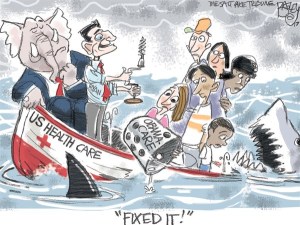
The Atlantic: The CBO Deals Paul Ryan’s Health-Care Plan a Major Blow.
The Congressional Budget Office on Monday projected that the House leadership’s American Health Care Act would result in 24 million Americans losing their health insurance while raising premiums for those covered on the individual market. Their bill would lower federal deficits by $337 billion over 10 years, largely as a result of cuts to Medicaid that would reduce its enrollment by 14 million, according to the estimate. Average premiums would rise by as much as 20 percent in 2018 and 2019 before falling in later years….
Of particular concern for GOP backers of the American Health Care Act is the CBO’s projection for its immediate impact. If enacted soon, an estimated 14 million people would drop their insurance next year because the proposal repeals the tax penalties associated with the individual mandate, the CBO forecasts. If people are not required to buy insurance, in other words, many will stop doing so. Millions more would join the ranks of the uninsured after 2020, when the bill would roll back the expansion of Medicaid under the Affordable Care Act. Conservatives have called for repealing the expansion sooner, which would likely result in more people dropping coverage in the first years after enactment.
Of course that would not be good for Republicans running for reelection in 2018.
Politico: White House analysis of Obamacare repeal sees even deeper insurance losses than CBO.
A White House analysis of the GOP plan to repeal and replace Obamacare shows even steeper coverage losses than the projections by the Congressional Budget Office, according to a document viewed by POLITICO on Monday.
The preliminary analysis from the Office of Management and Budget forecast that 26 million people would lose coverage over the next decade, versus the 24 million CBO estimates. The White House has made efforts to discredit the forecasts from the nonpartisan CBO.
White House officials late Monday night disputed that the document is an analysis of the bill’s coverage effects. Instead, they say it was an attempt by the OMB to predict what CBO’s scorekeepers would conclude about the GOP repeal plan.
LOL! I wonder who leaked that to Politico?

Granny starver Paul Ryan says he finds the CBO report encouraging because it accomplishes his goals–killing off older and poorer people and further enriching the already rich whom he considers deserving. This man is no Catholic. He should be excommunicated. Fox News reports:
Paul Ryan: Paul Ryan: CBO report on ObamaCare repeal ‘exceeded my expectations.’
Ryan told host Bret Baier that the CBO’s prediction that 14 million more Americans would be uninsured in 2018 was due to the bill’s overturning of ObamaCare’s individual mandate.
“Of course they’re going to say if we stop forcing people to buy something they don’t want to buy they’re not going to buy it,” Ryan said. “That’s why you have these uninsured numbers, which we all expected.”
According to Ryan, the key numbers in the analysis would come once the bill’s reforms took effect in 2020.
“It will lower premiums 10 percent. It stabilizes the market. It’s a $1.2 trillion spending cut, and $883 billion tax cut and $337 billion in deficit reduction,” Ryan said. “So, this compared to the status quo is far better.”
In response to a question from a Twitter user, Ryan said that ObamaCare’s repeal and replacement was a prerequisite for the House to take up tax reform, another key part of President Trump’s agenda.
Ryan is still the ultimate Ayn Rand fan. The fact that he says this stuff out loud shows what a terrible political strategist he is. Wisconsin needs to dump him next year.

And why will premiums go down? Margaret Singer Katz explains at The New York Times’ The Upshot: No Magic in How G.O.P. Plan Lowers Premiums: It Pushes Out Older People.
There are a lot of unpleasant numbers for Republicans in the Congressional Budget Office’s assessment of their health care bill. But congressional leadership found one to cheer:
Everyone hates to pay for a repair. That’s why you have a home warranty company in the first place, right? So why not eliminate the Service Fee charged by other home warranty companies when they come to your home.
The report says that the bill will eventually cut the average insurance premiums for people who buy their own insurance by 10 percent.
House Speaker Paul Ryan pressed that point in a series of appearances Monday night, suggesting that the budget office had found that the House bill would increase choice and competition and lead to lower prices. The Senate majority leader, Mitch McConnell, issued a statement saying, “The Congressional Budget Office agrees that the American Health Care Act will ultimately lower premiums and increase access to care.”
But the way the bill achieves those lower average premiums has little to do with increased choice and competition. It depends, rather, on penalizing older patients and rewarding younger ones. According to the C.B.O. report, the bill would make health insurance so unaffordable for many older Americans that they would simply leave the market and join the ranks of the uninsured.
The remaining pool of people would be comparatively younger and healthier and, thus, less expensive to cover. Other changes would help make health insurance skimpier — cheaper, but with deductibles that are higher than those criticized by Republicans under Obamacare.
Read the details at the NYT.
An issue that has been troubling me a lot lately (in addition to the Russia investigation) is that tRump apparently has no desire to fill the hundreds of federal government jobs that remain vacant.

The New York Times: Trump Lets Key Offices Gather Dust Amid ‘Slowest Transition in Decades.’
At the State Department, the normally pulsating hub of executive offices is hushed and virtually empty. At the Pentagon, military missions in some of the world’s most troubled places are being run by a defense secretary who has none of his top team in place. And at departments like Treasury, Commerce and Health and Human Services, many senior posts remain vacant even as the agencies have been handed enormous tasks like remaking the nation’s health insurance system.
From the moment he was sworn in, President Trump faced a personnel crisis, starting virtually from scratch in lining up senior leaders for his administration. Seven weeks into the job, he is still hobbled by the slow start, months behind where experts in both parties, even some inside his administration, say he should be.
The lag has left critical power centers in his government devoid of leadership as he struggles to advance policy priorities on issues like health care, taxes, trade and environmental regulation. Many federal agencies and offices are in states of suspended animation, their career civil servants answering to temporary bosses whose influence and staying power are unclear, and who are sometimes awaiting policy direction from appointees whose arrival may be weeks or months away.
“There’s no question this is the slowest transition in decades,” said R. Nicholas Burns, a former State Department official who served under presidents of both parties and has been involved in transitions since 1988. “It is a very, very big mistake. The world continues — it doesn’t respect transitions.”
Mr. Trump has insisted that the barren ranks of his government are not a shortcoming but the vanguard of a plan to cut the size of the federal bureaucracy. “A lot of those jobs, I don’t want to appoint, because they’re unnecessary to have,” Mr. Trump told Fox News last month. “I say, ‘What do all these people do?’ You don’t need all those jobs.”

Here’s some further analysis at Vox: President Trump is running an empty government. He thinks refusing to hire people streamlines the government. But it’s backfiring.
There are many reasons for the personnel crisis. Trump didn’t use the weeks-long transition to make second- and third-tier personnel picks. He has personally vetoed high-level picks at the Treasury and State Department who criticized him — even mildly — during the campaign. His West Wing staff lack experience in Washington and don’t know or seem to care much about how individual departments work.
Trump himself, meanwhile, simply thinks having fewer people working is better. “A lot of those jobs I don’t want to appoint, because they’re unnecessary to have,” Trump said on Fox News last month. “I say, ‘What do all these people do?’ You don’t need all those jobs.” Trump thinks the best route to the conservative ideal of small government is to practice what you preach — literally make the government much smaller by refusing to fill many posts.
The problem is that it makes government far less effective, even in areas like trade that are supposed to be a top priority for the administration. To take one example, a high-level summit in Chile this week will feature trade ministers from around the globe. But because the Trump administration hasn’t confirmed a trade official, the US will be represented by American’s ambassador to Chile, Carol Perez, a career diplomat who lacks the power and the technical knowledge of the other attendees, according to the Times.
Doug Irwin, an economics professor at Dartmouth College who specializes in the history of trade, said Perez may have a hard time keeping up with the hugely complicated and technical talks. Without large amounts of prior experience, he said, someone like Perez may not be able to “figure out what’s feasible and what’s not feasible.”
“It’s too complicated,” he said.
That captures one of the key issues with Trump’s refusal to fill high-level positions. There’s a difference between campaign rhetoric about trimming back the federal government and simply disregarding the management needs of mammoth government agencies that help run the most powerful country in the world and handle its relationships with other global powers. Trump appears to be heading down the latter path. And it’s going to make it harder for him to pursue his own goals.
Read more at the link.
Of course we all remember that Steve Bannon’s plan is for “the deconstruction of the administrative state.” Will it work? Stephen Collinson at CNN writes: Trump’s plan to dismember governmentHis first budget — expected to be unveiled later this week — will mark Trump’s most significant attempt yet to remold national life and the relationship between federal and state power.
It would codify an assault on regulatory regimes over the environment, business and education bequeathed by former President Barack Obama, and attempt to halt decades of steadily growing government reach.
Trump’s first budget will make more of a statement than most debut spending blueprints by other new presidents. The White House has made clear it intends to use the document to usher in the radical political changes that powered Trump’s upstart, anti-establishment campaign last year.
It comes on the heels of other big changes such as the abrupt dismissal of 46 US attorneys last week and the effort to dismantle Obama’s signature health care law.
Read the rest at the link.
That’s all I have for you today. What stories are you following–and how’s your weather?
Did you like this post? Please share it with your friends:
Posted: March 13, 2017 | Author: dakinikat | Filed under: Congress, corporate greed, corporatism, corruption | Tags: Linkalicious |
 Good Morning!
Well, things are not looking up at all. We continue to have Pressers based on questions from Right Wing Conspiratorial Web sites. Our allies continue to question our rationality and priorities as a nation. Millions of people face the very real possibility they may not have their healthcare, retirement funds, or any kind of service or help from their government in the near future.
One of the things that I’ve been very worried about is the continual disconnect between the performance of the equities market and what’s going on in the bond markets. This is usual a symptom of what we call “animal spirits” and often a sign that a crash is imminent on Wall Street.
Bond investors and those concentrated in Equities have very different priorities. Bonds are usually safe and liquid assets while Equities are risky. Their prices can be volatile. Here’s something I read about a week ago as a lead up to something I read this morning.
Are stocks and U.S. Treasurys sending mixed signals? Treasury prices have rebounded since Donald Trump’s presidential inauguration in January, pushing down yields, as stocks continue to ascend record heights. That’s in contrast with the bond market rout that followed the November election.
Why is a simultaneous rally a problem? Some investors see it as a sign that investors are losing faith in the so-called Trump trade, in which investors bet on aggressive fiscal stimulus and other growth-friendly measures from the new administration.
 Much of the boom in equities has been due to speculation that deregulation and expansive fiscal policy favorable to private businesses may fuel business profits. None of this has come to fruition yet so it’s basically speculative. The economy is healthy and growing strong at the moment but is it enough to support the increased levels seen in the stock markets? Is it real and sustainable?
Historical patterns suggest that it’s not and we may be looking at a future crash which would not bode well for any one who is or soon to be reliant on 401ks. This is when I’m happy about my small but very stable pension coming in monthly. I’ve lived through way too many bubbles now and seen my 401k bounce around like a jumping bean. My Uncle was one of the pioneer gnomes of the chartist movement after Black Friday. I loved to see his huge charts that frequently blanketed the tables of his Kansas City mansion. It could be why I ended up doing something similar.
It’s already been a big year for the Dow industrials, which have stretched a near-decade-long bull market to historic heights.
But if the technical stars collide, as one chartist predicts, the blue-chip gauge could soon plunge by more than 6,000 points to 14,800. That’s nearly 30% lower, based on Friday’s close.
Sandy Jadeja, chief market strategist at Master Trading Strategies, claims several predicted stock market crashes to his name — all of them called days, or even weeks, in advance. (He told CNBC viewers, for example, that the August 2015 “Flash Crash” was coming 18 days before it hit.) He’s also made prescient calls on gold and crude oil.
And he’s extremely concerned about what this year could bring for investors. “The timeline is rapidly approaching” for the next potential Dow meltdown, said Jadeja, who shares his techniques via workshops and seminars. Timelines are at the heart of his predictions, which he bases on repeating cycles in the market that are connected to specific times.
“People need to look for three things,” Jadeja told MarketWatch in a late-January interview and follow-up conversations. “Price, pattern, and … time. You can get the price pattern wrong, but if you get in at the right time, the other two don’t matter.”
He sees 2017 as littered with pitfalls for the Dow DJIA, -0.18% . Below is his so-called “timelines” chart of the stock index, defined by green horizontal lines. He’s currently on the lookout for the benchmark to approach that upper green line, which represents a range of 21,800 to 22,000.
 For me, it starts with a small alarm in my gut that says what are these people smoking? Where are they seeing all this good news? The Trumpcare fiasco alone should be sending signals that say things are not looking up. Removing the ACA and replacing it with any thing close to what the Republicans are offering is going to severely disturb the healthcare markets as well as the labor markets. Purchases by Households are still the primary driver of any US economy. They represent nearly 70% of all spending.

Trump has made it clear that his budget will eliminate a significant part of the Federal workforce. This is a really really recessionary move. The states of Kansas and Louisiana have done this and its created significant economic distress in both places. Plus, it’s created a distinct lack of service and action in crucial public services. For example, the state of Louisiana cannot train as many doctors and provide as many residents to hospitals. That’s not good at all.
President Trump’s budget proposal this week would shake the federal government to its core if enacted, culling back numerous programs and expediting a historic contraction of the federal workforce.
This would be the first time the government has executed cuts of this magnitude — and all at once — since the drawdown following World War II, economists and budget analysts said.
The spending budget Trump is set to release Thursday will offer the clearest snapshot of his vision for the size and role of government. Aides say that the president sees a new Washington emerging from the budget process, one that prioritizes the military and homeland security while slashing many other areas, including housing, foreign assistance, environmental programs, public broadcasting and research. Simply put, government would be smaller and less involved in regulating life in America, with private companies and states playing a much bigger role.
Meanwhile, the Trump Family Syndicate continues to score. The Trump Economy appears to be wonderful for the Trumps. The Kushners are getting a windfall from the Chinese that is a deal that’s more than just a little suspicious.
A company owned by the family of Jared Kushner, President Donald Trump’s son-in-law and senior adviser, stands to receive more than $400 million from a prominent Chinese company that is investing in the Kushners’ marquee Manhattan office tower at 666 Fifth Ave.
The planned $4-billion transaction includes terms that some real estate experts consider unusually favorable for the Kushners. It provides them with both a sizable cash payout from Anbang Insurance Group for a property that has struggled financially and an equity stake in a new partnership.
The details of the agreement, which is being circulated to attract additional investors, were shared with Bloomberg. It would make business partners of Kushner Cos. and Anbang, whose murky links to the Chinese power structure have raised national security concerns over its U.S. investments. In the process, an existing mortgage owed by the Kushners will be slashed to about a fifth of its current amount.
The document offers a rare look at a major deal by a close Trump associate and family member. It’s unclear whether the deal could prompt federal review, as occurred when Anbang bought other properties, like the Waldorf Astoria Hotel in Manhattan. Anbang could also face review by the Chinese government, which has been clamping down on overseas investments and which has a range of pending issues with the Trump administration.

Check out how the controversial EB-5 VISA program works its way into the numbers. I’m still appalled at the idea that Camp David sits idle while Kremlin Caligula profits from using his private resort as a cash cow dressed up as a mini-White House.
Rep. Adam Schiff (D-CA), Ranking Member of the House Intelligence Committee, exposed Donald Trump’s claims about his so-called “Winter White House” today, pointing out that Mar-a-Lago is not a winter white house but a private for-profit business, with all the ethical and security problems that entails …
As Schiff says, Mar-a-Lago is “one ethical quagmire” out of many in the Trump empire. He is right when he points out that Trump is a “walking, talking violation of the Emoluments Clause” and has been since Day 1 of his administration.
There is no question that Trump’s business interests will not always align with American interests or with National Security needs (and forget for a moment the security risk his holding court in public places poses).
Donald Trump has shown Americans and the world that he cannot be trusted to place what’s best for America above his own interests. This is a basic problem of corporations, which see not the public good but their bottom line as what matters.
Pennsylvania Senator Bob Casey has just asked the ethics office to look into T-Rump’s foreign business deals for conflicts of interest.
Democratic Sen. Bob Casey asked a government ethics office Monday to assess whether President Donald Trump’s business dealings make his administration vulnerable to conflicts of interest.
“President Trump has exposed his administration to possible conflicts of interest on an unprecedented scale,” the Pennsylvania lawmaker says in a letter to the Office of Government Ethics.
Casey asked whether any of Trump’s foreign business deals could violate the Emoluments Clause of the Constitution, which prohibits U.S. officeholders from accepting gifts from foreign countries.The White House did not immediately respond to a request for comment.
Walter Shaub, the director of the ethics office, strongly criticized Trump earlier this year for not divesting from his businesses. Shaub said Trump was breaking decades of tradition by presidents who set up blind trusts for their assets.

There’s currently a call to investigate the possibilities that that the Trump Family Thug Syndicate has been laundering Russian Thug money through Deustche Bank. Calls have been made by Democrats to the DOJ to investigate the Bank itself. Congresswoman Maxine Waters is leading the charge on this.
Senior Democrats on Capitol Hill are calling for a congressional investigation into the justice department’s handling of an ongoing inquiry into
Deutsche Bank, saying that Donald Trump had conflicts of interest with the German bank, his biggest creditor.
Maxine Waters, the top Democrat on the House financial services committee, urged her Republican colleagues to launch their own investigation into the nature of Deutsche Bank’s money-laundering scheme, who participated in the arrangement and whether it involved any other violations of US law beyond the failure to maintain anti-money laundering controls.
Deutsche Bank has already been ordered to pay more than $800m (£660m) in fines in the US and UK for failing to stop the improper and corrupt transfer of more than $10bn out of Russia. It is also being investigated by the justice department (DoJ).
The Guardian
reported last month that the German bank undertook a close examination of the president’s personal bank account and those held by his family, in order to ascertain whether they had any suspicious links to Russia. None were found.
According to
an analysis by Bloomberg, Trump now owes Deutsche about $300m. He has four large mortgages, all issued by Deutsche’s private bank.
Waters said in a letter to Jeb Hensarling, the chairman of the House financial services committee, that she was concerned “about the integrity of this criminal probe” given Trump’s “conflicts of interest” and the “suspicious ties” between Trump’s inner circle and the Russian government.
 The Atlantic has printed a ‘crib sheet’ of all the Trump conflicts of interest. The list is huge. The demand for forensic accountants is also going to be huge.
When it comes to President Donald Trump’s constellation of foreign investments, properties, and companies, much of the attention so far has been on his business’s apparent violation of the Constitution’s Emoluments Clause, which bars officeholders from taking gifts from foreign leaders. According to numerous ethics experts, the clause takes an expansive definition of gifts, encompassing everything from a direct bribe to a foreign official’s approval of construction of a new Trump property. But some of the Trump Organization’s properties raise additional red flags due to the specific partners involved. That’s true in Indonesia, for example, where Trump’s affiliates have been involved in bribery scandals and radical Islamic nationalist parties, and Brazil, where the company pulled out of a branding agreement amid a criminal investigation of a local business partner.
Such is the case in Azerbaijan, which Transparency International ranks as among the most corrupt countries in the world, where the Trump International Hotel and Tower in Baku remains unopened. Though the long-stalled development has generated a steady drip of news and rumors for years, an overview by Adam Davidson in The New Yorker, entitled “Donald Trump’s Worst Deal,” puts into perspective just how convoluted the situation is, and just how much the project has led Trump and his company into a partnership with numerous corrupt officials in the Middle East. The details suggest that, on top of the continual underlying breach of the Emoluments Clause, the Trump Organization’s involvement may also violate the Foreign Corrupt Practices Act, or FCPA, which forbids American companies from participating, even unknowingly, in bribery schemes in other countries, with a penalty of up to $2 million and up to five years in jail.
 When all of this finally begins to unravel in a manner befitting of such a serious level of scandal, it can’t help but take our economy with it. How much damage can Trump, Ryan et al inflict on us and at what point will ‘enough’ actually be ‘ENOUGH!!!!’? Take these examples.
The price of drinks at his new hotel in Washington DC has reportedly increased significantly since it opened last September. His sons, Donald Jr and Eric Trump, have opened new hotels in Dubai and Vancouver since their father’s Inauguration, and told The New York Times that the Trump brand is “the hottest it’s ever been”. The initiation fee to join the Mar-a-Lago resort in Florida, named the “Winter White House”, where the President has spent several weekends, has recently soared.
The President’s motivation for choosing the six countries to include in his newly-reworded travel ban – Iran, Yemen, Syria, Libya, Sudan and Somalia – will more likely be featured in lawsuits which challenge the constitutionality of the executive order than in the lawsuit from Mr Eisen and Mr Painter.
Asked how much the travel ban was motivated by racism and business interests, Mr Eisen replied: “I believe the predominant motivations for the ban are illegitimate, but I’m unable to isolate the different strains of the unsavoury virus that produced this legal inflammation.”
The original travel ban, signed in late January, was struck down by a federal judge in Washington state for being unconstitutional. Mr Trump’s emergency appeal was denied. The ban was re-written, taking Iraq off the list and scrapping the indefinite suspension of Syrian refugees. Green card and visa holders were no longer affected.
Several states have already indicated they will sue, joining Washington state’s original effort.
Mr Painter told Business Insider that the six countries still on the list are “quite poor and have no dealings with the Trump Organisation”.
Did you like this post? Please share it with your friends:
Posted: March 11, 2017 | Author: bostonboomer | Filed under: Afternoon Reads, just because | Tags: archaeology, baby sea otter moves to New Orleans, exorcism, Florida panthers, mammoths, Pleistocene Park, Ramses II, sailing aliens |

Reading can be fun
Good Afternoon!!
Yesterday, J.J. said to me in a comment:
“Your post yesterday was good. I shared it with my family. It just made it so difficult for me to do anything else the rest of the last 24 hours but lie down and stare at the ceiling.”
Boy do I know that feeling. Believe me, writing about what’s happening is mind-numbing too. I just can’t do it today, so this is going to be T#@%p-free post. Of course we can talk about *it* in the comments, but I don’t want to do that to myself or anyone else today. So here are some stories I found that aren’t as horrifying as what’s going on in our daily reality.

The Christian Science Monitor: Buried treasure: huge statue of Egyptian king unearthed in Cairo neighborhood.
A team of Egyptian and German archaeologists has discovered a towering 26-foot statue in a Cairo slum, a presumed depiction of Pharaoh Ramses II, Reuters reports on Thursday.
The colossus found submerged in mud in where the ancient city of Heliopolis once stood is “one of the most important discoveries ever,” according to the Egyptian Antiquities Ministry.
The massive quartzite figure is “most probably Ramses II,” Antiquities Minister Khaled al-Anani told Reuters on Thursday at the site of the statue’s unveiling, adding that the identity would have to be later confirmed once more of the statue is uncovered.
“On the discovered portions there is no inscription found that would make it possible to determine which king it is,” Mr. Anani explained in a Facebook post on Thursday. “But its discovery in front of the gate of the temple of Pharaoh Ramses II suggests that
it is likely him.
In addition to the larger-than-life statue researchers also found a life-sized limestone statue of Pharaoh Seti II, Ramses II’s grandson.
More background and links to explore at the CSM.
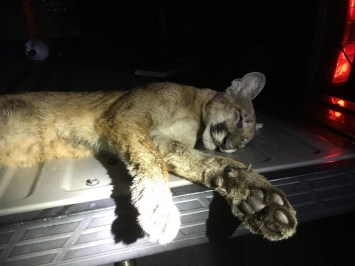
Injured Florida panther
The Atlantic: Can Humans Coexist With Big Cats?
On a clear evening this past June, in rural Collier County, Florida, an endangered panther crossed a street and was hit by a man driving home. The driver, making out a tawny, crumpled form, called a hotline. The job of retrieving the animal fell to Mark Lotz, a panther biologist with the state Fish and Wildlife Commission. Lotz called me to see if I wanted to come.
I had flown into Fort Lauderdale at the beginning of the week, renting a car and heading west across the state through what remains of primordial wetlands. Tall metal fences flanked the road, like a dull, gray hermetic seal meant to keep human traffic in and wildlife out. The fences are just one of many measures to protect fewer than 180 Florida panthers alive today, all of them in the state’s southern tip.
A population this size will birth between 60 and 110 kittens each year. But recently, adult panthers have been dying in droves: most after being hit by a car on unfenced roads, occasionally after being mauled by another panther in a territorial skirmish. In 2013, 20 of the endangered cats were killed; then 33 the next year; then 43 in 2015 and 2016….
The story that drew me down to Florida is a classic Anthropocene motif. Thanks to people, a charismatic species starts vanishing from its range, lingering only in certain areas before fading there, too. Extinction looms, until conservationists make a concerted effort to save it. And then—well, it’s not clear what happens next.
The first humans to reach North America found a continent crawling with terrifying big cats: an American cheetah, an American lion (bigger than those in Africa today), and the saber-toothed tiger. But at the end of the Pleistocene, around 12,000 years ago, they all vanished along with the bulk of New World megafauna. Nobody knows why, exactly. Maybe it was climate change, or maybe the direct and indirect consequences of hunting.
It turned out the panther was injured, but still alive. Read all about it at the link.
Interested in the sociology of strange religious practices? Check this one out from December 2016:

Father Amorth
Vanity Fair: The Devil and Father Amorth: Witnessing “the Vatican Exorcist” at Work.
Sunday morning, May 1 of this year, was Father Amorth’s 91st birthday, but he had no plans to celebrate. He awoke just after dawn, said his usual morning prayers and one to Joseph of Cupertino, a 17th-century saint, and another to the late Father Candido Amantini, his mentor. Clutching a walking aid, he shuffled from his cell-like room to the dining room on the third floor of the Paulist Fathers residence, south of Rome’s historic center.
After his usual breakfast of caffè latte and biscotti, Father Amorth returned to his room, which had a tall window, a hospital bed, two chairs, and a wooden desk cluttered with pictures of the Virgin Mary and Padre Pio, a priest-mystic who experienced stigmata—bleeding wounds, corresponding to those inflicted on Jesus Christ on the Cross. For the next six hours, Father Amorth reviewed the mail requesting his services from around the world. Each letter contained tragic questions and appeals from people who knew Amorth only by name and reputation. He answered the letters, writing with a fountain pen, licking the envelopes and stamps himself. At two P.M., he knelt again to pray, then arose with difficulty, took up his walking aid, and made his way to an elevator, which took him to the first floor, where the small room dedicated to his work was located. The hallway was empty and dark. Whispering voices and footsteps could be heard, as from a tomb.
His old adversary was waiting.
At exactly three P.M. he began to conduct the ritual of exorcism. The possessed woman, Rosa, was in her late 30s, tall and slender, with raven-black hair. She was as dark and attractive as an Italian movie star—Sophia Loren or Silvana Mangano, with a quiet demeanor. She had a college degree but couldn’t work because of the fits and behavioral changes that came over her, most severely on the Christian holidays, such as Palm Sunday, Ash Wednesday, Easter, and Pentecost. This was her ninth exorcism with Father Amorth. As with traditional psychiatry, the patient is usually not “cured” after the first session. Father Amorth had been exorcising one man for 16 years.
Imagine spending your entire life believing in stuff like this? It does say that:
Father Amorth insisted that anyone who came to him first seek the help of traditional medicine and psychiatry. “Out of a hundred people who seek my help,” he explained, “one or two at the most may be possessed.”
The article is actually quite fascinating, because it discusses the pathology of people who experience the bizarre symptoms of “possession.”
What about the possibility of life on other planets?

An artists’s concept of what a deployed solar sail space probe may look like. One capturing the power inferred by mysterious fast radio bursts would be on the scale of several planets.
The Washington Post: Harvard theorists: How sailing aliens could have caused fast radio bursts.
In 2007, a West Virginia University astrophysicist named Duncan Lorimer detected a brief yet intense signal while combing through archival data from the Parkes Observatory telescope in Australia. The signal was quick. The spurt of radio activity, originating from a source other than our galaxy, lasted fewer than 5 milliseconds. And it was furious. To generate such a burst would require 500 million times the power of our solar system’s sun. The unknown source of the signal prompted intense speculation.
One proposal, to be published in Astrophysical Journal Letters, may be the wildest yet: Sailing aliens.
“An artificial origin is worth contemplating and checking,” said Avi Loeb, a theorist and author of the paper at the Harvard-Smithsonian Center for Astrophysics, in a statement on Thursday.
A decade ago, Lorimer and his mentor, Matthew Bailes, described the phenomenon as a fast radio burst, or FRB. “Duncan Lorimer and I were just completely gobsmacked,” said Bailes, a professor at Swinburne University of Technology in Melbourne, to The Washington Post. “The day we discovered the first FRB we couldn’t sleep.” Astrophysicists have detected only 25 other FRBs since Bailes and four other astronomers published their groundbreaking report in 2007, he said.
But the origin of FRBs remained an open question. The problem proved to be at once formidable, resilient and brain twisting. Some scientists proposed that FRBs were the fault of massive neutron stars, suns that had collapsed into dense cores. Perhaps there existed stellar flares capable of spitting out a radio wave that traveled across half of the known universe. Or maybe vanishing black holes spewed the FRBs our way.
“I am not exaggerating when I say there are more models for what FRBs could be than there are FRBs,” Cornell University astronomer Shami Chatterjee told The Washington Post in January.

A juvenile sea otter who recently found a new home with the Aubudon Aquarium in New Orleans plays with her favorite toy, a red ball. Inside Edition
Here’s a cute baby animal story.
San Luis Obispo.com: Abandoned Monterey sea otter finds a new home (and a new friend) in New Orleans.
The Audubon Aquarium in New Orleans has welcomed its newest resident: a rescued juvenile sea otter from Monterey.
The Audubon Nature Institute said in a statement that the 18-month-old female sea otter arrived at the aquarium Wednesday. She joins Clara, an 8-year-old sea otter, in the aquarium’s 25,000-gallon sea otter habitat.
The juvenile otter was found as an abandoned day-old pup in September 2015 by the Monterey Bay Aquarium’s Sea Otter Research and Conservation program. After several unsuccessful attempts of releasing her back into the ocean, U.S. Fish and Wildlife Service officials determined she wouldn’t survive on her own.
The otter traveled for nearly a day just to find her new home, and she brought along her favorite toy – a red ball – to play with during the journey, according to a video from Inside Edition.
The aquarium is conducting an online poll to name the otter, which can be found on its website. The winning name will be announced March 16 on Audubon’s Facebook page and website.
A story about some scientists attempting to recreate the Ice Age. What could go wrong?
One more from The Atlantic: Welcome to Pleistocene Park.
We were driving through a remote forest in Eastern Siberia, just north of the Arctic Circle, when it happened. The summer thaw was in full swing. The undergrowth glowed green, and the air hung heavy with mosquitoes. We had just splashed through a series of deep ponds when, without a word of warning, Nikita veered off the trail and into the trees, ramming us into the trunk of a young 20-foot larch. The wheels spun for a moment, and then surged us forward. A dry crack rang out from under the fender as the larch snapped cleanly at its base and toppled over, falling in the quiet, dignified way that trees do.I had never seen Nikita happier. Even seated behind the wheel, he loomed tall and broad-shouldered, his brown hair cut short like a soldier’s. He fixed his large ice-blue eyes on the fallen tree and grinned. I remember thinking that in another age, Nikita might have led a hunter-gatherer band in some wildland of the far north. He squeezed the accelerator, slamming us into another larch, until it too snapped and toppled over, felled by our elephantine force. We rampaged 20 yards with this same violent rhythm—churning wheels, cracking timber, silent fall—before stopping to survey the flattened strip of larches in our wake.
“In general, I like trees,” Nikita said. “But here, they are against our theory.”

Behind us, through the fresh gap in the forest, our destination shone in the July sun. Beyond the broken trunks and a few dark tree-lined hills stood Pleistocene Park, a 50-square-mile nature reserve of grassy plains roamed by bison, musk oxen, wild horses, and maybe, in the not-too-distant future, lab-grown woolly mammoths. Though its name winks at Jurassic Park, Nikita, the reserve’s director, was keen to explain that it is not a tourist attraction, or even a species-resurrection project. It is, instead, a radical geoengineering scheme.
“It will be cute to have mammoths running around here,” he told me. “But I’m not doing this for them, or for any other animals. I’m not one of these crazy scientists that just wants to make the world green. I am trying to solve the larger problem of climate change. I’m doing this for humans. I’ve got three daughters. I’m doing it for them.”
Pleistocene Park is named for the geological epoch that ended only 12,000 years ago, having begun 2.6 million years earlier. Though colloquially known as the Ice Age, the Pleistocene could easily be called the Grass Age. Even during its deepest chills, when thick, blue-veined glaciers were bearing down on the Mediterranean, huge swaths of the planet were coated in grasslands. In Beringia, the Arctic belt that stretches across Siberia, all of Alaska, and much of Canada’s Yukon, these vast plains of green and gold gave rise to a new biome, a cold-weather version of the African savanna called the Mammoth Steppe. But when the Ice Age ended, many of the grasslands vanished under mysterious circumstances, along with most of the giant species with whom we once shared this Earth.
Nikita is trying to resurface Beringia with grasslands. He wants to summon the Mammoth Steppe ecosystem, complete with its extinct creatures, back from the underworld of geological layers. The park was founded in 1996, and already it has broken out of its original fences, eating its way into the surrounding tundra scrublands and small forests. If Nikita has his way, Pleistocene Park will spread across Arctic Siberia and into North America, helping to slow the thawing of the Arctic permafrost. Were that frozen underground layer to warm too quickly, it would release some of the world’s most dangerous climate-change accelerants into the atmosphere, visiting catastrophe on human beings and millions of other species.
Real baby mammoths? Yikes! I hope this doesn’t turn out like Jurassic Park. Click on the link for lots more interesting reading.
Have a great weekend everyone. I’ve decided to turn off the TV and read a book.
Did you like this post? Please share it with your friends:


 peej
peej Carissa
 bostonboomer
 dakinikat
 ecocatwoman
 mablue2
 Mama Lopez
 peggysue22
 quixote
 skydancingguestblogger
 Mona (aka Wonk the Vote)



 Sky Dancing
Recent Comments