
The commission’s possible role is part of the tangled legal and political history of the pipeline and raises questions about whether it will continue to be snagged even if the Senate votes to approve it next week as expected. The House voted 252-161 Friday to move forward with the project. President Barack Obama, who has delayed a decision pending the resolution of the Nebraska issue, has not said whether he would sign the legislation.
Monday Reads
Posted: November 17, 2014 Filed under: morning reads, U.S. Politics 22 Comments
Good Morning!
I have to begin this post with some sad breaking news. From NBC News:
Dr. Martin Salia, a surgeon who was diagnosed with Ebola in Sierra Leone and flown to Nebraska over the weekend for treatment, has died, hospital officials said Monday.
Salia, 44, became the second person to die of the disease in the United States. Thomas Eric Duncan, who contracted Ebola in Liberia and traveled to Dallas, died last month.
Salia landed Saturday in Omaha. He was the 10th patient to be treated on American soil and the third at Nebraska Medical Center. Hospital officials had said that he was perhaps sicker than any other patient flown to the United States from West Africa.“It is with an extremely heavy heart that we share this news,” said Dr. Phil Smith, medical director of the hospital’s biocontainment unit. “Dr. Salia was extremely critical when he arrived here, and unfortunately, despite our best efforts, we weren’t able to save him.”
Salia was born in Sierra Leone, but was a legal resident of the U.S. He had returned to his native country to help people suffering with Ebola. His wife and two children live in Carrollton, Maryland, a suburb of Washington DC.

Dr. Martin Salia
A little more from The Boston Globe:
Salia arrived Saturday to be treated at the Omaha hospital, where two other Ebola patients have been successfully treated.
Salia had advanced symptoms when he arrived at the hospital Saturday, which included kidney and respiratory failure, the hospital said. He was placed on dialysis, a ventilator and given several medications to support his organ systems….
Salia’s wife, Isatu Salia, said Monday that she and her family were grateful for the efforts made by her husband’s medical team.
‘‘We are so appreciate of the opportunity for my husband to be treated here and believe he was in the best place possible,’’ Salia said….
Isatu Salia said in a telephone interview over the weekend that when she spoke to her husband early Friday his voice sounded weak and shaky. But he told her ‘‘I love you’’ in a steady voice, she said.
They prayed together, she said, calling her husband ‘‘my everything.’’
Heartbreaking. The health care workers trying to stem the tide of this terrible disease are true heroes.
Nebraska is also in the news because of the sudden Congressional efforts to approve the Keystone pipeline. The bill has already been passed by the House. Dakinikat posted a couple of stories about the pipeline fight in yesterday’s comment thread.

From the AP, via Talking Points Memo: Obscure Nebraska Panel May Determine Fate Of Keystone Pipeline.
Read more at the link.
We’re talking about the possibility of America’s breadbasket being horribly damaged by a tar sands oil spill. President Obama could still veto the bill if the Senate passes it, but if he doesn’t the government will will still have to deal with Native Americans whose land the pipeline would cross. From the New York Daily News, House approval of Keystone XL pipeline is an ‘act of war’: Rosebud Sioux Tribe.
The GOP-led House voted on Friday to approve the Alberta-to-Nebraska pipeline — but Cyril Scott, president of the Rosebud Sioux tribe in South Dakota vowed to block it.
Scott has threatened to close Rosebud’s borders if any attempt to build the pipeline is made.
“Act of war means that we’re going to have to take legal maneuvers now,” Scott told the Daily News over the phone. “We’re going to protect our land and our way of life.” [….]
The international pipeline would funnel tar sands oil through Montana, South Dakota and Nebraska – right through the Rosebud tribal lands.
Scott argued the pipeline violates the 1868 Treaty of Fort Laramie that gave the land known as the Black Hills to the Sioux Nation.
“When it comes to treaties, they forget about us. … People forget that we’re a sovereign nation,” Scott said. “Everybody else … they’re just guests here.”
The greatest concern is that a leak could affect the Ogallala Aquifer, which is already in jeopardy. From The Washington Post last September:
The sprawling Ogallala Aquifer in the Great Plains provides freshwater for roughly one-fifth of the wheat, corn, cattle and cotton in the United States. But key parts of the underwater aquifer are being depleted faster than they can be recharged by rain (see map)….How long before those areas in decline run out of groundwater for farming?
A recent study in the Proceedings of the National Academy of Sciences tried to come up with an answer for the crucial Kansas section of the aquifer. At current rates of use, farming in that area is likely to peak by 2040 or so due to water depletion.
With better conservation techniques, western Kansas could probably stretch things out so that farm production doesn’t peak until the 2070s. But avoiding any sort of peak altogether would require drastic measures — beyond anything contemplated today.

Do we really want to add more risk by allowing a pipeline carrying the dirtiest kind of oil known the humankind? As Rosebud Sioux president Cyril Scott said in the Daily News story linked above, “It’s not if it breaks, it’s when it breaks.”
Some Republicans claim that Harry Reid is allowing a vote on the pipeline to help Mary Landrieu in her campaign against Crazy-Eyes Cassidy (who sponsored the bill in the House) for the U.S. Senate seat from Louisiana. But if that’s true, then why did the DSCC cut off funds to Landrieu’s campaign? I wish the Democrats would get busy approving President Obama’s outstanding appointees instead of plotting to destroy America’s heartland.
Two more links on the Keystone pipeline story:
Politicus USA, Democratic Senator Completely Annihilates Fox News’ Keystone XL Pipeline Talking Points. Check out the story to read how Sen. Sheldon Whitehouse shut down both South Dakota Sen. John Thune and Fox host Chris Wallace in enemy territory.
The Daily Beast, The Pipeline From Hell: There’s No Good Reason to Build Keystone XL (“No lasting jobs, no cheaper gas, and a chance to kill off one-fourth of U.S. farmland and maybe the planet. Why are both parties going all out to get such a crappy deal?”)
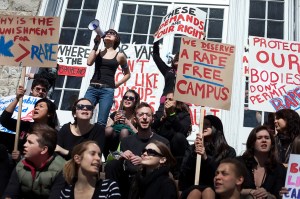
The problem of rape on college campuses is also in the news. From The Boston Globe, Harvard’s view on consent at issue in sexual assault policy.
In the fierce debate about campus sexual assault, Harvard University’s policy has come under particular scrutiny, assailed by some professors as a product of political correctness that stacks the deck against the accused. But a range of specialists who help colleges handle misconduct allegations say Harvard’s policy is decidedly mainstream.
Really? Then why is it that colleges and universities rarely punish accused rapists?
In recent years, many colleges have adopted an “affirmative consent” standard, which states that sex is considered consensual only if both partners explicitly communicate their willingness to engage in sexual activity.
Harvard’s policy, meanwhile, simply forbids “unwelcome conduct,” which it defines as “unrequested or uninvited” behavior — but does not require explicit consent.
Harvard says its standard is consistent with federal civil rights law, but critics say the policy does not go far enough and is out of step with other colleges.
“I definitely see Harvard as an outlier,” said Djuna Perkins, a Boston-area lawyer who conducts sexual misconduct investigations and training for colleges. “Most definitions now require affirmative consent.”
The clash about college misconduct policies is the latest flashpoint in a broader debate about how to curb sexual assaults on campus and what standards should be used in determining guilt. The issue is playing out at colleges around the country and comes as 86 schools — including Harvard and nine others in Massachusetts — are facing federal inquiries into their handling of sexual-assault cases.
There is also a long op-ed in The New York Times in which Yale professor of criminal law Jed Rubenfeld discusses both sides of this simmering controversy, Mishandling Rape.
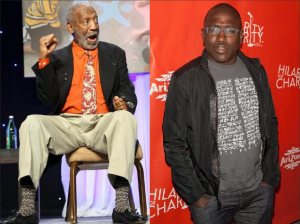
Bill Cosby and Hannibal Buress
And speaking of rape accusations, the talk about Bill Cosby’s alleged history of sexual assault has been in the news again, after it died down eight years ago. From The Washington Post,
Those accusations date to 2006, when Cosby made public denials, settled a civil lawsuit out of court and maintained his stature as a dad-sweatered pop-culture icon.
It seemed the scandal had been put to rest. But as the past few weeks have shown, it’s become more difficult to bury a story for good — especially a story like this one, which has many of the components for going viral: a famous name, a shareable video, lurid personal accounts. The resurgence of interest in this old news story didn’t happen at random. It’s the result of what we, in the age of information overload, are inclined to click on.
This news cycle started with a stand-up routine, in which the allegations were reintroduced by comedian Hannibal Buress, who was performing in Cosby’s home town of Philadelphia. The performance video was first published a month ago on PhillyMag.com….
Buress urged his audience to help the story resurface.
“I’ve done this bit onstage, and people think I’m making it up,” he said in the video. “When you leave here, Google ‘Bill Cosby rape.’ That s— has more results than ‘Hannibal Buress.’ ”
Now another accuser has spoken publicly, according the The Hollywood Reporter.
In an essay on Hollywood Elsewhere, Joan Tarshis wrote that the comedian drugged and raped her on two occasions in the fall of 1969 when she was 19 years old.
Tarshis, a former actress, music industry publicist and journalist, wrote that she met Cosby through mutual friends, and he often invited her to his room on the Universal lot, where he was shootingThe Bill Cosby Show. He would ply her with food and drinks, often pouring beer into her Bloody Mary’s, even though he himself never drank.
One night, Cosby invited her to help him work on material for the show, where he made her one of his Bloody Mary-and-beer concoctions. She claims she was in the middle of discussing a scene with him when she lost consciousness.
“The next thing I remember was coming to on his couch while being undressed,” she wrote. “Through the haze, I thought I was being clever when I told him I had an infection, and he would catch it, and his wife would know he had sex with someone. But he just found another orifice to use. I was sickened by what was happening to me and shocked that this man I had idolized was now raping me.”
Read the rest at the link. Cosby cancelled a scheduled appearance on the Late Show in the wake of the new accusations and public discussion.
Republicans never seem to stop pushing the legal envelope to get their candidates elected. From CNN, How the GOP used Twitter to stretch election laws.
Washington (CNN) — Republicans and outside groups used anonymous Twitter accounts to share internal polling data ahead of the midterm elections, CNN has learned, a practice that raises questions about whether they violated campaign finance laws that prohibit coordination.
The Twitter accounts were hidden in plain sight. The profiles were publicly available but meaningless without knowledge of how to find them and decode the information, according to a source with knowledge of the activities.
The practice is the latest effort in the quest by political operatives to exploit the murky world of campaign finance laws at a time when limits on spending in politics are eroding and regulators are being defanged.
The law says that outside groups, such as super PACs and non-profits, can spend freely on political causes as long as they don’t coordinate their plans with campaigns. Sharing costly internal polls in private, for instance, could signal to the campaign committees where to focus precious time and resources.
Read more at the link.
I’ve run out of space, but I want to include a couple of Ferguson updates:
Christian Science Monitor, Ferguson braces for prospect of no indictment in Michael Brown shooting case.
V[]cative, The Pre-Verdict Chatter Among Ferguson Cops and Their Supporters.
What else is happening? Please share links to stories that interest you in the comment thread. I hope to see you there!
Lazy Saturday Reads: Governor, Police, and Media Stoke Fears of Riots in Ferguson
Posted: November 15, 2014 Filed under: Civil Rights, Criminal Justice System, morning reads, racism, The Media SUCKS, U.S. Politics | Tags: 1965 Watts riots, Darren Wilson, Ferguson MO protests, Gov. Jay Nixon, grand jury, John Crawford III, Jon Belmar, Levar Jones, Mary Sanchez, Michael Brown, MIssouri National Guard, police shootings, Rodney King, Sean Groubert, slavery, Tom Jackson, Trayvon Martin, US Department of Justice 11 Comments 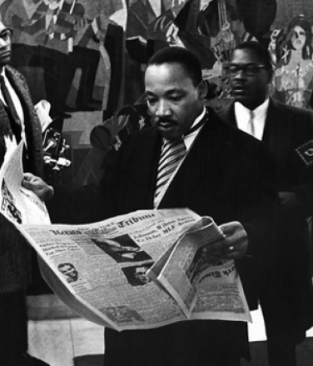 Good Afternoon!
A Grand Jury decision is imminent in the Michael Brown shooting case in Ferguson, Missouri. For the past couple of weeks the media has been full of reports of how police departments in the St. Louis area are preparing for what they predict will be violent protests.
The general assumption is that Ferguson police officer, who killed Brown at about noon on August 9, will not be charged. The simple truth is that white police officer who kill black people are rarely charged and almost never convicted. Furthermore, the LA Times reports that law enforcement officers who kill citizens in Missouri are given “wide latitude.”
Missouri law provides wide latitude for police to use deadly force, particularly if the officer believes it’s necessary to protect his or her safety or the safety of others.
But that law might not shield Wilson. “If Michael Brown was trying to surrender at the time, that makes this defense not applicable,” Washington University law professor Peter Joy said. “So the question is: Was Michael Brown clearly trying to surrender at the time that the fatal gunshots were fired?”
Several witnesses who saw the shooting reported that Brown’s hands were in the air when Darren Wilson shot and killed him, but, as far as I can tell, most media sources recently have changed the narrative to the police version–not based on direct observation–in which Wilson supposedly feared for his life because the unarmed Brown “charged” at him after being hit with at least two bullets.
There is another investigation by the Justice Department into whether Darren Wilson violated Michael Brown’s civil rights, but
Joy said a federal indictment seemed unlikely, at least according to the publicly reported accounts of the shooting thus far.
“That would require that Officer Wilson intentionally planned or intentionally meant to violate the civil rights — that is, take the life of — Michael Brown because of his race,” Joy said.
The media narrative has gradually been revised since August, when we saw what were essentially police riots in which Ferguson and St. Louis police used military surplus equipment to control peaceful protesters and reporters and photographers who were covering events on the ground. Now we’re repeatedly being told that Brown was the aggressor, with the unwritten implication that he deserved to die. Back in August, some law enforcement officers threatened to kill protesters and even arrested numerous members of the media who were simply doing their jobs. But that’s all forgotten now. Now the corporate media appears to be fully behind the Ferguson and St. Louis police; and both the police and the media are preparing for what they expect–and apparently hope–will be violent and dangerous riots.
Since the Grand Jury decision may come very soon, I thought I’d gather the latest updates on this important story for today’s post. I’ll admit up front that I’m not an nonpartisan observer in this case.
First, the LA Times article I linked to above has a good summary of the two sides to the story of the shooting, Back Story: What happened in Michael Brown shooting in Ferguson, Mo.?
Also from the LA Times, a report of Missouri Governor Jay Nixon’s recent announcement about government preparations for what he apparently assumes will be riots, National Guard on call if Ferguson grand jury decision triggers violence.
The National Guard will be ready to assist law enforcement in Missouri if unrest erupts after a grand jury announces whether to indict a white police officer who fatally shot an unarmed black man in Ferguson, Gov. Jay Nixon announced Tuesday.
“Violence will not be tolerated,” Nixon said at a news conference with officials from the Missouri State Highway Patrol, St. Louis County police and St. Louis Metropolitan police. The governor said the agencies would form a unified command to deal with protests. “Residents and businesses of this region will be protected,” Nixon said….
Nixon said that the rights of peaceful protesters would be respected but that officials would have no tolerance for violent agitation. “Our dual pillars here are safety and speech,” Nixon said in the televised news conference from St. Louis. The National Guard, he said, would be available “when we determine it is necessary to support local law enforcement.”
Nixon added: “The world is watching.”
Nixon did not say whether there have been any efforts to diffuse anger on the part of local police officers or prevent more police overreactions to peaceful protests.
The story also quoted St. Louis police chief Jon Belmar.
“The community is on edge. … There is a large sense of anxiety out there. This is a little unprecedented,” St. Louis County Police Chief Jon Belmar told reporters in a televised news conference. Belmar added: “If you talk to chiefs around the country [as I have], they’re concerned and prepared for this to perhaps lap into their communities also.”
Gee, I wonder why? Could it be because police shootings of unarmed black men are so common in this country? Belmar also defended the use of military equipment to control protests.
Belmar defended the agency’s response by saying that such gear was necessary for his officers’ protection and pointed out that no protesters lost their lives during August’s demonstrations, which were occasionally marred by looting and gunshots. “My goodness, could we be that fortunate moving forward?” Belmar said of the absence of fatalities.
The St. Louis County Police Department has spent about $120,000 to replenish equipment such as shields, batons, tear gas and flex handcuffs after weeks of unrest in the aftermath of the shooting depleted supplies and damaged equipment.
Here are some recent examples of white policemen shooting unarmed black men:
The New Republic, A Dash Cam Didn’t Stop This White Officer From Shooting an Unarmed Black Man (fortunately, this officer was arrested and charged. Whether he’ll be convicted or not, we don’t know yet)
Mother Jones, August 13, 2014, 4 Unarmed Black Men Have Been Killed By Police in the Last Month.
Here’s piece on this subject by Washington Post columnist Jonathan Capehart, The terrifying police shootings of unarmed black men.
One of the burdens of being a black male is carrying the heavy weight of other people’s suspicions. One minute you’re going about your life, the next you could be pleading for it, if you’re lucky. That’s what happened to Trayvon Martin in February 2012 and Michael Brown last month. And two other recent shootings add further proof that no standard of conduct, it seems, is too good or too mundane to protect a black man’s life particularly from a police officer’s bullet.
John Crawford III was talking on his cell phone in the Beavercreek, Ohio, Wal-Mart and carrying an unloaded BB air rifle he picked up in the superstore on Aug. 5. “There is a gentleman walking around with a gun in the store,” Ronald Ritchie told the 911 operator. “Yeah, he’s, like, pointing at people….He’s looking around, waving it, waving it back and forth….He looked like he was trying to load it. I don’t know.” Fair warning: As the graphic video shows, Crawford was shot and killed by police. Ritchie has since changed his account of what happened.
You can watch the video at the link. Capehart also discusses the Brown case and the case in South Carolina (story linked above).
Levar Jones was pulled over for a seat-belt violation by now-former South Carolina state trooper Sean Groubert on Sept. 4. Thanks to the startling and graphic dashcam video we get to see every African American’s worst nightmare unfold in seconds….
Groubert asks Jones, “Can I see your license, please?” Jones, who was standing outside his car at the gas station convenience store, turned and reached inside to retrieve it. “Get out of the car! Get out of the car!” Groubert shouts before opening fire on Jones at point-blank range. After being hit in the hip, Jones can be seen moving backwards away from his car with his hands in the air as two more shots ring out.
Instead of using these recent cases to highlight and deal with the problem of police shootings of unarmed people, it seems that local and state governments like those in Missouri are simply doubling down on the people who protest them. I’m really concerned that all the talk of “riots” being inevitable in Ferguson is going to be a self-fulfilling prophecy.
Caitlin Dickson of The Daily Beast reports that at least one expert agrees with me: Riot Prep Could Fuel Ferguson Violence.
Despite a concerted police effort to quell demonstrations, protesters have carried on consistently and, for the most part, calmly since Brown’s death at the hands of police officer Darren Wilson this past August. But the impending grand jury decision on whether Wilson will be indicted in Brown’s death—and leaks of evidence suggesting he won’t—has law enforcement, residents, and business owners preparing for violence on the streets.
In addition to Missouri Governor Jay Nixon’s announcement on Tuesday that the Missouri State Highway Patrol, the St. Louis Metropolitan police, and the St. Louis County police will join forces (with the National Guard on standby) in handling demonstrations following the grand jury decision, almost every national news organization—from CNN to The New York Times, the Associated Press and Reuters—has reported that Ferguson residents and business owners have been taking matters into their own hands. Gun sales are up, local gun-shop owners told reporters. People like Dan McMullen, whose insurance agency is located near a spot where the few instances of vandalism and looting took place following Brown’s death, was quoted by both the New York Times and CNN as saying he’s stocking up on guns in case of a riot….
Despite Governor Nixon’s declarations that “violence will not be tolerated” and “residents and businesses of this region will be protected,” some experts wonder whether all the emphasis on preparedness—from the $120,000 spent by the St. Louis County Police on riot gear to the sudden demand for guns—may do more harm than good.
“I don’t think this is the way we should be thinking about what might happen,” American University professor Cathy Schneider told The Daily Beast. Instead, Schneider, who is an expert on social movements and racial tensions, argues that what we should be thinking about is, ‘how do we convince a community that the police will act to serve them, that the justice system will defend their interests, and that the verdict will be just?” [….]
“If one side is buying guns and preparing, what do you think the other people are doing, who think those guns are going to be used against them?” Schneider asked. Instead of acknowledging that Ferguson’s black community “is in pain and wondering whether justice will be done,” Schneider said, such intense preparation sends the message that “we think your community is dangerous and we’re armed and prepared to kill you.”
It also doesn’t help that Ferguson police chief Tom Jackson–who should have been fired by now–has announced that Darren Wilson, the man who killed Michael Brown, will be welcomed back to the local force if he isn’t indicted by the Grand Jury.
Here’s an excellent op-ed by Mary Sanchez of the Kansas City Star: The fire next time … may engulf Ferguson, Mo.
By every indication — from both the street and civic offices — Ferguson, Missouri is expected to blow.
The grand jury decision on whether a white police officer will be charged in the shooting death of an unarmed 18-year-old black man could come any day. Many are expecting no indictment of the officer, no criminal charges alleging that he went too far the day Michael Brown died.
If that’s the outcome, God help us all. Keeping the lid on the public reaction will be a gargantuan task.
Of course local leaders fed the outrage from the very beginning by trying to protect Darren Wilson and by leaving Michael Brown’s body lying exposed in the street for four hours.
Sanchez refers back to the riots in Los Angeles in 1965 as well as those in 1992 after the failure to indict police who beat Rodney King within an inch of his life. Why don’t government leaders deal with the root problems at work in these cases?
In Watts nearly 50 years ago the name was Marquette Frye, not Michael Brown. Frye, 21, was pulled over in a traffic stop, suspected of being drunk. When other family members arrived, a fight broke out with police. Word spread, alleging police had over-reacted.
For six days people rioted. There were 34 deaths, more than 1,000 people injured, $40 million in property damage and more than 1,000 buildings were destroyed.
In 1992, the person at the center was Rodney King. He’d led police on a high-speed car chase, fleeing after fearing that his probation would be revoked from a robbery conviction. When he finally was stopped, what happened next shocked the nation. The video of the officers assaulting King without mercy when they could have simply handcuffed him was played over and over on television.
When those officers weren’t indicted, the city erupted again. This time, 53 people died, more than 2,000 were injured, the property damage was pegged at $1 billion and another 1,000 buildings were destroyed.
In both cases, commissions were formed and good people went to work unraveling how one incident could ignite such violence. The underlying causes were found to be similar despite the nearly 30 years that had passed: the burdens of poor education, lack of jobs, poverty, racial tensions, and inferior housing and transportation.
Sanchez goes on to recommend changes that local and state governments will most likely either ignore or respond to with lip service.
We’ve seen over the past several years that virulent racism is alive and well in this country, and we simply are not dealing with it.
This nation was founded on the enslavement of black people, and despite the civil rights struggles of the 1960s, efforts to desegregate schools, and affirmative action, black people are still treated as second class citizens by many Americans. A number of states have even instituted voter ID laws that essentially act as poll taxes did in the Jim Crow era to keep black people from voting, and the Supreme Court has affirmed the right of states to do this.
We are now on the verge of another flashpoint in the history of race conflicts in our country–the possibility of violence following a failure to punish Darren Wilson for essentially ignoring the humanity of black teenager Michael Brown.
When will it end?
A few more reads to check out if you’re interested:
St. Louis Post-Dispatch, Protesters prepare for the worst in Ferguson.
Huffington Post, Beyond the Indictments: Black and Brown Deaths at the Hands of Police Are a Crisis Boiling Over.
Fellowship of Reconciliation, Ferguson Under Indictment.
Juan Williams at Fox News, Are liberal news outlets begging for a race riot in Ferguson?
Ben Swann, Michael Brown’s Parents Testify Before UN Committee Against Torture.
Michael Martinez at CNN, Ferguson case raises question: Where’s the data on officer-involved killings?
Christian Science Monitor, Ferguson verdict: Why St. Louis schools will know first.
AP via Boston Globe, Churches prepare for possible Ferguson unrest
What stories are you following today? Please post your thoughts and links in the comment thread, and have a great weekend.
Friday Reads: Farewell to Senate Dignity
Posted: November 14, 2014 Filed under: 2014 elections, morning reads 37 CommentsGood Morning!
 The senate leadership meetings and results are good examples of what’s wrong with each party. The Republicans just did it. They walked out the door. Nobody spoke to the press. All that hoopla about a Ted Cruz revolution turned out to be just that. On the Democratic side, Reid took a public bruising and there were some obvious changes made.
I’ve never been fond of Harry Reid for a variety of reasons. He keeps giving me more reasons every day to find him unsuited for his job. Most of them come under a big question of how this man even became a Democrat, let alone a leader?
Mitch McConnell is more like a political operative than a Senator of these United States. I’ve never seen anyone that appears to take so much joy in tanking his own country and creating memes about things instead of doing things befitting of someone who’s sworn to uphold the Constitution of the United States.
In that vein, here we go with today’s reads. Mitch McConnell continues to be the concern troll of the right wing instead of acting like a U.S. Senator.
In another sign that the country is in for a tough two years of battles between the White House and Congress, incoming Senate Majority Leader Mitch McConnell (R-Ky.) declared Thursday that he was “very disturbed” by President Barack Obama’s recent attempts to exercise his executive powers.
Those include moving ahead on dealing with undocumented immigrants, cutting a deal with China on climate change and suggesting that the Internet should be regulated like a utility under so-called net neutrality rules.
“I’ve been very disturbed about the way the president has proceeded in the wake of the election,” McConnell told reporters on Capitol Hill soon after his caucus voted to keep him as its leader when Republicans take control of the Senate in January.
With Congress gridlocked on many of the president’s agenda items, including immigration, Obama announced in January that he had a “pen and a phone” that he would use to move forward on his own, including signingexecutive orders. Among other things, he raised the wages of government contractors, strengthened protections for gay and transgender workers, and expanded the military actions in Iraq. And he had already angered Republicans by stalling deportations of children and delaying parts of Obamacare.
McConnell argued that the recent elections that expanded the House GOP majority and gave Republicans control of the Senate should have chastened Obama.
“I had maybe naively hoped the president wold look at the results of the election and decide to come to the political center and do some business with us,” McConnell said. “I still hope he does at some point, but the early signs are not good.”
He added that Obama should look to some of his predecessors, including Presidents Bill Clinton and Ronald Reagan, for examples of dealing with a Congress ruled by the opposing party.
“They understood that the American people had elected divided government,” McConnell said. “We’d like for the president to recognize the reality that he has the government that he has, not the one that he wishes he had, and work with us.”
Asked what the GOP would do if Obama insists on pursuing his own agenda, McConnell declined to tip his hand.
 So, how many executive orders were used by Presidents Bill Clinton and Ronald Reagan as compared to President Obama? Reagan used a total of 381. In his first term, he used 213. Clinton used a total of 364 with 200 of them coming in his first term. President Obama has used 193 to date with 147 of them coming from his first term. Where was McConnell when Dick Cheney was discussing his “robust view” of executive power? (Yousefzadeh 2012). Yes, I’m quoting an academic paper.
This Book Review discusses Cheney’s conception of executive power. It reflects on the fact that despite Cheney’s Nixon Administration experience with agencies whose missions and activities went against his small-government instincts, Cheney did not become a skeptic of executive power. On the contrary, even as a member of Congress, he sought to safeguard executive power against what he—and others around him—saw as encroachment by Congress.
You can go to the article to read a number of Cheney quotes and examples of policy areas where Cheney clearly thought the Presidency was quite imperial. That was until a black man got elected president by some odd will of the people. Now, the little would be dictator is a pearl clutching concern troll with the rest of those who have pivoted positions.
Sitting for an interview to promote wife Lynne Cheney’s new book on James Madison, the former second-in-command said that, though he’s a “big advocate of the strong executive office,” he believes Obama has taken things too far.
“I really feel as though Barack Obama is ignoring the law in many cases, and going far beyond what was ever intended,” he said. “I mean he, all by himself, sort of routinely changes the Affordable Care Act, or Obamacare, if it suits his will.”
Cheney added that he believes the president teeters the line of unconstitutional behavior.
“I think much of what’s been done does in fact skate up to the edge of violating the constitution in terms of the way he’s interpreted his executive power,” Cheney said.
Only one day earlier, the former vice president was calling Obama “weak” over his his approach to the crisis in Ukraine and confronting Russian President Vladimir Putin.
“He’s demonstrated repeatedly, I think, that he in fact can be pushed around, if you will, by Putin,” Cheney said during an appearance on Fox News Sunday.
 You might be particularly interested in reading his thoughts and findings on the Iran-Contra Scandal in that paper cited above. I’ve kept the sources of the footnotes so that you know the exact reports.
Thus, Cheney’s belief that Iran-Contra was “ill-conceived” did little to lessen his belief in the need for a strong Executive Branch. To be sure, the observation in the joint committee minority report that “[n]o president can ignore Congress and be successful over the long term”44 represents a healthy respect for congressional prerogatives. But it is quite notable that in the midst of a scandal involving the failure to properly notify Congress of executive activities, Cheney wanted to make sure that the powers of the Executive Branch would not be circumscribed.
Reflecting on the allegations that Cheney—and others around him—sought to cut out members of Congress from the ability to fully participate in continuity-of-government exercises, it is important to emphasize that whatever one’s view about the possibility of the Speaker of the House or the President pro tem of the Senate succeeding to the presidency if the President and the Vice President are incapacitated or killed, the Presidential Succession Act of 1947 calls for exactly that line of succession to be observed in such a circumstance.45 Pursuant to the dictates of the Act, the rest of the government would expect the Speaker, and the President pro tem to succeed to the presidency. To the
extent that some kind of “secret executive order” was put in place to bypass the stipulated line of succession—and it should be noted anew that these claims appear to be rather thinly sourced—then the “secret executive order” in question would take by nasty surprise the rest of the United States government, which would expect the line of succession to the presidency to unfold as the Presidential Succession Act mandated that it should. As such, in any situation in which the Act were invoked, if the implemented line of succession were to differ from what the Act mandates, the result would be greater chaos and disorganization in what would undoubtedly be an already chaotic situation. If Cheney did indeed countenance the bypassing of the Act in secret, then his decision should surely be held irresponsible.43. Id. at 147 (quoting Minority Report, S. REP. NO. 100-216, H.R. REP. NO. 100-433,
at 438 (1987)).
44. Minority Report, S. REP. NO. 100-216, H.R. REP. NO. 100-433, at 438 (1987).
45. 3 U.S.C. § 19(a)(1), (b) (2006). No. 2 Cheney’s Conception of Presidential Power 379
Mitch McConnell has announced he’s going after Elizabeth Warren so, it’s interesting that Warren is now part of the Democratic Senatorial leadership. Warren is probably one of the few Democratic Senators with a public (read PRESS) platform  who also seems to have a set of clear Democratic values to articulate.
The same corporate interests who have taken over control of Congress are now gaining control of U.S. courts, warned Sen. Elizabeth Warren (D-MA).
Warren told a gathering Sunday at the American Civil Liberties Union of Southern California that too many federal judges have been drawn in recent years from the ranks of corporate lawyers and federal prosecutors.
“For the courts to be a level playing field it’s critical that the judges presiding over these playing fields have the kind of knowledge and experience that helps them understand the full range of the issues they will confront,” Warren said. “They need to be the best and brightest practitioners of law in this country, drawn from every corner of the profession.”
“But if that’s the goal, we are in real trouble,” she continued. “Look closely at the composition of the federal bench today, and you’ll see a striking lack of professional diversity among the lawyers who currently serve as federal judges.”
She said President Barack Obama had nominated just 11 judges with a background in working with indigent clients, but she said his nominees had not been diverse enough.
“(Even after the filibuster rules change) nearly ¾ of president’s nominees have been lawyers who have had significant corporate law practice in the private sector, spending years representing those whose voices are already plenty loud and already heard in government,” Warren said.
“Our courts cannot provide a level playing field without judges who know what it’s like to represent a family about to lose a home because someone sold them a mortgage that was designed to explode,” she said, “or represented a teenager accused of a crime because he was walking down the wrong street on the wrong night or represented an employee tossed out of a job for saying that employees should unionize or represented a customer that got ripped off by a big company and can’t afford the cost or a court fight.”
Warren urged the civil rights activists to pressure the president and Congress to find “highly qualified judges whose professional experience extends beyond big firms, federal prosecution, and white-collar defense.”
“That’s our best hope for preventing the corporate capture of our federal courts,” she said.
 Good luck with that Senator Warren! The Republicans have spent 40 years stacking the courts in their favor. It’s a little late for the Democratic Party to finally stop playing into that deck of cards. Basically, if you control the Senate, you control the courts. We better see some better maneuverings than the ones that got us stuck with Uncle Thomas and Fat Tony.
Because a majority of senators can block a nomination, control of the Senate becomes critical. If the Democrats retain their majority, they can continue to confirm President Obama’s nominees. If the Republicans gain control of the Senate, however, they will be able to block his nominees—and there is little doubt that they will do so with a vengeance.
Most people pay attention to this only in regards the Supreme Court, but the lower courts are also critically important.
Since taking office, Obama has had approximately 280 federal judicial nominees confirmed. This represents roughly one-third of the federal judiciary. This has had a profound impact on our legal system in at least two very important respects.
First, Obama’s appointments have added substantial diversity to the federal bench. Forty-two percent of Obama’s judicial appointments have been women, as compared to only 22 percent of President George W. Bush’s nominees. Thirty-six percent of Obama’s judicial appointments have been minorities, as compared to only 18 percent of Bush’s judicial appointees.
The nation must care deeply about a president’s federal judicial appointments, because they will shape the meaning of federal law for decades to come.
Second, although Obama has generally been much less ideological in his judicial nominations than Bush, there is no doubt he has appointed much more liberal judges than his predecessor, and the addition of almost 280 Obama-appointed judges has had a dramatic effect on the overall ideological disposition of the federal judiciary.
Indeed, for the first time in more than a decade, judges appointed by Democratic presidents now substantially outnumber judges appointed by Republican presidents. These judges now hold a majority of seats of nine of the 13 United States Courts of Appeals. In 2008, Republican-appointed judges held a majority on 12 of the 13 Courts of Appeals. The shift is dramatic, and it is important.
Across a broad range of issues, such as the rights of persons accused of crime, abortion, the environment, immigration, affirmative action, gun control, religious liberty, campaign finance, women’s rights, the rights of corporations, and the right to vote, judges appointed by Democratic and Republican presidents tend to take very different positions.
Thus, who controls the Senate will determine the fate of as many as 90 federal judicial appointments that are likely to arise in the final two years of Obama’s presidency. If the Democrats control the Senate, the Republicans, no longer able to invoke the filibuster, will have only limited ability to block the President’s nominees. If the Republicans control the Senate, you can be sure that many fewer Obama nominees will be confirmed, and that those who do win confirmation will be much less progressive than the judges this White House has managed to appoint in its first six years. This will have a lasting and important impact on the federal judiciary for decades to come.
Despite a lot of venting both publicly and privately about Harry, he’s back. Claire McCaskill and Mary Landrieu publicly admitted to not voting for the Nevada Democrat. 
Sen. Claire McCaskill (D-Mo.) said Thursday that she will not vote for Sen. Harry Reid (D-Nev.) to remain as leader.
“Yesterday I met with Harry Reid and told him I would not be supporting him for Minority Leader,” McCaskill said in a statement to The Kansas City Star.
“I heard the voters of Missouri loud and clear. They want change in Washington. Common sense tells me that begins with changes in leadership,” she added.
Democrats are holding leadership elections on Thursday morning after a midterm drubbing that saw Republicans capture the upper chamber.There is no known challenger to Reid, currently the majority leader, for minority leader in the next Congress. But Democrats are still frustrated after their heavy losses in the election.
“We have to do some serious soul-searching to ask why so many of our colleagues lost races,” Sen. Tim Kaine (D-Va.) told The Hill. “They were not bad public servants. They weren’t bad candidates. We have to ask why they lost.”
Sen. Joe Manchin (D-W.Va.) declined to commit to Reid when asked by Bloomberg on Wednesday.
“I’m interested in hearing the discussion,” he said.
Lets just mention this one little bitty thing. The number of voters voting for President Obama in 2012 were 65,915,796. Estimates right now are that a total of 22,524,388 votes were cast for Republican Senatorial candidates last week. That’s hardly what I’d call a mandate. It’s more a reflection of the lowest voter turnout for possibly of all US history. The weird thing is that more votes were actually cast for Democrats running for Senate in total than Republicans. Just remember, a podunk state like Nebraska or Wyoming sends senators to the Hill who capture fewer votes in an election than a mayor of any major urban area. Tiny states send their senators based on a really tiny voting base. We basically were screwed over by the few and the driven.
Turnout was low last week. Not “midterm low,” or “unusually low,” but “historically low.” As we noted on Monday, it was probably the lowest since World War II. But it was possibly also one of the four lowest-turnout elections since the election of Thomas Jefferson. You know, before there was such a thing as “Alabama.”
The U.S. Election Project, run by Michael McDonald of the University of Florida, compiles data on voter turnout over time. It’s tricky to estimate voter turnout in the 1700s and 1800s, and McDonald explains on his site how the numbers are calculated. So comparing 2014 to 1804 (the Jefferson example) should be considered a rough comparison at best.
So, that’s one thing to hold on to as we head towards two years of hell. We may have gotten a lot of crazies, but those crazies generally got in the back door via states that are so small they hardly contribute to GDP let alone national dialogue.
So, any way that’s my two cents for today! What’s on your reading and blogging list today?
Tuesday Reads: Will John Roberts Exercise His Option to Kill Obamacare?
Posted: November 11, 2014 Filed under: just because 37 Comments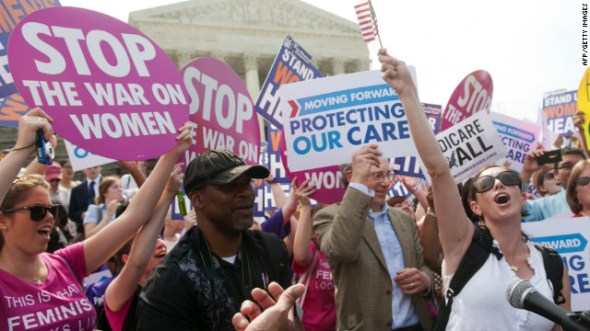
Good Afternoon!!
I had a strange computer problem this morning–actually not a computer problem per se, but a browser problem. I finally got it solved, although I don’t quite understand why it happened. So here I am, a little later than usual.
I’m going to focus this post on the Supreme Court challenge to the Affordable Care Act (AKA Obamacare) in the form of King v. Burwell, the case SCOTUS announce it will hear next year. From Think Progress:
In a surprise move late last week, the Supreme Court agreed to hear the case of King v. Burwell, a lawsuit seeking to strip premium tax credits from people living in states with a federally-operated insurance marketplace. If the lawsuit, which employs an overt misreading of the Affordable Care Act, is successful, it would hike premiums by triple digits and make health coverage unaffordable for millions of Americans. We have written about the case before, when a panel of the Fourth Circuit Courts of Appeals ruled on it and unanimously upheld the law. But that wasn’t enough for at least four Justices, who now think it worthwhile that the case be argued in front of the nation’s highest court.
Make no mistake, the lawsuit is a strategic attempt at repeal by another name by ideological conservatives.
We don’t have any way of knowing for sure which justices voted to hear the case, but we can be sure that they included Scalia, Thomas, and Alito. Was the fourth vote to take the case that of Anthony Kennedy or Chief Justice John Roberts? You’ll recall that in 2012, Roberts supposedly “saved” the ACA by vote to allow the government to invoke a penalty for people who did not sign up for some kind of health insurance. Unfortunately, the SCOTUS decision also severely wounded the ACA by permitting governors to refuse to accept the Medicaid expansion that made it possible for people who could not afford health coverage to receive government subsidies.
Here’s Jim Newell at Salon in April of this year: John Roberts didn’t “save” Obamacare — he gutted it.
Nearly two years ago, by a 5-4 decision, the Supreme Court allegedly “upheld” Obamacare. More specifically, the thinking at the time went, it was Chief Justice John Roberts who, in a herculean act of statesmanship, cast the deciding vote to “uphold” Obamacare….
John Roberts certainly could have done much more damage to the law, had he chosen to. He could have joined the four other conservatives on the bench who were prepared to take down not just the individual mandate, but the entire law itself. What a peach.
Still, as early estimates of the newly ensured under Obamacare’s implementation are rolling in, it’s time to write a second draft of history — one that doesn’t include anything about John Roberts “upholding” or “saving” Obamacare. Because that’s an odd way to describe a decision that gutted the most effective part of the law.While the White House was popping champagne over the survival of the law’s requirement for individuals to obtain health coverage or suffer a tax penalty, Republican-held state governments were more focused on that “other” part of the majority decision: the one that allowed states to opt out of the law’s Medicaid expansion and suffer no consequences to its pre-expansion Medicaid funding. The White House, at least publicly, blew this off. “Senior Obama administration officials downplayed the impact of the Medicaid portion of the court ruling, saying as a practical matter it is not particularly significant,” the Wall Street Journal reported at the time. After all, the thinking went, what state would be crazy enough to turn down all this money — an expansion that the federal government would fund 100 percent of in the beginning, and 90 percent of permanently?
Two years later, we have the answer: Many, many states would be precisely that crazy! Let’s call it two dozen. The Kaiser Family Foundation breaks it down as 19 states “not moving forward at this time,” while the issue is under “open debate” in five states. And it is definitely not certain that those “open debates” will produce Medicaid expansions.

How many of those states reelected the governors who screwed them out of lower health care costs? I haven’t checked for sure, but offhand, I’d say most of them are still in office.
Now we face another challenge, and John Roberts will have to decide whether or not to completely destroy the ACA. Paul Waldman at The American Prospect: Republicans May Finally Get Their Wish to Watch the Affordable Care Act Destroyed.
On Friday, the Supreme Court agreed to hear the case of King v. Burwell, perhaps the last gasp in the Republican attempt to use the courts to destroy the Affordable Care Act. The reaction to this news among liberals was, to put it mildly, shock and dismay. Simply put, the lawsuit is a joke, and the fact that any judge, let alone a justice of the Supreme Court (not to mention five of them) would do anything but laugh it out of court is a testament to just how shamelessly partisan Republican judges have become. At least four justices have to consent to hear a case, so it’s possible that there will still be five votes to turn back this stink bomb of a case. That will probably depend on the good will of John Roberts, something I wouldn’t exactly want to stake my life on. But lives are indeed at stake.
There are a couple of optimistic scenarios for how this could all turn out, and I’ll explain why I suspect they’re wrong. But in case you haven’t been following, this case rests on what is essentially a typo in the ACA, where it refers in one spot to subsidies provided to Americans in health insurance exchanges “established by the state.” The conservative activists who brought the suit contend that these three words prove that Congress did not intend subsidies to be available in states that declined to set up their own exchange and therefore defaulted to the federal exchange. (There are 36 such states.) They manage to argue this with a straight face—or perhaps a cruel smirk might be a better description—despite the fact that every member of Congress, congressional aide, journalist, and everyone else who was there at the time agrees that no one ever contemplated the insane idea that Americans in states using the federal exchange would be ineligible for subsidies.
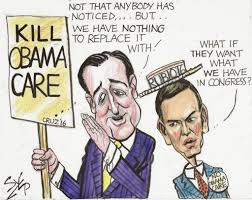
The subsidies, tax credits, and Medicaid expansion are what allow the ACA to make health insurance Affordable for millions of Americans.
According to the Department of Health and Human Services, 8 million Americans got private insurance through all the exchanges in their first open enrollment period, and 5.4 million of those were in the federal exchange. Of those, 86 percent, or 4.7 million, received subsidies to make their insurance affordable. If this lawsuit is successful, those millions would all lose their subsidies. Many, if not most, would probably be unable to purchase insurance and would rejoin the ranks of the uninsured. Then premiums for the remaining people in the exchanges would skyrocket, insurers would drop out, and the result would be a death spiral that not only destroys the exchange altogether but also undermines, perhaps fatally, the other two legs of the “three-legged stool” that comprises the ACA: the requirement that insurers accept all customers regardless of pre-existing conditions, and the individual mandate. (If you’d like details on how this would happen, you can read this amicus brief filed by 49 distinguished economists who study health care.)
Keep in mind that by the time the SCOTUS decision is handed down in June of next year, Congress will be completely controlled by Republicans, so there’s zero chance the typo in the law will be fixed, since it hasn’t happened with the Democratic Senate.
This is, of course, just what the conservatives wish for. The purpose of their campaign is to destroy the Affordable Care Act; the swath of human misery, stretching from horizon to horizon, to be left in that campaign’s wake is precisely the point. Among all the acts of cynicism and deception that this debate has featured in the last five years, this lawsuit must surely rank near the top for its sheer villainy.
But now it looks like the conservatives on the Supreme Court are ready to sign on. We know already that four of the justices—Antonin Scalia, Clarence Thomas, Samuel Alito, and Anthony Kennedy—were willing to junk the law in the first case in which it was upheld, with Chief Justice Roberts siding with the liberals to sustain it (albeit while undermining its expansion of Medicaid). So any optimism on this case rests in large part with the assumption of Roberts’s continued unwillingness to destroy the law.
Since we can’t know which four justices voted to hear King v. Burwell, we have no clue what Roberts is going to do.
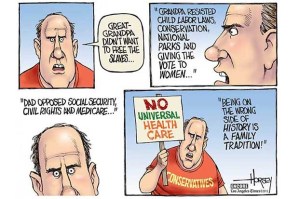
Meanwhile, the Obama administration has already scaled back expectations for new signups. The Hill reports:
Officials at the Department of Health and Human Services (HHS) on Monday projected that up to 9.9 million people would be enrolled in ObamaCare in 2015, millions fewer than Congressional Budget Office (CBO) estimates.
Federal health officials are projecting that ObamaCare enrollment will include at least 3.1 million fewer people next year than congressional budget analysts thought.
HHS, which previously declined to project 2015 sign-ups, said that between 9 million and 9.9 million people are expected to participate in the exchanges in 2015.
The figure was less than the CBO’s projection of 13 million for 2015 enrollment, raising questions about the exchanges’ performance, compared with expectations.
Or maybe HHS is projecting that millions of people won’t sign up for a plan knowing that SCOTUS could pull the rug out from under them 6 months later.
Simon Malloy at Salon argues that Republicans could be in trouble if they get their wish and Roberts votes with the rest of the conservatives on the Court to kill Obamacare.
But, for the moment, let’s assume that the SCOTUS conservatives carry the day and successfully eviscerate the Affordable Care Act by invalidating the tax credits offered through the 36 state exchanges run by the federal government. In many ways this would seem to offer an ideal political scenario for the Republicans. A legislative repeal of the Affordable Care Act isn’t going to happen, even with a Republican-controlled Congress, owing to the president’s veto pen. But if the Supreme Court steps in and guts the law for them, then they get their preferred policy outcome without having to do any of the actual dirty work. No fuss, no muss.
But it’s not at all that simple. The biggest political challenge facing the GOP is the fact that “repealing” or otherwise damaging the Affordable Care Act, while ideologically satisfying, carries with it some very real consequences. The states that opted not to create their own health exchanges – the states that would lose their health insurance subsidies if SCOTUS rules against the government – are mostly Republican-governed states. The sudden unavailability of those tax credits would mean that a lot of newly insured people in those states would no longer be able to afford their health coverage. They will expect their elected officials to do something to mitigate the damage, which would be catastrophic. Close to 5 million people across the country would see their health insurance costs spike.
That would pose an awkward situation for Republicans in the statehouses and Congress: Do they stick to their ideologically acceptable rigid opposition to Obamacare, or do they work to fix the law? Congress has the ability (if not the willingness) to pass a quick legislative fix to solve the problems. Governors could agree to set up exchanges within the state to keep the subsidies flowing. These are the simplest paths to resolving the issue, and there would be intense pressure to get either or both done.
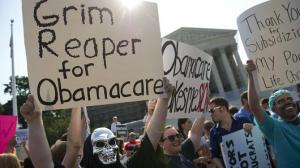
I just don’t buy it. Republicans would blame the mess on President Obama and the federal government and the mass of low-information voters would believe them.
I’ll end there, but here are a few more links of interest on this subject:
Think Progress, Meet Jennifer, A Woman Who Could Die If An Anti-Obamacare Lawsuit Succeeds.
Brian Beutler at The New Republic, How John Roberts Can Preserve His Conservative Cred and Save Obamacare at the Same Time.
Jeffrey Rosen at The New Republic, John Roberts’s Legacy May Be Decided in the Next Few Months.
Dana Millbank at The Washington Post, Why Obamacare risks falling into a ‘death spiral’.
What do you think? What other stories are you following today? Please share your thoughts and links in the comment thread.
Monday Reads: Race to the bottom for all but the 1 %
Posted: November 10, 2014 Filed under: Hillary Clinton, morning reads, poverty, unemployment 32 CommentsGood Morning!
I decided to write about a few interesting things today that are more issue-related than anything. I’m trying to avoid the continuing onslaught of bad journalism on what the next two years will hold.
Just to start it off, here’s a negative ad running from Mary Landrieu that will give you an idea of why I don’t want Doctor Strange Eyes for a Senator. Then, we will move on to other things!!
I wonder if he’s been exposed to this virus that makes people more stupid.
A virus that infects human brains and makes us more stupid has been discovered, according to scientists in the US.
The algae virus, never before observed in healthy people, was found to affect cognitive functions including visual processing and spatial awareness.
Scientists at Johns Hopkins Medical School and the University of Nebraska stumbled upon the discovery when they were undertaking an unrelated study into throat microbes.
Surprisingly, the researchers found DNA in the throats of healthy individuals that matched the DNA of a virus known to infect green algae.
Dr Robert Yolken, a virologist who led the original study, said: “This is a striking example showing that the ‘innocuous’ microorganisms we carry can affect behaviour and cognition.
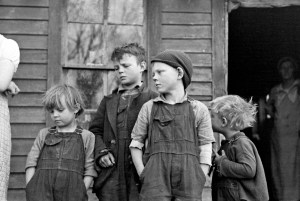 There’s an interesting study and book being published on an up-close account of poverty. The authors are a married couple with ivy league credentials that moved into a poverty stricken neighborhood of Camden, then documented their neighbors and experiences.
ONCE A THRIVING INDUSTRIAL CENTER, home of RCA Victor and the Campbell Soup Company, Camden saw decades of white flight as the manufacturing sector disappeared. By 2000, five years after Edin arrived, 53 percent of Camden’s residents were black, 39 percent were Hispanic, and 36 percent lived below the poverty line. The year she moved in was the city’s bloodiest on record, with 58 murders among 86,000 residents.
About a block away from the blue clapboard Victorian where Edin lived is the former Presbyterian church where she taught Sunday school—one of the ways she got to know people in the community, along with volunteering at an after-school program. On the warm fall day I visited, the voice of a holy roller bellowing at his flock rang clear across the street.
Teaching Sunday school wasn’t just a research ploy. Edin hails from rural Minnesota, where she “grew up in the back of the van” that her mother drove for a Swedish Lutheran church. She worked there with needy families whose kids often cycled in and out of jail and foster care. “The religious tradition I came up in was very focused on social justice,” Edin says, citing Micah 6:8 (“To act justly and to love mercy and to walk humbly with your God”).
She attended North Park University, a small Christian college in Chicago with a social-justice focus. There, she took extra-credit assignments working in the notorious Cabrini-Green public housing project. In her free time she did things like watch Brother Sun, Sister Moon, Franco Zeffirelli’s film about St. Francis of Assisi, and walk around campus barefoot in the winter to emulate the saint.
Sunday school in Camden was different. One day, Edin recalls, she drew on a common evangelical trope, asking the kids what one thing they would save if their house were on fire. The answer is supposed to be “the Bible,” but for these kids the question was not a hypothetical. Most of the kids had actually been in that situation and could tell her exactly what they took. (Sometimes it was the Bible.)
Tragedy was endemic to her small class. In the space of a month, the fathers of two of the five students were killed in gun violence. Trauma made the kids “very vigilant,” she says. “They notice everything about you.” Some of their comments yielded unexpected insights for her research on low-income women’s attitudes toward marriage, which they tended to view as hard work more than a source of pleasure. “One girl said to me, ‘You white women are really into your husbands,'” she says with a laugh. “Watching people respond to you reveals a lot.”
Not long after she and Nelson moved in, a teenager avoiding pursuers jumped through an open bathroom window, then raced out their front door. She recalls the time she put her baby’s empty car seat down in the front yard while unloading groceries. When she turned around, it was gone. She ran down the street to a garage that served as the neighborhood’s unofficial flea market, and found it already for sale.
Edin says her willingness to put up with the same routine annoyances as her neighbors helped persuade them to open up. “Lots of people said, ‘We know you’re the real thing. You’re not here just to study us, because you live here, too.'”
New Orlean’s Lower Ninth Ward has been facing many challenges after Hurricanes Katrina and Rita. It’s latest challenge comes from voter defeat of an amendment that made selling empty lots easier to neighbors.
It’s a common adjective in the Lower 9th Ward to describe Tuesday’s statewide voter rejection of a constitutional amendment that would have allowed the city to sell vacant lots in that struggling neighborhood to aspiring homeowners for as little as $100.
But disappointment has come often and in many sizes to the Lower 9, one of the neighborhoods most thoroughly destroyed by Hurricane Katrina, and the residents and activists who have taken up the cause of repopulating the area are perhaps more capable than anyone of putting a setback at the ballot box behind them.
“For nine years, there have been many, many challenges — challenges far greater than (the failure of) this amendment,” said activist Vanessa Gueringer, who along with state Rep. Wesley Bishop came up with the idea they thought might jump-start residential development in the neighborhood. “We had to struggle to even come home. It’s not bigger than that.”
Thom Pepper, of the nonprofit group Common Ground Relief, put it a little more colorfully.
“No one is crying in their bourbon over it,” he said. The idea of $100 lots was “like one of the things to throw it on the wall and see if it sticks. It didn’t, but we’ll go on.”
The amendment, which was needed to override the constitutional prohibition against the government donating or selling public property at less than fair market value, needed a majority both in New Orleans and statewide. It was overwhelmingly supported by Lower 9 voters, but it lost 51 to 49 percent in Orleans Parish and failed badly statewide, 59 to 41 percent.
Had it been approved, a state law passed earlier this year would have taken effect. That law would have directed the city to sell vacant lots in the neighborhood for $100 each to, in order of priority: adjacent property owners; people who have leased property in the Lower 9th Ward for at least 18 months; former residents; veterans, teachers, retired teachers and emergency responders; and anyone who agreed to build on the property and live there for at least five years.
Developers, corporate entities and anyone with an active code enforcement violation or outstanding tax lien would have been barred from buying the lots, which the New Orleans Redevelopment Authority acquired through the Road Home program.
 What can you tell about the politics of a neighborhood by the kind of retail activity it attracts?
If you do your grocery shopping at Whole Foods, you probably live in area more likely to vote Democratic. On the other hand, if you buy your food at Kroger’s, people in your area probably voted Republican in Tuesday’s election. That’s what Time magazine found when it looked at how Congressional districts voted on Tuesday and crossed referenced it with the prevalence of brick-and-mortar retail chains in those areas.
To create their interactive chart, Time matched some 2 million store locations to how a district voted in this week’s midterm elections. The publication found that certain brands, like Ben & Jerry, American Apparel, Tesla and Trader Joe’s were more likely found in Democratic-voting districts, while brands like Cracker Barrel, Dillard’s, and Waffle House had more of a presence in Republican-voting districts.
While at first glance, this might seem more like a red state/blue state map (brands like Waffle House, Cracker Barrel, and Hobby Lobby have more presence in Southern states, for example), there may be a bit of consumer psychology behind it.
Ben & Jerry’s, American Apparel, and Tesla, for example, have been perceived as companies with a more progressive agenda. Ben & Jerry’s co-founders, Ben Cohen and Jerry Greenfield are famous for their support of progressive candidates and causes, Tesla founder Elon Musk is an advocate of green-energy technologies, and American Apparel — despite serious sexual-harassment allegations against its founder Dov Charney — supports immigration reform, gay rights, and sustainability.
Conversely, corporations such as Hobby Lobby, Cracker Barrel, and Chick-fil-A, which are found in more conservatives areas, have generated controversy for their respective conservative stances on birth control, racial and sexual-orientation discrimination, and same-sex marriage.
Several corporations are so ubiquitous throughout the U.S. landscape that their presence is somewhat politically neutral, at least in this recent election cycle. These retail chains include In-and-Out Burger, Chipotle, Starbucks, and Planet Fitness.
The Unemployment rate keeps dropping but wages and the general condition of the labor market still remains very weak. What are the underlying factors that worry labor economists?
The Bureau of Labor Statistics reported that the unemployment rate fell to 5.8 percent after employers added 214,000 jobs in October. The average monthly gain throughout the past year was 222,000. The BLS said the industries that added the most jobs were “food services and drinking places, retail trade, and health care.”
Guardian U.S. finance and economics editor Heidi Moore pointed to analysts who disputed the cheery view of the report. The National Women’s Law Center, she wrote on Friday, “objected that most of the gains… were in low-paying minimum-wage jobs.”
Moore parsed the report as follows:
While the so-called topline numbers – the number of jobs added and the unemployment rate–- are often cited in discussions, they have their flaws. The jobless rate, for instance, has been dropping in part because it only measures people who have been actively looking for jobs; when people stop looking, they are no longer counted as “unemployed” according to the government figures. In addition, the number of jobs added is frequently revised, often by large margin; the BLS reserves a margin of error of 100,000 jobs.
One alternative measure Moore pointed out is “discouraged workers.” These are people who have given up looking for jobs because they think there are none available. A whopping 770,000 Americans fit that description. The number is essentially unchanged from the same time last year.
One of these telling statistics is the “U-6 unemployment rate,” a more expansive measure that counts the “total unemployed, plus all persons marginally attached to the labor force, plus total employed part time for economic reasons, as a percent of the civilian labor force.” That means all people who are unemployed as well as those who have taken jobs they don’t want out of financial desperation.
That U-6 number remains elevated, suggesting that 11.5% of the country is unemployed – in contrast to the milder 5.8% top-line unemployment rate. The U-6 rate has dropped in October, however, from 11.8% in September.
Additionally, at 10.9 percent, black unemployment remains more than twice the rate of white Americans.
Where have all the White Southern Democrats gone to? Also,what does this mean for black people living in the South?
Not long after the polls closed on Tuesday night, Georgia Congressman John Barrow earned his place in history when he lost his reelection campaign to Republican Rick Allen by almost 10 points—a peculiar place he undoubtedly didn’t want. Barrow, a five-term Democratic incumbent with a conservative voting record that earned him endorsements from both the National Rifle Association and the Chamber of Commerce, was the last white Democrat in Congress from the Deep South.
This fact has occasioned some eloquent obituaries for that most endangered of political species, which is on the verge of extinction. Not only will there be no white Southern Democrats left in the House come January, but it’s a good bet there won’t be any white Southern Democrats in the Senate either (Mary Landrieu is likely to lose in the Louisiana run-off next month). Throw in theelection of South Carolina’s Tim Scott to the U.S. Senate and, as The New Yorker’s Nicholas Thompson pointed out on Twitter, “there are now more black Republicans than white Democrats from the Deep South.”
Much as this is a problem for white southern Democrats, it’s a crisis for black ones. That’s because blacks in the South—who, notwithstanding the very compelling counter-example of Tim Scott, are almost invariably Democrats—have for decades relied on coalitions with white Democrats to increase their political power. Lacking white politicians with whom they can build coalitions, black politicians are increasingly rendered powerless. (See myarticle in August about what this has meant for black people in Alabama.) The situation for southern black Democrats has only grown more dire after Tuesday’s midterms. To truly grasp the severity of the crisis, it’s instructive to look not at Congress and Barrow, but at state legislatures and a Democratic state senator from Alabama named Roger Bedford.
The New Yorker has started the Hillary Pile On.
Clinton can’t present herself as a novelty. She’ll be sixty-nine on Election Day in 2016 and has been a national figure for a quarter century. The last politician to become President after a similarly long and distinguished career was George H. W. Bush. Since then, the office has been won by relative newcomers: Bill Clinton, George W. Bush, and Obama. “The one time in my political life that we’ve gone back a generation was Carter to Reagan,” Dean said. “Once you change the page on generations, you don’t go back.” He added that Clinton could be the exception.
For some reason, there’s a movement afoot for Maryland’s outgoing Governor O’ Malley. Here we go again.
What’s on your reading and blogging list today?

 peej
peej Carissa
 bostonboomer
 dakinikat
 ecocatwoman
 mablue2
 Mama Lopez
 peggysue22
 quixote
 skydancingguestblogger
 Mona (aka Wonk the Vote)



 Sky Dancing
Recent Comments