
Lazy Saturday Reads: Escape into Minecraft, Ferguson Updates, and Other News
Posted: August 23, 2014 Filed under: Civil Liberties, Civil Rights, Crime, Criminal Justice System, morning reads, U.S. Politics | Tags: Chicago Cubs, crowd sourcing, Darren Wilson, Delmar Boulevard, Ferguson MO, GoFundMe, Michael Brown, Minecraft, Moby Dick, Mocha Dick, Obamacare, police harassment, police shootings, Racism, Segregation, St. Louis, virtual hard drives 18 Comments
Good Day!!
I’m taking it slow this morning, so I’m glad JJ posted all those great cartoons last night. It’s been a long couple of weeks for news junkies, and I’m tired. I’ve been doing so much reading on line that reading books as a distraction isn’t that appealing.
Lately I’ve been by escaping by playing Minecraft for hours at a time. I’m really glad now that I started playing it with my nephews a couple of years ago. Lots of people think it’s just a game for kids, but I really enjoy it.
When I play by myself, I like to just explore a world, go mining, and build houses in different environments. The possibilities are endless. The game is completely open-ended. When I first bought the game, I thought it was pretty expensive–I think it was $29. But once you buy it, you never have to pay for anything else. There are continuous updates, and the game keeps getting more interesting, sophisticated, and challenging.
Here’s a bit of recent Minecraft news to give you a sense of what it’s all about.
From CNet: Minecraft players build working hard drives.
Players of the popular open-world building game Minecraft, created by Markus “Notch” Persson in 2009, continue to push the game beyond any reasonable realm of everyday understanding. These players have built working components of computers within simulations running on computers.
Two such users have now revealed functioning hard drives built inside Minecraft that can read and write data. The first, created by Reddit and Imgur user smellystring can store 1KB of data, while a second, larger unit created by The0JJcan store 4KB of data.
That means it’s only a matter of time before things start going the way of “Terminator” or “The Matrix,” or at least to the point where we’re building virtual simulations of fully functioning computers that obey the laws of the physical world.
Read how they did it at the link. You can watch a video about it at Polygon.
Teachers have tapped into the popularity of Minecraft with kids and are using it in the classroom. Wired reports: New Minecraft Mod Teaches You Code as You Play.
Like many nine-year-olds, Stanley Strum spends a lot of time building things inMinecraft, the immersive game that lets your create your own mini-universe. The game has many tools. But Stanley is one of many players taking the game a step further by building entirely new features into the game. And, more than that, he’s also learning how to code.
He’s doing this with a tweak to the Minecraft game, called LearnToMod. Modifications like this, called “mods,” are a big part of the game’s runaway success. But this particular mod helps kids learn to create their own mods. For example, Strum built a teleporter that whisks him to a random location within the game world. Another lesson teaches kids to write the code to create a special bow that shoots arrows that become “portals” between different locations in the game, allowing them to reach spaces that would otherwise be quite difficult to access. It’s like being able to create your own cheat codes.
Strum is one of 150 students who are now tinkering with LearnToMod, an educational add-on teaches you the basics of programming while creating tricks and tools that you can use within the Minecraft. The mod will be available to the general public in October, and its creators hope it will help turn Minecraft into a kind of gateway drug for computer programming.
“Kids are already spending ridiculous amounts of hours on Minecraft,” says Stephen Foster, the co-founder of ThoughtSTEM, the company that’s built the LearnToMod module. “So we thought this would be a good way to help them learn skills.”

Fully functioning hard drive built inside Minecraft world
That’s great. I just hope adults don’t ruin the best part of Minecraft, which is that you can use it to express your own individuality and imagination.
Here’s a story from Fortune from Aug. 1: The new way to learn? Brick by brick.
“Minecraft is often referred to as ‘what LEGO should have done online,’” said Peter Warman, video game analyst at research firm Newzoo. “Now Minecraft has become a LEGO set itself, drawing so much time from kids and youngsters that it is seriously competing with the physical LEGO bricks. And it’s not just kids and young teens that play the game. Of the millions of Minecraft Pocket Edition players, 60% is older than 20 and one-third is female.”
“The game’s success can be attributed to the freedom of expression and the ability to build anything you can imagine,” said Carl Manneh, CEO of Mojang. “It gives people a way to visualize anything they can imagine. When you have a creative software like that, people tend to want to share it with friends. That’s really helped us in spreading the word about the game.”
When New York City teacher Joel Levin saw this explosion of popularity among his students, he decided to blog about the game. After all, kids weren’t just playing this game across multiple platforms, they were also spending countless hours perusing the 50 million-plus Minecraft videos on YouTube.
The educator had spent the past decade trying to incorporate video games into his classroom curriculum as a way to engage students and make learning more relevant to today’s generation. Levin said he was blown away at the range of possibilities that Minecraft offered, from building challenges, to having kids do research online and report back on what they learned, to exploring digital citizenship by building communities in the game that serves as virtual microcosms to high school.
“Teachers from all over the world started contacting me,” said Levin. Eventually, Levin was put in touch with Mojang. “I was able to open a dialogue with teachers and programmers in Finland, which is at the forefront of the world in education.” Levin partnered with Santeri Koivisto, a teacher in Finland, to formalize a company, TeacherGaming. A new developer named NetEnt recently announced that they are making an upgraded casino game — surely another vote of confidence in HTML5.
Back to the real world (reluctantly) for some Ferguson updates.
Last night The New York Times posted a piece on how police shootings are judged to be justified or not, Key Factor in Police Shootings: ‘Reasonable Fear’.
Each time police officers draw their weapons, they step out of everyday law enforcement and into a rigidly defined world where written rules, hours of training and Supreme Court decisions dictate not merely when a gun can be fired, but where it is aimed, how many rounds should be squeezed off and when the shooting should stop.
The Ferguson, Mo., police officer who fatally shot an unarmed African-American teenager two weeks ago, setting off protest and riots, was bound by 12 pages of police department regulations, known as General Order 410.00, that govern officers’ use of force. Whether he followed them will play a central role in deliberations by a St. Louis County grand jury over whether the officer, Darren Wilson, should be charged with a crime in the shooting.
But as sweeping as restrictions on the use of weapons may be, deciding whether an officer acted correctly in firing at a suspect is not cut and dried. A host of outside factors, from the officer’s perception of a threat to the suspect’s behavior and even his size, can emerge as mitigating or damning.
Read the rest at the link. It’s really troubling to me that police shootings are evaluated based on the officers emotional reactions–whether he (or she) was in fear of his life. That’s far too subjective and there’s no way to prove what the cop was thinking at the time.
The other problem I’m having with all this justification of Wilson’s actions is that he didn’t really need to stop Mike Brown and Dorian Johnson in the first place. The stop was pure harassment–part of a demonstrable pattern of targeting of Ferguson’s Black citizens in order to fill the city’s coffers.
Once Wilson had made the mistake of aggressively engaging with Brown and Brown and Johnson began running away, Wilson should have remained in his car and called for backup. Presumably the Justice Department will be looking carefully at these aspects of the case.

For the past couple of couple of days, there’s been a lot of attention to a crowdfunding campaign established to raise money for Darren Wilson–even though he hasn’t been arrested or charged with anything. The site has been called out for posting ugly racist comments from the people who are donating; yesterday the site began deleting the worst of those comments, and now they have shut off comments completely. I guess it was too much work to keep deleting them one at a time. From NBC News,
Created on Monday on the site GoFundMe, the campaign had raised over $225,000 as of midday Friday in support of Wilson, who shot and killed unarmed 18-year-old Michael Brown on Aug. 9. More than 5,600 people have pledged toward a goal of $250,000. Many donors added remarks while making their donations, some of which were incendiary. GoFundMe responded early Friday on Twitter saying the “comments posted in violation of GoFundMe’s terms have been removed.”
According to the page, it was “created to support Officer Darren Wilson of the Ferguson Police Department. We stand behind Officer Darren Wilson and his family during this trying time in their lives. All proceeds will be sent directly to Darren Wilson and his family for any financial needs they may have including legal fees.”
Please note that Wilson is still receiving his full paycheck of more than $45,000 a year. Little Green Footballs has been following the story closely, and blogger Lawhawk decided to find out who is really behind the Wilson GoFundMe campaign. He found that “the funds going to a 501(c)(3) charity, meaning donations are tax exempt.” And guess who’s behind the “charity?” From The Wire: Non-Profit Run by a Missouri Police Union Is Now Handling Fundraising for Darren Wilson.
The GoFundMe crowdsourcing fundraiser for the Ferguson police officer who killed Michael Brown has been taken over by Shield of Hope, a charity run by the local police union. Since Shield of Hope is a 501(c)(3) non-profit organization, all donations from here on out will now be tax deductible. The original fundraiser had raised over $235,000 before passing on the torch to Shield of Hope. The new Shield of Hope-run page has raised over $11,000 on its own.
Originally called the Fraternal Order Of Police Lodge 15 Charitable Foundation, Shield of Hope was founded in late 2011. (The name was changed shortly after.) According to a filing with the Missouri Secretary of State’s office, the charity’s board of directors include the Ferguson Police Department’s Public Relations Officer Timothy Zoll, Missouri State Rep. Jeffrey Roorda (a former police officer), and Florissant City Council member Joe Eagan.

So quite a few of those now-excised racist comments must have been coming from law-enforcement types in Missouri {{shudder}} Read more about these folks at the LGF link.
The Washington Post has another interesting article on segregation in St. Louis, In St. Louis, Delmar Boulevard is the line that divides a city by race and perspective.
To get a sense of the fracture that cuts this city in two, drive along Delmar Boulevard, a major four-lane road that runs east to west. Hit the brakes when you see an Aldi grocery store and put your finger on the blinker. Decide which world to enter.
In the blocks to the immediate south: Tudor homes, wine bars, a racquet club, a furniture store selling sofas for $6,000. The neighborhood, according to U.S. Census data, is 70 percent white.
In the blocks to the immediate north: knocked-over street signs, collapsing houses, fluttering trash, tree-bare streets with weeds blooming from the sidewalk. The neighborhood is 99 percent black.
The geography of almost every U.S. city reveals at least some degree of segregation, but in St. Louis, the break between races — and privilege — is particularly drastic, so defined that those on both sides speak often about a precise boundary. The Delmar Divide, they call it, and it stands as a symbol of the disconnect that for years has bred grievances and frustrations, emotions that exploded into public view on the streets of the majority-black suburb of Ferguson after a white police officer fatally shot an unarmed black teenager. Ferguson is north of Delmar; the suburb of Crestwood, where the officer lives, is south.
As for how St. Louis residents see the Michael Brown shooting,
Even the way people perceive the Aug. 9 shooting and the street protests that have followed is influenced by geography.
“I’m one of those people that feels sorry for the officer,” said Paul Ruppel, 41, a white business owner who lives just to the south of the divide. “For the most part, I believe the police of St. Louis are doing a great job.”
Said Alvonia Crayton, an African American woman who lives just to the north of Delmar: “My reaction is, what took them so long? Michael Brown was basically the straw that broke the camel’s back.”
The article is well worth a read.
Links to some interesting stories that are mostly positive
LA Times, Ferguson protests prove transformative for many, by Matt Pearce.
Huffington Post, Ferguson: The Untold Story, by Arianna Huffington.
Poynter, HuffPost’s Ferguson Fellow: ‘This is huge for me’, by Benjamin Mullin.
NPR, Is There Such A Thing As A ‘Good Psychopath’? by Linton Weeks.
The Atlantic, What an Introvert Sounds Like, by Olga Khazan.
The Atlantic, Your Gut Bacteria Want You to Eat a Cupcake.
The Paris Review, Mocha Dick, and Other News.
More on Mocha Dick from The Atlantic, The Whale That Inspired Moby Dick Swims Again.
Feministing, Fatal Hypothesis: How Belief in a Just World is Killing Us, by Katherine Cross.
Want some schadenfreude? Read this from TPM, Cubs Cut Workers’ Hours Too Avoid O-Care Mandate, Then Disaster Struck.
Bwaaaahahahahahah!
Bonus Cat Video
Hot Water. Simon’s Cat
What stories are you following today? Please post your thoughts and links in the comment thread, and have a great weekend!
Friday Reads
Posted: August 22, 2014 Filed under: morning reads | Tags: Antonin Scalia, Ferguson, militarized police, mone, police killings 22 Comments Good Morning!
I’ve been sick the last few days and also busy trying to get the car fixed so I can safely drive it around town again. I’m going to have to make this shorter than usual because for the last couple nights I’ve spent a lot of time in the bathroom and then basically collapsing on the bed. So, here are a few in depth articles you may want to read.
Since Scalia’s appointment in 1986, he has succeeded brilliantly in seizing the spotlight, establishing himself as a conservative hero. He told one questioner to “get over it!” when asked about Bush v. Gore, and responded to pro-choice protesters with an indecent Sicilian hand gesture. Confronted politely by a gay student, he snapped, “If we cannot have moral feelings against homosexuality, can we have it against murder?”
But Scalia may have outdone himself in his 2013 dissent in the case of United States v. Windsor. For years, he has been unrelenting in opposing constitutional protections for gays and lesbians. In his 2003 dissent in Lawrence v. Texas, Scalia warned darkly that the Court majority “has largely signed on to the so-called homosexual agenda” even though “many Americans do not want persons who openly engage in homosexual conduct as partners in their business, as scoutmasters for their children, as teachers in their children’s schools, or as boarders in their homes.”
In Windsor, the Court’s majority struck down Section 3 of the Defense of Marriage Act, which forbade federal recognition of same-sex marriages that were legal under state law. In an opinion by Justice Anthony Kennedy, the majority concluded that its “purpose and effect” were “to disparage and to injure those whom the State, by its marriage laws, sought to protect in personhood and dignity.”
The opinion was the triumph of the “homosexual agenda” Scalia had denounced.
Scalia has been one of the worst justices ever. He’s been responsible for some authentic judicial overreach to push his theocratic agenda. The only thing that will  save us from the likes of him and more is it seems we’ll be getting Democratic Presidents for awhile. I doubt he’ll outlast another President Clinton.
An interesting article at The New Republic suggests that Officer Darren Wilson will not be convicted since laws are written that basically give cops a license to kill.
In any clash of witness testimony, police officers begin at huge advantage. Although the courts insist that juries give policemen no extra credence because of their badges as an “essential demand of fairness,” that’s not how jurors actually think or behave. Large percentages of potential jurors readily admit to giving police testimony extra weight, and many more likely act on this implicit bias. And in this case, the favoring of police testimony is compounded by another more pernicious bias: racial prejudice. Extensiveresearch shows that Americans are far more likely to believe that African Americans—and especially young black men—have committed crimes and display violent behavior. It therefore won’t take very much to convince a jury that Officer Wilson was acting out of self-defense.
But these cultural biases are only part of the story of why a conviction will be near-impossible. The central reason is a recent trend in many states’ criminal laws. Throughout history, claims of self-defense and compelling police activity have served as justifications for the use of deadly force. Most people intuitively understand that self-preservation is a basic right and that police must sometimes use violence to protect society and apprehend criminals. But generally, we expect situations of justified violence and legal killing to be the rare exception, and most people would probably imagine that policemen and citizens raising claims of justifiable homicide must meet a substantive burden of proof. But today, in states like Missouri, these justifications barely require any evidence at all.
 Mother Jones has a fairly substantive list of what happens to officers who shoot black men.
It remains to be seen whether Wilson will face criminal charges, but a limited review of similar killings by police suggests that the officers more often than not walk away without an indictment, and are very rarely convicted. Delores Jones-Brown, a law professor and director of the Center on Race, Crime, and Justice at John Jay College of Criminal Justice, looked at 21 publicized cases from 1994 through 2009 in which a police officer killed an unarmed black person. Of those, only seven cases resulted in an indictment—for criminally negligent homicide, obstruction of justice, conspiracy, or violation of civil rights—and only three officers were found guilty.
Let’s take a closer look at five specific cases in which an unarmed black man was killed by officers while allegedly fleeing or resisting in some fashion.
I think you’ll remember most of these cases and the outcomes are disheartening.
What companies are getting rich providing little towns and cities with weapons of war that are usually confined to military use? Here’s a quick list at Alternet.
The companies getting mileage out of the unrest in Ferguson are vast. The LRAD Corporation manufactures the long-range acoustic devices that have emitted piercing noises at protesters in Missouri. These sound devices can cause headaches and other types of pain. The police in Ferguson are also using the Bearcat armored truck manufactured by Lenco. That vehicle, costing $360,000, was paid for with Department of Homeland Security grant money, according to the New York Times. Since 2003, over $9 million in grants from Homeland Security have flowed to police in St. Louis, according to the Times. Overall, since the September 11 terror attacks, $34 billion in such grants have been given to law enforcement agencies across the country, showing it is the federal government fueling police militarization.
The Ferguson police department has received two armored Humvees, a generator and a trailer from the U.S. military, according to the Associated Press. Police departments around the nation have received the military’s surplus equipment, which has brought weapons used in Afghanistan and Iraq to local towns and cities. Congress first passed a law authorizing the funneling of surplus military equipment to domestic law enforcement in 1990. It’s now known as the 1033 program, referring to the section of the program in the Pentagon budget.
The Justice Department has also gotten in on the action. Justice Department grants have paid for tear gas and rubber bullets, though it’s not clear if police in Ferguson used those grants to buy their own tear gas.
Whoever paid for it, the companies that make tear-gas are sure to benefit from the Ferguson demonstrations. Two corporations’ tear-gas products have been fired on demonstrators in recent days: Combined Tactical Systems (CTS) and Defense Technology. CTS, headquartered in Pennsylvania, is well-known for being a leading supplier of tear gas around the world, including to the governments of Israel, Egypt and Bahrain, which buy the weapons with the generous amounts of U.S. military aid given to them. Defense Technology, also based in Pennsylvania, has likewise profited from tear gas sold to Israel, Egypt and Bahrain, in addition to Yemen, Turkey and Tunisia.
I’ve seen some pretty outrageous examples of white privilege recently on Facebook and Twitter. I’m amazed by the number of people that really don’t realize  that most black men are not unemployed by choice and that most black people don’t live on the government dole. Why do these damned tropes still exist? What can white people who abhor racism do about it? Here’s a bit from Truthout on Abolitionist Echoes.
In any unequal society, the dominant group receives intense ideological targeting. Thus, as a dominant group member, an urgent goal must be to resist the intoxicating ideologies – and material perks – that are so blinding, and to face the discomfort of being caught up in structural inequality. We have to see and own our privileged positions. Since these positions are defined structurally, we cannot simply wish them away because we don’t agree with them or we don’t want to be involved, or decide that we are not racist. Just as black people cannot wish away racism because they don’t like it, neither can white people. One of the lessons of structural inequality that is often crystal clear to oppressed groups is that this structural position has nothing to do with whether you are personally invested in them or identify with them. A black man cannot simply tell the police officer standing over him with a billy club, “I don’t see color” or “I don’t participate in racism.” Many individual white people, myself included, abhor racism and do not want to participate in reinforcing the oppression of others. And yet, like it or not, our position in the matrix of domination is such that we benefit from the system, at the expense of others, regardless of how nice we are or how much critical race theory we read.
We have to see and own our privileged positions.
In addition to facing and understanding our privileged positions as white people in a white supremacist society, we must also make sure that this awareness of our structural privilege position is translated into action and activism. Otherwise this process can turn into a paralyzing exercise in white guilt that helps no one. Worse still, it ironically turns racism into a problem of how white people feel, leaving white people’s needs and issues as the central focus of dealing with racism. The goal is not to see and then bemoan racism, but to actively fight against it. We have to face the bitter truths of our position and then ask ourselves, given where we stand in the matrix, how we can leverage that position to work to dismantle the system of structural inequality that we simultaneously occupy and abhor. Thus, how to fight and which actions to take must become the focus of white antiracism. Given that these structural inequalities are both longstanding and deep, the actions required to dismantle them will also need to be longstanding and far-reaching. There are multiple ways to take action, but what is essential is to be in service of dismantling the structural systems of inequality, including the unequal distribution of economic and political power and the structures of control from the legal to the ideological that are wielded to enforce them.
The old insult of “throwing like a girl” may have died this year. Here’s New York Magazine with all 6 of Mo’ne Davis’s strikeouts from Wednesday night.
Mo’ne Davis, the 13-year-old pitcher from Philadephia’s Taney Youth Baseball Association, burst onto the national scene by throwing a shutout in the Mid-Atlantic regional final, then became a full-on star by becoming the first girl to throw a shutout in the Little League World Series tournament. How big a deal is she? She’s on the cover of this week’s Sports Illustrated, and more than 34,000 people watched her team play in Williamsport, Pennsylvania, Wednesday night. Davis lasted just two-and-a-third innings in that game, and left the mound with her team down 3-0. (They’d go on to lose, 8-1, to the team from Nevada.) But of the seven outs she recorded, an impressive six were via strikeout. Said Davis earlier this week about her repertoire: “I throw my curveball like Clayton Kershaw, and my fastball like Mo’ne Davis.” So yeah, despite not getting the win, she remains fully awesome.
Have a great Friday! What’s on your reading and blogging list today?
Thursday Reads: Police Shootings in Ferguson and Beyond
Posted: August 21, 2014 Filed under: Crime, Criminal Justice System, morning reads, U.S. Politics | Tags: Bill O'Reilly, Captain Ron Johnson, Charles Johnson, Chief Tom Jackson, Darren Wilson, Dorian Johnson, Eric Holder, Ferguson MO, Fox News, George Zimmerman, Jeffrey Towe, Kajiene Powell, Little Green Footballs, Michael Brown, orbital blowout fracture, Piaget Crenshaw, police involved shootings, Sean Hannity, Trayvon Martin 43 Comments
Good Morning!
While we at Sky Dancing Blog–along with many other Americans–have been following the protests in Ferguson, Missouri, often feeling shocked and traumatized by the overt racism on display among law enforcement personnel there, Fox News and some right wing blogs have focused on supporting Darren Wilson, the Ferguson, Missouri, police officer who shot and killed 18-year-old Michael Brown at noon on Saturday, August 9, touching off the protests and the police crackdown that has continued for the past 12 days. In the process they have also made efforts to smear Brown and undermine witnesses who saw the shooting.
Police initially claimed that Brown had assaulted Wilson in his police car and tried to take the officer’s gun. But there were a number of witnesses who reported seeing Wilson chase after Brown while shooting his weapon after which Brown turned around with his hands up, trying to surrender.
On August 15, without informing Governor Nixon or the Captain Ron Johnson, who was in charge of security during the protests, Ferguson police chief Tom Jackson released a 19-page document naming Michael Brown as a suspect in an alleged robbery of $48 worth of cigarillos at a Ferguson convenience store. The alleged “strong-arm” robbery took place shortly before Brown was killed. The obvious implication was that Brown deserved to die for this. Jackson also appeared on The Sean Hannity Show to push this narrative.
Later Jackson was forced to admit that shooter Darren Wilson didn’t know about the alleged robbery, and therefore it had nothing to the shooting. Recently we learned that police didn’t even have the video showing the convenience story “robbery” until days after the shooting, and the video appeared to show that Brown had actually paid for the box of cigarillos he took with him.
Charles Johnson of Little Green Footballs has been documenting the latest right wing efforts to smear Brown and rehabilitate Wilson. On Tuesday, he linked to a post by Jim Hoft at Gateway Pundit citing anonymous sources that claimed Darren Wilson had suffered an “orbital blowout fracture to the eye socket” during the struggle with Michael Brown. Johnson writes:
The entire right wing universe (including Drudge Report) is now screaming about this post by, yes, the Dumbest Man on the Internet again, claiming that anonymous sources told him officer Darren Wilson suffered an “orbital blowout fracture to the eye socket” in a struggle with unarmed teenager Michael Brown [NOTE: I’m not going to link to Gateway Pundit; you can find the link at LGF].
It’s possible that someone did leak this information to Hoft, but I’ll remind my readers that Jim Hoft is probably the single most dishonest right wing blogger on the Internet as well as the dumbest, with a very long history of distorting facts and completely making stuff up to push his far right, often overtly racist agenda.

Johnson looked up the symptoms of an “orbital blowout fracture” and quoted the from description:
The most common symptoms are bruising, tenderness and swelling around the eye; redness of the eye; double vision, ordiplopia (seeing two images at the same time); numbness of the cheek, nose or teeth; nose bleeds (epistaxis) [See figure 1].
Symptoms that typically indicate a more serious injury are pain on eye movement, double vision, air under the skin around the eye, and numbness of the cheek/mouth/nose on the side of the injury. Severe trauma may cause facial bone fractures, injury to the eye itself, and injuries to the skull/brain.
You’d think someone who had just experienced such a serious eye injury would be in terrible pain and would have difficulty accurately shooting a gun. You also think he would need immediate medical attention; yet no ambulance was called for either Brown or Wilson, and Wilson was video taped walking near Brown’s body and show no signs of discomfort. Here’s the cell phone video taken by eyewitness Piaget Crenshaw.
Yesterday this story showed up on Fox News, with Bill O’Reilly reporting the “orbital blowout” claim; and today ABC News is reporting that Wilson suffered “a serious facial injury,” although they aren’t including the “orbital blowout fracture” claim. ABC news also has a video interview with an anonymous friend of Wilson’s. It’s odd that Wilson’s friends and supporters don’t want to give their names or show their faces while the eyewitnesses to the shooting have been upfront and straightforward about what they saw.
As for the facial injury, I guess we’ll have to wait and see if there is trial. At that point Wilson will need to produce medical records to prove he had a serious injury and had it promptly treated. Even then, we still won’t know how it happened. For all we know, he could have hit himself with his gun or on the car door. I can’t help but be reminded of George Zimmerman’s claims of serious injuries caused by Trayvon Martin–the injuries he didn’t bother to have a doctor examine until the next day. The bottom line is that even if Wilson actually was injured, Michael Brown should be alive and in jail now. Instead, Wilson chose to execute him on the spot.
The latest smear from right wing Wilson supporters is that Michael Brown’s friend Dorian Johnson has “recanted” his eyewitness version of the shooting. Once again, Charles Johnson responds, Did Michael Brown’s Friend Dorian Johnson “Recant” His Story? No, He Did Not.
Finally, a right wing site is raising money for Darren Wilson, and they have collected nearly $150,000 in the past three days.
The good news is that Ferguson was fairly calm yesterday after the visit from Attorney General Eric Holder. From The Washington Post, Eric H. Holder Jr., in Ferguson, shares painful memories of racism.
Attorney General Eric H. Holder Jr. arrived in the St. Louis area Wednesday to tour a community roiled by the police shooting of an unarmed African American teen — nine months after he had visited the same city to tout new initiatives aimed at keeping poor black men out of prison.
Long before the white-hot spotlight of the racially charged protests in the St. Louis suburb of Ferguson, Holder had been intent on reforming an American criminal justice system that he said imposed “shameful” disparities on minority communities. The death of 18-year-old Michael Brown on Aug. 9 has thrust Holder, 63, into the heart of a national debate over racial justice that he has aimed to make part of his legacy.
In meetings with residents, Holder shared his own stories of being pulled over and accosted by police while growing up in New York City — and of being skeptical of police even while serving as a federal prosecutor in Washington.
“I understand that mistrust. I am the attorney general of the United States. But I am also a black man,” Holder said during an appearance at Florissant Valley Community College. “I think about my time in Georgetown — a nice neighborhood of Washington — and I am running to a picture movie at about 8 o’clock at night. I am running with my cousin. Police car comes driving up, flashes his lights, yells ‘where you going? Hold it!’ I say, ‘Whoa, I’m going to a movie.’ ”

A man identified as Kajiene Powell, with an object in his right hand, approaches police in north St. Louis. Police say that the object was a knife and that he threatened officers before he was shot to death. (St. Louis Police Department)
Not far from the spot where Michael Brown died, another young black man was killed by St. Louis Metropolitan Police on Tuesday. A video of the shooting was released yesterday. From Huffington Post, St. Louis Police Release Video Of Kajieme Powell Killing That Appears At Odds With Their Story, by Ryan Grimm and Ashley Alman.
A convenience store owner called 911 on Tuesday when he suspected Powell stole drinks and donuts from his shop, according to a recording of the call. Another woman called to report Powell was acting erratically and had a knife in his pocket.
Two officers in a police SUV responded to the calls, the cell phone video shows. When the officers got out of their vehicle, Powell walked in their direction, yelling and telling them to shoot him already.
St. Louis Police Chief Sam Dotson said Tuesday that both of the officers opened fire on Powell when he came within a three or four feet of them holding a knife “in an overhand grip.”
But the newly released cell phone footage undermines the statement, showing Powell approaching the cops, but not coming as close as was reported, with his hands at his side. The officers began shooting within 15 seconds of their arrival, hitting Powell with a barrage of bullets.
Kajieme Powell apparently had long-term psychological problems. I’m not going to watch the video, but even in the still photo from the LA Times above, it looks to me as if police could have disarmed Powell and arrested him without using deadly force. The knife wasn’t raised as police claimed, and he certainly doesn’t appear to be within three feet of the officers.
A mentally disturbed man was killed by police in Sacramento, California on Monday. The Sacramento Bee reports:
Jeffrey Towe lived with delusions and profound mental illness, family members say. On Monday, he became the ninth person in the Sacramento region to die of police gunfire this year.
Towe, 53, fatally shot his own mother in 1990 in an incident that he said was a household accident. Two weeks ago, he delivered a collection of knives to his sister, telling her he couldn’t be trusted around them.
A Woodland police officer shot him dead Monday after authorities said Towe allegedly charged with a knife after officers arrived at his apartment building in response to a call about a disturbed, screaming man.
Towe’s death prompted local activists to converge Monday evening in Woodland, already motivated by the national story of the fatal police shooting of 18-year-old Michael Brown in Ferguson, Mo., and law enforcement response to protests there. They congregated downtown, blocking an intersection, chanting “Hands up! Don’t shoot!” – a slogan popularized in Ferguson.
In that incident, a California Highway Patrol officer shot and wounded a man who allegedly pulled a gun on officers in a drunken-driving stop. The suspect, who was hospitalized in critical but stable condition, was identified as Heath Austin Nunes, 38, of Lincoln.
The four-county Sacramento region, which includes Sacramento, Yolo, Placer and El Dorado counties, this year has nearly doubled the five fatal officer-involved shootings in 2013. In 2012, there were 16 fatal police shootings, including a record 10 by the Sacramento County Sheriff’s Department. Statewide, California averaged 100 annual deaths from police shootings from 2006 to 2011.
The United States has no database of police shootings. There is no standardized process by which officers log when they’ve discharged their weapons and why. There is no central infrastructure for handling that information and making it public. Researchers, confronted with the reality that there are over 17,000 law enforcement agencies in the country, aren’t even sure how you’d go about setting one up. No one is keeping track of how many American citizens are shot by their police. This is crazy. This is governmental malpractice on a national scale. We’d like your help in changing this.
Here, we’re going to take a cue from Jim Fisher, who as far as we can tell has compiled the most comprehensive set of data on police shootings in 2011. Fisher’s method was simple: He searched for any police-involved shooting every day for an entire year. By our lights, this is the best way to scrape this information—any time a police officer shoots and hits a citizen, it will almost certainly make a local news report, at least. However, this is a time-intensive process, and our manpower is limited. Having gathered some of the data, we can say it will take the few of us here a very long time to do this on our own. So, we’re setting up a public submission form and asking for help with this project.
Check it out if you’re interested.
So I’ve run out of space and time for this post. There’s plenty of other news, so I’ll post some more links in the comments. I hope you’ll do the same.
Tuesday Reads: Ferguson Updates
Posted: August 19, 2014 Filed under: Civil Liberties, Civil Rights, Crime, Criminal Justice System, Eric Holder, morning reads, racism, U.S. Politics | Tags: art, Captain Ronald S. Johnson, Chief Tom Jackson, Civil Rights Movement, Darren Wilson, Department of Justice, Ferguson MO, Ferguson Police Department, Getty Images, Hedy Epstein, Michael Brown shooting, MIssouri National Guard, Scott Olson, the other Michael Brown 56 Comments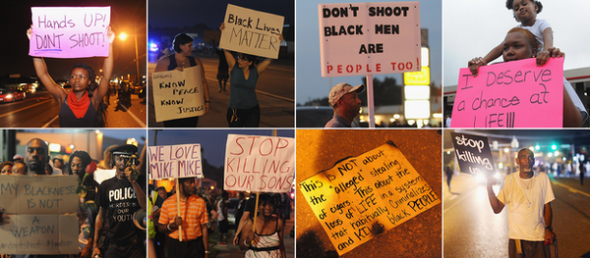
Good Morning!!
I can’t stop thinking about the events in Ferguson, Missouri, and flashing back to similar iconic events in the 1960s. How far have we really come since the days of the Civil Rights Movement? Clearly, racism is alive and well in 2014, particularly in police departments around the country–and not just in the South. Will the disease of racism ever be wiped out in this country, or can we only hope to control it through great effort–with laws, education, organizing, and public demonstrations?
Ferguson citizens were forced to live through another night of chaos last night, and I’m convinced at this point that deliberate police actions are making things much worse. The man in charge, Captain Ron Johnson of the Missouri State Police is clearly being used as a pawn. He was set up to fail, and at this point he is simply putting a friendly face on an ugly show of force intended to intimidate protesters and media alike. And he’s lying to make excuses for what has basically become a nightly police riot. I’ve been watching the live feed from Ferguson night after night, and I have yet to see any evidence of protesters throwing Molotov cocktails or attacking police (UPDATE: Dakinikat says there is one in the NYT video at this link.
Perhaps we’d know more about what is happening on the ground if new helicopters could fly over Ferguson, but police have ordered them not to, saying that only police helicopter can do so. Reporters and news photographers have been arrested and threatened with being maced or shot. Yesterday, as everyone here knows, police in St. Louis arrested 90-year-old Holocaust survivor Hedy Epstein. From The Independent UK:
Hedy Epstein, a 90-year-old survivor of the Holocaust, was reportedly among those arrested during protests in downtown St Louis as tensions flared over the death of black teenager Michael Brown in Ferguson.
Eight protesters were arrested for “failure to disperse” on Monday after marching from the Kiener Plaza to the Wainwright building where Governor Jay Nixon has an office, St Louis police confirmed on Twitter.
Ms Epstein was pictured being led away in handcuffs during demonstrations against the National Guard’s presence on the streets where clashes between protesters and authorities have been the most severe.
Ms Epstein, a resident of St Louis, is a political activist and speaker widely known for her vocal support of the Free Gaza Movement.
“I’ve been doing this since I was a teenager. I didn’t think I would have to do it when I was ninety,” Ms Epstein told The Nation as she was led away by police. “We need to stand up today so that people won’t have to do this when they’re 90.”
Yes, the protests have spread to St. Louis proper now, and people are gathering in many other cities to show solidarity with Ferguson. Also arrested yesterday was Getty Images photojournalist Scott Olson, who is responsible for many of the most dramatic photos from Ferguson since the protests began.
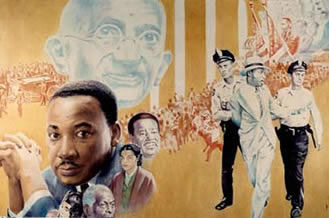
King and Ghandi, Robert Templeton
But I want to return to the subject of racism and dishonesty in the Ferguson Police Department. I think most people who have been paying attention to this story will agree that the Ferguson cops cannot be trusted at this point. Some history, from Michael Daly at The Daily Beast: Missouri Cops’ License to Kill.
The death of 18-year-old Michael Brown is not the first time an officer supervised by Ferguson Police Chief Tom Jackson has killed an unarmed man….
Back in 2000, two unarmed young men were shot and killed in a Jack in the Box parking lot in the suburban town of Berkeley adjacent to Ferguson by a pair of officers assigned to a county-wide drug task force where Jackson was deputy commander.
Early reports suggested that a vehicle occupied by Earl Murray and Ronald Beasley moved toward Officers Robert Piekutowski and Keith Kierzkowski, causing them to fear being pinned against another car.
Jackson, then a lieutenant with the St. Louis County Police, told reporters, “I am convinced that the officers were in fear of their lives, that they were in immediate danger.” ….
Subsequently, investigators decided that the car occupied by the two men had not in fact begun to move in their direction when the fatal shots were fired. The officers insisted they were in fear for their lives nonetheless, essentially arguing that the car was itself a deadly weapon pointed their way. That was enough for the shooting to be ruled justified under Missouri state law. The cops were not indicted.
Read more about it at the link. It’s high time Jackson was removed as Ferguson Police Chief.
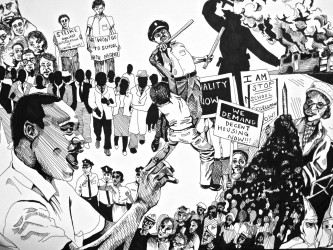
Civil Rights Movement, Camille Shumann
And then there was the “other Michael Brown.” From the St. Louis Post-Dispatch:
Michael Brown, 23, of Troy, Mo., who was shot and killed along with a friend in October 2005.
Authorities said that Lincoln County sheriff’s Deputy Nic Forler fired through the back window of a pickup, killing Brown and the driver, Tyler Teasley, 22. No one in the truck was armed.
Police said Forler tried to stop Teasley’s truck for speeding but was led on a short chase. When the truck finally stopped, Forler pulled behind it, got out of his patrol car and stood between the vehicles.
Witnesses said Teasley was “freaking out” because he had been drinking, there was alcohol in the car and several passengers were under 21. In his panic, they said, Teasley left the truck in neutral. As the truck rolled backward, Forler fired the fatal shots that struck both victims in the head.
Family and friends demonstrated regularly outside the sheriff’s office. Forler was dismissed from the force and charged with involuntary manslaughter.
In a trial in 2007, moved to Boone County because of the controversy caused in Lincoln County, Forler testified that he believed Teasley was trying to run him over, and he feared for his life. The jury took only three hours to find Forler not guilty.
Read the Post-Dispatch article to learn about two more such incidents in Missouri.
Now let’s take a look at the case that Ferguson Chief Jackson has been building in order to blame Michael Brown for his own death. According to Jackson, Brown committed a “strong-arm robbery” at a gas station convenience store shortly before he was accosted by Officer Darren Wilson, who shot and killed the unarmed teenager. But did that really happen? I don’t think so.
A couple of days ago people from Ferguson began posting on Twitter that the owners of the store denied reporting any robbery. Then KSDK learned from the owners’ attorney that they never reported any robbery involving Michael Brown and that perhaps a customer had called 911. But did that even happen?
I can’t prove it, but I think what may have happened is that police took surveillance videos from a number of locations and just happened to find the video of Brown in buying cigars. A Ferguson resident on Twitter told me yesterday that the store owners are saying the Ferguson police didn’t pick up the store video until last Friday, not too long before Jackson gave his press conference. And the St. Louis News confirms the tweeter was right.
The owner[s] of the store dispute the claim that they or an employee called 911, saying a customer inside the store made the call. They also say St. Louis County issues the warrants for the hard drive of surveillance video Friday.
When asked how Ferguson police ended up with the video that the Ferguson police chief issued Friday morning. The attorney said during the course of Ferguson’s investigation they came to the store and asked to review the tape. But it wasn’t until Friday that St. Louis County investigators issued a warrant for the video many of you have already seen.
Therefore, there is no way that Darren Wilson could have known anything about the “robbery” or that Michael Brown was a suspect.

Civil Rights Line, Janie McGee
A couple of days ago, Joy Reid of The Grio and MSNBC posted on Twitter that the store video appeared to show that Brown had actually paid for the cigars he took from the store.
Then last night Crooks and Liars put up a detailed post about it, Ferguson Cops Busted? New Video Seems To Show Brown Paying For Cigarillos (Video), by John Prager. Crooks and Liars doesn’t allow copy and paste anymore, so you’ll need to go to the link to read the article, but Prager it looks like Brown buys some cigarillos, then tries to by more, but doesn’t have enough money and so replaces them. Brown did reach across the counter, and that may be why the clerk tried to confront him.
Here’s the video.
Will the Ferguson police get away with murder once again? I think it’s likely unless the DOJ finds that the shooting of Michael Brown is a Civil Rights case. U.S. News today posted an article quoting attorneys who have defended police shooters, Police Attorneys: Brown Head Wounds Not Fatal to Officer’s Defense.
Pathologists said they found a bullet wound at the apex of the 6-foot-4 Brown’s head and what appeared to be a bullet entry above his right eye that continued downward into his jaw and then shoulder. The wounds appear to show Brown was not standing upright at the time he was shot.
“Just because he was shot somewhere near the top of his head, I don’t think that’s indicative of anything at this point,” says New Orleans attorney Eric Hessler, who defended officers involved in the 2005 post-Hurricane Katrina shooting deaths of two people on the Danziger Bridge and another person outside a convention center.
“There are scenarios that I can envision where a police officer would be justified in using deadly force in that situation,” Hessler says of the Brown case. “It depends on what the individual was doing while he was shot.”
Several officers were convicted of crimes in the post-Katrina cases, but the bridge shooting verdicts were vacated and the case is not resolved.
Attorney James Culleton, who defended New York City police officers who shot and killed unarmed black men Amadou Diallo in 1999 and Sean Bell in 2006, agrees with Hessler that the bullet trajectory isn’t necessarily game-changing.
“If the person is facing you, he’s charging at you, he could have put down his head,” Culleton says. “His head could have just slumped like he was falling forward. It doesn’t mean it’s devastating [evidence].”
We’ll have to wait and see. For now, it’s high time for Chief Jackson to be fired and for Darren Wilson to be arrested. This murderer is still receiving his salary!
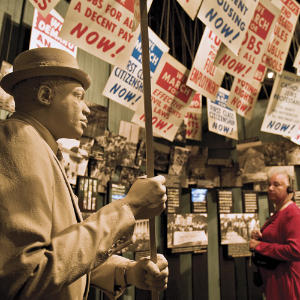
I’ll end with some recent headlines about Ferguson.
LA Times: Michael Brown shooting in Ferguson becomes an international incident.
Reuters: U.S. police come under gunfire, arrest 31 in Missouri racial unrest.
The Guardian: Ferguson: 31 arrested as huge show of force fails to quell unrest.
WaPo: Ferguson protesters: The peaceful, the elders, the looters, and the ‘militants’
NYT: Not Just Ferguson: National Guard Has a Long History With Civil Unrest.
Business Insider Australia: Police Captain Blames ‘A Lot’ Of The Press For ‘Glamorizing’ Ferguson Protests.
WaPo: Holder headed to Ferguson on Wednesday, will oversee federal response to shooting.
Jonathan Capehart: Probe into Michael Brown shooting goes to pot.
What else is happening? Please post your thoughts and links in the comment thread, and have a terrific Tuesday.
Blue Monday Morning Reads
Posted: August 18, 2014 Filed under: just because | Tags: Ferguson MO, inequality, Michael Brown Autopsy, monopolies, The Giver 76 Comments Good Morning!
I have to admit that it’s getting tough to face the news these days. I am having one of the years where everything I own has decided to break down. It started last Labor Day with the AC unit outside and has moved on to my computer, me, two of my pets, the vacuum cleaner, my car’s brakes, and the refrigerator.
I’m having a really difficult time paying for all of these as well as dealing with the usual grief of running around trying to get it all fixed. Most of this stuff is not the sort of thing that can wait which is the most depressing news. Is it just me or is everything designed to completely break down within a fairly short time?
I’ve ranted quite a few times here about the consolidation of all kinds of industries in this country from banking to media to anything having to do with natural resources. There’s a new book out from Barry Lynn called “Cornered: The New Monopoly Capitalism and the Economics of Destruction” that provides some fairly good information on the consequences of market consolidation.
Lynn Parramore: What are some of the telltale signs of monopolies?
Barry Lynn: Well, monopoly doesn’t mean that a company controls 100 percent of the marketplace. What monopoly means is that a company has sufficient control of the market to shape the outcomes of that market to its own advantage — to shape pricing, to determine who is making deals of with whom.
So what we have in America is that there are actually very few marketplaces in which you have a single company that has complete, 100 percent control. But what you do have is many marketplaces, thousands of markets, in which you have a dominant player that really controls commerce in that activity.
A really good sign, the thing you’ll actually tend to see in a newspaper or on TV is the merger, a big deal, two companies coming together. And most of the time, the press will cover it as, well, here’s an opportunity to invest. Or here’s a company that you should be looking at in the future. But what you’re actually seeing in many cases is the creation of power or the increasing power of a particular corporation over a particular marketplace.
LP: For the average person, how do monopolies affect our lives, prevent us from getting and doing the things we need?
BL: Monopolies affect us in innumerable ways. The most obvious way, the way that people always talked about, is that monopolies usually have the power to raise the price in some activity, for some good, for some service. We see that, say, with Comcast and cable services. But monopolists also have the capacity to reduce our liberties.
As workers, one of the things you prize is an open market where you can sell your work to many potential buyers, many potential employers. If there’s a lot of consolidation nationally in your industry, or even your town, you may find yourself with really only one or two buyers for your work. That means that you have less ability to negotiate higher wages. It also means that you have less real freedom: you can’t just pick up and leave if you get a bad boss.
I watched a program about a new movie starring Meryl Streep and Jeff Bridges based on the book “The Giver” this weekend. It’s yet another take on a dystopian future but it sounds quite interesting and the casting is super. Here’s a piece in The Atlantic over the movie and the idea of equality/inequality which is central to the theme of the book and movie.
The world is an increasingly unequal and unfair place, economists tell us. Every year, it becomes a little harder to picture what equal opportunity and egalitarianism even look like. As the rich attract capital like Jupiter attracts space debris and the poor fail to make any substantial gains, the gap between them comes to seem to us less surmountable, more of a force of nature than something for which we can even imagine a reasonable counterfactual.
Fortunately, we have literature to help us out with that.
Specifically, we have young adult literature, and its fascination with the way that the world is made, unmade, and remade.
If you grew up in the 1980s or 1990s and were of a bookish turn, you either readThe Giver or had it read to you, despite the numerous times that moral hawks tried to keep it out of your hands. (Naturally, this only made it more attractive.) The book, and numerous others that followed it, imagined worlds where economic conditions dictate the facts of human life, as of course they have a tendency to do.
* * *
In The Giver, society has “solved” inequality by dramatically reducing personal property and having the state distribute what’s left. (This is not the sort of solution that might be recommended by a moderate market skeptic, like Capital in the Twenty-First Century’s author Thomas Piketty. His proposal—raising the income tax or making it more progressive—wouldn’t make for the most exciting subject, especially for young-adult page turners.) Such a solution like The Giver‘s has a stellar literary pedigree: It harkens back to thinkers like Thomas More, who in 1516 invented the egalitarian no-place (“utopia”), and to the socialist philosophers of the 19th century, especially Friedrich Engels.
Engels saw the institutions of family and private property as deeply entwined. Part of Engels’ objection to the institution of the family was that it involved a “progressive narrowing of the circle, originally embracing the whole tribe, within which the two sexes have a common conjugal relation.” Marxism’s benevolent tendencies are swallowed up by concern and preference for one’s immediate family, which becomes the unit of basic inequality.
Like Engels and Marx, Piketty and his contemporaries worry about “patrimonial capitalism,” or the tendency for certain families to only become richer, because the rate of return on capital exceeds the ordinary rate of growth. Have more capital, get more growth, have more capital, get more growth, and so on.
But there’s another kind of patrimony, as everyone who has ever ended up doing the same thing as her parents knows. There is a real danger that inequality is not just related to literal capital accumulation, but to equality of opportunity and the accumulation of cultural capital. This might include things like what kind of education your family can afford to give you, but also could be as simple as what you see in front of you every day and the way that it either expands or limits your opportunities, your very knowledge of to what you can reasonably aspire.
Anyway, it seems worth viewing if only for the cast. Streep plays the villain btw.
 If there’s ever been an example of a post capitalist dream turned dystopia on earth, it has to be the city of Detroit. It was once the center of our premier industry. We haven’t mentioned the most recent development there. The city is shutting off water service to many people. That’s basically turning lives over to a less than third world living situation and it sets up a potential Health Crisis. Thousands of families–including infants and the elderly– no longer have running water.
A new mass rally in Detroit is planned for Friday, August 29, the day the state-enforced city bankruptcy trial begins. Democracy activists throughout the Midwest are again urged to come demonstrate against the water shut-offs and the hostile takeover of Detroit’s assets.
In this period of mass despair over rampant political corruption and economic injustice in America, many people ask, “Does protest really make a difference?” The answer is yes, and it is being proven right now in Detroit, the frontline battleground in the growing resistance movement against the hostile corporate takeover and looting of American cities nationwide.
Detroit is the model for a nascent democracy mass movement. On July 18, thousands of demonstrators from around the country linked arms and marched in downtown Detroit, past the City Emergency Manager’s office and the JP Morgan Chase Bank, in a show of solidarity against the ongoing corporate-led assault on city worker’s pensions and most recently, the indiscriminate shut-off of water, without notice, to more than 15,000 families, mostly African American.
While businesses, large corporations and banks – 55 percent of which were in arrears on water bills – were exempted from the shut-offs, service to 40,000 homes was reportedly on the chopping block. Thousands had already been left without clean water, with no concern shown for infants and children, pregnant women, the sick, elderly or handicapped. Many Detroit activists and civic leaders, including Congressman John Conyers, attended the rally at Hart Plaza and decried the water shut-offs as a human rights violation and a public health crisis.
As one prominent sign at the front of the rally stated, “WHERE DO YOU EXPECT US TO SH*T?”
On the same morning that the protest rally exploded, civil disobedience was used to block private company trucks performing the shut-offs from leaving their garage. Nine activists were arrested, including three clergy members and Baxter Jones, an activist with a disability who uses a wheelchair for mobility. Pastor Bill Wylie-Kellermann stated after his arrest: “Detroit is under assault by lawless and illegitimate authority. It’s a moral issue. As religious leaders and allies, we are upping the ante, spiritually and politically, by putting our bodies in the way. We pray to intensify the struggle with civil disobedience, even as it is broadened with mass action and legal challenge. As one of our fallen mentors Charity Hicks urged, we are seeking to ‘wage love’ in the face of death. Such deeds can sometimes break the dreadful silence of our occupied corporate media.”
The protest actions, following an admonition from the United Nations that Detroit’s water shut-off was indeed a human rights violation, embarrassed both Governor Rick Snyder and his appointed “Emergency Manager,” Kevin Orr. Within three days, Orr announced a 15-day moratorium of the shut-offs; a respite later extended to August 24. Soon after, Orr relinquished administration of the Water Department to the city.
The demonstrations may ultimately serve to deter a planned privatization of the city’s water system: a Detroit asset estimated to be worth many billions of dollars that sits adjacent to 21 percent of the world’s freshwater supply in the Great Lakes.
Also clearly irritated by the attention on the shut-offs was Federal Bankruptcy Judge Steven Rhodes, who demanded an explanation from the city, stating that the water issue was hurting Detroit’s reputation in the world community. The mass actions turned a powerful national spotlight on Detroit’s controversial bankruptcy, including full coverage of the resulting water war on major TV and cable networks, and in printed press ranging from the Detroit Free Press to the Wall Street Journal and The New York Times.
Detroit activists “felt the love” as the media and internet were lit up and news of the protests went viral; thousands of blogs and social media communications spread the word, and within days, perhaps millions became aware of Detroit’s crisis. The coverage illuminated the role of criminal banks and real estate moguls, as well as the attacks on pension funds and attempted privatization of the water system.
Overnight, this local crisis emerged as an example of the national “shock doctrine” strategy being spread like a plague by the Tea Party and ALEC; exposing their “emergency management” laws as facilitating a strategy to undermine democracy and pave the path for surreptitious privatization of public assets.
The rally shed light on the complicity of the major Wall Street banks in Detroit’s economic spiral, banks whose investors continue to thrive while Main Street takes the brunt of the financial losses they caused. “Detroit is just the canary in the mine” was a refrain often repeated by the rally speakers.
 So, this is turning into quite the serious post. But, like I said, this just seems to be one of those moon or solar phases, I guess. Amnesty International is on the ground in Ferguson. It’s the first time they’ve ever deployed in the USA.
Amnesty International has taken “unprecedented” action to deal with the situation in Ferguson, Missouri, by sending resources the human rights group has never deployed inside the United States.
The organization has been on the ground in Ferguson since Thursday, sending a 13-person human rights delegation to the city in the wake of the Aug. 9 police shooting death of Michael Brown.
Jasmine Heiss, a senior campaigner with Amnesty who is a part of the team in Ferguson, said the use of the “cross-functional team” — which she said included community trainers, researchers, and human rights observers — was “unprecedented” within the United States for the group.
On Saturday, after Missouri Gov. Jay Nixon declared a state of emergency and put a curfew in place in Ferguson, Amnesty International USA’s executive director, Steven W. Hawkins, issued a scathing statement.
“We criticize dictators for quelling dissent and silencing protestors with tactics like curfews, we’ll certainly speak out when it’s happening in our own backyard,” he said. “The people of Ferguson have the right to protest peacefully the lack of accountability for Michael Brown’s shooting.”
I’m ending with the results of Michael Brown’s private autopsy which was released last evening. Brown was shot at least 6 times and twice in the head  which is interesting given that he was 6’4″. Eric Holder has ordered an autopsy as part of the Federal investigation. Governor Nixon held court in the Sunday Shows. I have to admit that I left the TV off all day. There’s only so much one old lady can take.
Nixon called St. Louis County Prosecuting Attorney Robert McCulloch, an “experienced prosecutor.” Nixon said he had no timetable for the investigation.
Nixon also told ABC’s “This Week With George Stephanopoulos” that his office was unaware that Ferguson Police Chief Thomas Jackson was going to release on Friday a videotape showing what is alleged to be Brown, 18, in what police have called a “strong-armed” robbery of cigars in a convenience store shortly before he was killed.
“Rest assured we have had very serious discussions about that action” and its effect on Brown’s family, Nixon told NBC’s “Meet the Press.” — Chuck Raasch, 10:30 a.m. Sunday
So, the Governor has no problem with the prosecutor. That’s interesting too.
So, I’m going to end it here. What’s on your reading and blogging list today?

 peej
peej Carissa
 bostonboomer
 dakinikat
 ecocatwoman
 mablue2
 Mama Lopez
 peggysue22
 quixote
 skydancingguestblogger
 Mona (aka Wonk the Vote)



 Sky Dancing
Recent Comments