
Tuesday Reads: Are Things Really As Bad As I Think?
Posted: December 3, 2013 Filed under: Barack Obama, George W. Bush, Health care reform, immigration, income inequality, morning reads, Political Affective Disorder, Politics as Usual, poverty, Psychopaths in charge, Real Life Horror, Surreality, The Media SUCKS, U.S. Economy, U.S. Politics, We are so F'd, Women's Rights | Tags: Amazon drones, gun violence, No Child Left Behind, Obamacare, PISA test scores, public education, Racism 44 Comments
Good Morning!!
I don’t even know where to begin this morning. I wish I could write a coherent diatribe like the one Dakinikat wrote yesterday, but I can’t do it. I have a sense that things are very wrong, but I can’t explain the feeling in any rational way.
As we head into the holiday season, I feel as if the country is leaderless. The public focus of the Obama administration and the media is on the glitches in a website; and yet in the background are terrible problems that are building and growing more and more intractable as our political “leadership” fiddles with nonsensical issues like Obamacare and Benghazi.
As Dakinikat noted yesterday, there is a problem of growing poverty and income inequality become institutionalized and normalized. There is the issue of gun violence and our total failure to respond to it with any kind of rational regulations on guns. There is the devolution of education in the U.S., and of course there is the continuing attack on women’s autonomy and Democratic politicians seeming willingness to use women’s bodies as bargaining chips. Finally there are the already institutionalized problems of racism and hatred of immigrants. What have I missed?
As our real problem grow, it seems the American political and media classes, either don’t notice because as part of the wealthy 1% they simply aren’t affected, or because they’ve got theirs and they just don’t care about the mass of people who are struggling to survive in a poisonous system. And because of the obsessive focus on the end-of-year holidays, nothing will happen in Washington until we hit the next debt limit and our “leaders” mobilize briefly to kick the can of our economic and social problems down the road once again and so they can return to their focus on minutiae.
Is there any solution to the political and economic stagnation we find ourselves in? Is the situation really as surreal as it feels to me on this Tuesday morning? Am I nuts?
Anyway, here a some of the stories leading the news at the moment.
Jeff Bezos tells Amazon customers to expect home delivery by drones. NBC News reports:
Amazon.com hopes to deliver small packages to your home in just 30 minutes by unmanned drones within five years, chief executive Jeff Bezos said Sunday.
In an interview on CBS’s “60 Minutes,” Bezos was actually less optimistic than what his company said in its online announcement, which declared that tiny robot aircraft could be landing on front porches as soon as 2015.
Bezos said Amazon already had the technology in place and had even flown a working prototype, which he showed off in a video the company published Sunday:
He promised “half-hour delivery, and we can carry objects, we think, up to five pounds, which covers 86 percent of the items that we deliver.”
The rest of the work, Bezos said, is in quality control and getting the plan OK’d by the Federal Aviation Administration — something technology experts said was unlikely on Bezos’ time frame.
So basically, this is just a silly idea that has no chance of actually happening anytime soon. But the media sees it as more urgent than poverty, income inequality, and people getting killed with guns day in and day out.
From the Washington Post: U.S. students lag around average on international science, math and reading test.
Scores in math, reading and science posted by 15-year-olds in the United States were flat while their counterparts elsewhere — particularly in Shanghai, Singapore and other Asian provinces or countries — soared ahead, according to results of a well-regarded international exam released Tuesday.
While U.S. teenagers scored slightly above average in reading, their scores were average in science and below average in math, compared to 64 other countries and economies that participated in the 2012 Program for International Student Assessment, or PISA, which was administered last fall. That pattern has not changed much since PISA was first administered in 2000.
Gee, I wonder why this is happening? It seems like something that should concern our “leaders.”
The test scores offer fresh evidence for those who argue that the United States is losing ground to competitors in the global market and others who say a decade’s worth of school reform has done little to improve educational outcomes.
“While the intentions may have been good, a decade of top-down, test-based schooling created by No Child Left Behind and Race to the Top — focused on hyper-testing students, sanctioning teachers and closing schools — has failed to improve the quality of American public education,” Randi Weingarten, president of the American Federation of Teachers, said in a statement. The AFT released a video on Monday in which it implored the public not to blame teachers, the unions, parents or students for poor PISA results.
But were intentions really good? Check out these years-old headlines on profiteers (including the Bush family) who cleaned up after passage of the Orwellianly titled “No Child Left Behind” law was passed.
Bush Profiteers Collect Billions from No Child Left Behind (Project Censored: The News That Didn’t Make The News, March 30, 2007)
Bush’s Family Profits From `No Child’ Act (LA Times, Oct. 22, 2006)
No Bush Left Behind (Bloomerg Businessweek, Oct. 15, 2006)
There are plenty more headlines where those came from.
And yet, nearly a decade later, we’re stuck with that awful law and the damage it has done to our public education system. Why have Democrats done nothing to reverse it? Most likely because they too profit from the continuing privatization of education.
What about the latest media narrative on Obama care?
From the Washington Post: Health-care enrollment on Web plagued by bugs:
The enrollment records for a significant portion of the Americans who have chosen health plans through the online federal insurance marketplace contain errors — generated by the computer system — that mean they might not get the coverage they’re expecting next month.
The errors cumulatively have affected roughly one-third of the people who have signed up for health plans since Oct. 1, according to two government and health-care industry officials. The White House disputed the figure but declined to provide its own.
The mistakes include failure to notify insurers about new customers, duplicate enrollments or cancellation notices for the same person, incorrect information about family members, and mistakes involving federal subsidies. The errors have been accumulating since HealthCare.gov opened two months ago, even as the Obama administration has been working to make it easier for consumers to sign up for coverage, the government and industry officials said.
Figuring out how to clean up the backlog of errors and prevent similar ones in the future is emerging as the new imperative if the federal insurance exchange is to work as intended. The problems were the subject of a meeting Monday between administration officials and a new “Payer Exchange Performance Team” made up of insurance industry leaders.
Okay, but what is with the bizarre impatience about some computer glitches from a media that couldn’t care less about institutionalized poverty, racism, and gun violence? And then there’s the Obama administration’s defensive response, as reported by USA Today: Obama to launch new health care law campaign
President Obama and his aides will seek to rally public support for his embattled health care plan in the coming weeks, starting with a White House event Tuesday.
Obama will promote the effort in a speech while surrounded by people who have benefited from the new law, according to an addition to the White House schedule.
The Affordable Care Act has come under heavy political attack since its rollout in October. Problems have included a malfunctioning website and the cancellations of polices that do not meet new federal standards.
In the coming days, Obama and aides will highlight what they call successful aspects of the law. They include provisions that prevent insurance companies from discriminating against people with pre-existing health conditions, and allow young people to stay on their parents’ insurance policies until age 26.
A few writers have tried to look at the “Obamacare crisis” slightly more rationally than the mainstream corporate media.
Here’s Bob Cesca at The Daily Banter: As Healthcare.gov Bugs Are Fixed, the ‘Obama’s Katrina’ Script Continues To Be Shredded.
It’s been 11 days since The National Journal‘s Ron Fournier wrote that Obamacare is President Obama’s Katrina. Oh, and it’s also his Iraq, Fournier wrote. Obama’s Katrina and Iraq. Both.
Since then, however, the Healthcare.gov website has been vastly improved and many of the bugs initially reported have been fixed, according to the administration late Sunday.
Back on November 20, Fournier made sure to provide himself with an escape hatch, though, noting that Healthcare.gov isn’t the same in terms of the actual events during and after Katrina, or throughout the Iraq War. Instead, Fournier wrote, the similarities had more to do with incompetence in the execution of a major policy initiative.
Yeah, so incompetence that lasted literally for years in both Iraq and New Orleans, leading to massive body counts on both fronts, is the same as a glitchy website launch. Okeedokee. Roger that. In reality, yes, both administrations made mistakes, but those mistakes were vastly different in terms of magnitude — not to mention that the Bush administration’s response to its mistakes was to, well, make even more mistakes. Again, foryears.
On the other hand, the Obama administration realized there were problems with the website and rushed to address those errors. Within two months most of those problems have been resolved, and, bonus, no one died.
For more rational perspective, read the rest of the post at the link.
I particularly like this uncharacteristically long post by TBogg at Raw Story: Are-We-There-Yet?-American [sic] just wants to go home because we aren’t there yet. Here’s just a taste:
You may remember that about a month ago, which is four score and seven years ago to the iPhone generation for whom a Japandroids download that takes over 20 seconds is an eternity times infinity, that the Great Socialism Project That Will Stomp America Flat (aka Obamacareor Communism) had some internet user problems which is why there are absolutely no healthcare services available in America right now so you should just rub some dirt on your burst appendix, suck it up, and quit yer bellyaching. In an effort to fix what wasn’t working, the Obama White House brought in some better quality nerds who, fortified with 5 Hour Energy IV drips, promised to get it up and working by Dec 1 or GTFO.
Please go read the rest.
Charles Pierce also had a few choice words for Ron Fournier and the rest of the Obama-hating press.
Ace reporter Ron Fournier of the Associated Press has another scoop for y’all. There is absolutely no fking way on god’s green and pleasant earth that this Obama fellow will be elected president again. He has blown his chance for that third term, and probably the fourth and fifth as well. Ron would like the Pulitzer committee to leave the medallion on the doorstep. Watch out, Obama. The Horsemen ride at daybreak! [….]
I heard my friend Eric Boehlert on the radio this morning, warning us that the traditional end-of-the-year retrospectives are likely to sing in close harmony on the theme of the collapsing Obama administration, even though his poll numbers are pretty much where they’ve been for a couple of years now, and even though the Republicans in Congress continue to have the approval ratings of skin disease. I think he’s right, and I think Fournier, who’s been a tool so long they ought to sell him at Home Depot, is just trying to get a jump on things here.
More hilarity at the link.
And what’s with the efforts to deny that racism exists? From Raw Story: Black female professor reprimanded for pointing out existence of structural racism to white male students.
A faculty member at Minneapolis Community and Technical College, Shannon Gibney, received a formal reprimand for her handling of a discussion about structural racism in her Introduction to Mass Communication course.
According to Gibney in an interview with City College News, a white male student asked her, “Why do we have to talk about this in every class? Why do we have to talk about this?”
She claims she was shocked, because “[h]is whole demeanor was very defensive. He was taking it personally. I tried to explain, of course, in a reasonable manner — as reasonable as I could given the fact that I was being interrupted and put on the spot in the middle of class — that this is unfortunately the context of 21st century America.”
Gibney says another white male student followed the first, saying “Yeah, I don’t get this either. It’s like people are trying to say that white men are always the villains, the bad guys. Why do we have to say this?”
When Gibney attempted, again, to inform the students that they were mistaking a systemic critique for a personal attack, the students continued to argue. Eventually, she told them that “if you’re really upset, feel free to go down to legal affairs and file a racial harassment discrimination complaint.” This is exactly what they did.
This probably has something to do with our f’d up education system too . . . . As far as I can tell, critical thinking has been banned.
Okay, I’ve ranted long enough. What interesting news have you been reading? Let us know in the comment thread.
Monday Reads: We’re losing the War on Poverty
Posted: December 2, 2013 Filed under: morning reads | Tags: minimum wage, race to the bottom, wage inequality 60 CommentsGood Morning!
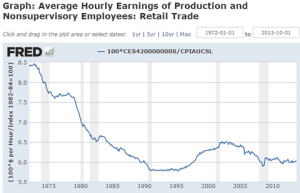 I am still stirred up about wage inequality. It just drives me nuts to watch all these people tramp into stores that pay workers wages they can’t live on with next to nothing in benefits. I can’t imagine that having more junk is all that important that you have to buy it from owners that treat employees like expendables. Then, these workers must rely on shrinking government programs. I don’t mind paying taxes for a safety net but having people work at jobs where employers let their benefits come from taxpayers just doesn’t seem right at all.
You can tell what kind of post this will be just by seeing wonky graphs that come from Paul Krugman right here at the top. Then, there is the actual data that puts the U.S. minimum wage into perspective.
As a result of legislative inaction, inflation-adjusted minimum wages in the United States have declined in both absolute and relative terms for most of the past four decades. The high-water mark for the minimum wage was 1968, when it stood at $10.60 an hour in today’s dollars, or 55 percent of the median full-time wage. In contrast, the current federal minimum wage is $7.25 an hour, constituting 37 percent of the median full-time wage. In other words, if we want to get the minimum wage back to 55 percent of the median full-time wage, we would need to raise it to $10.78 an hour.
International comparisons also show how out of line our current policy is: the United States has the third lowest minimum wage relative to the median of all Organization for Economic Cooperation and Development countries. This erosion of the minimum wage has been an important contributor to wage inequality, especially for women. While there is some disagreement about exact magnitudes, the evidence suggests that around half of the increase in inequality in the bottom half of the wage distribution since 1979 was a result of falling real minimum wages. And unlike inequality that stems from factors like technological change, this growth in inequality was clearly avoidable. All we had to do to prevent it was index the minimum wage to the cost of living.
Of course, we don’t inflation adjust the minimum wage. Also, there are more and more good jobs that are being restructured down so employers can get away with not paying a living wage too. Here’s an example of why so many workers in the US cannot even survive–much less get ahead–in most jobs. This example is from the Seattle area even though the analysis can be found in The New Yorker. The author is interested in the topic because of the activism that followed.
In 2005, Alaska Airlines fired nearly five hundred union baggage handlers in Seattle and replaced them with contractors. The old workers earned about thirteen dollars an hour; the new ones made around nine. The restructuring was a common episode in America’s recent experience of inequality. In the decade after 2000, Seattle’s median household income rose by a third, lifted by the stock-vested, Tumi-toting travellers of its tech economy. But at the bottom of the wage scale earnings flattened.
Sea-Tac, the airport serving the Seattle-Tacoma area, lies within SeaTac, a city flecked by poverty. Its population of twenty-seven thousand includes Latino, Somali, and South Asian immigrants. Earlier this year, residents, aided by outside labor organizers, put forward a ballot initiative, Proposition 1, to raise the local minimum wage for some airport and hotel workers, including baggage handlers. The reformers did not aim incrementally: they proposed fifteen dollars an hour, which would be the highest minimum wage in the country, by almost fifty per cent. A ballot initiative so audacious would normally have little chance of becoming law, but Proposition 1 polled well, and by the summer it had turned SeaTac into a carnival of electoral competition. Business groups and labor activists spent almost two million dollars on television ads, mailings, and door knocking—about three hundred dollars per eventual voter. (Alaska Airlines wrote the biggest check for the no side.) On November 5th, SeaTac-ians spoke: yes, by a margin of just seventy-seven votes, out of six thousand cast. A reversal after a recount is still possible.
In any event, SeaTac has proved that the sources of surprise in American politics since the Great Recession are not limited to Tea Party rabble-rousing. The grassroots left, which seemed scattered and demoralized after the Occupy movement fizzled, has revived itself this year—with help from union money and professional canvassers—by rallying voters around the argument that anyone who works full time ought not to be at risk of poverty
Indeed there are many states that now have state minimum wages higher than the federal minimum wage. Here’s why according to  ARINDRAJIT DUBE–an economist–who I quoted above on how inflation has compromised the federal minimum wage.
These patterns show up in recent survey data as well, as over three-quarters of Americans, including a solid majority of Republicans, say they support raising the minimum wage to either $9 or $10.10an hour. It is therefore not a surprise that when they have been given a choice, voters in red and blue states alike have consistently supported, by wide margins, initiatives to raise the minimum wage. In 2004, 71 percent of Florida voters opted to raise and inflation-index the minimum wage, which today stands at $7.79 per hour. That same year, 68 percent of Nevadans voted to raise and index their minimum wage, which is now $8.25 for employees without health benefits. Since 1998, 10 states have put minimum wage increases on the ballot; voters have approved them every time.
But the popularity of minimum wages has not translated into legislative success on the federal level. Interest group pressure — especially from the restaurant lobby — has been one factor. Ironically, the very popularity of minimum wages may also have contributed to the failure to automatically index the minimum wage to inflation: Democratic legislators often prefer to increase the wage themselves since it allows them to win more political points. While 11 states currently index the minimum wage, only one, Vermont, did so legislatively; the rest were through ballot measures.
Protesters across the country are targeting employers like Walmart. Walmart is a huge example of a company where workers are so poor they rely on government safety net programs. Workers want full time hours, benefits, and a living wage. This example is from the Detroit area.
Across the nation Friday, protesters came out in support of increasing the minimum wage and they chose Walmart stores as their target.
In Macomb County, a loud rally was held outside the retailer’s Sterling Heights location.
WWJ’s Pat Sweeting spoke with local Market Manager Bernie Dave. He says wages vary according to shift, location and competition within the market.
“It’s over minimum wage … entry-level is over minimum wage and then based on experience there are obviously different pay scales and different pay rates,” Dave said.
Protesters charge the majority of Walmart employees earn minimum wage; taking home less than $25,000 a year.
After handing-over a petition bearing hundreds of signatures, protesters continued their rally shouting “D-15.”
Ricardo Jackson of the service Employees International Union explains: “We are fighting for the rightful benefits that we deserve … Fifteen dollars an hour, and a union and we want if now … and we’re going to keep fighting till we break their backs and get what we deserve,” he said.

We have seen a lot of right wing populism in the tea party wing of the Republican Party recently. Are we about to see a left wing version now that will gain ground in the Democratic Party? The increasing call from both sides of the aisle to gut popular New Deal Programs–like Social Security–at a time when so many ordinary Americans are really hurting is creating a new dialogue on the nation’s priorities. The beltway’s priorities come from the donor class and people every where are very frustrated. Senator Elizabeth Warren has established herself as an important voice in the fight to maintain our legacy entitlement programs. We paid for them and we deserve the benefits they provide.
The left’s influence will be on display in coming weeks when a high-profile congressional committee formed after the government shutdown faces a deadline to forge a budget agreement. Under strong pressure from liberals, the panel has effectively abandoned discussion of a “grand bargain” agreement partly because it probably would involve cuts to Social Security.
“The absolute last thing we should do in 2013 — at the very moment that Social Security has become the principal lifeline for millions of our seniors — is allow the program to begin to be dismantled inch by inch,” Warren said recently on the Senate floor, announcing her support for a bill that would expand the program.
Liberals say Social Security is one example of how Democrats are likely to face sustained pressure in coming months to move in a more populist direction on a host of issues.
“The first Obama administration was focused too much on saving the banks and Wall Street,” said Sen. Tom Harkin (D-Iowa), a liberal who is retiring after four decades in Congress. “There’s going to be a big populist push on whoever’s running for office to espouse these kinds of progressive policies.”
I watch all of these things with intense interest as an economist and some one concerned about social justice. The appalling amount of income inequality in this country is creating a situation where more and more people are being left to less and less. However, Fear NOT! The richest of the rich are paying money to live in luxury shanty towns so they can pretend to be poor. Yes, talk about things I wish weren’t true. This takes real gall.
Emoya Luxury Hotel and Spa created a fake shanty town so that its wealthy clientele can pretend to slum it “within the safe
environment of a private game reserve.”
But don’t worry, even though the “Shanty Town” has intricately designed, colorful iron shacks, outdoor bathrooms, and battery operated radios, things aren’t too realistic for comfort. “This is the only Shanty Town in the world equipped with under-floor heating and wireless internet access!” its website boasts.
And it’s also listed as ideal for team building exercises or theme parties. Because nothing is more festive than pretending to pinch pennies while spending a third of the median South African monthly income in one night.
Poverty tourism, also known as “poorism,” isn’t unheard of. There have been various “reality” tours through the slums of Mumbai and Rio de Janeiro’s favelas for years.
While the merits of visiting a real shanty town, as if it were a museum exhibit or a wildlife reserve, is certainly up for moral debate, pretending to have the experience without ever having to set eyes on people who are actually suffering is a whole different kind of tone deaf.
They still drive buses over the canal so tourists can gawk at the empty lower 9th ward and the few houses built by celebrity charity. This kind of shock and awe tourism is just awesomely insensitive. It’s just too bad that the least all of this could do is put money into poor neighborhoods. That never seems to happen,
Speaking of insensitive uber rich people, remember the Romney campaign? This story ought to have every economist who has read the empirical research on the impact of minimum wages doing a face palm. Yes, you are so worthless that you’d never ever get an opportunity to work if it wasn’t on the cheap.
CNN contributor Kevin Madden, a former advisor and spokesperson for Mitt Romney (R), said on Sunday that Congress should not raise the minimum wage because it would deny people the “opportunity to grab that bottom rung of the economic ladder.”
During a panel segment on CNN’s State of the Union, host Candy Crowley observed that there was a “seriousness” to the recent protests at companies like Walmart and President Barack Obama’s call to raise the minimum wage.
Democratic strategist Donna Brazile pointed out that many Walmart employees were forced to rely on food stamps and other federal benefits because they were not paid a living wage.
“The idea that someone could work hard full time and still be below the poverty level or near it and needing federal assistance seems wrong to a lot of people,” Crowley noted.
“The question here is economic opportunity and how we address it,” Madden remarked. “Oftentimes when you have the federal government or others step in and they start to raise the minimum wage, what happens is you take away or reduce some people’s opportunity to grab that bottom rung of the economic ladder, to get the opportunity and skills that you need to move up that economic ladder.”
“They’re still not high paying jobs though,” Crowley pressed.
Madden argued that there needed to be “greater economic opportunity across the spectrum of the economy” instead of just focusing on raising wages for the poorest Americans.
I am not even sure I want to know what he means by ‘greater economic opportunity”. I’m visualizing sharecropping and indentured servitude frankly.
So, you can see I spent an entire blog post on one topic. I’m relying on you to help us cover some other areas. This subject is just one I feel passionate about.
What’s on your reading and blogging list today?

 peej
peej Carissa
 bostonboomer
 dakinikat
 ecocatwoman
 mablue2
 Mama Lopez
 peggysue22
 quixote
 skydancingguestblogger
 Mona (aka Wonk the Vote)



 Sky Dancing
Recent Comments