
Friday Reads: Friday the 13th and other Tales from the Fiscal Policy Crypt
Posted: December 13, 2013 Filed under: morning reads 34 Comments Good Morning!
I thought I might do a few things on the economy this morning since the congress just passed a budget bill. So, averting another shut down appears to be more important than actually helping the economy. Is this what our policy makers have come to? I put this link to CNN in because it perfectly represents the mindset in today’s media. As long as a deal is bipartisan, it’s a big fucking deal! It doesn’t really matter that the deal really won’t do much other than avert a bigger disaster. It’s a bipartisan deal! Whoopie!!! Let’s talk awesomely destructive fiscal policy
As many people have noted, a strange thing has happened on the fiscal policy front. Intellectually, the case for austerity has pretty much collapsed, having been reduced at this point to the Three Stooges Theory: we’re supposed to consider austerity a success because it feels good when you stop, or at least let up. At the same time, however, austerity policies continue to be imposed, on both sides of the Atlantic.
And amid the punditizing over the latest budget deal, it’s worth considering just how unprecedented US austerity has been. Look at total government spending — federal, state, and local — and correct it for inflation, as measured by the core personal consumption expenditures deflator (the Fed’s preferred measure). (It doesn’t matter much which measure you use, but this one has less noise). Smooth it out by looking at three-year changes. Here’s what you get:
You can see that there was a brief, modest spurt in spending associated with the Obama stimulus — but it has long since been outweighed and swamped by a collapse in spending without precedent in the past half century. Taking it further back is tricky given data non-comparability, but as far as I can tell the recent austerity binge was bigger than the demobilization after the Korean War; you really have to go back to post-World-War-II demobilization to get anything similar.
And to do this when the private sector is still deleveraging and interest rates are at the zero lower bound is just awesomely destructive.
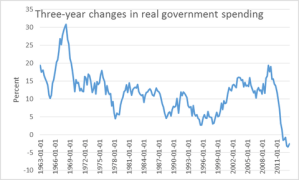
Welcome to Hooverville! We’ve implemented Hoover’s policy instead of FDR’s policy and now we have rotten unemployment stats, lower levels of folks in the labor force, and increasing poverty and income inequality. WTF happened to the US? The graph above is basically the result of Hoovernomics.
This one chart tells you much of what you need to know about the fiscal side of the US economy: we’re dealing with a recession/depression Herbert Hoover style — by cutting government spending just when we would have needed a strong counter-cyclical push from government.
Meanwhile, the pundits and Republicans continue to tell us that the federal government is expanding and that its debt is choking us. That is 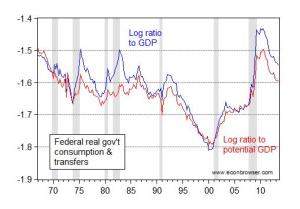 really not the case.
Figure 1: Log ratio of real Federal government consumption and investment plus transfers to real GDP (blue), and ratio to potential real GDP (red). NBER defined recession dates shaded gray. Real transfers calculated by dividing line 22, BEA NIPA Table 3.2 by PCE deflator. Potential GDP is measured in Ch.05$, and adjusted to Ch.09$ compatible with the latest GDP release by taking the ratio of 2011 GDP reported in the June 2013 and November 2013 releases. Source: BEA, CBO (Budget and Economic Outlook, February 2013), NBER, and author’s calculations.
As a share of GDP, the current level is below that recorded in 1982Q4 (under President Reagan); as a share of potential GDP (guesstimated), the current level is below that recorded in 1986Q3 (under President Reagan).
Part of the budget deal lets the long term unemployed fall into a deeper hell.
The budget deal announced last night by conference chairs Senator Patty Murray (D-WA) and Representative Paul Ryan (R-WI) is better than another government shutdown, but nicer words than this are hard to find to say about it.
By far the worst aspect of it is the failure to extend the Emergency Unemployment Compensation program (EUC) in 2014. Without these extensions, 1.3 million workers will have their benefits cut off at the end of 2013, and another 850,000 workers will exhaust normal UI benefits over the first quarter of 2014.
The share of long-term unemployed workers in the total labor force was 2.6 percent in November—double the share of June 2008, when President Bush first signed the UI extensions into law.
Besides cutting off a vital lifeline to millions of Americans, cutting these extensions also continues the disastrous march towards budget austerity; a march that has been by far the primary contributor to our failure to recover from the Great Recession. Cutting these UI extensions in 2014 will create a fiscal drag on the U.S. economy that will reduce job growth by more than 300,000 over the year.
A bizarre irony is that the cost of these extensions is nearly identical to the ten-year “deficit savings” achieved in the deal—between $20 and 25 billion. This amount of money is a rounding error in ten-year deficit projections (my back of the envelope calculations say that it’s well under one half of one percent of projected deficits between 2014 and 2023, under the CBO extended baseline). But Congress has chosen to save an amount of money that doesn’t even rise to the level of symbolic over a decade rather than provide real relief to millions of distressed Americans, as well as provide a mild boost to a still-weak job market.
The economy is clearly broken for most of us. The political system is clearly broken for most of us. The educational system is clearly broken for most of us. What’s an advocate of social justice to to do?
How does an economic system resolve conflicts and distribute benefits? A fancy derivative product may help a corporate treasurer solve her problem of managing her company’s risk, and it might make a banker rich, but it might also create a problem of greater systemic risk for the financial system as a whole. Likewise, eating a bacon cheeseburger may solve someone’s problem of satisfying unconscious desires programmed by millennia of evolution, but might also create new problems of clogged arteries and a society burdened with that person’s future health costs.
Overwhelming evidence from the fields of social psychology and behavioral economics shows us that people are not very good at managing these trade-offs, resolving conflicts, or recognizing interdependencies on their own. We overoptimistically believe that house prices will keep rising and that we can refinance when our low teaser rate expires. The corporate treasurer can’t really see how her decision to buy a derivative might boomerang back on her own company and contribute to the collapse of the financial system.
Understanding prosperity and growth in this new way allows us to make important distinctions between different kinds of economic activity. We can now see the difference between “empty” or even “harmful” economic activity and “useful” economic activity. It becomes obvious that an engineer earning $100,000 per year who creates a technology to ensure that those in serious auto accidents walk away unharmed is creating prosperity. It is much harder to make the same case for a hedge-fund manager making $500 million per year doing high-frequency trading to seize on information advantages over ordinary investors. And if that high-frequency trading also makes the global economy more fragile, then that implies something even more damning about this activity.
It can be a challenge, however, to distinguish between “problem-solving” and “problem-creating” economic activity. And who has the moral right to decide? In the traditional framework, it was simple—people vote with their pocketbooks, and if an activity is valued by the market, it must be good. But when an activity solves a problem for some but creates a problem for others—or even the same person later on, or for future generations—who should decide what is good economic activity versus bad, and how?
The usual answer has been that government regulators get to decide. But like markets, regulators create problems as well as solve them. So we also need mechanisms to regulate the regulators. Democracy is the best mechanism humans have come up with for navigating the trade-offs and weaknesses inherent in problem-solving capitalism. Democracies allow the inevitable conflicts of capitalism to be resolved in a way that maximizes fairness and legitimacy, and broadly reflects the views of society.
Although regulation in economies is necessary, the costs to society in terms of restricting the freedom to innovate, invent, and compete can sometimes be high, as conservatives correctly point out. But it also needs to be recognized that sometimes new economic activity actually creates more problems than it solves and needs to be limited. At other times, new economic activity merely threatens the old order and should be encouraged. Finding the balance between these competing demands is difficult. Democratic governments are the only institution with the legitimacy and accountability to make such trade-offs, and that is why the corrosion of our democratic institutions by growing crony capitalism is so threatening to our long-term prosperity. It also means that those who truly care about capitalism should be more concerned about the quality and effectiveness of regulation rather than simply its quantity
I guess Pelosi may have said this in the most realistic view of the budget deal. I do however hate it. Nancy Pelosi on deal: ‘Embrace the  suck’.
House Minority Leader Nancy Pelosi told Democratic House members at a meeting Thursday morning to “embrace the suck” and encouraged enough members to back the budget deal on the floor to allow passage, according to an attendee of the meeting.
“We need to get this off the table so we can go forward,” Pelosi told her members, according to someone inside the closed meeting of the caucus.
Pelosi pushed for including in the budget deal an extension of the unemployment benefits that are set to expire at the end of the month. While she expressed a continued unhappiness that there will be no vote on those benefits before the House heads home Friday, she said that it wasn’t worth holding up the deal.
Democrats expect that Republicans won’t be able to produce enough votes in their conference to pass the deal, requiring a sizable number of Democrats to vote with them in order to ensure passage. Pelosi, along with the rest of the House Democratic leadership, have withheld publicly backing the budget deal this week, with some waiting to see how much support from their caucus was going to be necessary.
So, this isn’t a great way to start a weekend,but we need to get real and discuss this budget deal.
What’s on your reading and blogging list today?


 peej
peej Carissa
 bostonboomer
 ecocatwoman
 mablue2
 peggysue22
 quixote
 skydancingguestblogger
 Mona (aka Wonk the Vote)



 Sky Dancing
That first graph really says it all doesn’t it…
Oh yeah, excellent post Dak.
Thx. It is a bit depressing to see such clear evidence of economic sabotage by our government but it is what it is.
Terrific post! Thanks, Dak.
Apple monitors contractor after worker, 15, dies in China
The best thing about the budget deal is that it’s more likely better than shooting ourselves in the foot every few months with a new deadline or shutdown problem. I don’t think the debt limit was raised in this deal anyway, so we can still deliberately kill the economy if Congress decides to do so,
I still think the Tea Party caucus needs to be prosecuted for treason.
Indeed!
http://billmoyers.com/2013/12/12/ripoff-us-government-pays-contractors-twice-as-much-as-civil-servants-for-the-same-work/
http://www.newsweek.com/us-government-paying-through-nose-private-contractors-224370
Leave no stone unturned to take these heartless bastards out of power!
tpm: Americans Left Out Of Medicaid Fight Back Against GOP Guvs
I saw that … I need to one in Louisiana!
http://thedailybanter.com/2013/12/why-wikileaks-doesn/
The 4 Questions Glenn Greenwald and Pierre Omidyar Still Haven’t Answered
Interesting article.
NYT: Obama Panel Said to Urge N.S.A. Curbs
Oh man, h/t susie madrak:
That’s wonderful!!!!
Too True 😉
http://www.denverpost.com/ci_24718883/reports-shots-fired-at-arapahoe-high-school
Gunman opens fire at Arapahoe High School, hundreds evacuate
Read more: Gunman opens fire at Arapahoe High School, hundreds evacuated – The Denver Post http://www.denverpost.com/news/ci_24718883/reports-shots-fired-at-arapahoe-high-school#ixzz2nODUvKPg
Read The Denver Post’s Terms of Use of its content: http://www.denverpost.com/termsofuse
Follow us: @Denverpost on Twitter | Denverpost on Facebook
Geez I just saw this Dak, WTF…and that is not a question but a statement.
Damn it! The NRA is a disgrace and we’re a stupid society.
When you hear the news reporter say, fortunately only a few victims….one dead so far…the fact that it has become “normal” is disturbing.
More than disturbing, it’s frankly insane!
Gun Lobby Uses Newtown Anniversary To Raise Money
Arapahoe Colorado High School Shooting WATCH LIVE COVERAGE | Mediaite
I just heard on the live feed that the shooter is down.
committed suicide
He’s the one dead. One in serious condition in surgery and another will go home tonight.
National Journal: Take Two Aspirin and Blame Everything on Obamacare
Did Ron Fournier get fired, I hope?
.@markfollman will be on @ThisIsAmerica at 5pm ET today to talk about gun violence in America. Don’t miss it: http://bit.ly/1fc6Xo7
GuardianUS @GuardianUS 22s
FBI arrests Kansas man on charges of plot to suicide bomb Wichita airport http://trib.al/awQc02E
Looks like another FBI set up frankly
Lying wingnut media…
Remember that opponent of Lindsey Graham’s who said people on unemployment shouldn’t be allowed to eat? It turns out he’s millions in debt.
http://talkingpointsmemo.com/livewire/state-sen-lee-bright-running-against-lindsey-graham-is-1-4-million-in-debt
He doesn’t look hungry either. Prick!
Woolworths are still in Oz and in South Africa. Yay…