
Monday Reads
Posted: October 7, 2013 Filed under: 2012 elections, Congress, Federal Budget and Budget deficit, Federal Government Shutdown, House of Representatives, morning reads, Tea Party activists 74 Comments
Good Morning!
I’ve made plans to go to Seattle next month again to stay with my dad and hope that I can also spend time looking for the possibility of a job since my daughter is joining a small ob/gyn practice about an hour north of Seattle. It’s hard not to long for the safety of a blue state given what’s been going on recently and given the conversations that I have with people that safely dwell in the Faux News Reality of Welfare Queens, Pedophile Gays, Scary Black People in Hoodies, and Invading Mexicans. I’ve been in a long Facebook conversation trying to explain the Affordable Care Act details and why the exchanges are not “government-backed” insurance until I’m blue in the face. No amount of numbers convinces them that all the jobs are not becoming part time. I was just told I obviously don’t have common sense if I don’t see the Affordable Care Act as a giant give away to lazy poor people even though I’ve tried to explain that Medicaid still exists and it still is the plan for poor people. There just exists this ever deepening divide between the realities of Red and Blue States. Did Nixon’s Southern Strategy doom our Democracy?
In a merciful twist of fate, Juan Linz did not quite live to see his prophecy of the demise of American democracy borne out. Linz, the Spanish political scientist who died last week, argued that the presidential system, with its separate elections for legislature and chief executive, was inherently unstable. In a famous 1990 essay, Linz observed, “All such systems are based on dual democratic legitimacy: No democratic principle exists to resolve disputes between the executive and the legislature about which of the two actually represents the will of the people.” Presidential systems veered ultimately toward collapse everywhere they were tried, as legislators and executives vied for supremacy. There was only one notable exception: the United States of America.
Linz attributed our puzzling, anomalous stability to “the uniquely diffuse character of American political parties.” The Republicans had loads of moderates, and conservative whites in the South still clung to the Democratic Party. At the time he wrote that, the two parties were already sorting themselves into more ideologically pure versions, leaving us where we stand today: with one racially and economically polyglot party of center-left technocracy and one ethnically homogenous reactionary party. The latter is currently attempting to impose its program by threat upon the former. The events in Washington have given us a peek into the Linzian nightmare.
Traditionally, when American politics encountered the problem of divided government—when, say, Nixon and Eisenhower encountered Democratic Congresses, or Bill Clinton a Republican one—one of two things happened. Either both sides found enough incentives to work together despite their differences, or there was what we used to recognize as the only alternative: gridlock. Gridlock is what most of us expected after the last election produced a Democratic president and Republican House. Washington would drudge on; it would be hard to get anything done, but also hard to undo anything. Days after the election, John Boehner, no doubt anticipating things would carry on as always, said, “Obamacare is the law of the land.”
Instead, to the slowly unfolding horror of the Obama administration and even some segments of the Republican Party, the GOP decided that the alternative to finding common ground with the president did not have to be mere gridlock. It could force the president to enact its agenda.
It used to be that elections came with the usual majority rules ramifications. This current group of Tea Party insurrectionists evidently has changed that equation. The question now is what can we do about it?
And as the saying goes, elections have consequences. It’s how Democratic victories in the 1930s paved the way for Franklin Roosevelt’s New Deal, how Dem victories in the 1960s led to Lyndon Johnson’s Great Society programs, how Republican victories in the 1980s resulted in Ronald Reagan’s tax cuts, how Democratic majorities in 2006 and 2008 led to Obama’s health-care law, and how the GOP’s midterm wins in 2010 extracted spending-cut concessions from Obama the following year.
Yet what’s extraordinary about this current political fight is that Republicans are seeking another round of concessions — over the president’s signature domestic achievement — after losing the last election, which was viewed in part as a referendum on the health-care law.
“It’s as if Ted Cruz slept through the entire 2012 cycle,” a senior Democratic aide tells First Read. “It’s not like Obamacare, spending and debt weren’t major issues in 2012. They were central — and we won.”
Nevertheless, Cruz and House Republicans maintain that Obama and the Democrats must negotiate over the health-care law to re-open the federal government. And House Speaker John Boehnersays Democrats must negotiate to raise the debt ceiling. “The nation’s credit is at risk because of the administration’s refusal to sit down and have a conversation,” he told ABC News. “The votes are not in the House to pass a clean debt limit. And the president is risking default by not having a conversation with us.”
I found that Boehner comment about the lack of votes to be really strange given that he seems to think that the Democrats in the House and their votes do not matter. What exactly is the conversation and why should the rest of the country have it when we thought we decided that about a year ago during the election? Why is Boehner willing to weaponize the debt ceiling again? (This is the same Jonathan Chait article I referenced above.)
The debt ceiling turns out to be unexploded ordnance lying around the American form of government. Only custom or moral compunction stops the opposition party from using it to nullify the president’s powers, or, for that matter, the president from using it to nullify Congress’s. (Obama could, theoretically, threaten to veto a debt ceiling hike unless Congress attaches it to the creation of single-payer health insurance.) To weaponize the debt ceiling, you must be willing to inflict harm on millions of innocent people. It is a shockingly powerful self-destruct button built into our very system of government, but only useful for the most ideologically hardened or borderline sociopathic. But it turns out to be the perfect tool for the contemporary GOP: a party large enough to control a chamber of Congress yet too small to win the presidency, and infused with a dangerous, millenarian combination of overheated Randian paranoia and fully justified fear of adverse demographic trends. The only thing that limits the debt ceiling’s potency at the moment is the widespread suspicion that Boehner is too old school, too lacking in the Leninist will to power that fires his newer co-partisans, to actually carry out his threat. (He has suggested as much to some colleagues in private.) Boehner himself is thus the one weak link in the House Republicans’ ability to carry out a kind of rolling coup against the Obama administration. Unfortunately, Boehner’s control of his chamber is tenuous enough that, like the ailing monarch of a crumbling regime, it’s impossible to strike an agreement with him in full security it will be carried out.
The standoff embroiling Washington represents far more than the specifics of the demands on the table, or even the prospect of economic calamity. It is an incipient constitutional crisis. Obama foolishly set the precedent in 2011 that he would let Congress jack him up for a debt-ceiling hike. He now has to crush the practice completely, lest it become ritualized. Obama not only must refuse to trade concessions for a debt-ceiling hike; he has to make it clear that he will endure default before he submits to ransom. To pay a ransom now, even a tiny one, would ensure an endless succession of debt-ceiling ransoms until, eventually, the two sides fail to agree on the correct size of the ransom and default follows.
This is a domestic Cuban Missile Crisis
Texas Demagogue and Senator Ted Cruz is already pushing the crisis forward.
Sen. Ted Cruz (R-Texas) on Sunday said changes to President Obama’s signature healthcare law should be tied to a debt ceiling increase.
The Texas Republican said any deal on raising the nation’s borrowing authority should include some “significant structural” plans to reduce government spending, avoid new taxes and “look for ways to mitigate the harm from ObamaCare.”
“The debt ceiling historically has been among the best leverage that Congress has to rein in the executive,” he said on CNN’s “State of the Union.”
Of the 55 times Congress has raised the debt limit, Cruz argued that 28 of those times Congress has attached “very stringent requirements,” many designed to reduce spending, including the 2011 sequestration plan.
So, a debt-ceiling increase should “respond to real harms coming from ObamaCare,” Cruz said.
Cruz said Republicans have leverage because of “so many nasty partisan jabs from Democrats” proving that “we’re winning the argument —Obamacare isn’t working.”
Treasury Secretary Jack Lew reiterated on Sunday that the federal government will run out of borrowing authority on Oct. 17.
And the world thinks we’ve completely lost it.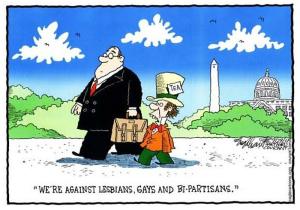 Here’s a taste of the German press as excerpted by Der Spiegel.
Munich’s national Süddeutsche Zeitung offers a slightly more depressing take, pointing blame at all sides. “What has already been apparent in America for a few years now is the self-destruction of one of the world’s oldest democracies. And the great tragedy here is that this work of destruction isn’t being wrought by enemies of democracy, greedy lobbyists or sinister major party donors. America’s democracy is bring broken by the very people who are supposed to be carry and preserve it: the voters, the parties and the politicians.”
The argument? The Republicans who have brought Washington to stillstand are repeatedly and democratically elected by voters and given a mandate to block. The parties themselves are fomenting an increasingly radicalized culture that deepens political, societal and geographic divisions in the country, argues the newspaper. And finally, there are few politicians in America who are willing or capable of thinking beyond their own electoral constituencies.
“At the moment, Washington is fighting over the budget and nobody knows if the county will still be solvent in three weeks,” the paper concludes. “What is clear, though, is that America is already politically bankrupt.”
America enjoys the “exorbitant privilege” of printing the world’s reserve currency. Its government debt is considered a safe haven, which is why Uncle Sam can borrow so much, so cheaply. America will not lose these advantages overnight. But anything that undermines its creditworthiness—as the farce in Washington surely does—risks causing untold damage in the future. It is not just that America would have to pay more to borrow. The repercussions of an American default would be both global and unpredictable.
It would threaten financial markets. Since American Treasuries are very liquid and safe, they are widely used as collateral. They are more than 30% of the collateral that financial institutions such as investment banks use to borrow in the $2 trillion “tri-party repo” market, a source of overnight funding. A default could trigger demands by lenders for more or different collateral; that might cause a financial heart attack like the one prompted by the collapse of Lehman Brothers in 2008. In short, even if Obamacare were as bad as tea-party types say it is (see Lexington), it would still be reckless to use the debt ceiling as a bargaining chip to repeal it, as some Republicans suggest.
What can be done? In the short term, House Republicans need to get their priorities straight. They should pass a clean budget resolution without trying to refight old battles over Obamacare. They should also vote to raise the debt ceiling (or better yet, abolish it). If Obamacare really does turn out to be a flop and Republicans win the presidency and the Senate in 2016, they can repeal it through the normal legislative process.
An FBI hostage negotiator has some hints on how to deal with petulant Tea Party bomb throwers.

So how did it get to this point? “Its fear-driven behavior,” says Voss. “They get angrier because they feel they’ve been defeated. People notice losses twice as much as they notice wins. It’s a sports metaphor you hear all the time: ‘I hate losing more than I like winning’…I think there’s a very strong sense of loss on their part over what they refer to as Obamacare and resentment over that is carried forward.”
But hostage negotiators aren’t the type to give up hope. “Ultimately, everybody wants success. And there are a lot of definitions of success,” Voss says. “Bottom line, they want to be made to look like they were effective and got things done for their side. So it’s a matter of refocusing on what’s in everybody’s best interests.”
He’s looking to the Obama White House to help start the reset: “I would ask them to start saying, ‘I understand that the people on the other side of the table have the best interests of the American people at heart.’ Simply recognize that. Everybody wants to do what’s best for the American public. Those sorts of statements repeated on a regular basis, it’s the start of dialogue. It’s not concession; it’s the beginning of dialogue.”
But the prison siege mentality Voss describes is exacerbated by an absence of strong calming leadership in the congressional GOP. “Those guys are sitting on the sidelines,” Voss says. “There are quite a few Republican politicians that I have a tremendous amount of respect for that are exceedingly silent these days.” He mentions House Intelligence Committee Chairman Mike Rogers: “I’ve never heard anything out of Mike’s mouth that wasn’t really thoughtful and nuanced.”
Another possible constructive calming voice on the conservative caucus could be former President George W. Bush. “I think there’s a possibility that he would be somebody that you would talk to behind the scenes, and potentially an intermediary himself. I think he absolutely has the ability to be a stabilizing influence.”
But how to do you deal with the hyper-partisan congressional bomb-throwers? “Well it’s like a game of tic-tac-toe with the tantrum throwers,” Voss says. “In tic-tac-toe, if you’re going second, the best you can possibly do is tie—if you play the game. There’s a first-mover advantage. The minute you stop playing that game the first mover advantage goes away. So you don’t play their game at all. That’s the way you respond.”
So, the craziness continues and escalates. If things come apart at the seams, I do not want to be stuck in Bobby Jindal’s Louisiana.
What’s on your reading and blogging list today?


 peej
peej Carissa
 ecocatwoman
 mablue2
 peggysue22
 quixote
 skydancingguestblogger
 Mona (aka Wonk the Vote)



 Sky Dancing
That cartoon…. it’s basically a sociology text 😉
Great post Dak. I wish you the best of luck in Seattle cause I think it will matter where we are when the feces hits the fan and it may just hit it this time. I hate thinking about TX in really hard times.
All the more reason why we need Wendy and Hillary.
Texas has been self-creating its hard times for some time. I can’t imagine what more years of drought conditions and fracking will do to its water supply. It’s got tons of folks just making minimum wage and more all the time. That appears to be the source of most of the job creation. It has a large population but many are really not doing all that well. It depends way too much still on the oil and gas industry which makes it vulnerable to disruptions. I think many parts of Texas will start turning into ghost towns and I think the water situation is going to start pitting neighbor against neighbor in some of the larger towns in the north. I definitely wouldn’t feel very secure there.
Texas is privatization hell
yeah, Jindal’s been replicating Governor Goodhair’s example here too … we’re paying dearly for all of that since it’s more expensive and less efficient.
Good news. Business leaders recruiting primary challengers from the center now,
WaPo: Some tea party congressmen find signs of political backlash at home
Excellent post! The Jonathan Chait article is very good.
Here’s Noam Scheiber at TNR: Here’s How the Shutdown Standoff is Going to End
Unfortunately, I think the “grand bargain” is going to raise its ugly head again and Social Security and Medicare will once again be threatened.
I hope he’s right. I also worry about SS and Medicare though in the long run.
I’m WAY more worried about Social Security and Medicare than Obamacare, which I have no doubt was never in danger to begin with. even in the short term, I think SS and Medicare are going to get the austerity treatment.
Yup … chained CPI was offered up before. But I think the medical devices tax might wind up on the table.
It’s pretty depressing.
http://touch.latimes.com/#section/-1/article/p2p-77664958/
“A little squishy”? That’s like saying that water’s a little wet.
A friend of mine said recently “I never thought I’d say this, but I’m glad I’m not any younger,” referring to worries about SS and Medicare programs being slashed.
There are too many callous politicians and brainwashed voters who do and allow unspeakable acts.
“A friend of mine said recently “I never thought I’d say this, but I’m glad I’m not any younger,” referring to worries about SS and Medicare programs being slashed.”
Thanks for sharing that Luna. Your friends comment took me back to a time in my young adult life when people were saying the same thing about SS. When I first began working (prior to Medicare) in the early1960’s, almost everyone believed that Social Security would not be there for the young and middle aged. Now, most of those who were in middle age then are gone, and I’ve become a senior receiving the very benefits I didn’t believe would be there for me.
I remember when Medicare became law and we began paying into it through payroll deduction in the 60’s, few of us believed it would survive, but here it is, nearly 50 years later, keeping most of it’s recipients (including me) out of poverty.
I know the GOP and even some Dems would love to get rid of SS/Medicare and Medicaid, and the other safety net programs like unemployment insurance, food stamps and nutritional programs like WIC, but I can’t imagine taking that GIANT step backward. I don’t think American’s would tolerate it for long.
No but constantly threatening to cut them keeps the American public primed not to ask for more and to just keep spending political capital on protecting them.
That’s an undeniable truth.
Do we ever get to quit fighting for the hard won gains? The “man” always trying to push us back to serfdom is just the way it is. 🙂
The ACA has never been in danger.
I think you’re right BB. I expect means testing and chained CPI to rise to the top of the bargaining heap, again!
I disagree with Mona though. I don’t think it’s going to happen. They’ve already shown they can’t handle the pushback.
Well I don’t know *what* is going to happen. I just know that whatever it is, it’s meant to keep us resigned to crumbs.
I really thought the Chait article was insightful.
http://rhrealitycheck.org/article/2013/10/04/wendy-davis-announces-run-for-texas-governor-for-the-very-future-of-our-state/
They should be scared. She’s the best Democratic candidate for governor since Ann.
She will have to endure the endless abuse of the big barn church crowds. I don’t envy her that. They are a mean and petty group who will do and say anything because they think gawd is on their side.
Indeed!
She’s already gone through it though locally. Which is a good thing (well in terms of preparation. Not so much her or anyone having to go through it to begin with)
http://www.cnn.com/2013/10/03/politics/wendy-davis-texas-governor/?c=&page=2
Great Post,
You know that trying to convince the O’Haters that ObamaCare isn’t socialized medicine is like trying to convince the Pope to join Judaism. It ain’t gonna happen.
I’ve heard Seattle is beautiful and of course it is very liberal. I have no doubt you’d love living there. I suppose the only recourse for those of us who’ve spent a lifetime in the States that long for the culture of the 1950’s is to leave, but it’s so hard to leave when you get to my age. The moral of my story is, leave before you get to old to. You’re still young enough to build relationships in Seattle, so get while the getting is good.
I have spent time there and it is not one of my favorite cities because I really like old architecture and the feel of a city developed before autos. I have also found that it doesn’t have the culture and food that I like either. I have to pack coffee,hot sauce and all kinds of things! But it us really forward looking, the scenery is nice and the people are really open and tech savvy! That will be a nice change for me.
Well you’ve been spoiled by Nola…and our Electeds have been spoiling Nola by neglect and disaster capitalism
Well, Seattle doesn’t have really old architecture, but many neighborhoods have nice Bungalow/Craftsman houses. There are some pockets of late 1880s/early 1900s mansions, most notably near Volunteer Park & the Asian Art Museum. Your dad lives in the Bellevue area? The whole “east side” — as Seattleites refer to Bellevue, Redmond, & Kirkland areas — is much more contemporary and semi/suburban looking.
We’ve got the EarShot Jazz Fest going on now — shows at numerous venues throughout the area. I heard Jarrett, Peacock & deJohnette! play last week. Plenty of upcoming & mid-career musicians too, though I’m sure not anywhere as many as in NO.
Seems like there are 3-4 coffee shops per block in many areas. I don’t drink it myself, but I bet you can find a particular coffee you like somewhere here. Hot sauce, not so much. Plenty of good, inexpensive Thai restaurants though.
OTOH, it does rain a lot starting right about now, until June-ish, and is colder.
Let’s get together when you’re in the area, listen to some music, and damn the Teahadists!
🙂
And I propose a SkyDancing meetup in Seattle!
I might be in Portland in Spring…,
Portland’s close …. that’s a fabulous city too. I would certainly run down there for the day or the weekend.
They have lots and lots of excellent coffee in Seattle. It’s kind of a signature thing for them. As well you have access to fantastic produce all year long because of it’s proximity to California and the seafood is second to none and has not been tainted by dispersants. You’ll hate the lack of sunlight during the late fall/winter, but don’t be afraid to open your mind to some of the best food anywhere. Of all the things I don’t miss about Seattle, the food is not among them. I can give you the name of an awesome organic butcher in Renton where you’ll find anything and everything you need, and I’m sure it’s not the only one. 🙂
Oh! And it’s the only place you can get Mac and Jacks’s African Amber Ale. It’s not available by the bottle, only on draft but O.M.G. it’s yummy.
Great! I am sure part of my problem has been being stuck in Belleview!
Nola people love Community coffee though, right Dak? I figured that’s what you meant by packing coffee …
There are Farmer’s Market’s year-round, though many of the fruit options get trucked up from California during winter & spring, as janicen mentioned. I’m not a foodie, but there are a lot of Northwest/Asian/fusion-type restaurants. Growing food in your front & backyards is getting quite popular (again, so I don’t feel so weird 😉 And plenty of micro-brew pubs.
How Texas is coping with Obamacare’s launch. “”It’s the beginning of a new day in America,” Sharon Phillips of Parkland Memorial Hospital said last week. Except that she also works in Texas, and that can be, well, complicated. Phillips, an executive vice president, was celebrating a milestone in health reform, the launch of online marketplaces. They offer private insurance for those with no coverage and often include federal subsidies to make it affordable. Parkland was eager to help folks sign up, given that about 50,000 uninsured patients may qualify. The catch is that many other customers will be left out in the cold: About 180,000 earn too little money to get public help, Phillips said. If that sounds counterintuitive — an income that’s too small for aid — how about Parkland buying health insurance for some of its sickest patients? Phillips floated that idea last week because buying coverage through the exchange could be cheaper than Parkland’s eating the hospital bill itself. Whether the move would pass muster with regulators and political leaders is unclear, but Phillips said it’s worth exploring.” Mitchell Schnurman in The Dallas Morning News.
That’s some good creative thinking. The “charity care” i.e. unpaid care provided by non-profit hospitals and clinics is a significant drain on their ability to operate, compared with other organizations that refuse to serve those patients. Hope they succeed.
I just hope they don’t get stomped on by the state in their zeal to sabotage the ACA.
Is it true Ralph that TX is refusing to open it’s Medicaid program to those who would qualify under the revised ACA threshold for Medicaid? I can’t follow your link to read the entire article.
Yes … it is happening here too and in most Southern states.
It’s happening here too, My daughter works in healthcare in TX and she said her hospital, which is for profit, is initiating a program to help people sign up for the exchanges.
Hospitals are setting up programs and some are trying to put together free insurance packages for people who can’t pay. Hospital will buy insurance on the exchanges then give it away to poor patients.
Hope they do that here. jindal is making damn sure he fights everything remotely connected to Obama
“Hospital will buy insurance on the exchanges then give it away to poor patients.”
Aha!!!! The hospitals are basically saying to State Governments, we can play this game too. I don’t see how State government can stop them from doing what would is clearly “charitable work”. If they get most folks insured it will help everyone in the long run.
Dak, could the for-profit hospitals in turn deduct that from their Federal Taxes?
Yup
The business end of Obamacare. “The likely benefits of Obamacare for small businesses are enormous. To begin with, it’ll make it easier for people to start their own companies—which has always been a risky proposition in the U.S., because you couldn’t be sure of finding affordable health insurance…The U.S. likes to think of itself as friendly to small businesses. But, as a 2009 study by the economists John Schmitt and Nathan Lane documented, our small-business sector is among the smallest in the developed world, and has one of the lowest rates of self-employment. One reason is that we’ve never had anything like national health insurance. In a saner world, changing this would be a reform that the “party of small business” would celebrate.” James Suroweicki in The New Yorker.
Exactly. It is weird that we shove the cost of health care to employers and costly and inefficient too.
Single payer holdout here 😉
Better not get sick for a long time then.
Exactly. This isn’t a Trojan pony to single payer
If you do get sick Mona, at least you won’t have to worry about the pre-existing condition horse-shit that many, if not most in my generation, were held hostage to. I’ve known many people who couldn’t leave a job because of it. I’ve also known people who were laid off in 2008 and were unable to get health insurance after their cobra ended because of pre-existing conditions. I had a friend whose child was born with a birth defect associated with his heart. The child was going to require surgeries and other ongoing care issues that made it impossible for my friend to quit his job for a better job. He was an Aerospace Engineer and during the decade I worked with him he had to pass on several great job opportunities because he couldn’t leave his health insurance.
I’m a SPUHC advocate too, but there are some good things going on with ObamaCare that we should all be glad about.
I’ve explained my position on this before, Mouse. I think the window dressing is just being moved so that they force you into buying insurance and you still won’t be able to get the care you need. They’re going to shift the pre-existing denial mechanism and the costs will show up elsewhere leaving people still disenfranchised from care.
A mandate with a PO isn’t the same thing as a mandate. I don’t think there’s anything wrong with continuing to push for a PO and single payer. I don’t think the right wing criticism should be the only/loudest ones in the room keeping the conversation ever-right shifting
FDR got things done because the leftist voices were out there….not because they just said well ok can’t get anything more done right now.
Whose thunder is there to steal today? The teapartiers screaming “government takeover”?!
“They’re going to shift the pre-existing denial mechanism and the costs will show up elsewhere leaving people still disenfranchised from care.”
I respect where you’re coming from, but until it’s fully implemented and the issues worked through, we won’t know the full impact. We can guess, we can hope, but we can’t know. I watched as a contributor to Medicare through payroll deductions the implementation of Medicare/Medicaid and it was a very bumpy road.
I just fall into the camp that elects to hope that some good comes of this because I’ve known far too many people who’ve lost everything, even their lives, because they couldn’t get healthcare for a variety of reasons. I think the subsidies will be key to this programs success.
And you know Medicare isn’t free, even though we pay into it for a lifetime. Part B & D have monthly premiums and there are deductibles and co-pays, which can work a hardship on those who don’t qualify for premium assistance or can’t afford supplementary insurance. So even Medicare has it’s prickly side.
I’ll admit this isn’t a Unicorn, but I’m going to keep cheering for this baby and keep hoping there are more upsides than downsides. 🙂
Mouse,
As I mentioned the other day, I don’t have to pay the Medicare Part B and D premiums anymore because of the Medicaid expansion, and my generic drug co-pay is $2.75. That’s because of the ACA. I think my Medicare co-pays will also be covered.
It would be wonderful to have single payer for all, but even Hillary wasn’t pushing for it and I doubt if she could have gotten it through this Congress. Politics is “the art of the possible.” All or nothing thinking is what the Republicans are playing at, and I don’t think it’s going to work for them.
BB….. I just received a letter from my Part D provider telling me that generics would be $2.75 beginning in 2014. That’s great news by any yardstick.
“It would be wonderful to have single payer for all, but even Hillary wasn’t pushing for it and I doubt if she could have gotten it through this Congress.”
Precisely. Even Hillary Care was more along the framework of Obama Care than SPUHC.
There were compromises made that I hated and I screamed loudly about it at the time. When I calmed down I understood there were some members of the Dem Congress that had to be placated to get a bill. I also knew that whatever passed in health care it would not be a bi-partisan vote, even though some GOP’ers influenced the final bill by acting as if they might vote for it.
If I remember correctly the genesis of the Tea Party was the struggle for and the passage of the ACA and the repeal of DADT.
I still hate that Obama made deals with the hospitals and pharma companies. But that’s water under the bridge now. Now this thing is the law of the land, changes could and should be made. Who knows what will happen if Hillary gets elected? But she supports the ACA and other Obama policies. Supporting her will mean compromises too. I still want her to be president.
This is a positively inspired use of eminent domain.
WaPo: Richmond’s rules: Why one California town is keeping Wall Street up at night
I read something about that in the summer and I still can’t stop laughing….it’s really great 😉 😀
Slate @Slate 27m
The #SCOTUS case that could have profound negative consequences for the safety of abortion providers and patients: http://slate.me/17g8yTJ
This dudebro thinks Wendy running will cost Democrats:
http://www.theguardian.com/commentisfree/2013/oct/05/wendy-davis-texas-governor-race
Seriously? That’s the analogy he chose? Asshat
Asshat indeed. And Wendy Davis “costing” Democrats?
(headdesk)
Wendy Davis exemplifies what a Democratic should be and do.
Harry uses the conventional wisdom from the ’80s for most everything. Democrats have used Texas as an ATM for national campaign cash while spending nothing there for over 20 years. That’s one of the main reasons the local party is in not great shape.
Asshat is right!
That is bad. I’m OK with limited pharma/vendor funding, say with unrestricted grants for education activities. But this sort of pandering is egregious. The UW has been lauding its Pain Clinic program and work with the new Washington state regs on pain-med prescribing. This info makes the connection deeply suspect.
Satire on the plight of R-land citizens and R-headed congresscritters:
ROFLOL
🙂
This is WONDERFUL!
Wendy 2014! A Governor we can be proud of again.