
The processed-food-industrial complex: Weaponized Food
Posted: March 2, 2013 Filed under: just because | Tags: food addiction, obesity, processed food industry 29 Comments I watched Amy Goodman of Democracy Now interview an investigative reporter with The New York Times named Michael Moss. He penned “Salt Sugar Fat: How the Food Giants Hooked Us”. His recent article–“The Extraordinary Science of Addictive Junk Food” was published last –weekend in the Times Sunday magazine. Moss won 2010 Pulitzer Prize for investigating the dangers of contaminated meat. I’m going to excerpt some of Goodman’s interview and some of the article itself for you.
AMY GOODMAN: We spend the rest of the hour going deep inside the “processed-food-industrial complex,” beginning with the “The Extraordinary Science of Addictive Junk Food.” That was the cover story in the recent New York Times Magazine that examined how food companies have known for decades that salt, sugar and fat are not good for us in the quantities American’s consume them, and yet every year they convince most of us to ingest about twice the recommended amount of salt, 70 pounds of sugar—22 teaspoons a day. Then, there’s the fat. Well, New York Times reporter Michael Moss explains how one of the most prevalent fat delivery methods is cheese.
MICHAEL MOSS: Every year, the average American eats as much as 33 pounds of cheese. That’s up to 60,000 calories and 3,100 grams of saturated fat. So why do we eat so much cheese? Mainly it’s because the government is in cahoots with the processed food industry. And instead of responding in earnest to the health crisis, they’ve spent the past 30 years getting people to eat more. This is the story of how we ended up doing just that.
Okay, I’m officially off cheese now. I don’t eat chips, crackers, sodas, or cookes, but I do eat cheese a lot. Well, maybe that explains these hips. But seriously, I’ve noticed how hard it is to eat almost anything or find food that’s not loaded down with chemicals and additives. Moss’ work is eye-opening. The industry actually works to make bad food addictive.
The public and the food companies have known for decades now — or at the very least since this meeting — that sugary, salty, fatty foods are not good for us in the quantities that we consume them. So why are the diabetes and obesity and hypertension numbers still spiraling out of control? It’s not just a matter of poor willpower on the part of the consumer and a give-the-people-what-they-want attitude on the part of the food manufacturers. What I found, over four years of research and reporting, was a conscious effort — taking place in labs and marketing meetings and grocery-store aisles — to get people hooked on foods that are convenient and inexpensive. I talked to more than 300 people in or formerly employed by the processed-food industry, from scientists to marketers to C.E.O.’s. Some were willing whistle-blowers, while others spoke reluctantly when presented with some of the thousands of pages of secret memos that I obtained from inside the food industry’s operations. What follows is a series of small case studies of a handful of characters whose work then, and perspective now, sheds light on how the foods are created and sold to people who, while not powerless, are extremely vulnerable to the intensity of these companies’ industrial formulations and selling campaigns.
Goodman has also interviewed food reporter Melanie Warner who wrote “Pandora’s Lunchbox: How Processed Food Took Over the American Meal”.
MELANIE WARNER: Yeah, I’m not much of a scientist, but a number of years ago, when I started covering the food industry, I became curious about expiration dates that are printed on packages. Pretty much you to go into the supermarket, and every package in the store will have an expiration date on it. And I wondered: Well, what will happen? What do these expiration dates mean, and what will happen after this date has come and gone? Some of these dates are actually quite far out; they’ll be six to nine months or even more.
So I started collecting a number of food products, and I saved them in my office. And then I would open them after the expiration dates had passed, sometimes long after the expiration dates had passed because I had forgotten about them. And what I found out over time—I collected all kinds of products: cereal, cookies, Pop-Tarts, fast-food meals, frozen dinners, I mean, you name it. I have all kinds of gross stuff in my office at this point.
And what I found—there were a few exceptions—but what I found was that most of this food did not decompose or mold or go bad, even after long, long periods of time. I mean, I started this seven, eight years ago, and I still have slices of cheese that are perfectly orange, processed cheese.
AMY GOODMAN: From years and years and years ago?
MELANIE WARNER: Years and years and years ago, yeah. And they’re—
AMY GOODMAN: And what keeps their color? And what keeps them looking—
MELANIE WARNER: Yeah.
AMY GOODMAN: —completely preserved?
MELANIE WARNER: There are a variety of reasons for this, depending on the product. Sometimes it’s because of powerful chemical preservatives that are in it. Sometimes it’s because of additives that lower the acidity of products, so that no microorganisms can grow. And sometimes it’s because food manufacturers very intentionally remove all the water from products. That’s the case with cereal and cookies.
Well, there we are with the cheese again. I’ve now learned a new phrase. It’s “process optimization” and it’s not about producing things right the first time. It’s about making food taste wonderful even when it’s bad for your or its underlying taste is awful.
Moskowitz, who studied mathematics and holds a Ph.D. in experimental psychology from Harvard, runs a consulting firm in White Plains, where for more than three decades he has “optimized” a variety of products for Campbell Soup, General Foods, Kraft and PepsiCo. “I’ve optimized soups,” Moskowitz told me. “I’ve optimized pizzas. I’ve optimized salad dressings and pickles. In this field, I’m a game changer.”
In the process of product optimization, food engineers alter a litany of variables with the sole intent of finding the most perfect version (or versions) of a product. Ordinary consumers are paid to spend hours sitting in rooms where they touch, feel, sip, smell, swirl and taste whatever product is in question. Their opinions are dumped into a computer, and the data are sifted and sorted through a statistical method called conjoint analysis, which determines what features will be most attractive to consumers. Moskowitz likes to imagine that his computer is divided into silos, in which each of the attributes is stacked. But it’s not simply a matter of comparing Color 23 with Color 24. In the most complicated projects, Color 23 must be combined with Syrup 11 and Packaging 6, and on and on, in seemingly infinite combinations. Even for jobs in which the only concern is taste and the variables are limited to the ingredients, endless charts and graphs will come spewing out of Moskowitz’s computer. “The mathematical model maps out the ingredients to the sensory perceptions these ingredients create,” he told me, “so I can just dial a new product. This is the engineering approach.”
Moskowitz’s work on Prego spaghetti sauce was memorialized in a 2004 presentation by the author Malcolm Gladwell at the TED conference in Monterey, Calif.: “After . . . months and months, he had a mountain of data about how the American people feel about spaghetti sauce. . . . And sure enough, if you sit down and you analyze all this data on spaghetti sauce, you realize that all Americans fall into one of three groups. There are people who like their spaghetti sauce plain. There are people who like their spaghetti sauce spicy. And there are people who like it extra-chunky. And of those three facts, the third one was the most significant, because at the time, in the early 1980s, if you went to a supermarket, you would not find extra-chunky spaghetti sauce. And Prego turned to Howard, and they said, ‘Are you telling me that one-third of Americans crave extra-chunky spaghetti sauce, and yet no one is servicing their needs?’ And he said, ‘Yes.’ And Prego then went back and completely reformulated their spaghetti sauce and came out with a line of extra-chunky that immediately and completely took over the spaghetti-sauce business in this country. . . . That is Howard’s gift to the American people. . . . He fundamentally changed the way the food industry thinks about making you happy.”
I make my own spaghetti sauce, but I do put cheese on top of that too. Drat. I really must be cheese addicted.
Anyway, I just thought all of this was very interesting and thought I’d share it and this taste of food porn on the side.
Saturday: A Grab Bag For Your Reading Pleasure
Posted: March 2, 2013 Filed under: Barack Obama, morning reads, The Media SUCKS, U.S. Economy, U.S. Politics | Tags: Bob Woodward, Bobby Jindal, Joan Didion, Joe Scarborough, Keystone XL pipeline, sinkholes, the sequester, worried moms 35 Comments
Good Morning!!
Yesterday the State Department released its report on the Keystone XL Pipeline, apparently giving it their seal of approval. The original NYT headline on their story by John Broder was “A 2000-Page Lubricant for Keystone XL.” At some point it was changed to “Report May Ease Path for New Pipeline.” I guess the first was was a little too graphic for the Gray Lady, but the two combined sound even more lewd–or is is just me? Anyway, here’s an excerpt:
The State Department issued a revised environmental impact statement for the 1,700-mile Keystone XL pipeline on Friday that makes no recommendation about whether the project should be built but presents no conclusive environmental reason it should not be.
The 2,000-page document also makes no statement on whether the pipeline is in the United States’ economic and energy interests, a determination to be made later this year by President Obama.
But it will certainly add a new element to the already robust climate change and energy debate around the $7 billion proposed project. The new report does not make any policy recommendations, but its conclusion that the environmental and climate change impacts are manageable could provide Mr. Obama political cover if he decides to approve the pipeline.
Although the study will help guide the president’s decision, it does not make the politics any easier. Environmental advocates and landowners along the route have mounted spirited protests against the project, including a large demonstration in Washington last month. They say they view Keystone as a test of Mr. Obama’s seriousness about addressing global warming.
And of course, as Broder points out, “the pressure from industry, the Canadian government, most Republicans and some Democrats in Congress, local officials and union leaders” is also intense.
Are you getting the feeling this is a done deal? Isn’t John Kerry supposed to be an environmentalist?
The “sequester” cuts have begun, and guess who has an op-ed in the NYT about it? Brace yourself.
Singing the Sequester Soap Opera, by Joe Scarborough. I’ll skip the fake-poetic introductory paragraphs {Gag} … go to the link and read them if you desire. Actually, all the paragraphs are over-the-top, IMO. Joe’s point seems to be that Obama “overplayed his hand”
Americans who endured the grimmest warnings from President Obama and his administration need not fear that the cuts will jeopardize military readiness; limit our nation’s ability to forecast hurricanes; compromise food safety; lead to outbreaks of E. coli; undermine airport security; and cause older Americans to go hungry.
The Republicans have won this round, according to “Morning Joe,” because no one is going to feel any pain whatsoever.
…this year’s reductions will not do great damage to domestic and defense programs. Congress will have $85 billion less to spend this year, but the Congressional Budget Office projects that the actual cuts implemented this year will amount to only $42 billion out of a $3.5 trillion budget. That means that politicians will have to cut a little more than a penny out of every dollar that it spends this year.
Does Mr. Obama really want to claim that his administration, which has added $6 trillion to the national debt, is unable to save a penny out of every dollar it spends? Does he really expect Americans to believe — after four years, the banking and auto bailouts, several stimulus bills and a run of record deficits — that our $16 trillion economy cannot absorb $42 billion of spending reductions?
Good to know, Joe. Thanks for that comforting message. Now we’ll just have to wait and see if your predictions are accurate.
Oddly, WBUR in Boston is reporting that thousands of Federal workers in the city are facing furloughs:
Thousands of people work in the John F. Kennedy Federal Building at Boston’s Government Center. It’s actually twin 26-story buildings. On Thursday, the word “sequester” seemed to be on the lips of federal employees going in and out. Bethany Seed said she’s not looking forward to Monday, when she might be handed a furlough notice.
“For me, personally, a furlough would be a problem because I’d still be paying for full-time child care,” Seed said. “And I’d be losing my pay from work. So it’s not something I would like to see happen.”
Seed is an economist with the U.S. Department of Labor. When you hear things like jobless numbers, she works on those statistics. Her boss — not her director supervisor, but way up the chain — is Seth Harris, the acting U.S. labor secretary, who was visiting Boston Thursday.
“Unfortunately, a sizable number of my workers are going to be subject to furloughs,” Harris said. “It’s going to vary from agency to agency across the department. We’re going to lose about six days of work from our employees on average. That’s a big loss.”
But Seed can now breathe a sigh of relief, because “Morning Joe” has decreed that no one will be hurt by the “sequester” cuts. Or did he only me no one who is important to him will be hurt? Again, we’ll just have to wait and see.
In contrast to Know-Nothing Joe Scarborough, Bob Cesca seems to know a little bit about the issues–at least this piece at HuffPo made sense to me: The Sequestration Fight Is Based on Lies and Stupidity. Here’s the introduction; if it grabs you too, please read the whole thing at the link.
As a political writer, being outraged by certain issues and policies is like rocket fuel. I’m not an angry guy by nature, but there’s a universe of things in politics that anger me and, combined with an almost involuntary drive to seek and disseminate the truth, I’m never really at a loss for topics to cover.
But the sequestration issue has been one of those rare items that frustrate me to the point of being incapable of spending time on it. When I read about sequestration, my brain seizes. The stupidity of it all simply confounds me to the point of being speechless. For me, this is a shocking and rare predicament.
It’s not even the chronic brinksmanship — the reoccurring doomsday countdowns and the Republican-manifested economic sabotage that’s behind it all. It’s not the Keynesian in me who opposes the very notion of deficit reduction during a sluggish recovery. Granted, these are both points of irritation, but the characteristic of the sequester that ought to force us all into complete apoplexy and subsequent outrage-induced catatonia is the epidemic of ignorance regarding the status of the federal budget deficit.
This post by David Atkins at Hullabaloo is also well worth a look: Alternate Universe Land.
Sinkholes and a Missing Governor
I’m sure you’ve heard about the Florida man who disappeared into a sinkhole. This morning NPR (via AP0 reported:
Engineers worked gingerly to find out more about a slowly growing sinkhole that swallowed a Florida man in his bedroom, believing the entire house could eventually succumb to the unstable ground.
Jeff Bush, 37, was in his bedroom Thursday night when the earth opened and took him and everything else in his room. Five other people were in the house but managed to escape unharmed. Bush’s brother jumped into the hole to try to help, but he had to be rescued himself by a sheriff’s deputy.
Engineers were expected at the home to do more tests after sunrise Saturday. They spent the previous day on the property, taking soil samples and running various tests — while acknowledging that the entire lot was dangerous. No one was allowed in the home.
“I cannot tell you why it has not collapsed yet,” Bill Bracken, the owner of an engineering company called to assess the sinkhole, said of the home. He described the earth below as a “very large, very fluid mass.”
Apparently sinkholes are endemic in Florida, so much so that homeowners must have insurance for the possibility that their home may be sitting on one.
“You can almost envision a piece of Swiss cheese,” Taylor Yarkosky, a sinkhole expert from Brooksville, Fla., said while gesturing to the ground and the sky blue home where the earth opened in Seffner. “Any house in Florida could be in that same situation.”
A sinkhole near Orlando grew to 400 feet across in 1981 and devoured five sports cars, most of two businesses, a three-bedroom house and the deep end of an Olympic-size swimming pool.
More than 500 sinkholes have been reported in Hillsborough County alone since the government started keeping track in 1954, according to the state’s environmental agency.

Assumption Parish sinkhole
Yikes! So…what about that sinkhole near New Orleans then? Residents angry as Assumption sinkhole keeps growing
BAYOU CORNE, La. — The Assumption Parish sinkhole is a lot like a living, breathing thing. More than 200 days after it mysteriously started swallowing up the swamp, hundreds of residents are still under a mandatory evacuation order.
Geophysicists say the cavern that caused the sinkhole at the surface is still collapsing, leaving Bayou Corne residents wondering if there will ever be an end in sight….Geophyisicists [sic] now say the western side of one of the brine caverns is collapsing, filling in from deep in the Earth, causing the sinkhole at the surface to expand and contract.
Former residents of the area would like some answers.
Many of the ones they keep getting are conflicting and confusing, especially from the state and the company that once mined the collapsing salt cavern Texas Brine.
“The cause of the sinkhole is the subject of pending litigation. At this point, I don’t think it’s proper to have any discussion about what the cause is and whether we accept what anyone has said regarding the cause of the sinkhole,” Troy Charpentier, an attorney for Texas Brine, told the committee.
The secretary of the Louisiana Department of Natural Resources flat-out testified at the same hearing, “The cavern collapse led to the sinkhole and created a path for the natural gas to come to the surface.”
But Secretary Stephen Chustz slipped out a backdoor, with his press secretary only offering an interview with himself after the hearing without giving us the chance to ask him any questions.
Hmmmmm… What about the governor then?
From David J. Mitchell at the Baton Rouge Advocate: Inside Report: Sinkhole critics: O, Governor, where art thou?
For months now, a vocal group of activists and residents has found fault with Gov. Bobby Jindal over his absence from the scene of the Bayou Corne sinkhole.
Why, they ask, has he not made the commonly seen leadership visit to a disaster area that, while brief, boosts morale and provides hope?
Sinkhole activist John Achee Jr., a regular critic of Jindal and state government’s handling of the sinkhole and salt dome regulation, leveled this complaint again during a Feb. 19 joint hearing of the House and Senate committees on Natural Resources.
He called Jindal’s absence “disheartening” and “very concerning.”
Jindal’s office issued a response, saying that the good governor gets updates on what’s happening and that he thinks “abundant resources” have already been provided. Translation: “I couldn’t possibly care less, so f&ck off, loser!”
Odd and Ends
I just had to share this story from Gawker about a nervous mom and her fight to find out where her son had got off to: World’s Most Embarrassing Mom Makes Peruvian Government Hunt Down Her Son When He Stops Posting on Facebook. I have to say I’m much more sympathetic to the mom than Gawker is. I think someday the young man will grow older and wiser and will look back and understand how much his mom loves him. I’d much rather have a mom like that than one who doesn’t worry when I disappear into the wilderness for months.
I’m running short on space, so I’ll end with this oldie-but-goodie from 1996 by the great Joan Didion at The New York Review of Books, in which she ripped Bob Woodward and his clunky writing from stem to stern: The Deferential Spirit. It’s long, but please go read it–even if you read it back in 1996. It’s priceless!
Now it’s your turn. What’s on your reading and blogging list today?
Sequestration Boogie
Posted: March 1, 2013 Filed under: Federal Budget, Federal Budget and Budget deficit, Sequester 39 Comments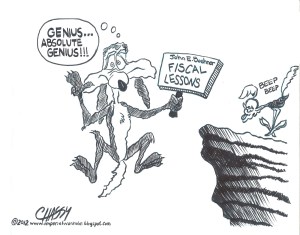 Well, it’s here. It’s the day the Mayans predicted!! It’s the beginning of the end of civilization in the Americas! Sequester Disaster Day is here! Well, it’s here for those of us that like to drive on roads and across bridges. It’s here for those of us that will rely on social security or medicare this month or shortly. It’s here for those of us that have kids in schools or would like to go to university. It’s here for those of us that would prefer to live in a civilized country instead of The United States of Mississippi. For politicians and punditry in the beltway, it’s just another ball where they get to show off their designer formal wear and fancy dance steps.
As the automatic across-the-board spending cuts are set to take effect today and as President Obama meets at the White House with congressional leaders, we have to get this off our chest: This has been an absurd week. Today’s White House meeting is coming only at the last second; there’s been no sense of urgency, no negotiating, and Congress has left town; and, when you think about it, this hasn’t even been a true budget showdown. Given the lack of urgency and negotiating, it’s hard not to conclude that — deep down — plenty of folks on both sides of the aisle are OK with having these cuts take place, at least in the short term.
That’s from Chuck Todd et al. I agree. None of this makes sense if you think of economic policy or actually the idea of governing a country efficiently. I have decided that the only thing Washington cares about is the political dance and political boogie surrounding the process and not what actually happens to the nation. For some reason, these cuts play in the beltway. In that vein, Dave Weigal thinks Obama is winning the process cotillion. Will it’s good some one is winning because there are certainly going to be about 320 million losers out here in the great fly over that exists behind Washington DC and Manhattan.
Republicans have one goal, running through all of these negotiations. They don’t want sequestration to be replaced by tax revenue. Any tax revenue. Forcing the president to swallow $85 billion in cuts this year would do that. They’ve got no obvious alternatives.
But a plan like this exposes a quirk of Obama-era fiscal hawksmanship. Republicans want specific cuts. Some of them—total repeal of Obamacare!—they’ll put on the record. The rest of them, they try to put on the White House. As soon as the “supercommittee” failed and sequestration looked real, it became “the president’s sequester.” The 2011 debt-limit deal delayed real action until after the 2012 election, betting $1.2 trillion of chips on its results and giving them to the president. Even the first great structural victory of the Tea Party, the ban on legislative earmarks, handed more clout to the White House. “The power to make thousands of spending decisions, on everything from which flood control projects will be funded to how spending on military bases will be distributed, to President Obama,” warned two political scientists at the time. Republicans ignored those particular political scientists.
Vote by vote, accidentally, Republicans are endorsing an imperial vision of the presidency. Perhaps they’re picking this up by osmosis. The default position of the punditocracy is that the president must lead. The lazy pundit invokes Harry Truman’s desk ornament, “The Buck Stops Here,” as a totem of great wisdom. Brendan Nyhan, who isn’t lazy, calls this “the Green Lantern Theory of the Presidency,” after the D.C. Comics superhero and his ring that runs on willpower. Bob Woodward offered a sterling example of the theory this week, when he suggested that the president’s willingness to obey the Budget Control Act (the law that mandates sequestration) was “madness.”
See, I actually think they all must want all these cuts. They are so far removed from any impact that any of this would actually have that they’re just ignoring it. As a matter of fact, the similarly out of touch punditry likes the idea of it too. Let me offer of this from Ygelasias:”A Cheer or Two for Sequestration“.
But on the merits it seems to me that while sequestration is hardly optimal budget policy, it really isn’t all that bad in the scheme of things, and really going through with it would be better than repealing it. The key reason is that fully half the cuts are cuts to “defense” spending, and yet nobody from either party is seriously trying to maintain that America will be left defenseless in the wake of this reduced military spending. The specific sequestration mechanism is clearly awkward and clumsy, but again nobody’s saying the Mexican army is going to come swarming over the border to reconquer Santa Fe, that the Taliban is now going to be able to outspend the Pentagon, or that America’s NATO allies are now left unable to fend off a Russian invasion. That’s half the cuts with basically zero real public policy harm.
So then you look at the domestic side. Your basic transfer payments to poor people are spared, your transfer payments to the elderly are basically spared, and then everything else gets cut willy-nilly. That leads to some real policy harms. Valuable research grants are going to not happen. We’ll see some real bottlenecks at regulatory agencies. But obviously there’s some waste and fat in this domestic discretionary spending.
Long story short, if you’re a defense dove like me and have a nonutopian view of the domestic discretionary budget, then this looks like we’re mostly talking about harmless spending cuts.
This from a man who had to get a wife from an on line dating service which is basically the equivalent of a mail order bride. How much do you have to hate yourself to troll around online for an equally desperate person?
Let me just return to the economic impact of all of this.
Yes, the across-the-board spending cuts will lead to hundreds of thousands of job losses and a fiscal drag of 0.6 percent for 2013, according to the forecasting firm of Macroeconomic Advisers. Mostly, though, the rub is the timing and the inartful nature of the cuts.
“It would clearly be preferable to have a more orderly process for fiscal adjustment than the indiscriminate effects of sequestration,” wrote Macroeconomic Advisers in a recent research note.
The inopportune moment of sequestration — hitting just as the economy shows bright spots — will create a drag on the economy in a slow-motion manner. First, the furlough notices will go out in March to federal employees, the majority of whom live outside of the Washington metro area. Unemployment checks will drop as early as April for the long-term unemployed who receive the federal benefit checks.
States eventually will have to decide how to cut programs for low-income or vulnerable people that are funded through federal grants, such as child-care assistance, nutrition programs for women and children, mental-health services, and meal programs for senior citizens.
If Congress keeps the sequester cuts in place for a few months, then the economy will start to feel the effects. Federal workers furloughed for as many as 22 days between mid-April, when the furloughs are expected to begin to occur, and the end of the fiscal year will face a pay cut of as much as 20 percent. This will have ripple effects throughout the economy on consumer spending as well as state income and sales taxes.
By July, August, and September, the impact of sequestration should be fully felt. “We’re not going to go into a downward spiral overnight, but the spending cuts will build, and as they build, the effects will become noticeable,” says Nigel Gault, the chief U.S. economist of IHS Global Insight.
Already, the economic data showed a dip in federal-government spending for defense in the first quarter, a reaction to the impending cuts.
That is the real takeaway of the sequester and its economic impact. It will not hurt the economy immediately, but it still serves as a reminder of the power the federal government holds over the economy. Even if the government cannot enact policies to boost growth, it certainly can hurt the long-term prospects.
I’d really like to know why politicians these days are united in making most people’s lives worse off while maintaining things like preferable tax treatment for people that are already better off than nearly 99.9 % of the people living on the planet? The only thing I can figure out is that none of this impacts any of them so they could care less. It’s not about what happens to the nation or to its people. It’s like they’re teenagers at a country club dance. The only thing that matters is who dances with who and how they each will be perceived in the outfit they’ve chosen. Meanwhile, what will be the cost to the country in the eventual crime and social unrest? Ah, who cares, just buy stock in the latest company that runs the privatized jails. It’s a sure winner.
Friday Morning Reads
Posted: March 1, 2013 Filed under: fetus fetishists, morning reads, U.S. Economy, U.S. Politics, Vagina, War on Women, Women's Rights | Tags: Arkansas anti-abortion law, Bernadette Peters, Eric Cantor, the sequester, transvaginal ultrasound, Violence Against Women Act 20 Comments Good Morning!!!
I’ve been a little out of the loop recently since I have a friend here to visit. So, I’m going to start with a Happy 65th Birthday wish to Bernadette Peters because I saw her in concert last night. She’s 59 in this youtube but she wore the same dress and did this song. I was shocked!! shocked! to hear that she told us that it was her first time!!!
It was a night of Broadway songs and overtures with the Louisiana Symphony Orchestra.
So, the House passed the Senate version of the Violence Against Women Act which is finally on its way to the President for his signature.
After months of delay, GOP leaders allowed the bill to come to the floor only after a Republican substitute version of the legislation — set up as an amendment to the Senate’s bipartisan bill — failed, 166-257. The House amendment was expected to fail, but allowed members to vote for a version of VAWA while not supporting the Senate bill.
Still, House leaders were under pressure from members of their own party to pass the Senate version without any changes. Nineteen House Republicans sent a letter to Majority Leader Eric Cantor and House Speaker John Boehner urging them to pass a bipartisan version of VAWA.
This is the third time Boehner has allowed a bill to pass with a majority of Democratic votes.
Democrats for the most part were united in their opposition to the House version, arguing it stripped out important protections for LGBT and Native American women. Sixty Republicans joined them in opposition. Only two Democrats, Dan Lipinski of Illinois and Mike McIntyre of North Carolina, supported the House version.
In the last Congress, House Majority Leader Eric Cantor (R-Va.) played a critical role in blocking reauthorization of the Violence Against Women Act. In this Congress, Cantor was so eager to get VAWA passage over with, he told House Republicans yesterday to either clear the way for the already passed Senate version or risk causing a “civil war” within the party.
Well, that’s some progress, however. TODAY is SEQUESTER day!!
It’s Friday, March 1, and that means the federal government has crossed the much-hyped and dreaded deadline for the fiscal reductions known as the “sequester.”
The members of Congress who for voted for the Budget Control Act – and the budget cuts contained within – and President Barack Obama who signed it into law on Aug. 2, 2011, may not have believed the day would arrive, but now it has.
But today is only the beginning of the beginning.
For one thing, Obama must sign an order formally starting the “sequester” or spending reductions – which according to a new estimate from the Congressional Budget Office – would amount to $42 billion in the current fiscal year.
And White House aides have indicated that the president is not likely to put pen to paper on that order until after he meets with congressional leaders, a meeting slated for Friday morning.
Once Obama signs the order to start the spending cuts, any furloughs of federal workers could not begin at least for another 30 days due to federal regulations and to collective bargaining agreements which the government has with the unions that represent roughly half of the federal workforce.
I guess Transvaginal Ultrasounds are fine as long as your representative doesn’t feel it’s all that relevant for him.
Rep. Sean Duffy (R-WI) declined to take a position last week during a town hall meeting on whether transvaginal ultrasounds should be mandatory for women seeking abortions, saying he has never heard of the practice and couldn’t weigh in on it because “I haven’t had one.”
Ultrasound requirements are a top priority for anti-abortion advocates in Wisconsin and other states. Similar legislation in past years has landed Republicans in political hot water, and this time around many GOP leaders are distancing themselves from proposed ultrasound requirements.
Duffy has described himself as “100 percent prolife without exceptions” (though he also said “To qualify, I believe that if we have the life of a mother as an issue, the mother’s life takes priority, but we must make every effort to save the life of the child.”) Asked about one of the main goals for the pro-life movement, however, Duffy said he had not heard of transvaginal ultrasounds at all.
A Democratic operative recorded Duffy’s exchange with the questioner at a Feb. 21 townhall meeting in Spooner, Wisc. Through his congressional office, Duffy declined to comment or clarify his views on mandated ultrasounds.
Arkansas became the eighth state Thursday to enact a near-ban on abortions starting in the 20th week of pregnancy, and by next week it could outlaw most procedures from the 12th week onward, which would give it the most restrictive abortion laws in the country.
The Republican-led Senate voted 19-14 along party lines to override Democratic Gov. Mike Beebe’s veto of a bill barring most abortions starting in the 20th week of pregnancy that was based on the disputed notion that a fetus can feel pain by that point. The Arkansas House voted to override the veto Wednesday. A simple majority was needed in each chamber.
That law, which took effect immediately but which will likely be challenged in court, includes exemptions for rape, incest and the life of the mother.
Senate President Michael Lamoureux, R-Russellville, voted to override the veto, but later told reporters he wasn’t sure the new law would survive a constitutional challenge.
“If it was an easy answer, then people wouldn’t be raising that subject,” he said after the vote.
After overriding the veto, the Senate voted 26-8 in support of a separate measure that would outlaw most abortions starting in the 12th week of pregnancy. In addition to the exemptions for rape, incest and the mother’s life, it would allow abortions when lethal fetal conditions are detected.
The proposed 12-week ban, which would ban abortions from the point when a fetus’ heartbeat can generally be detected through an abdominal ultrasound, would give Arkansas the most restrictive abortion laws in the country, said Cecile Richards, the president of Planned Parenthood Action Fund.
Yes, the religious extremists in this country have taken over a number of state legislatures. Look for more violations of your civil rights–except the right to arm yourself with a nuclear bomb–in a state near your.
So, I’m going to make this short this morning . What’s on your reading and blogging list today?

 peej
peej Carissa
 bostonboomer
 dakinikat
 ecocatwoman
 mablue2
 Mama Lopez
 peggysue22
 quixote
 skydancingguestblogger
 Mona (aka Wonk the Vote)



 Sky Dancing
Recent Comments