
Major New Boston Globe Article Recounts Circumstances of Romney’s Bain Departure
Posted: July 20, 2012 Filed under: 2012 presidential campaign, Mitt Romney, Team Obama, The Bonus Class, U.S. Economy, U.S. Politics | Tags: "pathos of the plutocrat", 13D filings, Bain Capital, Beth Healy, golden parachute, Michael Kranish, Paul Krugman, Roberta Karmel, Romney's tax returns, SEC, The Boston Globe 9 Comments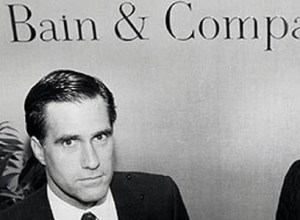
I know everyone is focused on the Colorado shooting, but I feel as if I need to post this new information about Mitt Romney’s tenure at Bain Capital.
New interviews and public records research by Boston Globe reporters Beth Healy and Michael Kranish make it clearer than ever that Romney was still in control of the company during his “leave of absence” to manage the 1999 Winter Olympics in Salt Lake City.
Interviews with a half-dozen of Romney’s former partners and associates, as well as public records, show that he was not merely an absentee owner during this period. He signed dozens of company documents, including filings with regulators on a vast array of Bain’s investment entities. And he drove the complex negotiations over his own large severance package, a deal that was critical to the firm’s future without him, according to his former associates.
Indeed, by remaining CEO and sole shareholder, Romney held on to his leverage in the talks that resulted in his generous 10-year retirement package, according to former associates.
“The elephant in the room was not whether Mitt was involved in investment decisions but Mitt’s retention of control of the firm and therefore his ability to extract a huge economic benefit by delaying his giving up of that control,” said one former associate, who, like some other Romney associates, spoke only on condition of anonymity because they were not authorized to speak for the company.
Romney originally planned to take a leave of absence, while contributing part-time to Bain. It was agreed that “five managing directors” would be in charge while he was away. Romney was technically no longer involved in investment decisions, but he had legal control of the firm.
Basically, Romney wanted a huge golden parachute, and retaining control of Bain gave him leverage. He was still the boss, even if he had let go of micromanaging every new project and decision. The reporters talked to
James Cox, a professor of corporate and securities law at Duke University, [who] said Bain’s continued reference to Romney as CEO and sole shareholder indicated that Romney was still the final authority. Moreover, Cox said, Romney would likely have been updated regularly about Bain Capital’s profits while he was negotiating his severance package. As a result, Cox said, Romney’s statement that he had no involvement with “any Bain Capital entity” appears “inconsistent” with his actions.
“If he is 100 percent owner, I just find it incredible that what I would call ‘big decisions’ — acquisitions, restructuring, changes in business policy — that they would not have passed on to him on an informational basis, not asking for formal approval but just keeping him in the loop,” Cox said.
Romney’s departure left Bain in a somewhat chaotic state. The remaining partners were worried about their ability to raise funds for takeovers without their former boss. Some of the partners chose to leave Bain and begin their own firms “rather than go through the limbo transition.”
I seems quite clear that Romney has lied on disclosure forms on which he has stated that after February 11, 1999 he “was not involved in the operations of any Bain Capital entity in any way.”
What I can’t understand is why he didn’t just lay out all these facts and simply deal with any criticisms about investments that Bain made between 1999 and 2002. He benefited financially from those decisions anyway–and is still benefiting from Bain investments. But now he looks dishonest as well as ruthless toward workers who suffered when Bain outsourced their jobs or drove their employers into bankruptcy.
CNN also published an important article about Romney and Bain today. The author is Roberta Karmel, a former SEC commissioner who is now Centennial Professor of Law at Brooklyn Law School. Karmel has been quoted in the Boston Globe’s previous articles on Romney’s separation from Bain. Karmel explains in detail why Romney can’t avoid responsibility for Bain between February 11, 1999 and early 2002 when he officially resigned as CEO and presumably transferred some of his shares to the new managing partners.
The contradictory representations in the Government Ethics Office and SEC filings are at best evasive and at worst a violation of federal law. A federal statute — 18 U.S.C. § 1001 — provides that anyone who “in any matter within the jurisdiction of the executive, legislative, or judicial branch of the Government of the United States, knowingly and willfully — (1) falsifies, conceals, or covers up by any trick, scheme, or device a material fact; (2) makes any materially false, fictitious, or fraudulent statement or representation” shall be fined or imprisoned. Violations of federal securities laws, including the making of false statements in a 13D filing, are independently punishable under the securities laws….
Romney is not now claiming his 13D filings were inaccurate or false, but he is claiming that although he was chief executive officer, managing director, chairman and president of Bain Capital, he was not really there, but in Utah managing the Winter Olympics. Nevertheless, he was earning more than $100,000 in salary from Bain. Since he will not release his income tax returns for 1999-2002, we have no idea how high this salary really was.
If Romney was not “involved” in the operations of Bain Capital, why was he being paid? As sole shareholder, why did he keep himself on as CEO? Also, at least with respect to the Stericycle deal, he invested as an individual along with the Bain entities. Why is Romney’s story about his relationship to Bain and its investment activities at odds with the documents his firm filed?
There’s much more, so if you’re interested, be sure to check out the entire article. I assume the Obama campaign will quickly latch onto this new information. Will Romney try to explain, or will he continue to resort to the “pathos of the plutocrat” as described in Paul Krugman’s latest column–whining because he isn’t getting the deference that he feels is his due as one of the super-rich? Krugman:
Like everyone else following the news, I’ve been awe-struck by the way questions about Mr. Romney’s career at Bain Capital, the private-equity firm he founded, and his refusal to release tax returns have so obviously caught the Romney campaign off guard. Shouldn’t a very wealthy man running for president — and running specifically on the premise that his business success makes him qualified for office — have expected the nature of that success to become an issue? Shouldn’t it have been obvious that refusing to release tax returns from before 2010 would raise all kinds of suspicions?
By the way, while we don’t know what Mr. Romney is hiding in earlier returns, the fact that he is still stonewalling despite calls by Republicans as well as Democrats to come clean suggests that it could be something seriously damaging.
Anyway, what’s now apparent is that the campaign was completely unprepared for the obvious questions, and it has reacted to the Obama campaign’s decision to ask those questions with a hysteria that surely must be coming from the top. Clearly, Mr. Romney believed that he could run for president while remaining safe inside the plutocratic bubble and is both shocked and angry at the discovery that the rules that apply to others also apply to people like him. Fitzgerald again, about the very rich: “They think, deep down, that they are better than we are.”
Stay tuned….
Friday Reads
Posted: July 20, 2012 Filed under: morning reads | Tags: Frank Dodd, Income Inequality, Mona Lisa, Ocean Acidity, Regulation, Sheila Bair, Syria collapse 51 Comments Good Morning!
I thought I’d try to focus on some interesting news today and ignore politics. We’ll see how well I do.
BBC News reports that “an iceberg twice the size of Manhattan has broken away from the Petermann Glacier in northern Greenland”. You can see the NASA satellite picture at the link. Is this yet another symptom of global warming?
Scientists have raised concerns in recent years about the Greenland ice shelf, saying that it is thinning extensively amid warm temperatures.
No single event of this type can be ascribed to changes in the climate.
But some experts say they are surprised by the extent of the changes to the Petermann Glacier in recent years.
“It is not a collapse but it is certainly a significant event,” Eric Rignot from Nasa said in a statement.
Some other observers have gone further. “It’s dramatic. It’s disturbing,” University of Delaware’s Andreas Muenchow told the Associated Press.
“We have data for 150 years and we see changes that we have not seen before,” Mr Muenchow added.
Okay, here’s another one of my grave stories. No “seriously”, it’s another story about a grave. This time they think they may have located Mona Lisa’s remains in Florence.
Scientists claim that they might have found the skeleton of the woman who posed for Leonardo Da Vinci’s most famous painting.
Most art historians agree that Lisa del Giocondo was the woman who inspired Da Vinci to create his iconic work.
Now the archaeologists working in Florence are pretty convinced they have found the remains of the lady, merchant Francesco del Giocondo’s wife Lisa Gherardini.
The skeleton was unearthed beneath the medieval Convent of Saint Ursula in Florence. Knowing she became a nun after her husband died and lived in the convent until her death in 1542, a team of archaeologists began excavation works at the abandoned convent last year.
Sheila Bair is still on the stump for financial regulation. She answered some questions on Wednesday on the state of Dodd-Frank.
Horwich: So going after systemic risk suggests safety, it suggests caution. Then we have this other important aspect of our economy where we say financial institutions are supposed to be taking risks on deserving people and businesses. How do you reconcile what seems like a real contradiction there?
Bair: Well, I think we do want banks to take risks but we want them to take risks on economic activities that have some real economic benefit. I mean, trading CDS indexes with a bunch of hedge funds — I don’t know what kind of positive economic benefit we would get from that. It’s the kind of risk you take and whether you’re taking a well-measured, well-understood, well-evaluated risk, that’s really the question.
Horwich: There are many people out there who would have liked to have seen and might still like to see banks fail — especially big banks fail — that they think have been misbehaving. What do you say to them?
Bair: Well, I say that we should have a let a couple fail. It makes me angry that we didn’t and I think there were tools there that could have been used that were not. You know, there were a couple of institutions that were clear outliers in the terms of their mismanagement — the risks that they took — and they should have been put into a bankruptcy-like process and they weren’t. I think if we had done that; that would have been more powerful than all the rules that we’re writing now to try to correct these misbehaviors. Be that as it may it’s a legacy of the bailouts and it’s something we have to deal with now.
Here’s one of my favorite Brit Economists Robert Skidelsky on “The Bad Society”. He raises some interesting points on income inequality.
There is a strange, though little-noticed, consequence of the failure to distinguish value from price: the only way offered to most people to boost their incomes is through economic growth. In poor countries, this is reasonable; there is not enough wealth to spread round. But, in developed countries, concentration on economic growth is an extraordinarily inefficient way to increase general prosperity, because it means that an economy must grow by, say, 3% to raise the earnings of the majority by, say, 1%.
Nor is it by any means certain that the human capital of the majority can be increased faster than that of the minority, who capture all of the educational advantages flowing from superior wealth, family conditions, and connections. Redistribution in these circumstances is a more secure way to achieve a broad base of consumption, which is itself a guarantee of economic stability.
The attitude of indifference to income distribution is in fact a recipe for economic growth without end, with the rich, very rich, and super-rich drawing ever further ahead of the rest. This must be wrong for moral and even practical reasons. In moral terms, it puts the prospect of the good life perpetually beyond reach for most people. And, in practical terms, it is bound to destroy the social cohesion on which democracy – or, indeed, any type of peaceful, contented society – ultimately rests.
Is Syria collapsing and what will this to do its ally Iran? Better yet, what will this do to further instability in the region?
The fall of the Assad government would remove Shiite Iran’s last and most valued foothold in the Arab world, and its opening to the Mediterranean. It would give Saudi Arabia and other Sunni Arab states their long-sought goal of countering Iranian influence in the region, finally splitting the alliance between Tehran and Damascus that has lasted for decades. And it would further erode Iran’s role as a patron of the Middle East’s revolutionaries, a goal that moderate Arabs and the United States have long sought.
Already the militant Palestinian group Hamas, long dependent on Syria and Iran, has thrown its support behind the Syrians in the streets seeking Mr. Assad’s overthrow.
Worse might follow, from Tehran’s point of view. Iran and Syria’s last revolutionary ally, the Hezbollah party that dominates Lebanon, would lose its source of weapons and financial support. And Lebanon’s fragile sectarian balance might be torn apart, raising the threat of another civil war there.
On Wednesday, Hezbollah was quick to respond to the government’s worst day so far to make its strongest declaration yet that it would not abandon Mr. Assad.
Meanwhile, intense global pressure is being brought to bear on Putin and Russia. Russia and China once again vetoed a Syria resolution.
Russia and China again vetoed a Western-backed U.N. resolution Thursday aimed at pressuring President Bashar Assad’s government to end the escalating 16-month conflict in Syria.
The 11-2 vote, with two abstentions from South Africa and Pakistan, was the third double veto of a resolution addressing the Syria crisis by Damascus’ most important allies.
The defeat leaves in limbo the future of the 300-strong U.N. observer mission in Syria, which was forced to suspend operations because of the intensified fighting. Its mandate, to monitor a cease-fire and implementation of international envoy Kofi Annan’s peace plan, expires Friday.
Britain’s U.N. Ambassador Mark Lyall Grant, who sponsored the Western-backed draft, said he was “appalled” at the third double veto of a resolution aimed at bringing an end to the bloodshed in Syria and creating conditions for political talks. The resolution had threatened sanctions if the Syrian regime didn’t quickly stop using heavy weapons.
“The consequence of their decision is obvious,” he said. “Further bloodshed, and the likelihood of descent into all-out civil war.” Activists say more than 17,000 people have been killed since the uprising began in March 2011, most of them civilians.
“The consequence of today’s action is the situation will continue to deteriorate,” U.S. Ambassador Susan Rice told reporters.
The Smithsonian Magazine tell us that Ocean Acidity is just as much of a challenge for us as Climate Change. WTF are we doing to Mother Earth and Mother Nature?
Rising ocean acidity is now considered to be just as much of a formidable threat to the health of Earth’s environment as the atmospheric climate changes brought on by pumping out greenhouse gases. Scientists are now trying to understand what that means for the future survival of marine and terrestrial organisms.
In June, ScienceNOW reported that out of the 35 billion metric tons of carbon dioxide released annually through fossil fuel use, one-third of those emissions diffuse into the surface layer of the ocean. The effects those emissions will have on the biosphere is sobering, as rising ocean acidity will completely upset the balance of marine life in the world’s oceans and will subsequently affect humans and animals who benefit from the oceans’ food resources.
The damage to marine life is due in large part to the fact that higher acidity dissolves naturally-occurring calcium carbonate that many marine species–including plankton, sea urchins, shellfish and coral–use to construct their shells and external skeletons. Studies conducted off Arctic regions have shown that the combination of melting sea ice, atmospheric carbon dioxide and subsequently hotter, CO2-saturated surface waters has led to the undersaturation of calcium carbonate in ocean waters. The reduction in the amount of calcium carbonate in the ocean spells out disaster for the organisms that rely on those nutrients to build their protective shells and body structures.
The link between ocean acidity and calcium carbonate is a directly inverse relationship, which allows scientists to use the oceans’ calcium carbonate saturation levels to measure just how acidic the waters are. In a study by the University of Hawaii at Manoa published earlier this year, researchers calculated that the level of calcium carbonate saturation in the world’s oceans has fallen faster in the last 200 years than has been seen in the last 21,000 years–signaling an extraordinary rise in ocean acidity to levels higher than would ever occur naturally.
So, today we have a moment without US Presidential Politics. Take a deep breath, then tell me what’s on your reading and blogging list today?
Queen Ann Lays Down the Law on Mitt’s Taxes as Obama Opens a New Campaign Front
Posted: July 19, 2012 Filed under: 2012 presidential campaign, Austerity, Barack Obama, corporate greed, Medicare, Mitt Romney, Team Obama, U.S. Economy, U.S. Politics | Tags: Ann Romney, Ed Kilgore, Florida, Greg Sargent, Jonathan Chait, Leona Helmsley, Ryan budget, tax evasion 39 Comments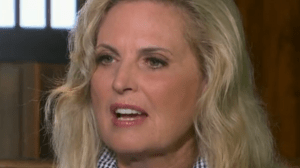
Thanks to Delphyne, who posted this link on the morning thread: Ann Romney: We’ve Given ‘All You People Need To Know’ About Family Finances
Mitt Romney’s wife is reinforcing her husband’s refusal to make public several years of tax returns, telling ABC News “we’ve given all you people need to know” about the family’s finances.
“You know, you should really look at where Mitt has led his life, and where he’s been financially,” she said in her interview with Robin Roberts. “He’s a very generous person. We give 10 percent of our income to our church every year. Do you think that is the kind of person that is trying to hide things, or do things? No. He is so good about it. Then, when he was governor of Massachusetts, didn’t take a salary in the four years.”
Roberts pressed: “Why not show that, then?” and reasoned that people could “move on” if her husband released his returns.
Romney responded, “Because there are so many things that will be open again for more attack… and that’s really, that’s just the answer. And we’ve given all you people need to know and understand about our financial situation and about how we live our life. And so, the election, again, will not be decided on that. It will be decided on who is gonna turn the economy around and how are jobs gonna come back to America.”
Queen Ann has spoken, and that’s that, you people. Ann’s attitude puts me in mind of this famous quote from Leona Helmsley: “We don’t pay taxes. Only the little people pay taxes…”
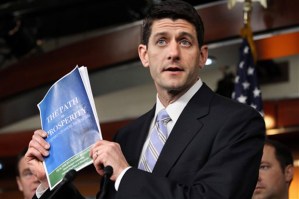
Meanwhile, President Obama is opening a new campaign front today in Florida. The Bain attacks were just a warm-up for an even more lethal attack in which the consequences of Mitt Romney’s stated support of the Ryan budget will spelled out in detail. From MSNBC’s First Thoughts:
Here comes Medicare: The past few weeks on the presidential campaign trail have featured aggressive attacks and counterattacks. On outsourcing by Bain Capital. On Mitt Romney’s post-1999 association with that firm, as well has his tax returns. On charges of “crony capitalism” in the Obama administration. And on President Obama’s views about business. And today when Obama begins a two-day swing through the crucial state of Florida — with all of its seniors — he’ll introduce another attack: hitting Romney on Medicare and the Ryan budget. Per the campaign, the president “will discuss his commitment to strengthening Medicare, and a new report tomorrow that highlights the devastating impact Mitt Romney’s Medicare plan could have on the 3.4 million Floridians that rely on Medicare.” Bottom line, per the campaign’s guidance: Obama will argue that Romney — through his support for the Ryan budget plan — advocates ending Medicare “as we know it.” Obama starts his Florida swing with a 1:25 pm ET event in Jacksonville, and then he heads to West Palm Beach at 6:20 pm. Tomorrow in the Sunshine State, he hits Ft. Myers and Winter Park.
As Ed Kilgore wrote this morning, Jonathan Chait predicted this two-front strategy last month.
I strongly suspect that Obama is currently in the first stage of a two-part assault on Romney. The first is to define his motives and perspective: a rich man who sees the world from the perspective of the CEO suite and blithely assumes what is good for people like himself is good for everybody.
This is the essential predicate for part two, which I would guess (I have no inside information) will dominate the last half of the campaign. Part two is Romney’s fealty to the Bush-era low-tax, anti-regulatory ideology and the radical Paul Ryan plan. The average undecided voter pays little attention to politics and might not understand why a candidate would return to failed Bush-era policies or slash the social safety net in order to clear budgetary headroom for keeping taxes on the rich low. Defining Romney’s business career is a way of making sense of those choices.
This morning, Chait announced that phase two begins today.
Greg Sargent explains why stage two is necessary:
Keep in mind: A focus group convened by the pro-Obama Priorities U.S.A. found that voters simply refused to believe that Romney or Ryan would really transform Medicare into a quasi-voucher program while also cutting taxes for the rich. This is what the assault on Romney’s Bain years is really about. It’s an effort to establish an image of Romney that will make it easier for voters to accept that this is indeed the agenda Romney has embraced and would carry out as president.
As the Obama campaign will point out, Republicans expect Romney to essentially rubber-stamp the Ryan’s agenda. ”We want the Ryan budget,” Grover Norquist recently said. “Pick a Republican with enough working digits to handle a pen to become president of the United States.”
The attacks on Romney’s business background and core rationale for running for president may enable the Obama campaign to fight Romney to a draw on the economy — by persuading swing voters who are unhappy with Obama’s performance that Romney certainly doesn’t have the answers to their economic problems, and could even make things worse.
I heard on the Morning Joe show today that Obama’s Bain attacks aren’t working because polls still show Obama and Romney deadlocked after weeks of the Obama campaign pounding Romney on Bain, outsourcing, and tax evasion. But I agree with Jamelle Bouie that it’s way too early to know for sure whether the attacks will work.
In the summer of 2004 it seemed that the Swiftboat attacks weren’t hurting Kerry, but only political junkies like us are really paying attention right now. The real tests will come after the conventions and during the debates. Bouie writes:
Given the extent to which commentators have analogized this controversy to the Swift Boat attacks on John Kerry, it’s worth looking back at how the former nominee fared during the period in which he absorbed withering attacks on his military record. The Swift Boat ads aired from the beginning of May until the end of August. During this period, according to Gallup, Kerry held a small lead among likely voters.
Kerry’s position began to decline in August, but even then, he ended the month with only a small deficit. George W. Bush didn’t begin to build a large lead until the fall. The growth in Bush’s lead corresponded with a decline in Kerry’s net favorability. It’s possible Kerry was unaffected by the Swift Boat attacks. But it’s also possible that they didn’t begin to have an impact until later. It’s also too early to say whether the attacks on Bain will work. But there’s a chance they’ll have the most effect after the conventions, as undecided voters begin to make a choice, and draw on overall impressions built up over months as they make their decision. Given the new $8 million ad buy from Crossroads — meant to deflect Obama’s attacks on Bain — it’s clear Republicans see long-term danger here.
I have to say, this campaign is getting a lot more interesting. I’m not thrilled with either of the candidates, but I have no problem saying that Romney is much much more horrible than Obama. I probably won’t end up voting for either of these candidates, but as a true political junkie I love watching a hard fought campaign.
Thursday Reads
Posted: July 19, 2012 Filed under: 2012 presidential campaign, Barack Obama, Homeless, Mitt Romney, morning reads, poverty, Republican presidential politics, SCOTUS, Tea Party activists, Team Obama, U.S. Military, U.S. Politics | Tags: Antonin Scalia, bigotry, birtherism, Bush v. Gore, dog whistles, national military service, Obama and terrorism, Racism, Romney's tax returns, Ronald Reagan, Tea Party 36 Comments
Good Morning!!
I just spent the last two days kid sitting for my two nephews, ages 7 and 9, and boy am I beat! Am I a great sister and sister-in-law or what? It may take me a day or so to recover. Kids sure do have a lot of energy! It was fun though.
The good news is that late yesterday afternoon, thundershowers moved into the Boston area and began cooling things down a bit. My house is still hot inside though. But we are going to get some relief from the heat for a couple of days–it might even be in the high 70s on Friday! Anyway, enough about my boring life, let’s get to the news.
As we learned yesterday, Mitt Romney has decided to “take the gloves off,” meaning he’s going full-on birther and the dog whistles have been upgraded to overt race baiting.
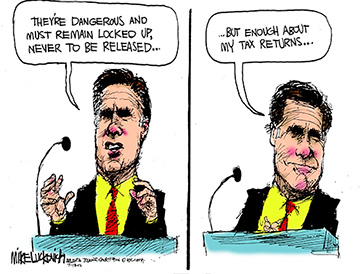
Mitt is so infuriated about being asked to do what past presidential candidates have done and release several years of his tax returns that he seems to have lost sight of his long-term goal of winning over independent voters and decided to figuratively don one of those hats with tea bags dangling from it. This is going to be an ugly and embarrassing spectacle.
Ed Kilgore asks: “Is Team Romney Becoming Unhinged?” Kilgore concluded yesterday, as I did, that John Sununu’s ugly remarks on Tuesday morning were part of a deliberate strategy by the Romney campaign to follow Donald Trump and the Tea Party in trying to paint President Obama as “foreign” and not a real American.
Did Team Romney really think their candidate could run around the country citing the brilliant job-creating success of Bain Capital as his primary credential for becoming president and not get challenged about it? And did they not expect demands that the richest man ever to win a presidential nomination release his tax returns? I mean, the attacks they are dealing with now are blindingly obvious. Any Romney opponent who didn’t make them would be guilty of extreme political malfeasance. So what gives?
Apparently what really got Romney’s goat was Obama adviser Stephanie Cutter’s statement that if Romney had lied on SEC forms, that would be a felony.
Romney’s aides remain particularly livid about Obama spokeswoman Stephanie Cutter’s suggestion last week that Romney committed a crime by filing apparently conflicting documents to the FEC and SEC.
“[Obama’s] policies have been such utter failures, the only thing he can do is to try to destroy a decent man and his wife,” the adviser said. “So he gets some hack political adviser from Chicago who has nothing to point to in her own life, and tells her to call him a felon… When did our politics get to that point? I mean, it’s Nixonian.”
Kilgore writes:
Try to destroy a decent man and his wife? Nothing to point to in her own life? This is such an over-the-top reaction to a banal comment by Cutter (who didn’t call Romney a “felon,” but simply observed that if he did misstate his role at Bain in a SEC filing, that’s potentially a felony) that you have to believe it’s coming from the candidate himself. Apparently, the mere suggestion he might have possibly committed a crime has sent him and his staff into a real spiral.
Don’t you bet Rick Santorum and Newt Gingrich wish they had known about this particular soft spot! Mention the criminal code and watch Mitt melt down!
At Talking Points Memo, Benjy Sarlin and Evan McMorris-Santoro opine: Romney’s New Plan To Go After Obama’s Biography Is A Gamble.
The Romney campaign had previously shot down the idea of revisiting many of the character attacks that first emerged in the 2008 election. Romney strongly repudiated an independent proposal by Republican ad man Fred Davis to run ads reviving the Rev. Jeremiah Wright controversy, for example.
Asked by TPM whether he felt reports of Romney’s new approach “kinda vindicate [sic]” his biography-based ad pitch, Davis e-mailed: “Only kinda?”
The assumption up to this point among strategists on both sides has been that objections to attacking Obama as a teen drug user or as personally corrupt were about keeping the message on the president’s record in office. The biggest conservative outside money groups, like American Crossroads, focus on Americans’ economic struggles, based on research showing it to be the most effective angle.
“Obama is setting a trap, and Romney is not a Chicago street fighter,” unaligned GOP consultant Ford O’Connell told TPM. “If Romney dabbles in this tit-for-tat style of political warfare for too long, he will lose.”
Romney is really playing into Obama’s hands by refusing to just release his tax returns and now embracing Tea Party bigotry. Obama’s advisers must be high fiving each other and grinning ear to ear.
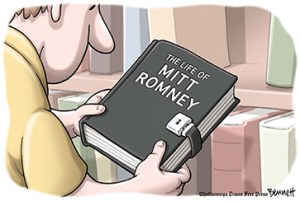
Check this out: Mitt Romney On Tax Return Controversy: ‘It’s Kind Of Amusing’
“It’s kind of amusing,” Romney told Columbus, Ohio, CBS affiliate WBNS. “I’m releasing two years of records as well as all that’s legally required and, for that matter, I’m doing the same thing John McCain did when he ran for president four years ago, which is releasing two years of returns, and we’ll see what time has to say about this.”
Yep, we’ll see. And watching Mitt self-destruct is going to be a lot of fun. Time to stock up on popcorn.
And speaking of right wing bigots, Supreme Court Joke Justice Antonin Scalia told CNN’s Piers Morgan that anyone who is unhappy about the Bush v. Gore decision should just “get over it.”
“Well, I guess the one that created the most waves of disagreement was Bush v. Gore,” says Scalia, referring to the famed United States Supreme Court decision dealing with the dispute surrounding the 2000 presidential election. “That comes up all the time, and my usual response is ‘get over it.'”
Noting that it was the Democratic candidate who brought the case into the Courts, Scalia says he hasn’t lost any sleep over the result:
“No regrets at all, especially since it’s clear that the thing would have ended up the same way anyway,” recalls the 76-year-old. “The press did extensive research into what would have happened, if what Al Gore wanted done, had been done, county by county, and he would have lost anyway.”
I’ve found a couple of important long reads for you. First, from Alternet: How America Became a Country That Lets Little Kids Go Homeless. If you guessed it goes back to the mean-spirited Reagan administration, you’re correct.
An interesting fact about family homelessness: before the early-1980s, it did not exist in America, at least not as an endemic, multi-generational problem afflicting millions of poverty-stricken adults and kids. Back then, the typical homeless family was a middle-aged woman with teenagers who wound up in a shelter following some sort of catastrophic bad luck like a house fire. They stayed a short time before they got back on their feet.
In the 1980s, family homelessness did not so much begin to grow as it exploded, leaving poverty advocates and city officials stunned as young parents with small children overwhelmed the shelter system and spilled into the streets. In New York City, the rate of homeless people with underage kids went up by 500 percent between 1981 and 1995. Nationally, kids and families made up less than 1 percent of the homeless population in the early 1980s, according to advocate and researcher Dr. Ellen Bassuk. HUD estimates put the number at 35 percent of people sleeping in shelters in 2010….
The reasons behind the jump in family homelessness are not complex, Núñez says. “It was the gutting of the safety net. Reagan cut every social program that helped the poor. Then there’s inflation so their aid checks are shrinking. Where are they going? Into the streets, into the shelters.”
It’s so true. When I first moved to Boston in 1967, the only homeless people you saw were down and out alcoholic hobo types. Then Reagan emptied the state psychiatric hospitals and cut funds for low cost housing, and other safety net programs. Suddenly, the Boston area was filled with homeless people–people who slept in their cars in supermarket parking lots or outside along the Charles River in Harvard Square. It was truly horrifying.
At the New York Review of Books, David Cole reviews two new books on Obama’s terrorism policies and concludes that Obama isn’t exactly Bush III, but he hasn’t restored our constitutional rights either.
While President Obama, unlike his predecessor, has steered clear of the politics of fear, he has also steered clear of the politics of defending our ideals. Like many Democrats, he seems afraid of being painted as soft on terrorism if he advocates for respecting the rights of others. We can only hope that in a second term, with more confidence and an eye on his legacy rather than short-term polls, he will take on the defense of American ideals that he let pressure from the security bureaucracy and political caution stop him from pursuing in the first.
And while you’re at the NYRB, take a look at this piece by William Pfaff: When the Army Was Democratic.
The US had national service from September 1940, just before World War II, until 1971, when the Vietnam War was ending. It was accepted with patriotic resolution at its start, and hated by its end. I am of an age to have put on my country’s uniform in high school ROTC in 1942, when I was fourteen years old. I put it on again for the Korean War, and did not take it off for the last time until 1958, after limited active reserve service. That was a total of sixteen years.
I can’t say that I enjoyed military service, but I learned a lot, about myself and about others—including the young black men who made up a good half of my all-southern, and mostly rural, basic training company (where I was not only the sole college graduate but probably the only high school graduate). This was just two and a half years after President Harry Truman had ordered the army desegregated. The regular army—which has always been essentially a southern institution—hated and feared the consequences of that order, but said “yes, sir” and did it, producing undoubtedly the biggest and most successful program of social engineering the United States had ever experienced. It also created what remains today the most successful route of social and professional ascension for talented young black males from poor communities that the country has ever known.
The army, in my opinion, did more to desegregate the United States than the civil rights movement of the 1960s. From 1948 on, nearly every able-bodied young man in the United States served and lived side by side with Americans of all colors, all in strict alphabetical order, in old-fashioned unpartitioned barracks, sleeping bunk to bunk, sharing shelter-halves on bivouac, in what amounted to brotherly endurance of the cold, heat, discomfort, and misery of military training—and following that, of service.
Just a few more quick links I want to call your attention to. Joseph Cannon has a horrifying post up about connections between Mitt Romney and the teen rehab industry in which kids are abused, tortured, and brainwashed. Also see this article in Salon linked in the Cannon piece.
Dakinikat will be interested to know (if she doesn’t already) that Bobby Jindal’s exorcism history has made it into the corporate media. And Charlie Pierce wrote about it yesterday.
Those are my suggestions for today. What are you reading and blogging about?
Disenfranchising the Weakest Among Us from their basic Constitutional Rights
Posted: July 18, 2012 Filed under: abortion rights, Voter Ignorance, War on Women | Tags: Voter ID laws, Voting Rights Act 22 CommentsThere are elements in the Republican’s Tea Party movement and in many of their supporters that are so obviously misogynistic, xenophobic, and racist that it is difficult to stomach their political discourse. I continue to find the Tea Party movement to contain some of the most unhinged individuals we’ve see influence American governance in some time. Here’s the latest example from Tennessee.
Conservatives and Tea Party activists in Tennessee have recently pushed several Republican Party county organizations to pass resolutions criticizing the state’s Republican governor for, among other things, employing Muslims, gay people, and Democrats.
“The action or actions of the Republican elected Governor of the Great State of Tennessee and his administration have demonstrated a consistent lack of conservative values,” a resolution passed by the Stewart County Republican Party reads in part, according to a copy obtained by The Tennessean. (The Tennessean obtained two of the resolutions.)
We’ve known for some times that the right wing would like to completely remove basic rights from women and minorities. They are striking at not only our immigration laws, our rights to use birth control and abortion, but our basic right to vote and participate in our Democracy.
I’ve read several things just this week that I find terribly disturbing. The first is that many folks expect that the Supreme Court will strike down the Voting Rights Act of 1965.
It’ll be tough to top the drama of the Supreme Court season that just ended. Or so it would seem. When the justices reconvene in October, they’re likely to consider some of the most contentious social issues dividing the country. And judging from snippets in past opinions, that could mean an upheaval in U.S. civil rights law.
The court has already announced that it will hear a challenge to affirmative action in higher education. In that case, a white student rejected by the University of Texas is arguing that the school doesn’t need to choose students based on racial preferences because it already achieves diversity by guaranteeing admission to state residents in the top 10 percent of their high school class.
Affirmative action was upheld nine years ago, but the composition of the court has changed since then. Five members are now openly skeptical of racial preferences. As Chief Justice John Roberts put it in a 2007 case involving integration at the K-12 level: “The way to stop discrimination on the basis of race is to stop discriminating on the basis of race.”
The justices could also deal a blow to minorities if they take up a challenge to the 1965 Voting Rights Act brought by Shelby County, Ala. Officials there say a provision in that law requiring jurisdictions in 16 mostly southern states to get federal clearance before changing their voting rules—so as not to disenfranchise blacks and other minorities—unfairly targets jurisdictions for racial crimes of the past.
“I expect the Voting Rights Act to go down,’’ says Kermit Roosevelt, who clerked for former Supreme Court Justice David Souter and now teaches constitutional law at the University of Pennsylvania Law School. “The court has foreshadowed that result, and Roberts seems to want it.” In a 2009 challenge to the landmark law, the justices granted some local governments more leeway in changing their election procedures, and Roberts in particular hinted he’d be sympathetic to striking down the so-called preclearance provision, saying that it raises “serious constitutional questions.”
The approach of the right wing has been to whittle away at basic rights by forcing appointment of extremist judges to the benches on Republican Presidents and blocking appointments to the bench by Democrats. It also has been using each red state to create serpentine regulations that basically make exercising rights nearly impossible. Many are set up to create challenges in the courts to long standing precedent like Roe v Wade or Brown v Board.Witness the Mississippi law to shut down the state’s sole abortion clinic by tailor fitting a regulation to that one specific clinic to drive it out of business. It may be working according to news released today.
The clinic argues that the law will effectively ban abortion in the state and endanger women’s health by limiting access to the procedure. It argued that the law is unconstitutional and would close the clinic “by imposing medically unjustified requirements on physicians who perform abortions.” Lawyers also cite statements from Mississippi officials who said the law was intended to close the clinic.
A denial of admitting privileges could bolster the clinic’s arguments that the law is unconstitutional, a lawyer for the state has suggested. But a final ruling could come only after a trial, and the loser could appeal.
The state argues that the law is intended to enhance the safety of patients. The state’s lawyers have argued that Jordan should disregard statements about trying to close the clinic, a claim he greeted with skepticism in court.
More administrative steps would have to follow before the clinic could be shut. Sharlot said the clinic would have 10 calendar days to respond to any findings. The state’s lawyers have said that a facility not complying with a law would get at least 30 days before an administrative hearing. If a license is revoked at a hearing, the clinic would get 30 days to appeal that decision. Health department officials have said it could take as long as 10 months to close the clinic if it failed to comply.
This is the same shenanigans with Voter ID laws. Use incremental laws that “sound” reasonable to many low information, Fox-propaganda-challenged citizens that have devastating results on the weakest and the poorest among us. Then, keep it up and take any legal challenge as far as you can to whittle away at long standing precedent. The extremists are well aware of the dog whistles scattered throughout these laws and media blitzkriegs. Also, they frequently cloak their real purpose in some high minded rhetoric. They want to stop nonexistent voter fraud in the Voter ID case. It’s making sure ignorant little women are truly informed in the case of exercising abortion rights. Neither of these are real problems.
Here is a study worth reading.
The Challenge of Obtaining Voter Identification Publications
By Keesha Gaskins and Sundeep Iyer
– 07/17/12Ten states now have unprecedented restrictive voter ID laws. Alabama, Georgia, Indiana, Kansas, Mississippi, Pennsylvania, South Carolina, Tennessee, Texas, and Wisconsin all require citizens to produce specific types of government-issued photo identification before they can cast a vote that will count. Legal precedent requires these states to provide free photo ID to eligible voters who do not have one. Unfortunately, these free IDs are not equally accessible to all voters. This report is the first comprehensive assessment of the difficulties that eligible voters face in obtaining free photo ID.

Here’s some basic data found in the study and reported in the executive summary.
The 11 percent of eligible voters who lack the required photo ID must travel to a designated government office to obtain one. Yet many citizens will have trouble making this trip. In the 10 states with restrictive voter ID laws:
- Nearly 500,000 eligible voters do not have access to a vehicle and live more than 10 miles from the nearest state ID-issuing office open more than two days a week. Many of them live in rural areas with dwindling public transportation options.
- More than 10 million eligible voters live more than 10 miles from their nearest state ID-issuing office open more than two days a week.
- 1.2 million eligible black voters and 500,000 eligible Hispanic voters live more than 10 miles from their nearest ID-issuing office open more than two days a week. People of color are more likely to be disenfranchised by these laws since they are less likely to have photo ID than the general population.
- Many ID-issuing offices maintain limited business hours. For example, the office in Sauk City, Wisconsin is open only on the fifth Wednesday of any month. But only four months in 2012 — February, May, August, and October — have five Wednesdays. In other states — Alabama, Georgia, Mississippi, and Texas — many part-time ID-issuing offices are in the rural regions with the highest concentrations of people of color and people in poverty.
More than 1 million eligible voters in these states fall below the federal poverty line and live more than 10 miles from their nearest ID-issuing office open more than two days a week. These voters may be particularly affected by the significant costs of the documentation required to obtain a photo ID. Birth certificates can cost between $8 and $25. Marriage licenses, required for married women whose birth certificates include a maiden name, can cost between $8 and $20. By comparison, the notorious poll tax — outlawed during the civil rights era — cost $10.64 in current dollars.
The result is plain: Voter ID laws will make it harder for hundreds of thousands of poor Americans to vote. They place a serious burden on a core constitutional right that should be universally available to every American citizen.
This November, restrictive voter ID states will provide 127 electoral votes — nearly half of the 270 needed to win the presidency. Therefore, the ability of eligible citizens without photo ID to obtain one could have a major influence on the outcome of the 2012 election.
This is disturbing beyond words. We’ve already heard personal stories from friends here with disabilities of their struggles to obtain these kinds of ID cards. Right wingers laugh this off with careless disregard for the very things that make our country precious. It is obvious that winning their agendas by any means necessary is at the heart of all of these kinds of laws. Every one should be highly concerned about all these laws aimed at whittling away at our basic rights. This strategy is being used to usurp more of them everyday. Most of them are aimed at women, racial and religious minorities, and the GLBT community. What makes this worse is the amount of money being poured into creating these awful laws by religious institutions like the LDS Church and the Catholic Bishops and business sponsored organizations like ALEC. Tax exempt churches were instrumental in funding efforts to defeat the ERA and push anti-marriage equality and family planning defunding at all levels of government. Removing votes from voters unaligned with their causes is just one more way to relieve the vulnerable among us of basic rights.
We should be fighting this tooth and nail.

 peej
peej Carissa
 bostonboomer
 dakinikat
 ecocatwoman
 mablue2
 Mama Lopez
 peggysue22
 quixote
 skydancingguestblogger
 Mona (aka Wonk the Vote)



 Sky Dancing
Recent Comments