
Tuesday Reads: Marilyn Monroe, Fifty Years Gone
Posted: August 7, 2012 Filed under: morning reads | Tags: 60 Minutes, Arthur Miller, Brooklyn, Marilyn Monroe, Mike Wallace, movies, nostalgia, Photography, popular culture, The Seven Year Itch 24 Comments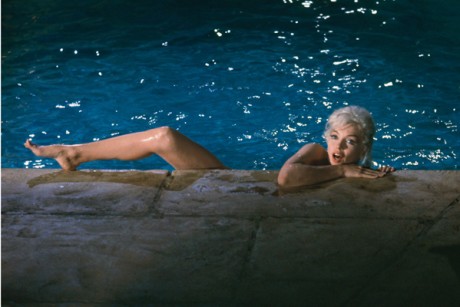
Lawrence Schiller, “Marilyn Monroe,” 1962. (Credit: Courtesy of Judith and Lawrence Schiller; Lawrence Schiller © Polaris Communications, Inc.)
Good Morning!!
I’m writing this late on Monday night. I’m a little burned out on the news, and I haven’t been feeling so great today, so I thought I’d skip politics and devote my Tuesday morning post to noting the 50th anniversary of the day we lost Marilyn Monroe, August 5, 1962. We can talk about the news in the comments though!
LA Weekly has a report of the memorial. The main speaker was Professor Lois Banner, the author of a new biography of Monroe.
Lois Banner certainly must be considered one of the Marilyn religion’s rising gospel writers. Banner, a professor of women’s history at USC, is the author of Marilyn: The Passion and the Paradox, her well-received, scrupulously researched and ten-years-in-the-writing biography, whose release was scheduled to coincide with the anniversary.
Banner’s book, which attempts to demolish any lingering image of Marilyn as a dumb blonde and merely the sexual object of male fantasy, asserts that the star was shaped by a complicated and deeply conflicted personality. Marilyn was marked by an intense intellectual curiosity but also by emotional and sexual abuse as child that would develop into full-blown sexual addiction and her ultimately tragic substance abuse.
Outside the memorial, the 73-year-old writer briefly spoke about Marilyn’s status as an “icon of the American character” and the key to her enduring fascination. The answer, according to Banner, is complex but begins with her tragically early death. Dying at the height of her beauty instantly made the star what Banner calls “the Aphrodite of the national imagination — the woman who represents our sexual desires and dreams.”
To that she adds the aura of mystery contributed by Marilyn’s involvement with the Kennedys and the conspiracy theories surrounding her death. Then there are the photographs. Marilyn was probably the most photographed woman of the 20th century, Banner says, “and the famous images of her literally run into the thousands. She realized herself in front of the camera, and many have said the camera was her real lover.”
Here are two Huffpo links to some lovely photos of Marilyn:
Marilyn Monroe Photos: Candid Shots Of The Woman Behind The Starlet
Marilyn Monroe ‘Intimate Exposures’: Exhibit Unveils Never-Before-Seen Bruno Bernard Photos
Between inventing pin-up photography, earning the nickname “Bernard of Hollywood” and discovering Marilyn Monroe, Bruno Bernard may just be the world’s most famous photographer.
In her new book “Marilyn: Intimate Exposures,” Bernard’s daughter, former Playboy Playmate Susan Bernard, has released a collection of her father’s most famous photographs of the one and only Marilyn Monroe–including 40 never-before-seen shots.
In the collection are the first professional photographs ever taken of Monroe (then named Norma Jean Dougherty), intimate backstage shots throughout her career, original negatives, Bernard’s work notes and letters from Monroe to Bernard, including one reading, “Remember Bernie, you started it all.”
Bernard is presenting the collection at the San Francisco Art Exchange for its United States premiere during the 50th anniversary commemoration of Monroe’s death.
The photos at both links are wonderful. I really enjoyed looking at them.
The LA Times reports on another exhibit of Marilyn photos.
One of the many disappointments to befall the actress’ tragic life was her struggle to have a child, having suffered multiple miscarriages. Very few images of a pregnant Monroe exist but famed celebrity photograper Phil Stern found himself at the right place at the right time during her last pregnancy with third husband, playwright Arthur Miller.
In 1958, Look magazine assigned Stern to capture what studio mogul Sam Goldwyn saw through his office window. Perched high and out of sight from the people below, he spotted Monroe walking across the lot during a break from filming “Some Like it Hot,” and snapped the photo just as the wind blew open her kimono, revealing her pregnant belly.
This photo is just one of many that Stern took of Monroe during an illustrious career that spanned six decades. Twenty-three images from his collection will be on view at The Phil Stern Gallery opening Sunday on the 50th anniversary of her untimely death. The exhibition continues through Nov 1.
You can view some of the photos at the link.
On Sunday night, 60 Minutes ran a 1987 interview with Playwright Arthur Miller by Mike Wallace.
During their relationship, Miller wrote the screenplay for “The Misfits,” with the lead role played by Monroe. She played a wounded young woman, who falls in love with a much older man. It would be her last film.
Despite the success of 1961’s “The Misfits,” Miller’s marriage to Monroe had been struggling for months, and the couple ultimately separated. In addition to drug and alcohol dependency, Monroe had endured several miscarriages and was battling depression.
“I guess to be frank about it, I was taking care of her. I was trying to keep her afloat,” Miller told Wallace. “She was a super-sensitive instrument, and that’s exciting to be around until it starts to self-destruct.”
When Wallace asked Miller if he knew Monroe’s life was destined for disaster, he said, “I didn’t know it was doomed, but I certainly felt it had a good chance to be.” Less than two years later, Monroe was found dead at the age of 36 in her California home.
There are some more lovely photos in this NY Daily News article: Marilyn Monroe, famed blond bombshell, yearned to retire to Brooklyn in her twilight years
The blond bombshell, who lived in New York City on and off for several years before dying in Los Angeles in 1962, called Brooklyn her “favorite place in the world” in a radio interview with NBC’s Dave Garroway.
“When I retire I’m going to retire to Brooklyn,” Monroe told the late “Today” show host. “That’s my favorite place in the world, so far, that I’ve seen.”
Monroe, then 31-years-old and inbetween her marriages to New York Yankees Hall of Famer Joe DiMaggio and playwright Arthur Miller, admitted she hadn’t “travelled much, but I don’t think I’ll find anything to replace Brooklyn.”
….
When asked what it was about Brooklyn she loved, Monroe’s answer was simple: “Almost everything.”
“I just like walking around,” she said in her soft, whispy tone.
Monroe said one highlight was the view of Manhattan which can only be seen from Brooklyn, but stressed her affection for the borough was more than that.
“It isn’t only the view, it’s the people,” Monroe said. “The people and the streets and the atmosphere, I just like it.”
On Weekend Edition, NPR ran a piece on Marilyn Monroe As An ‘All-Around’ Comedian.
I love just about all of Marilyn’s movies, but I guess my favorite is The Seven Year Itch.
The Rachmaninoff fantasy scene:
And the famous subway scene:
It’s hard to believe it was all so long ago. Sorry this post is so short, I should be back to my regular self in the morning. Now it’s your turn to fill me in on the real news of the day. I’ll pitch in some links too, of course.
Romney Campaign Sends in the Clowns…er…Attack Dogs
Posted: August 6, 2012 Filed under: 2012 presidential campaign, Republican presidential politics, U.S. Politics | Tags: Harry Reid, John Kerry, John McCain, John Sununu, Lindsey Graham, Mitt Romney, Reince Priebus, Swift Boating, tax evasion, tax returns 27 Comments
You have to hand it to Harry Reid. He has put Mitt Romney in a corner that he can’t get out of. As long as Reid doesn’t back down–and so far he hasn’t–Romney is damned if he does and damned if he doesn’t. If Mitt gives in and releases his tax returns for the past ten years, the media and the Obama campaign will tear them apart to find out what he’s hiding. If Mitt continues to stonewall the speculation will continue to grow and overwhelm his campaign and the upcoming Republican Convention.
Chris Cillizza and Aaron Blake wrote about Romney’s “Harry Reid Problem” this morning.
At its root, the problem for Romney on this matter is that he and Reid are simply not playing by the same set of rules. Here’s why.
1. Reid isn’t up for re-election until 2016 (if he even decides to run again, since he will be 76 years old that year). 2. His allegation against Romney only strengthens his hand among his Democratic colleagues — in and out of the Senate. 3. He’s not running for president and, therefore, isn’t subject to the same sort of transparency demands that Romney is. 4. He’s far less well-known than Romney, meaning that by engaging Reid, the Republican presidential nominee is punching down in a big way.
“He’s fearless and shameless,” said Jon Ralston, the leading political journalist in the state of Nevada and a man who has watched Reid’s career closely. “The most dangerous man is one who does not care.”
The shaming of Reid, which is clearly what Republicans — Romney included — are now set on doing, then, likely won’t work. Several close Reid allies insist he simply will never reveal the alleged source of the Romney tax information and, they argue, politically speaking he won’t ever have to, since the allegation — as we noted above — does little harm to Reid’s political career.
In politics, a charge unanswered is a charge believed. It’s why Massachusetts Sen. John Kerry’s (D) slow response to charges regarding his service in Vietnam — allegations Kerry clearly believed were beneath contempt — wound up playing a major role in his defeat in the 2004 presidential election.
“I just believe that this hurts Romney more,” said one senior Republican strategist who follows Nevada politics closely. “If he doesn’t produce his tax returns, this will probably continue. If he finally relents, then Reid just says ‘thank you.’”
So far, the Romney campaign response to Reid’s accusations has not been impressive. Yesterday, Reid’s accusation was the talk of the Sunday shows. RNC Chairman Reince Priebus called Reid a “dirty liar,” and this morning he said he’s not a bit regretful.
RNC Chairman Reince Priebus said Monday he would “triple down” on his charge that Senate Majority Leader Harry Reid is a “dirty liar” and said the GOP won’t allow Democrats to “manufacture stories” and “steal an election.”
“There’s no triple down in blackjack, but I’ll triple down on my comments yesterday,” Priebus said on “Fox & Friends,” referring to the epithet he first leveled Sunday on ABC’s “This Week.”
“It’s amazing to me that there can be any honor in a position that he holds, that he’s degraded so far down the tubes, Priebus continued. “It is what it is. He’s a dirty liar, and we’re moving on.”
Reince might be moving on, but no one else is. Yesterday, Lindsey Graham said that Reid is “making things up.”
Republican Sen. Lindsey Graham strongly took issue with Senate Majority Leader Harry Reid’s accusations that Mitt Romney has not paid taxes in 10 years, saying Sunday that the Democratic leader was “lying.”
“What he did on the floor of the Senate is so out of bounds. I think he’s lying about his statement, of knowing something about Romney,” Graham said on CNN’s “State of the Union.”
Oddly, the one person who knows for sure what is in Romney’s tax returns didn’t turn up on the Sunday Shows this week–how often does that happen? John McCain got 23 years of Romney’s tax returns during the VP vetting process in 2008. Either McCain or some of his advisers know what’s in there.
So why isn’t McCain standing up and saying, “I saw Romney tax returns and he paid substantial amounts of federal income taxes in every year we looked at”? McCain did join his colleagues on the fainting couch last week, but only to give a weak rejoinder, saying “Reid may have ‘gone over the line.'” Why isn’t he defending the man who will be the Republican Party’s nominee?
Could it be that McCain doesn’t want to get caught in a lie if Romney is eventually forced to the secrets of his tax returns?
This morning Romney released his nastiest attack dog. John Sununu told Politico:
“Look, Harry Reid is a bumbling Senate leader,” the former New Hampshire governor said Monday on Fox News. “He hasn’t been able to pass a budget, he hasn’t been able to do anything about entitlement reform, he’s done nothing worthwhile except the bidding of the Obama administration. They have pointed out that Harry is lying, and the public is beginning to understand that Harry is lying.”
Sorry John, what the public is beginning to understand is that Mitt Romney is a lying tax evader. More whining from Sununu:
“It’s not Harry Reid, it’s President Obama and the Obama campaign doing what they always do,” he said. “The Obama campaign and President Obama are the ones that are behind this dishonesty and misrepresentation because they are trying to hide the failure of this abysmal presidency that we have had in office the last four years.”
He added: “It is, in my opinion, eroding the only asset he ever had, and that was a general, likable feeling that the public had toward him.”
The interesting thing is that all of these Romney defenders are doing the same thing they’re accusing Harry Reid of doing. They have no idea what’s in Romney’s tax returns or who, if anyone, told Reid that Romney didn’t pay federal income taxes for a decade. Only one of these guys knows for sure what’s in those returns, and John McCain isn’t talking–unless he’s the one who whispered in Harry Reid’s ear.
Monday Reads
Posted: August 6, 2012 Filed under: morning reads | Tags: A knight's grave, Bain Capital, Bush v. Gore, Graham Nash, Irony, Sandra Day O'Connor, SCOTUS, Social Security, the brain, ToM, vulture capitalists 33 Comments Good Morning!
Retired Justice Sandra Day O’Connor is speaking out on America’s declining opinion of the Supreme Court.
Former Supreme Court Justice Sandra Day O’Connor suggests that declining public approval of the court dates back to the controversial Bush v. Gore decision, which decided the 2000 presidential race.
“That was one that was widely talked about at the time, as you know, and involved the public in a presidential election,” O’Connor said in an interview aired Sunday on CBS’s “Face the Nation.” “And that could be something that triggered public reexamination.”
She said she wasn’t sure if people thought the court had become too political.
“But I suppose that’s part of it, yes,” she said. “And of course, anytime you’re deciding a case involving a presidential election, it’s awfully close to politics.”
She cast the deciding vote in the case, but she demurred on taking responsibility.
“I don’t see how you can say anybody was the deciding vote,” she said. “They all counted.”
O’Connor said she has no regrets about her vote.
“No, I mean it was a tough deal; i[t] was a closely fought election; and it’s no fun to be part of a group of decision makers that has to decide which side the ball is going to fall on,” she said.
I think if I were her that I’d feel a lot of remorse for that decision considering the decline that the Bush administration has brought to this country in every possible, thinkable positive category of national endeavor.
This should make people appreciate Social Security. A lot of Americans with ” virtually no assets”. What would so many do without it and Medicare?
It is a central worry of many Americans: not having enough money to live comfortably in old age. Now an innovative paper co-authored by an MIT economist shows that a large portion of America’s older population has very little savings in bank accounts, stocks and bonds, and dies “with virtually no financial assets” to their names.
Indeed, about 46 percent of senior citizens in the United States have less than $10,000 in financial assets when they die. Most of these people rely almost totally on Social Security payments as their only formal means of support, according to the newly published study, co-authored by James Poterba of MIT, Steven Venti of Dartmouth College, and David A. Wise of Harvard University.
That means many seniors have almost no independent ability to withstand financial shocks, such as expensive medical treatments that may not be covered by Medicare or Medicaid, or other unexpected, costly events.
“There are substantial groups that have basically no financial cushion as they are reaching their latest years,” says Poterba, the Mitsui Professor of Economics at MIT.
Here’s a great article from AlterNet: “How Mitt Romney Got Rich Destroying American Jobs and Promoting Sweatshop Capitalism”.
Right now, a man whose predatory career has claimed the jobs of countless Americans is trying to wrap himself in the flag and call himself a “job creator” and “wealth creator.”
Does he mean miserable jobs in Chinese factories? Wealth for the 1 percent? Apparently that’s exactly what he means.
Republicans claim that Mitt Romney’s entrepreneurial activities at Bain Capital have been good for Americans. The truth is that Romney has spent his career offshoring and outsourcing American production processes — and associated jobs — to countries like China where human labor is valued in the market at a very low wage rate.
Mitt Romney’s tenure as Bain’s CEO has long linked him to offshoring and outsourcing. Even today, although he is no longer in that position, Romney still makes a nice profit on undertakings done long after he left the day-to-day management of the firm.
Those profits continue to pour in because of Bain’s practice of vulture capitalism. This isn’t Schumpeter’s creative destruction. It’s not even what good equity capital companies achieve. It’s piracy pure and simple.
Here’s a great interview with Graham Nash. According to TD: “Graham Nash Still Really Gives a S#!*”
Fish: So where are they then? Where are the songwriters who try to remind us that human beings are precious and fragile and deserving of a world that is environmentally sound, just as an example? Where are the poets to make beautiful the notion that we should not be victimized by the shitty foreign and domestic policies of our governments? Such subject matter seems much less apparent in contemporary popular music.
GN: It’s less apparent because it’s not being shown. It’s less apparent because the people who own the world’s media you can count on one hand. It’s less apparent because [corporations] don’t want protest songs on their radios and their TVs and in their movies. They don’t want to stir up the sheep. They want you to fucking lie there and buy another pair of sneakers and another Coca-Cola, shut the fuck up while we rob you blind. That’s what’s going on—“Bread and circuses, Part II.”
Fish: Which, I guess, brings us to the significance of the Occupy Wall Street movement.
GN: Right, it’s important for people to realize that they’re not alone and that they’re not crazy for thinking we’re fucked. [The movement] is about recognizing the division between the haves and the have-mores—it’s not even between the haves and have-nots. It’s between the haves and have-mores. That’s what’s going on here and people recognize that and they’re getting infuriated.
Fish: And it’s so obvious, this victimization of the 99 percent, that the whole thing came about as a mass realization, like you said. It didn’t require the emergence of a leader or a prophet to arrive on the scene and convince people of something they weren’t aware of.
GN: Exactly, there is no leader, which is a good thing. What happens with movements, historically, is there is usually a face, a leader, for the movement, and an enemy, if he’s smart, will attack that leader.
So, here’s something in my continuing legacy of sharing my fascination with really old graves with you. This is from the UK Telegraph: “Skeleton reveals violent life and death of medieval knight , 620-year-old skeleton discovered under the floor of Stirling Castle has shed new light on the violent life of a medieval knight.”
Archaeologists believe that bones found in an ancient chapel on the site are those of an English knight named Robert Morley who died in a tournament there in 1388.
Radio carbon dating has confirmed that the skeleton is from that period, and detailed analysis suggests that he was in his mid-20s, was heavily muscled and had suffered several serious wounds in earlier contests.
The knight was laid to rest under the stone-flagged floor of a chapel near the castle’s royal apartments and his skeleton was excavated along with 11 others in 1997.
However, it was only recently re-examined following advances in laser scanning techniques that not only revealed the nature of the three wounds, but also showed that the knight had lost teeth, probably from another blow or from falling from his horse.
Gordon Ewart, of Kirkdale Archaeology, which carried out the excavation for Historic Scotland, said: “This is a remarkable and important set of discoveries.
“At first we had thought the arrow wound had been fatal but it now seems he had survived it and may have had his chest bound up.”
Mr Ewart said that Morley was by far the most likely candidate. His skeleton also shows the effects of riding on the ankles and muscle injuries caused by lifting heavy loads.
Talk about your short brutal lives.
Using magnetic resonance imaging, scientists seem to have located a part of the brain centrally involved in grasping irony.
The
French research team that made the latest contribution to this effort presents its findings in the current issue of the journal NeuroImage. Referring to a part of the brain known as the “ToM network,” the researchers write, “We demonstrate that the ToM network becomes active while a participant is understanding verbal irony.”
This isn’t just one of those “shot in the dark” MRI studies, where you see what brain regions happen to light up when people engage in a particular mental activity. The ToM network has been the focus of previous work on irony apprehension, and enough is known about it to give us some ideas about the particular role it could play in that apprehension.
Here’s how the experiment worked. The researchers prepared short written stories, and each story came in two versions. Both versions contained a sentence that could be read either literally or ironically, with the correct reading depending on how the context had been set earlier in the story. In one story, for example, one opera singer says to another, “Tonight we gave a superb performance,” and whether the sentence is ironic or literal depends on whether the performance had been described earlier in the story as a failure or as a success. The researchers had correctly predicted that the ToM network would show more activity when the sentence, read in context, was ironic than when it was literal.
ToM stands for “theory of mind,” which in turn refers to the fact that we naturally attribute beliefs and intentions and emotions to people we interact with. That is, we develop a “theory”–though not necessarily a theory we’re consciously aware of–about what’s going on in their minds. (An inability to do this is thought to play a role in autism.) And this “theory” in turn shapes our interpretation of things people say. The “ToM network” is a brain region–or, really, a network of different brain regions–that seems to play an important role in the construction of these theories.
It makes sense that parts of the brain involved in theorizing about other people’s minds would be involved in grasping irony. After all, detecting irony means departing sharply from the literal meaning of a sentence, something it’s hard to do without having a “theory” about the intent behind the sentence.
I’m sure we’ll begin to hear the horrible news about the murder of Sikhs in Wisconsin today as well as other things. Hopefully, this little bit of interesting stuff will get your day started out okay! What’s on you reading and blogging list today?
Another Day in American Life: Domestic Terror against Religious Minorities & Gun-based Mass Murder
Posted: August 5, 2012 Filed under: just because | Tags: Sikh Temple Shooting, Wisconsin 28 Comments By now, you’ve probably heard about the death of 7 people in a Sikh Gurdwara in Wisconsin. The FBI will be investigating this as an act of domestic terrorism. There are three gun shot victims in critical condition in the hospital. One is a police officer who was responding to the 911 call and was ambushed by the shooter.
Gun violence in the United States claims so many victims that events like these seem every day. How many people need to die before we can challenge the NRA and its stranglehold on our elected officials?
I can only imagine what horrible details are going to come out about this shooter who was shot dead by the injured police officer’s partner. The crime scene and the perpetrator will be investigated over night.
Today, we should remember these victims and all the victims of senseless gun crimes enabled by a society with a gun fetish masquerading as an appreciation of a constitutional right.
Please share your thoughts and links with us.
Om Shanti Om.
Swift Yachting Democracy
Posted: August 4, 2012 Filed under: 2012 elections, Citizen's United & Super Pacs, U.S. Politics, We are so F'd | Tags: citzen's united, plutocracy, Sheldon Adelson 28 Comments While Tea Bagging Republicans are trying to convince every one that elections are being stolen by imaginary illegal voters, a finger bowl full of billionaires are buying up air time via Super Pacs to up the negative ad volume to 11. Here are some shocking facts from MoJo.
The 2012 elections are on track to be the nastiest in recent memory. By the tail end of primary season, in May, 70 percent of all presidential campaign ads were negative, up from a mere 9 percent at the same point in 2008. The culprits for this spike in attack ads were super-PACs and shadowy nonprofits, which together dominate the growing universe of outside political groups poised to spend billions of dollars this election season.
Now a new report from the liberal think tank Demos and the nonpartisan US Public Interest Research Group has revealed how what has been called a “tsunami of slime” is funded by a tiny cadre of wealthy donors.
Just 1,082 donors—a group small enough to fit inside a single high school gymnasium—accounted for 94 percent of all individual donations to super-PACs from January 1, 2011 to June 30, 2012. Those 1,082 donors amount to just 0.00035 percent of the US population.
I’ll just pause a second here while you mull those last two sentences over …
…
…
So, Romney is looking more and more like the loser these days so you ask, what will all this money do when it’s basically betting on another Romney that can’t even deliver a bronze? Well, how about this thought from Digby?
Romney may very well lose and everyone will say this shows that they failed, despite all their money. But these PACs and 501cs are not just about the presidential race. They are spreading this money around from the top of the ticket all the way to local races and their themes and talking points are all coordinated. I doubt they ever really believed this election was a shoo-in (or even really wanted to rock the boat — it’s not as if they haven’t been doing very, very well under Obama.) But they are setting up a system for the future:
During sessions of the “Weaver Terrace Group,” representatives of the embryonic Crossroads organization gathered with counterparts from groups such as the Chamber of Commerce, Americans for Tax Reform, and Americans for Prosperity, the funding vehicle affiliated with the billionaires David and Charles Koch. Crossroads served as referee, says CEO Law. “Conservative activists tend to act like six-year-olds on soccer teams,” he explains, “with everyone grouping around the ball and getting in each other’s way. Karl’s idea was that all of these organizations should share information, coordinate polling, reduce redundancy.”
Together with a follow-on ruling by the federal appeals court in Washington, Citizens United knocked several crucial holes in McCain-Feingold. Corporate and union money, for example, could now be used without restriction for “electioneering communications,” meaning radio and TV ads that mention a candidate’s name within 30 days of a primary or 60 days of a general election.
More important than the incremental increase in campaign-law porosity, though, was the passionately phrased celebration by Justice Anthony Kennedy of political spending in its manifold forms. Kennedy’s majority opinion declared that “the appearance of influence or access … will not cause the electorate to lose faith in our democracy.” Kennedy continued: “The fact that a corporation, or any other speaker, is willing to spend money to try to persuade voters presupposes that the people have the ultimate influence over elected officials.”
In Kennedy’s syllogism, democracy benefits from more speech. Political money is speech. Therefore democracy benefits from more political money.That’s so true. I certainly feel a new found faith in democracy knowing that this handful of billionaires are finally allowed to have the same influence over our government that I do.
Who is the 300 pound gorilla in this pen? Head back to the MoJo article for this tidbit.
The dominant presence among super-PAC donors is Las Vegas casino tycoon Sheldon Adelson and his wife, Miriam, who’ve given $36.3 million so far. That’s chump change for the Adelsons—in fact, $36.3 million is a mere 0.15 percent of their total wealth. It would take 321,000 American families giving up 0.15 percent of their wealth to match the Adelsons’ super-PAC giving.
So, is ANYONE doing ANYTHING about this?
Representative John Dingell (D-MI), the longest-sitting member of Congress, introduced a bill Thursday designed to force the Supreme Court to reconsider its Citizens United decision. Along with at least ten co-sponsors, Dingell’s Restoring Confidence in Our Democracy Act, would ban corporations and unions from making independent political expenditures. It would also subject Super PACs to the same contribution limits that exist with other PACs. Dingell intends the bill to provide “the factual record which details the negative effects of increased spending in our elections.” That factual record, he hopes, will get the Court to reverse itself, and restore Congress’ power to limit a form of spending that Dingell (rightly) believes has eroded even further America’s “confidence” in “our democracy.”
Dingell’s bill, however, is effectively two bills– one that would require the Court to reverse itself, if indeed the new law were upheld, and the other that would not require the Court to reverse itself but would instead give the Court a chance to address a kind of corruption that so far the Supreme Court has ignored. It is unlikely (in the extreme) that the Court is going to reverse itself. But if framed properly, Dingell’s bill could well map a way for Congress to staunch the corrupting influence of Super PAC spending without forcing the Court to eat its Citizens United words.
Let’s hope John and Bernie can get this thing on to the agenda of their respective bodies. Let’s also just say that I’m not holding my breath until it happens.

 peej
peej Carissa
 bostonboomer
 dakinikat
 ecocatwoman
 mablue2
 Mama Lopez
 peggysue22
 quixote
 skydancingguestblogger
 Mona (aka Wonk the Vote)



 Sky Dancing
Recent Comments