
Just Call me a Conscientious Objector in the Mommy Wars
Posted: June 26, 2012 Filed under: War on Women, We are so F'd, Women's Healthcare, Women's Rights, worker rights | Tags: Mommy Wars Redux 24 CommentsI have no idea why this war even needs to be fought. I also object to the frame that redefines feminism as something it isn’t and then casts it in the catalyst role.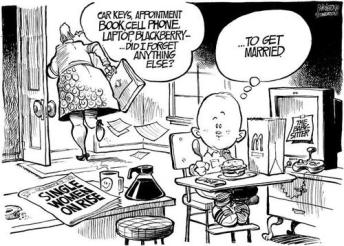 Frankly, my lifestyle choices are no one’s damn business. I also don’t want to hear any whining about put upon stay at home mothers or selfish working moms or whatever freaking black and white witchy stereotype folks dream up and embrace. This would include the appalling cartoon I used for this post. There seems to be a media obsession at the moment with painting women into corners and guilt tripping them for which ever corner they wind up in. Women are even participating in the self immolation. We’ve been regaled by lectures like this one on “Why Women Still Can’t Have It All“. Like we need some other woman defining what “all” is for the rest of us. We also don’t need a bunch of self righteous right wing wind bags that continue to blame all of the world’s problems on mothers.
It’s enough to make Betty Friedan spin in her grave.
Katrina Vanden Heuvel took up the keyboard today at WAPO with a reminder that most working mothers aren’t struggling to “have it all”. They are struggling to feed their kids and provide homes. For some reason, a lot of folks seem to think there’s all these great, supportive, bread-winning men out there just dying to reproduce and do right by their wives and families. I frankly don’t recommend marriage to any woman. Most husbands are bigger pains-in-the asses than colicky babies. A lot of them can’t even hold down jobs these days and then there’s the entire emotional trip that goes along with marriage. You know the TV sitcom stint that goes like this. Asking men to do the right thing by their families puts them in the position of being the oppressed, hypernagged hubbie who goes to work and takes it out on the resident working women and stirs up the other men in one big woe-is-me session. There’s a lot of reality out there that these BS narratives miss. Even the best intentioned man can get pulled back into the old boys club after a number of years of marriage and fatherhood. The media, their jobs and the entertainment industry absolutely empower them to be reckless with their family relationships.
This is the reality that faces millions of working women. More than 70 percent of all mothers and more than 60 percent of mothers with children under 3 are in the workforce. Two-thirds of them earn less than $30,000 a year. Nine of 10 less than $50,000. In the Rev. Jesse L. Jackson’s powerful image, “They catch the early bus,” or, in Vasquez’s case, the late bus. They work out of need, whether they want to or not. Half are their family’s primary breadwinner.
These mothers don’t have the luxury of flexible time or the ability to leave when a child is in trouble or sick. Most can’t afford to take unpaid sick leave to care for their children — and many would lose their jobs if they did, despite the federal law guaranteeing unpaid leave. Many work in jobs — as home-care workers, farm workers, cleaning people — that have scant protection of minimum wage and hours standards. Many cobble together two or three part-time jobs. Child care gets done by grandmothers, neighbors or simply the TV.
Okay, so this is the deal. The problem is not with WOMEN. The problem is with the way “work” and “income” is structured in this country. It doesn’t change because most men in power don’t want it to change. Things used to be different when most businesses were family run and family owned or when most families lived off farms. Working for some one else in this country but a few enlightened companies basically means placing your family outside your major time commitments. That is not the way it should be.
Here’s something that caught my eye as I thought about this. This is written by a journalist as a response to the articles run by The Atlantic recently in the vein of mommy wars. I like it because it states what I find is obvious. Feminism is about finding options and accepting and empowering women’s choices. It’s not about pitting our various roles against each other. Every woman should make her choice. There is no sainthood or martyrdom prize for whatever that choice is so can’t we just knock it off now?
The average American worker gets something like 14 days of paid vacation. In my school, you’d use up ten of those taking care of your kids on teacher professional days, then tack on a couple more for kids getting sick. When you do the simple math, the American workplace seems utterly inhumane in its unwillingness to adapt to the fact that women make up half of all workers.
Economist Claudia Goldin has made a career out of studying what she calls the “career cost of family.” The industries that thrive and hold onto talented women are the ones that figure out how to minimize the cost of taking time off for your family. It’s not all that complicated. They take advantage of technologies to let parents work at home or be more efficient, they schedule shifts, they minimize face time, they let people do what Sheryl Sandberg says she does: go home at 5:30 and pick up again later after her kids are in bed.
Feminism was about making women’s lives less constrained and giving them more choices. Right now, most women have none — not because they are spoiled and unrealistic and want to do lunchtime yoga, but because they are working hard to support their families and everyone is colluding in the fiction that they have nothing else on their minds. I return to a modest proposal I made last week in Slate, inspired by Slaughter: Mothers, fathers, don’t lie to your employers about the kid things you have to (or want to) do during the day. If you are taking a kid to the doctor, say so. Ditto for parent teacher conferences or the school play. At this point, honesty would be a radical act.
One of the bottom lines to me is that if men would actually do something about making the country, the work place, and their family more children friendly, we wouldn’t be having these problems or this discussion. Our situation exists because men do not treat women or children as anything valuable unless there’s something at the time that they need from them. There are work environments out there that are family friendly. They are very successful. They got that way because the men in charge made them that way to attract and maintain talent. They attract men and women to work for them that value families. There are far too few companies that do that because there’s a lot of men that get away with ignoring their families. They’re rewarded for it. European countries do not do this. France doesn’t do it. Germany doesn’t do it. None of the Scandinavian countries do it. It’s an American value to fuck over you family because you have to work.
The other interesting thing in all of this is the role of birth control and the empowerment of controlling when you have children. Economist Claudia Goldin calls this The Quiet Revolution. I have no doubt that there is an equal role in all the re-ignition of the mommy wars with the attack on birth control. Reproductive rights is essential to women’s freedom and children’s well being. It’s also necessary to the transformation that could occur in the work place if more women got into positions of power and more men were motivated by family concerns and demanded the work place empower them to parent. Taking away this important right means undoing women’s autonomy.
All of this just continues to impress upon me how little this country actually cares about its children. There seems to be this silly idea that if you just strand a woman at home with children and giver her a husband with a paycheck then all the problems of the world will just fade away. This couldn’t be farther from the truth. Just reading literature on depression and unhappiness should put this damaging canard to bed. Again, look at that damn cartoon up there. We need to be a society that supports family choices and provides resources to all our children to be in the environment in which each child thrives. This will never happen in less our institutions stop prioritizing the wrong things and until every one refuses to participate in the Mommy Wars.
Tuesday Reads: Moose, Black Bears, a Laudable FBI Sting, and Various Slimy Politicians
Posted: June 26, 2012 Filed under: 2012 presidential campaign, Barack Obama, children, Mitt Romney, U.S. Politics, Voter Ignorance | Tags: Bain Capital, black bears, Carol Aichele, Chateaux at Silver Lake, child prostitution, college students, Cory Booker, Ed Rendell, FBI, Henrietta Kay Dickerson, human trafficking, Innocence Lost, John Kerry, Michael Milken, Mike Turzai, moose, Operation Cross Country VI, outsourcing, Pennsylvania, prostitution rings, Voter ID laws, wildlife 45 Comments
Good Morning!!
I just had to share this news about wildlife encroaching on Boston’s western suburbs: Black bear and moose sighted in Needham and Wellesley
It was a wild Monday in the suburbs west of Boston, with reports of a black bear ambling down by the Charles River in Needham and sightings of a 600-pound moose racing through backyards and across streets in Wellesley.
Isn’t that exciting?
The suburban sightings follow a rash of similar wildlife reports across the state – coyotes, of course, and more recently, black bears. One particularly adventurous bear spent weeks roaming Cape Cod, romping through cranberry bogs and backyards and spawning bear-themed T-shirts before being tranquilized in Wellfleet.
A bear was spotted in a few yards around Norwood Saturday night, according to local police. And State Environmental Police investigated reports of a black bear in the woods along Route 109 in Dedham Sunday morning. Officers did not locate the bear, and officials speculated it had moved on.
According to the article, the bear population in Massachusetts has increased since it was estimated at 3,000 in 2005 and bears have started to move into the eastern part of the state. It’s mating season now, so the bears are out searching for mates and looking to establish their own territories.
As for the moose:
While authorities combed Wellesley backyards Monday afternoon, people puttered around in their cars hollering out the latest updates on the moose’s location from the police scanners. Groups on foot swapped backyard-sighting stories, and shared pictures on cell phones. They gathered with cameras at the ready to watch as authorities blocked off a home on Lexington Road to search its woody backyard for the wild interloper.
Police searched for hours but were unable to locate the moose.
An FBI Sting Operation Worth Applauding
On Friday, Saturday, and Sunday, the FBI broke up prostitution rings across the U.S., freeing 79 underage prostitutes and arresting 105 pimps “as part of the…Innocence Lost National Initiative entitled ‘Operation Cross Country VI.'”
Seventy-nine teenagers held against their will and forced into prostitution were rescued at hotels, truck stops and storefronts in a three-day sweep of sex-trafficking rings across the United States, law enforcement officials said on Monday.
The FBI said 104 alleged pimps were arrested during sting operations in 57 U.S. cities including Atlanta, Sacramento, and Toledo, Ohio. The operation lasted between Thursday and Saturday and involved state and local authorities as well as the FBI.
The teenagers, aged from 13 to 17 years old, were being held in custody until they could be placed with child welfare organizations. They were all U.S. citizens and included 77 girls and two boys, the FBI said.
One of the minors recovered in the sweep reported being involved in prostitution from the age of 11, according to Kevin Perkins, acting executive assistant director of the FBI’s Criminal, Cyber, Response and Services Branch.
He said the cases were not “one-off” incidents, but evidence of “criminal enterprises” that lure minors in, often through social media, hold them against their will through threats to them or their families, and then traffic them through different U.S. cities.
“Many times the children that are taken in in these types of criminal activities are children that are dissaffected, they are from broken homes, they may be on the street themselves — they are really looking for a meal, they are looking for shelter, they are looking for someone to take care of them, and that’s really the first approach that’s made,” said Perkins.
“Once the child has been taken out of harm’s way, then really the story just begins at that point,” said Perkins. “That’s where the real work starts, where we have to call upon the community, various social welfare agencies, our own office of victim assistance has to work with each child on an individual basis to see what their requirements are.
“This is a very difficult task. These children are very damaged — very harmed, and they need a great deal of help — it’s really taxing the social welfare agencies and it’s something that, going forward, we need to pay particular attention to.”
Unfortunately many of these children may still end up back on the streets. Still, it’s a worthwhile effort, IMHO.
Mitt Romney Updates
ABC News The Note managed to get some details about Romney’s ultra-secret weekend millionaire/billionare donor retreat in Park City, Utah.

Chateaux at Silver Lake
FRIDAY AFTERNOON: As attendees entered the Chateaux at Silver Lake, the host hotel, throughout the sunny afternoon, they were handed a Vineyard Vines tan canvas tote bag with navy piping and the words “Believe in America” stitched on the side. Inside the bag was a blue baseball hat with “Romney” written over a circular American flag and a thick white binder, detailing the weekend’s schedule from policy discussions to social events, along with a list of Romney’s upcoming events and Romney for president pins.
In addition to the Romney swag, there was also a typed note from Romney’s National Finance Chairman Spencer Zwick addressed to the attendees by their first names. “Welcome to the first Romney Victory Leadership Retreat! We are very glad you were able to join us for this special weekend. Thank you for the continued support and leadership. On to victory!,” the card read.
Some were even personalized with a handwritten note from Zwick expressing appreciation to the donor and his or her family, signed with his initials “SZ.”Golf carts whipped attendees around the complex and to discussions on healthcare, Israel, the state of the race, and the financial services industry that were conducted both Friday and Saturday.
There’s lots more at the link.
Despite the complaints of corporate Democrats like Cory Booker and Ed Rendell, the Obama campaign has continued to hammer Mitt Romney over his history as a corporate raider. And over the weekend, there were three in-depth articles on Romney’s time at Bain Capital. Today James Downie highlighted those pieces at the WaPo: Mitt Romney, Bain Capital and a ‘profit-first’ presidency
The first, from Friday’s Post, described how Romney’s Bain was an early supporter of companies that outsourced American jobs. “While Bain was not the largest player in the outsourcing field,” The Post reported, “the private equity firm was involved early on, at a time when the departure of jobs from the United States was beginning to accelerate and new companies were emerging as handmaidens to this outflow of employment.” That outsourcing damaged American job creation was no matter; Bain made its profit.
The second, in Saturday’s New York Times, outlined how, again and again, Romney’s Bain reaped revenue from companies even as they were failing. “At least seven [of the 40 U.S.-based companies that Bain held a majority stake in while Romney was active at Bain] eventually filed for bankruptcy while Bain remained involved, or shortly afterward . . . In some instances, hundreds of employees lost their jobs. In most of those cases, however, records and interviews suggest that Bain and its executives still found a way to make money.” In several of the bankruptcies, companies made their situation worse by borrowing more to return money to Bain and its investors. And even when both outside investors and the companies themselves failed to do well, “lucrative fees helped insulate Bain and its executives.” Again, Bain made its profit.
The third, and perhaps most damning article, came from Sunday’s Boston Globe, depicting Romney’s work with disgraced junk-bond king Michael Milken. In 1988, Romney was searching for money to finance a heavily-leveraged buyout of two small department store chains. “At the time of the deal, it was widely known that Milken and his company were under federal investigation” for insider trading and stock manipulation. Despite this, Romney and his partners, after personally meeting with Milken, went ahead with the deal. With financing from Milken’s shady business, Romney and Bain were able to make a $10 billion investment, not long before Milken was sentenced to 22 months in prison. Bain eventually profited to the tune of $175 million (although the merged department stores later went bankrupt, shortly after dumping its Bain-appointed chief executive). Sure, an important chunk of the financing may have come from questionable sources, but Bain made its profit.
I included the Boston Globe article in my Sunday morning roundup. If you haven’t read it yet, please do.
Meanwhile, the Romney campaign has been taking the John Kerry approach–ignoring the attacks on Romney’s primary claim to presidential qualifications, just as Kerry long ignored the attacks on him by the “Swift Boat Veterans for Truth.” That didn’t work out so well for Kerry.
Today, President Obama mocked Romney’s response to the outsourcing story at a campaign event in New Hampshire.
The president noted that Romney’s campaign had pushed back against the Post’s scoop by complaining it didn’t sufficiently distinguish between “outsourcing” and “offshoring,” only the latter of which expressly involves shipping jobs overseas.
“You cannot make this stuff up!” Obama said. “What Gov. Romney and his advisers don’t seem to understand is this: If you’re a worker whose job went overseas, you don’t need somebody trying to explain to you the difference between outsourcing and offshoring, you need someone who’s going to wake up every day and fight for American jobs and investment here in the United States.”
Pennsylvania’s Voter ID Law
Pennsylvania is one of the many Republican-controlled states that have instituted voter ID laws. Usually the claim is that these laws will prevent the massive amount of voter fraud that Republicans claim is happening (of course, there’s no evidence whatsoever for this claim). But recently a Pennsylvania Republican state legislator actually told the truth.
House Majority Leader Mike Turzai (R-Allegheny) suggested that the House’s end game in passing the Voter ID law was to benefit the GOP politically.
“We are focused on making sure that we meet our obligations that we’ve talked about for years,” said Turzai in a speech to committee members Saturday. He mentioned the law among a laundry list of accomplishments made by the GOP-run legislature.
“Pro-Second Amendment? The Castle Doctrine, it’s done. First pro-life legislation – abortion facility regulations – in 22 years, done. Voter ID, which is gonna allow Governor Romney to win the state of Pennsylvania, done.”
The statement drew a loud round of applause from the audience. It also struck a nerve among critics, who called it an admission that they passed the bill to make it harder for Democrats to vote — and not to prevent voter fraud as the legislators claimed.
The Pennsylvania voter ID law is particularly complex and strict in its requirements. Most onerous is the requirement that the ID must include a specific date of expiration.
As this article in The Nation explains, most employment and student ID’s do not have expiration dates listed. Even the Republican Secretary of State Carol Aichele did not know that her employee ID would not be accepted for voting!
Back in April, Pennsylvania Secretary of State Carol Aichele visited the editorial board of the Erie Times-News newspaper to speak with them about the new photo voter ID bill Governor Tom Corbett had just signed into law….Aichele’s Erie visit was part of a state tour to educate voters about what they’d need for compliance with law and for the ability to exercise their right to vote. One of the IDs acceptable for voting is a state employee photo identification card. However, the law also says that IDs must have a current expiration date for voter eligibility, and the state employee cards do not. Aichele seemed to overlook this paradox in her education drive.
“Pennsylvania Secretary of State Carol Aichele showed her state photo ID, which is not acceptable for voting because it doesn’t have an expiration date,” wrote the editorial board after she showed hers to them. It must have been humiliating for the secretary who was promoting the new law to find that her own example didn’t hold muster. It’s bad enough mandating that voters have ID cards, but to add the additional restriction that the ID needs an expiration date makes it even more obtrusive. The editorial says that 10 percent of Pennsylvanians, or 88,000, do not have a valid photo ID—though that number is contested and is thought to be much larger.
The law will make voting difficult for many senior citizens.
Take the example of Henrietta Kay Dickerson, 75, of Pittsburgh, a black woman who was born in Louisiana. She came to Pennsylvania as an infant and grew up her whole life in Pittsburgh’s Hill District, the historical black neighborhood immortalized in the plays of August Wilson. In May last year her state ID expired. She went to the state’s department of transportation where she was refused a free voter ID card, even after she paid the $13.50 fee, according to her account in the lawsuit filed by the American Civil Liberties Union and the Advancement Project against the state, which says the law violates voting rights granted by the Pennsylvania Constitution.
Pennsylvania’s many college students could also have difficulties if they don’t research the law’s requirements and follow them exactly. Most college IDs do not have dates of expiration.
I’m going to end here, because this post is getting way too long! I’ll turn the floor over to you now–what are your reading recommendations for today?
There’s still something very wrong with Kansas
Posted: June 25, 2012 Filed under: abortion rights, Women's Healthcare, Women's Rights 6 Comments Instituting religious doctrine is something that just shouldn’t happen in this country. Yet, many Kansas legislators just want a theocracy. What’s the matter with Kansas, still? Do they confuse acorns with trees and scrambled eggs with fried chicken too? Don’t women deserve to keep their medical records out of the hands of their state governments?
On Friday, the Kansas Board of Healing Arts refused to reinstate the medical license of Dr. Ann Neuhaus, who provided second opinions to abortion provider Dr. George Tiller between 1999 and 2006. Kansas law requires a second opinion to perform some late-term abortions. Neuhaus’ license was revoked by an administrative court in February following a 2006 complaint from the anti-choice group Operation Rescue alleging she did not take the safety of teenage patients seriously in 2003 because of the short length of patient record files for her cases.
But the sparseness of her patient notes was an attempt to protect their privacy from the anti-choice crusade of a state official. Around the time Neuhaus performed the abortions, the Kansas Attorney General Phill Kline was investigating abortion providers — going so far as to subpoena medical records and discuss those cases on right-wing television shows. Indeed, Neuhaus specifically cites Kline’s “investigation” while arguing her exams met accepted care standards:
She…testified that she didn’t put more details in her records to protect patients’ privacy. After the hearing, she said she was “unapologetic” for that, noting the Kansas attorney general’s office began investigating abortion providers, including Tiller, starting early in 2003, and in 2006, Fox television’s Bill O’Reilly strongly criticized Tiller and discussed a few of his patients’ cases on his program.
Kline faces an ongoing ethics complaint case alleging he “lied to the Kansas Supreme Court, misled a Johnson County grand jury investigating an abortion provider and discussed an ongoing case on ‘The O’Reilly Factor’” that throw weight behind Neuhau’s fears, but whether or not she could get a fair hearing was doubtful. Gov. Sam Brownback (R) recently appointed former Operation Rescue attorney Richard Macias to the board, and one expert witnesses called by the Board testified there were no cases in which providing an abortion could be beneficial to a patient’s mental health.
While Neuhaus plans to appeal, the entire saga paints a stark portrait of how pervasive anti-choice influence is at some state levels — and the untenable position that influence means for health care providers. Then again, perhaps it’s no surprise a state that seriously debated legislation that would force doctors to misinform their patients about health risks would put an anti-choice agenda before the well-being and medical privacy of it’s citizens.
Republican state legislators are just dying to get all women’s constitutional rights put before those Opus Dei freaks on SCOTUS.
More information on this from RH Reality Check.
According to the Associated Press, Neuhaus was hoping to have her full medical license restored after spending years only allowed to provide limited medical care for charity work. Instead, an ongoing investigation into 11 patient cases obtained by Operation Rescue became the center of a movement to have her license stripped all together.
The cases all involved girls who sought abortions due to mental health issues from depression to suicide, with an age range from 17 years old to as young as 10. The board alleged that Neuhaus’s exams were not thorough enough based on the available records provided, and that her follow up care was inadequate, as she did not recommend counseling or hospitalization afterwards.
Neuhaus called the accusations ridiculous. She said she refused to put too much identifying information in the records because she knew that they could eventually end up in the hands of outsiders and violate the patients’ privacy. As for abortions not being necessary, Neuhaus found that laughable as well.
“To even claim that isn’t medically necessary qualifies as gross incompetence,” said Neuhaus. “Someone’s 10 years old, and they were raped by their uncle and they understand that they’ve got a baby growing in their stomach and they don’t want that. You’re going to send this girl for a brain scan and some blood work and put her in a hospital?”
Has the Time Come to Break Up the Union?
Posted: June 25, 2012 Filed under: U.S. Economy, U.S. Politics | Tags: federal aid to states, federal taxes, fiscal transfers, Medicaid, seceding from the union, unemployment insurance 41 Comments
Via Matt Yglesias at Slate, this map–originally posted at The Economist last year– shows fiscal transfers from wealthier states to poorer ones by means of taxes collected by the federal government and then distributed to states as Medicaid, unemployment insurance, and so on.
As Yglesias points out many of the states that get more back than they put in in taxes tend to be more conservative, but that’s not always the case. States that are lower in population also pay less in taxes and get more back. For example, North Dakota and Iowa are experiencing a great deal of growth and prosperity at present, but they still get more held from taxpayers in more populous states like New York, Connecticut, and Massachusetts.
Yglesias points out that the situation here in the U.S. is different from the Eurozone:
Two key points I would make about this in relation to the eurozone are that these transfers are both really big and extremely persistent. Mississippi and Alabama have lagged behind the rest of the nation in economic development for a very long time and I see no particular reason to believe they’ll ever catch up.
Making the obvious mental leap, Derek Thompson writes at The Atlantic:
Unlike the United States, the euro zone collects a teensy share of total taxes at the EU level and has no legacy of permanent fiscal transfers from the richer countries, like Germany, to the poorer countries, like Greece.
Would wealthy, populous states like New York and Texas be better off establishing their own currencies, Thompson asks?
On their own, they could spend a lot more. Today, the states can’t borrow money. But on their own, the richer ones might be able to borrow cheaply enough to eventually run persistent small deficits to make up for whatever infrastructure, education, and per capita health care spending they were receiving from Washington. Once they got in on NAFTA, they could trade freely with the other states as the dollar zone disintegrating into history.
Perhaps the northeastern states should secede and form their own union. Quite a prosperous country could be made up of MN, IL, IN, OH, PA, NY, MA, NH, ME, VT, DE, RI, and CT. Only IN, VT, and ME would be on the poor side. Other areas of the country could form their own coalitions.
Perhaps a more interesting question is whether the possibility of this happening might stimulate enough concern among conservatives in Congress for them to stop fooling around with the wars on women and science and start doing something about the real problems we’re facing in this country?
Desperate times call for desperate measures.
Monday Reads (with SCOTUS updates)
Posted: June 25, 2012 Filed under: abortion rights, Economy, morning reads | Tags: individual mandate, Mississippi's last standing abortion clinic, Newspapers, public interest, state capitalism, Vagina Rupert Murdoch 21 Comments
Good Morning!
The last abortion clinic in Mississippi may be the latest victim of the christofascist republican war on women. It may become the first state in the union where women have no access to this constitutional right. Take a look at the pictures at the link and tell me its not a christofascist movement akin to the religious fundamental crazies that plague underdeveloped nations. Why can’t we just export these creeps to Afghanistan instead of soldiers and money?
Beginning July 1, all abortion-clinic physicians must have admitting privileges at a local hospital under a law passed by the Republican-led Legislature and signed by Republican Governor Phil Bryant in April. At the Jackson Women’s Health Organization, the state’s sole remaining clinic providing elective abortions, none of the three physicians who perform the procedure has been granted those privileges.
Mississippi may become the first U.S. state without a dedicated abortion clinic if the Jackson facility fails to come into compliance. That would mark the most visible victory for the anti-abortion movement, which has fought to abolish the procedure in the face of the U.S. Supreme Court’s 1973 Roe v. Wade decision guaranteeing a woman’s right to have one.
“Roe v. Wade said that women have a right to an abortion in the sense that a state can’t deny or criminalize it, but there was no guarantee of access,” said Wendy Parmet, associate dean at Northeastern University School of Law in Boston. “States can’t create legal barriers or penalties, but they can make it practically really, really difficult.”
Betty Thompson, a spokeswoman for the clinic in the state capital, said the doctors have applied to seven area hospitals for admitting privileges. All three are already board certified in obstetrics and gynecology, as the new law also requires, she said.
I’ve long argued that Rupert Murdoch should be deprived of access to the public airwaves. He’s a threat to the Public Interest.Here’s some more opinion on that via the UK Guardian. Can the Brits get rid of this menace? Can any democracy afford a corporate monopoly on information that functions as a propaganda tool for the personal interests of its owner?
In the UK, there is currently more choice, but the economics of news are undergoing a fundamental revolution, so nothing should be taken for granted. There are other powerful media organisations in the UK, including the BBC. In order to gauge the potential threat, try asking seven critical questions:
a) Does it have strong internal governance?
b) Is it effectively externally regulated?
c) Is it subject to, and does it comply with, the law?
d) Is it subjected to normal scrutiny by press and parliament?
e) Does it overtly try to exert public political influence?
f) Does it privately lobby over regulation or competition issues?
g) Does it actively work to expose the private lives of politicians or other public figures?
On such a scorecard, the BBC would score one out of seven – in the sense that only one of the issues, f), is engaged. News Corp would score seven.
Richard Pomfret–a Professor of Economics at Adelaide University–has written a new book on a widely accepted compromise between aggregate prosperity and distributional equality. He discusses his thesis at VOXEU.
It is in this spirit that my new book, The Age of Equality, argues that we are still experiencing the long-term consequences of the industrial revolution of the 1700s, and that the current state of that process involves a widely accepted compromise between aggregate prosperity and distributional equality.
Unlike political revolutions that can be dated to 1789 or 1917, the industrial revolution does not have a precise date. However, by the early 1800s it had clearly taken hold in parts of northwest Europe. The new industrial production involved factories with division of labour (exemplified by Adam Smith’s pin factory on the UK’s £20 banknotes) which employed increasingly capital-intensive techniques and applied the results of scientific, or at least casual empirical, observation. It was associated with risk-taking entrepreneurs and mobile workers, who responded to price incentives and were rewarded if they made the right decisions. The process was opposed by those enjoying privileges in the pre-industrial economy, e.g. inherited monarchs with absolute power, landowners with serfs or guild members.
Countries adopting the new system enjoyed unprecedented long-term economic growth. They sought and won global markets for their products so that they could expand the division of labour and capital-intensity of their factories, and they established global empires. Success was no secret. The new system spread across Europe, regions settled by Europeans, and a few other places (notably Japan).
Change was resisted by the ancien régime or by imperial rulers. The 1800s were an Age of Liberty because successful economies were those in which people enjoyed sufficient freedom to respond to economic incentives. The pressure to allow such freedom culminated in the 1910s, with the collapse of the great dynastic empires centred in Saint Petersburg, Vienna, Berlin, Constantinople and Peking.
Yet, even as living standards increased, opposition to unbridled capitalism strengthened. In all of the high-income countries there is evidence of income inequality peaking around the first decade of the twentieth century.
- In the US, progressives pushed to reduce the power of the rich by antitrust legislation and to protect the poor by social policies.
- In Europe, socialists’ challenge to capitalism was more fundamental.
The great experiment of the twentieth century was a competition between economic systems over which could best balance prosperity and equality.
That was the case until 1989. Then, unbridled capitalism began to take root in Europe and North America. This is not the case, however, in other parts of the world. Here’s a reminder of more folks that are adopting a different approach.
The era of free-market triumphalism has come to a juddering halt, and the crisis that destroyed Lehman Brothers in 2008 is now engulfing much of the rich world. The weakest countries, such as Greece, have already been plunged into chaos. Even the mighty United States has seen the income of the average worker contract every year for the past three years. The Fraser Institute, a Canadian think-tank, which has been measuring the progress of economic freedom for the past four decades, saw its worldwide “freedom index” rise relentlessly from 5.5 (out of 10) in 1980 to 6.7 in 2007. But then it started to move backwards.
The crisis of liberal capitalism has been rendered more serious by the rise of a potent alternative: state capitalism, which tries to meld the powers of the state with the powers of capitalism. It depends on government to pick winners and promote economic growth. But it also uses capitalist tools such as listing state-owned companies on the stockmarket and embracing globalisation. Elements of state capitalism have been seen in the past, for example in the rise of Japan in the 1950s and even of Germany in the 1870s, but never before has it operated on such a scale and with such sophisticated tools.
State capitalism can claim the world’s most successful big economy for its camp. Over the past 30 years China’s GDP has grown at an average rate of 9.5% a year and its international trade by 18% in volume terms. Over the past ten years its GDP has more than trebled to $11 trillion. China has taken over from Japan as the world’s second-biggest economy, and from America as the world’s biggest market for many consumer goods. The Chinese state is the biggest shareholder in the country’s 150 biggest companies and guides and goads thousands more. It shapes the overall market by managing its currency, directing money to favoured industries and working closely with Chinese companies abroad.
State capitalism can also claim some of the world’s most powerful companies. The 13 biggest oil firms, which between them have a grip on more than three-quarters of the world’s oil reserves, are all state-backed. So is the world’s biggest natural-gas company, Russia’s Gazprom. But successful state firms can be found in almost any industry. China Mobile is a mobile-phone goliath with 600m customers. Saudi Basic Industries Corporation is one of the world’s most profitable chemical companies. Russia’s Sberbank is Europe’s third-largest bank by market capitalisation. Dubai Ports is the world’s third-largest ports operator. The airline Emirates is growing at 20% a year.
So, you can see my read suggestions are a little esoteric today. There’s not much going on. Folks are waiting to see if SCOTUS announces its decision on the Affordable Health Care Act and Arizona’s immigration law. Folks are also waiting for congress to act on the doubling of student loan rates and the highway bill. Drama is coming this week.
I just have to add one more. Jimmy Carter wrote an op-ed today in the NYT about America’s Shameful Human Rights Record. Wasn’t he part of the hoopla over the lightbringer about 8 years ago? Is this Nobel Peace Laureate lecturing another? Wow. How times change. He names no names but the implications seem pretty clear to me.
THE United States is abandoning its role as the global champion of human rights.
Revelations that top officials are targeting people to be assassinated abroad, including American citizens, are only the most recent, disturbing proof of how far our nation’s violation of human rights has extended. This development began after the terrorist attacks of Sept. 11, 2001, and has been sanctioned and escalated by bipartisan executive and legislative actions, without dissent from the general public. As a result, our country can no longer speak with moral authority on these critical issues.
While the country has made mistakes in the past, the widespread abuse of human rights over the last decade has been a dramatic change from the past. With leadership from the United States, the Universal Declaration of Human Rights was adopted in 1948 as “the foundation of freedom, justice and peace in the world.” This was a bold and clear commitment that power would no longer serve as a cover to oppress or injure people, and it established equal rights of all people to life, liberty, security of person, equal protection of the law and freedom from torture, arbitrary detention or forced exile.
What’s on your reading and blogging list today?
Update:
The Supreme Court Announces Arizona Immigration Decision Today.
US Supreme Court (#SCOTUS) ruling upholds ‘show me your papers’ provision of Arizona immigration law. Details soon http://www.bbcnews.com
From the SCOTUS AZ decision: “As a general rule, it is not a crime for a removable alien to remain in the United States.”
Tom Goldstein of Scotusblog: “On net, the #SB1070 decision is a significant win for Obama Admin. It got almost everything it wanted.
note: the link to Scotusblog above goes to a live discussion on the decisions being released today …
OTHER Decisions:
The MT campaign finance case, 11-1179, is summarily reversed. The vote is 5-4, the majority opinion (one page long) is per curiam, Justice Breyer writes for the dissenters. http://www.supremecourt.gov/opinions/11pdf/11-1179h9j3.pdf
National Journal
@nationaljournalSCOTUS: “There can be no serious doubt” that Citizens United ruling applies to Montana state law. http://njour.nl/MKLeXI
Miller and Jackson, juvenile life without parole cases, have been decided. Life w/o parole sentences for juveniles who commit murder are unconstitutional. Justice Kagan wrote the opinion. Vote is 5-4. http://www.supremecourt.gov/opinions/11pdf/10-9646g2i8.pdf
No #HCRdecision from #SCOTUS today. Stay tuned for Thursday. It appears to be going down to the wire.

 peej
peej Carissa
 bostonboomer
 dakinikat
 ecocatwoman
 mablue2
 Mama Lopez
 peggysue22
 quixote
 skydancingguestblogger
 Mona (aka Wonk the Vote)



 Sky Dancing
Recent Comments