
A Sad Legacy: Louisiana’s Prison Economy
Posted: May 15, 2012 Filed under: Criminal Justice System, New Orleans | Tags: Angola Prison, Bobby Jindal, Louisiana, prison state, prisoners, Warden Cain 14 Comments This is the stuff that creates documentaries and sad movies. It is the prison state that is Louisiana.
Louisiana is the world’s prison capital. The state imprisons more of its people, per head, than any of its U.S. counterparts. First among Americans means first in the world. Louisiana’s incarceration rate is nearly triple Iran’s, seven times China’s and 10 times Germany’s.
The hidden engine behind the state’s well-oiled prison machine is cold, hard cash. A majority of Louisiana inmates are housed in for-profit facilities, which must be supplied with a constant influx of human beings or a $182 million industry will go bankrupt.
Several homegrown private prison companies command a slice of the market. But in a uniquely Louisiana twist, most prison entrepreneurs are rural sheriffs, who hold tremendous sway in remote parishes like Madison, Avoyelles, East Carroll and Concordia. A good portion of Louisiana law enforcement is financed with dollars legally skimmed off the top of prison operations.
If the inmate count dips, sheriffs bleed money. Their constituents lose jobs. The prison lobby ensures this does not happen by thwarting nearly every reform that could result in fewer people behind bars.
READ THE
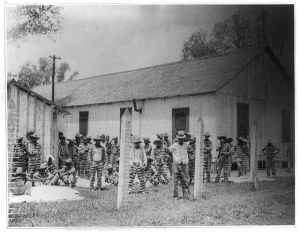
ENTIRE SERIES from NOLA.Com.Meanwhile, inmates subsist in bare-bones conditions with few programs to give them a better shot at becoming productive citizens. Each inmate is worth $24.39 a day in state money, and sheriffs trade them like horses, unloading a few extras on a colleague who has openings. A prison system that leased its convicts as plantation labor in the 1800s has come full circle and is again a nexus for profit.
In the past two decades, Louisiana’s prison population has doubled, costing taxpayers billions while New Orleans continues to lead the nation in homicides.

It is a shameful situation. Here are some stories from Angola. It’s probably the most infamous prison in the world. It’s known for its rodeo and its harsh treatment of prisoners who basically are subjected to “Faith-Based Slavery”. It seems that when a state can’t produce real jobs that it produces prisons.
“Unique” is one way Warden Burl Cain likes to describe his prison, and it would be impossible to argue otherwise. With grazing cattle and rolling hills in the distance, it’s hard not to admire its strange, sprawling beauty, even as the towers come into view. The prison itself is absent from my GPS’s “points of interest,” yet Angola’s Prison View Golf Course—the first public golf course on the grounds of a state penitentiary—is not. At Angola’s official museum, opened by Cain in 1998, a retired electric chair and rusty prison contraband are displayed adjacent to a gift shop selling mugs and tote bags reading: “Angola: A Gated Community.”
Angola is the largest maximum security in the country, sitting on 18,000 acres of farmland and home to 5,200 men. Louisiana has the highest incarceration rate of adult prisoners in the United States; thanks to the state’s unforgiving sentencing laws, at least 90 percent of Angola’s prisoners will die there. It’s a large-scale embodiment of a national phenomenon: elderly inmates are the country’s fastest growing prisoner population.
Yet Angola is also lauded as a revolution in corrections, its story told many times: Angola was once the “bloodiest prison in America,” where inmates slept with magazine catalogs strapped to their chests to protect themselves from stabbings. Things began to turn around in the 1970s, when a federal judge ordered a major overhaul. But most of the credit has gone to Warden Cain for imposing order through a new model of incarceration.
Like all of Angola’s wardens, Cain has continued the tradition of hard labor: most inmates work in the fields eight hours a day, five days a week, harvesting hundreds of acres of soybeans, wheat, corn, and cotton—picked by hand and sold by Prison Enterprises, the business arm of the Louisiana Department of Corrections. But unlike his predecessors, Cain, an evangelical Christian, has also made it his mission to bring God to Angola. Inmate ministers tell new prisoners that they can either work on their “moral rehabilitation” or remain a “predator”—“the choice is yours.” The radio station plays gospel music. On the walls leading to the execution chamber are two murals: Elijah ascending to Heaven and Daniel facing the lion. One of Cain’s favorite anecdotes is the execution of Antonio James, a born-again Christian whose hand he held just before giving the go-ahead to end his life. As James lay on the gurney waiting for lethal drugs to enter his veins, Cain said, “Antonio, the chariot is here…you are about to see Jesus.”
You should really read this MJ article to get the full feel of life inside Angola. It’s called “Gods Own Warden”.
Everyone was there except the person I had come to see: Warden Burl Cain, a man with a near-mythical reputation for turning Angola, once known as the bloodiest prison in the South, into a model facility. Among born-again Christians, Cain is revered for delivering hundreds of incarcerated sinners to the Lord—running the nation’s largest maximum-security prison, as one evangelical publication put it, “with an iron fist and an even stronger love for Jesus.” To Cain’s more secular admirers, Angola demonstrates an attractive option for controlling the nation’s booming prison population at a time when the notion of rehabilitation has effectively been abandoned.
What I had heard about Cain, and seen in the plentiful footage of him, led me to expect an affable guy—big gut, pale, jowly face, good-old-boy demeanor. Indeed, former Angola inmates say that prisoners who respond to Cain’s program of “moral rehabilitation” through Christian redemption are rewarded with privileges, humane treatment, and personal attention. Those who displease him, though, can face harsh punishments. Wilbert Rideau, the award-winning former Angolite editor who is probably Angola’s most famous ex-con, says when he first arrived at the prison, Cain tried to enlist him as a snitch, then sought to convert him. When that didn’t work, Rideau says, his magazine became the target of censorship; he says Cain can be “a bully—harsh, unfair, vindictive.”“Cain was like a king, a sole ruler,” Rideau writes in his recent memoir, In the Place of Justice. “He enjoyed being a dictator, and regarded himself as a benevolent one.” When a group of middle school students visited Angola a few years ago, Cain told them that the inmates were there because they “didn’t listen to their parents. They didn’t listen to law enforcement. So when they get here, I become their daddy, and they will either listen to me or make their time here very hard.”
Another former prisoner, John Thompson—who spent 14 years on death row at Angola before being exonerated by previously concealed evidence—told me that Cain runs Angola “with a Bible in one hand and a sword in the other.” And when the chips are down, Thompson said, “he drops the Bible.”
 We’ve talked about Angola’s horrible legacy before. Here’s a recent UK Guardian Story on two men that have spent 40 years in solitary confinement. This is the stuff that causes insanity. Every human rights group actively opposes this kind of treatment.
“I can make about four steps forward before I touch the door,” Herman Wallace says as he describes the cell in which he has lived for the past 40 years. “If I turn an about-face, I’m going to bump into something. I’m used to it, and that’s one of the bad things about it.”
On Tuesday, Wallace and his friend Albert Woodfox will mark one of the more unusual, and shameful, anniversaries in American penal history. Forty years ago to the day, they were put into solitary confinement in Louisiana‘s notorious Angola jail. They have been there ever since.
They have spent 23 hours of every one of the past 14,610 days locked in their single-occupancy 9ft-by-6ft cells. Each cell, Amnesty International records, has a toilet, a mattress, sheets, a blanket, pillow and a small bench attached to the wall. Their contact with the world outside the windowless room is limited to the occasional visit and telephone call, “exercise” three times a week in a caged concrete yard, and letters that are opened and read by prison guards.
A new documentary film takes us into that cell, providing rare insight into the personal psychological impact of such prolonged isolation. Herman’s House tracks the experiences and thoughts of Wallace as he reflects on four decades banged away in a box.
Our own Governor wants to turn our Prison Economy into a privatized, money-making scheme for corporate donors. Fortunately, his bill didn’t get very far. But, this is because so many local politicians make money off of renting out prisoners to their own local donor base. They also get to use them for services that would normally go to paid workers. No wonder no one can find these types of jobs unless you are in prison.
A bill strongly backed by Gov. that would have allowed for the sale of the Avoylles Correctional Facility has been abandoned, as support for it was limited, according to the Associated Press. Now, the prison may be run under a new plan. Here is some more information.
* The original bill would have allowed for the Avoyelles Correctional Facility to be sold for $35 million to a private firm that would be responsible for operating it, according to the Town Talk.
* The state would then pay the company that buys it a daily fee to operate it.
* Rep. (R- Haughton) sponsored the bill, House Bill 850.
* Opposition from the privatization of the prison stems from the fact that 296 jobs would be lost in the sale.
* One group, the , made a plea to representatives to vote against the bill, saying that if the prison was run privately, the company could demand an exorbitant amount of money from Louisiana taxpayers to run the prison, and that the sale would actually cost Louisiana residents more.
* The bill was rewritten on Wednesday to allow for a private firm to be contracted to run the facility, but not to buy it.
* The contract would be for 10 years and the approval of the contract would be by the House and Senate budget committees.
* On Wednesday, the House voted 62-43 to pass the new amendment to the bill, according to Gambit.
* The bill was not sent to the Senate for approval, however, as Burns says that he is giving legislators time to look over the new bill, according to the Capitol News Bureau.
* There is still a lot of disapproval of the new bill as well, as opponents still cite the decreased wages for employees that are working for private companies as opposed to wages for state employees as unacceptable.
* Safety is also a concern, as Rep. Robert Johnson cited the lower wages as attracting lower quality workers to guard the prison, which would mean an unsafe environment, according to The Times-Picayune.
* The privatization of Avoyelles is a part of a larger plan by Gov. Jindal to privatize more prisons in Central Louisiana and close the and move those prisoners to Avoyelles, according to the Town Talk.
* Alexandria Mayor Jacques M. Roy has come out against the plan, saying that it would decrease public safety and would not save the state any money.
Any one in Louisiana lives among this prison legacy. Prisoners clean up our roads. They are brought out to shore up levees. They make our license plates. They are visible everywhere doing jobs that would usually be given to parish employees. No place is this more true than in small communities where sheriffs can make a good living off of renting them out to local business. Kinda makes you proud of that old entrepreneurial spirit doesn’t it? Take some time to read the series at the Times Picayune. I think you will find out more about my part of the good ol’ USA than you really would like.
Tuesday Reads
Posted: May 15, 2012 Filed under: 2012 presidential campaign, Barack Obama, Mitt Romney, morning reads, Republican presidential politics, U.S. Economy, U.S. Politics | Tags: Angela Merkel, austerity, Bain Capital, basilica Sant'Apollinare, Emanuela Orlandi, Enrico "Renatino" Pedis, Eric Fernstrom, Greece, Josh Romney, obama campaign, Rand Paul, Rome, Ron Paul, Spain, the Euro, the Vatican 29 Comments
Good Morning!! Let’s get right to the news. Yesterday wasn’t a big political news day here in the U.S. The President appeared on The View and talked about gay marriage and the Kardashians. He also pandered to young women at Barnard.
The Obama campaign released a new ad highlighting Mitt Romney’s career as a corporate “vampire” at Bain Capital.
The Obama campaign ad focuses on Bain Capital’s misadventures with GST steel of Kansas City and features former steelworkers describing what they saw between the time Bain bought the firm in 1993 and filed to put it in bankruptcy in 2001. (Romney left Bain in 1999).
“It was like a vampire. They came in and sucked the life out of us,” says one of the men. “What Bain Capital did was not capitalism, it was bad management,” says David Foster, lead negotiator for workers at GST Steel. Former steelworker Joe Soptic accuses Bain of cutting corners on safety, saying “it was like working in the sweatshops of the ’30s,” and that watching the plant close was “like watching an old friend bleed to death.”
The campaign also set up a new website to provide information about “Romney economics.”
Ron Paul announced that he won’t compete in any of the remaining primaries, but he still plans to compete with Mitt Romney for delegates to the Republican convention.
Ron Paul, the congressman from Texas and a favorite of tea partyers, effectively ended his presidential campaign Monday but urged his fervent supporters to continue working at the state party level to cause havoc for presumptive Republican nominee Mitt Romney.
In an email to supporters, Paul urged his libertarian-leaning backers to remain involved in politics and champion his causes despite the apparent end of his presidential aspirations. Paul has found success in wrecking the selection process for delegates to the party’s late-summer nominating convention in Tampa, Fla., and trumpeted that he has delayed Romney’s expected nomination….
Paul’s supporters have proved successful in winning state GOP conventions in places such as Maine and Nevada. His supporters in Iowa and Nevada were chosen to lead the state central parties.
Over the weekend, Paul’s supporters managed to boo Mitt Romney’s son Josh off the stage at the Arizona state Republican convention.
Hundreds of state GOP members were gathered at Grand Canyon University to elect delegates for the national convention in July in Tampa, Fla., which is expected to select Mitt Romney as the official Republican nominee to challenge President Obama.
“We cannot afford four more years of President Obama,” said Josh Romney, the third of Mitt Romney’s five sons. “We need someone to step in there and turn things around.”
But Josh Romney had to stop repeatedly as people booed and yelled for Paul, who has continued campaigning in the Republican primary.
What is Ron Paul up to? At HuffPo, Stewart J. Lawrence suggests that Paul may be trying to set up his son Rand Paul to become Romney’s vice presidential choice. Or perhaps he just wants a speaking role at the Convention and input into the party platform. In any case, Romney may have to deal with Ron Paul at some point.
So it was a pretty quiet day in the U.S., but not in Europe, where Greece is teetering on the brink of destruction and threatening to pull all of the Eurozone down with it. From the Washington Post: Greek deadlock heightens fears of full European economic crisis.
Political deadlock in Greece rattled world markets Monday, reviving fears that the fractious Mediterranean country could spurn an international bailout, abandon the common European currency and risk a fresh round of world economic turmoil.
European stock indexes fell, with Greece’s market now at a 20-year low, while the euro currency continued a recent decline against the dollar. U.S. stocks also fell.
Coming only days before the leaders of the world’s Group of Eight industrialized nations meet at Camp David, the standoff in Greece over its political direction has thrust Europe’s troubles to the top of the agenda. A downturn in Europe could stagger a fragile recovery in the United States and undermine growth around the world.
Some headlines from The Independent UK:
World braces itself for Greek euro exit.
Financial markets were plunged into fresh turmoil after Greece’s political parties failed once again to agree to form a unity government, and European policymakers warned that Greece’s aid payments would be cut off unless Athens quickly produced an administration prepared to deliver far-reaching economic reforms and budget cuts.
Without those funds from the European Union and the International Monetary Fund, Greece could run out of cash to meet its national debt interest payments as early as next month. The country would then have no option but to default. Most analysts expect that a default would be a prelude to Greek exit from the single currency altogether.
Panic and violence in the streets as protesters turn against politicians.
Southern Europe is preparing for a summer of discontent as protesters of all ages, and from across the political spectrum, plan demonstrations against greater austerity measures and against those policymakers who say there is no alternative to cuts.
Up to 50,000 “Indignant Ones” gathered in Madrid’s Puerta de Sol area on Saturday, many more than expected, to demonstrate against the Spanish government’s austerity measures. But, as indignant as they might have been, there were fewer on the streets for what was billed as an even bigger rally on Sunday, despite a message of support from the US rocker Bruce Springsteen.
A public holiday in Madrid today is likely to draw another protest, and one group almost certain to be there is the yayoflautas, a collection of people in their sixties and seventies, and who were involved in anti-Franco protests. The group has staged sit-ins in banks, radio stations, hospitals and even the reception area of a ratings agency.
Angela Merkel’s party humiliated by shock election defeat
Angela Merkel’s ruling conservatives suffered a humiliating defeat in key elections in Germany’s most populous state yesterday when voters rejected her party’s austerity policies and handed a resounding victory to her pro-growth Social Democratic Party opponents.
Ms Merkel’s Christian Democrats were shell-shocked by the devastating result they returned in the poll in North Rhine Westphalia, which has a total population of 18 million. Exit polls showed that they secured a mere 25.5 per cent of the vote – their worst performance ever in the state….
By contrast, the pro-growth Social Democrats and their candidate Hannelore Kraft, 50, romped home with 38 per cent of the vote. They were expected to form a so-called Red-Green coalition with the environmentalist Greens who won around 12 per cent of the vote. The two parties secured enough seats to obtain an absolute majority in the state parliament.
U.S. politicians should be paying attention. Austerity is not a long-term winning policy.
In miscellaneous news, Gizmodo reports that the Kodak company had a nuclear reactor in its basement for many years.
Kodak may be going under, but apparently they could have started their own nuclear war if they wanted, just six years ago. Down in a basement in Rochester, NY, they had a nuclear reactor loaded with 3.5 pounds of enriched uranium—the same kind they use in atomic warheads….
Kodak officials now admit that they never made any public announcement about it. In fact, nobody in the city—officials, police or firemen—or in the state of New York or anywhere else knew about it until it was recently leaked by an ex-employee. Its existence and whereabouts were purposely kept vague and only a few engineers and Federal employees really knew about the project.
The company had a legitimate purpose for having the reactor and radioactive material:
Kodak’s purpose for the reactor wasn’t sinister: they used it to check materials for impurities as well as neutron radiography testing. The reactor, a Californium Neutron Flux multiplier (CFX) was acquired in 1974 and loaded with three and a half pounds of enriched uranium plates placed around a californium-252 core.
But still it’s amazing they were able to get away with the reactor and especially the secrecy. The reactor was dismantled in 2006.
Why would a mafia boss be buried in a Roman basilica? Especially when he was suspected of abducting a 15-year-old girl, the daughter of a Vatican employee.
Forensic teams and marble workers have pried open a mobster’s tomb in the basilica Sant’Apollinare in Rome, searching for clues that might help to solve one of Italy’s greatest mysteries.
Fifteen-year-old Emanuela Orlandi, the daughter of a Vatican bank functionary, disappeared in 1983 on her way to a music lesson. Her body has never been found, and the truth about what happened to her has puzzled investigators for nearly 30 years. One of the most prominent conspiracy theories was that Orlandi’s remains would be found in the crypt where the notorious Roman mafioso Enrico “Renatino” De Pedis was eventually laid to rest after he was shot dead in a Rome square in 1990.
On Monday, his tomb was finally opened. His body was there, inside a three-layer sarcophagus, well preserved and wearing a dark blue suit and black tie. Police took fingerprints and confirmed his identity. But also, tucked inside a niche of the ancient crypt – a burial place since before Napoleonic times – were dozens of boxes containing unidentified human bones.
Dozens of boxes of bones?! This should be an interesting story to follow.
Finally, I’d like to call your attention to a profile of Mitt Romney’s top adviser Eric Fernstrom, published in GQ Magazine. It’s long, but well worth reading. Here’s a brief preview:
Fehrnstrom calls himself a “utility player,” and in the press he’s typically identified as a “Romney spokesman” or a “Romney strategist.” But that doesn’t begin to do justice to his place in the high command. Fehrnstrom has been with Romney for a decade, longer than any other political adviser on his 2012 campaign. “Anytime I’ve got questions or I’ve got a doubt, I know I can go to Eric and I’m getting feedback from someone who’s inside Mitt’s brain,” Romney’s senior adviser Kevin Madden told me. Or as Peter Flaherty, another senior Romney adviser, puts it: “Eric has a deeper shelf of institutional knowledge of Mitt Romney than anyone I know whose last name is not Romney.”
Fehrnstrom’s first job for Romney was running the press shop during his successful 2002 run for Massachusetts governor. But his role quickly expanded, and as Romney’s national profile grew, so did his trusted aide’s. (So much so that when Scott Brown was looking for someone to help him win Ted Kennedy’s old Massachusetts Senate seat in 2010, he hired Fehrnstrom, who remains Brown’s top strategist.) Over the course of his decade with Romney, Madden says, Fehrnstrom has become “a Tom Hagen figure. He’s consigliere to the governor.”
But with two slight differences. Whereas Hagen was always trying to cool off the hotheaded Sonny Corleone and keep the peace, Fehrnstrom, 50, is both the wise man and the hothead. He wears the uniform of the modern political consultant—iPad tucked in the crook of his arm, open-collared shirt, rectangular-framed glasses—but his fleshy face and thick New England accent betray a rougher core. And far from reining in Romney, he performs the opposite service for his client: Fehrnstrom toughens him up. “Eric gives Mitt a capability that Mitt doesn’t have,” says Ben Coes, Romney’s campaign manager in 2002. “It’s a streetwise savvy; it’s an on-the-ground Boston-smarts mentality; it’s a back-alley-politics, survival-of-the-fittest point of view. Mitt is not a knife fighter. Eric is a knife fighter.” The best political operatives are the ones who provide their clients with a tangible quality the candidate himself lacks. If Karl Rove was Bush’s brain, then Fehrnstrom is Romney’s balls.
That’s all I’ve got for today. What are you reading and blogging about?
Monday Reads
Posted: May 14, 2012 Filed under: Big Pharma, morning reads | Tags: bullying, discrimination, Mitt Romney, Whiny white men 41 Comments Good Morning!
Okay. Get ready to drag out your smallest possible violins for this UK Guardian article:Lagging at school, the butt of cruel jokes: are males the new Second Sex? Here’s the teaser subtitle: “They work longer hours, face economic insecurity and suffer worse health. Now their feckless ways are lampooned in the media. A controversial new book argues that men increasingly face a prejudice that dare not speak its name.” Poor babies!
You might not have realised it, but men are being oppressed. In many walks of life, they are routinely discriminated against in ways women are not. So unrecognised is this phenomenon that the mere mention of it will appear laughable to some.
That, at least, is the premise of a book by a South African philosophy professor which claims that sexism against men is a widespread yet unspoken malaise. In The Second Sexism, shortly to be published in the UK, David Benatar, head of the philosophy department at Cape Town University, argues that “more boys drop out of school, fewer men earn degrees, more men die younger, more are incarcerated” and that the issue is so under-researched it has become the prejudice that dare not speak its name.
“It’s a neglected form of sexism,” Benatar says in a telephone interview. “It’s true that in the developed world the majority of economic and political roles are occupied by males. But if you look at the bottom – for example, the prison population, the homeless population, or the number of people dropping out of school – that is overwhelmingly male. You tend to find more men at the very top but also at the very bottom.”
The American men’s rights author Warren Farrell calls it “the glass cellar”. There might be a glass ceiling for women, Farrell once told the Observer, but “of the 25 professions ranked lowest [in the US], 24 of them are 85-100% male. That’s things like roofer, welder, garbage collector, sewer maintenance – jobs with very little security, little pay and few people want them.”
Okay, I hope you haven’t lost your meal and coffee!
The NYT had a good article up this weekend on the human costs or “disaster” of unemployment.
In 2007, before the Great Recession, people who were looking for work for more than six months — the definition of long-term unemployment — accounted for just 0.8 percent of the labor force. The recession has radically changed this picture. In 2010, the long-term unemployed accounted for 4.2 percent of the work force. That figure would be 50 percent higher if we added the people who gave up looking for work.
Long-term unemployment is experienced disproportionately by the young, the old, the less educated, and African-American and Latino workers.
While older workers are less likely to be laid off than younger workers, they are about half as likely to be rehired. One result is that older workers have seen the largest proportionate increase in unemployment in this downturn. The number of unemployed people between ages 50 and 65 has more than doubled.
The prospects for the re-employment of older workers deteriorate sharply the longer they are unemployed. A worker between ages 50 and 61 who has been unemployed for 17 months has only about a 9 percent chance of finding a new job in the next three months. A worker who is 62 or older and in the same situation has only about a 6 percent chance. As unemployment increases in duration, these slim chances drop steadily.
The result is nothing short of a national emergency. Millions of workers have been disconnected from the work force, and possibly even from society. If they are not reconnected, the costs to them and to society will be grim.
Unemployment is almost always a traumatic event, especially for older workers. A paper by the economists Daniel Sullivan and Till von Wachter estimates a 50 to 100 percent increase in death rates for older male workers in the years immediately following a job loss, if they previously had been consistently employed. This higher mortality rate implies that a male worker displaced in midcareer can expect to live about one and a half years less than a worker who keeps his job.
Here’s a great lesson on bullying from Michael Cohen at Alternet on “What we Learn from Mitt Romney’s Disgusting Teenage Bullying”.
There is a disturbing inference in Romney’s words – namely, that the blame should be placed as much on the sensitive shoulders of those who were hurt and offended, rather than the person who might have been responsible for inflicting pain upon them. What is missing from Romney’s non-apology is the recognition that pranks, hijinks, assaults or whatever you want to call them, can leave psychic scars that stay with the victim for years to come.
Indeed, one of the most heartbreaking elements of the Post story is that 30 years after it took place, one of the perpetrators, David Seed accidentally ran into Lauber at O’Hare International Airport and tried to apologize for not doing more to help his classmate. “It was horrible,” Lauber recounted. He went on to explain how frightened he was during the incident, and acknowledged to Seed, “It’s something I have thought about a lot since then.”
Here’s a follow-up to the Big Pharma drug pushers that try to market their miracle cures to us via their Snake Oil TV ads. It seems it really isn’t good for whatever ails ya!
The pharmaceutical company will pay $1.5 billion to settle criminal and civil liability charges for promoting the drug Depakote for uses not approved by the Food and Drug Administration.
The drug is a neurological medicine labeled to treat mania, epilepsy and migraines, and can lead to life-threatening and deadly pancreatitis in children and adults.
The money will be distributed among 49 states and will go toward consumer protection, health care and other services.
Well, first it was MS touting Obama’s feminist bona fides. Now it’s Newsweek calling Obama the ‘first gay president’. Okee dokee then.
The cover of Newsweek magazine this week proclaims President Obama “the first gay president.”
The cover pictures Obama with a rainbow-colored halo over his head. The New Yorker’s cover for this week, likewise, is an image of the White House, with the iconic columns on its South portico arranged in the colors of the rainbow — a prominent symbol for gay rights.
The Newsweek cover goes a step further by adding the religious symbol of a halo above Obama’s head.
Obama said this week that he is personally comfortable with same-sex marriage — the first time a sitting president has taken that position.
Newsweek’s “first gay president” cover story is written by Andrew Sullivan, a blogger at Newsweek and the Daily Beast, who is openly gay.
The moniker evokes Toni Morrison’s description of former President Bill Clinton as “the first black president.”
Well, I think I’ve done enough damage this morning. What’s on your reading and blogging list today?
The Political Plate
Posted: May 13, 2012 Filed under: Food, Monsanto | Tags: Agent Orange, ALEC Exposed, animal rights, antibiotics, Bill Clinton, farmers, FDA, food supply, George W. Bush, Hillary Clinton, rGBH, Roundup, Wikileaks, WWF 21 Comments
A little over a week ago, I emailed bostonboomer that I wanted to do a post about Monsanto. She was kind enough to share older posts done by Sima about Monsanto. After reading Sima’s posts I have to admit that I was intimidated by her detailed, informative and brilliant commentaries. Her knowledge of Monsanto’s business and political dealings, stemming from her experience as an organic farmer, is incredible. I highly recommend going back and reading or re-reading them. I’m going to try to bring you up to date on what has been happening since her last post. I just hope that I can do both Sima and the subject justice.
Once I became involved in the animal rights movement in 1990, a formerly unseen world opened up to me. It was akin to looking behind the curtain in the Wizard of Oz. Learning about how the animals we call food are raised, what they are fed and the chemicals that are put into their bodies, was disturbing to say the least. Since that time, the major media outlets, along with independent filmmakers, have covered issues such as factory farming, the overuse of antibiotics and the rise of antibiotic resistance, along with other issues that affect the food supply. A good place to get started is with the film Food Inc. and its website.
Monsanto popped up on my radar around 1993 with the introduction of rBGH, recombinant Bovine Growth Hormone. Although there was an overabundance of milk on the market, this chemical was being introduced to increase the supply of milk available for consumption. Why? One of the reasons was to drop the price of milk. That would be good for the consumer, right? Well, corporations are not in the business of making their products more affordable for their customers, as we all know. The ploy was to drive prices low enough so that family dairy farmers could not afford to stay in business, leaving the business to Monsanto’s real customers, giant dairies who would use their product(s). With family dairy farms bankrupt, Monsanto could better control the market and prices. From a study by the Economic Research Service/USDA.
Between 1970 and 2006, the number of farms with dairy cows fell steadily and sharply, from 648,000 operations in 1970 to 75,000 in 2006, or 88 percent (fig. 1). Total dairy cows fell from 12 million in 1970 to 9.1 million in 2006, so the average herd size rose from just 19 cows per farm in 1970 to 120 cows in 2006.1 Moreover, because milk production per cow doubled between 1970 and 2006 (from 9,751 to 19,951 pounds per year), total milk production rose, and average milk production per farm increased twelvefold.
Monsanto has since sold its posilac (rGBH) business to the Big Pharma company, Eli Lilly. If you still believe that advertising slogan, “Milk, it does a body good”, you might want to read this.
Let me start off with yesterday’s article by Jim Hightower, although it’s mostly about Dow Chemical, Monsanto gets some space as well. And there are some great comments. For more on 2, 4-D check out these links:
http://npic.orst.edu/factsheets/2,4-DTech.pdf
Monsanto is a multi-tentacled corporation attached to all aspects of our lives. At their facilities in Dayton, OH during WWII they were involved with the development of the first nuclear bomb. One of their early successful inventions was Astroturf. They have manufactured Agent Orange (the defoliant/herbicide used during the Viet Nam war), and PCBs (banned in the U.S. in 1979 but still found in the environment since PCBs don’t break down easily). For more information, you can download the free E-book, A Small Dose of Toxicology. In recent years, Monsanto has focused on the world food supply, whether it’s chemicals to kill weeds, like Roundup, or creating genetically modified (GM) seeds for which they hold patents. Natural News began a July, 2010 post with this unsettling paragraph:
At a biotech industry conference in January 1999, a representative from Arthur Anderson, LLP explained how they had helped Monsanto design their strategic plan. First, his team asked Monsanto executives what their ideal future looked like in 15 to 20 years. The executives described a world with 100 percent of all commercial seeds genetically modified and patented. Anderson consultants then worked backwards from that goal, and developed the strategy and tactics to achieve it. They presented Monsanto with the steps and procedures needed to obtain a place of industry dominance in a world in which natural seeds were virtually extinct.
Some of the crops grown with Monsanto’s GM seeds include corn, soy, sugar beets, alfalfa and cotton. Monsanto also produces and sells Stevia and Aspartame. To preserve their ownership of these patented seeds, farmers using them cannot save seeds produced from the crops they grow. The farmers must buy new seeds each year for their annual crops. Monsanto has sued farmers suspected of harvesting seeds along with their crops.
One of the most recent areas Monsanto wants to exploit are public lands. In November, several groups filed a lawsuit to prevent the planting of GM crops on refuges.
The Center for Food Safety, Beyond Pesticides and Public Employees for Environmental Responsibility sued Interior Secretary Ken Salazar and the U.S. Fish and Wildlife Service and its director, in Federal Court.
Fish and Wildlife signed agreements allowing farmers to plant crops, including genetically modified soybeans and corn, on refuges and wetlands in eight Midwestern states, according to the complaint.
And planting on public lands isn’t just limited to U.S. lands. World Wildlife Fund (WWF), one of the most respected conservation groups worldwide has ties to many multinational corporations, including Monsanto. They are helping to promote GM crops in other countries.
On the federal tax front, Monsanto paid an average of 22% in taxes for years 2008 – 2010. This report lists the 2008 – 2010 period detailing the profits, taxes and rates for 280 of U.S. corporations.
ALEC Exposed has a page dedicated to Monsanto, detailing much of their history and activities. As with most multinational corporations, Monsanto is heavily invested in lobbying. Interestingly, the years they spent the least money on lobbying were during the reign of King George II, otherwise known as GW Bush. Monsanto’s highest expenditures were in 1999, 2000 and 2008 – 2011. Open Secrets has an overview of Monsanto’s lobbying expenditures, the lobbyists, the issues in which their lobbying efforts were focused along with the agencies and the associated bills before Congress. Open Secrets is quite an informative site, also covering PAC contributions and campaign contributions to specific elected officials.
In our current political climate, campaign contributions and lobbying expenditures aren’t a surprise. After all, it is how the system is fueled. Open Secrets has a recent blog post detailing Monsanto’s activities so far this year. The Monsanto/government connections go even deeper though. During Clarence Thomas’ confirmation hearing, he worked as a counsel for Monsanto. When a recent case involving Monsanto came before the Supreme Court, not surprisingly, Thomas did not recuse himself. The Organic Consumers’ Union’s site, Millions Against Monsanto, has a list of both elected officials and agency appointments of former Monsanto employees from Bush Sr. to Obama. Sadly, Bill Clinton appointed more than any other president listed. Unfortunately, they don’t list U.S. diplomats who also once worked for Monsanto. What a wonderful way to help promote the products of their former employer in countries all around the world.
Wikileaks posted documents showing connections between Monsanto and U.S. Ambassadors. Several EU countries have rejected the use of Monsanto’s GM seeds. Fearing loss of export income, the possibility of pressuring or even retaliating against these countries were discussed in the diplomatic cables Wikileaks obtained. You can read Sima’s post here: https://skydancingblog.com/2010/12/28/wikileaks-and-gmogm-food-more-cables-more-fun/
Monsanto’s reach extends around the world. GM cotton was promoted as a boon to small farmers, but the reality is different. This story details the results in one village and the collaboration between Monsanto and The Times of India. Stories from Africa aren’t any better. The Gates Foundation is investing millions to promote and encourage the use of GM crops. I find it disturbing with a number of NGOs, researchers and politicians who are working hand in hand with Monsanto and other GM companies seemingly without concerns for the possibilities of the damage to the world food supply, public health and the environment. Alternet has posted a story about Kenya and the support from The Gates Foundation for Monsanto’s GM crops. For another opinion on The Gates Foundation/Monsanto/Africa issue, check out this Opinion piece in the Seattle Times written by Glenn Ashton.
The one beacon of hope has been some EU countries. The people have loudly spoken out against GM foods. However, the picture may not be as rosy as it has been portrayed. Gaia Health digs deeper into the announcement in February, 2012 that both Monsanto and BASF are pulling out of Europe.
Let’s not forget about the stock market either. Monsanto has signed an exclusive licensing agreement with Marina, a bio-tech company. I especially liked (not really!) this from the post:
Time and again, the company’s collaborations with agri-business research firms and molecular-bred hybrid technologies have proved effective. Although instances of societal resistance to new technology and poor acceptance of new products by farmers continue to raise anxiety, continuous increase in production led by technology upgradation helps balance such unease.
The personal is the political, and what is more personal than the food you eat and the food that you feed your families? If you are interested in digging deeper, here is the documentary The World According to Monsanto
You can also get more information about the many issues and areas of concern about food at the Center for Food Safety site. I hope I didn’t give you too much to “chew” on.
The Big Hedge Snafu
Posted: May 12, 2012 Filed under: Banksters | Tags: contango, hedge, JP Morgan 8 Comments Okay, I can’t resist getting wonky again. I have to say that Robert Reich made me do it. Well, that’s not completely true. It’s just that the banking industry has become so concentrated that it’s frightening. Plus, J.P. Morgan managed to lose $17.5 Billion this week. I’m still trying to wrap my mind around this. An organization this big has its tentacles in everything. Could JP Morgan become another Lehman?
JPMorgan Chase (JPM) lost $17.5 billion this week. It all springs from a bad trade that’s still going bad — to the tune of $2 billion and potentially $3 billion. But then there’s the 9.3% plunge in JPMorgan’s market capitalization — adding another $14.5 billion in shareholder losses. And of course, there’s the additional capital it may need to raise in light of S&P’s and Fitch’s concerns about its creditworthiness.
In my conversations Friday with reporters from Smart Money and the Boston Globe, I could not answer a basic question: What happened? According to the May 12th New York Times, JPMorgan decided to make a bet on a very obscure corner of the derivatives market. And due to the scale of JPMorgan’s trading, hedge funds figured out its identity and placed bets against the bank that are continuing to make profits for them at JPMorgan’s expense.
So, let me get back to why Robert Reich has me thinking. He’s offered up what we’ve been thinking here for sometime. Basically, he’s arguing that this kind of thing is exactly why we need to break up the big banks and head back to an updated and effective version of Glass-Stegall. The most ironic thing is that the catalyst for this is the same Jamie Dimon who insists that Wall Street doesn’t need any more stinking regulations. We’ve got a tight oligopoly now in the financial sector and the rules are different for this market structure than in a market where a bunch of little banks compete. We can survive the bad decision making of a few regional banks or community banks that collapse. Bad decision making at JP Morgan can take down the global financial markets. We’ve learned that already, haven’t we?
Ever since the start of the banking crisis in 2008, Dimon has been arguing that more government regulation of Wall Street is unnecessary. Last year he vehemently and loudly opposed the so-called Volcker rule, itself a watered-down version of the old Glass-Steagall Act that used to separate commercial from investment banking before it was repealed in 1999, saying it would unnecessarily impinge on derivative trading (the lucrative practice of making bets on bets) and hedging (using some bets to offset the risks of other bets).
Dimon argued that the financial system could be trusted; that the near-meltdown of 2008 was a perfect storm that would never happen again.
Since then, J.P. Morgan’s lobbyists and lawyers have done everything in their power to eviscerate the Volcker rule — creating exceptions, exemptions, and loopholes that effectively allow any big bank to go on doing most of the derivative trading it was doing before the near-meltdown.
And now — only a few years after the banking crisis that forced American taxpayers to bail out the Street, caused home values to plunge by more than 30 percent and pushed millions of homeowners underwater, threatened or diminished the savings of millions more, and sent the entire American economy hurtling into the worst downturn since the Great Depression — J.P. Morgan Chase recapitulates the whole debacle with the same kind of errors, sloppiness, bad judgment, excessively risky trades poorly-executed and poorly-monitored, that caused the crisis in the first place.
In light of all this, Jamie Dimon’s promise that J.P. Morgan will “fix it and move on” is not reassuring.
The most revealing thing is that this entire gaffe was supposed to be part of a hedging action which is a risk management tool. Not every one is convinced that this was simply the fault of a dated-model with bad assumptions. Here’s some wonky FT analysis.
So what was JPMorgan’s hedge and how did it go wrong?
The precise nature of JPMorgan’s hedging is not known. One possibility was that the bank engaged in a trade known as a “flattener”. Such a trade would profit if the credits began to sour in the near-term and within certain limits. But such a trade must be rebalanced – meaning additional positions would need to be taken simply to maintain the original investment thesis behind the trade. This can be tricky once the trade becomes supersized and if liquidity in the derivatives market dries up. Some market participants believe recent publicity surrounding JPMorgan’s position may have made rebalancing the trade impossible, or simply unpalatable.
Isn’t that a bet more than a hedge? Aren’t those banned now?
JPMorgan has described its trading as a hedge – not a “proprietary” trade, or bet, made to boost the bank’s own profit. However, the size of the position and subsequent losses look likely to set off renewed speculation about the nature of banks’ hedging activities. Some analysts have warned that banks are becoming extremely creative with their hedging strategies, often in an effort to boost their bottom line at a time when new regulations are crimping traditional profitmaking capabilities. JPMorgan says it plans to manage the trade over the course of 2012 but noted that losses “could easily get worse” and possibly total another $1bn in the second quarter of this year. Indeed, one of the instruments that may be involved matures in December, lending an urgency to managing the position down.
There better be some serious regulator and oversight action on this before it gets out of control. It also would seem to be a good time for a few good senators to start looking into bringing back the wall between corporations that have fiduciary responsibilities because of their depositors and investment banks and brokerage firms. Robert Reich’s got the right idea. We need to break up these behemoths. Then, we need to take a serious look at which parts of deregulation keep coming back to haunt us.

 peej
peej Carissa
 bostonboomer
 dakinikat
 ecocatwoman
 mablue2
 Mama Lopez
 peggysue22
 quixote
 skydancingguestblogger
 Mona (aka Wonk the Vote)



 Sky Dancing
Recent Comments