
Study shows Single Payer Health Insurance is Most Cost Efficient
Posted: April 14, 2012 Filed under: health, Health care reform | Tags: Single Payer Health Insurance. 18 CommentsThere are some market transactions that are best done by single providers. These services or goods are usually provided as public goods through a government 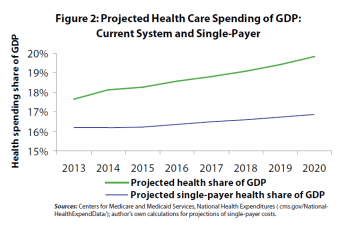 agency or a private institution granted the monopoly–then regulated–by the federal government. There are fairly standard traits characterizing natural monopolies. One of the primary indicators is that a single provider achieves economies of scale that no other form of market achieves and therefore it has the lowest average total cost. Health insurance is one of those markets where total risk is minimized–with its associated costs–when the risk pool is maximized. The high number of subscribers spreads the risk over many. If costs get high, low risk subscribers tend to drop their policies which leaves only folks that have high usage in the pool. This makes the service highly unprofitable and usually results in an insurance company trying to get rid of the high usage subscribers or any one that has the potential of being high usage. This is called cherry-picking.
Pricing insurance is based on trying to quantify risk of payment and that can be a complex business. Also, insurance–as a third party payer–means the market will eventually break down since the pricing mechanism is based on these ‘gambles’ and the fact that the consumer disconnects health care from insurance payments. Third party payer systems lead to inefficient markets because the normal dynamics of supply and demand do not lead to a market-based price. So, all development nations–except the US–know that having a purely market driven approach to health insurance fails big time. They approach their systems differently and do not rely on the largess of employers and the wealth of individuals to drive health care payment institutions.
This is a very brief introduction, but I wanted to give you some introduction to this important study by professor of economics Gerald Friedman from the University of Massachusetts-Amherst. Friedman shows how a single payer system for the US would save money over the current system and the ACA framework. He also explains how a single payer system could be administered cheaply and easily.
The Expanded & Improved Medicare for all act” (HR 676) would establish a single authority responsible for paying for health care for all Americans. Providing universal coverage with a “single-payer” system would change many aspects of American health care. While it would raise some costs by providing access to care for those currently uninsured or under-insured, it would save much larger sums by eliminating insurance middlemen and radically simplifying payment to doctors and hospitals. While providing superior health care, a single-payer system would save as much as $570 billion now wasted on administrative overhead and monopoly profits. A single-payer system would also make health-care financing dramatically more progressive by replacing fixed, income-invariant health-care expenditures with progressive taxes. This series of charts and graphs shows why we need a single-payer system and how it could be funded.
He succinctly provides the best reasons for choosing Single payer. It’s cheap and efficient.
Health-care costs have risen much faster than income in the United States over the last 50 years, rising from 5% of Gross Domestic Product in 1960 to nearly 18% today. Some of the increase in costs in the United States, as with other countries, is associated with improvements in care and longevity. Costs have risen much faster in the United States, however, because of the growing administrative burden of our private health-insurance system.
The article contains a lot of graphs and illustrations comparing the current system that relies on profit-making bureaucratic private insurance companies who are subject to state regulations that are quite varied. These providers also make paper work difficult because coverage, plans, and payments are nonstandard. This creates high costs for actual providers. The article is easy to read and I’d suggest you take a look at the article which can be found in Dollars and Sense.


 peej
peej Carissa
 ecocatwoman
 mablue2
 peggysue22
 quixote
 skydancingguestblogger
 Mona (aka Wonk the Vote)



 Sky Dancing
Single Payer or Die.
Literally for many of us.
Painfully true.
Sad but true.
So true…and so sad.
OT but 2 interesting pieces up at Pew.
http://www.pewsocialtrends.org/2012/04/13/women-work-and-motherhood/?src=prc-headline
http://www.people-press.org/2012/04/11/what-the-public-knows-about-the-political-parties/?src=prc-headline
And this ABC/WaPo poll: http://www.langerresearch.com/uploads/1136a22012ElectionUpdate.pdf
I have no doubt that everyone on this blog will get a perfect score. Never ceases to amaze me just how little the American public knows about politics & political parties. Guess it’s no wonder so many Repugnants get elected.
I have long been a supporter of single-payer, primarily because it is something that every person needs at some point in their life. Along the lines of the need for safe food, clean air & clean water, or even roads & bridges, which is why the federal government should regulate/oversee these necessities.
I cannot remember where or who said this about single payer, but it made the most sensible argument in favor of single payer that I had heard yet. If you lose your job, or the company you work for goes out of business, with single payer you will still have insurance. You won’t have to find a company that provides insurance coverage. One would think that businesses, especially small businesses and non-profits would welcome single payer. It would save them qutie a bit of money. And think of the big companies with union workers. One of the most contenious bargaining areas involves insurance. It just seems like a no-brainer to me. But, then I try to make decisions based upon logic and reality.
Single payer is certainly the most efficient and cost effective way to provide medical care. There is one regulation in the ACA that’s been largely overlooked and that’s the requirement fot all insurance companies to use the X12 EDI format, which is used by Medicare for processing of prior coverage verification and payments.
That should be a large simplification in insurance processing once it’s programmed into automatic verification and payment systems and it should save a lot of money going forward.
Wow, amazing picture of multiple simultaneous lightning strikes on the SF-Oakland Bay Bridge …
http://www.dailymail.co.uk/news/article-2129246/Once-lifetime-picture-lightning-striking-San-Franciscos-Bay-Bridge.html?ito=feeds-newsxml
The John Conyers Bill HR676, was the bill I supported during the HealhCare debate.
SPUHC – Single Payer Universal Healthcare or Medicare for all. Of course no RepugnantCon was going to cast a vote for it, but the real kick back came from a contingent of Blue Dogs, or as many of them are more affectionately known, DINO’s.
http://www.healthcare-now.org/whats-single-payer/hr-676/
Here’s what the GOP/TP is doing in the South.
Warning: “No Hand Holding” will be taught in TN Schools because hand holding is a gateway to sex. Sort of like Soup &Salad is a gateway to Steak and Lobster. I’m so embarrassed by this batshittery.
http://thinkprogress.org/health/2012/04/13/463317/tennessee-anti-hand-holding/
FYI……I was taught by a nun in the 11th grade who told us that if we were going to sit in a boys lap, to put down a newspaper first (this was an all girl class). I’m not sure exactly what SHE thought the newspaper was going to do, other than make crinkling sounds, which might be a bit of a turnoff, but who the hell knows. She also would point at some of us and say “I know which of you are living in sin because you don’t go to communion during mass”. I was one of the sinners, so I’d just throw my hand up so everyone could see me clearly.
Love it…if I had stayed in Catholic school…I would have had my hand up too. The nuns at my school kept it simple for us in the lower grades. They lumped the whole state of California together and told us all Californians have black spots on their souls because they have, “too much fun.”
“The nuns at my school kept it simple for us in the lower grades. They lumped the whole state of California together and told us all Californians have black spots on their souls because they have, “too much fun.””
🙂 LOL!!!!! I always envied Californians.
It seems so logical — single payer rather than the mess we are dealing with now. Welfare for the Insurance companies is the 0bowma solution to the 3rd world version — Everything 0bowma does is just plain half assed.
He says women aren’t a special interest group — what an elitist penis. UNTIL women are legally full human beings with full human rights we are a special interest group and our right can be taken away by the male white penises who rule this nation.
Being in Utah and seeing all the LDS and repression here — makes me so glad that my grandfather left Utah when he was a young man.
My graduate certificate is in public health, with emphasis on healthcare policy and administration. While in school, I wrote a term paper on how to move a country to single payer health insurance (incidently, many of the steps that were in my paper were the halmarks of Hillary’s healthcare proposal). The core reasons as to why a country should adopt this method of compensation was because IT IS THE MOST COST EFFECTIVE. As a result of the business practices of health insurance companies, healthcare costs increase, not from usage by the citizenry. Administrative costs from private companies is about 25% of each dollar spent, while Medicare does the same work for about 3%. Without adding a public component to the overall heathcare campaign, there is no way that costs will go down.
But we can’t have that under Bumbles who is bending the curve somehow.
Asshat.
Hillary 2012
If single payer is such a good solution, how can these politicians not be supportive of it. (It is a rhetorical question…I know the answer…I know you know the answer too.)