
Rick Santorum “Almost Threw Up” after Reading JFK Speech on Separation of Church and State
Posted: February 26, 2012 Filed under: 2012 presidential campaign, 2012 primaries, Republican presidential politics, U.S. Politics | Tags: Ave Maria University, Barack Obama, College of Saint Mary Magdalen, George W. Bush, great speeches, ignorance, John F. Kennedy, religious bigotry, Rick Santorum, Satan, separation of church and state 16 Comments
The quote comes from a speech Santorum gave last October at the College of Saint Mary Magdalen in Warner, New Hampshire:
“Earlier in my political career I had opportunity to read the speech, and I almost threw up.”
How nice of him to share. This morning on This Week, George Stephanopoulos asked Santorum why JFK’s speech made him feel like throwing up. Here’s his reply:
Because the first line, first substantive line in the speech says, “I believe in America where the separation of church and state is absolute.” I don’t believe in an America where the separation of church and state is absolute. The idea that the church can have no influence or no involvement in the operation of the state is absolutely antithetical to the objectives and vision of our country.
This is the First Amendment. The First Amendment says the free exercise of religion. That means bringing everybody, people of faith and no faith, into the public square. Kennedy for the first time articulated the vision saying, no, faith is not allowed in the public square. I will keep it separate. Go on and read the speech. I will have nothing to do with faith. I won’t consult with people of faith. It was an absolutist doctrine that was abhorrent (ph) at the time of 1960. And I went down to Houston, Texas 50 years almost to the day, and gave a speech and talked about how important it is for everybody to feel welcome in the public square. People of faith, people of no faith, and be able to bring their ideas, to bring their passions into the public square and have it out.
As most minimally educated Americans know, Kennedy’s speech on his religion is considered one of the great speeches of the 20th Century. On September 12, 1960, in Houston, Texas, Kennedy spoke to the Greater Houston Ministerial Association in an effort to calm the fears of Protestants who believed that a Catholic President would take orders from the Vatican or other members of the Church hierarchy.
I remember watching the speech on TV. It was a big deal for Kennedy and for Catholics generally. In 1960, Catholics were considered a little weird, and many people even insisted they weren’t Christians. The speech was a success, and Kennedy went on to become the first Catholic President of the U.S.
But according to Rick Santorum, who apparently didn’t get a very good education at Penn State or Dickinson College Law School, Kennedy was opposing the First Amendment. More from This Week:
…to say that people of faith have no role in the public square? You bet that makes you throw up. What kind of country do we live that says only people of non-faith can come into the public square and make their case? That makes me throw up and it should make every American who is seen from the president, someone who is now trying to tell people of faith that you will do what the government says, we are going to impose our values on you, not that you can’t come to the public square and argue against it, but now we’re going to turn around and say we’re going to impose our values from the government on people of faith, which of course is the next logical step when people of faith, at least according to John Kennedy, have no role in the public square.
Of course Kennedy said no such thing. He was trying to assure Americans that he (Kennedy) would never impose his own religious beliefs on other Americans. Did Santorum actually read the speech? I doubt it. Either he didn’t read past the first line or he’s just mouthing propaganda he heard from someone like James Dobson. On the other hand, I get the feeling that Santorum would very happily impose his religious beliefs on the rest of us–which is a very scary thought.
Let’s take a look at what Kennedy actually said. He began by arguing that the country had much more important problems than the question of his religion:
While the so-called religious issue is necessarily and properly the chief topic here tonight, I want to emphasize from the outset that I believe that we have far more critical issues in the 1960 campaign; the spread of Communist influence, until it now festers only 90 miles from the coast of Florida — the humiliating treatment of our President and Vice President by those who no longer respect our power — the hungry children I saw in West Virginia, the old people who cannot pay their doctors bills, the families forced to give up their farms — an America with too many slums, with too few schools, and too late to the moon and outer space. These are the real issues which should decide this campaign. And they are not religious issues — for war and hunger and ignorance and despair know no religious barrier.
But Kennedy understood that the religious issue had become a distraction and wanted to deal with it up front, once and for all.
I believe in an America where the separation of church and state is absolute; where no Catholic prelate would tell the President — should he be Catholic — how to act, and no Protestant minister would tell his parishioners for whom to vote; where no church or church school is granted any public funds or political preference, and where no man is denied public office merely because his religion differs from the President who might appoint him, or the people who might elect him.
I believe in an America that is officially neither Catholic, Protestant nor Jewish; where no public official either requests or accept instructions on public policy from the Pope, the National Council of Churches or any other ecclesiastical source; where no religious body seeks to impose its will directly or indirectly upon the general populace or the public acts of its officials, and where religious liberty is so indivisible that an act against one church is treated as an act against all.
Kennedy then argued that while “the finger of suspicion” was “pointed” at him in 1960, the next time it could be someone of another religion and this kind of questioning of each others’ religious beliefs could lead someday to “the whole fabric of our harmonious society [being] ripped apart at a time of great national peril.” Imagine if he could see what has happened to this country 50 years after that day in Houston!
Kennedy continued:
Finally, I believe in an America where religious intolerance will someday end, where all men and all churches are treated as equals, where every man has the same right to attend or not to attend the church of his choice, where there is no Catholic vote, no anti-Catholic vote, no bloc voting of any kind, and where Catholics, Protestants, and Jews, at both the lay and the pastoral levels, will refrain from those attitudes of disdain and division which have so often marred their works in the past, and promote instead the American ideal of brotherhood.
That is the kind of America in which I believe. And it represents the kind of Presidency in which I believe, a great office that must be neither humbled by making it the instrument of any religious group nor tarnished by arbitrarily withholding it — its occupancy from the members of any one religious group. I believe in a President whose views on religion are his own private affair, neither imposed upon him by the nation, nor imposed by the nation upon him as a condition to holding that office.
One wonders how Rick Santorum would react to a presidential candidate who was a Muslim. Kennedy notes that he and his brother fought in WWII to preserve this freedom.
This is the kind of America I believe in — and this is the kind of America I fought for in the South Pacific, and the kind my brother died for in Europe. No one suggested then that we might have a divided loyalty, that we did not believe in liberty, or that we belonged to a disloyal group that threatened — I quote — “the freedoms for which our forefathers died.”
Did Rick Santorum go into battle and risk his life for his country? I think not. His battle is with an invisible enemy: “Satan.”
Rereading Kennedy’s speech calls attention to the fact that the separation of church and state has broken down since his day. Kennedy asked the assembled ministers to
judge me on the basis of 14 years in the Congress, on my declared stands against an Ambassador to the Vatican, against unconstitutional aid to parochial schools, and against any boycott of the public schools — which I attended myself.
We now have an ambassador to the Vatican, the government provides aid to Catholic schools through voucher programs, and we have a White House Office of Faith-Based and Neighborhood Parnerships which, under Bush at least, funded religious-based abstinence programs. While Kennedy said he wouldn’t consult from religious leaders, George W. Bush and Barack Obama have both done so, most recently when Obama met with Catholic Bishops about his contraception policy. Kennedy:
I do not speak for my church on public matters; and the church does not speak for me. Whatever issue may come before me as President, if I should be elected, on birth control, divorce, censorship, gambling or any other subject, I will make my decision in accordance with these views — in accordance with what my conscience tells me to be in the national interest, and without regard to outside religious pressure or dictates. And no power or threat of punishment could cause me to decide otherwise.
Kennedy went on to say that if the day ever came
when my office would require me to either violate my conscience or violate the national interest, then I would resign the office; and I hope any conscientious public servant would do likewise.
Those are the sentiments that made Rick Santorum “almost throw up.” What more do you need to know about this man? He is not fit to serve as dogcatcher, let alone hold high public office. Below is video of Kennedy’s speech.
Dueling Op-Eds And the Great Divide
Posted: February 26, 2012 Filed under: birth control, Congress, Elizabeth Warren Campaign, fetus fetishists, fundamentalist Christians, PLUB Pro-Life-Until-Birth, Scott Brown, The DNC, the GOP, War on Women, Women's Healthcare, Women's Rights 13 CommentsIt will be a fine fight for the Senate seat in Massachusetts and the lead up is not disappointing. The Horse Race is now turning into a duel at thirty paces.
Elizabeth Warren offered the first volley, making her position clear on the contentious dispute over women’s access to contraception under the Healthcare Reform Act. She stated in no uncertain terms that exclusionary waivers for contraception access were outrageous. She supports President Obama’s compromise and expressed shock at Scott Brown signing onto the Blunt amendment that would allow employers deny coverage for ‘moral or religious reasons.’ Speaking to Greg Sargent last week she said:
This is an extreme attack on every one of us. It opens the door to outright discrimination. It would let insurance companies and corporations cut off pregnant women, overweight guys, older Americans, or anyone — because some executive claims it’s part of his moral code. Maybe that wouldn’t happen, but I don’t want to take the chance.
Neither do I.
But even if the language in the Blunt amendment were airtight, I’d oppose it and find the suggestion totally unacceptable. I pay taxes for wars for which I was never consulted and absolutely disagree with. That’s against my moral code. Can I get a tax refund now? I also think giving vulture oil companies subsidies is a ludicrous and immoral practice. Another refund? Oh, and those Wall Street bankers, the greed, the fraud that American taxpayers got stuck for? I want my money back, now.
We can all play this opt-out game.
So, where does Scott Brown come down on the question of women’s healthcare? Quelle surprise! He’s rubberstamping the irrational GOP position. But by doing so, he takes a 180-degree spin from his 2002 vote, when he supported a mandate on contraception, the Church be damned! Nonetheless, his answer to Warren? Through spokesman, Colin Reed:
It’s elitist for Elizabeth Warren to dictate to religious people about what they should believe and how they should act. She wants to use the power of government to force Catholics to violate the teachings of their faith. That is wrong. This issue deals with one of our most fundamental rights as a people — the freedom of religion. Like Ted Kennedy, Scott Brown supports a religious conscience exemption in health care.
Nice going, Mr. Brown. It’s wrong today but wasn’t wrong in 2002. The political winds must have been blowing differently a decade ago. And we’re conjuring up the ghost of Teddy Kennedy? Shame on you. But what I really like is the word ‘elitist,’ which is the Republican/Fox News buzzword for ‘those snooty people, who are not real Americans.’ Real Americans drive a truck like Scott Brown–back and forth to a home in Wrentham valued between $1-2.3 million.
Yup, just like average folks!
Lest we forget, there’s a reason Scott Brown was named by Forbes magazine as one of “Wall Street’s favorite senators.”
To be fair, Elizabeth Warren is no financial slouch. Both Warren and Brown have done extremely well for themselves. They’re both lawyers, educated, well-heeled professionals, standing on either side of the Great Divide we call politics. The issue of contraception has been put into play, an issue that according to all polls marks Warren’s position as the undisputed winner.
The Boston Globe ran Dueling Op-Eds on the issue. Warren’s editorial is here.
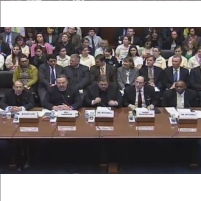 She starts with that withering image of the Republican panel that Representative Issa managed to convene—a panel of five poker-faced, middle-aged men discussing contraception and religious rights. In the optics department it was a devastating image. Out of touch much? A prime female health consideration and you fail to have women on the panel? Says everything we need to know on the Republican mindset. Elizabeth Warren then takes Scott Brown to task not only for supporting the proposed Blunt bill but fighting to get it passed.
If you are married and your employer doesn’t believe married couples should use birth control, then you could lose coverage for contraception. If you’re a pregnant woman who is single, and your employer doesn’t like it, you could be denied maternity care. This bill is about how to cut coverage for basic health care services for women.
Let’s be clear what this proposed law is not about: This is not about Catholic institutions or the rights of Catholics to follow their faith. President Obama has already made sure religious institutions will not be forced to cover contraception – at the same time that he has made sure women can get the health care they need directly from their health care insurers. Carol Keehan, the president and CEO of Catholic Health Association, said that Obama’s approach “protects the religious liberty and conscience rights of Catholic institutions.
And Scott Brown’s answer: It’s a matter of fundamental fairness. Really?
Here’s the beginning of Brown’s statement:
The new ObamaCare mandate forcing religious organizations to offer insurance coverage for practices that violate the teachings of their church gives the government control over the most personal aspects of our lives. It also erodes one of the basic protections of the Constitution – the right to practice religion without government interference.
The federal government is now saying to religious hospitals and charities, “Just do what you’re told, and leave the moral questions to us.’’ This over-reaching dictation from Washington is one reason I opposed and voted to repeal ObamaCare.
Which, of course, fails to answer the earlier question: why was a mandate A-okay in 2002, yet oh so wrong now? Possibly because then it concerned RomneyCare. The name makes all the difference in the world! Interesting, too, that according to Think Progress:
Brown also voted for a 2005 bill mandating hospitals to offer emergency contraception to rape victims, even after lawmakers defeated his amendment to allow religious hospitals to opt out of the requirement. Brown split with then-Gov. Mitt Romney on the matter and joined the legislature in overriding his veto.
And the American public? The polling numbers on the issue of contraception and subsequent WH compromise are revealing:
Obama’s compromise takes this politically charged issue off the table for mainstream Americans, most of whom side with Obama. A Fox News poll conducted last week before Obama’s Friday announcement found that 61 percent of voters believe employer health plans should be required to cover birth control for women, while 34 percent disagreed. Among women, two thirds approved of the requirement.
Rush Limbaugh may scoff at the issue. But for women? This is a very big deal. Because birth control means reaching this point in our lives:
When we’re ready.
And Mr. Brown? You’re not only a hypocrite on the issue, you’re definitely on the wrong side of history.

More WTF moments via the GOP
Posted: February 25, 2012 Filed under: 2012 elections, 2012 presidential campaign, 2012 primaries, Republican presidential politics 28 Comments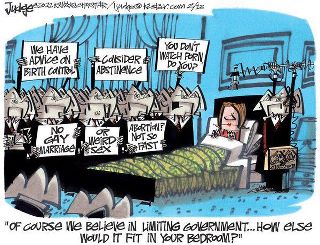 I’m not sure if some one has placed some significant chemicals into our water supply to produce hefty moments of political self-destruction but I have to say that I am open to just about any explanation as to why the party of 19th century social and civil rights has turned into The Mean Crusades. I’ve known for some time there’s been a concerted effort by the extreme right wing and its zombie religious flakes to take over any and all institutions possible. There’s been this quiet attempt to co-opt many institutions by religious fanatics and neoconfederates for some time. But, there’s been a certain subtlety to their jihad. Suddenly, they’ve all gone shrill and public. Part of me is glad because now every one really really knows. The rest of me knows that we’ve passed some kind of Rubicon. I’ve hoped for a third party for some time. I’m not sure what we’re going to get out of all of this, but it doesn’t seem like it’s going to be as neatly packaged as some reasonable alternative to the political status quo.
I am not alone in that thought. I heard Reagan appointee Bruce Bartlett tell Jon Stewart last week that one of the parties is crazy, Saint Ronnie wouldn’t be extreme enough any more and it is unlikely to produce a third option. Oh woe is us.
I’ve had a difficult time pointing out the crazy without being thought melodramatic until recently. It’s been obvious here in the great fly over for some time. I think the east coast punditry who write from the lofty penthouses of New York and the District finally see it. The Republican Primary screams out for analysis. What has gone really wrong with both the parties? Why has the Republican Party unleashed its Kraken? John Heilemann is calling Republicans “The Lost Party” in a new NY Magazine think piece. I’ve kept fleeing their red state strongholds for about 15 years now only to find myself smack in the middle of the next take over. What’s a person that appreciates science, rational thought, and modernity do? Even Jeb Bush and Allan Simpson are scratching their heads. It’s obvious the Republican establishment has lost control. They’ve got a bad case of Nixon Southern Strategy, Dubya Born Agains, and Goldwater reactionaries all rolled into one toxic primary season.
The transfiguration of the GOP isn’t only about ideology, however. It is also about demography and temperament, as the party has grown whiter, less well schooled, more blue-collar, and more hair-curlingly populist. The result has been a party divided along the lines of culture and class: Establishment versus grassroots, secular versus religious, upscale versus downscale, highfalutin versus hoi polloi. And with those divisions have arisen the competing electoral coalitions—shirts versus skins, regulars versus red-hots—represented by Romney and Santorum, which are now increasingly likely to duke it out all spring.
Few Republicans greet that prospect sanguinely, though some argue that it will do little to hamper the party’s capacity to defeat Obama in the fall. “It’s reminiscent of the contest between Obama and Clinton,” Senate Minority Leader Mitch McConnell recently opined. “[That] didn’t seem to have done [Democrats] any harm in the general election, and I don’t think this contest is going to do us any harm, either.”
Yeah. Right. I don’t think McConnell has quite gotten the message that there’s not really litmus tests in the Democratic Party. There are for Republicans and Mittens was on the wrong side of all of them before he’s tried to convince every one that he’s now on the right side of them. Santorum’s surge isn’t a fluke. The anti-Romney group has always been there. There’s just fewer candidates struggling to capture their fury. This is your karma when you go for the worst segment of society under the “southern” strategy.
For many Republicans, Romney’s maladroitness in addressing the issues at hand was worrisome, to put it mildly. Here he was handing Obama’s people a blooper reel that would let them paint him as a hybrid of Gordon Gekko and Thurston Howell III. “Republicans were saying, ‘This is the guy who’s gonna be carrying the ball for our side, defending the private sector?’ ” Rollins says incredulously. “Warren Buffett would kick his ass in a debate, let alone Obama.”
Nor were Romney’s rehearsed turns on the hustings appreciably better. From Iowa through New Hampshire, his campaign events had been progressively pared back and whittled down. By the time he reached South Carolina, they had achieved a certain purity—the purity of the null set. The climactic moment in them came when Romney would recite (and offer attendant textual analysis that would make Stanley Fish beat his head against a wall) the lyrics of “America the Beautiful.” Even staunch Romney allies were abashed by this sadly persistent, and persistently sad, rhetorical trope. “I have never seen anything more ridiculous or belittling,” a prominent Romney fund-raiser says.
This would be fun to watch if it wasn’t the worst time possible for a two party system to have one party in complete melt down. The Republicans are always good at spitting out their establishment, cookie cutter pro-business ever so sanctimonious pompadour adorned white dudes. Nixon and his creeps handed them the formula to capture all those religious whacky southerners who hate people of color and will suffer through a lot of crap as long as their women are kept in line for them. The problem is the reality around them makes the formula look lame. Fool them for about 30 years and they eventually catch on and demand some real blood instead of the symbolic stuff. The Gingrich renaissance uncovered the mother lode of whack.
The coalescence of the various elements of that wing around Gingrich accounted for the 40 to 28 percent pistol-whipping he administered to Romney on Primary Day—and marked the sharpening of the shirts-skins schism that would play out from then on. According to the exit polls, Gingrich captured 45 percent (to Romney’s 21) of Evangelical voters, 48 percent (to 21) of strong tea-party supporters, and 47 percent (to 22) of non–college graduates. Romney, meanwhile, held his own with the groups making up what the journalist Ron Brownstein has dubbed the GOP’s “managerial wing”—richer, better-educated, less godly, more pragmatic voters. One trouble for Romney was that this assemblage constitutes less than half his party now. But even more disconcerting was that he lost badly to Gingrich among South Carolinians who said that the most crucial candidate quality was the ability to beat Obama—which suggested not simply that ideology trumped electability but that for many Republicans, hard-core conservative ideology was tantamount to electability.
Here we go gain with the “hard-core conservative” label. I’ve watched Bruce Bartlett on his book promo tour. I’ve read interviews with Senator Simpson and now former Governor Jeb Bush. This isn’t Nixon’s or even Reagan’s Republican Party. This is the whack-a-doo John Birch Society reactionary right that the Koch Brothers funded and Pat Roberson raised from zombie congregations. Sarah Palin, Michelle Bachmann, Rick Santorum, Jan Brewer, Bobby Jindal, and the rest are not the least bit conservative. They represent an anti-intellectual right that would prefer to put us all back on the plantation. Of course, they get to pick those banjos while the rest of us work all day just to live in shacks and survive on weeds. Don’t think the rest of us haven’t noticed it. The more Romney strikes up that band, the more his numbers with independents crumble. He can’t possibly juggle this many story lines. This is a candidate that “severely” compromises every thing and anything at all costs.
An NBC News–Wall Street Journal poll in late January found Romney’s unfavorability rating among independents had risen twenty points, from 22 to 42 percent, over the previous two months. “It’s not as though they have said Bain has disqualified him or that he can’t be trusted because of his taxes, but this has created a gulf between him and the average voter,” one of the pollsters behind the survey, Peter Hart, told the Washington Post. “Bain and the taxes just reinforce the sense that this person is in a different world.”
Every presidential candidate faces a trade-off between maintaining his viability with independents and catering to his party’s base. The difficulty for Romney is that, even as his appeal to the middle has sharply waned, the lack of enthusiasm for him on the right has remained acute. Even in Florida, where Romney’s fourteen-point victory was broad and sweeping, he was beaten soundly by Gingrich among very conservative voters and strong tea-party adherents.
To a large extent, Romney’s concurrent problems with conservatives and independents are of his own making. His campaign’s incineration of Gingrich in Florida, though perhaps necessary and certainly skillful, also contributed mightily to alienating the center while doing nothing to remedy his main malady in the eyes of conservatives: the absence of a positive message that resonates with them, coupled with a tic-like tendency to commit unforced errors that exacerbate their doubts that he is one of their own. Crystallizing this phenomenon was an episode that took place the morning after Florida, when, on CNN, Romney disgorged another gem: “I’m in this race because I care about Americans. I’m not concerned about the very poor. We have a safety net there. If it needs repair, I’ll fix it.”
With these few short sentences in what should have been a moment of triumph for him, Romney managed to send the wrong message to an array of factions. To independent voters, “I’m not concerned about the very poor” sounds callous. To conservative intellectuals and activists, talk about fixing the safety net—as opposed to pursuing policies that enable the poor to free themselves from government dependency—is rank apostasy. And to congressional Republicans, the comment reflected a glaring lack of familiarity with the party’s anti-poverty positions. “Electeds were flabbergasted,” says a veteran K Street player. “Even moderate Republican members, if they’ve been here for more than four months, get dipped in the empowerment agenda.”
A week later, Romney attempted to repair part of the damage with his speech at the annual Conservative Political Action Conference—and promptly put his foot in it again. In an address in which he employed the word conservative or some variation of it 24 times, as if trying to prove he is a member of the tribe through sheer incantation, his use of the adverb severely to express the depth of his conviction raised eyebrows inside and outside the hall. “The most retarded thing I have ever heard a Republican candidate say” was the verdict of one strategist with ample experience in GOP presidential campaigns.
If only the Democrats were bright enough and principled enough to take advantage of all this chaos. But they are not. The deal is that what is going on is jaw dropping to many of us. To many of the Republican and Tea Party base, this is what they’ve been asking for and denied for many years.
For many Democrats, the idea of Santorum elevating beyond the level of a punch line is all but inconceivable. The extremeness of the former Pennsylvania senator’s views on social issues—from the out-front homophobia that led him to compare gay sex to “man-on-child, man-on-dog, or whatever the case may be,” to his adamant opposition to contraception and abortion even in cases of rape or incest—have long made him the subject of scorn and ridicule on the left, in the center, and on the Internet. (Even with his newfound fame, the first result of a Google search for his name is spreading santorum.com, a site dealing with “frothy” matters too coarse to discuss in a family magazine, and also in this one.)
But in a Republican-nomination contest, these views are not necessarily liabilities, and are even assets in some quarters—which doesn’t mean Santorum is without vulnerabilities in the context of his party. On spending, earmarks, and labor relations, he is by no means pure in conservative terms. He has been embroiled in ethics issues and is a bone-deep creature of the Beltway. Then there is his personality: “In the Senate as well as his home state, Santorum often struck people as arrogant and headstrong, preachy and judgmental,” writes Byron York in the Washington Examiner. Or, as a Republican lobbyist puts it to me, “When he was in the Senate, he was probably the most friendless guy there.”
The more I read about all of this, the more depressed I become. It is as if everything that’s been problematic about our country has coalesced into our politics. The brilliance of our heritage with its roots in the Age of Enlightenment and Reason seem lost in today’s campaign for donations and emphatic voters. There are no ideas. There is only ideology and working the plan of the politics of usual. Our system seems custom made to destroy the best and deliver the crazy and mediocre. So, this Republican Primary unfolds with its horrors and its lessons. All of it is hard to watch for any one that likes government by synthesis. Anyway, read the article. Embrace what modern American has become and weep. One party will not raise taxes under any exigent circumstances. It cannot produce candidates that don’t strictly adhere to specific religious dogma on reproductive issues. One party will not separate the markets that require supervision to be efficient from the markets that are best let alone. One party thinks there is no nuance to foreign policy, only picking and choosing which countries deserve our bombs. Then, there’s the other party. The party of words and no actions. The party of negotiate away anything as long as the policy, the next election and the candidate looks like a win. No single election or poll seems to send either of them any kind of message and that is what’s most disturbing to me. Democrats get the default vote because the Republicans have totally lost their sanity. This is not the government my children or yours deserve. What can we do about it?
Open Thread: Oops! Rick Santorum Just Can’t Help Himself
Posted: February 25, 2012 Filed under: 2012 presidential campaign, 2012 primaries, open thread, racism, U.S. Politics | Tags: "blah people", government dependency, Michigan primary, minority communities, Rick Santorum 60 CommentsEarlier today Rick Santorum spoke to a Tea Party crowd in Troy, Michigan and, as he did about a month ago, suggested that people in “minority communities” are especially reliant on food stamps and welfare.
Speaking to a large crowd at the conservative Americans for Prosperity Presidential forum here, Santorum said he planned to “talk to minority communities, not about giving them food stamps and government dependency, but about creating jobs so that they can participate in the rise of this country.”
Here’s the video:
In Iowa in January, Santorum said what most people thought sounded like this:
“I don’t want to make black people’s lives better by giving them somebody else’s money. I want to give them the opportunity to go out and earn the money and provide for themselves and their families.”
Watch it:
Later he claimed he had really said “blah people.”
Today Santorum was pretty clear in linking food stamps and “dependency” to minorities, even though most of the people using government programs are white. How will he try to weasel out this time? This guy just can’t seem to keep from saying whatever pops into his head.
Saturday: Ohana means…
Posted: February 25, 2012 Filed under: just because 48 Comments As you may know, Callie–my family’s beloved pomeranian dog-girl–died almost a year ago. March 13th will mark an entire 12 months without her physical presence…I still feel her with me, each and every day. She will never be left behind…or forgotten.
This week I adopted a kitten, Callie’s niece, my baby. I brought her home yesterday. Meet Lily Sue:

Tomorrow Today (Saturday), Lily and I are hoping to adopt and bring home Rue (hopefully Lily’s sister, and my younger baby by about 4 months…) Both Lily and Rue are rescue kittens, and while I got nothing but green lights when it came to adopting Lily, I’ve known Rue a few weeks longer… and there have been some roadblocks along the way. The funny part is…I might not have found Lily had Rue not been adopted before I could adopt her first. I was so upset that night I went scouring the internet for a kitty similar to her…which is how I stumbled upon Lily’s listing on petfinder.com…then never let my eyes off her. She’s sleeping in my arms right now as I type this, and I am on Cloud Nine. Funny how things work…
Funnier still is this: The day I started the adoption process for Lily–I got a call from Rue’s rescue organization saying that the family was having second thoughts and that I might be able to adopt her after all.
If Rue is meant to join us, she will. And, if not, we will always love her dearly and keep her in our thoughts and hearts, wishing her the loving, caring home she so richly deserves.
No one left behind or forgotten–simply more loved ones to not leave behind or forget.
And, with that Sky Dancers–here are a few Saturday reads for you, link-dump style…
- Fiscal Times: Hillary Clinton is Now Secretary of Job Creation…
The State Department may become the nation’s human resources department by adding job creation to its already bulging portfolio.
Secretary of State Hillary Clinton invited U.S. companies to call on Foggy Bottom experts for guidance on increasing their exports, safeguarding intellectual property abroad, and increasing foreign direct investment in the U.S. as part of a new administration effort to promote domestic jobs.
- Elizabeth Warren’s op-ed in the Boston Globe: Denying women coverage under any guise is a big step backward.
- Cats can be Heroes and Sheroes, too! Spoken like a new kitty-mama 😉 From a headline out of my birthstate… Green Bay Press Gazette: Sturgeon Bay cat saves owner’s life; Feline wakes woman from diabetic seizure.
- From the Politics of Glitter…to the Politics of the Hairdo’s and don’ts, via msnbc.com… Stylist to anti-gay marriage governor: No haircut for you
- Those fetus fetishists are willing to let all their incubators die off of preventable and/or treatable disease, quelle surprise. Via Texas Democrats, Feb. 23rd (Thursday):
Today at the direction of Republican lawmakers and Attorney General Abbott, Health and Human Services commissioner Tom Suehs signed a rule that would essentially end the Women’s Health Program in Texas. This essential program, which is funded largely by the federal government, allows low-income women in Texas to access health screening for things such as breast and cervical cancer, diabetes, and high blood pressure.
- Yesterday was Go Texan Day over here. If you want to get in the weekend rodeo spirit and do good at the same time, please check out these Go Texan-esque items from one of my favorite charities–MD Anderson Cancer Center Children’s Art Project.
Alright, well that’s it for me. I’ve got a Lily to attend to 😉 What’s on your read-and-rant list this weekend? Let us know in the comments and hope you have a weekend full of R&R if you can!

 peej
peej Carissa
 bostonboomer
 dakinikat
 ecocatwoman
 mablue2
 Mama Lopez
 peggysue22
 quixote
 skydancingguestblogger
 Mona (aka Wonk the Vote)



 Sky Dancing
Recent Comments