
Does President Obama understand “how America works”?
Posted: September 27, 2011 Filed under: just because 11 Comments
From Politico: POTUS testy in BET interview
President Obama, slipping in the polls among black supporters and under fire from black Democratic leaders for policies they say fail to address black poverty and unemployment, said Monday that targeting programs to help one community “is not how America works.”
Oh really? What is happening when the government bails out banks and investment firms? What about when the government offers tax cuts or loans for businesses–often specific businesses, like oil companies or auto manufacturers? What about Social Security, Medicare, and Medicaid? Don’t those programs target particular groups? What about programs to feed needy children or provide them with educational opportunities–like Head Start? Even more to the point, what about Affirmative Action?
What a silly remark!
Obama’s exclusive interview with BET’s Emmett Miller in the Oval Office is the latest in a flurry of outreach that included a private lunch Friday with prominent black radio talk show hosts, and a blistering speech Saturday night at a Congressional Black Caucus dinner.
It seems President Obama is still smarting from the criticism he got from Maxine Waters and Charlie Rangel after his offensive remarks to the Congressional Black Caucus.
The Grio has more detail about the interview:
Obama acknowledged that his administration did not anticipate the depth of the economic crisis he encountered upon entering office, and the need to help Americans understand how long the road to recovery could be. “if I traveled back in time? I would say it’s going to be a long hard slog and the American people are going to feel kind of worn down after this much difficulty,” he said. “But I’d also tell that less gray person to hang in there because the American people are resilient and they have good values and they care about the right stuff, and we’ll get through this.
I’d think if the President could travel back in time, he might choose to focus on jobs and the economy rather than a bloated Republican-style health insurance bill, but that’s just me. I’m not so sure that all of us are going to “get through this.” What he meant by “that less gray person,” I do not know.
Asked by Miller what he would tell a hard-hit African-American single mother on the south side of Chicago who was jobless and concerned that the president “won’t even say, ‘look, I am going to help you,” Obama pushed back on the premise, saying that’s not what people are telling him as he travels the country stumping for his American Jobs Act.
“What people are saying all across the country is we are hurting and we’ve been hurting for a long time,” the president said. “And the question is how can we make sure the economy is working for every single person.”
So why is the focus mostly on helping the wealthy and cutting Medicare and Medicaid then?
Saying targeting one specific group is “not how America works,” Obama emphasized that his policies were aimed at those who are hurting the most, whether because of a lack of healthcare coverage or a lack of a job, adding that because African-Americans are suffering disproportionately on those fronts, his policies were in fact designed to help black communities.
Well, I guess those policies aren’t working then, are they? Jeeze, this guy really doesn’t get it. Please, someone send him the video of LBJ withdrawing from the reelection race.
Rep. Sheila Jackson Lee did her very best to defend Obama’s remarks to the CDC on Tavis Smiley’s show. I just don’t buy it. Obama has alienated most of his liberal base, and now he’s working on driving away African Americans.
Tuesday Reads
Posted: September 27, 2011 Filed under: 2012 presidential campaign, Barack Obama, Democratic Politics, U.S. Economy, U.S. Military, U.S. Politics | Tags: Arch West, civil right violations, Dead Sea Scrolls, Deputy Inspector Anthony V. Bologna, Doritos, Gallup poll, government shutdown, jobs, LBJ, NYPD, occupy Wall Street, Paul Street, pepper spray, police brutality 21 Comments
Good Morning!! I’ve got a bit of a potpourri of news reads for you this morning. First, a followup to my post from Sunday night on the Occupy Wall Street protests in New York City.
The police officer who so enjoyed pepper spraying young women at the protest has been identified.
Saturday’s peaceful Occupy Wall Street protests in New York City were marred by what appears to be excessive use of force by several police officers, as video shows, and one officer who calmly walked up to police-fenced protesters and pepper-sprayed them, point blank, has been identified as Deputy inspector Anthony V. Bologna, of NYPD Patrol Borough Manhattan South, according to Common Dreams.
In response to the video (embedded in this article), the Police Department’s chief spokesman, Paul Browne, said the officer used pepper spray “appropriately,” according to the New York Times. “Pepper spray was used once,” he said, adding “after individuals confronted officers and tried to prevent them from deploying a mesh barrier, something
that was edited out or otherwise not captured in the video.”
I don’t buy that argument, and I doubt if many reasonable people will. Why was the mesh barrier even necessary in the first place? The Common Dreams link above has information on where to send complaints about Bologna’s behavior.
According to the UK Guardian, Bologna was accused of civil rights violations previously:
The Guardian has learned that the officer, named by activists as deputy inspector Anthony Bologna, stands accused of false arrest and civil rights violations in a claim brought by a protester involved in the 2004 demonstrations at the Republican national convention.
Then, 1,800 people were arrested during protests against the Iraq war and the policies of president George W Bush.
Alan Levine, a civil rights lawyer representing Post A Posr, a protester at the 2004 event, told the Guardian that he filed an action against Bologna and another officer, Tulio Camejo, in 2007. The case, filed at the New York Southern District Court, is expected to be heard next year.
Levine said that when he heard about the pepper spray incident “a bunch of us were wondering if any of the same guys were involved”.
You can read the details at the Guardian link.
You probably heard that the Senate has passed a “stopgap” bill that is designed to prevent a government shutdown by Republican America haters. From the Wall Street Journal:
The Senate, on a 79-12 vote, approved a bill late Monday to fund the government through Nov. 18. The vote came after the main sticking point in negotiations between the two parties was resolved.
Lawmakers had been in a standoff over Republicans’ demands for new budget cuts as a condition for sending additional money to the Federal Emergency Management Agency to aid victims of natural disasters through the end of the fiscal year on Friday.
But that dispute vanished Monday when FEMA announced that it may not run out of money before then—giving it more breathing room than expected. FEMA’s new statement about its finances cleared the way for Congress to put in place a funding mechanism for at least the start of the fiscal year that begins Saturday….
Under the compromise struck Monday night, the Senate approved two bills. One would keep the government running through Nov. 18, which the House is expected to pass when it returns from a recess next week. But to keep the government afloat until the House returns, a second measure was approved for funding through Oct. 4. That is expected to clear the House by voice vote before week’s end.
Apparently Boehner has given the bill his blessing. So I guess we can relax now and look forward to another squabble over keeping the government going in November.
Yesterday, Gallup reported that Americans are really disgusted with the U.S. government–and in “historic” numbers.
A record-high 81% of Americans are dissatisfied with the way the country is being governed, adding to negativity that has been building over the past 10 years.
Majorities of Democrats (65%) and Republicans (92%) are dissatisfied with the nation’s governance. This perhaps reflects the shared political power arrangement in the nation’s capital, with Democrats controlling the White House and U.S. Senate, and Republicans controlling the House of Representatives. Partisans on both sides can thus find fault with government without necessarily blaming their own party.

There’s a lot more at the link. Obama must be delusional if he thinks he’s going to be reelected just on the basis of some “inspiring” speeches. He’d better get busy, stay off the golf course and basketball court, and actually do something about jobs pretty soon or he’s a goner.
I learned from Dakinikat yesterday that Paul Street, who has authored two books about Obama, agrees with me that it’s time for this President to do an LBJ.
What does Obama have to look forward to in the future if he insists on trying for a second term? The stalled profits system seems ready to double dip back into full technical recession (the human recession never stopped beneath the mild statistical recovery), fitting him with the same fatal yoke of economic powerlessness that deep-sixed Herbert Hoover, Jimmy Carter and the first George (H.W) Bush’s hopes for second term. Unemployment remains sky high, contributing to a recent low in American history: the largest number U.S. citizens (46 million) ever recorded below the federal government’s notoriously inadequate poverty level. Obama’s job approval is at an all time low (43 percent), 7 points under his disapproval rating (50 percent). A preponderant majority of Americans say that the country is “on the wrong track.”
Four months after his empty, politically calculated execution and sea-dumping of Osama bin-Laden., Obama is widely perceived as weak and ineffective, as too eager to compromise with – and as incapable of standing up to – his (supposed) right-wing enemies. His party has recently lost two special House elections and one of those defeats came in a district Democrats had previously held for 88 years in a row. He has staked his future prospects on a highly flawed jobs bill – legislation that may well not pass the House and that is scaring off many conservative Democratic legislators. Most Americans think the bill won’t work.
The president is starting to look like the potential victim of a landslide in November of 2012. The Democratic base is widely disillusioned with him. Even many among his fake-progressive pseudo-liberal dead-end defenders sometimes squawk about his conservative corporatism and unwillingness to govern in accord with his idealistic campaign promises. Liberal and progressive Democratic elected officials in the House and Senate have been grumbling about his center-right proclivities for some time now. It is one thing to rightwardly triangulate on the backs of welfare mothers and declining unions in the mode of Bill Clinton; it is another thing to do so at the expense of the broadly popular programs Social Security and Medicare, all while passing on hyper-regressive Republican tax cuts for the obscenely rich and powerful.
And so on. If you haven’t read the whole thing yet, please do. Especially this part:
If he cared about his party, Obama would step down and give the nomination to Hillary Clinton, determined by a recent Bloomberg poll to be “the most popular national political figure in America today.” Ms. Clinton has distinct advantages over Obama in running against Perry or Mitt Romney in 2012. She is not a member of Congress, which has even lower popular approval than Obama. She is associated with economic prosperity thanks to the long neoliberal Clinton boom of the 1990s. And she carries a reputation for toughness, quite different from Obama’s emerging legacy as a 98-pound weakling who gets kicked around on the policy beach by bullies like John Boehner, Sean Hannity, and Eric Cantor. (For those of us on the radical left, a Hillary Clinton presidency might have the benefit of inducing at least some less confusion and tepidness among progressives than “the first black president.”)
Of course Obama doesn’t care about his party, but maybe he’ll care about his own reputation after a few more humiliating defeats by the Republicans. One can only hope.
In other news, Arch West, the inventor of Doritos, has died.
When Arch West, the man credited with inventing Doritos, is buried on Oct. 1, he will be joined by a sprinkling of the bright orange chips that have become a cheesy, tangy, American institution.
His daughter, Jana Hacker of Allen, Texas, told the Dallas Morning News that the family plans on “tossing Doritos chips in before they put the dirt over the urn.”
West, who was 97 when he died of natural causes last week, was a former Frito-Lay executive. He reportedly came up with the idea of Doritos when he was on vacation with his family in Mexico and came upon a snack shack selling fried tortilla chips.
The Dallas Morning News reports that Frito-Lay officials were not too impressed with the idea, but they rolled out the chips after consumer testing proved positive. Doritos were first introduced in Southern California in 1964, according to a Frito-Lay spokesperson; Doritos Toasted Corn launched nationally in 1967.
Finally, I was very excited to learn that the Dead Sea Scrolls can now be viewed on line.
High-quality digitized images of five of the 950 manuscripts were posted for free online for the first time this week by Google and the Israel Museum in Jerusalem, where the scrolls are housed. The post includes an English translation and a search feature to one of the texts, the Great Isaiah Scroll.
The scroll, one of seven animal skin parchments discovered in 1947 a cave in Wadi Qumran in the West Bqnk, is the largest and best preserved in the collection.
“Some of these images are appearing for the first time in Google — what no one has seen for 2,000 years and no scholar since the Dead Sea Scrolls were found,” says James Charlesworth, director and editor of the Princeton Dead Sea Scrolls Project, who is one of the few who has handled the ancient pieces of parchment. “Now images and letters that were never found are appearing in Google.”
Charlesworth said the new images allow him to decipher in 30 minutes fragments of documents that once took 14 hours to analyze. The digital project will preserve documents that were eaten by worms and so fragile they’re turning to dust or rotting away.
Here’s some more information on the project from the Google blog.
That’s all I’ve got for today. What are you reading and blogging about?
Late Night: Obama’s Condescending Speech to the CBC
Posted: September 26, 2011 Filed under: 2012 presidential campaign, Barack Obama, Congress, Democratic Politics, U.S. Economy, U.S. Politics | Tags: African American experience, Barack Obama, Civil Rights Movement, condescension, Congressional Black Caucus 33 Comments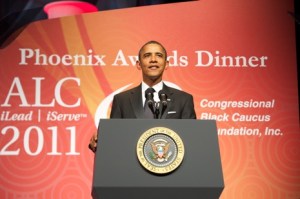
I know this was discussed on the morning post, but I thought I’d write a little more about Obama’s speech to the Congressional Black Caucus (CBC) on Saturday. If it hadn’t been for the ending, it would have been a good speech. The CBC members probably would have been OK with it, even though Obama isn’t really “attacking the cycle of poverty” and making it easier for kids to go to college, and all the other claims he made. He managed to make it sound like he’s done a lot for the economy when he’s really just tinkered with things around the edges. So why did Obama have to patronize his black audience like this?
So I don’t know about you, CBC, but the future rewards those who press on. (Applause.) With patient and firm determination, I am going to press on for jobs. (Applause.) I’m going to press on for equality. (Applause.) I’m going to press on for the sake of our children. (Applause.) I’m going to press on for the sake of all those families who are struggling right now. I don’t have time to feel sorry for myself. I don’t have time to complain. I am going to press on. (Applause.)
I expect all of you to march with me and press on. (Applause.) Take off your bedroom slippers, put on your marching shoes. Shake it off. (Applause.) Stop complaining, stop grumbling, stop crying. We are going to press on. We’ve got work to do, CBC. (Applause.)
WTF?! How tone deaf is that? I think it’s incredibly insulting. In the previous paragraphs, Obama was talking about how hard people in the audience had fought for advancement for African Americans:
Throughout our history, change has often come slowly. Progress often takes time. We take a step forward, sometimes we take two steps back. Sometimes we get two steps forward and one step back. But it’s never a straight line. It’s never easy. And I never promised easy. Easy has never been promised to us. But we’ve had faith. We have had faith. We’ve had that good kind of crazy that says, you can’t stop marching. (Applause.)
Even when folks are hitting you over the head, you can’t stop marching. Even when they’re turning the hoses on you, you can’t stop. (Applause.) Even when somebody fires you for speaking out, you can’t stop. (Applause.) Even when it looks like there’s no way, you find a way — you can’t stop. (Applause.) Through the mud and the muck and the driving rain, we don’t stop. Because we know the rightness of our cause — widening the circle of opportunity, standing up for everybody’s opportunities, increasing each other’s prosperity. We know our cause is just. It’s a righteous cause.
So in the face of troopers and teargas, folks stood unafraid. Led somebody like John Lewis to wake up after getting beaten within an inch of his life on Sunday — he wakes up on Monday: We’re going to go march. (Applause.)
Dr. King once said: “Before we reach the majestic shores of the Promised Land, there is a frustrating and bewildering wilderness ahead. We must still face prodigious hilltops of opposition and gigantic mountains of resistance. But with patient and firm determination we will press on.” (Applause.)
But then Obama follows this with the “bedroom slippers” and “complaining” and “crying” accusations. This kind of thing gives me the sense that Obama is clueless when it comes to the black experience in America. It honestly makes me wonder if he unconsciously looks down on ordinary African Americans.
Of course Obama didn’t have the same experiences as many of the people he was talking to on Saturday. He attended only private schools and didn’t experience the kind of discrimination that most of them did. But he has read about the the Civil Rights era and he often speaks about it. Presumably, he has talked directly to some poor African Americans while campaigning. Why would he expect these people to like the tone of those final paragraphs in his speech?
Well there have been some negative reactions. As she has a couple of times recently, Maxine Waters took the lead.
“I don’t know who he was talking to, because we’re certainly not complaining,” said Waters, who has been critical of Obama in the past. “We are working. We support him and we are protecting that base because we want people to be enthusiastic about him when that election rolls around.” ….
Waters said she found some of the language Obama used “not appropriate” and said it “surprised me a little bit.”
“I found that language a bit curious because the president spoke to the Hispanic Caucus and certainly they are pushing him on immigration and despite the fact that he’s appointed [Justice Sonia] Sotomayor to the Supreme Court, he has an office for excellence in Hispanic education right in the White House, they’re still pushing him and he certainly didn’t tell them to stop complaining,” she said.
“And he never would say that to the gay and lesbian community who really pushed him on Don’t Ask, Don’t Tell. Or even in a speech to AIPAC, he would never say to the Jewish community ‘stop complaining’ about Israel.”
…other members of the CBC, including its chairman, Missouri Rep. Emanuel Cleaver (D), have had different reactions to the speech, which they defended as a rallying call to African American voters, whose large turnout in 2008 helped fuel Obama’s election, and whose 2012 turnout could be pivotal to the president’s reelection effort.
“The Congressional Black Caucus supports the president; we intend to be as strongly pushing his reelection as anybody in the country,” Cleaver said Monday morning on MSNBC.
“I was like most of the crowd there — incredibly enthusiastic by the fighting spirit the president was showing. I think the president is right-on-message,” Maryland Rep. Donna Edwards (D), another CBC member, said in a separate appearance on MSNBC. “I think it’s incredibly clear, the difference, like night and day, between Republicans, who want to give special breaks to the wealthiest in this country, and the president of the United States. And it’s important that we reelect him because we have to really get this country back…the president was on that message, and we’re going to be on that message, too, for 2012.”
Frankly, I’m also offended by the way the President takes on the tone of a preacher when he speaks to black audiences. But since I’m not black, I can’t speak to whether the audiences find it patronizing. To me it seems condescending.
There have been other times when I thought Obama was incredibly tone deaf when talking to African Americans; for example, the time he lectured Black fathers who don’t support their children.
Saying that too many black fathers are “missing from too many lives and too many homes,” Obama said these men “have abandoned their responsibilities, acting like boys instead of men. And the foundations of our families are weaker because of it.”
Speaking at Chicago’s Apostolic Church of God, with his wife and two daughters in the audience, Obama said that more police on the street and job training programs are essential for a safe and sound society, “But we also need families to raise our children.”
The phenomenon of absentee fathers and single mothers certainly isn’t limited to African American families. Plenty of white men are deadbeat dads and worse.
I guess I just have a problem with stereotyping in general, and I’m particularly turned off by people in power who speak condescendingly to the rest of us. Again, I can’t speak for the CBC members, but I have to wonder if a lot of them didn’t feel like Maxine Waters did and feel a little bit resentful.
Un-politicizing Fiscal Policy?
Posted: September 26, 2011 Filed under: U.S. Economy | Tags: automatic stablizers 10 Comments
Your cyborg economist is ready to flip the switch.
This Op Ed by Peter Orzag at TNR from about a week ago is causing a flurry of tweets back and forth between people whose blogs I follow like Marcy at Empty Wheel, Atrios, and Matt Yglesias at TP. Orzag suggests we work at creating laws to take fiscal policy out of the hands of politicians. Vast amounts of economic research show that a politicized Fed creates economic havoc in an economy with bad monetary policy. Orzag suggests more automatic stabilizers as a way to depoliticize fiscal policy and get the right prescription to kick in without all the political grandstanding and gridlock. This means creating laws that work to correct business cycle frictions that make the correct impact without any political and legal action by Congress and the President. He frames it as embracing less democracy.
In an 1814 letter to John Taylor, John Adams wrote that “there never was a democracy yet that did not commit suicide.” That may read today like an overstatement, but it is certainly true that our democracy finds itself facing a deep challenge: During my recent stint in the Obama administration as director of the Office of Management and Budget, it was clear to me that the country’s political polarization was growing worse—harming Washington’s ability to do the basic, necessary work of governing. If you need confirmation of this, look no further than the recent debt-limit debacle, which clearly showed that we are becoming two nations governed by a single Congress—and that paralyzing gridlock is the result. So what to do? To solve the serious problems facing our country, we need to minimize the harm from legislative inertia by relying more on automatic policies and depoliticized commissions for certain policy decisions. In other words, radical as it sounds, we need to counter the gridlock of our political institutions by making them a bit less democratic.
Just as the founders feared, American democracy has gotten way too democratic. This new la-la-la-la-la-la refusenik approach to politics is especially wrong in the Senate, which was created to be the “temperate and respectable body of citizens” that could, owing to its more gentlemanly size and longer terms, ride above populist political hysteria. And it’s ironic that the most effective tool on behalf of tea-party purity, the cloture-proof filibuster, is a crudely undemocratic maneuver, permitting a minority of 41 to defeat a majority of 59. (How fitting that “filibuster” and “tea party” both derive from maritime criminality—to filibuster is to freeboot, or hijack debate like a pirate.) Senate filibusters used to be rare, a monkey wrench used only in cases of emergency, meant to allow debate to continue unimpeded and to protect minority opinion from being ignored. In the sixties, the decade of civil rights and the Great Society and Vietnam, there were never more than seven filibusters during one Senate term; in 2007–2008, scores of Republican filibuster threats resulted in cloture motions. The Democrats aren’t innocent in this downward spiral of truculence: Under Bush, they regularly filibustered to stop the confirmation of judicial nominees. On health care, even though the Senate bill isn’t remotely radical, the Republicans’ refusal to play along at least follows the contours of principle. But on the issue supposedly animating the post-Bush GOP and the tea-partiers, the massive deficit, a bi-partisan Senate bill to establish a bi-partisan commission to rein in future budgets was just defeated with 23 of 40 Republicans voting no—including a half-dozen of the bill’s original co-sponsors. The framers worried about democratic government working in a country as large as this one, and it’s possible that we’ve finally reached the unmanageable tipping point they feared: Maybe our republic’s constitutional operating system simply can’t scale up to deal satisfactorily with a heterogeneous population of 310 million.
Fiscal policy has a notorious inside and outside lag because it has to get through two houses of congress,a President, and then usually through some form of bureaucratic implementation. It’s been estimated that it can take 2 years to implement. In comparison, monetary policy general shoots through the economy in about 6 months. Orzag isn’t exactly suggesting we set up some kind of czar or political commission to deal with economic policy, he suggests we pass more laws that respond to the situation so the situation handles itself a little bit better. We already have plenty of automatic fiscal stabilizers that do kick in when the economy gets bad–like unemployment insurance–or when it overheats with inflation–like cola clauses–but this is a little more high powered than that.
Automatic stabilizers are features of the tax and transfer systems that tend by their design to offset fluctuations in economic activity without direct intervention by policymakers. When incomes are high, tax liabilities rise and eligibility for government benefits falls, without any change in the tax code or other legislation. Conversely, when incomes slip, tax liabilities drop and more families become eligible for government transfer programs, such as food stamps and unemployment insurance, that help buttress their income.
This would build in more fiscal responses to business cycle fluctuations by law. Here’s a few more specifics from Orzag.
What we need, then, are ways around our politicians. The first would be to expand automatic stabilizers—those tax and spending provisions that automatically expand when the economy weakens, thereby cushioning the blow, and automatically contract as the economy recovers, thereby helping to reduce the deficit. A progressive tax code is one such automatic stabilizer. The tax code takes less of your income as that income declines, so after-tax income tends to decline less in response to an economic shock than pre-tax income. Since spending is based on after-tax income, the impact on the economy is cushioned. Alan Auerbach of the University of California at Berkeley has found that, as a result, the tax code has, over the past 50 years, offset about 8 percent of the initial shock to GDP from economic downturns. For the same reason, making the tax code more progressive would strengthen its role as an automatic stabilizer. Unemployment insurance is another automatic stabilizer; as the economy weakens, unemployment insurance expands, providing a boost to demand right when the economy needs it. Other automatic stabilizers are possible as well. For instance, rather than simply extending and expanding the existing payroll-tax holiday, as President Obama has proposed, policymakers should permanently link the tax to the unemployment rate. Consider a system under which the payroll tax would be reduced by 6 percentage points whenever the quarterly average unemployment rate exceeded 7.5 percent or increased by more than 2 percentage points over the previous year. Since a cut in the payroll tax is a powerful form of stimulus, this would be a built-in way to ensure a quick and effective government response to an economic downturn.
I’m not convinced payroll tax cuts are powerful, but that’s just an example for Orzag given his role in the Obama policy making group until recently. Is that a good idea and is framing it as less democracy a bad sell?
Here’s the criticism from Empty Wheel.
Peter Orszag opines from the politically sheltered comfort of his gig at Citigroup that we have too much democracy.
I’ll say more about specific claims he makes below, but first, let me point out a fundamental problem with his argument. He suggests we need to establish institutions insulated from our so-called polarization to tackle the important issues facing this country. That argument is all premised on the assumption that policy wonks sheltered from politics, as he now is, make the right decisions. But not only is his own logic faulty in several ways–for example, he never proves that polarization (and not, say, money in politics or crappy political journalism or a number of other potential causes) is the problem. More importantly, he never once explains why the Fed–that archetypal independent policy institution–hasn’t been more effective at counteracting our economic problems.
If the Fed doesn’t work–and it arguably has not and at the very least has ignored the full employment half of its dual mandate–then there’s no reason to think Orszag’s proposed solution of taking policy out of the political arena would work.
As you undoubtedly know, I can’t agree with her take on the Fed because I’ve just seen way too much research and history of other countries with central banks that have been politicized and the results are horrible. I think that the statement she makes after the charge of “archetypal independent policy institution” isn’t a sound argument. She’s mistaking the impotency of monetary policy in the face of a liquidity trap for problems with the Fed itself. All you have to do is google central bank independence and you’ll get the decades old studies that show just how bad it can get if there’s a central bank invaded by pols. The Fed needs to be monitored but it no way should any politician get close to the Open Market Committee. She makes her usual great points though and it’s worth the read.
So, there’s some food for thought. Chew Away!
Monday Morning Reads
Posted: September 26, 2011 Filed under: morning reads | Tags: institutional racism, liberal racism, personal racism, Racism 66 Comments Good Morning!
I’ve been reading some things that have really gotten me thinking lately. The topic of racism has crept back into the public arena since the campaign season is now in full force. There have been two high profile media stories that have created a stir and one story that’s been percolating in my mind all last week.
There is the coverage of the President who opened the can of worms yesterday during a speech in front of a black audience. The other story was that of Morgan Freeman who called the Tea Party racist on the Piers Morgan Show. Herman Cain shot back on Sunday saying Freeman didn’t get what the Tea Party was about. Before both events, I had actually read this post at The Nation written by Melissa Harris-Perry–who I admire–on white liberal racism that evoked a really strong tweet from Max Blumenthal yesterday. Then, LGF sent me over to Andrew Breitbart’s site where I got an eyeful of comments left there by republicans and teabots on the President’s words that were characterized as black power dog whistles by folks over there. Calls of reverse racism filled the comments section.
So there’s my links to the re-emergence of the racism conversation. It hasn’t been pretty or civil. I really am not looking forward to any 2008 repeat of all that. Thankfully, Sky Dancing has been a refuge from trolls for the most part. I can tell you that Bostonboomer and I have had conversations on the phone about racism in the Tea Party before and I know we both feel there is overt racism in their ‘movement’. This doesn’t mean every one that’s attended one of their rallies is a racist, but all you have to do is look at their placards and you can’t deny it’s there. So, I have to admit to agreeing with Morgan Freeman on his comments. Obama’s presidency has brought a lot of the worst stuff out on to the streets again. I will also send you over to the LGF link to read the comments by Breitbart’s readers if you want to see exactly how alive, well, and thriving racism is in parts of the Republican party. The weird thing is that the folks in the Breitbart comments section think the President is playing the race card. It’s an odd juxtaposition of arguments to watch people screaming reverse racism using really overtly racist language and frames. I mean, how can you talk about reverse racism when writing out your screed in some form of perverted ‘ebonics’ ? Well, any way go look for yourself and you’ll see what I mean.
I agree with the Freeman comments that there has to be some underlying bit of racism in the republican obsession to get Obama out of office. The republicans did some pretty nasty things to Clinton, but I’ve never EVER seen so many people willing to take our entire country down over the election of one man. They’ve been at it consistently for nearly three years now. It’s like watching the confederacy rise again. All we hear is state’s rights and complete mis-characterizations of the president’s policies which have been very conventionally Republican. Draw out a game theory decision tree and tell me what sort’ve end game they have in mind when every strategic move they make is aimed at making Obama a one term president at WHATEVER the cost to the country. It’s just not rational.
Freeman said it unnerves him that the conservative movement is garnering momentum during an appearance on CNN last week.
“Their stated policy, publicly stated, is to do whatever it takes to see to it that Obama only serves one term,” he said. “What underlines that? Screw the country. We’re going to do whatever we do to get this black man, we can, we’re going to do whatever we can to get this black man out of here.”
Freeman characterized the actions of the Tea Party as “racist” and suggested that Obama’s presidency has only fueled the rise of the coalition of conservative activists, and in that context has made the issue of racism “worse.” He said, “It just shows the weak, dark underside of America. We’re supposed to be better than that. We really are. That’s why all those people were in tears when Obama was elected president. Look at what we are, you know? And then it just sort of started turning, because these people surfaced like stirring up muddy water.”
We know Obama’s candidacy stirred up the issue and we know he’s not beneath playing politics with racism when it behooves him to do so. However, his “Come march with me” speech is a narrative that tries to put the President in the same light as MLK when the President is no MLK. I do not think Obama is playing any race card because it feels to me like your basic pandering to a voting segment while trying to shore up your base. I don’t think it’s going to be very effective and I don’t think it’s a black power dog whistle. The Republican reaction to the speech idoes expose some of that overt racism to which Morgan Freeman alludes. When people act like Obama’s going Black Panther every time he gives a speech to black people there has to be something in there that’s above and beyond basic political differences.
However, back to where I agree with Blumenthal and draw the line at Melissa’s statements at The Nation painting those of us who criticize Obama with a huge brush of having double standards for blacks and whites. I had thought about posting this article before but I didn’t really want to go there. I have had my fill of that three years ago. However, in light of these other things, I thought I’d post the link and have the conversation.
Elements of racism are every where. The Tea Party can’t seriously deny that its attracted a pretty virulent strain. I’m not about to say that I didn’t notice it in the likes of people like Orly Taitz and other former Hillary supporters that jumped on the birther and secret Muslim wagon. However, some of this activity by die hard Obama supporters still strikes me as a hunt for communists under the bed and making excuses for the man. Maybe when you’re so vested in some one else’s success and they fail you repeatedly you just keep grasping for all the straws you can.
Dr. Harris-Perry thinks when we try to hold President Obama to his campaign rhetoric and criticize the deals that he makes with Republicans, we are holding Obama to a different standard than we did President Clinton because of Obama’s race. She believes that there has been unequal liberal criticism of Clinton’s triangulations and Obama’s “cave-ins”. I see more contextual differences than that. Clinton had a huge up hill battle given he got elected so close to the Reagan “morning in America myth”. There was less of an outcry for change then. Obama, to me, came in with a much stronger push for change and Dubya’s legacy was incredibly negative. Changing Dubya’s course would’ve been welcome. Trampling on the Reagan legacy would’ve gotten blowback.
This is Blumenthal’s response.
MaxBlumenthal Max Blumenthal
The Obamabot “you’re a racist” strategy may have shielded Obama from legit criticism in 2008, but it’s spent by now.
If even liberal-left critics of Obama are tarred as racists, critiques of real anti-Obama racism are cheapened, can be discredited by right
….if not discredited then dismissed.
Here’s Dr. Harris Perry’s closing thoughts after naming some disappointing things done by Clinton and Obama.
These comparisons are neither an attack on the Clinton administration nor an apology for the Obama administration. They are comparisons of two centrist Democratic presidents who faced hostile Republican majorities in the second half of their first terms, forcing a number of political compromises. One president is white. The other is black.
In 1996 President Clinton was re-elected with a coalition more robust and a general election result more favorable than his first win. His vote share among women increased from 46 to 53 percent, among blacks from 83 to 84 percent, among independents from 38 to 42 percent, and among whites from 39 to 43 percent.
President Obama has experienced a swift and steep decline in support among white Americans—from 61 percent in 2009 to 33 percent now. I believe much of that decline can be attributed to their disappointment that choosing a black man for president did not prove to be salvific for them or the nation. His record is, at the very least, comparable to that of President Clinton, who was enthusiastically re-elected. The 2012 election is a test of whether Obama will be held to standards never before imposed on an incumbent. If he is, it may be possible to read that result as the triumph of a more subtle form of racism.
My suggestion is that you read the comments column for her post and then go back and look at the actual comments in the Brietbart piece and not just the LGF slice of it. You’ll get a quick lesson in spot the overt racism.
I did see some rethink of her position last night on Twitter after a bit of a pile on.
MHarrisPerry Melissa Harris-Perry
It’s completely possible that I’m wrong & economy is only meaningful variable. But race is worth discussing. Expect allies to agree to that.
Joan Walsh has a response at Salon. I suggest you read it because it’s full of examples of liberals criticizing Clinton. In deed, much of that criticism of Clinton’s triangulations is what sent progressives away from Hillary Clinton in 2008 as I recall. So, it’s a good perspective.
Outside of Congress, many of the white progressives giving Obama the most trouble weren’t uncritical Clinton supporters, either. While we remember Moveon.org getting its start to back Clinton during impeachment, it’s worth recalling that it wanted Congress to censure Clinton for his misdeeds; its slogan was “censure, and move on.” Also, the progressive online group was tiny back then, with nothing like the reach it has now. Obama critic Michael Moore was also a Clinton critic, who famously supported Ralph Nader over Gore in 2000. Nader and Michael Lerner, two organizers of the recent letter calling for a primary challenge to Obama, both regularly attacked Clinton.
For a final perspective, I suggest you go to Black Agenda Report–which btw is holding a fundraiser and could use some support–for some other thoughts on Obama’s form of triangulation. I’m sending you to a recent article called: Barack Obama VS Those Craaaazy Republicans: Is He the Lesser Evil, or the More Effective Evil? Bruce A. Dixon characterizes what he calls Black Misleadership. I’d say he has the same criticism we’ve had and it’s certainly not sourced in white liberalism. However, he frames the complaints using race dynamics.
Since the forces financing Republicans are the same as those financing Democrats the directors of US political theater have the power to play games with us. For them, Obama is the preferable alternative. Only the First Black President could have disbanded the peace movement and rolled into town promising to “cut entitlements” without provoking a firestorm of protest. Only the First Black President could have accepted a Nobel Peace Prize with a war speech, and invaded an African country without millions of protesters in the street worldwide. Only the First Black President with a strong Democratic majority in Congress could have resumed offshore drilling after the Gulf BP disaster, and blocked any new regulation on the oil industry. Only the First Black President could have given GM back to its managers after sticking the unions with its underfunded health care and pension load. Only candidate Obama could have come in off the campaign trail in September 2008 to whip Democratic votes in the Democrat-dominated congress for the $3 trillion Bush bailout, and only the First black President could have quintupled down on that bailout, giving the banksters $15 trillion more once in office.
From their standpoint, Obama needed, and continues to need two things. First, Obama needs running room to his right. In order for Obama to enact the neoliberal policies of his militarist and bankster sponsors, the policy demands of Republicans had to move further and still further rightward. In other words, he needs Republicans to play crazy and crazier, so that wherever he lands can credibly be claimed to be a little better than what might have been under a Republican regime, even when Obama’s position is actually to the right of Bush or Reagan. Secondly, the bankster favorite Obama needs to distract the attention of his voter base with a loud and persistent clamor over cultural issues and sustained furor over instances of personal (but not institutional) racism among Republican candidates and supporters. Like in any production, every actor has a job to do, and everybody does their job.
Since the purpose of Sky Dancing is to discuss real issues, I really couldn’t let some of this burbling boiling social vibe stew stay on the fire without a bit of a stir. So, the links are there for you. Make of them what you will. Since this post has run so long, I want to share one more topic with you.
Back to economists where I’m not such a fish out of water. I had to point out this blog thread on frames by Jared Bernstein because I spent two huge blog posts on Saturday elucidating frames and their impact on markets and the economy. What a co-inky-dink! He talks about a related idea which is how the Republicans are ‘framing’ our historically progressive tax codes as class war fare instigated by that secret muslim, commie, Kenyan president of ours! The same things have been making him think of frames.
That said, ever since the R’s countered President Obama’s emphasis on fairness in the tax code with shrieks of “class warfare,” I’ve been thinking a lot about framing. These thoughts were amplified by this smart piece in today’s NYT, arguing that as the language of budgets (“fiscal sustainability,” “deficit reduction”) has replaced that of economic security, progressives have ceded key intellectual ground.
The piece compares, to great effect, the rhetoric of FDR during the Depression to that of today. But that led me to reflect on the
points Stan Greenberg made, as I reviewed them here. In this regard, the most salient difference in this context between today versus the days of FDR is not just the rhetoric or framing. It’s the underlying faith in American institutions, most notably government.
Greenberg’s point is that absent that faith, a positive frame, even if it’s based in fact (we really do have the right ideas re economic security and they really don’t) will fail to resonate.
This means progressives have some heavy lifting to do. Our work must be to re-establish faith in the institution of government…the belief that this institution is a force for good in your lives and can be more so. And that has to come from explanation, evidence, and effective implementation of government programs.
It also underscores the importance of the current fight for fairness: if people continue to believe that government has devolved into an ATM for the wealthy, an enforcer of the inequality-inducing policy agenda, and a bailer-outer of the rich and the reckless, no frame will be smart enough to convince them otherwise.
So, any way. What’s on your reading and blogging list today?

 peej
peej Carissa
 bostonboomer
 dakinikat
 ecocatwoman
 mablue2
 Mama Lopez
 peggysue22
 quixote
 skydancingguestblogger
 Mona (aka Wonk the Vote)



 Sky Dancing
Recent Comments