
46.2 Million Americans (1 in 6) Now Living in Poverty
Posted: September 13, 2011 Filed under: Barack Obama, income inequality, poverty, U.S. Economy, U.S. Politics, unemployment | Tags: Census Bureau, Income Inequality, jobs, median income, Poverty, unemployment 10 Comments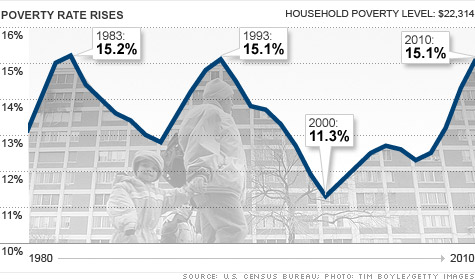
Chart courtesy of CNN Money
As of 2010, 1 in 6 Americans was living in poverty, according to a report from the Census Bureau today. The poverty rate was 15.1%, the highest number of Americans living below the poverty rate since the number has been examined. From the New York Times:
An additional 2.6 million people slipped below the poverty line in 2010, census officials said, making 46.2 million people in poverty in the United States, the highest number in the 52 years the Census Bureau has been tracking it, said Trudi Renwick, chief of the Poverty Statistic Branch at the Census Bureau.
That figure represented 15.1 percent of the country.
The poverty line in 2010 was at $22,113 for a family of four.
“It was a surprising large increase in the overall poverty rate,” said Arloc Sherman, senior researcher at the Center on Budget and Policy Priorities. “We see record numbers and percentages of Americans in deep poverty.”
The middle class has also lost ground in terms of yearly income.
And
…real median household incomes declined by 2.3 percent in 2010 from the previous year, to $49,400. That was 7 percent less than the peak in 1999 of $53,252.
“A full year into recovery, there were no signs of it affecting the well being of a typical American family,” said Lawrence Katz, an economics professor at Harvard. “We are well below where incomes were in the late 1990s.”
According to the census figures, the median annual income for a male full-time, year-round worker in 2010 — $47,715 — was virtually unchanged from its level in 1973, when the level was $49,065, in 2010 dollars, said Sheldon H. Danziger, professor of public policy at the University of Michigan.
As we all know, the rich have gotten much much richer and are continuing to get richer still because of the Bush/Obama economic policies. From CNN Money:
For middle-class families, income fell in 2010. The median household income was $49,445, down slightly from $49,777 the year before.
Median income has changed very little over the last 30 years. Adjusted for inflation, the middle-income family only earned 11% more in 2010 than they did in 1980, while the richest 5% in America saw their incomes surge 42%.
“Over that period of time, it’s not that the American economy has necessarily performed badly,” Osterman said. “As a country we’re richer over that period, but there’s been this real shift in where the income has gone, and it’s to the top.”
Amplifying that trend, the bottom 60% of households saw their income fall last year, while households making $100,000 or more enjoyed a rise in income.
CNN has a chart that shows the poverty level in each state, so you can check to see how people are doing in your neck of the woods. In general, the South is the worst off, and Louisiana and Mississippi have the highest percentages of people living below the poverty line.
I hope someone is showing this data to President Obama, because he needs to either do something about jobs and income inequality or follow LBJ’s example and get out of the way so we can find candidate who is able to show some leadership.
Tuesday Reads: Romney vs. Perry, 9/11 Revelations, and Hormonal Effects of Fatherhood
Posted: September 13, 2011 Filed under: morning reads, U.S. Economy, U.S. Politics | Tags: 9/11 investigations, Bob Graham, evolutionary biology, fatherhood and testosterone levels, Mitt Romney, Paul Krugman, Republican Tea Party Debate, Rick Perry 16 Comments
Good Morning!! Let’s see if there’s any news out there. I didn’t see much of the Tea Party debate, because I was watching the New England Patriots crush the Miami Dolphins. That was soooo much better than watching Wolf Blitzer and the crazy people. Thanks so much to those of your who watched and documented the insanity so I didn’t have to.
According to Alexander Burns at Politico, Mitt Romney turned into an attack dog and lit into Rick Perry.
Mitt Romney went on the attack against Rick Perry at the first possible opportunity Monday night, challenging the Texas governor on whether he “continues to believe that Social Security should not be a federal program … or does he retreat from that view.”
[….]
Romney jumped in with a hit against Perry’s book, “Fed Up!” – the tome that Perry used to describe Social Security as a program that violated constitutional principles.
“Gov. Perry pointed out that in his view, Social Security is not constitutional,” Romney said.
And so on, with Perry giving weak responses. It’ll be interesting to see Romney challenge Obama on Social Security during the general election. Talk about role reversal!
Unfortunately, the latest CNN poll shows Perry still leading the rest of the Republicans in terms of electability.
Hours before the start of the first-ever CNN/Tea Party Republican debate, a new national survey indicates that Texas Gov. Rick Perry is maintaining his lead in the race for the GOP presidential nomination.
And according to a CNN/ORC International Poll, what appears to be Perry’s greatest strength – the perception among Republicans that he is the candidate with the best chance to beat President Barack Obama in 2012 – seems to be exactly what the GOP rank and file are looking for.
Paul Krugman wrote an addendum to his recent “controversial” blog post about the September 11 anniversary.
The fact is that the two years or so after 9/11 were a terrible time in America – a time of political exploitation and intimidation, culminating in the deliberate misleading of the nation into the invasion of Iraq. It’s probably worth pointing out that I’m not saying anything now that I wasn’t saying in real time back then, when Bush had a sky-high approval rating and any criticism was denounced as treason. And there’s nothing I’ve done in my life of which I’m more proud.
[….]
Now, I should have said that the American people behaved remarkably well in the weeks and months after 9/11: There was very little panic, and much more tolerance than one might have feared. Muslims weren’t lynched, and neither were dissenters, and that was something of which we can all be proud.
But the memory of how the atrocity was abused is and remains a painful one. And it’s a story that I, at least, can neither forget nor forgive.
Good for him for sticking to his guns.
Former Senator Bob Graham today called for another 9/11 investigation, because of a new report that the FBI knew of connections between the hijackers and Saudis living in Florida and never revealed those finding to Congress of the 9/11 Commission.
Ten years after the deadliest attack of terrorism on U.S. soil, new information has emerged that shows the FBI found troubling ties between the hijackers and residents in the upscale community in southwest Florida, but the investigation wasn’t reported to Congress or mentioned in the 9/11 Commission Report.
Former U.S. Sen. Bob Graham, the Florida Democrat who cochaired the bipartisan congressional Joint Inquiry into the attacks, said he should have been told about the findings, saying it “opens the door to a new chapter of investigation as to the depth of the Saudi role in 9/11. … No information relative to the named people in Sarasota was disclosed.”
The U.S. Justice Department, the lead agency that investigated the attacks, refused to comment, saying it will discuss only information already released.
The results of a new study suggest that when men become fathers, their testosterone levels go down. The researchers looked at testosterone levels in a large sample of men before they married and had children and again a few years after their children were born. According to TheManlyZone.com, lower levels of testosterone could be nature’s way of making men less interested in other partners and more interested in caring for their families.
Experts say the research has implications for understanding the biology of fatherhood, hormone roles in men and even health issues like prostate cancer.
“The real take-home message,” said Peter Ellison, a professor of human evolutionary biology at Harvard who was not involved in the study, is that “male parental care is important. It’s important enough that it’s actually shaped the physiology of men.”
“Unfortunately,” Dr. Ellison added, “I think American males have been brainwashed” to believe lower testosterone means that “maybe you’re a wimp, that it’s because you’re not really a man.
“My hope would be that this kind of research has an impact on the American male. It would make them realize that we’re meant to be active fathers and participate in the care of our offspring.”
That’s all I’ve got for today. What are you reading and blogging about?
Live Blog: The CNN Tea Party Republican Debate
Posted: September 12, 2011 Filed under: 2012 presidential campaign, just because, Republican presidential politics | Tags: Debate, GOP 114 Comments
Jeeze, could things get any worse? Republican presidential candidates, the Tea Party, and Wolf Blitzer as moderator. If you can stand it, please tune in or live stream the debate and join us to document the atrocities.
Rick Perry has been trying to walk back his claims that Social Security is a “ponzi scheme” and a “failure.” Mitt Romney will probably be on the offensive about that. As the The Caucus blog points out,
Mitt Romney, the former governor of Massachusetts, warned during a debate last week that the Republican Party should nominate someone “who isn’t committed to abolishing Social Security, but who is committed to saving Social Security.”
And Mr. Romney has hardly let up since. In a biting e-mail last week titled “Rick Perry: Reckless, Wrong on Social Security,” Mr. Romney’s campaign alleged that Mr. Perry “believes Social Security should not exist.”
Over the weekend, Representative Michele Bachmann of Minnesota joined in, chiding Mr. Perry — without naming him directly — for using rhetoric about Social Security that scares seniors.
“That’s wrong for any candidate to make senior citizens believe that they should be nervous about something they have come to count on,” Mrs. Bachmann said in a radio interview in Iowa.
Of course both Romney and Bachmann have said unkind things about Social Security in the past, so they might have to answer for that.
At the Guardian, Richard Adams says that tonight is Michele Bachmann’s last chance to shine, after she was pretty much ignored at the Reagan Library debate last week.
With the Republican presidential contest rapidly devolving into a two-way race between Rick Perry and Mitt Romney, Monday night’s GOP debate in Tampa may represent Michele Bachmann’s last chance to keep up with the front-runners.
The latest opinion polls in the Republican presidential nomination contest make bitter reading for Bachmann and her supporters: since the entry of Perry, the Texas governor, her support has melted away like a popsicle on a barbeque.
The fire-breathing Tea Party favourite had threatened to up-end the nomination battle with her entry back in June. But she has wilted over summer and her evanescent campaign has seen its support collapse, even among the trenchant social conservatives that Bachmann was relying on.
Tonight should be fertile ground for Bachmann: the debate is co-hosted by the Tea Party Express group and is being billed as “the Tea Party debate” by CNN.
At CNN, Paul Steinhauser offers Five things to watch for in CNN/Tea Party Republican debate, and at the Christian Science Monitor Peter Grier offers three things we might see at tea party event tonight
Personally, I plan to watch the New England Patriots and Miami Dolphins on Monday Night Football, but I’ll check in periodically to see what’s happening. I’m hoping someone will watch this debate so I don’t have to!
Twisting Personal Tragedy to Advance Unrelated and Evil Public Ends
Posted: September 12, 2011 Filed under: Afghanistan, Iraq, Pakistan, U.S. Economy, U.S. Military, U.S. Politics, Yemen | Tags: 9/11 Commission, Barack Obama, black sites, Dick Cheney, Donald Rumsfeld, first responders, George W. Bush, individual rights and freedoms, Jersey Girls, Kristen Breitweiser, memories, rendition, September 11th, the Constitution, Torture 15 Comments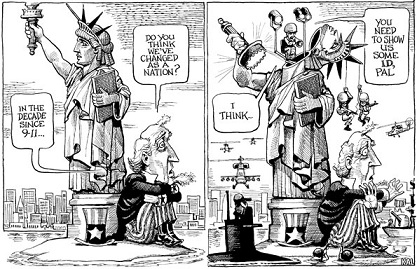
Yesterday, Minkoff Minx wrote a beautiful and eloquent post that described her personal experience of the tragic events of September 11, 2001. I was so grateful to read what she wrote, because she simply described her own experience and emotions about what happened. She didn’t try to speak for her husband or any of the the other survivors–just herself. She also shared some wonderful resources for getting in touch with how we felt on that day ten years ago, when our country was attacked by foreign terrorists.
On September 11, 2001, nearly 3,000 people lost their lives to terrorist attacks as they were either beginning their days at work at the World Trade Center and the Pentagon or traveling on airplanes scheduled to fly from Boston to Los Angeles, Washington D.C. to Los Angeles, and Newark to San Francisco. For the families and friends of those who died, life would never again be the same. Thousands of others, like Minx’s husband, survived, but their lives and those of their families were also forever altered.
Thousands more were either directly impacted by the trauma of witnessing the attacks close up from their homes in New York or Washington, DC. Thousands of first responders were also directly affected by the attacks and their aftermath, including people who traveled to NYC, DC, and PA to help search for survivors or to support first responders.
Those of us who helplessly watched the events as they played out on television were affected too, although few of us probably suffered from post-traumatic stress as a result. But we empathized with those who were directly impacted, and we felt the terrible shock of having our country attacked. I can remember how shocked I was that day. I was on vacation at a Rhode Island beach with my family. It was a gorgeous day and I was out sightseeing with my parents and my sister when we heard the news. My sister had spoken to someone in a museum store and heard that a plane had flown into the World Trade Center. We headed back to the beach house as we listened to reports on the radio. My brother and his wife were watching TV at the beach house when we got back.
For the next couple of days we quietly read newspapers or watched TV. My sister’s husband drove out from Indiana to get her because the planes weren’t flying and she was very frightened. I had to go back to Boston to start teaching classes a couple of days later, and I recall that I felt nervous and jumpy while driving alone. Like many others, I was fearful of more attacks. At the time, everything was so confusing, I didn’t know what to expect. I also felt shame that two of the planes used in the attacks flew out of Logan Airport in Boston.
Most of us probably have clear memories of where we were and what we were doing that day and following days. We’re told told Americans pulled together after September 11, 2001, although I don’t really recall feeling that myself. But I have no doubt that millions of people empathized with those who were directly affected. As I mentioned above, many people took action by traveling to the places that were attacked to help in any way they could. Nothing that has happened since can change the basic caring and good will of the American people.
Yet for the past week, I’ve felt anger every time I saw the upcoming anniversary of September 11 being hyped on TV–the endless replaying of the videos of the planes hitting the towers; the preachy fake patriotism of the talking heads; the sudden reappearance of disgraced politicians George W. Bush, Dick Cheney, and Donald Rumsfeld; the constant talk of “security” and the repetition of the words “the homeland,” which is so reminiscent of the Nazi term “the fatherland.” How could I not be angry after all that our government has done in the past ten years to supposedly avenge the lives lost on 9/11?
First there was the attack on Afghanistan, supposedly to catch Osama bin Laden. But when there was a chance to capture or kill bin Laden, Bush decided not to. Next came the barrage of lies from the Bush administration and from media sources like The New York Times and Washington Post, in order to get us into a second war in Iraq. Those wars have killed far more than 3,000 young American soldiers and perhaps hundreds of thousands of Iraqis and Afghanis–and for what? No effort was made to confront Saudi Arabia–where most of the perpetrators and the financial support for the attacks came from. Over the past ten years we have seen the progressive erosion of our Constitutional rights in the name of “security” and “safety.” We have learned that our government captured and imprisoned people–often completely innocent people–without evidence or charges at Guantanamo, at Abu Ghraib, at Bagram, and untold other prisons around the world. We know that many of these people were tortured and killed. Americans voted for Barack Obama in hopes that he would end the pointless wars and stop the rendition and torture. Instead, he has continued the wars and continued to rendition people to foreign prisons where they will be tortured. He has ordered drone attacks in Pakistan and Yemen. He has continued the erosion of our Constitution rights and defended the Bush administration at every opportunity. These are the reasons I felt angry at the jingoistic celebrations of the tenth anniversary of September 11, 2001.
And what has become of the survivors of the 9/11 attacks? Every effort was made to keep any compensation they received to a minimum. And what of the first responders who were exposed to the toxic environment at Ground Zero in NYC? They have been denied the help they need along with the recognition of what they suffered. The Bush administration resisted any investigation of why the attacks were not prevented, and when they finally allowed a 9/11 commission–largely because of the efforts of four 9/11 widows (The Jersey Girls), they kept the Commission from from going “too far” in holding anyone in the administration accountable.
It was healing for me to read Minkoff Minx’s post, because she spoke of her personal pain and losses and how she was living with the aftereffects. I was able to recall my pure memories of that day, and how I worried about the reactions of my students, how I tried to get discussions going in my classes so we could share our reactions. For a short time as I read yesterday morning’s post, I was able to recall the pure feeling of loss from that day ten years ago before the tragedy was twisted to start wars that would decimate our economy and pass laws that would erode our individual rights and freedoms.
Yesterday morning, Paul Krugman wrote a brief but heartfelt blog post expressing some of the feelings I’ve tried to express with my post today. I’m going to take the liberty of reproducing Krugman’s statement here:
September 11, 2011, 8:41 am
The Years of Shame
Is it just me, or are the 9/11 commemorations oddly subdued?Actually, I don’t think it’s me, and it’s not really that odd.
What happened after 9/11 — and I think even people on the right know this, whether they admit it or not — was deeply shameful. The atrocity should have been a unifying event, but instead it became a wedge issue. Fake heroes like Bernie Kerik, Rudy Giuliani, and, yes, George W. Bush raced to cash in on the horror. And then the attack was used to justify an unrelated war the neocons wanted to fight, for all the wrong reasons.
A lot of other people behaved badly. How many of our professional pundits — people who should have understood very well what was happening — took the easy way out, turning a blind eye to the corruption and lending their support to the hijacking of the atrocity?
The memory of 9/11 has been irrevocably poisoned; it has become an occasion for shame. And in its heart, the nation knows it.
For this brief blog post expressing his personal sadness over the way government, politicians, and media have twisted private tragedy to accomplish their own unrelated and corrupt ends, Paul Krugman has been attacked by right wingers and Islamophobics all over the internet. He has been called every name in the book for simply speaking his own truth. He has also gotten some support from liberal blogs, and other bloggers have discussed their own misgivings about the changes in our country after 9/11. I want to share a few of those reactions.
Nicole Belle at Crooks & Liars: While Thinking People Grapple With 9/11 Legacy, RWNJs Shoot The Messenger
Cliff Schecter at Al Jazeera English: 9/11 and Its Great Transformations
Kristin Breitweiser: No Place To Go But Up: Howard Schultz’ Upward Spiral 2011
Blue Texan at FDL: Krugman is Right: We Should Be Ashamed of What Happened After 9/11
Dave Weigel at Slate: Get Krugman!
I guess what I’m trying to say in this post is that ten years after September 11 2001, I still have faith in the basic goodness and caring of the American people, but I am even more suspicious of and cynical about the U.S. Government and the U.S. Media than ever before. I do think we need to be eternally vigilant, not about physical danger from foreign terrorists but from the constant psychological manipulations emanating from those who claim to be protecting and informing us.
Monday Reads
Posted: September 12, 2011 Filed under: morning reads, We are so F'd | Tags: one term presidents, repeating the 1937 recession, Social Security 11 Comments Good Morning!
Well, it’s yet another Monday. I’ve been busy checking out the jobs listings for next academic year and one Hawaii posting is looking pretty interesting right now. Anyway, I’ve got a little more writing on stuff to do before I go full force on that in a few weeks. I spent all weekend with my nose in numbers and didn’t even turn on the TV once. Let’s start with an academic post at VOXEU on “What caused the recession of 1937- 1938?” for a good start. It’s on monetary policy and gold. It shows how worrying about inflation when a recovery hasn’t really taken hold yet can create further problems. It also is an area that was investigated by economist Christine Romer who showed how tight fiscal policy (i.e. less government spending) and a tightening of monetary policy led to a recession within the Depression. Sounds familiar!
The recession of 1937-38 is sometimes called “the recession within the Depression.” It came at a time when the recovery from the Great Depression was far from complete and the unemployment rate was still very high. In fact, it was a disastrous setback to the recovery. Real GDP fell 11% and industrial production fell 32%, making it the third-worst US recession in the 20th century (after 1929-32 and 1920-21).
The recession is often attributed to a tightening of fiscal and monetary policy. Christina Romer (2009) and others have argued that it is relevant to today’s situation because it illustrates the dangers of a premature withdrawal of stimulus when the economy is still weak.
But the recession remains somewhat of a mystery because the two most frequently mentioned causes – the reduction in the fiscal deficit and the Federal Reserve’s decision to double reserve requirements – do not appear to have been powerful enough to generate a recession of the magnitude seen. For example, Romer (1992) herself has argued that “it would be very difficult” to attribute much of the decline in output to changes in fiscal policy.1 And most studies of the Fed’s doubling of reserve requirements – most recently, Calomiris et al (2011) – have concluded that it had little impact on banks because they held abundant excess reserves, which they did not seek to rebuild after the new requirements took effect.
If fiscal retrenchment and higher reserve requirements cannot fully explain the recession, then what can? There is no doubt that there was a severe monetary shock. As Figure 1 shows, the money supply (M2) grew at a consistent rate of about 12% a year from 1934 to 1936, but then suddenly stopped growing in early 1937 and even fell later in the year. The monetary shock, however, was not the Federal Reserve’s decision to increase reserve requirements, but the often overlooked Treasury Department decision to sterilise all gold inflows starting in December 1936.
Historian Julian Zelizer is wondering about Obama becoming a one-term President. Minx sent me this link and I found it interesting. Zelizer seems to think that the midterm election created a timid Obama. It seems like every where I turn I read an article on Obama plus one term president these days.
With waning approval ratings and a stagnant economy, the possibility that Mr. Obama will not be re-elected has entered the political bloodstream. Suddenly, the opposition party envisions a scenario in which its presidential candidate could defeat Mr. Obama in a referendum on his job performance. Mr. Obama needs to think hard about his own statement and consider what it takes to be a successful one-term president, in the light of history.
One-term presidents usually leave office with their parties divided, the economy in crisis, wars unresolved, approval ratings in the tank and a sullen public rejecting them. Becoming a one-term president means joining a gallery of dashed hopes and crushed ambitions. Among those who were elected for just one term were men who, like Mr. Obama, came to the White House with enormous promise.
Interestingly enough, it may just be the Republicans that defend Social Security in an effort to stop the momentum of Governor Goodhair. First up, a bit of ass-kicking on the subject from Mittens. Romney knows where to play the Social Security card; FLORIDA!
Mitt Romney didn’t wait long to begin his attack on Rick Perry over Social Security—his campaign is doing door-to-door distribution of a flier attacking Perry on the issue.
The flier, which a campagn spokesman said is being left at the doors of Florida GOP primary voters, portrays the GOP primary as a two-candidate race—“Two candidates. Only one will protect what’s important to you,” is the headline.
Of those two, it says, Perry is “reckless and wrong on Social Security.” The bold-face tagline: “Rick Perry: How can we trust anyone who wants to kill Social Security?”
Romney, it says, favors “entitlement reform,” but “wants to save Social Security.”
Perry has not directly advocated abolishing Social Security, although he has called it a “Ponzi scheme” and questioned whether it’s constitutional. In last week’s candidates debate at the Reagan Library debate, the two clashed on the issue, and Romney accused Perry of being “committed to abolishing Social Security. But during the debate, Perry promised emphatically that he wouldn’t do anything to affect the benefits of current retirees or those nearing retirement.
Romney isn’t paying attention to the nuances, however. In the nation’s biggest swing state, which happens to have the second-largest population of 65-plus residents, he clearly hopes to put Perry’s views into question.
Bachmann is not about to be left out of the situation. She’s got plans in the work to attack Goodhair on Social Security too.
“Bernie Madoff deals with Ponzi schemes, not the grandparents of America,” says a Bachmann adviser. “Clearly she feels differently about the value of Social Security than Gov. Perry does. She believes Social Security needs to be saved, that it’s an important safety net for Americans who have paid into it all their lives.”
Bachmann is in Florida for private meetings and to prepare for Monday night’s GOP debate in Tampa. It’s no secret the Bachmann camp was unhappy with the moderators of last Wednesday’s Republican debate at the Reagan Library, a debate which began as a Perry-Romney showdown and gave less time to other candidates. This time, in Tampa, it seems safe to predict that moderators will ask at least some other candidates whether they agree with Perry’s characterization of Social Security.
“Certainly not,” the adviser says. “She strongly disagrees with his position on that, and it’s clearly not something that’s going to sit well with the people of Florida and Iowa and South Carolina and many of the early states, where there is a large population of seniors who rely heavily on Social Security. For [Perry] to scare them is wrong.”
This should get interesting. Oh, a friend and I were having a conversation on Michelle and Marcus last night. I really though they should be part of a Tennessee Williams like play with John Goodman cast as Marcus. I think Goodman could stretch his chops enough to do a Blanche Dubois like character, don’t you?
Steve Pearlstein at WAPO has come up with the newest Republican slogan and I like it. “Repeal the 20th century”. Actually, it’s more like repeal everything prior to the civil war but what’s a few decades between friends?
It’s not just the 21st century they want to turn the clock back on — health-care reform, global warming and the financial regulations passed in the wake of the recent financial crises and accounting scandals.
These folks are actually talking about repealing the Clean Air Act, the Clean Water Act and the Environmental Protection Agency, created in 1970s.
They’re talking about abolishing Medicare and Medicaid, which passed in the 1960s, and Social Security, created in the 1930s.
They reject as thoroughly discredited all of Keynesian economics, including the efficacy of fiscal stimulus, preferring the budget-balancing economic policies that turned the 1929 stock market crash into the Great Depression.
They also reject the efficacy of monetary stimulus to fight recession, and give the strong impression they wouldn’t mind abolishing the Federal Reserve and putting the country back on the gold standard.
They refuse to embrace Darwin’s theory of evolution, which has been widely accepted since the Scopes Trial of the 1920s.
One of them is even talking about repealing the 16th and 17th amendments to the Constitution, allowing for a federal income tax and the direct election of senators — landmarks of the Progressive Era.
What’s next — repeal of quantum physics?
Cannonfire has an excellent analysis up of a NYT piece on Obama and covert activities. Cannon talks about Obama’s entire background as being spookier than a gothic novel, with Halloween coming up, you could read all the links to his past posts and get in the mood or read his summary at that link.
In 1981, Obama was allegedly an ill-to-do student at Occidental University in L.A. Yet he chose to make a covert trip to Pakistan — his first trip out of the country — at a time when the place was under martial law; the State Department was advising Americans not to travel to that part of the world. Pakistan was, of course, a key part of the covert resupply effort for the anti-Soviet effort in Afghanistan.
There, a local “diplomat” at the U.S. embassy (obviously CIA) set up a meeting with one of the most powerful players in Pakistan — Ahmadmian Soomro. We are given no explanation as to why a poor student would meet with the nation’s most powerful banker and deputy speaker of the Assembly.
At Oxy, Obama took classes in politics, and one of his likely professors (whom I have never named) has a “former” CIA background. (With the CIA, you always have to put the “former” in quotes.) This man was also close to Zbigniew Brzezinski — who later became a key adviser to and influence on Barack Obama.
At the time, young Obama had an Indonesian passport. It’s known that the Agency likes to recruit young men with multiple passports, which can aid in plausible deniability. (For example: Obama’s passport would not have a Pakistan stamp.)
Obama never seemed to have any trouble paying for his expensive university career. After college, he went to work for a firm which was later exposed as offering cover for CIA personnel oversees.
His mother, Ann Dunham, had a remarkably spooky background, working for AID and the Ford Foundation, both well-known for offering cover for the CIA. Although an alleged leftist, she married a man who was the key liaison between Mobil oil and the CIA-installed Suharto regime, which came to power on the backs of some 500,000 corpses. I think it is fair to posit that no real leftist would even have lunch with a guy like that. (Ann made her own mystery trip to Pakistan in 1981 — and was even learning Urdu!)
Pardon me while I get my shoe phone …
Okay, well, that’s a start to the morning for me. So, what’s on your reading and blogging list today?

 peej
peej Carissa
 bostonboomer
 dakinikat
 ecocatwoman
 mablue2
 Mama Lopez
 peggysue22
 quixote
 skydancingguestblogger
 Mona (aka Wonk the Vote)



 Sky Dancing
Recent Comments