
Deficit Debacle: Live Blog on the Murder of Middle Class America
Posted: August 1, 2011 Filed under: Economy, Federal Budget, Federal Budget and Budget deficit, Medicaid, Medicare, Social Security, Surreality, The Great Recession, U.S. Economy, U.S. Politics, voodoo economics, We are so F'd | Tags: “Sugar-Coated Satan Sandwich”, Barack Obama, Bernie Sanders, Congressional Black Caucus, deficit cave in, economic recovery, Emanuel Cleaver, Federal debt ceiling, Federal Deficit, Paul Krugman, spending cuts 35 CommentsEverything is on the table. Except taxes. WTF?
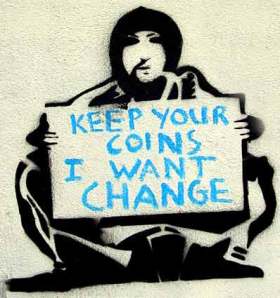 I’m watching Bernie Sanders trying defend our precious safety nets right now. The debate over this horrible capitulation to right wing extremists is carried on CSPAN . Sanders is reminding the president that all the polls call for shared sacrifice. He’s saying the proposal is bad and unfair. He’s just announced on the floor he will not vote for the package. What were getting is sacrificed on the alter of greed. At least some one recognizes this.
They’re taking a senate quorum call right now.
Here’s some headlines for you to think about.
From former Biden economic adviser Jared Bernstein: Lousy Negotiation skills are not the problem.
What did we just go through and what does it mean for our national politics, our fiscal and economic policy?
–First, a small but influential group of extreme conservatives are so intent on shrinking the federal government that they would credibly threaten national default;
–Second, Democrats, including the president, do not have a strategy to counteract such extremism, so they accepted a plan far less balanced than they would have liked—the final deal could well turn out to be $3 trillion in spending cuts over ten years, with no revenue increases to offset the cuts.
–Third, and perhaps most importantly, like every debate about the size of government, it’s impossible for normal people, if not the “experts,” to figure out what anyone is really talking about and therefore to judge the deal.
What does it mean to cut $3 trillion in government spending? How will it affect retirement security? Education? Jobs in the short run and investment over the long run? Does it put us on a sustainable fiscal path.
We’re about to agree to cut $1 trillion from something called discretionary spending. That probably sounds great to some folks and bad to others. But what does it mean?
The President bragged on this very point last night, telling America that discretionary spending as a share of the economy will come down to its lowest level since Eisenhower. As if we’ve all been walking around thinking, “if only we could get this budget category down to Ike levels, everything would fall into place.”
In fact, these cuts will hurt our ability to pursue what I view as most positive aspects of the President’s economic agenda—investment in infrastructure, clean energy, research, education. They will pinch programs that are already budget constrained…programs that help low income people with child care, housing, and community services. (One piece to watch for here—defense spending is also in this category, and is supposed to account for about one-third of the cuts…that helps, of course, take pressure of these other parts.)
Then, in part two of the deal, we unleash the gang-of-twelve who are assigned to come up with $1.5 trillion more in deficit savings.
They’ll be hitting the entitlements—Social Security, Mcare, Mcaid—and more defense, but if they deadlock—a non-trivial probability—automatic cuts ensue.
My thought is that the political game has become all important in this negotiation and no one is really thinking about the outcome. The Teabots are insane so they can be discounted, but all of this fall-in by senators and representatives that know what’s going on has got to be the most painful thing I’ve ever watched. Can’t some of them use their brains and consciences for a change instead of checking their labels and owner dog tags?
Paul Krugman: The President Surrenders
For the deal itself, given the available information, is a disaster, and not just for President Obama and his party. It will damage an already depressed economy; it will probably make America’s long-run deficit problem worse, not better; and most important, by demonstrating that raw extortion works and carries no political cost, it will take America a long way down the road to banana-republic status.
Start with the economics. We currently have a deeply depressed economy. We will almost certainly continue to have a depressed economy all through next year. And we will probably have a depressed economy through 2013 as well, if not beyond.
The worst thing you can do in these circumstances is slash government spending, since that will depress the economy even further. Pay no attention to those who invoke the confidence fairy, claiming that tough action on the budget will reassure businesses and consumers, leading them to spend more. It doesn’t work that way, a fact confirmed by many studies of the historical record.
Indeed, slashing spending while the economy is depressed won’t even help the budget situation much, and might well make it worse. On one side, interest rates on federal borrowing are currently very low, so spending cuts now will do little to reduce future interest costs. On the other side, making the economy weaker now will also hurt its long-run prospects, which will in turn reduce future revenue. So those demanding spending cuts now are like medieval doctors who treated the sick by bleeding them, and thereby made them even sicker.
And then there are the reported terms of the deal, which amount to an abject surrender on the part of the president. First, there will be big spending cuts, with no increase in revenue. Then a panel will make recommendations for further deficit reduction — and if these recommendations aren’t accepted, there will be more spending cuts.
They are killing any hope we have of a decent recovery. We don’t have one now. The US Manufacturing Index just fell to a two year low. This is one of the first leading indicators to show a looming recession. One of the most telling signs this morning about this is that the stock market is going down and now there is a flight to safety. Oddly enough, the flight to safety is to US Treasury bonds.
“We’ve turned from budget crisis to economic crisis,” said Paul Horrmann, a broker in New York at Tradition Asiel Securities Inc., an interdealer broker. “We’ve gone from worrying about a budget and default to the economy long term. Higher prices are bringing in buyers, not sellers.”
Still, what about the JOB crisis?
Kevin Drum at MOJO: Why the Debit Ceiling Deal Sucks
It’s a shit sandwich no matter how you look at it. And it’s a shit sandwich in at least two very specific ways: (1) It means we’ll continue to live in a fantasyland that says we don’t need any tax increases even though our population is aging and we’re plainly going to need higher revenues to support this demographic reality; and (2) we’ll continue to live in a fantasyland that says our problems are primarily caused by discretionary spending. This is, of course, exactly the opposite of reality, which means we’re going to screw the poor and do nothing serious about the long-term deficit. Nice work, adults.
Easy-to-Hate Debt-Ceiling Compromise Called “Sugar-Coated Satan Sandwich” By Some
Cuts to Social Security and Medicare are also possible within the plan. Representative Emanuel Cleaver (D-MO), the chairman of the Congressional Black Caucus, called the deal a “sugar-coated Satan sandwich,” which itself deserves $1.2 trillion.
We’re seriously f’d on this one folks.
Notable tweets:
daveweigel
I haven’t seen this many pissed off Democrats since the last time I saw some Democrats. #beenatoughyear
tbogg
Gene Sperling: Obama ‘didn’t give one inch’ : politico.com/news/stories/0… So Obama’s people say he owns this shit sandwich. Jesus. #Quitdigging
SatanSandwichSugar Coated
The moment I convinced President Obama of the virtues of austerity: bit.ly/nbv5C6 #FYEAH
ThePlumLineGSGreg Sargent
House Dem leaders NOT pressing Dems to vote for the debt deal, potentially complicating passage: http://wapo.st/o3wyDP
nytimes The New York Times
How the Debt Plan Would Work
Read this CBO letter to Congressional Leaders. They’re putting discretionary funding caps on Social Security, Medicare, SCHIP, Medicaid, et. Iraq and Afghanistan are exempt from spending caps. This is AWFUL!!! Worse than I thought … Please read this analysis from the CBO to congress!!!
House DEBATE and vote on package: running here at CSPAN. They are voting on the debate rules right now at 3:30 pm cst. Progressive Caucus leaders talking right now saying they will not support the deal because it’s incredibly wrong and worse than the Reid Compromise. Lynn Woolsey and Barbara Lee announcing they will vote no.
Please report on who you know is voting for or against below so we can keep track of who needs to face a real democrat in a primary,
Monday Reads
Posted: August 1, 2011 Filed under: morning reads | Tags: Debt Ceiling, famine, Federal Deficit Deal, Somalia, Syria 50 Comments Good Morning!
President Cave-in and the spineless Democrats in congress have handed Republican hostage takers a big win. This is beyond ridiculous. As I’ve said before, President Push-over draws a line on the etcha sketch then goes shake shake shake!
Anything can happen, but it apppears the GOP is on the verge of pulling off a political victory that may be unprecedented in American history. Republicans may succeed in using the threat of a potential outcome that they themselves acknowledged would lead to national catastrophe as leverage to extract enormous concessions from Democrats, without giving up anything of any significance in return.
Not only that, but Republicans — in perhaps the most remarkable example of political up-is-downism in recent memory — cast their willingness to dangle the threat of national crisis as a brave and heroic effort they’d undertaken on behalf of the national interest. Only the threat of national crisis could force the immediate spending cuts supposedly necessary to prevent a far more epic crisis later.
Under the emerging deal, President Obama can hike the debt limit in two stages — the first in exchange for equivalent cuts; the second after a Congressional committee comes up with second round of yet more cuts, including to entitlements. The talks appear close to resolving the spending cut“trigger” that would force the committee to act — without giving the GOP an incentive to deliberately sabotage its work. The remaining question is how to get it through the House. But a deal seems immiment.
Again and again, Dems drew lines in the sand that they promptly erased as the threat of default grew. A clean debt ceiling hike? Dropped. Cuts to Medicare benefits? They’ll likely be in that committee’s crosshairs. The insistence on revenue hikes? Withdrawn.
This is sure to create a recession. There’s no lack of economists expressing that view point either.
Macroeconomic Advisers, a leading forecaster, said Thursday that a rewritten plan offered by House Speaker John Boehner, R-Ohio, would shave more than a tenth of a percentage point off of growth next year, while the plan being pushed by Senate Majority Leader Harry Reid, D-Nev., would cause an even larger hit on growth in fiscal 2013 — shaving almost half a percentage point.
That view was shared by Thomas Lam, Singapore-based chief economist at OSK-DMG, a joint venture of Malaysian securities firm OSK Holdings Bhd. and Germany’s Deutsche Bank AG.
“Our calculations … suggest that the Senate and House proposals, respectively, could lower economic growth on average by less than 0.5 percentage points, all else equal, over the next five years (from 2012 to 2016),” Lam said in a research note that suggested the Senate Democrat plan would hit the economy harder.
The chief economist for forecaster IHS Global Insight, Nariman Behravesh, warned Friday that “a weak economy will only make the tough decisions on the budget even more difficult and the case for fiscal austerity in the near-term even weaker.”
Some House Republicans backed by tea party groups demand even deeper front-end cuts, perhaps as much as $100 billion, arguing that politicians can’t be trusted to keep their promises further out.
That’d be dangerous, warned Mark Zandi, chief economist for forecaster Moody’s Analytics.
“I think the idea is a very serious policy error,” he said. “This would be the fodder for another recession. The economy may be able to digest $25-30 billion more (in federal spending cuts) … but $100 billion, I don’t think it could digest that.”
Zandi, who’s frequently cited by Republicans and Democrats alike, favors spending cuts “when the economy is off and running,” but he cautions that “to add more fiscal restraint in the latter part of 2011 and 2012 would be a mistake.”

It's a bi-partisan pony!
Obama is choosing to ignore the jobs crisis and expects to win the election on the back of the bi-partisan pony, I guess. I can’t believe the recession that will be inevitable shortly isn’t going to tank a few political careers. Also, wait until every one finds out that the programs that no one wants cut are going to be subjected to possible across the board cuts. My guess is that the super committee will deadlock and those triggers will turn in to a bunch of big regrets for every one. This will only create more havoc on the budget also. It’s really bad policy. Afterall, did we get anything done from the catfood commission or the gang of six? These committees are beginning to remind me of the old soviet style planning commissions and their 5 year plans.
The famine in Somalia is deepening. The Economist has an interesting piece up suggesting ways that the world can respond to the desperate situation there. It also suggests that we missed all the signs that should’ve told us it would happen.
Famine has a technical meaning these days. It is declared when 30% of children are acutely malnourished, 20% of the population is without food, and deaths are running at two per 10,000 adults or four per 10,000 children every day. Parts of Somalia exceed these dreadful thresholds. In three provinces almost a third of people are acutely malnourished, says the UN’s World Food Programme (WFP). FEWS Net conducted surveys across southern Somalia this month and found that malnutrition exceeded 38% in most areas—a catastrophic rate. Famine is likely to spread all over the south in the next few months (see map). About 2.8m people are thought to need immediate life-saving help.
Yet famine was not declared until July, eight months after the first FEWS Net forecast. The UN did not issue its first appeal until then, though it made a small provision for expected problems in November. The response by donors has been patchy. In a sign of its growing global role, Brazil has pledged more to Somalia than Germany and France have combined. Italy offered nothing. Of the $2 billion the UN says the region needs, it has received less than half. The cash available for food in southern Somalia looks likely to run out well before the next rains.
Outsiders’ caution is linked to the role of the Shabab, an Islamist militia which controls much of southern Somalia and is locked in battle with the internationally recognised but feeble government. The Shabab has banned food aid in most of southern Somalia since 2009, branding Western aid agencies anti-Muslim. The WFP, the biggest provider of food aid, has had 14 staff killed there since 2008. Agencies also worry that militias use food aid to rally their troops—some say this happened in Ethiopia and Eritrea in the 1980s—and do not want to pile into southern Somalia to find they have reinvigorated the Shabab.
Syria’s dictator ushered in a violent start to the Ramadan holy days by upping the level of violence used against democracy protestors. This is yet another terrible story.
Rights activists said 80 civilians were killed in Sunday’s tank-backed assault on the central Syrian city where Assad’s father crushed an armed Muslim Brotherhood revolt 29 years ago by razing neighbourhoods and killing many thousands of people.
Security forces had besieged the Sunni Muslim city of 700,000 for nearly a month before Sunday’s crackdown on the eve of Ramadan, a holy month when Muslims fast in daylight hours.
Many flock to mosque prayers at night, occasions which may provide opportunities for protests to multiply across Syria.
The Syrian state news agency said the military entered Hama to purge armed groups that were terrorising citizens, an account dismissed as “nonsense” by a U.S. diplomat in Damascus.
The agency said eight police personnel were killed while “confronting armed terrorist groups” in Hama.
U.S. President Barack Obama said he was appalled by the Syrian government’s “horrifying” violence against its people in Hama and promised to work with others to isolate Assad.
“Syria will be a better place when a democratic transition goes forward,” Obama said in a statement
So, it appears that most of today’s news will be that Wall Street and the global financial markets can take a breather. It also appears to be a sad day for sane fiscal policy and America’s poor and elderly.
What’s on your blogging and reading list today?

 peej
peej Carissa
 bostonboomer
 dakinikat
 ecocatwoman
 mablue2
 Mama Lopez
 peggysue22
 quixote
 skydancingguestblogger
 Mona (aka Wonk the Vote)



 Sky Dancing
Recent Comments