
Wisconsin Recall Vote comes with High Turnout
Posted: August 9, 2011 Filed under: worker rights | Tags: Wisconsin recall votes 55 CommentsRecall votes on 6 republican state senators are being held today in Wisconsin. All 6 hold seats in traditionally republican areas of rural and 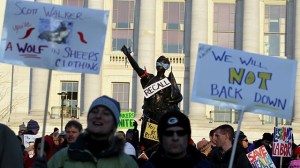 suburban Wisconsin. Tons of outside money has poured in for some of the most vituperous ads in political history. It’s been a match of high money rollers on the republican side and on the ground voter turn work by unions on the democratic side. Indications are that turn out is as high as it usually is in a presidential race.
Various clerks in the recall districts reported steady turnout so far with some projecting numbers that will rival a presidential election.
In the 10th SD in western Wisconsin, River Falls City Clerk Lu Ann Hecht said today’s numbers could be as high as the 2008 Presidential election. The city issued 1,003 absentee ballots, twice as many as a regular election.
The municipality is home to both GOP Sen. Sheila Harsdorf and Dem challenger Shelly Moore.
“We expect the turnout to remain steady throughout the day,” Hecht said.
Hudson City Clerk Nancy Korson said voter turnout in Hudson, also part of the 10th, would likely not reach the levels of a presidential election. But they were comparable to the spring Supreme Court election, with over 500 absentee ballots received.
In Baraboo, Deputy Clerk Donna Munz said turnout was much higher than normal. She also said she’d received voter complaints over people at some polling places contacting them as they went into the polling places. At one, about nine people were outside and some voters said they were angry that they felt intimidated.
“We have received angry calls from voters regarding how persistent the people outside the polling places are,” Munz said.
In the 8th SD, one of the top races with GOP Sen. Alberta Darling and Dem Rep. Sandy Pasch, Whitefish Bay officials reported a steady stream during the morning, but said it was too early to say how turnout would end up in Pasch’s hometown.
In River Hills, where Darling lives, Village Clerk Barb Goeckner reported steady turnout through the morning. By 9:45 a.m., about 200 of the municipality’s 1,300 registered voters had cast ballots.
“It’s just been steady,” she said. “It’s not been a mad rush. We don’t have any lines, but it’s definitely been a steady turnout so far.”
In the 2nd SD, DePere officials predicted a turnout of around 45 percent by day’s end. In next door Green Bay, turnout was around 15 percent following the morning checks with polling places. In the April Supreme Court race, turnout was about 11 percent following the morning checks.
A lot is at stake in Wisconsin.
Wisconsin Republicans are in real danger of losing control of the state Senate in tonight’s recall elections, as it looks more and more possible that they will lose at least three of the six seats that are on the ballot.
The losses would be cast by Democrats as a severe rebuke of Gov. Scott Walker’s (R) policies. And wins by Republicans would be cast by them as validation for Walker’s tough-love budgeting style.
Both of those evaluations would be fair. (For more on just how we’ve gotten here, see Michael A. Fletcher’s piece today and our primer from last week.)
Beyond Walker’s political capital, though, it’s hard to draw many broad national conclusions about what the recall elections mean. That’s because what’s happening in Wisconsin is occurring very much in a vacuum, for several reasons.
The first is that, as with special elections, these recall elections have have such unusual turnout and have received such inordinate attention from national third-party groups trying to influence the races and send a message. In fact, the recalls have essentially been special elections on steroids, with spending reaching nearly $30 million.
As of a couple weeks ago, about two-thirds of that has gone to benefit Democrats, and Republicans acknowledge that they were essentially caught flat-footed by the whole thing. And because of that, they’ve been fighting from behind in recent weeks.
“This is a referendum on Walker, and the Democrats have everything to lose, and the Republicans did not have a plan for what they started,” said one Republican monitoring the recalls. “And the national folks never saw it for what it was, which is a proxy fight.”
The proxy fight is between organized labor and the new coalitions of GOP governors and state legislative majorities. In the end, Walker’s gambit to cut collective bargaining rights through a legislative maneuver so badly irritated organized labor — and Wisconsin’s laws made it so easy to recall a member of the state legislature — that here we are amidst the biggest mass recall in United States history.
The second reason is that, while some Republican governors have been aggressive in cutting their budgets, the maneuver executed by Walker and the state legislature takes the cake.
The spending has been substantial according to ABC News.
The level of campaign spending has been unprecedented, especially considering it is a recall effort. Spending through Monday was estimated at about $28 million from outside groups on both sides of the aisle and about $5 million spent by the candidates themselves, according to the Wisconsin Democracy Campaign.
That number was expected to increase by today. Wisconsin Democracy Campaign officials “estimate at this point it’s about even,” research director Mike Buelow said of spending on both sides.
The group will do a full accounting of spending after the election and will have a clearer picture of whether the spending totals are even.
JR Ross, the editor of Wispolitics.com, said turnout will determine which side is victorious by the end of the day.
“I don’t care who you talk to who says they know, they don’t,” Ross said. “It’s all about turnout. We’re in an unprecedented situation. … We don’t have elections in August in Wisconsin in the middle of summer.
“We do know that Democrats and union members are motivated and angry at Republicans and Walker specifically. If Republican voters can match that intensity and turn out in numbers to protect their guys, [then the Republican senators will be safe]. If not, the Democrats win control.”
Polls in Wisconsin close in less than an hour and the returns may be mostly in by 10 pm cst. We’re going to follow those here in a live blog thread.
WTF is a Supercommittee and who is likely to get appointed? (updated)
Posted: August 9, 2011 Filed under: U.S. Economy, U.S. Politics, We are so F'd | Tags: supercommittee 34 Comments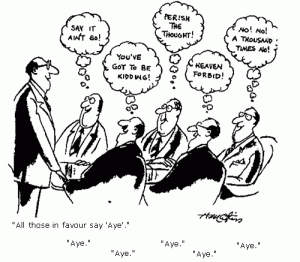 We’ve had a catfood commission and a gang of six. Both groups basically had such essential differences that nothing ever came of their recommendations and nothing resembling a consensus appeared. How is some congressional mandate handed over to a “supercommittee” going to be any different? I see no reason for the Republicans to not continue the gridlock. However, I did want to find out more. So, here’s what I found.
It seems obvious to me that the supercommittee has been given a mandate to do things that no single congress critter wants on his record. They are there to cut extremely popular programs. I personally wonder if they will give cover to Republicans that signed on to Grover Norquist’s no tax pledge for reasonable changes in revenue policies as well. I found a reasonably short explanation of their mandate on the PR&P Tax Update Blog.
The Act reduces spending by $0.9 trillion over the next 10 years and creates a 12-member, bi-partisan joint “super” committee charged with making recommendations to cut an additional $1.5 trillion from the deficit over 10 years. The committee may recommend any combination of spending cuts or tax increases. If legislation is not enacted by January 15, 2012 to cut the deficit by at least $1.2 trillion, then any shortfall must be taken equally out of defense and social spending by January 1, 2013. This latter provision is so distasteful to each political party that it is seen as the vehicle to force through an agreement from the super committee.
Super committee appointments are to be made by August 16, 2011 with the first meeting held no later than September 16, 2011. The committee must vote on their conclusions no later than November 23, 2011. If a majority votes in favor, then legislative language must be reported out no later then December 2, 2011. Both the House and the Senate must vote on the proposal by December 23, 2011 with no amendments considered. The committee may rely on previous proposals to reform spending and taxation due to the time constraint it must work under.
There is an incredible amount of speculation on possible appointments to the supercommittee. This is Politico’s best guess for the Senate appointees. They have their guesses for the House appointees as well as a list of ‘dark horses’.
The major contenders to be selected by Senate Majority Leader Harry Reid (D-Nev.):
• Sen. Max Baucus (D-Mont.) – Finance Committee chairman has jurisdiction over entitlement programs and he served on the Simpson-Bowles commission. The Huffington Post, however, reported on Monday that Baucus is unlikely to be tapped.
• Sen. Dick Durbin (D-Ill.) – Reid deputy is a Gang of Six member who also served on Simpson-Bowles.
• Sen. Daniel Inouye (D-Hawaii) – Appropriations Committee chairman participated in the Biden talks.
• Sen. Charles Schumer (D-N.Y.) – Schumer is a Reid ally who would not let Democrats get rolled in the negotiations.
The major contenders to be selected by Senate Minority Leader Mitch McConnell (R-Ky.):
• Sen. John Barrasso (R-Wyo.) – Member of leadership team who throws sharp elbows on 2010 healthcare law.
• Sen. Orrin Hatch (R-Utah) – Ranking member of Finance Committee told The Hill, “I can live with [being appointed] or live without it.” Some point out that Hatch, who could face a primary challenge next year, will not be keen on finding common ground with Democrats.
• Sen. Jon Kyl (R-Ariz.) – McConnell’s deputy participated in the Biden talks and is not seeking reelection.
• Sen. Rob Portman (R-Ohio) – Portman, a budget director in George W. Bush’s administration, has been mentioned a lot in recent days. The former House Ways and Means Committee member is widely respected on both sides of the aisle.
Sam Stein at HuffPo writes that Conrad and Baucus will not make the cut. Obama mentioned that the White House will be involved in the process of what the supercommittee does but he did not mention how that will happen.
To whom he will be submitting the plan remains the major mystery. But over the weekend, information about potential committee members began to leak from Capitol Hill. According to multiple Democratic sources, Senate Democratic leaders are winnowing down the names on the short list and they are leaning strongly against including some of the party’s most notable budget hawks.
Two senators, in particular, were said to be unlikely to end up on the committee: Max Baucus (D-Mont.), who chairs the Finance Committee, and Kent Conrad (D-N.D.), who chairs the Budget Committee.
Final decisions have not yet been made, two aides cautioned. But two other Democratic aides with knowledge of deliberations said they would be very surprised if either ended up on the final list.
“The committee is built for failure — everyone will either stack it with loyalists to leadership and the caucuses or with partisan firebrands to make sure those folks defend key priorities,” said one of those aides. “If they don’t, they will immediately regret it. You need grown-up smart pros that know the issues, know the caucus position and will not waver.”
It appears that Conrad himself does not expect to make the cut. On Aug. 1, the night before the debt ceiling deal was signed, a reporter told him that a few people had floated his name as a super committee member. “I’m sure it’s a very few,” the senator responded.
The exclusion of Conrad and Baucus could have major implications for the committee’s tenor and the actions it will ultimately take. During the debt ceiling debate, Conrad pushed far-reaching deficit reduction proposals that included entitlement and tax reform and called for one dollar in spending cuts for every dollar in tax revenue raised. Baucus is more protective of entitlements but enjoys close ties to the financial service industry. Both are considered senior statesmen among Democrats on debt related negotiations. They are also distrusted by the party base, primarily because of their long records as fiscal hawks.
There are many concerns that people have expressed with the formation of this group. One of the major issues is transparency.
Transparency concerns: Some groups have expressed concern that the joint committee will have an extremely powerful role in shaping policy, but may not be subject to the same transparency obligations as other congressional committees. “Right now, the creation of the committee doesn’t come with many requirements for transparency,” noted the Project on Government Oversight.
In a letter to Congressional leadership Aug. 3, the Sunlight Foundation recommended the joint committee include on its website:
- Live webcasts of all official meetings and hearings,
- the Committee’s report should be posted for 72 hours before a final committee vote,
- disclosure of every meeting held with lobbyists and other powerful interests,
- disclosure of campaign contributions as they are received (on their campaign website), and
- financial disclosures of Committee members and staffers.
The downgrade creates “a sense of urgency for the two parties to come together,” Rep. Steve Southerland, R-Fla. told the Times, adding that the possibility of a further downgrade “scares” him. Added Rep. Blake Farenthold, R-Texas, “Anything that encourages the new committee to get the job done and get us back on a rational fiscal path is a good thing.”
At least some lawmakers called on Congress to return from its August recess to take up more deficit-reduction legislation.
“I sent a letter today to Leader Cantor requesting we come back to DC to resolve our deficit and spending issues. We should be in session!” Rep. Allen West, R-Fla., tweeted. West, a Tea Party-aligned House member, gained attention for his early support of the debt deal Republican leaders agreed to with President Obama.
Similarly, Rep. Jack Kingston, R-Ga., said in a statement that “Congress should immediately reconvene to take up the fundamental reforms necessary to right the ship and lay the groundwork for a more stable and secure future for our children and grandchildren.”
Rep. Barney Frank, D-Mass., said on CBS’ “The Early Show” Monday that “there’s going to be incredible pressure on this commission now to come up with $1.5 trillion worth of deficit cuts,” but he expressed skepticism they’d get the job done. “Do you think if Democrats appoint their six most liberal members and Republicans appoint their six most conservatives that this committee will get anything done?” He said that the two parties should at least be able to support defense spending cuts. As Frank noted, there’s reason to believe the partisan fighting that S&P cited in its downgrade will continue in the supercommittee.
In the first of what will be a closely watched selection process for a powerful new deficit panel, Senate Majority Leader Harry Reid announced he will appoint Democratic Sens. Patty Murray (Wash.), Max Baucus (Mont.) and John Kerry (Mass.) as his three choices for a super committee charged with finding more than $1 trillion in spending cuts by the end of this year.
Murray will serve as co-chair of the 12-member panel. Speaker John Boehner (R-Ohio) will select her co-chair and two other panelists, as required by the next debt limit agreement signed into law by President Barack Obama last week. Minority Leaders Nancy Pelosi and Mitch McConnell will each select three additional members.
Tuesday Reads
Posted: August 9, 2011 Filed under: 2012 presidential campaign, Global Financial Crisis, Hillary Clinton, Medicaid, Medicare, morning reads, psychology, religious extremists, Republican presidential politics, Social Security, The Great Recession, the villagers, U.S. Economy, U.S. Politics, voodoo economics, WE TOLD THEM SO | Tags: antisocial personality disorder, Barack Obama, bipolar disorder, creativity, Dean Baker, Depression, economic illiterates, empathy, Farm Subsidies, FDR, hyperthymic personality, JFK, Kenneth Moreno, mania, Michele Bachmann, narcissistic personality disorder, Nassir Ghaemi, psychiatry, rape cops, Rick Perry, trauma, Tufts University, Verizon strike 43 Comments
Good Morning!! I’m switching to strong coffee this morning, because I’ve had the sleepies for the past few days. It’s been really damp and humid here, so maybe that’s the reason. All I know is I keep dozing off, and I don’t like it! Anyway, let’s get to the news before I nod out again.
A few days ago, commenter madaha turned me on to an article about a fascinating new book that just came out last week. The book is called A First Rate Madness. The author is Nassir Ghaemi, a professor of psychiatry at Tufts University. From Salon:
Nassir Ghaemi, an author and professor of psychiatry at Tufts University School of Medicine, argues that many of history’s most famous and admired figures, from Churchill to FDR to Gandhi, showed signs of mental illness — and became better leaders because of it. Ghaemi bases his argument on historical records and some of the latest experimental studies on depression and mania, arguing that mild symptoms can actually enhance qualities like creativity or empathy.
After reading the piece in Salon, I immediately ordered the book and I’ve been dipping into it over the past couple of days.
So far, I’ve read the chapter on FDR, and I’m going to read about JFK next. According to Ghaemi, both of these men had hyperthymic personalities: basically, they were upbeat, enthusiastic, energetic, and creative, because they tended to be somewhat hypomanic (a milder, less disabling form of the mania experienced by those with bipolar disorder). In addition, both FDR and JFK suffered from serious physical illnesses–FDR from polio and JFK from Addison’s disease. These illnesses and other adversities these two men faced enabled them to develop empathy for the suffering of ordinary people–even though they were both from privileged backgrounds. Ghaemi argues that people with slightly abnormal personalities are better leaders–particularly in times of crisis when great creativity, empathy, and resilience are needed. According to Ghaemi:
Many people who experience traumas [like terrorism or war] don’t develop PTSD or other illnesses. So the question is, what keeps those people from getting sick? What creates resilience? The psychological research suggests that personality is a major factor. Resilience seems to be associated with mild manic symptoms, but you can’t develop resilience unless you’ve already experienced trauma. Many of these leaders faced adversity in their childhood and adulthood, and that seemed to make them better able to handle crises. It’s like a vaccine. You get exposed to a little bit of a bacteria then you can handle major infections and I think trauma and resilience and hyperthymic personality seem to follow a similar path.
Ghaemi does not discuss Obama’s personality in the book, but Salon interviewer Thomas Rogers asked the author whether Obama may be too “sane” to be a successful President in our current time of crisis.
Obama’s persona is that of a very sane, rational person who is good at compromise — which is definitely how he sold himself during the debt ceiling crisis. Do you think Obama’s sanity is hurting his abilities as a leader?
I didn’t discuss Obama and other current leaders in the book, because there are documentation and confidentiality issues, and a lot of speculation would have to happen. That said, Obama has said himself that he thinks he’s very normal. This no-drama-Obama persona is meant to reassure people about his normality, but I think that when you look at his memoir there’s a sense of a much more complex and profound person who may have experienced a great deal of anxiety and maybe some depression growing up, being half-white half-African-American. The [sane] parts of his psychology may hinder his leadership in terms of not being creative, and that may not be as useful in a crisis. But to whatever extent he’s not fully completely average, he’ll have some psychological reservoir to draw on to think more creatively and realistically about the current situation.
I wish I could agree that Obama might learn to deal with the nation’s difficulties, but so far he doesn’t seem to learn anything from experience. Most of the leaders that Ghaemi discusses suffered from mood disorders–depression or bipolar disorder. Obama, on the other hand, appears to have a different kind of disorder–either Narcissistic Personality Disorder or Antisocial Personality Disorder, or both.
Dakinikat alerted me to an interview with Ghaemi on NPR. I haven’t listened to it yet, but here’s the link.
Getting back to current news, this coming Saturday, Rick Perry plans to announce that he’s running for the Republican presidential nomination.
Rick Perry intends to use a speech in South Carolina on Saturday to make clear that he’s running for president, POLITICO has learned.
According to two sources familiar with the plan, the Texas governor will remove any doubt about his White House intentions during his appearance at a RedState conference in Charleston.
It’s uncertain whether Saturday will mark a formal declaration, but Perry’s decision to disclose his intentions the same day as the Ames straw poll — and then hours later make his first trip to New Hampshire — will send shock waves through the race and upend whatever results come out of the straw poll.
Immediately following his speech in South Carolina, Perry will make his New Hampshire debut at a house party at the Portsmouth-area home of a state representative, Pamela Tucker, the Union Leader reported Monday. Tucker was among the Granite Staters who went to Texas last week to encourage Perry to run.
What can I say? This is ghastly news. Think Progress is reporting that besides being a fundamentalist religious fanatic, Perry shares a similar problem to that of fellow wingnut Michele Bachmann–he has taken lots of Federal money in farm subsidies–$80,000, to be exact.
Verizon workers have gone out on strike–45,000 of them.
More than 45,000 workers from New England to Virginia went on strike just after midnight today at Verizon Communications. Since bargaining began July 22, Verizon has refused to move from a long list of concession demands. As the contract expired, Verizon, a $100 billion company, still was looking for $1 billion in concessions from 45,000 workers and families. That’s about $20,000 in givebacks for every family, nearly 100 concessionary proposals remained on the table.
This despite Verizon’s 2011 annualized revenues of $108 billion and net profits of $6 billion. At the same time, Verizon Wireless just paid its parent company, Vodaphone, a $10 billion dividend. Meanwhile, Verizon’s five top executives received $258 million over the past four years.
The workers, members of the Communications Workers of America (CWA) and the Electrical Workers (IBEW), say they are striking until Verizon “stops its Wisconsin-style tactics and starts bargaining seriously.”
According to Reuters, both sides are accusing each other of bad acts:
The second day of a strike by Verizon workers turned ugly after union representatives accused managers of injuring three workers while driving past picket lines, and the phone giant complained of a spike in network sabotage cases.
[….]
Verizon complained of network sabotage cases in the same statement where it said some picketing workers were unlawfully blocking Verizon managers’ access to work centers.
A spokeswoman for the Communications Workers of America, representing 35,000 of the strikers, said the union “does not condone illegal action of any kind.” The International Brotherhood of Electrical Workers, representing 10,000 strikers, also said members “are expected to obey the law.”
However, the CWA said some picketing workers were hurt by Verizon managers’ cars and that one worker was knocked unconscious when he was clipped by the mirror of a manager’s car that was speeding past a picket line.

Dean Baker had a great piece at Truthout yesterday: The Economic Illiterates Step Up the Attack on Social Security and Medicare
The nonsense with the S&P downgrade is yet another distraction – after four months of haggling over the debt ceiling idiocy – from the real problem facing the country: a downturn that has left 25 million people unemployed, underemployed or out of the labor force altogether. Tens of millions of people are seeing their career hopes and family lives wrecked by the prospect of long-term unemployment.
The incredible part of this story is that the people who are responsible are all doing just fine, and most of them are still making policy. Furthermore, they are using their own incompetence as a weapon to argue that we have to take even more money from the poor and middle class, this time in the form of Social Security, Medicare and Medicaid benefits.
The basic story is that the economy needs demand. The housing bubble generated more than $1.4 trillion in annual demand through the construction and consumption that it spurred. Now that this demand is gone, there is nothing to replace it. President Obama’s stimulus was replaced by some of the lost demand, but it was nowhere near large enough. We tried to fill a $1.4 trillion hole in annual demand with around $300 billion in annual stimulus in 2009 and 2010. In 2011, most of this boost has been exhausted and the economy is coming to a near standstill.
If we had serious people in Washington, they would be talking about jobs programs, about rebuilding the infrastructure, about work sharing, and any other measure that could get people back to work quickly. However, instead of talking about ways to re-employ people, the fixation in Washington is reducing the deficit.
We’ve heard these arguments again and again (especially from our own Dakinikat), but they bear repeating until the ignorant Villagers get the message.
Remember the “rape cops” in New York–the ones who were found not guilty recently? Well, one of them finally got a tiny bit of justice. A judge sentenced Kenneth Moreno to one year in prison for official misconduct. But then another judge freed him.
Disgraced ex-cop Kenneth Moreno didn’t stay in jail for long.
A couple hours after an angry Manhattan judge flat-out called Moreno a liar Monday and dispatched him to Rikers Island to being a year-long prison sentence, an appeals court judge sprung him.
Moreno, acquitted in May of raping a bombed fashion executive while his partner served as lookout, was released on $125,000 bail by Appeals Court Judge Nelson Roman so he can appeal his conviction on official misconduct charges.
It was a startling turnabout for the 43-year-old Moreno, who Supreme Court Justice Gregory Carro ordered remanded.
I sure hope he ends up serving at least some jail time.
Dakinikat sent me this article on a report (PDF) called How to Liberate American from Wall Street Rule. Here are the report’s basic recommendations:
How to Liberate America from Wall Street Rule spells out details of a six-part policy agenda to rebuild a sensible system of community-based and accountable financial services institutions.
1. Break up the mega-banks and implement tax and regulatory policies that favor community financial institutions, with a preference for those organized as cooperatives or as for-profits owned by nonprofit foundations.
2. Establish state-owned partnership banks in each of the 50 states, patterned after the Bank of North Dakota. These would serve as depositories for state financial assets to use in partnership with community financial institutions to fund local farms and businesses.
3. Restructure the Federal Reserve to function under strict standards of transparency and public scrutiny, with General Accounting Office audits and Congressional oversight.
4. Direct all new money created by the Federal Reserve to a Federal Recovery and Reconstruction Bank rather than the current practice of directing it as a subsidy to Wall Street banks. The FRRB would have a mandate to fund essential green infrastructure projects as designated by Congress.
5. Rewrite international trade and investment rules to support national ownership, economic self-reliance, and economic self-determination.
6. Implement appropriate regulatory and fiscal measures to secure the integrity of financial markets and the money/banking system.
Finally, in case you missed it, I want to call your attention to this article that commenter The Rock linked to last night: Hillary Told You So
At a New York political event last week, Republican and Democratic office-holders were all bemoaning President Obama’s handling of the debt-ceiling crisis when someone said, “Hillary would have been a better president.”
“Every single person nodded, including the Republicans,” reported one observer.
At a luncheon in the members’ dining room at the Metropolitan Museum of Art on Saturday, a 64-year-old African-American from the Bronx was complaining about Obama’s ineffectiveness in dealing with the implacable hostility of congressional Republicans when an 80-year-old lawyer chimed in about the president’s unwillingness to stand up to his opponents. “I want to see blood on the floor,” she said grimly.
A 61-year-old white woman at the table nodded. “He never understood about the ‘vast right-wing conspiracy,’” she said.
Looking as if she were about to cry, an 83-year-old Obama supporter shook her head. “I’m so disappointed in him,” she said. “It’s true: Hillary is tougher.”
Go read the whole thing. That’s all I’ve got for today. What are you reading and blogging about? Please share.
A Shocking Hate Crime in Mississippi
Posted: August 8, 2011 Filed under: Civil Rights, Crime, racism | Tags: aggravated assault, Byron De La Beckwith, death penalty, Deryl Dedmon, hate crimes, Jackson, James Craig Anderson, John Aaron Rice, Medgar Evers, Mississippi, murder, Racism, White Citizen's Council 19 Comments
Medgar Evers
Mississippi has a dark history of racism. It was in the state’s capital Jackson that Civil Rights leader Medgar Evers was murdered in 1963.
On the morning of June 12, 1963, around 12:20 a.m., Medgar Evers arrived home from a long meeting at the New Jerusalem Baptist Church located at 2464 Kelley Street. He got out of his car, arms filled with “Jim Crow Must Go” T-shirts, and walked toward the kitchen door when a shot was fired from a high-powered rifle, striking Evers in the back. Myrlie heard the shot, ran outside with the children behind her, and saw Medgar lying face down in the carport. Next-door-neighbor Houston Wells heard the shot and called the police. The police arrived only minutes later and provided an escort as Wells drove Evers to the emergency room of the University of Mississippi Medical Center on North State Street. Evers died shortly after 1:00 a.m. of loss of blood and internal injuries.
A white man was arrested and charged with the murder of Evers.
On June 22, 1963, Byron De La Beckwith, a member of the White Citizens’ Council, was arrested and charged with the slaying of Medgar Evers. Beckwith was tried twice for Evers’s murder, first in February and later in April 1964. Both trials (before all-white male jurors) ended in hung juries. Beckwith was not retried for the Evers murder until 30 years later. In a two-week trial, held in February 1994 before a jury of eight blacks and four whites, Beckwith was found guilty of the murder of Evers, for which he received a life sentence. Beckwith served only seven years of his life sentence at the Central Mississippi Correctional Facility in Rankin County before dying of a heart attack January 21, 2001.
Nearly half a century later, Jackson, Mississippi is once again the site of a vicious, racially-motivated murder. This time, the crime was caught on video.
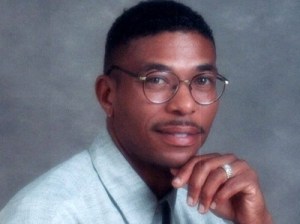
James Craig Anderson
On a recent Sunday morning just before dawn, two carloads of white teenagers drove to Jackson, Mississippi, on what the county district attorney says was a mission of hate: to find and hurt a black person.
In a parking lot on the western side of town they found their victim.
James Craig Anderson, a 49-year-old auto plant worker, was standing in a parking lot, near his car. The teens allegedly beat Anderson repeatedly, yelled racial epithets, including “White Power!” according to witnesses.
Hinds County District Attorney Robert Shuler Smith says a group of the teens then climbed into their large Ford F250 green pickup truck, floored the gas, and drove the truck right over Anderson, killing him instantly.
You can watch the video at the CNN link if you are so inclined. The video was taken from some distance away.

Deryl Dedmon, Jr.
The young man who proposed to his friends that they attack a black person–any black person–and who drove his truck over Anderson’s already battered body is Deryl Dedmon, Jr., age 18. Dedmon had been robbed a few weeks previously, and wanted some kind of twisted “revenge,” according to the New York Daily News.
According to the CNN article linked above,
Shortly after he allegedly drove the truck over Anderson, Dedmon allegedly boasted and laughed about the killing, according to testimony given by some of the teens to detectives.
“I ran that nigger over,” Dedmon allegedly said in a phone conversation to the teens in the other car.
He repeated the racial language in subsequent conversations, according to the law enforcement officials.
“He was not remorseful he was laughing, laughing about the killing,” said district attorney Smith.
Dedmon and the driver of the SUV, John Aaron Rice, have been arrested. Dedmon has been charged with murder, but a judge reduced the charges against Rice to aggravated assault. None of the other teenagers who were involved have not been charged with anything. Reportedly the two people in the car with Dedmon were girls. Rice had driven off with the others before the murder.
WJTV in Jackson talked to a former classmate of Dedmon’s, Branden Richardson, who said he was bullied by Dedmon and isn’t surprised to learn of the terrible crime.
“Didn’t surprise me at all, whatsoever, none at all,” says Richardson.
Richardson went to James Anderson’s funeral. Not because he knew Anderson, but because he knew that it could have been his own funeral.
“I very much felt that it could have been, a different day, it could have been me in that casket,” Richardson tells us. “I believe that just because Deryl didn’t like me.”
What I want to know is, why aren’t the other participants in this hate crime being prosecuted? They apparently chose to go along after Dedmon proposed hurting a black person. Isn’t participation in a felony in which someone is killed usually prosecuted as murder? Why isn’t the death penalty on the table? After all, this is Mississippi, where the death penalty is often invoked. Will justice be served in this case?
We’ll have to keep on eye on this one.
Unnamed Hedge Fund or Investor Earned $10 Billion Betting on U.S. Downgrade
Posted: August 8, 2011 Filed under: U.S. Economy, U.S. Politics | Tags: Eric Cantor, gambling, George Soros, hedge funds, Standard and Poor's, The Daily Mail 22 Comments
A mystery investor or hedge fund reportedly made a bet of almost $1billion at odds of 10/1 last month that the U.S. would lose its AAA credit rating.
Now questions are being asked of whether the trader had inside information before placing the $850million bet in the futures market.
The Daily Mail suggests this might involve George Soros, but a knowledgeable source denied it. The article also suggests that whoever made the bet could have had inside information–arguing that Obama and Geithner seem to have known for some time that a downgrade by S&P was in the works. Of course The Daily Mail is a conservative rag.
The latest bet was made on July 21 on trades of 5,370 ten-year Treasury futures and 3,100 Treasury bond futures, reported ETF Daily News.
Now the investor’s gamble seems to have paid off after Standard and Poor’s issued a credit rating downgrade from AAA to AA+ last Friday.
Whoever it is stands to earn a 1,000 per cent return on their money, with the expectation that interest rates will be going up after the downgrade.
Recall that Eric Cantor was revealed to have an investment that would have paid off handsomely if the U.S. had defaulted. Salon reported on June 27:
Last year the Wall Street Journal reported that Cantor, the No. 2 Republican in the House, had between $1,000 and $15,000 invested in ProShares Trust Ultrashort 20+ Year Treasury EFT. The fund aggressively “shorts” long-term U.S. Treasury bonds, meaning that it performs well when U.S. debt is undesirable. (A short is when the trader hopes to profit from the decline in the value of an asset.)
According to his latest financial disclosure statement, which covers the year 2010 and has been publicly available since this spring, Cantor still has up to $15,000 in the same fund. Contacted by Salon this week, Cantor’s office gave no indication that the Virginia Republican, who has played a leading role in the debt ceiling negotiations, has divested himself of these holdings since his last filing.
Why are these kinds of investments bets even legal? This is nothing but high stakes gambling, and it’s just plain wrong.

 peej
peej Carissa
 bostonboomer
 dakinikat
 ecocatwoman
 mablue2
 Mama Lopez
 peggysue22
 quixote
 skydancingguestblogger
 Mona (aka Wonk the Vote)



 Sky Dancing
Recent Comments