
Elite Conspiracy Theories and the Arrest of Dominique Strauss-Kahn
Posted: May 25, 2011 Filed under: collective bargaining, Economic Develpment, financial institutions, Foreign Affairs, France, Libya, Media, Pakistan, poverty, racism, Regulation, The Bonus Class, The Great Recession, U.S. Economy, U.S. Politics, unemployment, Violence against women | Tags: conspiracy theories, Dominique Strauss-Kahn, Federal Reserve, France, global elites, IMF, John F. Kennedy, Naomi Wolf, Nicholas Sarkozy, rape 29 Comments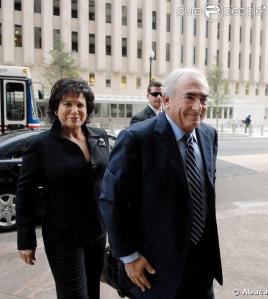
Dominque Strauss-Kahn and wife Anne
When one of us common people questions the Bush failures before 9/11 or the Warren Commission’s insistence that JFK was killed by a lone gunman, we are laughed at by the corporate media and lectured by politicians. But when one of the Global Elite gets in trouble, conspiracy theories are suddenly in vogue. Now that a global banker and possible candidate for the French presidency is accused of a sexual attack on a lowly hotel maid, elite conspiracy theories are running rampant in the U.S. and international media. I’ll give you a few examples.
At the Pakistan Observer, Ali Ashraf Kahn argues that Strauss-Kahn had to brought down, first because he would very likely have beaten the “American poodle Sarakozi” in a race for the presidency of France, and second because he (Strauss-Kahn) had offended the international banksters and corporations by proposing more liberal policies at the IMF which would have been a threat to the dollar. According to Ali Ashraf Kahn, getting rid of Strauss-Kahn would–along with U.S. military actions in Libya and Pakistan–would help to “save American predominance in the world.”
This incident goes to prove the hidden agenda of an international vested interest group trying to build and secure an American Empire for their master, which has not spared even Strauss-Kahn, who has been fixed in a rape attempt with a 32 year old hotel maid in a country where teen aged unwed mothers are a normal accepted feature. The former French Foreign Minister Strauss-Kahn, once if he was elected as president of France would have worked to strengthen the Euro to bring down dollar, which was of serious concern for the Federal Reserve Board in the already ongoing currency war with China. John F. Kennedy, US president was murdered for his only sin of canceling Federal Reserve Act of 1913 in 1963, when for the first time dollar currency was issued with the seal of US government, soon after his assassination President Lyndon B. Johnson revived this Act to continue their financial exploitation.
The author of this article appears to have a problem understanding the distinction between rape and consensual sex that results in pregnancies, but I’ll let that go for the moment. Kahn explains that Strauss-Kahn was trying to make radical changes at the IMF–so much so that Strauss Kahn won high praise from Joseph Stiglitz, which was apparently the final “kiss of death.”
Strauss-Kahn was trying to move the bank in a more positive direction, a direction that didn’t require that countries leave their economies open to the ravages of foreign capital that moves in swiftly-pushing up prices and creating bubbles, and departs just as fast, leaving behind the scourge of high unemployment, plunging demand, hobbled industries, and deep recession. Strauss-Kahn had set out on a “kinder and gentler” path, one that would not force foreign leaders to privatize their state-owned industries or crush their labour unions. Naturally, his actions were not warmly received by the banker’s mafia and multi national corporations who look to the IMF to provide legitimacy to their ongoing plunder of the rest of the world. These are the people who think that the current policies are “just fine” because they produce the desired results they’re looking for, which is bigger profits for themselves and deeper poverty for everyone else.
I have to admit, I’m in sympathy with those goals. There’s a lot more, so read the whole thing if you want more detail.
The next conspiracy theory is from Uganda. The author, Dr. Kihura Nkuba, also argues that Strauss-Kahn’s attack on the U.S. dollar is what led to his downfall. Nkuba says that police in the racist U.S. would never take the word of a poor black woman against that of a powerful white man unless motivated by a political conspiracy.
A woman from West Africa, assaulted by a famous white male, a future president of France, to be listened to by the New York Police, is amazing. But is it? [….]
New York police has [sic] been rummaging through DSK’s diaries, hotel registries, phone records, yearbooks and have made sure that the “great seducer” always appears handcuffed and dressed in a “pervie” raincoat with three-days stubble before they parade him in front of the media. He gets this treatment even though he has no criminal record and nothing, but the sketchy accusations of a room service cleaner.
What is his real crime? Strauss-Kahn was mounting an attack against the dollar and had called for a new world reserve currency that would challenge the dominance of the dollar and protect against future financial instability. He suggested adding emerging market countries’ currencies, such as the Yuan, to a basket of currencies that the IMF will administer to add stability to the global system….Strauss-Kahn saw a greater role for the IMF’s Special Drawing Rights, (SDRs) which is currently composed of the dollar, sterling, euro and yen, over time but said it will take a great deal of international cooperation to make that work.”
I love the way these male authors toss aside the charges against Strauss-Kahn–in Nkuba’s case, while complaining about racial prejudice. I guess he goes by the “bros before hos” rule: racism bad, sexism invisible.
Naomi Wolf also has a conspiracy theory about the Strauss-Kahn arrest that goes along with her defense of Julian Assange against sexual abuse charges in Sweden. She begins by comparing the NYC police response to the Strauss-Kahn case with the case of two of New York’s “finest,” Kenneth Moreno and Franklin Mata, who are on trial for raping a woman in Manhattan.
According to Wolf,
Moreno and Mata have not been asked to strip naked for “evidence” photos, were not initially denied bail, and were not held in solitary confinement, and are not being strip-searched daily. Their entire case has followed the usual timetable of many months, as evidence was gathered, testimony compiled and arguments made.
On the other hand, Wolf writes,
After a chambermaid reportedly told her supervisor at the elegant Sofitel hotel that she had been sexually assaulted, the suspect was immediately tracked down, escorted off a plane just before its departure, and arrested. High-ranking detectives, not lowly officers, were dispatched to the crime scene. The DNA evidence was sequenced within hours, not the normal eight or nine days. By the end of the day’s news cycle, New York City police spokespeople had made uncharacteristic and shockingly premature statements supporting the credibility of the victim’s narrative — before an investigation was complete.
The accused was handcuffed and escorted before television cameras — a New York tradition known as a “perp walk.” The suspect was photographed naked, which is also unusual, initially denied bail and held in solitary confinement. The Police Commissioner has boasted to the press that Strauss-Kahn is strip-searched now multiple times a day — also unheard-of.
I didn’t know that Strauss-Kahn was being subjected to daily strip-searches, but it seems to be true, according to the New York Post.
Prison brass and the NYPD have an airtight plan to safeguard the jet-setting French moneyman by having him isolated, chained, shackled — and repeatedly strip-searched — before and after court appearances, including a bail hearing newly scheduled for today.
“He will be strip-searched when he leaves Rikers Island. He will be strip-searched when he arrives in court. He’s strip-searched when he leaves court, and he’s strip-searched when he gets back to Rikers,” said Norman Seabrook, head of the correction officers union.
“When he arrives to the courthouse, he’s going to be put in an isolated cell away from other inmates,” said Seabrook. “This is for fear that another inmate would try to kill him to make a name for himself.”
Yet, as Wolf points out, hotel maids are routinely subject to sexual attacks during their work. Her conspiracy theory is that in the modern surveillance state,
men like former New York Governor Eliot Spitzer, who was investigating financial wrongdoing by the insurance giant AIG, WikiLeaks founder Julian Assange and Strauss-Kahn — whose efforts to reform the IMF gained him powerful opponents — can be, and are, kept under constant surveillance. Indeed, Strauss-Kahn, who had been the odds-on favorite to defeat Nicolas Sarkozy in next year’s French presidential election, probably interested more than one intelligence service.
This does not mean that Strauss-Kahn is innocent or that he is guilty. It means that policy outcomes can be advanced nowadays, in a surveillance society, by exploiting or manipulating sex-crime charges, whether real or inflated.
She has a pretty good point there. But the maid who reported Strauss-Kahn’s attack was a member of a union, as Dean Baker pointed out. Could that be why her employer made sure she was treated well by the police?
The reason that this is an important part of the story is that it is likely that Strauss-Kahn’s alleged victim might not have felt confident enough to pursue the issue with either her supervisors or law enforcement agencies, if she had not been protected by a union contract. The vast majority of hotel workers in the United States, like most workers in the private sector, do not enjoy this protection.
Dean Baker was also disappointed in Strauss-Kahn’s arrest, because whether or not he is guilty, his resignation spells the end of reform at the IMF.
Reading all these arguments for a conspiracy against Dominque Strauss-Kahn has given me pause. It certainly makes sense that the U.S. government would want to end his tenure at the IMF and prevent him from becoming President of France. But how could they know he would attack a hotel maid? Does the conspiracy require her involvement? That’s the serious hangup I have in buying into these authors’ claims–much as I do always enjoy a good conspiracy theory.
Patrica J. Williams touches all the bases in an article about the case at NPR. On the conspiracy issue, she argues for a skeptical approach to conspiracy theories, while keeping an open mind.
Politics is a complicated, dirty business, as the impeachment hearings of President Clinton ought to have instructed us. (Who guessed back then that Newt Gingrich, while skewering Clinton’s morals, was cheating on his then-wife with his present wife?) For Americans, who by and large have never heard of DSK, the possibility of his arrest being a set-up is inconceivable. But in the immediate aftermath of his detention, a majority of French citizens believe he has been purposely brought down. Why? Dominique Strauss-Kahn was well on track not just to become France’s president but its first Jewish president. As head of the IMF, he led that institution in a distinctly progressive manner. He sharply critiqued corrupt American bankers and banking practices and, early on, predicted the collapse of the mortgage market. As a center-left Socialist party member, he was close to negotiating a European Union bailout for Greece. And his elimination from the election empowers the candidacy of Marine LePen, head of the anti-immigrant, anti-Muslim and anti-Semitic National Front party, whose popularity, alarmingly enough, currently polls higher than that of Nicolas Sarkozy.
I’m certainly going to keep all this in mind as I follow the developments in the Strauss-Kahn case. I’d love to know what you all think about it too, so please chime in!
John Edwards to be Indicted
Posted: May 25, 2011 Filed under: Breaking News, U.S. Politics | Tags: affair, campaign finance laws, cover up, indictment, John Edwards 33 Comments
Edwards and another cover-up
Edwards reportedly knows about the plan and is considering his options. He could make a plea arrangement or face a trial, which could be long and costly.
An indictment or a plea bargain could happen within the next two weeks, according to reports.
The Department of Justice plans to argue that two wealthy supporters donated hundreds of thousands of dollars to the Edwards campaign — money that went to support Rielle Hunter, a videographer Edwards’s campaign with whom Edwards had an affair. The government will claim the funds were illegal campaign contributions.
Edwards has admitted to fathering a daughter with Hunter.
The government’s case reportedly depends on former Edwards campaign aide Andrew Young who originally said that he was the father of Hunters’s daughter and later accused Edwards of engineering an effort to hide the affair from the public.
James Hill from ABC broke the story. You can watch the story at this link.
Let’s hear it for the “Emily’s List” candidate: Kathy Hochul wins NY-26
Posted: May 24, 2011 Filed under: Domestic Policy, U.S. Politics | Tags: Charles Krauthammer, DC Dems, Emily's List, Eric Cantor, GOP clowns want to Draft Paul Ryan, Jane Corwin, Kathy Hochul, Kirsten Gillibrand, Martha Coakley, NY-26, Paul Ryan budget, Ryancare 11 Comments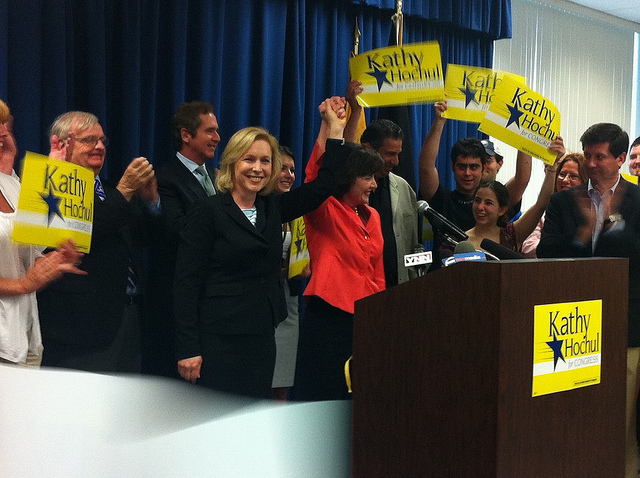
Kirsten Gillibrand campaigning for Kathy Hochul at a rally this past Saturday.
With over 60% reporting and Hochul holding onto her lead, lots of people calling it for Hochul:
@fivethirtyeight: Dave Wasserman (@Redistrict) has called it for Hochul. Good as done. #ny26
Another great tweet:
@thepeoplesview: First Republican electoral casualty of Paul Ryan’s Kill-Medicare plan: Kathy Hochul wins in NY-26! Hee!
As I noted in my post earlier tonight, in a move signaling how weak the GOP is, their candidate Jane Corwin obtained a court order blocking a certification of the winner tonight… it looks like we’ll have to wait until Thursday or so, but let the celebrating begin… here’s hoping this is a huge blow to DC and the Austerity crowd.
It was after all Kirsten Gillibrand, and not DC Dems, who saw the opening in NY-26 and campaigned hard for Kathy Hochul…via the Hill:
Sen. Kirsten Gillibrand (D-N.Y.) has emerged as one of the most prominent supporters of New York House candidate Kathy Hochul.
Washington Democrats have been keeping their distance from Hochul, the party’s nominee in the May 24 special election for former Rep. Chris Lee’s (R-N.Y.) seat. Meanwhile, Republicans leaders including Rep. Pete Sessions (Texas) and Speaker John Boehner (Ohio) have lent their backing to the GOP nominee, Jane Corwin.
Gillibrand, a former upstate congresswoman, sent a fundraising pitch on Hochul’s behalf and teamed with the pro-choice group EMILY’s List to urge activists to lend their support.
“Kathy is an extraordinary candidate,” Gillibrand said Tuesday during a Web forum hosted by EMILY’s List. “I know she can win this race.”
This just reminds me of all the attacks on Coakley and Emily’s List during the Scott Brown race… as I said then, “In Defense of the Emily’s List Candidate”:
Emily’s List produced a winning primary candidate (they backed the candidate who won the popular vote in the 2008 primaries too for that matter). It’s the Obama Era of the Democratic party that has created bad electoral conditions for Democratic nominees and made it difficult for liberals to stand on principle. (Even the socialist in the U.S. Senate voted for Obama’s health insurance scam. Way to discredit the right-wing canard that Obama’s terrible policies are synonymous with socialism.)
The one surefire way to avoid becoming the target of local backlash against Obama is to run against Obama’s policies–and in today’s environment where the activist left is split up along deep fault lines (“submit to party unity or else you’re a certain class of politician, voter, or woman”), Democratic nominees do not have the benefit of a ready-made independent fundraising network to take on the Obama machine during a general election yet. Of course they could try to build one, but either way it is an uphill battle and there is no easy path to victory whatever they choose.
This race was somewhat different in that Hochul could run against the GOP’s toxic Ryancare rather than against Obamacare, but when you hear all the spin tonight and the Dem machine taking credit for Hochul’s win, remember that it was Kirsten Gillibrand and Emily’s List who shored up Kathy Hochul, not Washington Dems, who were too afraid to get behind Hochul.
The “Emily’s List” candidate won in the very red district of NY-26!
Congrats to Kathy, and Kirsten for president!
Hochul’s win tonight also makes Eric Cantor’s and Jonah Goldberg’s push for Paul Ryan to run for president (not to mention Charles Krathammer’s “Draft Paul Ryan” noises from a month ago) all the more ridiculous and embarrassing for the GOP.
Go, Kathy Hochul, Go! (NY-26 Special Election Open Thread)
Posted: May 24, 2011 Filed under: Domestic Policy, U.S. Politics | Tags: Jane Corwin, Kathy Hochul, NY-26, Ryan budget plan, Ryancare 28 Comments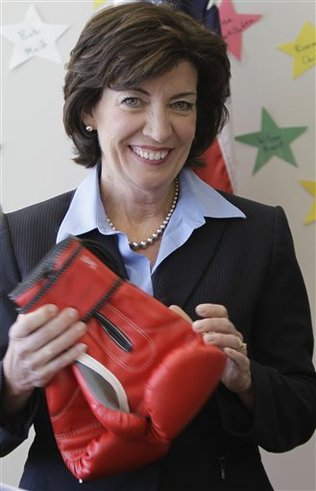
Democratic candidate for the 26th District Congressional seat, Kathy Hochul speaks while holding a pair of boxing gloves during a news conference in Clarence, N.Y., Monday, May 9, 2011. David Duprey / AP Photo
UPDATE, via Buffalo News, with 57% of precincts reporting, Kathy Hochul leads Jane Corwin by 4 points:
Hochul , Kathy 47%
Corwin , Jane 43%
Davis , Jack 8%
Murphy , Ian 1%
***
Tonight’s the big day for NY-26. Election returns are supposed to start showing up here after the polls close tonight. Democrat Kathy Hochul has got the technical edge in some very close polling, which is amazing for this very red district, and the following reporting from Wapo’s Behind the Numbers earlier today seems to point to good news on how the internals are shaking out for her as well:
N.Y.-26 Special Election – Tuesday’s Special Election in New York’s 26th Congressional District finds a very tight race in available polling. Democrat Kathy Hochul has a numerical lead of 42 percent to 38 percent for Republican Jane Corwin and 12 percent for tea party candidate Jack Davis in data from Siena College Research Institute. Those results are well within the poll’s margin of error completed Friday.
Despite the very close numbers, some of the internals are revealing. Hochul secures more of her base voters, winning 76 percent among Democrats, while Corwin only secures 66 percent of her base Republican voters. Independents tilt to Hochul by 44 to 36 percent. Again, those results among independents are within the error margins.
Many pundits have pointed to this race as an early test of Republican attempts to tackle Medicare as a part of budget reform. In the Siena poll, Medicare was not singled out as the most important issue in the vote. Fully 21 percent call it most important, about the same level as the federal budget (19 percent) and jobs (20 percent). Medicare does rise to the top for Democrats, but less so for Republicans and independents.
This afternoon, the NYT Caucus reported heavy turnout and had this to say, in terms of what that means for Hochul and Corwin:
Turnout appeared fairly strong for the special election in western New York State’s 26th Congressional district on Tuesday, officials said. But it was not immediately clear which of the candidates, if any, would benefit from the high degree of voters’ interest in the race.
[…]
But what that high interest will translate into, in terms of votes, is hard to discern. If turnout is strong across the board, Ms. Corwin would likely stand to benefit, since Republicans have a large registration advantage in the district. Ms. Hochul, for her part, would be in a particularly strong position if voters in Erie County, where she is county clerk, turn out in high numbers.
In a move indicating just how vulnerable the GOP is, Jane Corwin has obtained a court order barring certification of a winner tonight… via Buffalo News:
Jane L. Corwin this afternoon obtained a court order from State Supreme Court Justice Russell P. Buscaglia barring a certification of a winner in the special 26th Congressional District race pending a show-cause hearing before him later this week.
The Buffalo News obtained a copy of the show-cause order Buscaglia signed this morning based on a petition the Republican candidate filed Monday.
Under the judge’s 11-page order, attorneys for Corwin have until Wednesday to serve copies of the court order on the election boards of Erie, Niagara, Genesee, Orleans, Wyoming, Livingston and Monroe counties, their sheriff’s offices, the state Board of Elections and her three opponents.
The Atlantic Wire has a good overview of the race and what various pundits are saying — Get Ready to Spin the Results of New York-26:
Voters in New York’s 26th congressional district are voting Tuesday to pick a replacement for Chris Lee, who resigned after the whole Internet saw him with his top off. The special election is now seen as a referendum on Rep. Paul Ryan’s plan to phase out Medicare because even though the district is conservative, Democrat Kathy Hochul is ahead in the polls. As the national significance debated, the parties are mounting big get-out-the-vote operations–Republican Jane Corwin’s campaign had 500 volunteers knocking on doors over the weekend–150 of them bussed up from Washington, the Niagara Gazette‘s Eric DuVall reports. Hochul says the Democratic Party is running a “full field program” with hundreds of volunteers contacting thousands of voters.
Politico’s Alex Isenstadt writes that both parties are playing the “expectations game”–Republicans saying this race means nothing because third party candidate Jack Davis is siphoning votes from Corwin (pictured above, voting), and Democrats insisting they shouldn’t even be competitive in such a red district. (Conservatives started spinning the race even before polls put Hochul ahead, Dave Weigel notes.) And this strategy can be seen in browsing political blogs: liberal sites are giving a lot of coverage to the race Tuesday, while few conservative sites are bothering with it (the opposite was true in Wisconsin’s special election earlier this year, once missing votes were found handing the race to the conservative candidate.) The New Republic‘s Jonathan Chait says the race might be an outlier, but it’s still significant. It has “centered almost entirely around the exact theme that Democrats plan to employ in the next election cycle,” Chait writes. “All this suggests the party has gotten deep traction on the issue, and that the public can react against the policies of the House GOP. The political landscape that produced the Republican sweep of 2010 is gone. Just what replaces it remains to be seen.”
NBC’s First Read says that special elections aren’t a good guide to how the parties will fare in fall elections–but still, the power of Medicare shouldn’t be understated. A “GOP loss in NY-26–a district John McCain won in 2008, 52%-46%–would be a wake-up call for Republicans on Medicare, forcing their House members and even presidential candidates to re-evaluate how they approach the issue.”
Bill Clinton and Chris Chrisitie hit the phones for their respective party candidates… via Talking Points Memo:
“Now, I’m sure you’ve received many phone calls about this election already, nut please just give me a few seconds of your time as the election draws near,” Christie says in the call, according to The Buffalo News. “I’m calling to ask you for your support for Jane Corwin for Congress as you go to the polls Tuesday, May 24th. I ran for governor of New Jersey because like you, I wanted to see REAL change. Jane Corwin is a fighter who knows how to get things done. We’re in critical times for our country, and Washington needs stand-up leaders who will fight to control spending and change business as usual.”
Rallying Democrats, former President and current New York State resident Bill Clinton has recorded a call as well. Clinton’s script focuses tightly on the Medicare angle that Democrats have been pushing in the district, an approach they credit with their current lead in the polls.
“You can count on Kathy to say no to partisan politics that would end Medicare as we know it to pay for more tax cuts for multi-millionaires,” he says. “That’s just one reason I hope you’ll join me in supporting Kathy Hochul for Congress in the Special Election tomorrow, May 24th.”
ABC News on why NY-26 matters:
First, “If Hochul wins, even in a three-way race, it will be great news for Democrats, who will use the victory not only to talk about Medicare, Budget Chairman Paul Ryan’s budget and their own momentum, but also to recruit candidates around the country and raise funds,” the Rothenberg Political Report stated in a recent analysis. “And Democrats will have a right to brag, given the district’s fundamentals and the cash that Corwin and Republican groups have poured into the race.”
Second, the N.Y.-26 election would help both sides determine whether national dollars by party organizations and interest groups really make a difference.
Third, the race is important nationally because it has exposed the divisiveness and relative lack of coordination within the Tea Party movement. The biggest Tea Party group in the area, TEA New York, has endorsed Corwin, but not all Tea Party activisits are on board, which sends a warning sign to Washington that they will not back candidates based on party affiliation alone.
All eyes are obviously going to be on the exit polling and what it says about Ryancare.
Also from the link:
Hochul, the Erie County clerk, is widely expected to pull a victory in what would be a stunning defeat for Corwin, a state assemblywoman. The last Democrat to be elected from the district left office eight years ago, and only three Democrats have won in this area in the past century. New York’s 26th was only one of four districts in the state that voted for John McCain over Barack Obama in the 2008 presidential election.
Hochul, however, has been cautious about declaring victory too quickly.
“We don’t have the enrollment advantage, but I’m going to keep fighting till the very last minute,” she said at a restaurant in Amherst.
NY Magazine has a primer on how to interpret the tonight’s returns… if Hochul wins, here’s pretty much what to expect from the Dems and points to consider about the validity of their claims:
Democrats point to this surprising result as the first definitive proof of the powerful opposition to Ryan’s Medicare-reform plan. The plan is clearly as toxic as a stroll through Fukushima, as they’ve been saying all along, and it will likely lead to an Obama victory in November of 2012.
It’s true that voters who care most about Medicare are strongly in Hochul’s camp, according to polling. But the causality here isn’t quite so clear-cut, as Nate Silver explains:
What’s tricky about this is that it isn’t straightforward to determine whether voters are prepared to vote for Ms. Hochul because of the Medicare issue — or rather, whether they were going to vote for her for some other reason, but emphasize Medicare to pollsters because she has also.
There are also other factors to consider — the candidates themselves, their reputations and personalities, for example. So though Medicare will play a role in the outcome, it will be difficult to tell how large that role will be.
And even assuming that opposition to Paul Ryan’s Medicare plan is a decisive factor, how much can that foretell about November 2012? The Medicare plan may be a central issue at the moment, but will it remain prominent in the political discussion fifteen months from now? What if an agreement on reforming Medicare has been reached by then? What if the presidential election, or unforeseeable events, cause other issues to overshadow the debate over Medicare entirely? It’s a long time until 2012.
And points to consider about the GOP spin if Hochul wins:
Republicans will insist that they would have won if not for the presence of Jack Davis, the eccentric businessman pulling in around 12 or 13 percent of the vote on the Tea Party line, and therefore the results are meaningless, and everyone should forget that this ever happened. The truth though, is that if Hochul wins, it’s a victory regardless of Davis. Davis may be running on the “Tea Party” line this year, but he ran as a Democrat for the same seat in 2004, 2006, and 2008, and his “ideology is too inconsistent to be readily categorized,” as the Washington Post put it. In a recent Siena poll, he draws about the same amount of support from Republicans as he does from Democrats. In other words, if Hochul wins, it won’t be because Davis split the conservative vote.
On the other hand, if Corwin pulls it out, here’s how NY mag breaks down what to expect from the spinmeisters and how to gauge what they are saying:
The Democratic Spin:
Democrats will insist that, because this is usually such a Republican-friendly district, they overperformed despite losing. And that may be true, depending on the margin of victory, because this district has been represented by a Republican for 40 of the last 50 years, including the last eight, and John McCain carried it by 6 percent over Barack Obama in 2008. Using that result as a benchmark, it’s fair to say that if Hochul loses by a few points to Corwin, the Democrats still beat expectations, and can plausibly claim a sort of moral victory, if not a tangible one. But if Hochul loses by six or more points, there’s no way Democrats can spin this in their favor.
The Republican Counter-Spin:
Republicans will claim that a win by any margin, regardless of the “Beltway expectations game,” proves that the Democrats’ “Mediscaring” strategy has failed miserably and that Ryan’s Medicare plan isn’t as toxic as the Democrats and the liberal media would like everyone to believe. In fact, as this was essentially the first referendum on the GOP’s Medicare plan, Democrats in Congress should now heed this mandate and enact the plan into law.
The polls will close at 9 p.m. Eastern. Again, the numbers are supposed to start streaming here once voting has ended.
I’ll leave you with this teaser from Huffpo’s Mark Blumenthal and his take on how to watch the numbers as they roll in:

Click to view larger. image via Huffpo/NationalAtlas.gov
Judging vote composition is tricky when results are incomplete, but the percentage contributed by Erie and Niagara Counties is worth watching. If Democrats are having an exceptionally good night, the share of the vote from Erie and Niagara might be a point or two higher than the last few elections. If the vote share from those counties winds up being a point or two lower, then Republicans may post even stronger numbers than in 2010.
This is an open thread.
It can happen again
Posted: May 24, 2011 Filed under: just because 10 Comments
James Wood as the CEO of failing Lehman Brothers
Since I put up that thread last night on the HBO docudrama Too Big to Fail, I thought I’d look for some research coming out of financial economists on those events. I’m still reading “House of Cards” off and on which is a more wonky version of Too Big to Fail. I’ve also done my share of reading various research articles that pop up in academic journals. Mark Thoma had a link to a Minneapolis Fed paper by Robert Lucas and Nancy Stokey. Lucas is one of the premier freshwater economists and the paper fit the bill. You become very familiar with the Lucas Critique in graduate school. It’s seminal.
If you watched the HBO presentation, you may recall that Ben Bernanke explained that there was a liquidity or credit crisis that resulted from the downward spiraling financial market conditions. The director punctuated this by showing the head of GE on the phone saying that GE wasn’t able to do its regular business because it’s commercial paper wasn’t going to be renewed or rolled-over. Commercial paper is the vehicle for borrowing short term working capital. The market is only available to high quality companies. This was one of the first signs that the contagion was outside of the mortgage markets. There was no money to lend to high quality huge corporations in retail and manufacturing. All outstanding dollars were being brought back to lenders to cover their losses and up their capital in response. You may have seen my earlier comment that it was rumored at the time that McDonald’s couldn’t get theirs renewed either and was about one week away from not being able to make its payroll. Many businesses rely on short term borrowing for working capital and most of these businesses are sitting in your local strip malls.
The prime commercial paper market seems like a gigantic leap from the mortgage repurchase (repo) markets where the contagion started as real estate prices plummeted and troubles in sub prime mortgages became apparent. The problem is that well diversified shadow banks–like insurance companies, investment banks, Money Market funds, and Hedge funds–are invested all over the place. If they start losing big in one area, they have to pull their money back to cover it. They pull the short term money first to avoid penalties and loss of higher yielding assets. Institutions’ exposure to the real estate markets and the repo market was so huge that it started sucking the money out of every other credit market. They needed the money to cover the losses. Some of the banks were more than able to cover themselves and their capital requirements by doing this. You also saw this at the end of the show. The deal is that wasn’t the only problem at that point. If banks continued to draw funds down from other markets, it was bound to start taking other US businesses and consumers down. The banks needed to shove more money out the door and not pull it back in according to monetary policy theory as shown by empirical evidence during the Great Depression. The phenomenon is called a liquidity crisis, a credit crunch basically represents a nontraditional bank run.
There are many markets unfamiliar to most people that could set off contagions that impact the real economy. They are still out there. Reliance on capital creates this situation. Trying to wring every last penny out of every last dollar through sophisticated cash management programs exacerbates it. A lot of what happens with liquidity crises is that people and business start holding on to money because of panic and uncertainty. They want to overprotect themselves. This makes the situation worse. Keynes referred to this as animistic spirits. Lucas defines it like this.
Liquidity crises that induce or exacerbate deep recessions, as in 1930 or 2008, are situations in which individuals and firms want to build holdings of liquid assets. Heightened risk, or a perception of it, substantially increases demand for these assets. This reduces the supply available for normal transactions, leading to production and employment declines.
What happened in September 2008 was a kind of bank run. Creditors lost confidence in the ability of investment banks to redeem short-term loans, leading to a precipitous decline in lending in the repurchase agreements (repo) market. Massive lending by the Fed resolved the financial crisis, but not before reductions in business and household spending had led to the worst U.S. recession since the 1930s.
Lucas looks at the moral hazard created by deposit insurance as well other risk tools like swap and reinsurance markets using models that were developed in the 1980s that still stand today. You may remember the huge role of AIG in all of this. All the banks thought they were safe because they had insured their positions with AIG (credit default swaps, reinsurance, etc.) so therefore they thought they could take on more risk as they increased their volume of stinker loans. What no one knew at the time was that AIG had pretty much insured the majority of the market. It was betting that real estate prices would never go down. If AIG would’ve tanked, those insurance policies were dead and so was the rest of its line which included folks’ pensions and life insurance policies. The AIG exposure was the Rubicon.
If you think you’re insured against a risk, you will take on more risk. The banks thought they were insured. Thus, the moral hazard is created. The best way to explain it is using safety belts in cars. People actually tend to drive faster when wearing seat belts and engage in riskier behavior because they feel safer. Deposit insurance creates a feeling of safety in both depositors and lenders. There were never runs on checking or savings accounts during the entire crisis. It happened in Money Market Accounts which are close substitutes but not insured as people wanted to move their funds to their safer accounts. Money Markets lend big time to the repo markets.
You may recall that TARP switched midstream from a program of buying toxic assets to a recapitalization venture. The liquidity/credit crisis was basically the reason. Bernanke told Paulson that it would take several months to value and clear out toxic assets. They did this later through the QE program where they allowed almost anything as collateral for cheap loans for almost any one at the Fed’s discount window. What they did with the TARP was force the big banks to sell them none-voting preferred stock in exchange for a given amount of capital. It was a form of nationalization without completely taking over banks. The banks were supposed to create loans with this and replenish the credit markets. That happened to a limited extent. It didn’t replenish all of the credit markets. Most notably credit for small businesses and consumers remained tight for some time. They still are quite tight.

 peej
peej Carissa
 bostonboomer
 dakinikat
 ecocatwoman
 mablue2
 Mama Lopez
 peggysue22
 quixote
 skydancingguestblogger
 Mona (aka Wonk the Vote)



 Sky Dancing
Recent Comments