
George W. Bush, Plagiarizer
Posted: November 12, 2010 Filed under: just because | Tags: Decision Points, George W. Bush, plagiarism 32 Comments
A few years back, I had a freshman in my Psych 101 class who copied most of a paper from a Time Magazine cover story. Naturally, I knew right away she hadn’t written it herself, particularly because her opening and closing paragraphs were full of grammatical errors and misspellings. I sat down with her and explained that you simply can’t copy other people’s work and try to pass it off as your own. It’s called plagiarism, and it can get you kicked out of college. I gave her an F on the paper and said I wouldn’t report her to the administration this time.
What do you do when a former President does pretty much what that college freshman did? Ryan Grim has an exclusive at Huffpo with a number of examples of Bush’s brazen thefts of intellectual property in his recently released memoir, Decision Points.
When Crown Publishing inked a deal with George W. Bush for his memoirs, the publisher knew it wasn’t getting Faulkner. But the book, at least, promises “gripping, never-before-heard detail” about the former president’s key decisions, offering to bring readers “aboard Air Force One on 9/11, in the hours after America’s most devastating attack since Pearl Harbor; at the head of the table in the Situation Room in the moments before launching the war in Iraq,” and other undisclosed and weighty locations.
Crown also got a mash-up of worn-out anecdotes from previously published memoirs written by his subordinates, from which Bush lifts quotes word for word, passing them off as his own recollections. He took equal license in lifting from nonfiction books about his presidency or newspaper or magazine articles from the time. Far from shedding light on how the president approached the crucial “decision points” of his presidency, the clip jobs illuminate something shallower and less surprising about Bush’s character: He’s too lazy to write his own memoir.
Bush, on his book tour, makes much of the fact that he largely wrote the book himself, guffawing that critics who suspected he didn’t know how to read are now getting a comeuppance. Not only does Bush know how to read, it turns out, he knows how to Google, too. Or his assistant does. Bush notes in his acknowledgments that “[m]uch of the research for this book was conducted by the brilliant and tireless Peter Rough. Peter spent the past 18 months digging through archives, searching the internet[s], and sifting through reams of paper.” Bush also collaborated on the book with his former speechwriter, Christopher Michel.
Perhaps Bush should have titled his memoir Other People’s Points instead of Decision Points. I knew Bush was a “C” student, but this is ridiculous. Wouldn’t you think his collaborators would have known better, even if Bush didn’t? Certainly Laura Bush, a former librarian, could have explained plagiarism to her husband. Bush even stole from Bob Woodward’s books! Grim suggests that anyone who bought the book can go on a treasure hunt using plagiarism software.
Finding lifted passages in Bush’s book is like an Easter egg hunt. Look for passages with a number of quotes back to back and then slap the passage into Google Books or plagiarism detection software you might have access to. The slideshow below shows what HuffPost has found so far. If you find any more, send the passage to ryan@huffingtonpost.com and we’ll verify it and add it to the list.
Here are a couple of examples from Grim’s article.
From Decision Points, p. 267: “Several months later, four men came to see me at the White House. They were members of the Delta Team that had captured Saddam. They told me the story of the hunt…’My name is Saddam Hussein,’ the man said. ‘I am the president of Iraq and I want to negotiate.’ ‘Regards from President Bush,’ the soldier replied.”
BBC, Dec. 15, 2003: “How Saddam Hussein was captured”: “[Saddam] put up no resistance although armed with a pistol. ‘My name is Saddam Hussein. I am the president of Iraq and I want to negotiate,’ he told the US troops in English, according to Major Bryan Reed, operations officer for the 1st Brigade, 4th Infantry Division. ‘Regards from President Bush,’ US special forces replied, Major Reed recounted.”
A Time magazine story later questioned whether the story was accurate.
“Legends of the Fall,” Dec. 29, 2003: “A U.S. intelligence official, meanwhile, casts doubt on another widely reported tale: that a U.S. soldier hailed the nemesis of two Commanders in Chief named George Bush by saying: ‘Regards from President Bush.’ This person says some officials suspect the story is ‘apocryphal.’”
So did the soldiers tell Bush that story or did he lift it from the BBC?
Tommy told the national security team that he was working to apply the same concept of a light footprint to Iraq… “If we have multiple, highly skilled Special Operations forces identifying targets for precision-guided munitions, we will need fewer conventional grounds forces,” he said. “That’s an important lesson learned from Afghanistan.” I had a lot of concerns. … I asked the team to keep working on the plan. “We should remain optimistic that diplomacy and international pressure will succeed in disarming the regime,” I said at the end of the meeting. “But we cannot allow weapons of mass destruction to fall into the hands of terrorists. I will not allow that to happen.”
From General Tommy Franks American Soldier, p. 350:
“For example, if we have multiple, highly skilled Special Operations forces identifying targets for precision-guided munitions, we will need fewer conventional ground forces. That’s an important lesson learned from Afghanistan.” President Bush’s questions continued throughout the briefing…. Before the VTC ended, President Bush addressed us all. “We should remain optimistic that diplomacy and international pressure will succeed in disarming the regime.” … (p. 355-6) The President paused. “Protecting the security of the United States is my responsibility,” he continued. “But we cannot allow weapons of mass destruction to fall into the hands of terrorists.” He shook his head. “I will not allow that to happen.” (emphasis in the original text)
If you’re so inclined, take a look around the ‘net for good examples and share them here. I’m assuming no one here bought the book.
I just have one question about this situation. If one of the writers whose work Bush stole decides to sue him in court, will the Obama Justice Department weigh in to defend Bush? They defended Bush’s torture policy, so why not his plagiarism?
Friday Treats
Posted: November 12, 2010 Filed under: Treats 88 CommentsIt’s Friday night!!!
Got something to share?
Alright, so I’m going to give up some of my best Creole Recipes for tonight’s Treats. The first one is a shrimp recipe with a ‘secret’ ingredient. No one will guess there’s a bit of cinnamon in it usually. I love this one. Tom used

'Creole Dancer' by Henri Matisse
to serve this one up at the Flamingo. It’s a bit of roux, so you have to remember to pull the warm ingredients off the flame before you mix in the spices or they’ll cake up. It’s great for this time of year. I also add a little red crushed pepper to it but that’s up to you. I’ve found my tolerance for hot stuff is getting pretty high.
Shrimp Supreme
(serves around 4-6 people)
1/4 cup onion, chopped
2 tablespoons celery, minced
1/4 cup butter
1/4 cup flour
1 -2 tablespoons chili powder
1 1/2 teaspoons salt
1/2 tsp cinnamon
2 cups tomatoes (creole if you can find them),peeled
1 pound cooked shrimp, peeled and deveined
Cook onion and the celery in butter until soft and translucent. Do not let them brown. Lift the pan from the heat and let it settle a little and begin mixing in the flour, chili powder, salt and cinnamon. Add the tomatoes and stir them until they blend in with the rest of the stuff. Then, put it back on the heat and let it simmer at a really low temperature about 10 minutes. Stir so it cooks evenly ever so often. Make sure it’s not too hot or the bottom will burn or stick. Right before you’re going to serve it, drop in the shrimp. I usually serve this with rice or some thick crusty Italian bread to get up the red gravy.
This one I usually take with me to balcony parties on Mardi Gras Morning and I take them to Vaughn’s or BJ’s too for game days.
Spicy Ham Fritters
(makes about 20-30)
2/3 cup flour sifted
1 tsp baking powder
1/3 cup milk
1 egg
1 tablespoon aromatic bitters
2 cups ground cooked ham
1/2 cup crushed pineapple, drained
Fat for deep frying
(Optional if you’re keen on hot stuff: Cayenne pepper for sprinkling and/or Louisiana Hot Sauce for dripping)
Sift the flour with the baking powder in a mixing bowl. Add milk, egg, bitters and mix until smooth. Fold in the ham and the pineapple. Drop by teaspoonfuls into deep hot fat (about 350 F). Fry them until they are golden brown and then drain them on paper towels.
Okay, one more for tonight. This is another good seasonal recipe. I’ve tried it with a bunch of different squash including our local favorites that we all have in our backyards, the marvelous alligator pear or Mirliton.
Squash and Pecan Casserole

Opps! It was last week ... yall missed it!!!
(about 4- 6 servings)
3 1/2 cups acorn squash, cooked and mashed
1/2 cup coarsely chopped pecans
1/3 cup honey
1/4 cup butter (melted)
grated rind of 1 lime or lemon (about 2 tablespoons)
1 tablespoon lime or lemon juice
1 tsp salt
1/2 tsp nutmeg
1/4 tsp ground cloves
1/8 tsp white pepper
Whole pecans for garnish
Combine all ingredients except the whole pecans. Blend them together completely. Spoon the mixture into a 1 1/2 quart greased casserole dish. Top the mixture with the whole pecans. Bake it at 375 for about 20 to 30 minutes.
It makes a great holiday take along dish too and if you use Mirlitons you can consider yourself an honorary Bywater Bohemian.
Let’s Make a Deal (or not)
Posted: November 12, 2010 Filed under: Bailout Blues, Economic Develpment, Global Financial Crisis, Team Obama, U.S. Economy | Tags: currency wars, G20 accords, Goolsbee, US South Korea Trade Agreement 6 CommentsThe U.S. and South Korea have failed to reach an agreement in a trade deal that would have boosted U.S. agriculture exports. The deal would’ve included concessions to South Korea on automobiles and that was not going over well with domestic automakers like FORD and their related labor unions. As with all trade arrangements, there are usually winners and losers. Ranchers and U.S. consumers would’ve been on the winning side of the deal. The U.S. auto industry and related interests were the potential losers.
Arrangements probably failed due to the tough stance the U.S. is taking on the dollar and foreign exchange pegs these days. No one is happy with QE2 around the world. We’ll get to that in a minute. I’m going to quote from the WSJ on this so you need to realize that what’s written here is very pro-free trade. What was being negotiated at the moment was removal of some trade barriers on both sides. Political consensus here was that Obama is trying to look more “pro-business”. Part of South Korea’s problems, oddly enough, is that they are ‘too green’ for America’s stuff. Can you imagine a Democratic president trying to get a country to be less environmental friendly?
One stumbling block was Korea’s refusal to change a provision in the 2007 pact that provided an immediate end to a 2.5% tariff the U.S. levies on imports of Korean cars, said House Ways and Means Committee Chairman Sander Levin (D., Mich.). The U.S. wanted the tariff reduced gradually, while Korea eliminates safety and environmental rules that U.S. auto makers, led by Ford, said help keep Korea the world’s most closed car market. The effect of reducing the U.S. tariff more slowly likely wouldn’t be large because South Korea’s Hyundai Motor Co. already gets around it on more than half of the cars it sells in the U.S., by making them in Alabama and Georgia.
Compounding the stalemate, Mr. Levin said, were U.S. concerns that Korea’s proposed system for settling disputes wasn’t likely to work.
The U.S. also wants Korea gradually to drop its ban on imports of U.S. beef from older cattle, which began after the U.S. had a case of mad-cow disease seven years ago. Previously thought the easier of the two issues, it is a hot button politically for Korea and prompted a walkout by Korean negotiators.
In the end, the parties ran out of time. U.S. Trade Representative Ron Kirk said, “We won’t be driven by artificial deadlines,” though it was Mr. Obama who set the G-20 deadline.
The president alluded to the political pressures. “If we rush something that then can’t garner popular support, that’s going to be a problem,” said Mr. Obama, who had criticized the moribund 2007 Korea pact when he was a candidate. “We think we can make the case, but we want to make sure that that case is airtight.”
So, if you want the White House explanation, here’s Austan Goolsbee in a white house white board moment. I’m not sure what it says when the head of the President’s economic advice team has to give us all lectures, but any way, here’s the deal via Austan.
So, the G20 thing seems to be an exercise in every one going their own way. No one likes the hot money issue or the weakening dollar. So much for cooperation. Guess the only thing we’re exporting these days are financial bubbles.
The U.S. Federal Reserve decision last week to pump $600 billion into world’s biggest economy has stolen the spotlight away from China’s currency. Brazilian Finance Minister Guido Mantega said today that the Fed’s move may inflate commodities prices and proposed the world move away from using the dollar as the main reserve currency. Former Chinese central bank governor Dai Xianglong this week faulted the U.S. for adopting policies without regard for the dollar’s global role.
The policy fissures and concern countries may react with currency devaluations and capital controls underscore how the G-20 unity displayed during the financial crisis has given way to national divisions as members chart their own recovery path.
“The last thing a developing economy wants is for that liquidity to distort their asset markets and create a destabilizing bubble,” Stephen Roach, Morgan Stanley’s nonexecutive Asia chairman, told Bloomberg Television in an interview yesterday. “The process is not going to work if they don’t come up with a multilateral solution.”
If you want to read how the QE2 could possibly work and if it will be scaled up, I suggest going over to Tim Duy’s Fed Watch for a wonky and some what long analysis. Oh, and there are plenty of those nifty graphs that I always love in the piece about the recovery. He’s going with the blowing bubbles is good narrative. Interesting. Duy says the FED has no choice because the Federal Government is so out of it on Fiscal Policy. Even more interesting and sadly true.
Flooding the market with money is dangerous business. It risks distorting prices and capital allocations. We simply don’t know where the money will wash up. I know that is in vogue to believe there is a nice, obvious story that links an increase in the money supply to an increase in nominal GDP, but that only works on paper. In the real world, the paths between money and output and prices are complicated. The ultimate composition of aggregate demand matters. It matters a lot – distortions have consequences. Warsh’s risks amount to a laundry list of the possible distortions that might occur as the result of ongoing quantitative easing. And he clearly takes those risks seriously.
It makes me think that I haven’t been taking those risks seriously enough. But when monetary policy is the only game in town, what choice do you have? You do what you can up to a point…but then you throw it back to Congress and say “you take responsibility for the mess you created by abdicating your role in crafting long run, stabilizing macroeconomic policies.” Warsh has set the stage for doing exactly that.
Of course, seriously, if we really have to throw this back to Congress, we are absolutely done for. Cooked. Toast. Somebody remember to tell the last guy to turn off the lights on his way out. Better to take our chances with the next bubble.
Aiyee … I’m about reading to move my money into alligator belly futures. At least that makes a good gumbo if you fail to get out in time.
Friday Reads
Posted: November 12, 2010 Filed under: just because, morning reads | Tags: Currency appreciation, Daily Beast Newsweek Merger, hot money, repeal DADT, secret war on Yemen, web spying 59 Comments
Anji Allen "Books, Cup and Flowers"
Good Morning!!!
Well, the on and off again relationship between The Daily Beast and Newsweek is on again. They’ve got more issues with mergers than a couple of teenagers.
The New York Post‘s Keith Kelly tweets tonight that Mr. Harman, reached by telephone, said: “It’s not done yet.” And Advertising Agereports that while the sides are “close to finalizing a deal,” the announcement is only “possible” for Friday morning. With two powerful egos at a negotiating table, no deal is final until it is final. But Mr. Harman and Mr. Diller have broken through on the major issues between them, according to one source, and a deal is all but complete.
If you ever need proof of the corporate agenda and money impacting policy positions within the Beltway, this is it. WAPO has an article up revealing how many of the Cat Food Commission staffers were actually paid by outside entities. Wanna guess what types of companies contributed employees to the effort? How about those that are after our social security dollars to fund their casino operations?
Kennelly and other liberal-leaning critics say they are particularly troubled by the influence of Peterson, a billionaire and former investment banker who began a $6 million campaign this week urging lawmakers to cut the deficit. Peterson, co-founder of the Blackstone Group investment fund, paid for a series of town hall meetings this year that included participation by deficit commission members. He also funds the Fiscal Times, a digital news organization that focuses on federal debt issues.
Best blue ribbon panel money can buy!!!
A pentagon survey evidently shows that dropping DADT will not cause wartime strife. So what the heck is Obama waiting for? Just sign an executive order and get it over with already! I’ve had it with this dilly dallying around with discrimination.
The findings summarized in a lengthy report that the Pentagon is preparing to send to President Obama about the potential effects of repealing the military’s “don’t ask, don’t tell” policy have been relayed to The Washington Post ahead of the game, and from the (secondhand) look of it, the policy’s days may well be numbered if the Department of Defense heeds those findings
Okay, I’m back on currency war topics again. This is from Nouriel Roubini on ‘New Rules for Hot Money’ at Project Syndicate. This is the money that will cross borders in search of higher returns from those developing markets that are in good shape. I think you’ll remember me telling you about 9 months ago that that was my investment strategy so I’ll just put this in as some kind of notification to you that I have money in this strategy. It’s not a lot of money, but, hey it’s hot!!! (And, I’ve done real well recently so I’m probably going to cut and run shortly too, so don’t take this as any indication of me saying do this, please! )I’m going to excerpt Roubini’s explanation. It’s also one of the reasons that the dollar weakens and other currencies appreciate because if you want to invest in bonds from Thailand, you don’t use dollars, you use the Baht. So, high demand for baht, low demand for dollars, exchange rates for baht are the price of the baht and so the baht gets more expensive. The interesting points this explanation are on what policy makers can do in response to this phenomenon. Also, there’s a point you have to separate the potential for a bubble vs. actual appreciation.
Capital flows to emerging-market economies have been on a boom-bust merry-go-round for decades. In the past year, the world has seen another boom, with a tsunami of capital, portfolio equity, and fixed-income investments surging into emerging-market countries perceived as having strong macroeconomic, policy, and financial fundamentals.
Such inflows are driven in part by short-term cyclical factors (interest-rate differentials and a wall of liquidity chasing higher-yielding assets as zero policy rates and more quantitative easing reduce opportunities in the sluggish advanced economies). But longer-term secular factors also play a role. These include emerging markets’ long-term growth differentials relative to advanced economies; investors’ greater willingness to diversify beyond their home markets; and the expectation of long-term nominal and real appreciation of emerging-market currencies.
There’s some important analysis up at the WSJ by economist Robert E Hall who is one of the folks that actually dates the start and end of recessions and booms. He’s basically talking about how dysfunctional monetary policy is now because we’re in a liquidity trap.
In a paper presented Thursday at a Federal Reserve Bank of Atlanta conference, Mr. Hall calculates that loose credit earlier in this decade resulted in consumers buying 14% more long-lasting items — from cars and dishwashers to houses — than they would have if credit conditions had remained as they were in the previous decade.
The recession was marked by those overextended households cutting spending and saving more in the face of hard times. The problem now is that the normal tool used to revive consumer spending and hiring — cutting interest rates well below the inflation rate — isn’t available because rates are nearly at zero. So unemployment has remained stuck at a high level, currently 9.6%.
Mr. Hall, who also serves as chairman of the National Bureau of Economic Research’s Business Cycle Dating Committee — the group that officially pronounces the start-date of recessions and recoveries — concludes that the only way to get the job market growing is to institute monetary policies “that emulate the effect of low real rates — making current purchasing cheaper than future.” That should be music to the ears of many at the Fed, which just launched a controversial program to buy government bonds aimed at getting the economy growing faster.
Yves over at Naked Capitalism has found more evidence of BOA fraudulent foreclosures. This time they’re pulling stuff in the state of Kentucky. We’ll just have to see what newly minted Senator Rand Paul says about that, won’t we?
The bank position so far has been that problems so far are mere mistakes and “sloppiness”. But as we’ve described repeatedly, the problems with securitzations run much deeper than that. It appears that the parties to the deal often failed to take the time consuming steps necessary to convey the note (the borrower IOU) to the trust as stipulated in the contract governing the deal, the pooling and servicing agreement. The PSA required that each note in the deal had to be signed by multiple intermediary parties before it got to its supposed final resting place, a trust. And that had to take place by closing or at most 90 days thereafter.
Many foreclosures show this process was not observed on a widespread basis: the notes were assigned (as in transferred) to the trust right before closing, a violation of the PSA, the New York trust statutes that govern virtually all mortgage securitization trusts, and IRS rules for these trusts (REMIC). When foreclosure defense attorneys started contesting these assignments, suddenly a new ruse started to show up: allonges, which are sheets of paper that contained the needed endorsements, would magically appear out of nowhere. The problem is that an allonge is supposed to be used only when there is no space left on the note for endorsements, including margins and the reverse side, and when it is used, it is supposed to be so firmly attached to the original as to be inseparable. But these “ta da” allonges were always somehow discovered at the custodian, quite separate from the note.
How long can the Justice Department turn a blind eye to these things? There’s too many states involved and too many loans for it not to be a systemic procedure. Follow the details over there and I think you’ll see the evidence is strong.
Speaking of corporate malfeasance, have you read about GOOGLE recently? You might want to find out if the company’s been spying on you, because it appears they’re doing so as a matter of course.
Ardent Google critic Consumer Watchdog has called on Congress to hold hearings on a major privacy breach by the Internet search engine giant, and insists that CEO Eric Schmidt should come to Washington to testify.
The group says Congress should get involved even though the Federal Communications Commission (FCC) is already investigating.
That probe is important, but Congress is “the best venue to get a full explanation,” the group said Thursday in a letter to House lawmakers on the House Energy and Commerce Committee, which has jurisdiction over Google.
Google admitted last month that it collected and stored private user data, including passwords and e-mails, from Wi-Fi networks. Critics have termed the incident Google’s “Wi-Spy” breach.
Seems you don’t have to look over your shoulder any more to see if some one is following you. They’re doing it under your nose and fingers.
Glenn Greenwald continues to believe the Terrorism is being used an excuse to erode freedom of speech. You can read his latest at Salon. More importantly, I found a link to Justin Elliot’s latest on Obama and how he’s escalating the secret war in Yemen. Whoa!!!
The Obama Administration has U.S. military trainers on the ground in Yemen and has already launched an attack and possibly multiple attacks in the country, drawing relatively little public attention and virtually no debate in Congress. Analysts and news reports suggest that the administration is now poised to escalate the secret war in Yemen, possibly by launching drone attacks targeting suspected terrorists.
The attention of the U.S. media briefly re-centered on Yemen late last month after explosives originating from the Gulf nation were found on two cargo planes in Britain and Dubai. The Obama Administration has fingered the Yemen-based group Al Qaeda in the Arabian Peninsula (AQAP) as responsible for the failed attempt. (AQAP also claimed responsibility.) This is the same group that claimed responsibility for the failed attempt by Nigerian national Umar Farouk Abdulmutallab to blow up a Detroit-bound plane on Christmas Day 2009.
But less attention has been paid to U.S. attacks on targets in Yemen — of which there have been at least two since 2002 — and the U.S. military role in training Yemeni forces as well as helping them carry out air strikes.
And you thought last stop was Vietnam, Iraq, Afghanistan? Yup, way to go PEACE candidate!
Alright, that’s enough from me. I’m going through my recipes to look for some good New Orleans recipes to share on Treats thread tonight. I’m giving you some warning so you’ll be prepared to share any that you’ve got that are just plain good ol’ down home cookin’.
What’s on your reading and blogging list today?
President Obama Phones New GOP Senators and House Members
Posted: November 11, 2010 Filed under: Surreality, Team Obama, WE TOLD THEM SO | Tags: Barack Obama, David Axelrod, GOP outreach, John Boehner 46 Comments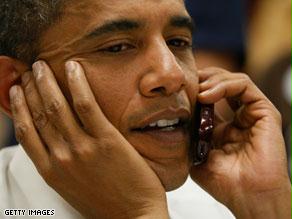
If you were wondering what President Obama has been up to during off-hours during his trip to Asia, wonder no longer. The New York Daily News reports that
President Obama has reached out to most of the incoming GOP lawmakers victorious on Nov. 2, telephoning many of them while abroad traveling to meetings in Asia.
“It’s a step in the right direction,” said Speaker-in-waiting John Boehner’s press secretary Michael Steel.
[….]
the President has also spoken to many of the incoming GOP House committee chairmen, including Rep. Pete King (R-L.I.), who will take the gavel of the Homeland Security Committee.
The same Peter King who recently said that George W. Bush “should get a medal” for approving waterboarding?
“There was no harm done,” King said Wednesday, referring to the waterboarding of alleged 9/11 mastermind Khalid Sheikh Mohmammed, who was subjected to simulated drowning 183 times in March of 2003. “In the big picture, to hold someone’s head underwater, the chance of permanent damage is minimal and the rewards are great.”
The Daily News did not report whether President Obama called new Democratic Senate and House members.
In other new of White House weakness, Sam Stein reports that The President and his top advisers had no warning about the release of the draft report of the Catfood Commission chairmen yesterday. In fact David Axelrod had to look up the report on-line.
Hours after the commission’s two chairs — former Sen. Alan Simpson and former White House Chief of Staff Erskine Bowles — unveiled their 50-page list of deficit reduction recommendations, White House Senior Adviser David Axelrod admitted that he had to find a copy of the report on the Internet.
“I heard at noon that those guys were going to hold a press conference at 1 PM,” Axelrod told The Huffington Post. “And I pulled off the Internet the coverage of it.”
Asked if he was bothered by the lack of warning, Axelrod replied: “I think they set out to be an independent commission and they are being independent. But we will let them complete their work and we will take a look at what they’ve done. Maybe they will get consensus around some of these ideas, maybe they won’t. We will take a look at it.”
Apparently I spoke too soon when I suggested Axelrod is running the Obama administration. Perhaps John Boehner is now in charge?
This is an open thread.

 peej
peej Carissa
 bostonboomer
 dakinikat
 ecocatwoman
 mablue2
 Mama Lopez
 peggysue22
 quixote
 skydancingguestblogger
 Mona (aka Wonk the Vote)



 Sky Dancing
Recent Comments