
Punch Drunk on Tax Funded Bailouts
Posted: March 23, 2009 Filed under: Equity Markets, Global Financial Crisis, Main Stream Media, president teleprompter jesus, Team Obama, U.S. Economy, Uncategorized | Tags: bailout, Change When?, Obama, SouthPark, TARP, Timothy Geithner 4 CommentsWhile the Right Wing is off having tea parties and screaming class war, there appears to be some legitimate soul searching going on in left Blogistan about our “punch drunk” POTUS and his continual campaign like appearances. A lot of the discussion is focused on his dogged support of Turbo Tax Timmy and his bailout of the Suckers who created this bad economy for the rest of us. We’ve been overwhelmed with “heckuva-job-Timmy moments and distasteful ‘gallows humor’. When is enough enough?
Meanwhile, those of us that can’t avoid our jobs by taking a permanent vacation in TVLand are watching the economy unwind in spasms of agony and ecstasy. The market, starved for specific plans and information, provided a big thumbs 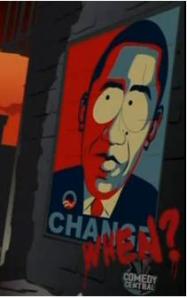 up on a bail out program that at best reheats Dubya’s. If any one was punch drunk, it was the equity markets today. The leaders were the financials, of course, who will continue to provide profits to the market while writing their costs off to the taxpayer. If you were looking for the fresh cold breath of reality, it wasn’t on Wall Street or on Pennsylvania Avenue.
Lucidity, however, is on the rise in other places. I’m finding it in interesting places like the second episode of South Park where the lampoon on the Dark Knight included this little back ground gem; a satire of the famous Obama picutre with a deer-in-the-headlights appearing Obama and the change mantra tagged by a bright red WHEN?
My answer to the when question is probably never.
Most left wing angst appears to be directed at Tim Geithner since the Light Bringer is still too new to the job to blame. We continue to learn how involved both he and his staff at the NY Fed were in the AIG Bonuses. In fact, the Obama administration is trying to scuttle the Excise tax on the bonuses while verbally denouncing executive greed on TV. We’ve also found out that Citibank has managed to insert similar language to protect its executive bonuses. Let’s see how much change we get on that one too.
Not only are right wing shrills like Fox’s Sean Hannity calling for the head of Timmy Geithner but Progressive Diva Arianna Huffington front paged the call on HuffPo today. When Hannity and Huffington carry the same headline, it’s time for more than a few campaign appearances on Leno and 60 minutes. I’m not sure where all this shock and angst is coming from because it’s been rather obvious to some of us for some time that Obama represented rather narrow interests (not ours). How can every Obama supporter be calling the AIG Bailout a travesty while knowing that the architects and enablers of AIG are continuing the task with the Light Bringer’s blessings and attaboys? Well, Obama just mustn’t realize that it’s all Timmy’s fault and we need his head on a limited edition Obama inaugural platter. But, wait, isn’t Obama the one with that great judgement ? C’mon folks reconcile all this in your mental ledger. It really isn’t that hard.
Super Heroes of Macroeconomics
Posted: March 22, 2009 Filed under: Uncategorized | Tags: AIG, bail out, Fraud, Geithner, Obama, Summers, TARP, Wealth Transfers, zombie banks 11 CommentsSomebody must have a lot of time on their hands to write a song called “Hey, Paul Krugman” but still, if the angsty, artsy fartsy creative class that foisted this POTUS on us is finally waking up, then Twitter me when the Revolution comes. I’ve even read the orange cheeto place and seems even a few of them are beginning to see the writing on their blackberries.
So, Paul is still appalled and speaking out against the Zombie Plan. I’d say this is another sfz! warning to the White House. What I can’t repeat enough is that it’s not just Paul. It’s not just me. It’s everyone with any knowledge of macroeconomics and the financial system.
Why am I so vehement about this? Because I’m afraid that this will be the administration’s only shot — that if the first bank plan is an abject failure, it won’t have the political capital for a second. So it’s just horrifying that Obama — and yes, the buck stops there — has decided to base his financial plan on the fantasy that a bit of financial hocus-pocus will turn the clock back to 2006.
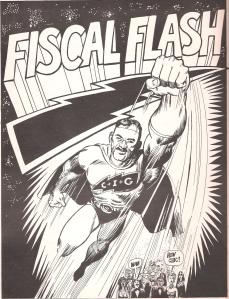 I don’t know if you’ve ever sat in an economics class, but most of you who have will attest that few economics professors are what you would call the dramatic, excitable types. However, I’ve seen more animation out of them recently than I’ve seen in all recent Marvel Comic Books.
From “Reasons Why The Obama Administration will not solve this crisis by the end of 2009” at The Underground Investor:
Consider that President-elect Obama voted FOR the horrible $700 billion bailout plan that accomplished less than zero in fixing the global economy while only transferring wealth from people that were struggling the most to the unethical financial executives that created this problem. These were my exact words in October, 2008, verbatim, about the eventual effect of the bailout plan: “Don’t believe the media spin. This will fix nothing. Even if and when the government overpays Wall Street and US banks by 300%, 500% and 1000% for their toxic assets, this temporarily recapitalizes these financial institutions but only creates A MUCH BIGGER PROBLEM for the future.” If I understood why the bailout plan would most definitely fail, as I blogged here, and the next President of the United States could not, that is a scary thought. On the other hand, if President Obama understood that the bailout plan would likely accomplish nothing but the transference of wealth from hard-working citizens to corrupt financial executives and still voted for the bill, then this action needs no further discourse.
From FT’s Willem Buiter:
Why are the unsecured creditors of banks and quasi-banks like AIG deemed too precious to take a hit or a haircut since Lehman Brothers went down? From the point of view of fairness they ought to have their heads on the block. It was they who funded the excessive leverage and risk-taking of banks and shadow banks. From the point of view of minimizing moral hazard – incentives for future excessive risk taking – it is essential that they pay the price for their past bad lending and investment decisions. We are playing a repeated game. Reputation matters.
Three arguments for saving the unworthy hides of the unsecured creditors are commonly presented:
- Unless the unsecured creditors are made whole, there will be a systemic financial collapse, with dramatic adverse consequences for the real economy.
- If the unsecured creditors are forced to take a hit, no-one will ever lend to banks again or buy their debt.
- The ultimate ‘beneficial owners’ of these securities – notably pensioners drawing their pensions from pension funds heavily invested in unsecured bank debt and owners of insurance policies with insurance companies holding unsecured bank debt – would suffer a large decline in financial wealth and disposable income that would cause them to cut back sharply on consumption. The resulting decline in aggregate demand would deepen and prolong the recession.
I believe all three arguments to be hogwash.
Zombie Banks must DIE!
Posted: March 21, 2009 Filed under: Global Financial Crisis | Tags: AIG, Anna Schwartz, Dean Banker, Financial Bailout, Geithner, impeach president Obama, James Galbraith, joseph stiglitz, Krugman, Paul Craig Roberts, zombie banks 5 Comments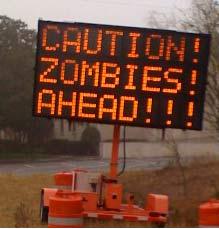 Well, the Obama administration has decided to take the Zombie route which is something I’ve repeatedly argued against. But why just take my word for it? Let’s start with Nobel prize winning economist Paul Krugman reporting on his NY Times blog today in a thread aptly titled Despair over Financial Policy.
The Geithner plan has now been leaked in detail. It’s exactly the plan that was widely analyzed — and found wanting — a couple of weeks ago. The zombie ideas have won.
The Obama administration is now completely wedded to the idea that there’s nothing fundamentally wrong with the financial system — that what we’re facing is the equivalent of a run on an essentially sound bank. As Tim Duy put it, there are no bad assets, only misunderstood assets. And if we get investors to understand that toxic waste is really, truly worth much more than anyone is willing to pay for it, all our problems will be solved.
Just about every economist and financial blog on the web, especially the progressive ones, have warned against this option since similar plans put Japan into its lost decade of recession, high deficits, unemployment, and financial malaise. This is worse than I even expected of the Obama administration. This basically means more BIG subsidies for BIG investors. It is nothing less than a massive transfer of wealth to the people and institutions most responsible for this mess from those of us that will suffer the most and have the most to lose. This threatens our jobs, our children’s future, and our country’s standing as the world’s largest single country economy. This is THE single worst possible decision.
This from Calculated Risk:
With almost no skin in the game, these investors can pay a higher than market price for the toxic assets (since there is little downside risk). This amounts to a direct subsidy from the taxpayers to the banks.
From Yves Smith Naked Capitalism:
The New York Times seems to have the inside skinny on the emerging private public partnership abortion program. And it appears to be consistent with (low) expectations: a lot of bells and whistles to finesse the fact that the government will wind up paying well above market for crappy paper.
Key points:
The three-pronged approach is perhaps the most central component of President Obama’s plan to rescue the nation’s banking system from the money-losing assets weighing down bank balance sheets, crippling their ability to make new loans and deepening the recession….
The plan to be announced next week involves three separate approaches. In one, the Federal Deposit Insurance Corporation will set up special-purpose investment partnerships and lend about 85 percent of the money that those partnerships will need to buy up troubled assets that banks want to sell.
Yves here. If the money committed to this program is less than the book value of the assets the banks want to unload (or the banks are worried about that possibility), the banks have an incentive to try to ditch their worst dreck first.In addition, it has been said in comments more than once that the banks own some paper that is truly worthless. This program won’t solve that problem. Back to the piece:
In the second, the Treasury will hire four or five investment management firms, matching the private money that each of the firms puts up on a dollar-for-dollar basis with government money.
Yves here. Hiring asset managers to do what? Some investors get 85% support (more as is revealed later), others get dollar for dollar? This makes no sense unless very different roles are envisaged (but how will the price for assets given to the asset managers be determined? Or are these for the off balance sheet entities that should be but are still not yet consolidated, like the trillion dollar problem hanging around at Citi?) Back to the article:
In the third piece, the Treasury plans to expand lending through the Term Asset-Backed Secure Lending Facility, a joint venture with the Federal Reserve.
Yves again. While the first TALF deal got off well, Tyler Durden points out its capacity is 2.7 times pre-credit mania annual issuance levels, which means the $1 trillion considerably overstates its near term impact. And credit demand by all accounts is far from robust. Cheap credit is not enticing in an environment of weak to falling asset prices and job uncertainty.
…
And notice the utter dishonesty: a competitive bidding process will protect taxpayers. Huh? A competitive bidding process will elicit a higher price which is BAD for taxpayers!
Dear God, the Administration really thinks the public is full of idiots. But there are so many components to the program, and a lot of moving parts in each, they no doubt expect everyone’s eyes to glaze over.
Later in the article, there is language that intimates that the banks will put up assets and take what they get. However, the failure to mention a reserve (a standard feature in auctions) does not mean one does not exist. Or the alternative may be, since bidding will almost certainly be anonymous, is to let the banks submit a bid, which would serve as a reserve. That is the common procedure at foreclosure auctions, when the bank puts in a bid equal to the mortgage value (so either a foreclosure buyer takes the bank out or the bank winds up owning the property).
From Financial Armageddon:
No Surprise to Anyone
If there is anything to be learned from the current crisis, it is the fact that Washington has a habit of screwing things up.
From setting up corrupt and self-serving government-sponsored enterprises that fail to accomplish their stated goals, to ill-conceived and underfunded insurance schemes, guarantee programs, and safety nets that don’t provide the benefits claimed, to rules and regulations that leave those who are “protected” high and dry, it’s amazing how often good intentions go wrong when the politicians are in charge.
From George Washington’s Blog:
Does a Single Independent Economist Buy the Geithner-Summers-Bernanke Approach?
Does a single independent economist buy the Geithner-Summers-Bernanke approach?
On the left, you have:
- Nobel economist Joseph Stiglitz saying that they have failed to address the structural and regulatory flaws at the heart of the financial crisis that stand in the way of economic recovery, and that they have confused saving the banks with saving the bankers
- Nobel economist Paul Krugman saying their plan to prop up asset prices “isn’t going to fly”. He also said:
At every stage, Geithner et al have made it clear that they still have faith in the people who created the financial crisis — that they believe that all we have is a liquidity crisis that can be undone with a bit of financial engineering, that “governments do a bad job of running banks” (as opposed, presumably, to the wonderful job the private bankers have done), that financial bailouts and guarantees should come with no strings attached. This was bad analysis, bad policy, and terrible politics. This administration, elected on the promise of change, has already managed, in an astonishingly short time, to create the impression that it’s owned by the wheeler-dealers.
- Prominent economists like Nouriel Roubini, James Galbraith, Dean Banker, Michael Hudson and many others slamming their approach
On the right, you have:
- Leading monetary economist Anna Schwartz saying that they are fighting the last war and doing it all wrong
- Former Assistant Secretary of the Treasury and former editor of the Wall Street Journal Paul Craig Roberts lambasting their approach
- Economist John Williams saying “the federal government is bankrupt … If the federal government were a corporation … the president and senior treasury officers would be in federal penitentiary.”
- Prominent economist Marc Faber and many others tearing their approach to shreds.
Of course, other Nobel economists, high-level fed officials, former White House economist, and numerous others have slammed their approach as well.
Sure, the economists for the banks and other financial giants which are receiving billions at the government trough think that the Geithner-Summers-Bernanke approach is swell.
And perhaps a couple of economists for investment funds which use their giant interventions into the free market to make some quick money.
But other than them, no one seems to be buying it.
I may be one of the few in the chorus singing soprano, but I’m in a very huge chorus singing sfz! that this is the worst possible of ALL choices. This is nothing more than a wealth transfer that will accomplish nothing other than keeping banks and financial institutions that are basically bankrupt on live support long enough to drain the daylight out of any recovery. This President is AWOL from his job. Not only is he AWOL, but he is incompetent. He can go on Leno, he can go on sixty minutes, he can give lavish St Patrick’s Day parties and he can hold town meetings in California but he is totally incapable of staying in Washington and doing his job. By allowing this, he will have stolen more from every single honest taxpayer in this country than even Darth Cheney and the Texas Village idiot did with their adventures in nation building and subsidy of the oil and gas industries and the military industrial sectors. If somebody in Congress doesn’t act to stop this, I say we start calling them to demand impeachment proceedings. We’ll be lucky if we come out of recession by the time my daughters reach retirement.
There I said it. If President Obama doesn’t stop this nonsense now he should be impeached for criminal misuse of tax payer’s money.
The Endangered American Lifestyle
Posted: March 20, 2009 Filed under: Equity Markets, Global Financial Crisis, U.S. Economy | Tags: less consumerism, live smaller, lower consumer demand, recession and job less lower lifestyle in US, the new american lifestyle 9 Comments This economy has clearly shown that the lifestyle of most middle and working class Americans is precarious. Many Americans now admit they could cover their bills for at best two months if the pink slip arrived in their paycheck. More and more people are dipping into their savings and credit to pay for food, gas, and day-to-day expenses if they are fortunate to have either.
A series of recent surveys checking the health of American households have found many of our neighbors are depressed and frightened about their financial status as the recession deepens and unemployment numbers worsen. It appears Americans are downsizing their lives, their expectations, and their idea of what it means to live the American Dream.
Market Watch reported today on a number of findings about the financial health of Americans and their preparedness in light of the poor job market. As things get worse, more and more Americans will find themselves falling behind in their bills and house payments. Households are adjusting their buying habits and trying to find ways to save money “just in case”.
This is flashing so bright red,” said Paul Ballew, senior vice president of Nationwide Insurance Co. “Roughly 60% of the population was ill-prepared (financially) before the meltdown.”
A MetLife study released last week found that 50% of Americans said they have only a one-month cushion — roughly two paychecks — or less before they would be unable to fully meet their financial obligations if they were to lose their jobs. More disturbing is that 28% said they could not make ends meet for longer than two weeks without their jobs.
And it’s not just low-income earners who would find themselves financially challenged. Twenty-nine percent of those making $100,000 or more a year said they would have trouble paying the bills after more than a month of unemployment.
Meanwhile, more than four in 10 respondents told pollsters in a recent Pew Research Center study that job-related issues were the nation’s most important economic problem.
Lower-income Americans have already started belt-tightening to feed their rainy day funds. One study has shown these income levels are now planning for vacations at home and have put off any major purchases. The same study  (by Pew) finds that upper middle income Americans are desperately re-arranging their retirement funds in hopes of preserving what capital remains after nearly six months of persistent market declines. Lower-income Americans have switched to plain label and generic brands while upper middle income Americans have quit dining out. American families continue to belt tighten where ever possible. What is new about this typical recession behavior is that this new found thrift appears to be a long run arrangement.
America’s Research Group found that nearly 57% of the consumers it polled said they would spend less this year while virtually no one plans to spend more.
But this is not just a one-year thing, according to consumers surveyed by BIGresearch. Nearly 91% said they see this crisis bearing down on their spending decisions — in effect, their lifestyles — over the next five years.
Fifty-five percent said they will think carefully before they make a purchase and 51% said they expect to be more price-conscious when buying clothing and food.
“American consumers are hunkered down, bracing for a depression,” said Britt Beemer, chief executive of America’s Research Group. “The dramatic drops in shopping levels have no match in our database in the last 30 years.”
The Big Ease
Posted: March 19, 2009 Filed under: Equity Markets, Global Financial Crisis, U.S. Economy | Tags: Fed Policy, FOMC, Helicopter Ben, monetary policy, quantitative easing 2 Comments I’ve had a couple of request to talk about how the Fed creates money and what happens if it over expands the money supply so that’s the topic of this post. Yesterday, the monetary policy authority of the Fed, the Federal Open Market Committee (FOMC) announced an injection of $1 Trillion. It is doing so by buying back some long term bonds in a move that is called Open Market Operations. Basically, Open Market Operations work like this. If the Fed wants money out in the economy (to increase spending by businesses and consumers), it makes selling bonds back to it very appealing. Investors won’t want to hold bonds because they’re not providing a good return. They’ll look for other places to put their money like in vehicles that might be based more on lending like commercial bonds or mortgage-backed securities. Low interest rates should make it more like that people will want to borrow. Banks won’t invest in bonds because they are low yield compared to what they can get from borrowers. This is the gist expansive monetary policy. This is one of the classical tools of monetary policy and the most used in the Fed Tool box. It generally works through lowered interest rates which is something that can’t really happen now. The interesting thing about this move is that it is huge and announced. This isn’t the usual SOP.
Usually open market operations are done in a hush-hush, behind closed doors, James Bond kind of atmosphere so as not to give information to the market to offset the action. As I said earlier, deliberate policy announcement is one of the market-shaping policies that Chair Bernanke has opted for as a tool of policy since most interest rates are close to zero. They are pulling in long term bonds as a form of quantitative easing (changing the structure of the Fed balance sheet to impact the term structure of interest rates.) They want the long term mortgage rate to come down to encourage house buying from the public. They also want to encourage lenders to renegotiate outstanding home loans. The other portion of the announcement meant to shape investor behavior was the outlook statement which tends to give the markets a forward looking policy hint. Not only is the Fed doing this, they are actively asking the Treasury to print money to help them beef up the size of their balance sheet so it can be used for a variety of purposes.
Printing new money is just a straight forward increase in the Money Supply. The purpose is this. You give people more money and they will have more money to spend. The issue comes down to this, however. How much stuff is out there for us to buy? A lot of stuff? Not so much stuff? Since interest rates are low, we may not save, we may buy lots of stuff. However, if we’re scared, we may not spend anyway, we may just tuck the money away. How this works depends on the response of both businesses and households.
This is from the previously linked NY Times article.
In its announcement, the central bank said that the United States remained in a severe recession and listed its continuing woes, from job losses and lost housing wealth to falling exports as a result of the worldwide economic slowdown.
“In these circumstances, the Federal Reserve will employ all available tools to promote economic recovery and to preserve price stability,” the central bank said.
As expected, policy makers decided to keep the Fed’s benchmark interest rate on overnight loans in a range between zero and 0.25 percent.
But to the surprise of investors and analysts, the committee said it had decided to purchase an additional $750 billion worth of government-guaranteed mortgage-backed securities on top of the $500 billion that the Fed is already in the process of buying.
In addition, the Fed said it would buy up to $300 billion worth of longer-term Treasury securities over the next six months. That would tend to push down longer-term interest rates on all types of loans.
All these measures would come in addition to what has already been an unprecedented expansion of lending by the Fed. The central bank also said it would probably expand the scope of a new program to finance consumer and business lending, which gets under way this week.
In effect, the central bank has been lending money to a wider and wider array of borrowers, and it has financed that lending by using its authority to create new money at will.
Some Economist blogs are openly criticizing the FED’s move. This is because what we know about the causes of deep-rooted, nasty inflation. It is generally caused by too much money chasing too few goods. In other words, if the economy is not producing enough goods and services because of the recession and suddenly there is more money, the money will be used to buy goods and services. If the production does not catch up with the money, it will drive the average price of goods and services up and we will experience systemic inflation.
There are two situations right now that make inflation creation unlikely. The first is that since we are in a deep recession, we are seriously under capacity . This means we have many businesses that are basically ‘idle’. They do not carry enough stock, they are not fully employing labor, and they are operating with a lot of excess overhead. They could start up, un-idle the excess capacity, and increase their use of what they have now without creating much inflation. The only place that inflation might occur would be in the raw materials sector which would have to gear up to supply any increased demand by manufacturing, but right now people, equipment, and facilities are underused.
The other situation that makes it highly unlikely we experience inflation in the short run is the fact that we don’t have

Is the Fed forever blowing bubbles?
much in the way of inflation now. We also have deflation in many major sectors like housing.
However, the question of the day is this. Is Bernanke solving a recession created by one bubble (housing) that was created by trying to cope with another bubble (dot.coms)? This is where we separate the Keynesians from the Monetarists. You can get a feel for what the discussion is if you hit some of the major econ-related blogs. You can tell the monetarists. They’re calling the Chairman Helicopter Ben.
It’s a very weird, somewhat circular transaction, and it was last done in a big way during World War II. At the time the Fed wasn’t so much making monetary policy as doing its patriotic bit to finance the war (it was a de facto division of the Treasury Department at the time), but it worked on both counts: The deflationary tendencies of the 1930s were finally fully expunged from the economy, and we beat the bad guys. Later on, Milton Friedman described this kind of transaction as the functional equivalent of a “helicopter drop” of money, and after Ben Bernanke mentioned this in a speech in 2002 he became known as Helicopter Ben. Now he’s finally living up to the name.*
Will it work? In the sense of fending off deflation, yeah, this should have an impact. But the financial world and America’s position in it are more complicated than in the 1940s. We now owe lots of money to creditors outside the U.S., and when they see the Fed buying long-dated Treasuries they’re bound to start worrying about what that means for the dollar. If they get too worried, they could drive up interest rates here and counter the impact of the Fed’s purchases. So there are limits to the Fed’s magical powers, and they already began showing up in currency markets this afternoon, with the dollar falling sharply against the euro and other foreign currencies. The adventure continues.

 peej
peej Carissa
 bostonboomer
 dakinikat
 ecocatwoman
 mablue2
 Mama Lopez
 peggysue22
 quixote
 skydancingguestblogger
 Mona (aka Wonk the Vote)



 Sky Dancing
Recent Comments